








![3D Explainer Video - ScribbleLive.mp4_snapshot_00.12_[2022.03.09_03.14.16]](https://increditors.com/wp-content/uploads/elementor/thumbs/3D-Explainer-Video-ScribbleLive.mp4_snapshot_00.12_2022.03.09_03.14.16-r7wb53mx72rxst3qcqyrfxdmeyzb5r9jbl0wbjujh4.png "3D Explainer Video – ScribbleLive.mp4_snapshot_00.12_[2022.03.09_03.14.16]")



















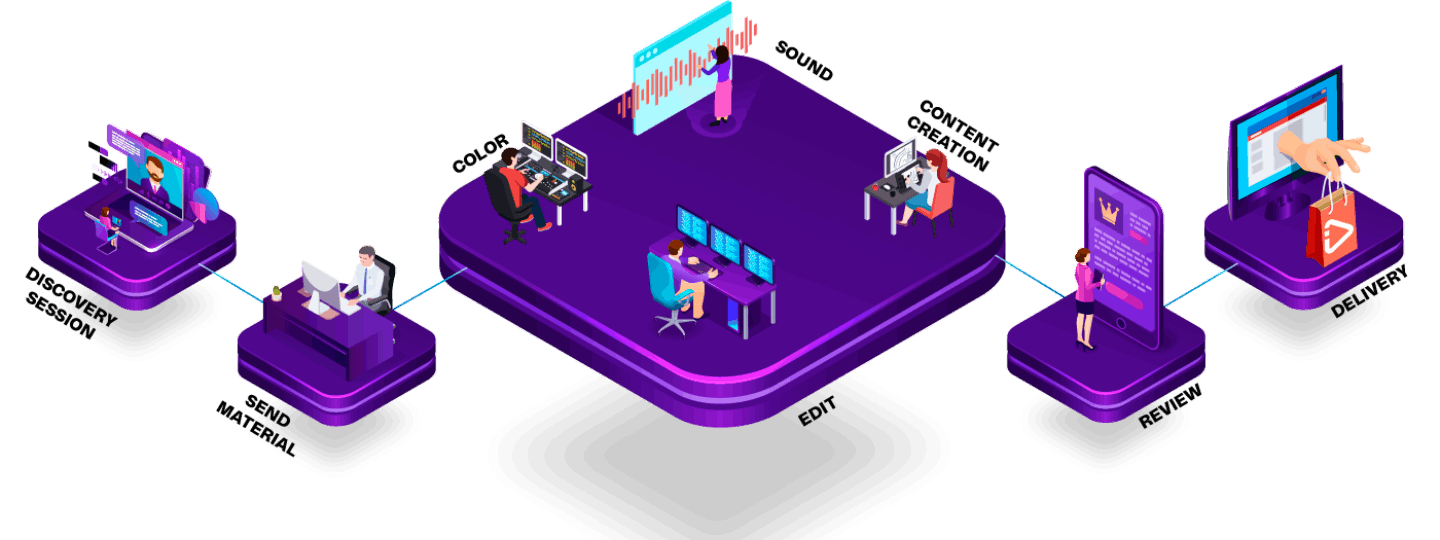










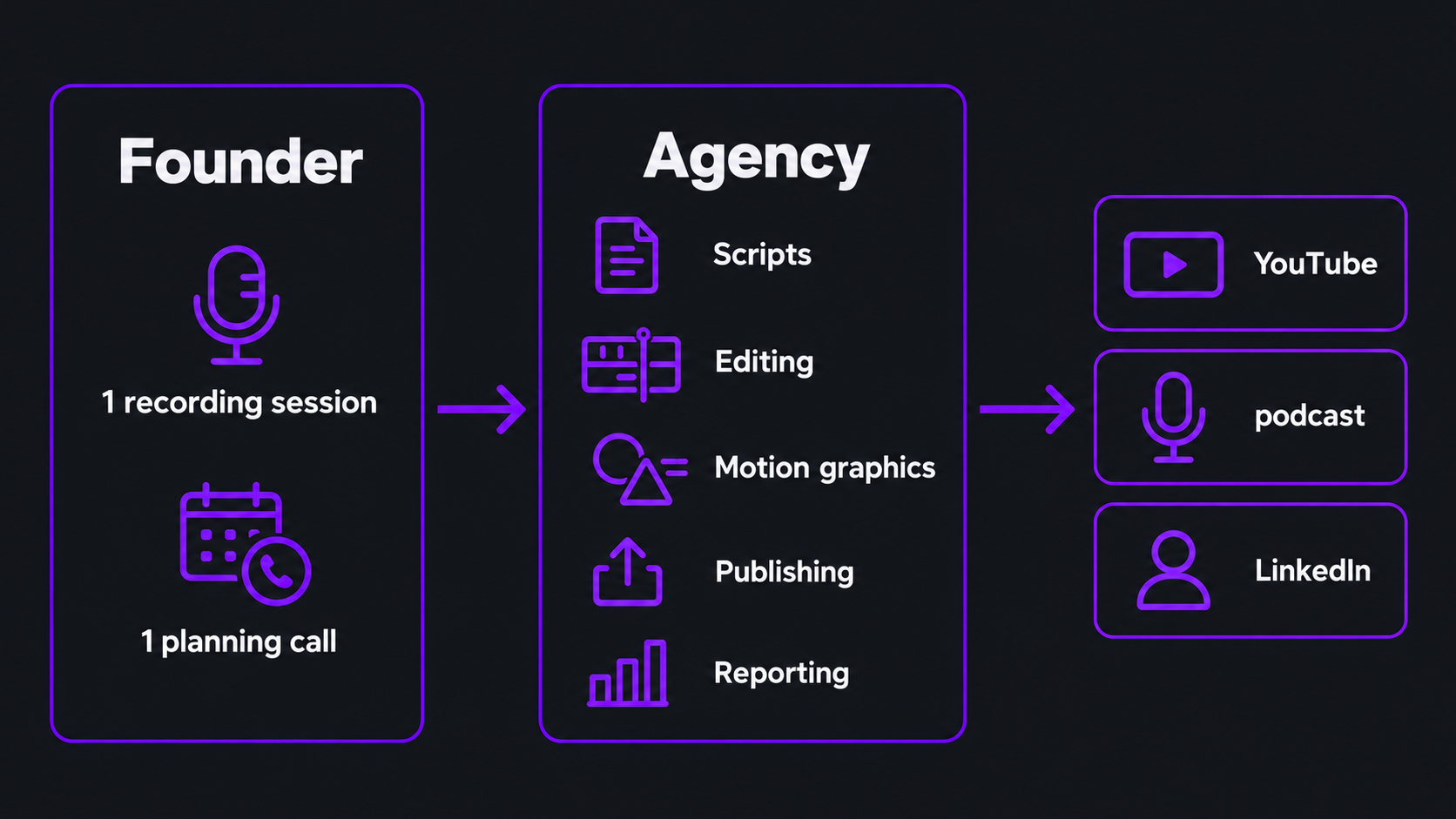
A founder-led content agency takes the expertise in your head and turns it into a regular schedule of YouTube videos, podcast episodes and short clips. You record; the agency plans, scripts, edits, designs, publishes and reports. Expect a monthly retainer priced by output and by how much strategy is included, usually in the thousands to low tens of thousands per month for B2B tech. Your time commitment should be a few fixed hours a month. Judge any agency on whether it understands a complex product, not on how polished its reel looks.
A founder-led content agency is an outside team that turns a founder’s expertise into a consistent publishing system. The founder records raw material on a fixed schedule. The agency handles everything around it: strategy, scripting, editing, motion design, distribution and reporting. For a B2B software company selling a complex product, the point is simple. Buyers trust the people who build the product, and founders rarely have the hours to turn that trust into content themselves.
This guide is the service explainer: what the work includes, how often it ships, who records what, and what a fair retainer looks like. It is different from our founder LinkedIn video guide, which is a how-to for the founder on LinkedIn posting, formats and the algorithm. Here the question is how to buy and run the service, with a focus on YouTube and podcast formats where the material compounds. If YouTube is your main channel, our guide to hiring a YouTube agency for SaaS goes deeper on that side.
What a founder-led content agency is
A founder-led content agency sits between two things people often confuse: a freelance editor who cuts whatever footage arrives, and a ghostwriting shop that writes posts in the founder’s name. It does neither alone. It owns the full path from a founder’s idea to a published asset, and it is accountable for consistency. The term “founder-led” describes the voice and face on the content, not who does the production work.
Founder-led marketing as a discipline is well covered. The HubSpot founder-led content strategy playbook argues that founders already do work every day that makes good content, and the hard part is keeping it going when a product fire or a fundraise takes over. That is the gap an agency fills. The same logic shows up in sales: the Dock guide to founder-led sales and the First Round Review library on founder-led sales both treat the founder as a uniquely credible voice for early B2B buyers. Content extends that credibility to buyers you will never meet on a call.
💡 Quick test: if the founder’s presence is the asset, you need a founder-led program. If the product demo is the asset and nobody needs to appear on camera, you need a product video or explainer engagement instead.
What you get: scope by layer
A credible engagement covers five layers, and the best way to compare proposals is to ask where each layer lives. The table below shows the typical split between the agency and the founder.
Notice how much of the table sits on the agency side. That is deliberate. A founder-led program fails when the founder’s job quietly grows to include scripting, scheduling and file management. The most useful question in any sales call is “what exactly will you need from me each month?” If the answer is longer than a short list, the program will stall.
Who records what
The founder records the raw material, and the agency decides how it is captured, cut and distributed. There are three common capture models, and most programs mix them.
1. Founder self-records
The founder records short talking-head segments on a laptop or phone with a decent microphone, following a prompt list from the agency. This is the cheapest model and the one most B2B founders can sustain. It works best for point-of-view videos, product updates and answers to common sales questions.
2. Interview-style remote sessions
A strategist or host from the agency interviews the founder over a remote recording tool. The founder talks; someone else supplies the questions and the structure. This model suits podcasts and long YouTube conversations, because most founders speak better in dialogue than to a blank lens. One session can yield several pieces, which is how a small time commitment turns into a steady schedule. Our podcast clip strategy shows how one episode becomes many assets, and the video repurposing explainer covers the principle.
3. Screen and product walkthroughs
For software, a founder walking through the product on screen often beats any scripted explainer. The agency cleans up the screen capture, adds callouts and animates the parts that are hard to show. If your product is technical, expect some of the value to come from this layer, since the editor has to follow what is on screen and keep it accurate.
💡 Rule of thumb: the founder should only be asked to do what no one else can: have opinions, tell customer stories and explain why the product exists. Everything that can be delegated should be.
A realistic monthly cadence
A sustainable cadence is built around the founder’s calendar, not around an ambitious posting target. The example below is illustrative; real programs vary with team size and channel mix.
The cadence is also where scale gets decided. If you want to move from a handful of pieces to a heavier schedule, our guide on how to scale from 4 to 30 videos a month explains what changes in the workflow, and our video approval workflows article shows how to keep reviews from becoming the bottleneck. The first month with a new agency also takes more effort, which is why the first-30-days onboarding guide is worth reading before you sign.
What it costs
Founder-led content agencies price by scope, and nearly all of them quote monthly retainers instead of publishing a rate card. The price follows four variables: how many long-form pieces ship each month, how much motion design and editing complexity each piece carries, whether strategy and scripting are included, and how much of the founder’s time the agency absorbs by hosting sessions. Treat any number you see online as a pattern, not a quote. A rough market picture, framed as models rather than quotes, looks like this:
The honest comparison is against hiring. One salaried employee rarely covers strategy, scripting, editing, motion design and analytics, and a senior hire in a US or Canadian market can cost well into six figures a year once benefits are included, before you add software and management time. An agency retainer gives you a full bench for a monthly fee and lets you scale up or down. For a broader view of how pricing models compare, see our explanation of video editing agency pricing models.
We do not publish Increditors prices here, because scope differs for every software company and a number without scope misleads. What we will say is that we operate as a strategy-led premium option: the brief, the planning and the quality control are part of the work, not add-ons. If you want a comparison point on typical agency retainers across B2B video, our B2B video agency cost guide breaks the numbers down with sources and dates.
💡 Ask every agency for a one-page scope: number of recording sessions, deliverables per month, revision rounds, turnaround time, who owns strategy, and what reporting you receive. If a price arrives without these, it cannot be compared.
How this played out
Two long-running B2B engagements show what the working relationship looks like when the subject is hard to explain. TuMeke, an AI ergonomics SaaS company, has been a four-year client, and its team has told us that the animations make everything clear, which is the whole job when the product needs visual explanation. Stratabeat, a B2B marketing agency, runs a monthly retainer with us and said the videos are helping with a complex, considered sale. Neither is a pure on-camera founder program, but both show the part that matters here: a stable monthly rhythm and an editorial team that understands a complicated product. You can read more on our case studies page and in the TuMeke project write-up.
YouTube, podcast and LinkedIn: where each fits
YouTube and podcasts hold the material that buyers search for while they are evaluating, and LinkedIn spreads the founder’s point of view. Treat them as one system fed by the same recordings rather than three separate programs.
- YouTube: long-form answers to buyer questions, product walkthroughs and founder conversations. It is searchable, so it keeps working after publication. Our B2B YouTube benchmarks give context on realistic expectations.
- Podcast: a founder conversation or a customer interview, published as audio and video. It is the easiest format for a founder who dislikes scripts.
- LinkedIn clips: short cuts that point back to the long-form pieces. The LinkedIn B2B Institute publishes research on how B2B marketing works at the category level, which is useful background when you are deciding how much to invest in reach versus conversion.
Format decisions matter too. Our analysis of Shorts versus long-form performance is a good starting point for deciding how much of the budget goes to each, because B2B buyers researching a purchase usually need depth that a short clip cannot carry.
How to choose an agency
Choose on product literacy, a clear scope and a named team, in that order. A founder-led program only works if the agency can follow what the founder is saying.
- Product literacy: ask them to explain your product back to you after a short call. If they cannot, scripts and edits will be shallow.
- B2B software, data or AI examples: consumer creator channels are a different job.
- A written scope: sessions, deliverables, revisions and reporting in one page.
- A named team: know who strategizes, who edits and who answers your messages.
- An honest view on fit: a good agency will tell you when you only need an editor.
A specialist video editing company is often a better fit than a generalist content shop when the product is technical, because editors who handle software, AI and data work every week already know how to read a dashboard or a diagram. If you are still deciding between formats, our complete guide to video editing for SaaS companies covers the wider picture. A remote video editing agency also lets you hire the right specialists without a local-market premium, which matters when the engagement is a monthly retainer.
Frequently asked questions
What does a founder-led content agency do?
It turns a founder’s knowledge into a steady stream of finished content. The founder records raw material, usually a talking-head session, a podcast-style conversation or a short Q&A. The agency handles strategy, topic selection, scripting or outlines, editing, motion graphics, captions, thumbnails, publishing and reporting. The founder supplies the expertise and the face; the agency supplies the system.
How much does a founder-led content agency cost?
Most agencies quote custom monthly retainers rather than publishing prices. As a market pattern, retainers for B2B tech companies commonly run from a few thousand dollars to the mid five figures per month, depending on how many long-form videos you publish, how much motion design is involved and whether strategy is included. Always compare the scope behind a number, not the number alone. For a wider breakdown, see our guide to professional video editing costs.
How much time does a founder need to give?
Plan on a small, fixed block each month rather than constant involvement: one or two recording sessions and one planning call is a common shape. HubSpot’s founder-led content playbook is built around the idea that founders will only keep going if the weekly time ask is small. A good agency designs the process around that constraint, so the founder is never the bottleneck.
Should founder-led content live on LinkedIn, YouTube or a podcast?
Most B2B tech companies need more than one, because they do different jobs. LinkedIn is where the founder’s point of view reaches buyers quickly. YouTube and podcasts hold the longer, searchable material that buyers watch while evaluating a purchase. A single long recording can feed all three. Our founder LinkedIn video guide covers the LinkedIn side in depth.
When is a founder-led content agency the wrong choice?
It is the wrong choice when the founder will not record, when the product story is not settled yet, or when you only need an editor for footage you already produce. In the last case, a video editing partner on a subscription or per-project basis is simpler and cheaper than a full strategy-led engagement.
Verdict
A founder-led content agency is worth it when the founder is willing to record on a fixed schedule and the company needs a steady presence on YouTube, podcasts and LinkedIn without hiring a team. The value is the system: a small, protected block of founder time that turns into a regular publishing rhythm. Compare agencies on scope, product literacy and the exact founder time they require, not on price alone. If you would like to talk through what a program would look like for your product, book a call below.
Planning a founder-led content program?
Tell us about your product and your buyer and we will map the plan together.