








![3D Explainer Video - ScribbleLive.mp4_snapshot_00.12_[2022.03.09_03.14.16]](https://increditors.com/wp-content/uploads/elementor/thumbs/3D-Explainer-Video-ScribbleLive.mp4_snapshot_00.12_2022.03.09_03.14.16-r7wb53mx72rxst3qcqyrfxdmeyzb5r9jbl0wbjujh4.png "3D Explainer Video – ScribbleLive.mp4_snapshot_00.12_[2022.03.09_03.14.16]")




























TikTok works for B2B companies — but not the way most marketing teams imagine. The platform’s discovery algorithm can put your expertise in front of cold decision-maker audiences that LinkedIn’s pay-to-play reach can’t match. The catch: it demands consistent educational video output, not polished brand content. This playbook covers which B2B companies actually see pipeline from TikTok, the six content formats that perform, how to build a publishing cadence your team won’t abandon, and honest ROI expectations so you don’t burn budget chasing vanity metrics.
Does TikTok Actually Work for B2B? The Honest Answer
Yes — for the right companies, with the right expectations. The short answer is that TikTok’s For You Page algorithm is one of the most powerful organic discovery engines available to marketers today, and it does not care whether your follower count is three or three million. A well-made educational clip can reach tens of thousands of people in your target market with zero paid spend. For B2B companies willing to commit to video content, that is a meaningful competitive lever.
The honest caveat: most B2B companies that try TikTok treat it like a brand awareness channel and wonder why no one converts. The companies seeing actual pipeline results — new demos booked, email list growth, qualified inbound — are using TikTok as an expertise channel, not a brand channel. They teach. They demonstrate. They share opinions. Their content earns saves and shares from people with real buying intent, not just passive scroll-past views from a general audience.
Which B2B Companies See Real Traction
Not every B2B category performs equally on TikTok. Companies in the following spaces tend to report the strongest organic reach: SaaS tools with a visible use case (show the product in action — watch time spikes), professional services where expertise is the differentiator (accounting, legal tech, marketing agencies), manufacturing and supply chain where “how it’s made” content outperforms anything in the finished-product genre, and HR/recruitment brands where company culture content doubles as hiring marketing.
B2B companies where TikTok is harder to justify include niche enterprise software with a very small addressable market (fewer than a few thousand potential buyers worldwide), heavily regulated industries where legal review slows publishing frequency below sustainable levels, and companies where no one on the team is comfortable on camera or has the internal bandwidth to produce consistent content.
The Metric That Actually Predicts B2B Success on TikTok
Stop watching follower count. In B2B TikTok, the metric that predicts downstream pipeline is saves-to-views ratio. When viewers save your video, they are bookmarking it to revisit — a strong intent signal. Comments asking for more detail, your website link, or your pricing are equally telling. Profile visits that convert to link-in-bio clicks and email subscribers are the cleanest B2B conversion path available without paid. Chasing view counts alone is how B2B brands waste six months producing content that looks successful but generates no sales conversation.
6 B2B TikTok Content Types That Actually Perform
After watching dozens of B2B brands experiment on TikTok, the content that consistently earns saves, shares, and comment-section buying signals falls into six formats. Not all six will suit your brand equally — pick two or three to master before expanding.
1. Behind-the-Scenes and Process Content
Show how your product or service actually works. For an agency this might be the edit timeline on screen with a voiceover walking through creative decisions. For a SaaS company it might be a real customer dashboard with the feature use narrated. Process content outperforms polished brand spots on TikTok because the algorithm rewards watch time, and viewers stay longer when they feel they are getting real access rather than a marketing presentation.
A practical format: 45-75 second “How we did this” clips where the hook in the first three seconds names the outcome (“We edited 80 videos for this SaaS brand in one month — here’s the system”). The reveal structure keeps watch-through rates high, which the algorithm interprets as quality.
2. Rapid-Fire Educational Tips
The “three things your [industry] team is getting wrong” format is a proven TikTok structure for B2B. Keep it to 30-60 seconds. Each tip is a standalone insight, not a teaser for a longer piece. Buyers save these clips to share with colleagues — that is one of the cleanest virality mechanisms available on any platform. The format also positions your company as a confident expert, which builds trust over time with cold audiences who are months away from being ready to buy.
3. Industry Commentary and Honest Takes
TikTok’s comment culture rewards genuine perspective. When a B2B company shares a real opinion — “Most video briefs we receive are missing this one thing and it doubles production time” — the response from practitioners in the comment section creates the kind of engagement that boosts organic reach dramatically. Avoid corporate hedging. State a position and defend it. The risk of sharing a genuine industry perspective is far lower than the cost of producing forgettable neutral content.
💡 Pro Tip: Save TikTok comments on your own content and on competitors’ content. Comments like “I had no idea this was possible” or “we just ran into exactly this problem” are free research into what your market is struggling with — and each one is a future video topic.
4. Customer Outcomes in Under 60 Seconds
A traditional case study runs three pages and takes six weeks to approve. A TikTok customer story runs 45 seconds and focuses entirely on one specific problem and one specific result. You do not need the customer on camera. An animated before-and-after, a screen recording of the result with narration, or a simple talking-head with their logo and one quoted metric works. Keep names general if legal requires it (“a SaaS company in the HR space”), but be specific about the problem and the outcome. Vague results (“improved their video strategy”) earn no saves. Specific results (“went from two videos per month to eighteen, same headcount”) earn shares.
5. Company Culture and Hiring Content
For B2B companies building a talent brand alongside their buyer brand, TikTok outperforms LinkedIn for raw reach. Day-in-the-life content, office reveals, and team spotlight clips consistently generate high engagement because TikTok’s audience skews younger and more mobile. If your company is hiring, a well-produced culture clip on TikTok can reach people who never visit LinkedIn — and often at a cost-per-impression dramatically below paid LinkedIn campaigns.
6. Product Demos and Feature Walkthroughs
For SaaS brands in particular, a 60-second genuine product demo showing a specific workflow or feature change earns the highest saves-to-views ratio of any content type. The key is showing a real use case, not the best-case scenario — “here’s how to do X in our tool” not “here’s why our tool is amazing”. Authentic demos build trust because viewers can assess the product honestly. Overselling in a product demo clip is one of the fastest ways to damage your brand on TikTok, where comments and comparisons are public.

TikTok Algorithm: What B2B Teams Actually Need to Know
TikTok has published more about how its For You Page works than most platforms combined — and most of it is directly actionable for B2B teams. According to TikTok’s own engineering newsroom, the recommendation system weighs four primary signals: video completion rate, shares, comments, and likes (in roughly that priority order). For B2B, the key insight is that completion rate matters most. A 45-second video where 70% of viewers watch the full clip will outrank a one-minute video with twice the views but only 20% completion.
The For You Page Discovery Advantage for B2B
LinkedIn’s organic reach is algorithm-suppressed unless a post earns immediate engagement from your existing followers. Instagram Reels favors accounts with established audiences. TikTok’s For You Page starts with no prior assumptions about your account — every video is tested with a small initial audience, and if signals are strong, distribution expands. This is why a brand-new B2B account posting consistently can reach meaningful audiences within weeks, not the months required on other platforms to build a following from zero.
Posting Frequency vs Quality Trade-off
The question every B2B team asks: how often should we post? TikTok’s own creator guidance suggests daily posting for those seeking to grow quickly, but that pace is unsustainable for most B2B marketing teams without dedicated resources. In practice, B2B brands that publish three to five times per week with consistent educational content outperform those that publish daily for three weeks, burn out, and go dark. Consistency across months beats burst publishing. The algorithm rewards accounts that maintain steady publishing cadences — long gaps in posting reduce distribution on your return.
TikTok Format Specs for B2B Videos
Get the technical specs right or the platform will suppress your content. Per TikTok’s official video guidelines, the recommended format is vertical 9:16 at 1080×1920px. File formats: MP4 or MOV. Maximum file size: 500MB (for ads; organic is more permissive). Bitrate: minimum 516kbps. For audio: stereo AAC at 44.1kHz. Caption-safe zones run roughly 15% from the bottom (where TikTok UI overlays) and 10% from the top. Any text or graphic elements placed in those zones will be covered by the interface on most devices.
Building Your B2B TikTok Content Engine Without Burning Out
The single biggest reason B2B brands quit TikTok within three months is that they treat each video as a standalone production. The brands that maintain consistent output build a system — one that turns existing assets and expertise into TikTok content without requiring a full production shoot for every clip.
The Content Batching System That Sustains B2B Accounts
Effective B2B TikTok teams typically block one half-day every two weeks for content recording. In that session, a founder or subject-matter expert records ten to fifteen short talking-head clips — often just two or three takes each, scripted from a two-line prompt. Those clips then get edited, captioned, and scheduled to publish across the following two weeks. The editing work happens asynchronously; the on-camera time is minimal. This batching model means your brand can maintain a daily publishing cadence without daily on-camera demands on your team.
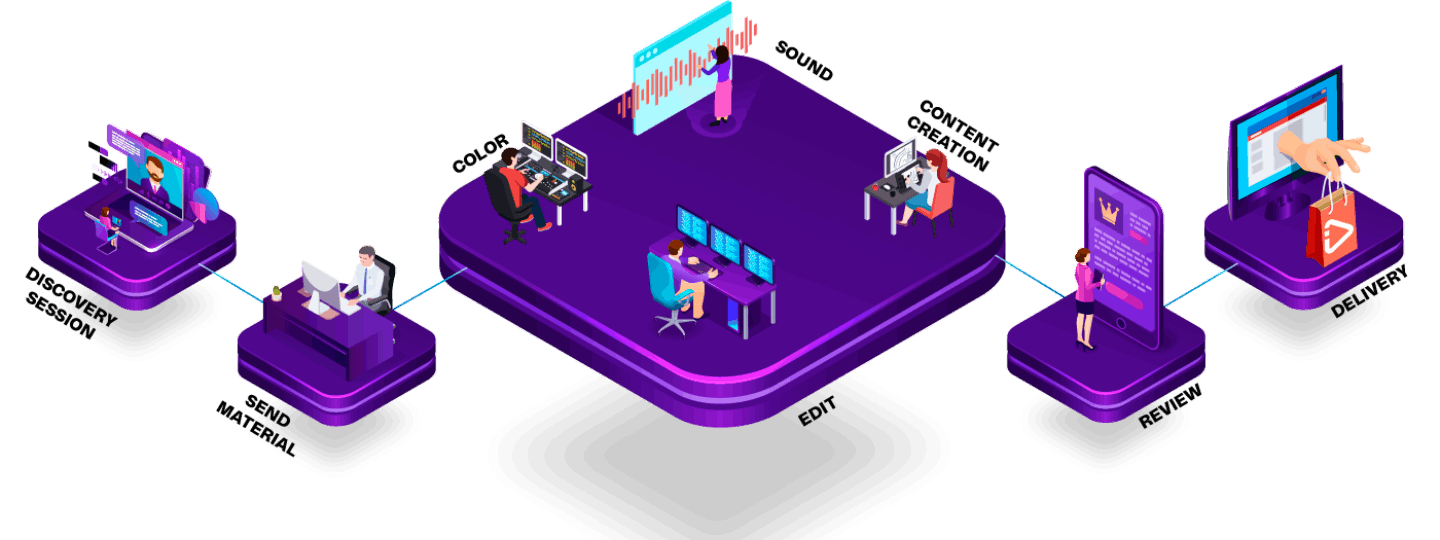
For the editing side, the quality bar on TikTok is lower than YouTube or LinkedIn, but it still matters. Captions are non-negotiable — a significant share of TikTok videos are watched without audio. Jump cuts should be clean but not so aggressive that the speaker feels robotic. Text overlays reinforcing key points increase watch time measurably. Music or sound design (from TikTok’s commercial library for business accounts) helps retention in the first three seconds. These are exactly the elements a specialist video editing agency handles — and when you have consistent editing support, content batching becomes genuinely scalable.
Repurposing Existing Assets for TikTok
If your company already produces webinars, podcast episodes, customer demos, or long-form YouTube content, you have a TikTok library waiting to be cut. A 45-minute webinar typically contains eight to twelve usable TikTok clips — each one covering a specific insight that stands alone as a short video. The workflow: transcript → identify the high-insight moments (usually wherever the presenter pauses for emphasis or where Q&A spikes) → crop to a vertical frame → add captions → export. This repurposing workflow is one of the highest-ROI content production paths available to B2B marketers because the source material already exists. See our guide on professional video editing costs to understand what budgeting this kind of repurposing workflow looks like in practice.
💡 Pro Tip: Use TikTok’s native scheduling tool for business accounts. It allows you to schedule posts up to ten days in advance and provides optimal posting time suggestions based on when your specific audience is most active. This removes the daily manual publishing step from your content calendar.
Editing Quality Standards for B2B TikTok
B2B audiences on TikTok are more forgiving of production imperfections than LinkedIn audiences — to a point. The line is professionalism in audio and framing. Choppy audio, background noise, or poor lighting signals low production value, which in B2B contexts signals low attention to quality in general. That impression transfer is real. Clean audio (lavalier mic or a quiet room), decent lighting (a window or a simple key light), and a stable frame are the technical floor. Motion graphics, text animations, and polished transitions are differentiators that lift performance — but they are improvements on a clean baseline, not substitutes for it.
The video editing workflow for B2B TikTok is distinct from YouTube or Instagram. Jump cut pacing needs to match TikTok’s faster consumption tempo. Captions need to be styled and on-brand, not just auto-generated white text. Text overlays should appear and disappear in sync with spoken emphasis, not float static throughout. These are details that compound over months of publishing — accounts that get them right look more credible and earn more saves. If you are scaling TikTok content beyond one or two posts per week, having dedicated post-production support matters. For a full comparison of what’s possible with specialist editing, see our SaaS video editing guide.
TikTok Ads for B2B: When Paid Makes Sense
Most B2B companies should not start with TikTok ads. The organic play should come first — if your educational content earns saves and profile visits organically, paid amplification then makes economic sense. If your organic content is not working, paid promotion will not fix a content problem.
TikTok Lead Generation Ads for B2B
TikTok’s Lead Generation ad format lets users submit a form without leaving the app — pre-populated with their profile data. For B2B use cases (demo requests, guide downloads, newsletter signups), this format typically outperforms sending traffic to a landing page because friction is removed. The form completion rate for TikTok Lead Gen is consistently higher than LinkedIn Lead Gen forms at comparable CPMs, according to benchmarks published by WordStream’s TikTok ads benchmark report. That said, lead quality requires scrutiny — TikTok audiences skew younger and the job-title targeting is less precise than LinkedIn’s.
Targeting B2B Audiences on TikTok
TikTok’s targeting for B2B is less surgical than LinkedIn but it has improved significantly. Available targeting options include interests (Business and Entrepreneurs, Technology, Finance are the most relevant B2B categories), behavioral signals (users who engaged with specific content categories), Custom Audiences (email list upload or website pixel), and Lookalike Audiences built from your customer list or organic video engagers. The strongest B2B paid TikTok strategy combines a warm Custom Audience (your existing email list) with a Lookalike expansion — you are reaching people most similar to your known buyers, not just anyone interested in “business content.”
Realistic Budget Ranges for B2B TikTok Paid
TikTok’s minimum daily budget for campaign-level spend is $50 USD; ad group level minimum is $20/day. For B2B testing, teams commonly start with monthly budgets in the range of $1,500–$4,000 to gather enough data for optimization (minimum a few hundred clicks to a landing page, or several hundred lead form completions). Do not expect these budgets to produce the same precision as LinkedIn Campaign Manager — TikTok’s B2B targeting is a volume play. Plan for a 4-6 week learning period before drawing conclusions about ROAS. The video creative is the primary variable: the same budget with strong creative versus weak creative can produce a 3–5× difference in cost-per-lead based on widely-reported advertiser experience.
Measuring B2B TikTok ROI: Real Metrics, Real Expectations
B2B TikTok ROI is measured differently from B2C TikTok because the sales cycle is longer and direct conversion is rarely the first touch. Build your measurement framework around the buyer journey, not last-click attribution.
Metrics That Indicate Pipeline Potential
The metrics that correlate with B2B pipeline impact are: saves rate (saved videos / total views × 100 — benchmark for B2B educational content is typically 1–3%), profile-to-link-click rate (what percentage of people who visit your profile click the link in bio — a clean bio with a specific CTA can push this above 5%), and email subscriber growth directly attributed to TikTok link-in-bio or link-in-caption. Track these monthly, not weekly — TikTok organic distribution has high variance. A video that does nothing for two weeks can spike unpredictably when the algorithm resurfaces it to a new cohort.
What Good B2B TikTok Performance Actually Looks Like
For a B2B company publishing three to four times per week for six months, realistic outcomes include: a content library of 70-90 videos across educational topics in your market, 3,000–15,000 followers depending on niche specificity, inbound DMs and comment-section conversations from potential buyers (these are extremely high-intent signals — respond to all of them), and enough profile visit data to run a Lookalike audience for paid with statistical confidence. Attributing direct revenue to TikTok in the first six months is difficult and often misleading — the channel’s value in B2B is typically in first-touch awareness and brand recall that gets credited elsewhere in the attribution model.
When to Pivot or Stop
After 90 days of consistent posting (at least three times per week), check these signals: if your average saves rate is below 0.5% across all content, your content format is not resonating — experiment with a different category (shift from commentary to education, or from talking head to product demo). If profile visits are strong but link clicks are near zero, your bio or link destination needs rework. If no inbound conversations are coming in via comments or DMs, your content may be reaching the wrong audience — review your hashtag strategy and post timing. After 90 days with consistent effort and no movement on any of these signals, TikTok may not be the right organic channel for your specific market — and that is a legitimate conclusion, not a failure.
TikTok vs LinkedIn vs YouTube Shorts for B2B: Honest Comparison
B2B companies should run short-form video on multiple platforms where bandwidth allows — but each platform requires a different angle. If you are already publishing on LinkedIn or YouTube Shorts, TikTok is a distinct channel with different optimization logic, not just a distribution checkbox. For a full breakdown of LinkedIn video requirements, see our LinkedIn video specs guide. For the YouTube Shorts B2B playbook, see YouTube Shorts strategy for B2B brands. And for the Instagram angle on B2B short-form, Instagram Reels for B2B covers what works there specifically.

FAQ: TikTok for B2B Companies
Is TikTok appropriate for a professional B2B brand?
Yes, with the right content approach. B2B brands that lean into education, expertise, and process transparency consistently maintain professionalism while earning strong organic reach on TikTok. The platform’s B2B use has matured significantly — business, finance, and technology content now represent some of the most-saved categories on the platform. The brands that struggle with brand perception on TikTok typically attempted to mimic viral entertainment trends rather than committing to educational content that matches their positioning.
Do B2B decision-makers actually use TikTok?
More than most B2B marketers assume. According to Pew Research Center social media data, TikTok’s adult user base has grown substantially across age groups — the platform is no longer exclusively under-25. Business owners, directors, and managers across industries consume TikTok content personally. The B2B opportunity is in reaching those same people in their personal-consumption mindset — which often produces stronger brand recall than reaching them in their professional, email-overloaded work context.
How long does it take for B2B TikTok to show results?
Most B2B companies see the first meaningful signals within 60-90 days of consistent posting — inbound comments from potential buyers, profile visit spikes, or a particular video that earns significantly higher saves than your average. Attribution to pipeline takes longer, typically 3-6 months, because TikTok sits at the top of the funnel. The channel builds familiarity over time — your brand becomes the one a buyer remembers when they are ready to evaluate solutions, not the one that closes them in a single TikTok view.
What is the biggest mistake B2B companies make on TikTok?
Treating it like Instagram. TikTok’s algorithm rewards teaching, not aesthetics. B2B brands that arrive with polished brand videos, product launch clips, and corporate imagery earn low watch time and low saves because the platform’s audience expects to learn something or be entertained. The brands that adapt — shift from “look at our brand” to “let us show you how this works” — see dramatically different results. The shift in content philosophy is harder than the shift in format specs.
Should B2B companies use TikTok hashtags, and which ones?
Hashtags on TikTok function less as discovery mechanisms and more as category signals that help the algorithm classify your content. For B2B, use a mix of broad topic tags (#marketing, #business, #saas, #startup) and specific niche tags relevant to your industry. Avoid using irrelevant trending tags to chase reach — TikTok’s algorithm is sophisticated enough to detect mismatched content and hashtag pairings, which can suppress distribution rather than boost it. Three to six targeted hashtags typically outperform a spray of twenty generic ones.
Verdict: Should Your B2B Company Be on TikTok?
The honest answer is: it depends on two things — whether your team can produce consistent educational video content, and whether your buyer profile overlaps enough with TikTok’s growing adult audience to justify the channel investment.
For B2B companies in SaaS, marketing services, professional services, and manufacturing, TikTok represents one of the last remaining organic reach channels where a new account can build meaningful audience without paid spend. That window will not be open indefinitely — platform algorithms tighten over time as more brands join and competition for feed space increases. Companies that establish their TikTok content engine now build a compounding advantage: a library of indexed educational content, an established audience, and algorithm credibility that new entrants will have to buy their way around.
For B2B companies where the buyer profile skews exclusively toward enterprise procurement teams, or where no one in the company has the bandwidth or comfort level to produce consistent video content, TikTok is not the right priority right now. LinkedIn, YouTube Shorts, or email are better uses of limited marketing bandwidth.
The production side — editing, captioning, text overlays, pacing — is where most B2B teams run out of steam. Getting a consistent twelve to sixteen videos per month edited, formatted, and scheduled is a real operational ask. Working with a professional video editing agency that understands short-form B2B content is what separates the brands that sustain a TikTok presence from those that publish for eight weeks, burn out, and stop. The content strategy is yours — the production workload does not have to be. For a deeper look at what full-service video editing support looks like for a scaling B2B content program, see our agency vs freelancer comparison.
Ready for Video That Actually Converts?
Tell us about your project and we will put together a custom plan.