






































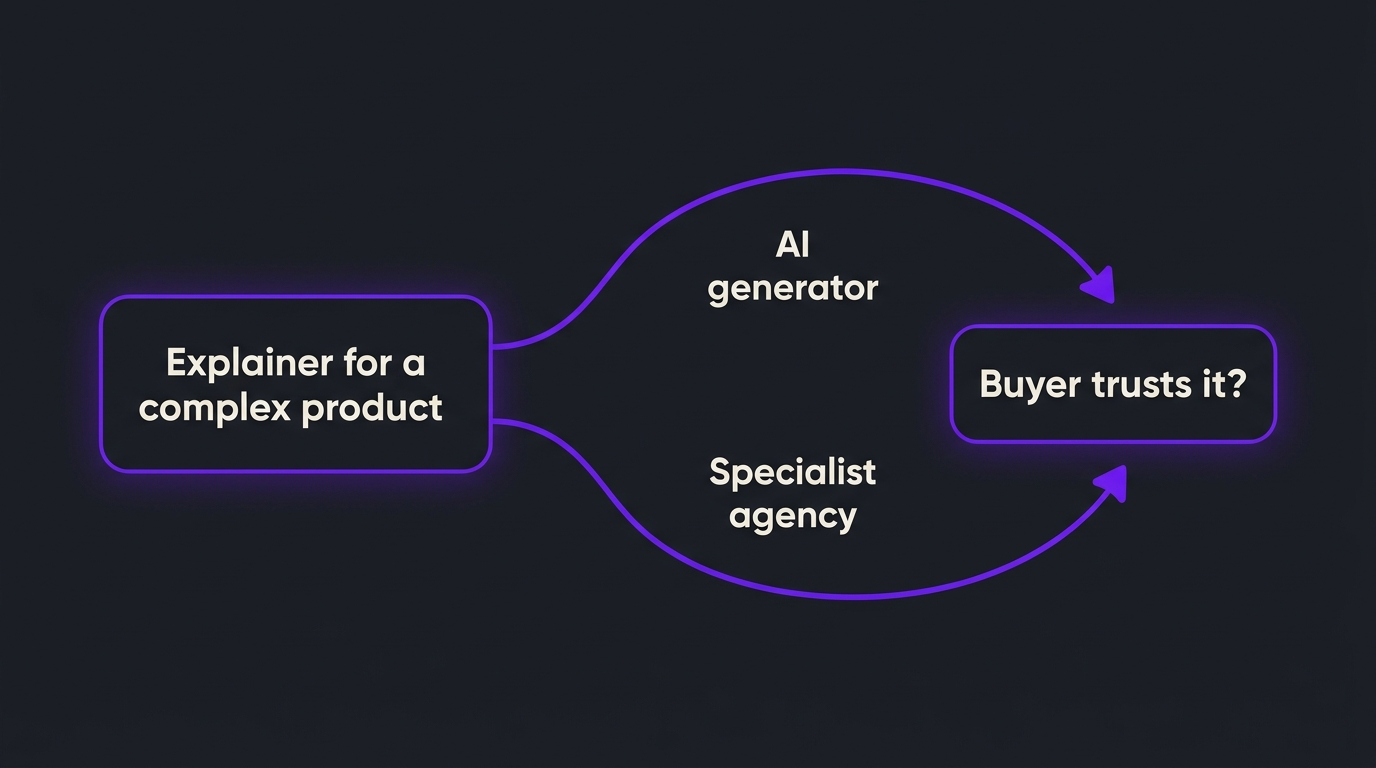
For a complex B2B product, use an AI explainer video generator for drafts, internal explainers and low-stakes variations, and hire a specialist agency for the flagship explainer a skeptical buyer will judge you on. The deciding factors are accuracy, domain fluency, consistency across a series, and what a mistake would cost you. This guide gives founders and marketing leads at B2B software companies a decision framework and six tests to run before you commit. It is different from our post on AI video editing versus human editors, which is about editing existing footage, and from how AI startups explain what nobody can see, which covers the visual craft. This one is about the buying decision between a generator and a partner. If you land on the partner side, a specialist video editing company that knows your domain is the shortcut.
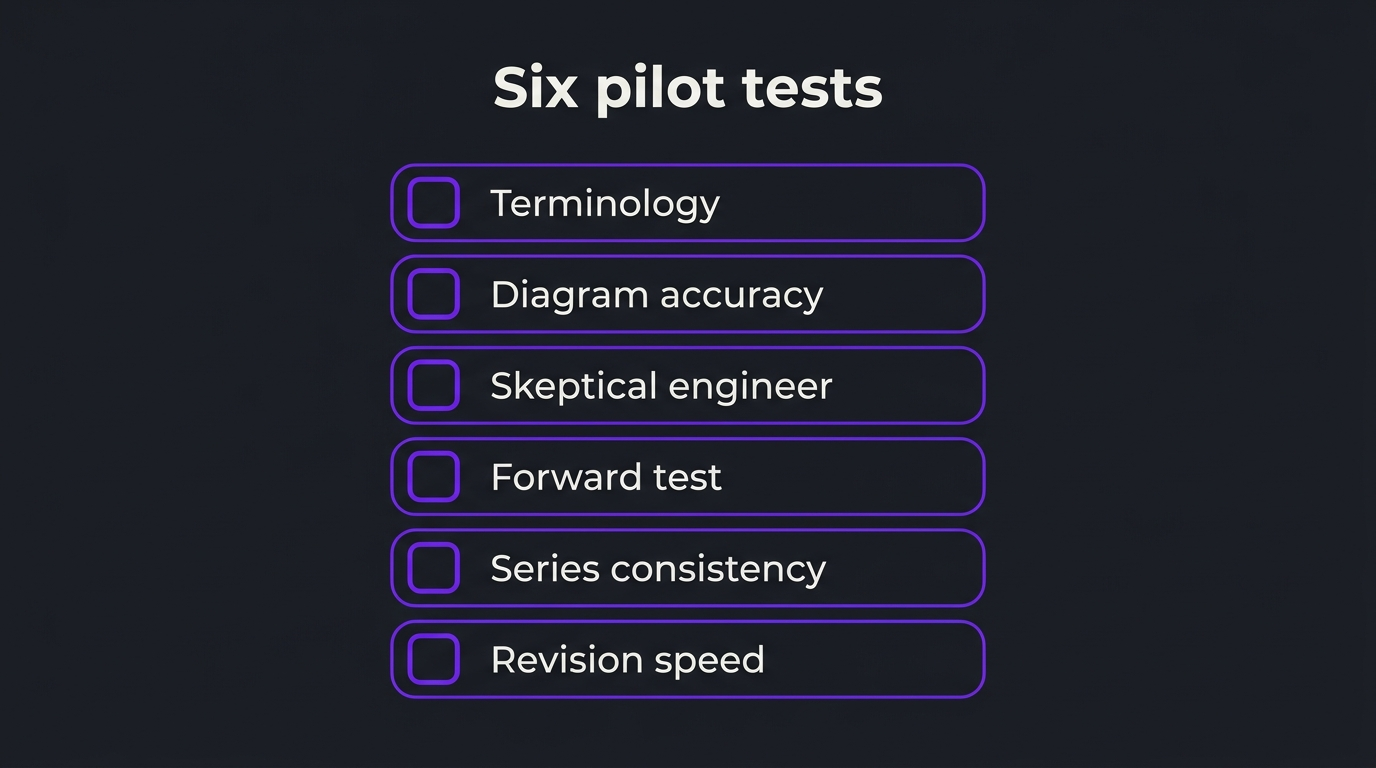
AI generators are fast and cheap to try, and good for storyboards, internal clips and variations. They struggle with technical accuracy, product-specific diagrams and series consistency, which are exactly what a complex-sale buyer scrutinizes. Do not decide on a demo reel. Run six pilot tests on your own product concept: terminology, diagram accuracy, a skeptical engineer, a forward test, series consistency and revision speed. If the tool fails any of the first four on a customer-facing video, bring in a specialist. Most B2B teams end up with a hybrid: AI for drafts, humans for the video that carries the pitch.
- What “AI explainer video” actually means
- What AI generators do well
- Where they break on a complex B2B product
- What an agency adds, and what it costs you
- Side-by-side comparison
- Six pilot tests to run before you decide
- Decision matrix by video type
- The hybrid model most B2B teams land on
- How this played out
- Disclosure, accuracy and search
- Frequently asked questions
- The verdict
What “AI explainer video” actually means
Search for “AI explainer video” and you will find three different things sold under one label. Which one you mean changes the decision, so it is worth separating them before you compare anything against an agency.
Note the last row. A modern agency does not avoid AI; it uses it where it saves time. So the real decision is not “AI or humans”. It is whether the finished explanation can come from a template-driven generator, or whether it needs someone who will design the explanation around your product. Our AI video tools report and the list of best AI video editing services map the tooling landscape in more detail.
What AI generators do well
Honesty first: these tools are genuinely useful, and a team that ignores them is wasting time. For a B2B marketing lead they earn their place in several jobs.
- Storyboards and concept tests. Turning a script into rough visuals in an afternoon is a cheap way to find out whether an idea is clear before paying for production.
- Internal explainers. Onboarding, internal enablement and “how this feature works” updates for a team that already knows the product forgive a generic look.
- Variations and localization drafts. Reformatting a finished video, swapping a voiceover or drafting a translated version is a good fit for tools.
- Early-stage validation. If you are still testing positioning, a quick throwaway video tests the message without locking in an expensive asset.
- Mechanical tasks inside a professional workflow. Transcripts, captions, resizing and rough assembly save real hours when a person reviews the output.
💡 Pro Tip: Treat the first AI-generated version as a free storyboard, not a draft of the final product. If the idea only works with the generator’s default visuals, it is probably not a strong idea yet.
Where they break on a complex B2B product
The failure modes are consistent, and they show up precisely where complex-sale buyers are least forgiving.
Accuracy of terms and claims
Generative models predict plausible wording; they do not look up facts. Google’s own guidance on generative AI content makes the point that outputs may contain inaccuracies and should be manually fact-checked before publishing. In a general consumer video, a slightly off phrase is invisible. In a video about data pipelines, compliance workflows or trading logic, a wrong term tells a technical buyer that your team does not understand the domain.
Diagrams that match your actual product
An explainer for a complex product usually hinges on a diagram: how data moves, how a decision is made, where a human steps in. Generators tend to produce illustrations of the idea rather than an accurate picture of your system. The arrows go to plausible places, not necessarily the right ones. Fixing a single mislabeled arrow in a template tool can mean re-prompting the whole scene.
Sameness
Template libraries and stock footage are shared by thousands of companies. When a prospect has watched several competitor videos in a week, a look they have seen before reads as a lack of investment. Buyers of expensive software notice that.
Consistency across a series
One video rarely answers a considered sale. Teams usually need an explainer plus follow-ups, as we argue in why one explainer video is not enough. Generators can drift in style, voice and characters from one episode to the next, so a series built entirely from prompts often looks like several different companies made it.
No point of view
A tool will produce a video about whatever you type. It will not tell you that the third paragraph of your script is the real reason people buy, or that your first thirty seconds explain the problem to people who already know it. That judgment is the part a strategist and writer bring, and it is hard to substitute.
What an agency adds, and what it costs you
A specialist agency is not automatically better. It is better at a specific set of things, and it comes with trade-offs you should weigh fairly.
What you get
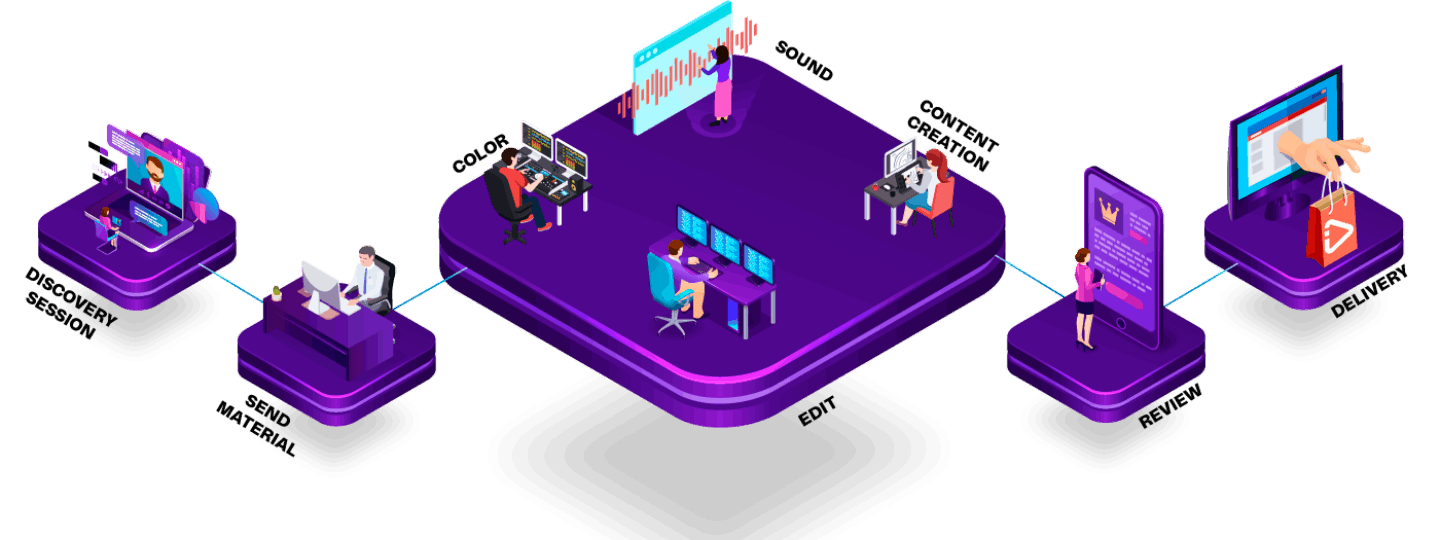
- Discovery and strategy. Someone interrogates who the buyer is, what they already believe and what the video must change.
- Scripts with expert review. A writer who can interview your engineers and turn their answers into plain language, a skill the Nielsen Norman Group has long argued matters for any audience, including experts.
- Custom visuals. Diagrams, motion graphics and screen treatments designed around your product, which our guide to technical explainer videos for complex products goes into.
- Quality control and revisions. A reviewer who checks terminology, numbers and consistency, with a defined revision process.
- A system, not a one-off. The same team can extend the flagship into a series, demos and cut-downs.
What you give up
- Speed. A professional process takes weeks, not hours, because discovery, review and revisions are part of the value.
- Money. Agency work costs more than a tool subscription. Our explainer video cost guide and the broader professional video editing cost overview frame the market ranges.
- Your time. A good agency needs access to a subject-matter expert for interviews and review. If nobody on your side can give that, quality drops whichever route you choose.
- Fit risk. Many studios are generalists. If you go this route, choose one that has made videos for your kind of product, as covered in how to pick a SaaS explainer video agency and the roundup of best explainer video companies.
Side-by-side comparison
Here is how the two routes compare on the criteria that matter to a B2B software team. This is a general comparison, not a promise about any particular tool or vendor.
Six pilot tests to run before you decide
Do not decide from a tool’s demo reel or an agency’s showreel. Take one real concept from your own product and run it through each route. These six tests are pass or fail, so you do not need invented benchmarks. Take them to a short internal review with your product lead and one engineer.
How to score the result
Treat tests 1 to 4 as gates. If a customer-facing video fails any of them, the generator is not ready for that job, whatever its price. Tests 5 and 6 decide whether it can scale into a program. A generator that passes all six on your content is a legitimate choice, and you should use it; a partner that cannot pass them is not worth hiring either, so give agencies the same pilot.
⚠️ Watch out: Test the tool on your hardest explanation, not your easiest. Everything looks good when the product is a dashboard with a clear screen. The case that matters is the invisible part: the model, the pipeline or the logic that makes the output trustworthy.
Decision matrix by video type
Use this as a starting point. The right choice depends on who is watching and what a mistake would cost.
For product walkthrough-specific guidance, see our piece on video editing for product demos and explainers, and for the broader context on video for software, the complete guide to video editing for SaaS companies.
The hybrid model most B2B teams land on
In practice, the answer is often not either-or. A sensible split for a B2B software company looks like this:
- Use AI for exploration. Outline options, hooks and storyboard drafts so you arrive at the briefing call with a clearer idea.
- Use a specialist for the claim-bearing video. Anything that states what the product does, how it works or why it is trustworthy.
- Let the specialist use AI too. A good agency uses tools for transcripts, captions, resizing and rough assembly, so you are not paying for hours that machines can do.
- Keep one owner on your side. One person approves the terminology and claims, so reviews do not stall.
- Reserve tools for variations after the master exists. Once you have the flagship and a design system, a lot of derivative work becomes cheaper and safer.
This is also how we think about AI inside our own work: tools save time on the mechanical parts, and senior people spend that time on the explanation. If you are weighing a partner on that basis, our post on where AI helps and where human editors still win has the editing-side detail.
How this played out
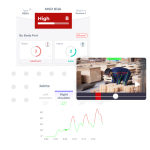
TuMeke is an AI ergonomics SaaS company and has been an Increditors client for four years. A product like that is hard to show: the value sits in analysis a viewer cannot see. The feedback we hear on our work is that the animations make everything clear, which is the test that matters when a buyer has to understand something invisible before they will trust it. We would not claim a template could not get you part of the way, but clarity that holds up over four years of a client relationship comes from a team that learns the product and keeps refining how it is explained. You can read more on our case studies page and the TuMeke project page.
Disclosure, accuracy and search
A few practical rules apply whichever route you choose, and they matter more once AI is part of the process.
- Disclose realistic synthetic content. YouTube’s policy on disclosing GenAI content asks creators to label realistic content that was meaningfully altered or generated with AI. Clearly stylized animation generally falls outside that. Check the current wording before you publish.
- Keep a human fact-check step. Google’s generative AI guidance recommends manually reviewing AI-generated content for accuracy, including metadata such as titles and descriptions.
- Write for people first. The same principle appears in Google’s helpful, people-first content guidance: show real expertise and add value instead of publishing volume.
- Add captions. They help people who watch muted and viewers who need them. The W3C explains how captions and transcripts work.
- Help the page get found. Google’s video best practices for Search cover how to make a video page indexable.
Frequently asked questions
Is there a free AI explainer video generator that is good enough for B2B?
Many AI explainer video generators offer free tiers or trials, and they are fine for experiments, storyboards and internal clips. Check the watermark, the commercial-use terms and the export quality before anything customer-facing goes out. For a product that buyers need to trust, the limiting factor is usually accuracy and clarity rather than price, so test the output against the six pilot tests in this guide before you rely on it.
What is the best AI explainer video generator for a SaaS company?
There is no single best tool, because they solve different problems: script-to-video assembly, avatar presenters and template-based animation each fit different content. Pick the type that matches the job, then run your own terminology, diagram and skeptical-engineer tests on a real product concept. The tool that passes on your content is the best one for you.
When should a B2B SaaS company hire an agency instead of using AI?
Hire a specialist when the video will be judged by a skeptical buyer, when the product is hard to visualize, when the same look needs to carry across a series, or when an error would damage credibility. Use AI tools when stakes are low: internal explainers, drafts, rough storyboards and quick variations.
Can AI write the script and an agency make the video?
Yes, and it is a common hybrid. AI is useful for first-draft outlines and alternative hooks. A subject-matter expert and a strategist should then rewrite the script for accuracy, tone and the specific buyer, because generative models predict likely wording rather than retrieve facts, as Google’s guidance on AI-generated content points out.
Do we have to disclose AI-generated video?
YouTube requires creators to disclose realistic content that was meaningfully altered or generated with AI, such as a realistic scene that did not occur or a real person appearing to say something they did not. Clearly non-realistic animation generally does not need the label. Check the current YouTube policy and your own legal and brand guidelines before publishing.
How long does an agency explainer take compared with an AI tool?
AI tools can produce a rough draft in minutes to hours. An agency explainer for a complex product typically takes weeks, because it includes discovery, scripting, subject-matter review, design, animation and revisions. Most of that time goes into getting the explanation right, which is the part the tool cannot do for you.
The verdict
If you are choosing between an AI explainer video generator and an agency for a complex B2B product, do not argue about tools in the abstract. Run the six pilot tests on one real concept, and let the results decide. Use generators where the stakes are low and speed is the point. Hire a specialist for the video that states what your product does and has to survive a skeptical engineer. Most teams end up with both, which is a perfectly good outcome. If you want a second opinion on your own concept, we are a video editing company that works with B2B software teams, and we will tell you honestly if a tool is enough.
Not Sure Whether a Tool Is Enough?
Book a discovery call and we will review your concept and tell you which route fits.