










![3D Explainer Video - ScribbleLive.mp4_snapshot_00.12_[2022.03.09_03.14.16]](https://increditors.com/wp-content/uploads/elementor/thumbs/3D-Explainer-Video-ScribbleLive.mp4_snapshot_00.12_2022.03.09_03.14.16-r7wb53mx72rxst3qcqyrfxdmeyzb5r9jbl0wbjujh4.png "3D Explainer Video – ScribbleLive.mp4_snapshot_00.12_[2022.03.09_03.14.16]")































Video repurposing services typically charge $25–$150 per finished clip, $800–$4,000/month on a subscription, or $3,000–$12,000/month on a full agency retainer depending on volume, turnaround, and platform complexity. The right model depends on your output volume and how many platforms you need to feed. This guide breaks down every pricing tier, compares the three main billing structures, and gives you a simple cost-per-output formula to calculate your actual ROI before you sign anything.
- What Video Repurposing Pricing Actually Covers
- The Three Pricing Models Explained
- Price Ranges by Content Format and Platform
- Freelancer vs. Agency vs. Subscription: Full Comparison
- How to Calculate Your Cost-Per-Output (ROI Framework)
- What Drives Repurposing Prices Up or Down
- Choosing the Right Pricing Model for Your Team
- Frequently Asked Questions
- Verdict
What Video Repurposing Pricing Actually Covers
Video repurposing service pricing is not the same as standard video editing pricing — and treating them as interchangeable is the fastest way to buy the wrong service at the wrong price. When you hire someone to repurpose video content, you are paying for a fundamentally different workflow than trimming a raw shoot. Understanding exactly what is in scope is what separates a well-priced contract from an expensive surprise on your next invoice.
Standard video editing starts with raw footage and produces one finished video. Video repurposing starts with a finished (or near-finished) video and produces multiple derivative assets optimized for different platforms, audiences, or formats. The intellectual and technical work involved is different: a repurposing editor needs to identify strong standalone moments, reframe the story arc of each clip for a new context, add platform-native captions and graphics, reformat aspect ratios (16:9 to 9:16 being the most common), and sometimes write entirely new hooks and CTAs for each output.
What Repurposing Services Typically Include
The deliverables bundled into a repurposing engagement vary by provider, but the core scope almost always includes: clip selection and curation (identifying the 30–90 second moments worth extracting), aspect-ratio reformatting (vertical for Reels/Shorts/TikTok, square for LinkedIn/Facebook, widescreen for YouTube), caption and subtitle generation with styling, hook optimization (trimming or rewriting the first 3 seconds), and platform-specific polish — lower thirds, progress bars, end cards, or animated text overlays depending on the destination.
Add-ons that commonly push prices up include original B-roll sourcing, custom animated graphics or intro sequences, advanced color grading for each output, blog-post transcripts derived from the video, audiogram creation for podcast repurposing, and express turnaround guarantees under 24 or 48 hours. Knowing which of these you actually need before you request a quote is the single most practical thing you can do to keep repurposing costs predictable.
💡 Pro Tip: Before requesting a repurposing quote, list every platform you publish on and the exact number of clips you need per source video. Providers price per-output — vague scope leads to vague (and usually inflated) estimates.
Why Repurposing ROI Is So Calculable
Unlike original content production, video repurposing has a hard cost ceiling you can calculate in advance. Every repurposing job starts with an existing asset, which means the creative risk (scripting, shooting, performance) has already been paid for. What remains is production labor: editing, formatting, and optimization. This makes repurposing one of the most ROI-transparent content investments available to marketing teams. According to research from Wyzowl’s annual video marketing report, a growing share of marketing teams now cite video repurposing as a primary strategy for expanding reach without proportionally increasing production budgets.
The core metric to track is cost-per-output — the total monthly spend on repurposing divided by the number of platform-ready clips delivered. A well-run repurposing program at $2,000/month producing 20 clips gives you a $100 cost-per-output. A freelancer delivering 5 clips at $500 total gives you the same $100 per clip. The number that matters is not the contract size — it is the per-clip cost benchmarked against what it would cost to produce that clip from scratch.
The Three Pricing Models Explained
Video repurposing services bill in three primary ways: per-clip (project-based), monthly subscription, and retained agency engagement. Each model has a distinct cost structure and is optimized for a different type of buyer. The correct model for your team depends almost entirely on your output volume and how predictable that volume is month to month.
Per-Clip Pricing: Maximum Flexibility, Highest Unit Cost
Per-clip pricing is the default for most freelancers and smaller editing services. You pay a flat rate for each finished clip delivered — typically ranging from $25 for a basic caption-and-reformat job to $150 or more for a polished clip with custom graphics, sound design, and a rewritten hook. Per-clip pricing is transparent and carries no commitment, which makes it ideal when your content calendar is irregular or you want to test a provider before committing to a longer arrangement.
The trade-off is unit cost. At $75 per clip and 30 clips per month, your bill is $2,250 — at that volume, a subscription almost always delivers the same or better quality at a significantly lower per-clip rate. Most teams find per-clip pricing starts to look expensive once they publish more than 15–20 clips per month consistently. If you are already at that cadence, the math usually favors moving to a subscription model for the bulk of your output.
Monthly Subscription: Predictable Costs for Consistent Schedules
Subscription-based repurposing services emerged as a pricing innovation from the unlimited editing model — you pay a flat monthly fee in exchange for a fixed number of clip deliveries per month (or occasionally a truly unlimited queue). Pricing typically starts around $800–$1,200/month for entry-level plans covering 8–12 clips, scales to $2,000–$3,000/month for 20–30 clips, and reaches $4,000+/month for high-volume plans. Some providers differentiate between clip complexity tiers within the subscription; others price purely on output count.
Subscription pricing works best for teams with a predictable source-video cadence — a weekly podcast, a bi-weekly webinar series, or a daily livestream that generates consistent raw material. The monthly cap creates a forcing function: you need to have enough source footage each month to justify the subscription, and you need a consistent publishing plan to actually deploy the clips produced. Teams that batch-publish in some months and go quiet in others often find per-clip pricing more economical overall. You can learn more about how subscription models compare across editing providers in our unlimited video editing services comparison guide.
Agency Retainer: Strategy Plus Execution at Scale
Agency retainers for video repurposing go beyond clip production. For $3,000–$12,000+ per month, you typically get a dedicated editor or editing team, a content strategist who guides clip selection and platform optimization decisions, turnaround guarantees, and often integration with your broader marketing calendar. The retainer model makes sense when repurposing is a core part of your content distribution engine — not just a nice-to-have supplement — and when you need someone accountable to both quality and strategy outcomes, not just output count.
Premium agencies like Increditors approach repurposing with a senior editor who understands your brand voice and platform strategy, not just a clip-factory workflow. This is the meaningful difference between a subscription service and a true agency retainer: the subscription delivers clips; the retainer delivers a functioning repurposing system. For B2B brands with significant video assets and multi-platform distribution goals, the retainer typically produces better downstream performance because the strategy layer compounds over time.
Price Ranges by Content Format and Platform
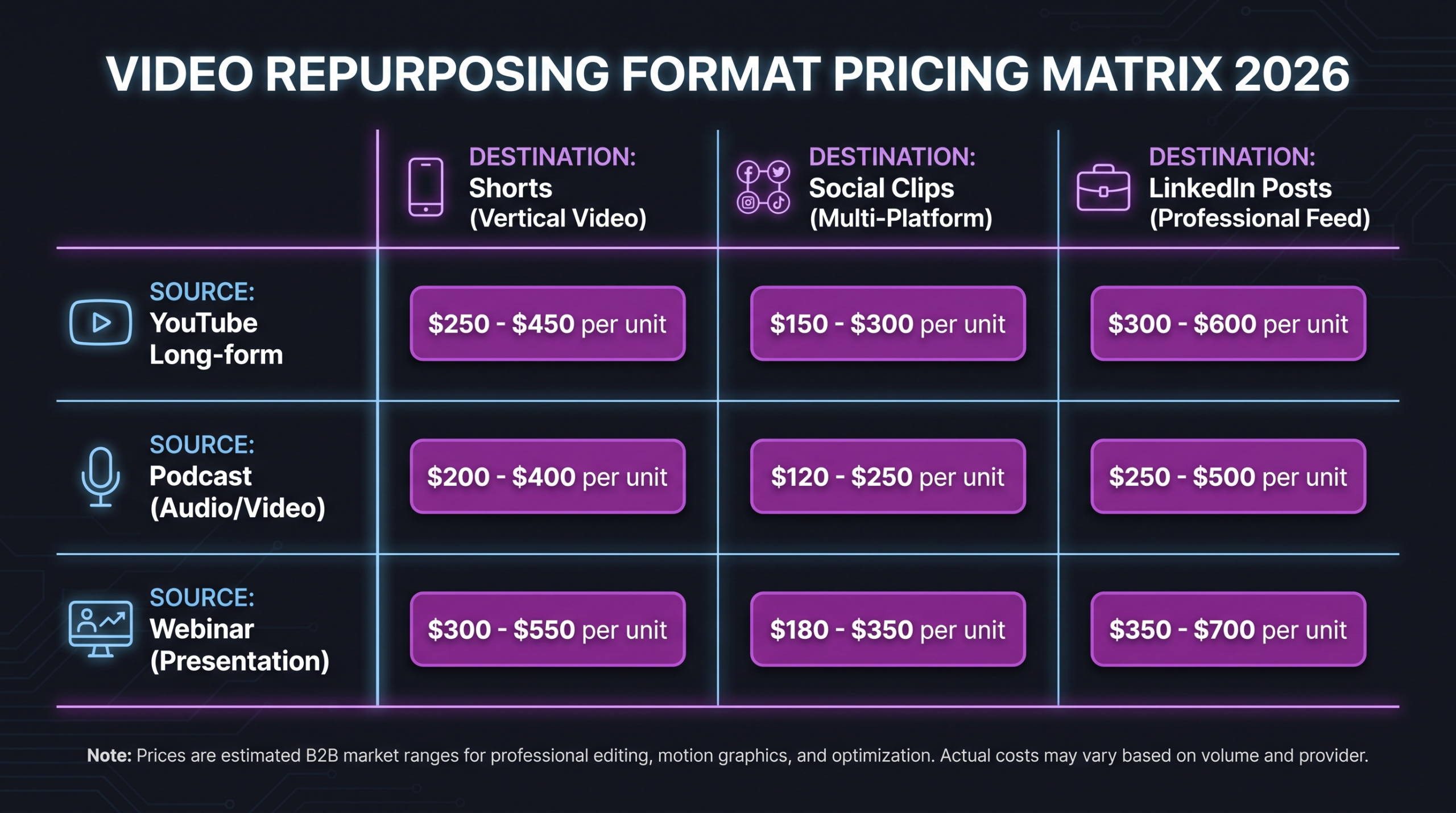
Not all repurposing jobs are priced equally — the source format, destination platform, and complexity of the edit all move the price. A podcast clip destined for Instagram Reels costs less to produce than a webinar clip with custom lower thirds, captions, and a rewritten hook for LinkedIn. Understanding per-format price ranges helps you budget by content type rather than guessing at a flat blended rate.
Platform-Specific Complexity Premiums
Certain platforms carry implicit complexity premiums that push per-clip prices toward the top of their range. LinkedIn clips tend to command a premium because the professional context demands higher caption accuracy, clean lower thirds, and a hook written for a business audience rather than an entertainment one. TikTok clips produced for paid campaigns require platform-safe aspect ratios, specific safe zones for UI overlays, and often faster pacing than organic social clips — all of which add editing time.
YouTube Shorts produced specifically to drive subscribers (rather than just views) often benefit from end-screen call-to-actions and subscribe bumpers that need to be designed, animated, and composited into each clip. If you are repurposing content specifically to support your YouTube channel growth strategy, our guide to YouTube Shorts strategy for B2B brands covers the production decisions that affect both quality and cost at the platform level. For UGC-adjacent formats being repurposed for DTC brands, the UGC video editing rates guide is a useful companion resource.
Freelancer vs. Agency vs. Subscription: Full Comparison
The provider type — not just the pricing model — significantly affects what you get for your money. A per-clip rate from a freelancer on Upwork and a per-clip rate from a specialist repurposing agency can be identical on paper but wildly different in practice: different turnaround guarantees, quality consistency, strategic input, and scalability ceilings. Here is how the three provider categories compare across every dimension that matters for a content team making a budget decision.
The per-clip blended cost for subscription services looks attractive mid-table, but it only holds if you consistently hit the volume ceiling your plan is priced for. A $2,400/month plan covering 24 clips is $100 per clip — exactly. But if you only use 14 clips in a given month because your content calendar slipped, the effective rate jumps to $171. Subscription math works in your favor only when your publishing discipline is reliable. This is a point most repurposing services do not volunteer upfront; it is worth building into your cost modeling before you commit. For a broader comparison between agency and freelance cost structures, the video editing agency vs. freelancer cost analysis covers the full picture beyond repurposing specifically.
How to Calculate Your Cost-Per-Output (ROI Framework)
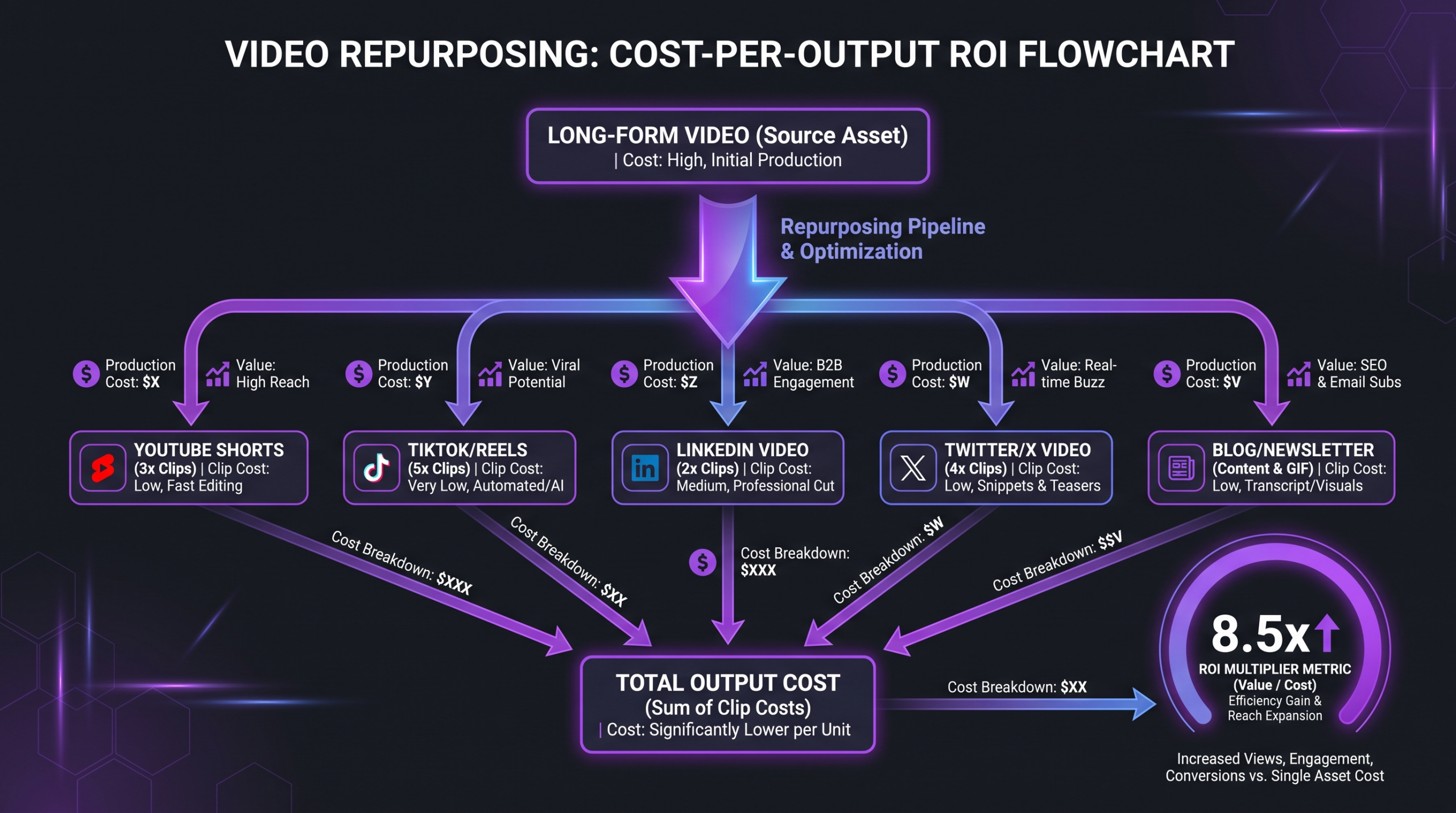
The most useful number in any repurposing budget conversation is not your monthly spend — it is your cost-per-output asset benchmarked against the cost of creating that same asset from scratch. This is the formula that turns a line item into a business case. Here is how to build it for your own situation, using honest ranges rather than fabricated benchmarks.
Step 1: Establish Your From-Scratch Clip Cost
What does it cost your team to produce a single finished social media clip from zero? For many content teams, the fully-loaded cost includes scripting time, shoot coordination, editor time, revision rounds, and platform optimization — often landing anywhere from $200 to $800 per clip depending on production quality and whether you are using internal or external resources. This is your baseline. Everything you spend on repurposing that costs less per output than this number is, by definition, ROI-positive on a per-asset basis.
Step 2: Calculate Your Repurposing Cost-Per-Output
Divide your total monthly repurposing spend (including any platform fees, revision time, or internal coordination costs) by the number of finished clips delivered and actually deployed. The “actually deployed” qualifier matters — clips that sit in a Dropbox folder and never get published do not count toward your ROI calculation. If you produce 30 clips but only publish 18, your effective cost-per-output is higher than your clip rate implies, and your publishing workflow needs as much attention as your production budget.
Step 3: Account for the Asset Multiplier Effect
The most compelling ROI argument for repurposing is the asset multiplier: a single well-produced 60-minute webinar can yield 8–15 social clips, a summary reel, a highlight compilation, an audiogram series, and platform-specific edits for LinkedIn, YouTube, Instagram, and TikTok — all from one source event. If your average webinar costs $2,000 to produce and a repurposing service converts it into 12 finished clips at $80 each ($960), the per-asset content cost falls from $2,000 to roughly $160 (12 clips + 1 parent video at $2,960 total for 13 assets). Platform research consistently shows that video content drives higher engagement rates when it is natively formatted for each channel, according to data from Sprout Social’s social media video insights.
💡 ROI Rule of Thumb: If your repurposing cost-per-clip is less than 40% of your from-scratch clip cost, repurposing is generating clear positive ROI. Most well-managed programs land between 20–35% of scratch costs per output. Teams that exceed 50% are typically over-specifying clip complexity or underutilizing their source footage volume.
For a full picture of video production cost benchmarks to compare against, the guide to how much professional video editing costs covers from-scratch production ranges by format and quality tier. Running that against your repurposing quote makes for a defensible budget conversation with any stakeholder.
What Drives Repurposing Prices Up or Down
Most price variation in video repurposing quotes comes from a handful of predictable variables. Understanding which variables apply to your situation lets you negotiate more intelligently and avoid paying premiums for features you do not actually need.
Factors That Push Prices Up
Source video length and complexity: A 3-hour conference recording takes significantly more time to review and mine for clips than a 45-minute interview. Some providers charge a source-review fee on top of per-clip rates for any source video longer than 60–90 minutes.
Platform count: Repurposing the same clip for three platforms (LinkedIn, TikTok, and YouTube Shorts) is not simply one clip times three — each platform has different safe zones, caption placement rules, and optimal pacing. Providers typically charge per platform output, not per source clip.
Custom motion graphics: Branded lower thirds, animated titles, custom caption styles, and intro/outro animations are all charged separately from basic clip editing. These elements add $15–$60 per clip depending on complexity and whether templates already exist for your brand.
Turnaround guarantees: Express delivery (under 24 hours) commonly adds a 25–50% premium to the standard rate. For most content teams, 48-hour standard turnaround is entirely workable and keeps costs at baseline. Riverside’s video repurposing workflow guide outlines how production-side choices upstream affect the editing complexity and cost at the repurposing stage.
Caption accuracy requirements: Auto-generated captions are cheap; manually reviewed and corrected captions for technical content, non-native speakers, or brand terminology take 2–3× longer and are priced accordingly. If your content features specialized vocabulary, budget for manual caption QC.
Factors That Bring Prices Down
Volume commitment: Providers almost universally discount per-clip rates at volume thresholds. A team producing 8 clips per month may pay $90 per clip; a team committing to 40 clips per month from the same provider may negotiate $55–$65. The savings at scale often make the business case for doubling output cadence.
Consistent source format: When every source video follows the same structure (same interview format, same lighting, same platform destination), editors build templates and workflows that dramatically reduce per-clip time. Standardized source material from teams that use video production SOPs commonly comes in 20–30% cheaper than one-off varied footage, according to accounts from content teams using repurposing services at scale documented by HubSpot’s video marketing research.
Pre-built brand kit: Providing your editor with a complete brand kit — logo files, color hex codes, font files, approved caption style examples, and a style guide — eliminates revision rounds and reduces clip setup time. Teams that provide a complete brand kit on day one commonly see lower rates and faster turnarounds from all three provider types.
Longer contracts: Agencies and specialized services commonly offer 10–20% discounts for 6-month versus month-to-month arrangements. If your content strategy is stable, a semi-annual commitment is one of the lowest-risk ways to reduce your blended per-clip cost.
Choosing the Right Pricing Model for Your Team
The right pricing model is the one that matches your output volume to your publishing discipline and your budget tolerance for variable versus fixed costs. There is no universally correct answer — but there is a clear framework for matching the model to your situation.
Choose per-clip if: You publish fewer than 12 clips per month, your content calendar is irregular, you are testing a new provider, or you are producing a one-time campaign push. Per-clip pricing gives you zero commitment and maximum flexibility at a higher unit cost — the right trade-off when volume is low or uncertain.
Choose a subscription if: You consistently produce 15–40 clips per month from a predictable source (weekly podcast, bi-weekly webinar, regular long-form YouTube publishing). Subscription services are the best-value option for teams with disciplined publishing calendars and clear monthly source material. They scale well within their plan tier and keep your per-clip cost lower than per-project rates at equivalent quality. According to the Social Media Examiner’s industry report, content teams that repurpose consistently at scale report meaningfully higher content ROI than those that repurpose sporadically.
Choose an agency retainer if: Video distribution is central to your marketing and demand-generation strategy; you need someone accountable to downstream performance (not just clip delivery); you are distributing across four or more platforms with distinct audiences; or you are spending $250,000+ annually on content and need repurposing to be a strategic function rather than a production task. A video editing agency at the retainer tier integrates clip strategy with your broader marketing calendar — something no subscription service is designed to do. Agencies like Increditors bring senior editors with platform expertise, feedback loops built around distribution performance, and account management structures that ensure your repurposing program compounds in quality over time rather than cycling through a generic production queue.
💡 Decision Shortcut: Start with per-clip for your first 30–60 days with any new provider. Once you have real data on your monthly clip deployment rate and publishing consistency, you have everything you need to choose the subscription tier or retainer scope that actually fits — without over-committing to a plan based on optimistic projections.
Frequently Asked Questions
How much does video repurposing cost on average?
Per-clip rates from freelancers and specialized services commonly run $25–$150 per finished clip depending on complexity, platform requirements, and turnaround speed. Monthly subscriptions for small-to-mid teams typically range $800–$4,000/month. Full agency retainers with a strategy layer run $3,000–$12,000+/month. The right benchmark for your situation is cost-per-output compared to your from-scratch clip production cost — not the total contract number.
Is it cheaper to hire a freelancer or use a subscription service?
At low volumes (under 12 clips per month), per-clip freelancers are usually more economical because there is no base fee. At consistent mid-volumes (15–40 clips per month), subscriptions typically deliver a better blended per-clip cost because the monthly fee is amortized across more output. At high volumes or when you need strategy and accountability alongside production, a retainer delivers compounding value that neither freelancers nor subscriptions are structured to provide.
What is included in a video repurposing service at the standard rate?
Standard-rate repurposing typically includes clip selection from the source video, aspect-ratio reformatting for the target platform(s), caption generation and basic styling, and hook optimization (trimming or rewriting the first 3–5 seconds). Add-ons commonly priced separately include custom motion graphics, branded lower thirds, manual caption QC for technical content, blog-post transcripts, and express turnaround. Always clarify scope before signing — “repurposing” is not a standardized SKU and providers define the scope boundaries differently.
How do I know if repurposing is worth it for my business?
Run the cost-per-output comparison from Section 5 of this guide: if your repurposing cost per clip is below 40% of what it costs you to produce a clip from scratch, the math favors repurposing clearly. Also audit your existing video library — most marketing teams are sitting on dozens of hours of footage that has been published once and then archived. That archive is an untapped repurposing asset already paid for. Research from Wyzowl consistently shows that teams increasing their video output by repurposing existing content report stronger ROI than teams spending equivalent budgets on new production.
Can I negotiate a lower rate for a video repurposing service?
Yes, and the most effective levers are volume commitment, contract length, and source format standardization. Volume discounts are nearly universal — providers structure their unit economics around predictable workloads. Committing to a 6-month arrangement versus month-to-month commonly unlocks 10–20% off the per-clip or monthly rate. Providing a complete brand kit, consistent source formats, and a clear brief per batch also reduces editor time and some providers will pass that efficiency back as a lower rate when you can demonstrate the pattern upfront.
Verdict: Which Pricing Model Is Right for You in 2026
Video repurposing is one of the highest-leverage content investments available in 2026 — it extends the reach of assets you have already paid to create, at a cost-per-output that is typically a fraction of original production. The pricing model that extracts the most value from that leverage depends entirely on your publishing discipline and output volume.
Per-clip pricing is the right starting point for any team new to repurposing or operating at low volume. Subscription services are the right long-term choice for teams with a consistent source-video cadence and clear monthly publishing targets. Agency retainers are the right choice when video distribution is a growth lever, not a nice-to-have, and when accountability to downstream performance — not just clip count — matters.
Whichever model you choose, price it against your cost-per-output, not your total contract value. A $5,000/month retainer producing 60 platform-ready clips is $83 per clip — cheaper than many per-clip freelancers for the same output quality. The number that drives the decision is always the per-asset cost, benchmarked against what it would cost your team to build that same asset from scratch. Start there and the right model becomes obvious. According to LinkedIn’s video marketing data, video content on the platform generates significantly higher engagement rates than static posts — making a well-executed repurposing program one of the clearest ROI opportunities for B2B content teams heading into the second half of 2026. For a deeper read on how Increditors approaches repurposing within a broader video strategy, our complete guide for SaaS video teams is the most comprehensive starting point.
Ready for Video That Actually Converts?
Tell us about your project and we will put together a custom repurposing plan.