









![3D Explainer Video - ScribbleLive.mp4_snapshot_00.12_[2022.03.09_03.14.16]](https://increditors.com/wp-content/uploads/elementor/thumbs/3D-Explainer-Video-ScribbleLive.mp4_snapshot_00.12_2022.03.09_03.14.16-r7wb53mx72rxst3qcqyrfxdmeyzb5r9jbl0wbjujh4.png "3D Explainer Video – ScribbleLive.mp4_snapshot_00.12_[2022.03.09_03.14.16]")































Choosing the right video editing service comes down to six structured stages: mapping your output volume and format requirements, matching pricing models to your cadence, verifying core capabilities, scoring reliability and communication, reviewing contracts and IP rights, and running a structured paid trial. This checklist is built for marketing directors managing multi-format video programs at scale — work through each stage before committing budget to any vendor.
- The 6-Stage Evaluation Checklist at a Glance
- Stage 1: Map Your Video Output Requirements
- Stage 2: Match Pricing Models to Your Production Cadence
- Stage 3: Verify Core Capabilities and Portfolio Depth
- Stage 4: Score Reliability, Revisions, and Communication
- Stage 5: Contract, IP Rights, and File-Handoff Standards
- Stage 6: Run a Paid Trial and Grade the Results
- How Different Service Types Perform on the Checklist
- Frequently Asked Questions
- Verdict
The 6-Stage Evaluation Checklist at a Glance
Most marketing teams choose a video editing service the wrong way. They browse a few websites, watch a showreel, collect three quotes, and select whoever replied fastest. Six months later they are managing deadline escalations, revision disputes, and footage that does not match brand guidelines — and switching costs have become real.
This checklist exists to prevent that outcome. It is structured around the six decision stages that matter most for organizations running serious video programs — the kind where missing a deadline or mishandling brand assets carries actual business consequences. If you want to understand what a video editing company actually does before running this evaluation, this primer on what a video editing company does is worth reading first.
Each stage produces a concrete score or decision gate. By the time you complete all six, you will have a ranked shortlist with documented reasoning — not just a gut instinct. The entire framework takes roughly four to six hours spread across two weeks. That investment pays back every time you avoid a bad fit that would have cost three to six months of productivity.
Who This Checklist Is For
This framework is written for marketing directors and content operations leaders at companies producing ten or more videos per month across multiple formats. If you are sourcing a single editor for a one-off project, the evaluation can be lighter — but the core criteria still apply. The stakes simply scale with volume and program complexity.
The six stages are: (1) requirements mapping, (2) pricing model alignment, (3) capability verification, (4) reliability and communication scoring, (5) contract and IP review, and (6) paid trial execution. Work through each in sequence — later stages depend on clarity built in earlier ones.
Stage 1: Map Your Video Output Requirements
Before evaluating any vendor, you need a clear picture of what you are actually buying. Services are priced, staffed, and optimized around different output profiles. A service that is excellent for a weekly YouTube show may be completely wrong for a team producing forty short-form social clips and four long-form testimonials every month.
Volume: How Many Videos Per Month?
Start by counting your actual monthly output — not what you would like to produce, but what you currently deliver across all channels. Include all formats: short-form social, YouTube and long-form, webinar recordings, product demos, internal communications, event recap videos, and testimonial cuts. Most marketing teams undercount by 30–40% because they exclude repurposed clips derived from existing long-form content.
According to Wyzowl’s State of Video Marketing research, organizations producing video at scale consistently cite turnaround time and consistency as the top two pain points with external services. Both stem from a mismatch between production volume and the vendor’s staffing model — a problem that surfaces quickly when you are explicit about numbers upfront.
Format and Platform Mix
Different formats require meaningfully different skill sets. A service that excels at long-form documentary-style edits may struggle with the fast, high-energy cuts that TikTok and Instagram Reels demand. Motion graphics for SaaS product demos require different tooling and training than color-grading cinematic brand films. Map your format mix before shopping — it becomes a core filter in Stage 3.
Turnaround SLAs
Be honest about your actual turnaround requirements. Many teams claim they need 24-hour edits but realistically operate on 72-hour cycles with occasional true rush requests. Overstating your SLA needs will push you toward premium pricing tiers that your actual workflow does not justify. Understating them will cause delivery failures during crunch periods. Document your real SLA distribution: what percentage of your deliverables are genuinely urgent, and what is the comfortable default?
Stage 1 checklist items:
- ☐ Current monthly video count by format (trailing 90-day actual — not estimated)
- ☐ Projected 12-month volume growth (will output double or triple?)
- ☐ Peak periods identified (product launches, trade shows, seasonal spikes)
- ☐ Platforms and aspect ratios required per deliverable (9:16, 16:9, 1:1, etc.)
- ☐ Average raw footage length per deliverable
- ☐ Actual turnaround SLA distribution (urgent vs standard vs flexible)
Stage 2: Match Pricing Models to Your Production Cadence
The pricing model is often a better predictor of fit than the price itself. A per-project arrangement at a higher rate may be dramatically cheaper than a monthly retainer if your volume is irregular — and the reverse holds for teams with steady, predictable output. Understanding what professional video editing actually costs across different pricing structures helps you evaluate whether a proposal is competitively positioned or carrying hidden margin.
Hidden Cost Variables to Probe
Proposals rarely show the full cost picture. During Stage 2, ask vendors explicitly about: per-revision fees beyond the included rounds, rush delivery surcharges and what qualifies as rush, motion graphics billed at a different rate than straight cuts, storage and asset management costs, and onboarding or brand-setup fees. These add-ons frequently represent 15–30% of the visible quoted price for high-volume teams.
💡 Pro Tip: Ask each vendor for the total all-in cost for a typical month that includes two minor revisions per video, one rush delivery, and one complex motion graphic request. This stress-test scenario reveals how the pricing model behaves under real conditions, not just the clean base case in the proposal.
Stage 2 checklist items:
- ☐ Confirm exact inclusions per billing period (video count, length caps, revision rounds)
- ☐ Document all overage rates in writing before signing anything
- ☐ Minimum contract length and exit clause terms confirmed
- ☐ Rush fee policy confirmed in writing with clear trigger definition
- ☐ Motion graphics: included in base rate or billed separately?
- ☐ Stress-test scenario run (two revisions + one rush + one complex request)
Stage 3: Verify Core Capabilities and Portfolio Depth
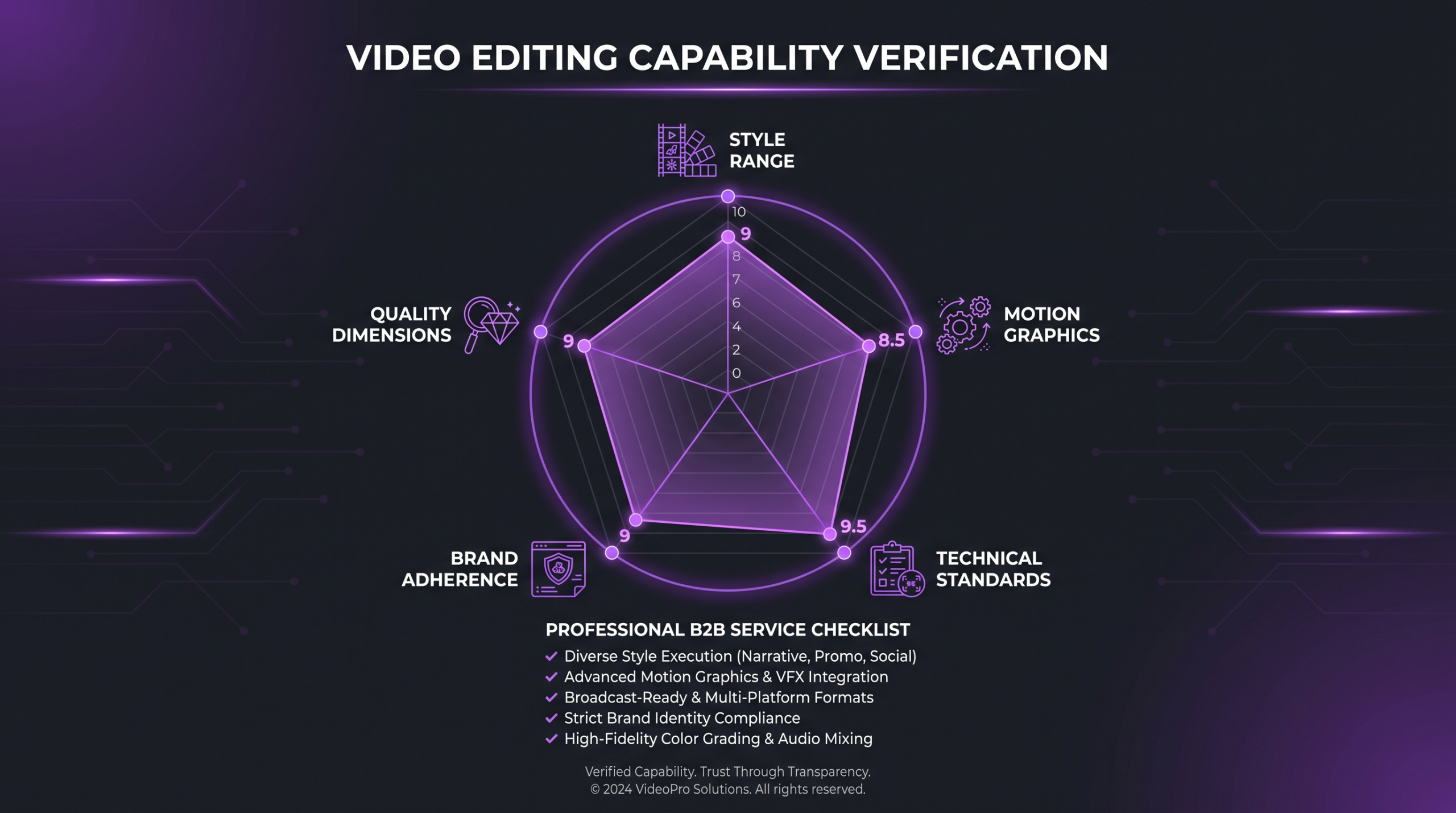
A polished showreel is marketing, not evidence. Stage 3 is about verifying that the specific capabilities you need — in the formats and at the quality level you require — are consistently deliverable, not just achievable on the vendor’s best day for their best client.
Style Range and Brand Adherence
Ask vendors to share work for clients in your industry with comparable brand positioning — not their most impressive showpiece from a different category. A luxury automotive reel tells you nothing about whether the team can execute clean, on-brand SaaS demo videos at a 48-hour turnaround. Request five to ten examples that match your specific format needs, and look for consistency across the full set, not just the highest-quality outlier.
Motion Graphics and Animation
Many services subcontract motion graphics work rather than handling it in-house. That is not inherently a problem — but it creates coordination complexity, longer turnarounds, and variable quality control. Ask directly: is motion graphics handled by the same team that edits the footage, or a separate contractor? If separate, how is quality controlled between the two, and who owns the relationship when a revision dispute arises?
Technical Output Standards
Beyond visual style, verify technical output requirements: export specifications (codec, bitrate, color space), audio normalization practices (LUFS targets for different platforms), and subtitle and caption accuracy. Poor technical specs rarely surface during a portfolio review but cause real problems when you are uploading to LinkedIn versus YouTube versus a broadcast partner with specific delivery requirements.
Stage 3 checklist items:
- ☐ Five to ten portfolio examples in your specific format — not just the hero showreel
- ☐ Motion graphics: in-house or subcontracted? Who performs QC?
- ☐ Export specs confirmed for all platforms you publish to
- ☐ Color grading philosophy and consistency across multiple editors
- ☐ Caption and subtitle process (accuracy standard and turnaround time)
- ☐ Multi-platform asset delivery confirmed (correct aspect ratios per deliverable)
- ☐ Brand guideline adherence process (fonts, colors, logo safe zones)
Stage 4: Score Reliability, Revisions, and Communication
Capability gets you onto the shortlist. Reliability determines whether the partnership actually works. Most vendor-client breakdowns at scale are not about editing quality — they are about missed deadlines, ambiguous revision policies, and communication that functions well in month one then degrades as the vendor’s client roster grows.
Revision Policy: The Details That Matter
Ask vendors to describe their revision policy in specific terms — not “unlimited revisions” as a marketing phrase, but how revisions are tracked, what counts as a new revision round versus a minor correction, and what happens when a client provides conflicting direction across multiple internal stakeholders. The answers reveal how the service handles ambiguity, which is the most common root cause of revision escalations in ongoing engagements.
Project Management and Communication Tools
Ask which project management platform the vendor uses and whether it integrates with your existing tools. More importantly, ask how status is communicated when a deadline is at risk. Vendors who proactively flag delays before they land are in a different category from those you have to chase. Request a reference from a client who has worked with the service for twelve or more months — not a recently onboarded, still-in-honeymoon-phase customer.
Wistia’s State of Video research consistently finds that production speed and communication clarity rank ahead of pure editing quality when marketing teams rate their external partnerships — a signal that operational reliability is often the true differentiator between services that look similar on a showreel.
Escalation Paths and Backup Coverage
Ask how the service handles editor unavailability — illness, overload, or departure. A single-editor operation with no backup coverage is a genuine risk for time-sensitive deliverables. Services with dedicated teams or pod-based models typically have built-in redundancy. Confirm who you escalate to when a delivery problem occurs, and what the response SLA for escalations is in writing.
💡 Reliability Score Tip: Score each vendor 1–5 across four dimensions: deadline adherence (from references), revision clarity, communication speed, and escalation path. Weight deadline adherence at 40% — it is the hardest to recover from when it fails at scale.
Stage 4 checklist items:
- ☐ Revision policy in writing: what counts as a revision round vs minor correction
- ☐ PM tool used and integration options with your stack
- ☐ Proactive delay communication: how and when are you notified?
- ☐ Reference from a 12+ month client relationship obtained
- ☐ Editor backup coverage and continuity policy confirmed
- ☐ Named escalation contact and written response SLA
- ☐ Process for handling conflicting multi-stakeholder feedback
Stage 5: Contract, IP Rights, and File-Handoff Standards
Contract review is the least glamorous stage in this checklist and the one most marketing directors delegate without reading. That is a mistake. IP ownership, raw footage rights, and exit clause terms have real consequences if the relationship sours, the vendor is acquired, or your business direction changes.
Intellectual Property Ownership
Confirm that all finished deliverables are assigned to your organization with full commercial rights — including unlimited broadcast, digital, and paid media use — and that this assignment does not lapse if the contract ends. Some contracts retain rights to finished work if invoices are unpaid; understand the exact trigger. Also verify that the service requires your explicit per-project sign-off before using your footage in their portfolio or marketing materials.
Raw Footage Rights and Project File Ownership
Clarify who owns the project files, raw selects, and motion graphics templates built for your brand. If you switch vendors, can you take the After Effects templates your current service created? Who holds storage responsibility for your project archives? A vendor who controls your project files has meaningful leverage at contract renewal — worth understanding before you are in that negotiating position.
Exit Clauses and Transition Support
Read the exit terms carefully. A 30-day notice period with a 90-day billing tail is common in retainer agreements and can cost several months of fees if you need to exit quickly. More importantly, ask whether the contract includes a transition support clause — a commitment to deliver all project files, templates, and in-progress work in an organized handoff format within a defined window. Without one, transitions become chaotic. For a detailed look at what well-structured video editing contracts should cover, that guide walks through the clauses that matter most for ongoing production relationships.
Stage 5 checklist items:
- ☐ IP assignment: all deliverables fully assigned to your org with unlimited commercial rights
- ☐ Portfolio usage: your footage requires explicit per-project consent from you
- ☐ Project file ownership: templates and raw selects belong to your organization
- ☐ Notice period and billing tail clearly stated and acceptable
- ☐ Transition support clause present and specific (files, timeline, format)
- ☐ NDA or confidentiality provision covers sensitive footage and unreleased content
- ☐ Dispute resolution process specified
Stage 6: Run a Paid Trial and Grade the Results
The paid trial is the single most reliable data point in the entire evaluation. Everything before it is assessment and prediction — the trial is live evidence. A service that performs excellently through the first five stages then struggles on a real-world deliverable has told you something the portfolio and references could not have shown.
For guidance on structuring the actual trial project scope, brief quality, and what to look for in the first cut, this guide on finding and hiring a video editor online covers trial design in depth. The scoring matrix below focuses on how to evaluate the output systematically once you have received it.
Designing a Representative Trial
Choose a trial project that is representative of your actual workflow — not simpler. Use a brief that reflects your typical briefing quality, not an unusually detailed one prepared specially for the trial. Submit real footage at your typical handoff state. The goal is to see how the service performs under normal operating conditions, not their best-case scenario.
Pay for the trial at the vendor’s standard rate. Unpaid trials attract minimal senior-editor attention and teach you very little. The trial fee is the cheapest possible due-diligence investment before signing a multi-month commitment.
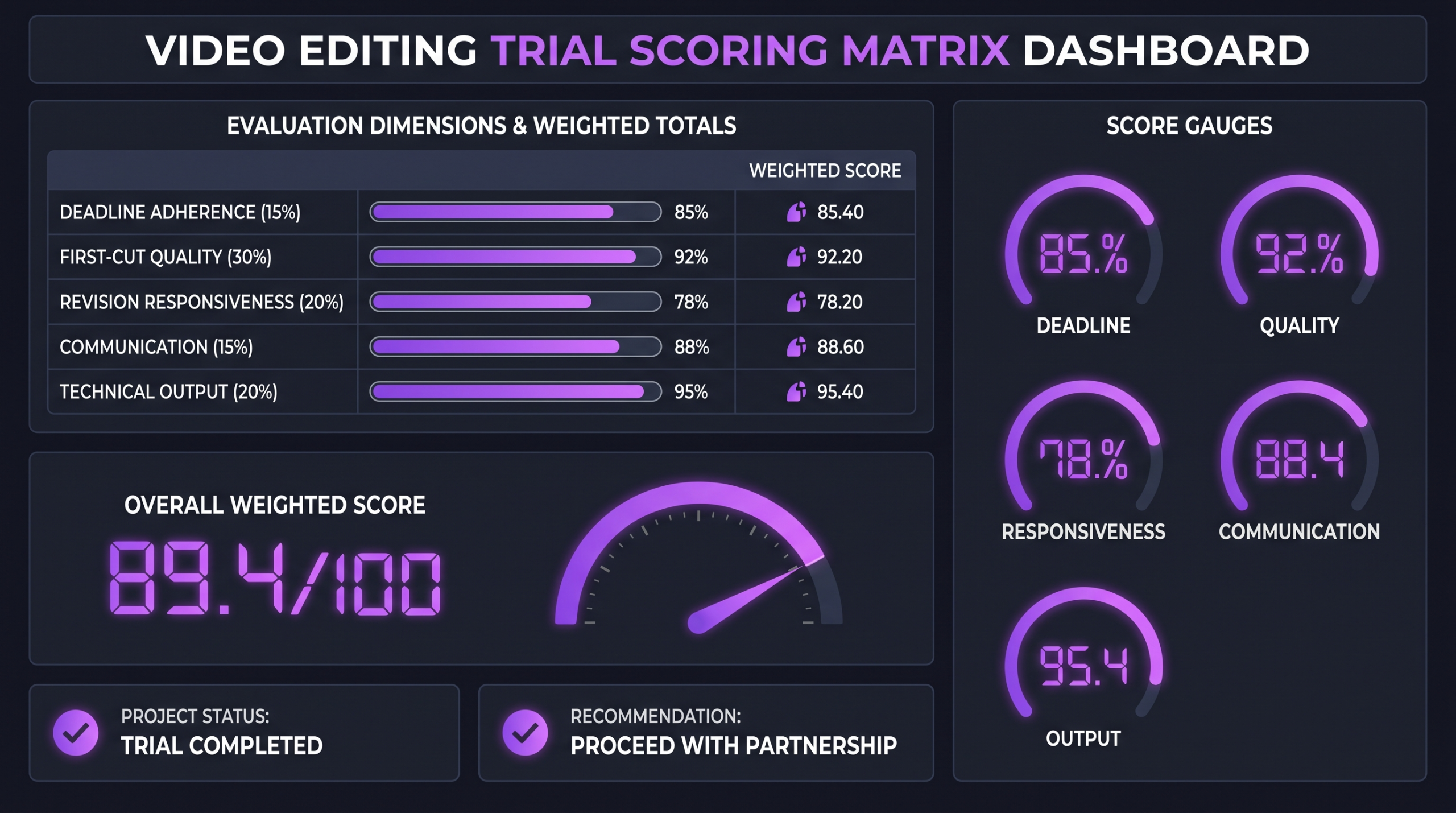
Trial Output Scoring Matrix
Score each dimension 1–5, multiply by the weight, and sum the weighted scores. A weighted total below 3.5 out of 5 is a strong signal to move to your next candidate. A score above 4.2 combined with clean contract terms from Stage 5 is a green light to negotiate a longer agreement with confidence.
How Different Service Types Perform on the Checklist
After running this six-stage framework across multiple evaluations, a consistent pattern emerges: different service types have predictable strengths and predictable failure modes. The checklist criteria do not change — but knowing where each type tends to score low helps you probe harder in the right places and weight your references accordingly.
For organizations running serious multi-format video programs — twenty or more deliverables per month across LinkedIn, YouTube, product demos, and testimonial content — a full-service agency with dedicated editing teams typically clears the checklist most consistently. The higher minimum commitment is offset by the elimination of backup coverage risk, quality variability, and contract ambiguity that characterize the alternatives at scale.
Increditors’ video editing services operate on a dedicated-team model — senior editors assigned to specific client programs, consistent output regardless of volume spikes, with a strategic layer built into every engagement. Organizations that want to understand the full agency-versus-freelancer trade-off before finalizing their checklist scores will find the agency vs freelancer comparison a useful reference point.
HubSpot’s marketing benchmarks research consistently shows that video-mature organizations — those with dedicated external production support — produce more content at higher consistency than those managing video ad-hoc. The checklist itself is what creates the conditions to find and maintain a reliable partner. For a broader comparison of video editing services across tiers and use cases, that ranked comparison covers the full competitive landscape for teams still building their initial shortlist.
Clutch’s video production agency research finds that communication quality and project management are the top two factors marketing teams cite when rating satisfaction with external video partners — reinforcing that Stage 4 reliability scoring is often the true differentiator between vendors who look similar on their service pages.
Frequently Asked Questions
How long should the full checklist evaluation take?
Plan for two to three weeks from initial outreach to completed trial results. Stages 1 through 3 can often run in parallel with vendor shortlisting. The trial (Stage 6) typically adds one to two weeks on top of that. Rushing the trial to compress the timeline is the most common evaluation mistake — it produces unreliable signal and often leads to a decision that needs to be reversed within six months.
How many vendors should I evaluate with this checklist?
Run the full six-stage checklist with two to three vendors maximum. For Stages 1 through 4, pre-screen a broader list of six to eight and eliminate most before reaching contract review and trials. Running paid trials with more than three vendors is rarely practical and typically produces comparison fatigue rather than sharper decisions.
Is a free trial sufficient, or does the trial need to be paid?
The trial needs to be paid. Free trials receive minimal senior-editor attention and do not reflect working conditions. Pay the standard rate for a real deliverable from your actual pipeline. The cost — typically a few hundred to a few thousand dollars depending on complexity — is negligible relative to the cost of committing six months to the wrong partner.
What is the most commonly skipped stage in this checklist?
Stage 5 — contract, IP rights, and file-handoff terms. Most marketing directors delegate contract review to legal without providing context on what matters most for video production: who owns the finished deliverables, who controls the project files, and what happens at exit. Legal can review the language, but someone with production-context knowledge needs to flag the operational clauses that are often buried in standard service agreements.
Can this checklist apply to renewing or expanding an existing vendor relationship?
Yes — and it is especially valuable in that context. Expanding scope with an existing vendor often skips the evaluation steps from initial onboarding. Running a condensed version of Stage 2 (pricing model fit for the new scope), Stage 3 (capability verification for any new formats), and Stage 5 (contract review for amended terms) catches the issues that surface most often in rushed scope expansions.
Verdict: Use the Checklist, Not Your Gut
Choosing a video editing service on instinct — a polished website, a founder who sounds confident on a call, a showreel that impressed in a meeting — is how organizations end up mid-contract with a vendor who cannot scale, cannot hit deadlines reliably, and cannot hand over their own project files cleanly when the relationship eventually ends.
The six-stage checklist does not guarantee a perfect outcome, but it eliminates the worst ones. It surfaces capability gaps before you are mid-campaign, contract traps before you are mid-dispute, and reliability gaps before you are managing escalations that are technically your editor’s problem but practically your problem to solve.
The organizations that find lasting video production partners are the ones who do the evaluation work upfront rather than discovering the gaps on a deadline. Start with Stage 1: your actual monthly output numbers. Everything in this checklist builds from that foundation.
Ready for Video That Actually Converts?
Tell us about your project and we will put together a custom plan.