








![3D Explainer Video - ScribbleLive.mp4_snapshot_00.12_[2022.03.09_03.14.16]](https://increditors.com/wp-content/uploads/elementor/thumbs/3D-Explainer-Video-ScribbleLive.mp4_snapshot_00.12_2022.03.09_03.14.16-r7wb53mx72rxst3qcqyrfxdmeyzb5r9jbl0wbjujh4.png "3D Explainer Video – ScribbleLive.mp4_snapshot_00.12_[2022.03.09_03.14.16]")




























You’ve picked a video editing agency. You’ve agreed on pricing. You’re ready to start sending footage. But before a single frame gets cut, there’s a document that will determine whether this relationship works or falls apart — your Service Level Agreement.
A video editing SLA isn’t legal theater. It’s the operating manual for your partnership. It defines what “good” looks like, what “on time” means, and what happens when things go sideways. And things will occasionally go sideways — that’s not pessimism, that’s production reality.
We’ve seen creators sign five-figure annual contracts with editing services and have zero documentation beyond a Stripe receipt. We’ve also seen enterprise clients with 40-page SLAs that nobody actually reads. Both approaches fail. The sweet spot is a clear, practical agreement that protects both sides without creating bureaucratic drag.
Here’s exactly what your video editing SLA should cover — and what to push back on if it doesn’t.
What’s in This Guide
- What Is a Video Editing SLA (and Why It Matters)
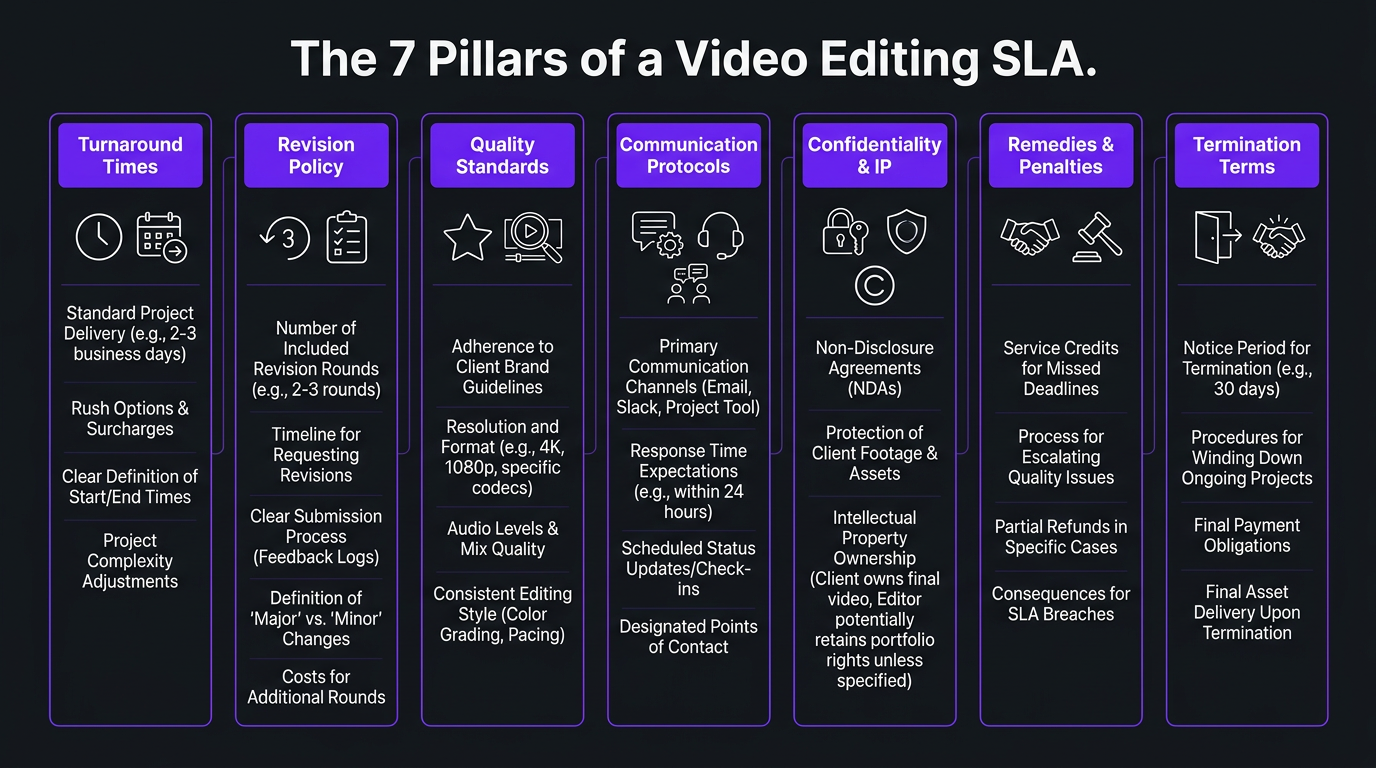
- Turnaround Time Guarantees
- Revision Policies That Actually Work
- Quality Standards & Technical Specs
- Communication & Escalation Protocols
- Confidentiality & IP Ownership
- Remedies & Penalties for Missed SLAs
- SLA Comparison: Budget vs Premium Agencies
- SLA Checklist & Template
- How to Negotiate Without Burning Bridges
- FAQ
What Is a Video Editing SLA (and Why Most Creators Skip It)
A Service Level Agreement is a formal commitment between you and your video editing provider that defines the rules of engagement. It answers every “what if” question before it becomes an argument:
- What if they deliver late?
- What if the quality doesn’t match the sample work?
- What if you need a rush edit at 11 PM on a Friday?
- What if your editor disappears for a week?
- What if you want to cancel mid-contract?
Most creators skip SLAs because they seem corporate, unnecessary, or awkward to bring up. But here’s the thing: the best time to define expectations is when everyone’s still excited about working together. The worst time is during a dispute when both sides have different memories of what was “agreed.”
SLA vs Contract: What’s the Difference?
A contract covers the legal basics — payment terms, liability, governing law. An SLA covers the operational specifics — how fast work gets done, what quality looks like, and how problems get resolved. Think of the contract as the marriage certificate and the SLA as the shared understanding of who does what around the house.
Many agencies roll both into one document. That’s fine. What matters is that the operational commitments are specific and measurable, not vague promises like “we deliver high-quality work quickly.”
When Do You Need an SLA?
If you’re spending more than $1,000/month on video editing, you need an SLA. Period. Below that threshold, a simple email confirming turnaround times and revision rounds is usually sufficient. But once you’re at a scale where missed deadlines mean missed revenue — sponsorship windows, launch dates, content calendars — verbal agreements aren’t enough.
Our clients at Increditors’ enterprise tier always operate under formal SLAs. But even our startup and creator clients benefit from a lightweight version that keeps everyone aligned.
Turnaround Time Guarantees: The Heart of Any SLA
Turnaround time is the single most contentious issue in video editing partnerships. “Fast” means something different to everyone. Your SLA needs to eliminate ambiguity by defining exact timelines for every deliverable type.
Defining “Start” and “Done”
Before you set turnaround windows, define two things precisely:
- When does the clock start? When raw footage is uploaded? When the brief is submitted? When the editor confirms receipt? This matters more than you think. A client who uploads 40GB of footage at 11:57 PM and expects “24-hour turnaround” is setting everyone up for failure.
- What counts as “delivered”? Is it when the first draft hits the review link? When the final approved version is exported? When it’s uploaded to YouTube? Each interpretation adds hours or days.
The clearest approach: the clock starts when the editor confirms they have all materials (footage, brief, music, brand assets) and a complete submission. The clock stops when the first draft is available for review.
Standard Turnaround Benchmarks by Content Type
| Content Type | Standard SLA | Rush SLA | Rush Premium |
|---|---|---|---|
| Short-form (Reels/Shorts/TikTok) | 24–48 hours | 12 hours | +25–50% |
| YouTube long-form (10–20 min) | 3–5 business days | 24–48 hours | +50–100% |
| YouTube long-form (20–45 min) | 5–7 business days | 2–3 business days | +50–100% |
| Brand/commercial video | 5–10 business days | 3–5 business days | +75–150% |
| Podcast episode (video) | 2–3 business days | 24 hours | +25–50% |
| Revision rounds | 24–48 hours each | 12 hours | Varies |
These are industry-standard ranges for professional agencies. Budget subscription services often quote faster turnarounds but frequently miss them because they’re juggling volume with small teams.
Business Days vs Calendar Days
This distinction catches people constantly. An SLA that says “5-day turnaround” means very different things depending on whether weekends count. If you submit footage on Thursday afternoon with a “5-day” SLA:
- 5 business days = delivery by the following Thursday
- 5 calendar days = delivery by Tuesday
Most agencies operate on business days and observe major holidays. Your SLA should specify this explicitly and list which holidays are observed. If you have a global team, note the time zone — a Monday morning in Auckland is still Sunday in Los Angeles.
Revision Policies That Actually Work
Revisions are where most editing relationships get strained. Without clear boundaries, you end up in one of two traps: the client feels nickel-and-dimed for every small change, or the editor gets buried under endless rounds of “just one more tweak.”
How Many Revision Rounds?
The industry standard for professional video editing services is 2-3 revision rounds included per video. Here’s what each round should look like:
- Round 1: Structural feedback — pacing, story flow, segment ordering, major cuts
- Round 2: Detail feedback — text corrections, color adjustments, audio tweaks, graphic refinements
- Round 3 (if included): Final polish — minor tweaks only, usually under 30 minutes of editor time
The SLA should specify a turnaround time for each revision round (typically 24-48 hours) and a deadline for the client to submit feedback. If you sit on a draft for two weeks and then send a page of notes, the editor shouldn’t be held to the original delivery timeline.
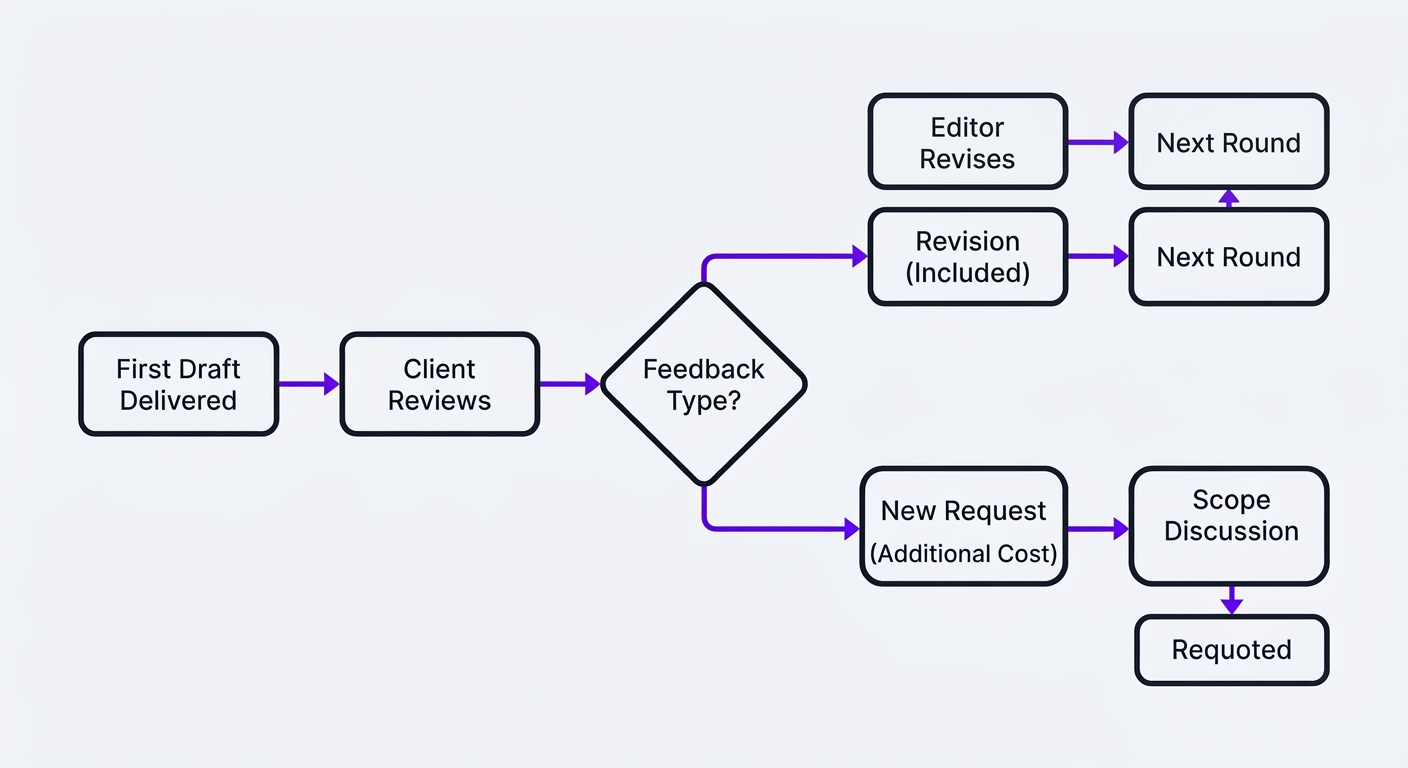
Defining “Revision” vs “New Request”
This is the clause that prevents 90% of revision disputes. Your SLA should clearly distinguish between:
| Revision (Included) | New Request (Additional Cost) |
|---|---|
| Adjusting the pace of an existing section | Adding a new section or segment |
| Swapping a music track for another from the library | Custom music sourcing or licensing |
| Fixing a text overlay typo | Adding 10 new text overlays |
| Adjusting color grading warmth/contrast | Re-grading the entire video in a different style |
| Trimming or extending by 10-15% | Re-editing from scratch with new direction |
| Swapping a B-roll clip | Sourcing and integrating 20+ new B-roll clips |
When we work with clients at Increditors, we handle this with a simple rule: if the feedback could have been included in the original brief, it’s a revision. If it changes the scope or direction of the project, it’s a new request. Clear, fair, and drama-free.
Want an SLA That Actually Protects You?
Every Increditors engagement includes clear SLA terms — turnaround guarantees, revision policies, and dedicated account management. No guesswork.
Quality Standards & Technical Specifications
“High-quality editing” is meaningless in an SLA. Quality needs to be measurable. Here’s how to define it in terms both sides can agree on.
Technical Export Specifications
Your SLA should lock down the technical deliverables:
| Specification | YouTube Long-Form | Short-Form (Reels/Shorts) | Brand/Commercial |
|---|---|---|---|
| Resolution | 3840×2160 (4K) or 1920×1080 | 1080×1920 (vertical) | 4K minimum |
| Codec | H.264 or H.265 | H.264 | ProRes 422 + H.264 |
| Frame rate | Match source (24/30/60fps) | 30fps | Match source |
| Audio | -14 to -16 LUFS, stereo | -14 LUFS, stereo | -14 LUFS, stereo/5.1 |
| Bitrate | 20-50 Mbps (4K) | 8-12 Mbps | 50-100+ Mbps (ProRes) |
| Subtitles | SRT file + burned-in option | Burned-in | SRT + burned-in |
Brand Guideline Adherence
If you have brand guidelines — fonts, colors, logo usage, intro/outro sequences — your SLA should reference the specific brand document and require adherence. This isn’t optional for enterprise clients or agencies using white-label editing services.
The SLA should also specify who provides the brand assets. If you expect the editor to use your custom font but never send the .otf file, that’s on you, not them.
Quality Benchmarks Beyond Tech Specs
The harder part is defining creative quality. While subjective, you can set guardrails:
- Sample match: Delivered work should match the style and quality of agreed-upon sample videos (reference links in the SLA)
- Audio clarity: No background hiss, pops, or volume inconsistencies beyond ±2dB
- Color consistency: Skin tones and brand colors should remain consistent across all videos in a batch
- Pacing: No dead air longer than 1.5 seconds unless intentional
- Transitions: Consistent transition style per brand (no random effects not in the brand guide)
When we onboarded Brightwell for their educational content series, we spent the first week calibrating on exactly these standards. We edited three sample videos, got detailed feedback, then documented the approved style as our quality baseline. Every video since has been measured against that benchmark — and the consistency shows in their audience retention curves.
Communication & Escalation Protocols
The fastest way to kill a video editing partnership isn’t bad editing — it’s bad communication. Your SLA should codify how, when, and through what channels communication happens.
Communication Channels
Define the official channels and their purposes:
- Project management tool (Asana, Notion, Trello, Frame.io): All briefs, feedback, and deliverables. This is the system of record.
- Slack/Discord: Quick questions, status updates, informal communication
- Email: Formal communications, contract changes, billing
- Video calls: Weekly/biweekly syncs, complex feedback sessions, strategy discussions
The SLA should specify that feedback submitted through the project management tool takes priority over verbal or chat feedback. This prevents the “but I told you on Slack” problem when something gets lost in a thread.
Response Time SLAs
| Communication Type | Response Time | Channel |
|---|---|---|
| Urgent production issue | Within 2 hours (business hours) | Slack/phone |
| Brief clarification question | Within 4 hours | PM tool or Slack |
| Standard project update | Within 1 business day | PM tool |
| Billing/contract inquiry | Within 2 business days | |
| Strategy/scope change request | Within 2 business days | Email + call |
Escalation Tiers
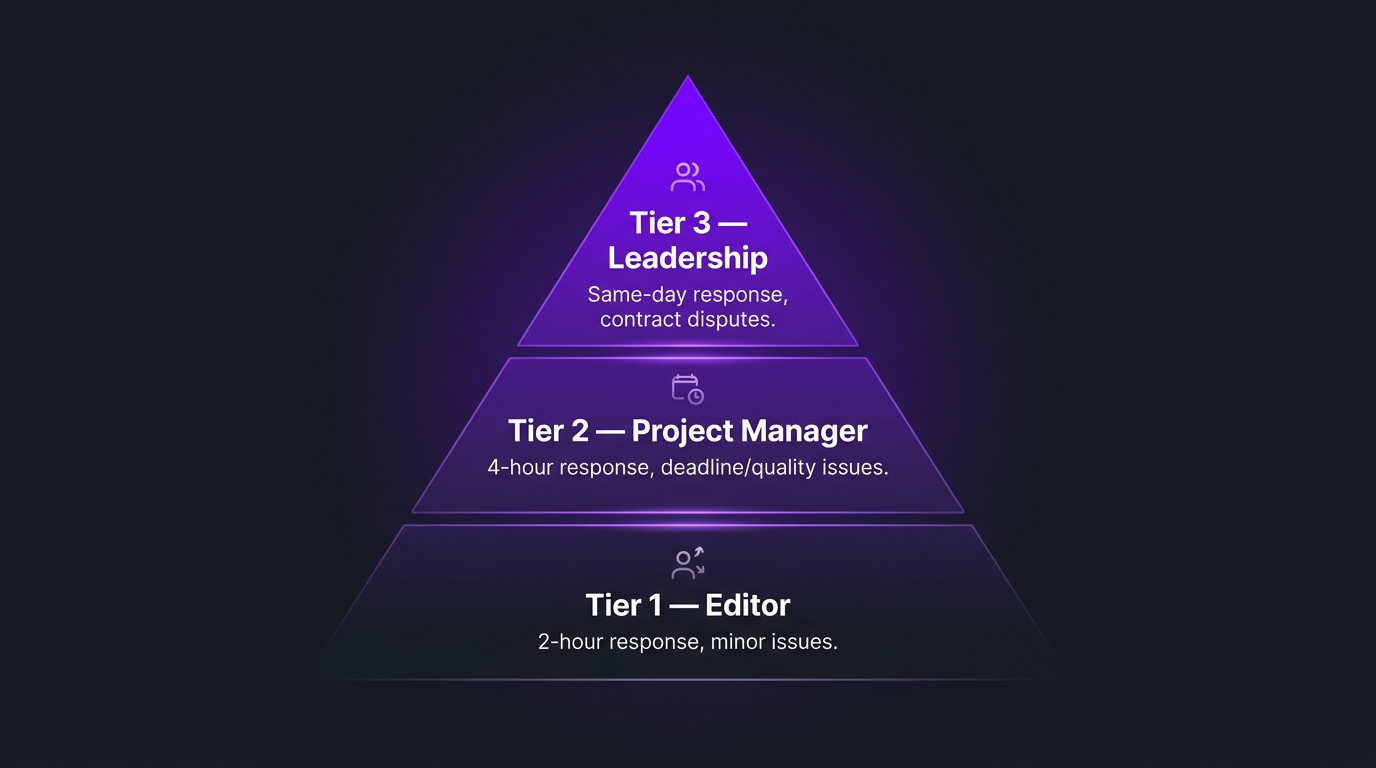
Every SLA needs an escalation path. When a problem isn’t resolved at the editor level, where does it go?
- Tier 1 — Editor: Day-to-day feedback and minor issues (wrong font, audio sync off by a frame)
- Tier 2 — Project Manager/Account Manager: Missed deadlines, quality concerns, workflow issues
- Tier 3 — Agency Leadership: Pattern of missed SLAs, contract disputes, relationship-level problems
The SLA should include contact names (or roles) and response commitments at each tier. At Increditors, every client has a dedicated point of contact who handles Tier 1-2 escalations directly, with our leadership team stepping in for anything that reaches Tier 3 — which, candidly, almost never happens because we catch issues at Tier 1.
Confidentiality & IP Ownership
This section gets skipped constantly and it’s arguably the most important for creators who share unreleased content, business strategies, or revenue data with their editing team.
What Should Confidentiality Cover?
- Raw footage: Unreleased content cannot be shared, posted, or used in the agency’s portfolio without written permission
- Business information: Revenue numbers, subscriber data, sponsor rates, growth strategies
- Embargoed content: Product launches, partnership announcements, anything with a release date
- Creative processes: Editing techniques, workflows, or templates developed specifically for your brand
A proper NDA should survive the end of the contract — typically for 2-5 years after termination. This means even after you stop working together, they can’t use your unreleased footage or share your business information.
IP Ownership: Who Owns What?
This is where many creators get burned. Your SLA should clearly state:
- Client owns all final deliverables — the edited videos, graphics, templates, and project files
- Client owns raw footage — the agency has a license to use it during the engagement, not ownership
- Agency retains their tools — proprietary templates, LUTs, presets, and workflows that existed before your engagement remain theirs
- Portfolio usage: Define whether the agency can show your work in their portfolio (most clients allow this for final, published content)
When eSafety engaged us for their educational video series, IP ownership was a non-negotiable priority. Government-adjacent content with strict usage guidelines required airtight documentation of who owns what. We structured their agreement with full IP transfer on delivery and restricted portfolio usage — and that clarity made the entire 12-month engagement seamless.
Remedies & Penalties for Missed SLAs
An SLA without consequences is a wishlist, not a commitment. But remedies need to be practical — punitive clauses that destroy the relationship defeat the purpose. The goal is accountability, not punishment.
Tiered Remedy Framework
| SLA Breach Level | Definition | Remedy |
|---|---|---|
| Minor | Delivery 1-24 hours late; minor quality issue | Priority re-queuing; issue logged |
| Moderate | Delivery 1-3 days late; quality below agreed standard | Service credit (10-25% of affected deliverable); root cause review |
| Critical | Delivery 3+ days late; unusable deliverable; missed launch date | Full credit for affected deliverable; emergency escalation; option to terminate without penalty |
| Pattern | 3+ moderate breaches in 30 days | Contract review; option to terminate; potential partial refund |
Service Credits vs Refunds
Most agencies prefer service credits over cash refunds — and honestly, that’s usually better for the client too. A credit means you get extra work at no cost, which keeps the relationship going. A refund means you’re looking for a new editor, which costs more in onboarding time than the refund is worth.
That said, your SLA should include a refund option for critical or pattern breaches. If the agency consistently can’t hit SLAs, credits just keep you trapped in a relationship that isn’t working.
Client-Side SLAs
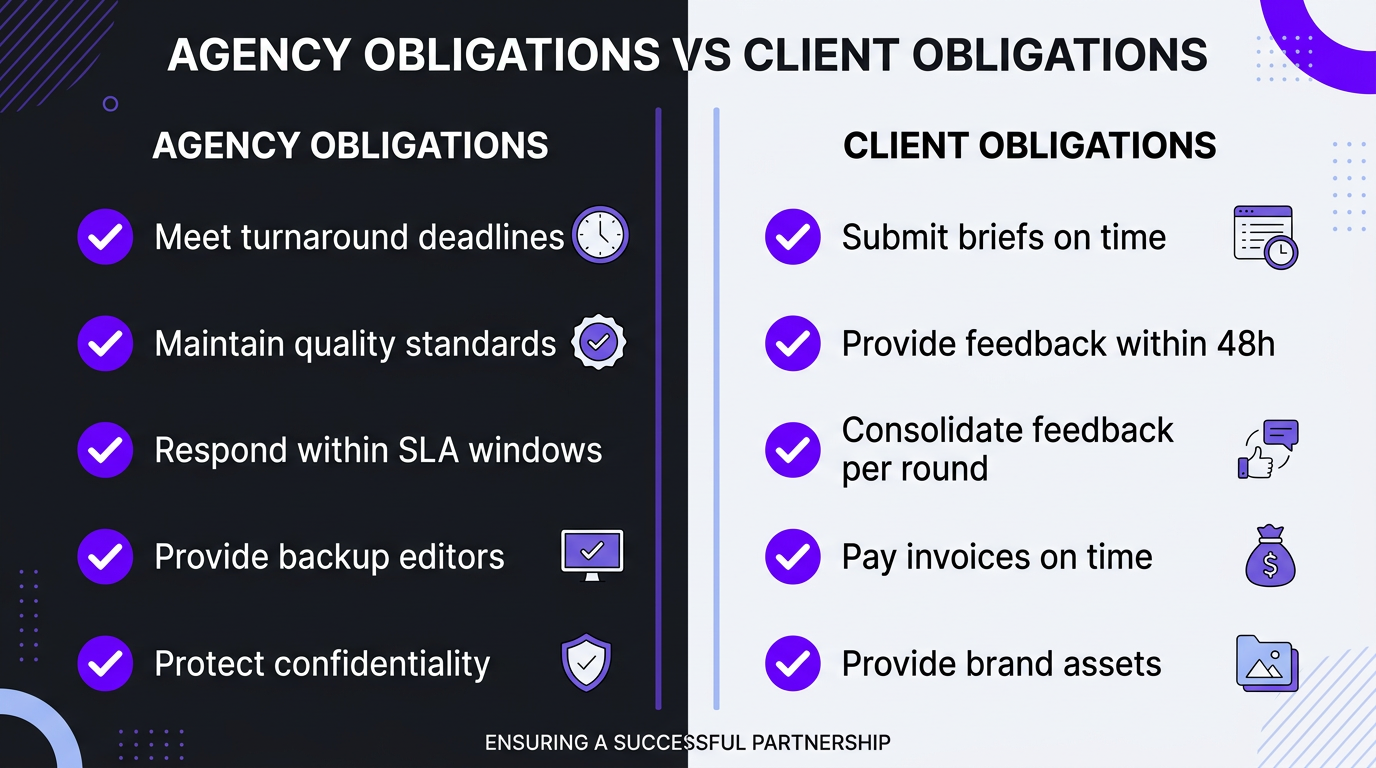
Good SLAs are bilateral. The agency has obligations, but so do you. Common client-side commitments include:
- Submit briefs and footage by the agreed deadline
- Provide feedback within 48-72 hours of receiving drafts
- Consolidate feedback into a single round (no drip-feeding notes over days)
- Respond to clarification questions within 4 business hours
- Pay invoices within the agreed terms (typically Net 15 or Net 30)
If the client misses their SLAs, the agency’s turnaround clock pauses. This is fair and prevents the blame game when late footage leads to late deliverables.
SLA Comparison: Budget vs Mid-Tier vs Premium Agencies
Not every agency offers the same SLA protections. Here’s what you can realistically expect at different price points:
| SLA Element | Budget ($300-$800/mo) | Mid-Tier ($1,500-$3,000/mo) | Premium ($3,500-$8,000+/mo) |
|---|---|---|---|
| Written SLA | Rarely offered | Basic terms in contract | Comprehensive standalone document |
| Turnaround guarantee | “Typically 2-3 days” | Defined business day windows | Specific hour commitments with rush options |
| Revision rounds | 1-2 rounds, loosely defined | 2-3 rounds, defined scope | 2-3 rounds with clear revision vs new request policy |
| Dedicated editor | ❌ Pool-based assignment | ✅ Semi-dedicated | ✅ Fully dedicated team |
| Account manager | ❌ | Shared PM | ✅ Dedicated account manager |
| Escalation path | Support ticket only | PM + management access | Named contacts at every tier |
| Missed deadline remedy | None / apology | Priority re-queuing | Service credits + root cause analysis |
| NDA/confidentiality | Basic or none | Standard NDA | Custom NDA with IP transfer |
| Termination notice | Cancel anytime (monthly) | 30-day notice | 30-60 day notice with transition support |
| Increditors | Custom SLA at every tier — turnaround guarantees, dedicated teams, named escalation contacts, and full IP transfer |
The pattern is clear: as you move up in price, you move from generic promises to specific, measurable, enforceable commitments. The question isn’t whether SLAs cost more — it’s whether the consequences of not having one cost more. (They always do.)
SLA Checklist: Everything Your Agreement Should Include
Use this checklist to evaluate any video editing SLA — or to build one from scratch with your provider.
Scope & Deliverables
- ☐ Content types covered (long-form, short-form, ads, etc.)
- ☐ Monthly volume commitments (minimum and maximum)
- ☐ Export specifications per content type
- ☐ Deliverable formats and file transfer method
- ☐ What’s included vs what costs extra (motion graphics, sound design, color grading)
Turnaround & Scheduling
- ☐ Turnaround windows per content type
- ☐ Business days vs calendar days (specified)
- ☐ Time zone for all deadlines
- ☐ Holiday schedule and blackout dates
- ☐ Rush delivery availability and pricing
- ☐ Queue priority rules (FIFO vs priority tiers)
Revisions & Feedback
- ☐ Number of included revision rounds
- ☐ Definition of “revision” vs “new request”
- ☐ Turnaround time per revision round
- ☐ Client feedback submission deadline
- ☐ Feedback format requirements (timestamped, consolidated)
Quality & Standards
- ☐ Reference sample videos linked
- ☐ Brand guidelines document referenced
- ☐ Audio level standards (LUFS targets)
- ☐ QC process before delivery
Communication & Reporting
- ☐ Official communication channels defined
- ☐ Response time commitments
- ☐ Escalation tiers and contacts
- ☐ Regular sync meeting cadence
- ☐ Monthly performance reporting
Legal & Administrative
- ☐ IP ownership (client owns all deliverables)
- ☐ Confidentiality/NDA terms
- ☐ Portfolio usage agreement
- ☐ Termination notice period
- ☐ Remedies for SLA breaches
- ☐ Force majeure clause
- ☐ Payment terms and late payment penalties
This checklist covers what Emerge needed when they set up their content creator partnership with us. They came from a previous agency where the lack of documented quality standards led to inconsistent output across their video series. Once we locked down the SLA with specific sample references and QC checkpoints, their content consistency improved dramatically within the first month.
How to Negotiate an SLA Without Burning Bridges
Asking for an SLA doesn’t make you difficult. It makes you professional. But how you approach the conversation matters.
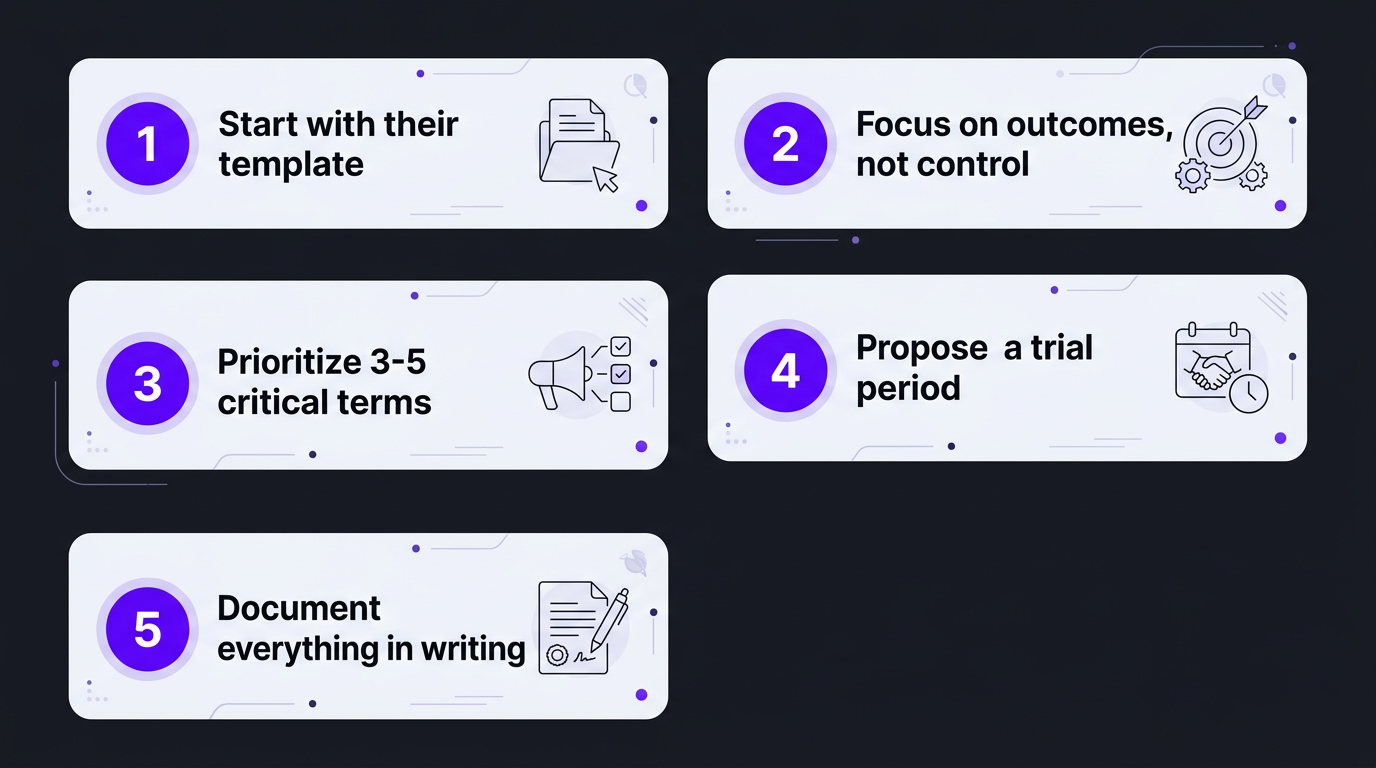
Start With Their Template
Always ask the agency for their standard SLA or service terms first. This tells you three things:
- Whether they have one — If they don’t, that’s a red flag. Professional agencies have documented processes.
- What they’re already comfortable committing to — Their standard terms represent the floor, not the ceiling.
- Where there’s room to negotiate — The gaps between their template and your needs are the negotiation points.
Focus on Outcomes, Not Control
Frame SLA discussions around mutual success, not micromanagement:
- Instead of: “I need a 48-hour turnaround guarantee with penalties”
- Try: “Our content calendar requires publishing every Tuesday and Friday. Can we build turnaround commitments that support that schedule?”
This approach gets you the same result while signaling that you’re a collaborative client, not a difficult one.
Don’t Negotiate What Doesn’t Matter
Pick 3-5 SLA terms that are genuinely critical to your operation and negotiate those firmly. Common priorities:
- Turnaround time (almost always #1)
- Revision rounds and scope
- IP ownership and confidentiality
- Escalation path and remedies
- Termination flexibility
Everything else — the specific format of status reports, the exact wording of the force majeure clause — can usually default to the agency’s standard terms.
Trial Period SLAs
If either side is nervous about committing to specific SLA terms, propose a trial period. Run the first 30-60 days under provisional SLA terms, track actual performance, then formalize the SLA based on real data. This is exactly how we handle startup engagements — the trial period lets both sides calibrate expectations based on reality rather than assumptions.
Trade with Pat took this approach when they initially engaged us for their trading education content. The first month operated under lightweight SLA terms — 4-day turnaround, 2 revision rounds, weekly syncs. After 30 days, we had enough data to lock in tighter turnarounds (3 days) and add quality benchmarks based on their actual feedback patterns. The result was an SLA that both sides knew was achievable because it was built on real performance data.
Frequently Asked Questions
A video editing SLA (Service Level Agreement) is a formal document between a client and a video editing provider that defines turnaround times, revision policies, quality standards, communication protocols, and escalation paths. It sets mutual expectations and provides accountability for both parties. Unlike a basic contract, an SLA focuses on operational commitments — how the work gets done, not just the legal framework around it.
Standard turnaround SLAs range from 24-48 hours for short-form content (Reels, Shorts) to 3-5 business days for long-form YouTube videos. Rush delivery (12-24 hours) is typically available at a 25-100% premium. The SLA should specify business days vs calendar days, define when the clock starts (materials confirmed received), and note the time zone used for all deadline calculations.
Most professional video editing agreements include 2-3 revision rounds per video. Unlimited revisions sound attractive but often indicate lower quality on first drafts and can lead to scope creep. A good SLA defines what counts as a revision (adjusting existing elements) vs a new request (adding new elements or changing direction) and sets response times for each round.
A well-written SLA includes tiered remedies: minor delays (under 24 hours) get priority re-queuing; moderate delays (1-3 days) trigger service credits of 10-25% of the affected deliverable; critical misses (over 3 days or missed launch dates) warrant full credits and an option to terminate without penalty. Pattern breaches should trigger a contract review.
Yes, especially if your content includes unreleased products, proprietary business information, or embargoed content. Most professional agencies include confidentiality clauses in their standard agreements. Ensure it covers raw footage, final deliverables, strategy discussions, and business data. The NDA should survive contract termination for 2-5 years.
Quality standards should include: export specifications (resolution, codec, bitrate), audio levels (targeting -14 to -16 LUFS for YouTube), color consistency requirements, brand guideline adherence, and reference sample videos that define the expected style. Some SLAs also include minimum viewer retention benchmarks after a ramp-up period, though these are harder to enforce.
Start by asking for their standard SLA template. Identify 3-5 terms that are critical to your operation (usually turnaround time, revision rounds, IP ownership). Frame negotiations around mutual success — for example, “Our content calendar requires publishing Tuesdays and Fridays” rather than “I demand 48-hour turnaround.” Consider a 30-60 day trial period to build SLA terms based on real performance data.
Ready to Work With an Agency That Puts Commitments in Writing?
Every Increditors engagement comes with clear SLA terms, dedicated account management, and the transparency you deserve. Let’s build something that works for both sides.
This guide reflects industry-standard SLA practices as of March 2026. SLA requirements vary by project scope, content type, and organizational needs. For Increditors-specific SLA terms and capabilities, schedule a discovery call or visit our pricing page.