










![3D Explainer Video - ScribbleLive.mp4_snapshot_00.12_[2022.03.09_03.14.16]](https://increditors.com/wp-content/uploads/elementor/thumbs/3D-Explainer-Video-ScribbleLive.mp4_snapshot_00.12_2022.03.09_03.14.16-r7wb53mx72rxst3qcqyrfxdmeyzb5r9jbl0wbjujh4.png "3D Explainer Video – ScribbleLive.mp4_snapshot_00.12_[2022.03.09_03.14.16]")






























Subscription box brands and DTC companies have a unique content problem: they need fresh, high-volume video every single month — and the content has a short shelf life. Last month’s box reveal is irrelevant by the time this month ships.
That creates an editing treadmill most brands can’t keep up with. You need unboxing videos, social ads, product showcases, customer testimonials, and behind-the-scenes content — all on a cycle that resets every 30 days.
The brands that win aren’t necessarily spending more on production. They’re spending smarter on editing — turning raw footage into a content engine that drives acquisition, reduces churn, and builds a community that sticks around long after the novelty wears off.
This guide covers exactly how subscription box and DTC brands should approach video editing — from content types and costs to workflows that actually scale.
What’s in This Guide
- Why Video Is Non-Negotiable for DTC Brands
- The 8 Video Types Every Subscription Brand Needs
- Video for Acquisition: Ads That Convert
- Video for Retention: Reducing Churn
- Building a Monthly Video Workflow
- What DTC Video Editing Actually Costs
- In-House vs Agency for DTC Brands
- Real Examples from DTC Brands
- Scaling from 5 to 50 Videos per Month
- FAQ
Why Video Is Non-Negotiable for DTC and Subscription Box Brands
Static images used to be enough. A well-shot flat lay, a lifestyle photo, maybe a carousel ad. That era ended around 2023, and in 2026, the data is overwhelming:
- Video ads convert 2-3x higher than static image ads on Meta and TikTok for ecommerce brands
- Product pages with video see 80%+ longer time-on-page and 34% higher conversion rates
- Unboxing content is one of the most-searched content categories on YouTube — and subscription boxes are perfect for it
- Social algorithms prioritize video — organic reach for Reels and TikTok dwarfs what static posts achieve
For subscription box brands specifically, video solves two critical business problems simultaneously: acquisition (getting new subscribers) and retention (keeping them past month three, when most churn happens).
The challenge isn’t knowing you need video. It’s producing enough of it, fast enough, at a quality level that represents your brand — every single month.
The Volume Problem
A typical ecommerce brand might launch a product line and create a batch of videos that last 6-12 months. A subscription box brand creates products that are relevant for 30 days. That means your content calendar never stops.
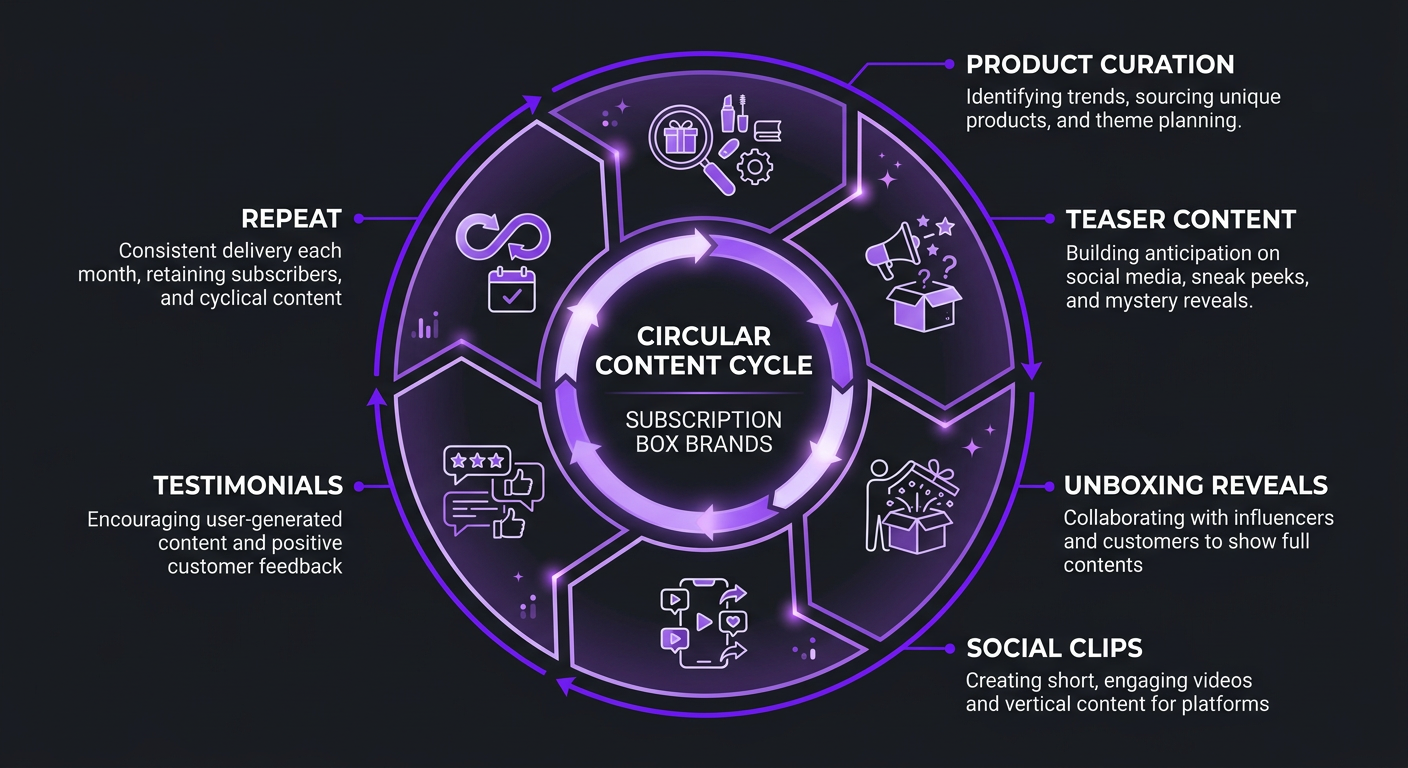
Consider what a single monthly box cycle requires:
- 2-3 teaser videos before the box ships
- 1 full unboxing reveal video
- 3-5 individual product spotlight clips
- 2-4 ad creatives for paid acquisition
- 1-2 customer testimonial compilations
- Behind-the-scenes or founder content
That’s 10-16 pieces of edited video content per month — minimum. Brands running aggressive growth playbooks produce 30-50+.
The 8 Video Types Every Subscription Brand Needs
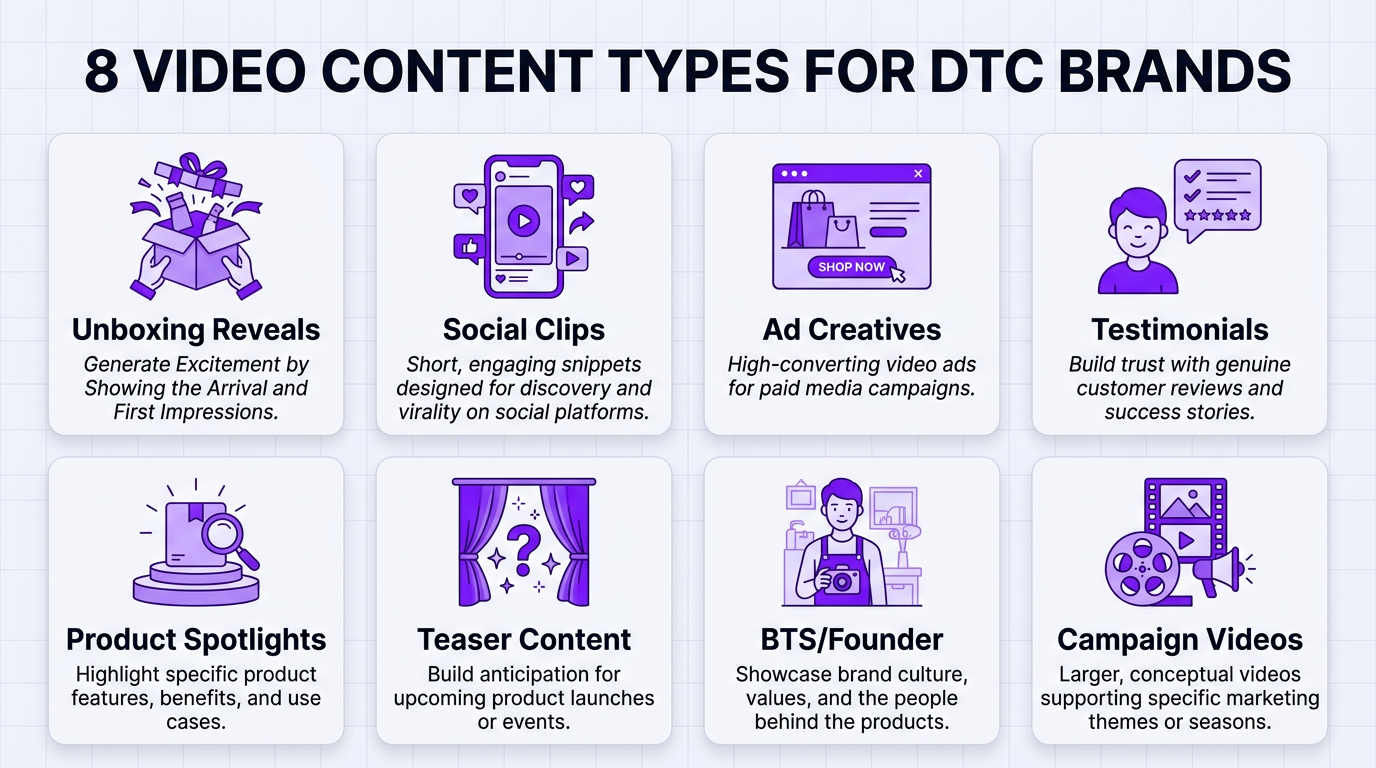
Not all video content is created equal. Each type serves a specific function in your growth engine. Here’s what to prioritize and what each type demands from an editing perspective.
1. Unboxing Reveal Videos (YouTube / Long-Form)
The bread and butter. These 5-12 minute videos showcase each month’s box, product by product. They serve double duty: content marketing for acquisition and anticipation-building for existing subscribers.
Editing requirements: Multi-camera cuts, product close-ups, lower thirds with product names and values, branded intro/outro, background music, color grading that makes products pop. This isn’t just cutting footage — it’s creating a viewing experience that makes people want to subscribe.
2. Short-Form Social Clips (Reels / TikTok / Shorts)
15-60 second cuts optimized for each platform. These are your top-of-funnel workhorses — the content that gets discovered by new audiences.
Editing requirements: Fast pacing, text overlays with hooks, trending audio integration, platform-specific aspect ratios (9:16), captions, and the ability to create 3-5 variations from the same raw footage for A/B testing.
3. Paid Ad Creatives
Purpose-built video ads for Meta, TikTok, and YouTube. These need to stop the scroll in the first 2 seconds and communicate value in under 30 seconds.
Editing requirements: Multiple hooks (first 3 seconds), fast cuts, product benefit callouts, pricing overlays, strong CTA, and multiple versions for testing. A single ad concept should produce 4-6 variations with different hooks, CTAs, and lengths.
4. Customer Testimonial Compilations
User-generated content and customer reviews edited into polished social proof videos. These are conversion machines at the bottom of the funnel.
Editing requirements: Cleanup of UGC footage (color correction, audio normalization), text overlays with subscriber names and quotes, brand-consistent framing, and compilation editing that tells a narrative rather than just stringing clips together.
5. Product Spotlight Videos
Individual product features from the monthly box, optimized for product pages and email embeds. Each item gets its own 30-90 second showcase.
Editing requirements: Clean product shots, specification overlays, benefit callouts, and a consistent template that can be produced efficiently across 5-10 products per month.
6. Pre-Shipment Teaser Content
Sneak peek videos that build anticipation before the box ships. These reduce churn by creating excitement and giving subscribers a reason to stay.
Editing requirements: Mystery and reveal pacing, blurred or partially hidden product shots, countdown elements, and an emotional arc that builds anticipation without spoiling the full box.
7. Founder / Behind-the-Scenes Content
The human story behind the brand. Why you curate what you curate, how you source products, what your team looks like. This content builds the emotional connection that prevents churn.
Editing requirements: More relaxed pacing, authentic feel (not over-produced), subtitles, and strategic editing that makes founder content feel genuine while still being watchable.
8. Seasonal / Limited Edition Campaign Videos
Holiday boxes, collaborations, anniversary editions — these require campaign-level creative that feels premium and creates urgency.
Editing requirements: Higher production value, motion graphics, custom music, and a cinematic quality that differentiates these from regular monthly content.
| Video Type | Frequency | Length | Primary Platform | Editing Complexity |
|---|---|---|---|---|
| Unboxing Reveals | 1-2/month | 5-12 min | YouTube | High |
| Social Clips | 8-12/month | 15-60 sec | Reels, TikTok | Medium |
| Ad Creatives | 4-8/month | 15-30 sec | Meta, TikTok Ads | High |
| Testimonials | 2-4/month | 30-90 sec | Website, Social | Medium |
| Product Spotlights | 5-10/month | 30-90 sec | Product Pages | Low-Medium |
| Teaser Content | 2-3/month | 15-30 sec | Email, Social | Medium |
| BTS / Founder | 2-4/month | 2-5 min | YouTube, Social | Low-Medium |
| Campaign Videos | 1-2/quarter | 1-3 min | All Platforms | Very High |
Video for Acquisition: Ads That Actually Convert
Let’s talk about the content that directly impacts your subscriber numbers: video ads.
DTC subscription brands live and die by their ad creative. The product itself matters, but in a crowded market (there are now 7,000+ subscription box companies in the US alone), your video creative is often the differentiator between a $15 CAC and a $45 CAC.
The Anatomy of a Converting Subscription Box Ad
After analyzing hundreds of DTC ad creatives, the pattern is clear. The best-performing subscription box ads follow this structure:
- Hook (0-3 seconds): Visual surprise or bold claim. “I just got $200 worth of [category] for $39.” Show the box opening or a product spread.
- Value showcase (3-15 seconds): Quick cuts through individual products with price/value overlays. Show quantity and quality simultaneously.
- Social proof (15-20 seconds): Quick testimonial clip or subscriber count mention. “Join 50,000+ subscribers.”
- Offer + CTA (20-30 seconds): First-box discount, money-back guarantee, and clear subscribe link.
The editing makes or breaks this structure. Poor pacing, weak transitions, or unprofessional text overlays kill conversion rates — even when the product is excellent.
Creative Testing at Scale
Top-performing DTC brands don’t run one ad. They test 15-25 ad variations per month, systematically testing:
- Different hooks (3-5 variations per concept)
- Different value propositions (price vs. curation vs. exclusivity)
- Different formats (UGC-style vs. produced vs. hybrid)
- Different lengths (15s, 30s, 60s)
- Different CTAs and offers
This volume of testing requires an editing partner who can turn around variations fast. Waiting 5-7 days for ad creative means you’re running behind the algorithm. The brands winning on Meta and TikTok are iterating on creative weekly.
Need a Content Engine for Your DTC Brand?
We help subscription box and ecommerce brands produce 20-50+ pieces of edited content per month — ads, social clips, unboxings, and everything in between.
Video for Retention: Reducing Churn with Content
Acquisition gets the headlines, but retention is where subscription businesses actually make money. The math is simple: if your average subscriber churns at month 3, you need every new subscriber just to replace the ones leaving. Growth becomes impossible.
Video is one of the most underused retention tools in the subscription box playbook.
The Churn Timeline
Most subscription box churn follows a predictable pattern:
| Period | Churn Risk | Why They Leave | Video Solution |
|---|---|---|---|
| Month 1 | Low (5-8%) | Impulse buyers, wrong expectations | Welcome video + unboxing guide |
| Month 2-3 | High (15-25%) | Novelty wears off, not using products | Product tutorial videos, community content |
| Month 4-6 | Medium (10-15%) | “Is this still worth it?” evaluation | Value breakdown videos, behind-the-scenes |
| Month 7+ | Low (5-8%) | Life changes, budget cuts | Community/loyalty content, annual deal offers |
Video addresses the month 2-3 danger zone better than any other medium. When a subscriber is debating whether to cancel, a well-produced teaser for next month’s box creates just enough anticipation to push the “stay” decision.
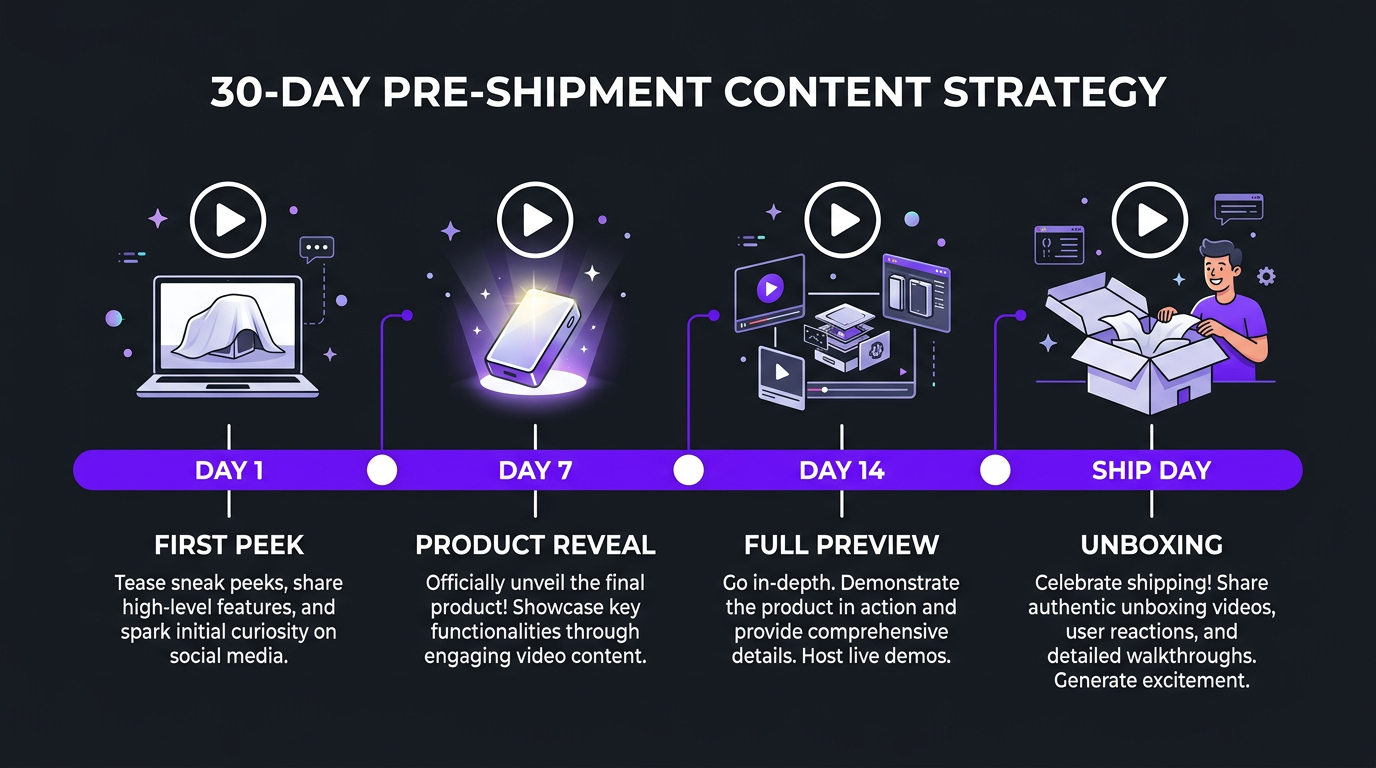
The Pre-Shipment Teaser Strategy
This is the single highest-impact retention tactic we’ve seen subscription box brands implement through video:
- Day 1 of the cycle: 15-second “first peek” video — a blurred or partially revealed product hint. Sent via email and posted on social.
- Day 7: 30-second reveal of 1-2 products with founder commentary on why they were chosen.
- Day 14: Full box preview with value breakdown ($X worth of products for your $Y subscription).
- Ship day: Full unboxing reveal goes live on YouTube and social.
This creates a content cadence that keeps subscribers engaged throughout the entire month — not just when the box arrives. Brands using this approach report 10-20% reductions in month 2-3 churn.
Product Tutorial Content
One of the biggest churn drivers for subscription boxes is subscribers not actually using the products. They stack up unopened boxes and eventually cancel because they “have too much.”
Short tutorial videos (60-120 seconds) showing creative ways to use each product solve this. A beauty box brand might show a 90-second makeup tutorial using that month’s products. A snack box might share recipe ideas. A craft box might show the completed project.
These don’t require high production value — but they do require consistent, professional editing to maintain quality across dozens of product tutorials per year.
Building a Monthly Video Workflow That Doesn’t Break
The operational challenge for subscription box brands isn’t making one great video. It’s making 15-30+ every single month without burning out your team or draining your budget.
Here’s the workflow framework that works:
Phase 1: Batch Shooting (Days 1-3)
Once the monthly box is finalized, schedule a 1-2 day shoot that captures everything:
- Full unboxing footage (multiple angles)
- Individual product B-roll
- Founder/team talking head segments
- Customer testimonial collection (via submissions)
- Ad-specific footage with various hooks
The goal: capture enough raw footage in 1-2 days to fuel the entire month’s content. This is dramatically more efficient than shooting piecemeal throughout the month.
Phase 2: Editing Sprint (Days 3-10)
Your editing team takes the raw footage and produces the full content batch:
- Long-form unboxing edit (YouTube)
- 8-12 short-form clips (social platforms)
- 4-8 ad creative variations
- Product spotlight videos
- Teaser content for next month’s marketing
This is where having a dedicated editing team pays for itself. A single freelancer can’t turn around 20-30 pieces in a week. A team with a dedicated editor, a motion graphics specialist, and a project manager can.
Phase 3: Scheduled Distribution (Days 10-30)
Content is scheduled across platforms throughout the month. This creates the illusion of constant fresh content while actually requiring a concentrated burst of production in the first 10 days.
What DTC Video Editing Actually Costs
Let’s get specific about pricing. DTC brands often overspend on production and underspend on editing — when the editing is what actually determines whether content performs.
| Content Volume | Freelancer Cost | Budget Agency | Premium Agency |
|---|---|---|---|
| 5-10 videos/month | $1,000–$2,500 | $1,500–$2,500 | $2,500–$4,000 |
| 10-20 videos/month | $2,500–$5,000 | $2,500–$4,000 | $4,000–$6,000 |
| 20-40 videos/month | $5,000–$10,000 | $4,000–$6,500 | $5,000–$8,000 |
| 40+ videos/month | Not feasible solo | $6,000–$9,000 | $8,000–$12,000+ |
Notice that at higher volumes, freelancers become more expensive than agencies — and at 40+ videos per month, a single freelancer simply can’t deliver. Agencies scale because they have teams; freelancers don’t.
The Per-Video Math
For DTC brands, think about cost per video rather than monthly totals:
- Short-form social clip: $50-$150 per video
- Ad creative (with variations): $150-$400 per concept
- Full unboxing edit: $300-$800 per video
- Product spotlight: $75-$200 per video
- Testimonial compilation: $150-$350 per video
On a retainer model, per-video costs drop 30-50% because the editor is already familiar with your brand, templates are built, and workflow is streamlined. This is why monthly retainers make more sense for subscription brands than per-project pricing.
ROI Calculation for Subscription Brands
Here’s a straightforward ROI model for a subscription box at $45/month with 5,000 subscribers:
| Metric | Without Video Strategy | With Video Strategy |
|---|---|---|
| Monthly churn rate | 12% | 8% |
| Subscribers lost/month | 600 | 400 |
| Revenue saved (retained subs) | — | $9,000/month |
| CAC improvement from video ads | $35 CAC | $22 CAC |
| Savings on 200 new subs/month | — | $2,600/month |
| Total monthly value of video | — | $11,600/month |
| Monthly editing cost | — | $4,000-$6,000 |
| Net ROI | — | +$5,600-$7,600/month |
At a $4,000-$6,000/month editing budget generating $11,600 in retained revenue and acquisition savings, the ROI is 2-3x. And this doesn’t account for organic growth from YouTube and social content, which compounds over time.
In-House Editor vs Agency: What Makes Sense for DTC Brands
This is the most common question we get from DTC founders. Let’s break it down honestly.
| Factor | In-House Editor | Editing Agency |
|---|---|---|
| Annual cost | $55,000-$85,000 + benefits | $36,000-$72,000 |
| Capacity | 15-25 videos/month | 20-50+ videos/month |
| Skill range | 1 generalist | Editor + colorist + motion designer |
| Scaling | Hire another person | Increase retainer |
| Vacation / sick days | Content stops | Backup editors |
| Brand knowledge | Deep (embedded in team) | Grows over time with dedicated editor |
| Creative diversity | Limited to one perspective | Team brings cross-industry insights |
| Management overhead | High (you manage directly) | Low (PM handles workflow) |
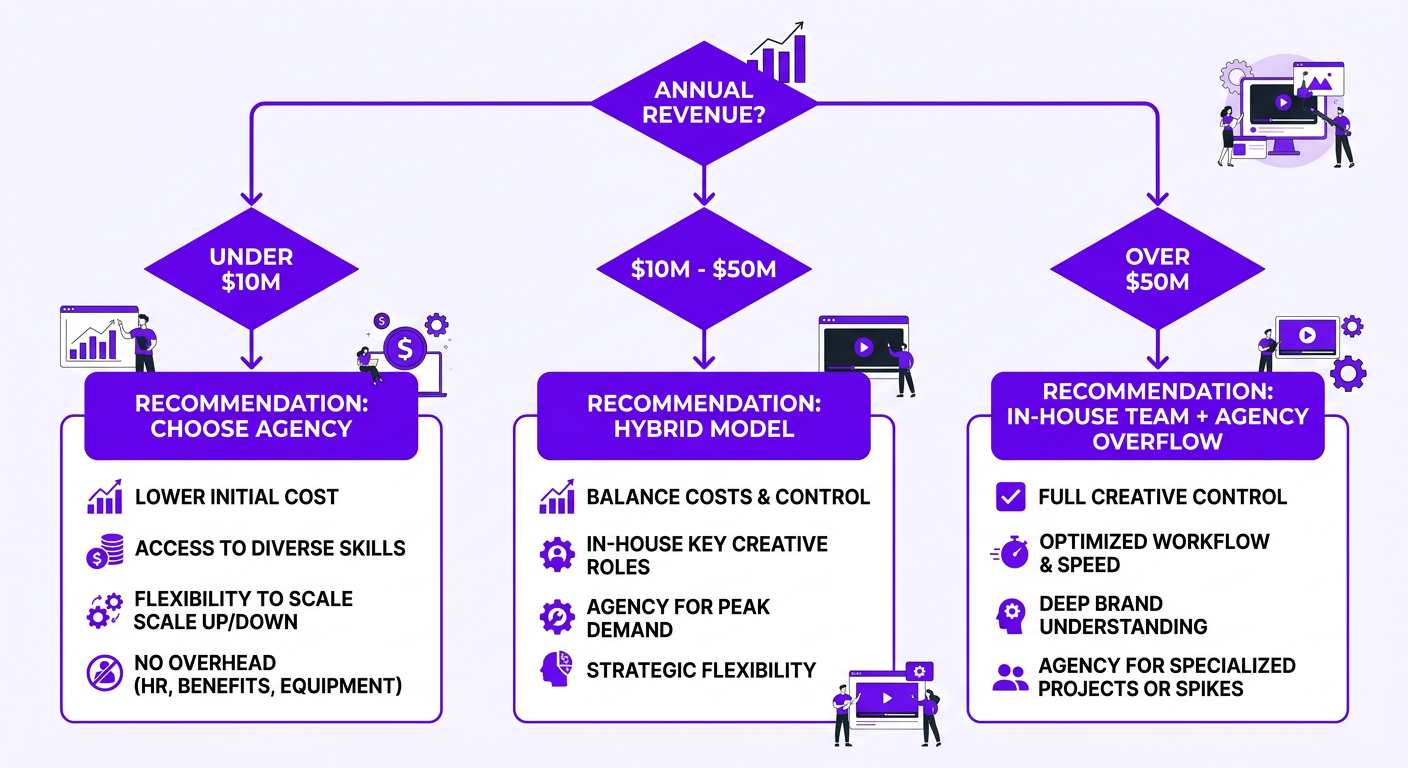
Our recommendation: DTC brands under $10M in annual revenue should use an agency. The math doesn’t justify an in-house hire until you’re producing 30+ videos per month and have the management bandwidth to direct an editor daily.
Between $10M-$50M, a hybrid model works best — one in-house editor for quick-turnaround content (stories, real-time social) paired with an agency for the heavy lifting (ads, YouTube, campaign content).
Above $50M, you likely need an in-house creative team — but even then, most brands maintain agency relationships for overflow capacity and fresh creative perspectives.
Real Examples: How DTC Brands Win with Video Editing
VYVE Wellness: From Static Ads to Video-First Growth
VYVE Wellness, a health and wellness DTC brand, struggled with plateauing ad performance. Their static image ads were showing diminishing returns with Meta’s algorithm changes, and their in-house team didn’t have the editing capacity to test video ad creative at scale.
By partnering with a dedicated video editing team, VYVE transitioned to a video-first ad strategy. The editing team produced 15-20 ad variations per month from VYVE’s raw product footage and UGC submissions. Within three months:
- Cost per acquisition dropped 38%
- Ad creative testing velocity increased 4x
- Best-performing video ads outperformed previous best static ads by 2.7x in ROAS
The key wasn’t bigger production budgets — it was having an editing partner that could iterate fast enough to keep up with ad platform algorithms.
Brightwell: Community Content That Reduced Churn
Brightwell operates in a competitive subscription space where customer retention was their biggest challenge. Average lifetime value was stuck at 3.2 months — well below the 6+ months needed for profitability.
Their approach: a video content strategy focused entirely on retention. Monthly behind-the-scenes videos, product tutorial content, and subscriber spotlight videos created an emotional connection that email newsletters alone couldn’t achieve.
The editing workflow was built around a monthly retainer model where a dedicated editor produced 12-15 pieces of retention content per month — teasers, tutorials, and community features. Over six months, average subscriber lifetime increased from 3.2 to 5.1 months, representing a 59% increase in customer lifetime value.
Ink Magnet: Scaling Content from 5 to 40 Videos per Month
Ink Magnet started with a founder who edited everything personally — about 5 videos per month. As the brand grew, content production became the bottleneck. The founder was spending 20+ hours per month on editing instead of product development and partnerships.
The transition to an agency model happened gradually. Month one: 10 videos. Month two: 20 videos. By month four, Ink Magnet was producing 40+ pieces of content per month across YouTube, social, and ads — all edited by a team that had learned the brand voice during the ramp-up period.
The founder reclaimed 25+ hours per month, which translated directly into two new product partnerships and a retail distribution deal that never would have happened if they were stuck in Premiere Pro.
Scaling from 5 to 50 Videos per Month: A Practical Roadmap
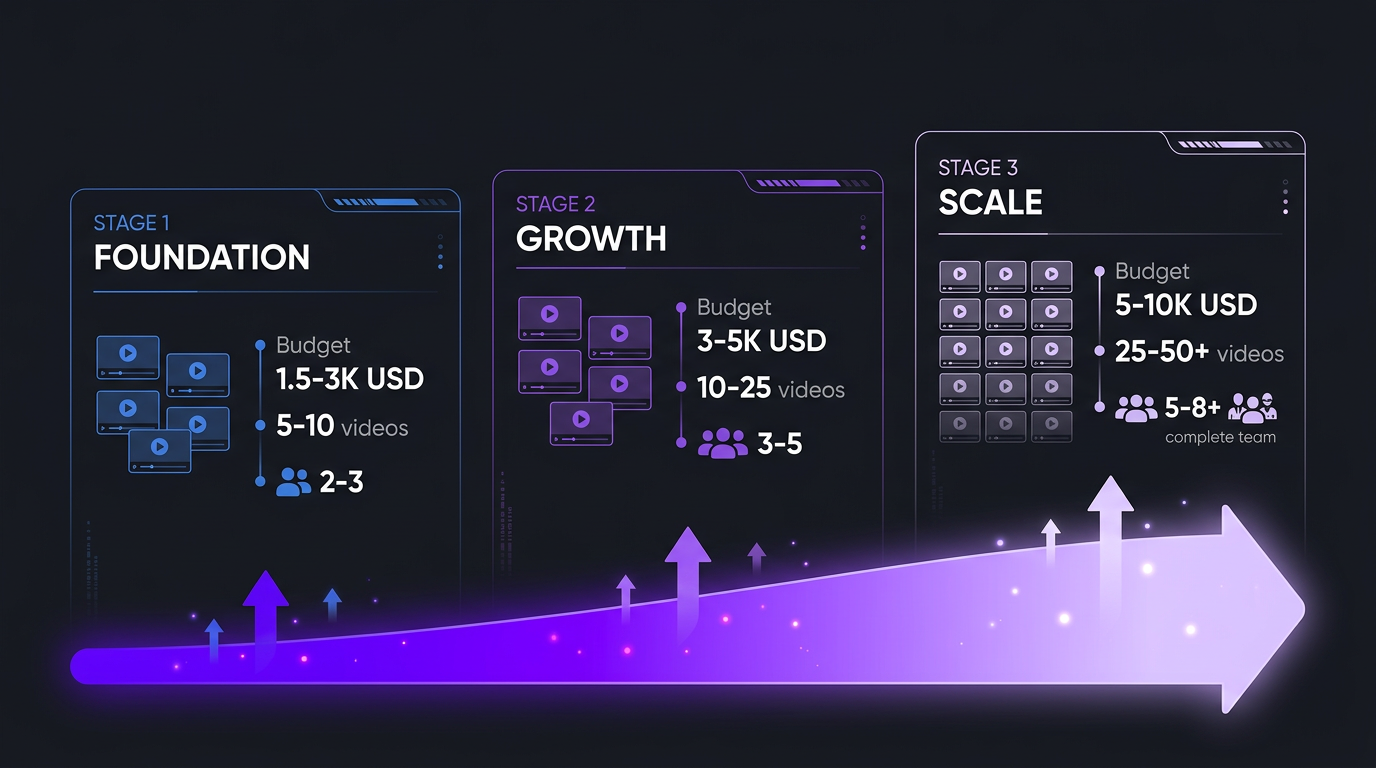
Most DTC brands don’t jump from zero to 50 videos overnight. Here’s a realistic scaling roadmap:
Stage 1: Foundation (5-10 videos/month) — Budget: $1,500-$3,000/month
Focus on core content: one long-form unboxing, 4-6 social clips, and 2-3 ad creatives. This is enough to establish a video presence and start gathering data on what content types perform.
At this stage, a single dedicated editor (via agency retainer) handles everything. Templates are built, brand guidelines are established, and the editing workflow is dialed in.
Stage 2: Growth (10-25 videos/month) — Budget: $3,000-$5,000/month
Add product spotlights, testimonial compilations, and teaser content. Begin systematic ad creative testing (5-10 variations per month). Introduce a color grading standard across all content for visual consistency.
This usually requires expanding from one editor to a small team — editor, motion graphics, and a project manager. The workflow shifts from “send footage, get video” to a structured production pipeline with briefs, review stages, and feedback loops.
Stage 3: Scale (25-50+ videos/month) — Budget: $5,000-$10,000/month
Full content engine running across all platforms. Every monthly box cycle produces a complete content batch. Ad creative testing is continuous with 15-25 variations. Retention content runs on autopilot with established templates and formats.
At this stage, you need a team — and the team needs to operate semi-independently. They should understand your brand well enough to produce content with minimal direction for recurring formats, while still receiving detailed briefs for new campaign concepts.
| Stage | Videos/Month | Budget | Team Size | Key Focus |
|---|---|---|---|---|
| Foundation | 5-10 | $1,500-$3,000 | 1 editor | Core content + templates |
| Growth | 10-25 | $3,000-$5,000 | 2-3 specialists | Ad testing + retention content |
| Scale | 25-50+ | $5,000-$10,000 | 3-5 specialists | Full content engine |
Common Scaling Mistakes
We’ve seen DTC brands stumble on the same issues as they scale video production:
- Hiring too many freelancers: Managing 3-4 different freelancers for social, ads, YouTube, and product videos creates inconsistency and management overhead. One agency team with multiple specialists is almost always better.
- Skipping the template phase: Not building reusable templates at Stage 1 means every video at Stage 3 is custom — which is expensive and slow.
- Neglecting audio: DTC brands invest in visuals but forget that 80%+ of social video is watched with sound on. Professional audio mixing is not optional.
- Not archiving raw footage: Organized raw footage libraries let you repurpose content across campaigns. Brands that dump footage into unorganized drives lose the ability to create compilation content later.
Choosing the Right Editing Partner for Your Subscription Brand
Not all editing services are built for the DTC model. Here’s what to evaluate:
Must-Haves for DTC Video Editing Partners
- Ecommerce experience: They should understand product-focused editing — hero shots, value overlays, conversion-oriented pacing. YouTube vlog editing skills don’t translate directly.
- Ad platform knowledge: They need to know Meta, TikTok, and YouTube ad specs and best practices. Creative that performs organically often bombs as paid ads.
- Fast turnaround: 24-48 hours for social clips, 3-5 days for long-form. DTC brands operate on tight monthly cycles — slow editors kill your content calendar.
- High-volume capacity: They need to handle 20+ videos per month without quality degradation. Ask about their team structure and capacity limits.
- Template systems: Good DTC editors build brand templates that make recurring content faster and cheaper. This reduces per-video cost as you scale.
- Revision efficiency: DTC content moves fast. You need editors who get it right in 1-2 rounds, not 4-5.
Red Flags to Watch For
- No ecommerce portfolio — they only show YouTube and podcast work
- Can’t handle more than 8-10 videos per month
- No project management layer (you’re managing the editor directly)
- Per-video pricing only (no retainer option for volume)
- Turnaround times longer than 5 business days for short-form
At Increditors, our DTC clients get a dedicated editor paired with specialists in motion graphics and color — plus a project manager who coordinates the entire monthly content cycle. The editing team learns your brand over time, which means faster turnarounds and fewer revisions as the relationship matures.
Build Your DTC Content Engine
From unboxing reveals to ad creative testing at scale — we handle the editing so you can focus on growing your brand. See how our DTC clients produce 30+ videos per month without burning out.
Frequently Asked Questions
Subscription box brands typically need unboxing videos, product reveal edits, monthly highlight reels, customer testimonial compilations, social media ads (Instagram Reels, TikTok, YouTube Shorts), and longer-form brand story content. The key is variety — each month’s box requires fresh creative that showcases new products while maintaining consistent brand quality.
DTC video editing typically costs $200-$500 per video for individual projects, or $2,000-$5,000/month for retainer packages covering 10-30+ pieces of content. Brands producing higher volumes (40+ videos/month) can expect $5,000-$10,000/month with a premium agency. See our pricing page for current rates.
Most DTC brands under $10M in revenue get better results from an agency. An in-house editor costs $55,000-$85,000/year plus software, equipment, and management time. An agency retainer at $3,000-$5,000/month gives access to multiple specialists, higher capacity, backup editors, and no HR overhead. The hybrid model (in-house for real-time content + agency for production content) works best for brands between $10M-$50M.
Short-form unboxing clips (15-60 seconds) drive the highest conversion rates for acquisition ads on Meta and TikTok. For organic growth, full-length unboxing videos (5-12 minutes) perform best on YouTube. Customer testimonial compilations are the most effective bottom-of-funnel content for converting hesitant prospects on product pages.
High-performing DTC and subscription box brands publish 3-5 pieces of video content per week across platforms. This typically means 2-3 short-form social clips, 1-2 ad creatives for testing, and at least 1 longer-form piece weekly. During launch periods or seasonal campaigns, that volume should double.
Absolutely. A structured video retention strategy — including pre-shipment teasers, product tutorials, and community content — can reduce month 2-3 churn by 10-25%. Video creates emotional anticipation and perceived value that email alone can’t replicate. The brands with the lowest churn rates are almost always the ones investing most heavily in subscriber-facing video content.
Prioritize ecommerce editing experience, ad platform knowledge (Meta, TikTok specs), fast turnaround (24-48 hours for social clips), high-volume capacity (20+ videos/month), and template systems that reduce per-video costs as you scale. Avoid generalist editors who primarily work with talking-head or vlog content — product-focused editing is a different skill set. Schedule a discovery call to discuss your specific needs.
Ready to Scale Your DTC Video Content?
We work with subscription box and DTC brands producing 10-50+ videos per month. Tell us about your brand and content needs — we’ll build a plan that fits your growth stage.
Data and benchmarks in this article reflect 2026 DTC and ecommerce industry averages from public sources and direct industry research. Results vary by brand, product category, and execution. For a custom content strategy for your brand, schedule a call.