








![3D Explainer Video - ScribbleLive.mp4_snapshot_00.12_[2022.03.09_03.14.16]](https://increditors.com/wp-content/uploads/elementor/thumbs/3D-Explainer-Video-ScribbleLive.mp4_snapshot_00.12_2022.03.09_03.14.16-r7wb53mx72rxst3qcqyrfxdmeyzb5r9jbl0wbjujh4.png "3D Explainer Video – ScribbleLive.mp4_snapshot_00.12_[2022.03.09_03.14.16]")




























You’ve got a product that works. You know content marketing drives growth. Your competitors are pumping out YouTube videos, product demos, social clips, and thought leadership content at a pace you can’t match. And the gap is widening.
The obvious solution — hire a video editor — creates new problems. Finding someone good takes months. Training them on your product takes more months. And a full-time salary plus benefits doesn’t scale down when you need fewer videos, or scale up during a launch.
That’s why a growing number of startups are turning to a video editing agency instead. Not for occasional freelance projects — for an ongoing production partnership that acts as their content team without the overhead of building one.
This guide covers everything startup founders and marketing leads need to know: why agencies beat hiring for most startups, how to budget for one, how to scale from seed to Series B, and what to look for when choosing the right video editing agency for startups.
What’s in This Guide
- Why Startups Outsource Video Editing (It’s Not Just About Cost)
- Agency vs In-House: The Full Comparison
- Video Types Startups Need at Each Stage
- Budget Planning: What to Spend at Every Funding Stage
- The Scaling Roadmap: Seed to Series B
- Choosing the Right Video Editing Agency
- How Startups Scale With Increditors
- 5 Mistakes Startups Make With Video Production
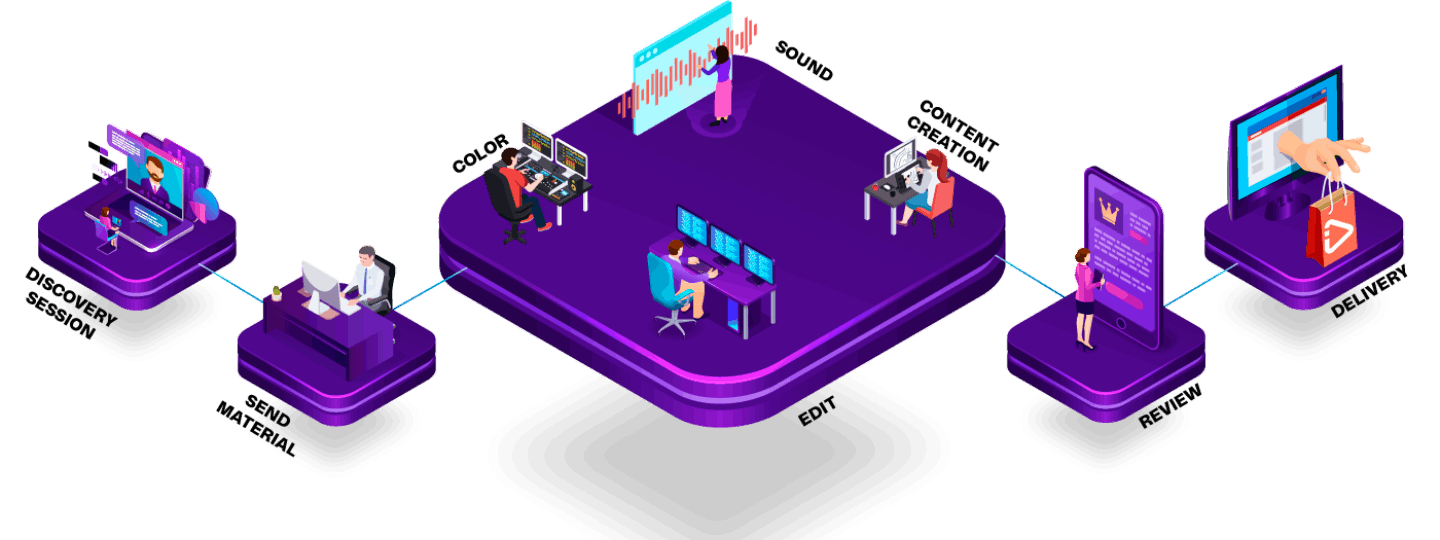
- Setting Up the Workflow: How It Actually Works
- FAQ
Why Startups Outsource Video Editing (It’s Not Just About Cost)
The cost argument is obvious — and we’ll cover it in detail. But cost isn’t even the primary reason smart startups choose a video editing agency over hiring. Here’s the fuller picture:
1. Speed to Production
Hiring a video editor takes 6-12 weeks: posting the job, reviewing portfolios, interviewing, negotiating, onboarding. An agency starts delivering edited content within a week of signing. For startups where every month of market visibility matters, that speed gap is significant.
2. Access to a Full Team, Not a Single Generalist
One in-house editor is one person with one skill set. They might be great at cutting YouTube videos but average at motion graphics. They might know Premiere but not After Effects. An agency gives you access to an entire team — dedicated editors, colorists, motion designers, and a project manager — at the cost of a single hire.
3. Scalability Without Commitment
Startups are inherently unpredictable. You might need 20 videos during a product launch month and 4 videos the following month. With an in-house editor, you’re paying the same $5,500/month salary regardless. With an agency, you scale your retainer to match your actual needs.
4. No Management Overhead
Hiring means managing. Providing feedback, tracking deadlines, handling PTO coverage, dealing with performance issues. An agency manages its own team — your contact is a project manager who handles everything. Your involvement is: submit footage, review edits, approve. That’s it.
5. Built-In Quality Control
When your only editor is the person who edits and reviews, quality issues slip through. Agencies have multi-layer QC: the editor produces, a senior editor reviews, and a project manager checks against your brief before delivery. This process catches 95% of issues before you see the first cut.
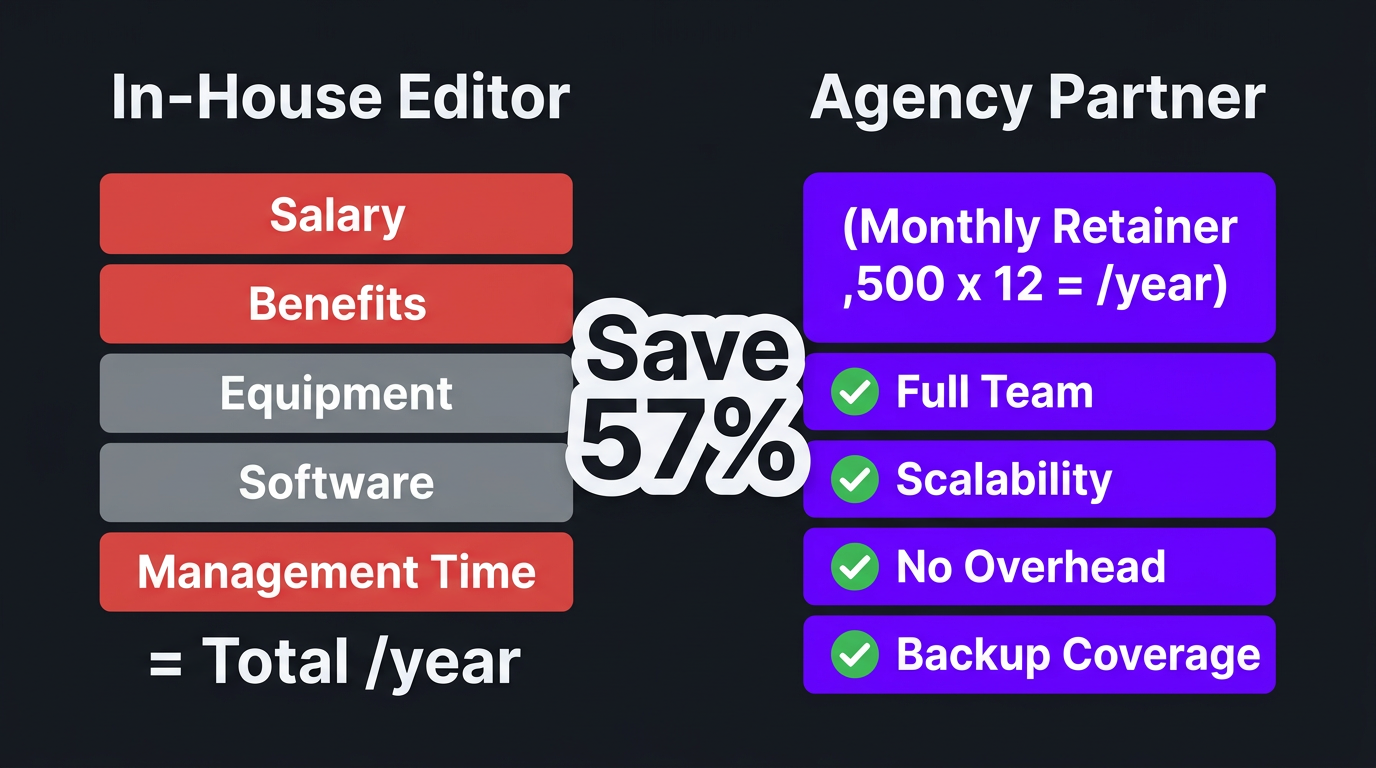
Agency vs In-House Editor: The Full Cost Comparison
Let’s put real numbers side by side. These are based on U.S. market rates for 2026:
| Cost Factor | In-House Editor | Freelancer Pool | Agency Partner |
|---|---|---|---|
| Annual base cost | $55,000–$80,000 salary | $2,000–$5,000/mo ($24K–$60K/yr) | $2,500–$5,000/mo ($30K–$60K/yr) |
| Benefits & overhead | $12,000–$20,000/yr | $0 | $0 |
| Equipment & software | $3,000–$8,000/yr | $0 (their own) | $0 (included) |
| Recruiting cost | $5,000–$15,000 (one-time) | $0 (but ongoing search) | $0 |
| Management time | 5-10 hrs/week ($25K–$50K/yr value) | 8-15 hrs/week ($40K–$75K/yr value) | 1-3 hrs/week ($5K–$15K/yr value) |
| Ramp-up time | 6-12 weeks | 2-4 weeks per new freelancer | 1 week |
| Backup coverage | ❌ None (PTO = no editing) | ⚠️ Find another freelancer | ✅ Team covers automatically |
| Scalability | ❌ Fixed capacity | ⚠️ Slow to scale | ✅ Scale monthly |
| Capabilities | 1 person’s skill set | Varies by freelancer | Full team (edit + color + motion + PM) |
| True annual cost | $95,000–$170,000 | $65,000–$135,000 | $35,000–$75,000 |
The numbers are stark. When you factor in all costs — not just salary but benefits, equipment, recruiting, management time, and the opportunity cost of lost productivity — an agency is 40-60% cheaper than hiring in-house for most startups.
And the agency delivers more: a team instead of a single person, built-in scalability, and zero HR headaches. For startups specifically, where every dollar and every hour of founder time is precious, this comparison isn’t close.
Video Types Startups Need at Each Stage
The video content a startup needs changes as it grows. Here’s the content roadmap by stage:
Pre-Seed / Seed Stage
| Video Type | Purpose | Priority |
|---|---|---|
| Product demo (2-5 min) | Show investors and early users what you’ve built | 🔴 Critical |
| Explainer video (60-90 sec) | Homepage hero — explain the problem and solution | 🔴 Critical |
| Founder story / pitch video | Investor decks, about page, fundraising | 🟡 High |
| Social clips | Early traction on LinkedIn/Twitter | 🟢 Medium |
Series A Stage
| Video Type | Purpose | Priority |
|---|---|---|
| Product tutorials / onboarding | Reduce churn, improve activation | 🔴 Critical |
| Customer testimonials | Sales enablement, website social proof | 🔴 Critical |
| Thought leadership (YouTube/LinkedIn) | SEO, brand authority, inbound leads | 🟡 High |
| Webinar recordings | Lead generation, nurture content | 🟡 High |
| Social media clips (weekly) | Audience building across platforms | 🟡 High |
| Sales enablement videos | Support sales team with product walkthroughs | 🟢 Medium |
Series B+ Stage
| Video Type | Purpose | Priority |
|---|---|---|
| All Series A content at higher volume | Scale what’s working | 🔴 Critical |
| Brand campaign videos | Market positioning, competitive differentiation | 🟡 High |
| Event / conference content | Capture and repurpose speaking engagements | 🟡 High |
| Internal training videos | Scale onboarding for growing team | 🟢 Medium |
| Podcast / interview series | Thought leadership at scale | 🟢 Medium |
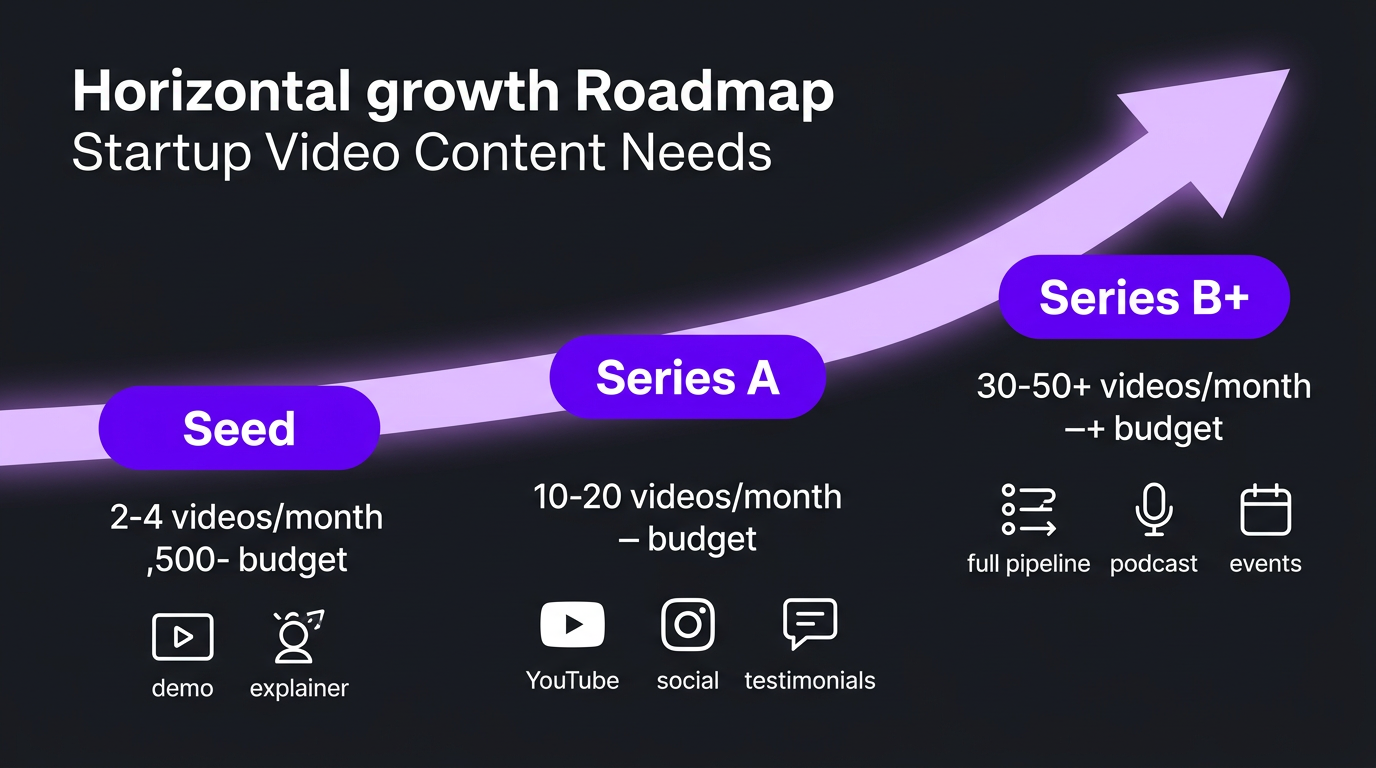
The key insight: your video needs don’t just grow in volume — they grow in complexity. A seed-stage startup needs 2-4 videos total. A Series A company needs 10-20 videos per month across multiple formats. A Series B+ company might need 30-50+ pieces per month. Trying to hire your way through that scaling curve is a nightmare. An agency partnership handles it seamlessly.
Budget Planning: What to Spend on Video Editing at Every Funding Stage
One of the hardest questions for startup marketing leads: “How much should we spend on video editing?” Here’s a framework based on what we see working across dozens of startup clients:
| Funding Stage | Monthly Marketing Budget | Video Editing Allocation | Monthly Editing Budget | What You Get |
|---|---|---|---|---|
| Pre-Seed | $2,000–$5,000 | 20-30% | $500–$1,500 | Product demo + explainer, founder content |
| Seed | $5,000–$15,000 | 15-25% | $1,000–$3,000 | 4-8 videos/mo: demos, social clips, testimonials |
| Series A | $15,000–$50,000 | 15-20% | $2,500–$8,000 | 10-25 videos/mo: full content pipeline |
| Series B+ | $50,000–$200,000+ | 10-15% | $5,000–$20,000+ | 30-50+ videos/mo: dedicated team, all formats |
The 15-25% Rule
A good rule of thumb: allocate 15-25% of your content marketing budget to video editing. This assumes you’re doing the content strategy, scripting, and recording internally — and outsourcing the post-production. If you need full production (including filming), budget 30-40%.
For most Series A startups, the sweet spot is $3,000-$5,000/month. That budget gets you a dedicated editing team producing 10-20 videos monthly — enough to run a consistent YouTube channel, maintain social media presence, and support the sales team with fresh content.
The ROI Framework for Startups
Startup video content drives three measurable outcomes:
- Reduced customer acquisition cost (CAC): Organic video content on YouTube and social generates leads at a fraction of paid ad costs. Well-optimized product tutorials and thought leadership videos create a compounding library that drives traffic for months or years.
- Improved activation and retention: Product demo and tutorial videos reduce support tickets, improve onboarding, and decrease churn. One SaaS client saw a 23% reduction in churn after implementing a video onboarding sequence — produced by their editing agency.
- Faster sales cycles: Sales teams armed with polished product videos, customer testimonials, and case study content close deals faster. When a prospect watches a 5-minute demo video before the sales call, the call becomes a closing conversation instead of a discovery conversation.
The Scaling Roadmap: Seed to Series B and Beyond
Here’s what a healthy video content scaling trajectory looks like for a startup:
Phase 1: Foundation (Months 1-3)
Build your core video assets:
- Product demo video (updated quarterly)
- 1-2 minute explainer for homepage
- 3-5 customer testimonials
- Founder story / about video
- 2-4 YouTube videos testing content topics
Budget: $1,500-$3,000/month
Phase 2: Content Engine (Months 4-8)
Start building consistent output:
- Weekly YouTube or LinkedIn video
- 4-8 social clips per week (repurposed from long-form)
- Monthly webinar + recording polish
- Ongoing testimonial collection and editing
- Product update videos as features ship
Budget: $3,000-$5,000/month
Phase 3: Scale (Months 9+)
Full production pipeline:
- 2-3 long-form videos per week
- 10-15 social clips per week
- Weekly podcast or interview series
- Sales enablement video library
- Event content capture and repurposing
- Multi-language versions for international expansion
Budget: $5,000-$10,000+/month
This progression is what makes an agency model superior to hiring for startups. In Phase 1, you’d never justify a full-time editor for $1,500-$3,000 worth of work. In Phase 3, you’d need 2-3 full-time editors to match the output. An agency partner scales seamlessly between these phases — you simply adjust your retainer.
Choosing the Right Video Editing Agency for Your Startup
Not all agencies are built for startups. Here’s how to evaluate potential partners:
The Startup-Specific Evaluation Framework
| Criteria | What to Look For | Red Flags |
|---|---|---|
| Product understanding | Agency invests time in product onboarding before editing | Starts editing without understanding your product |
| Startup experience | Portfolio includes SaaS, tech, or startup clients | Only wedding videos or local business content |
| Flexible contracts | Month-to-month or quarterly, easy to scale up/down | Annual contracts with penalties for reducing volume |
| Multi-format capability | Handles YouTube, social, product demos, and motion graphics | Only does one format (e.g., YouTube only) |
| Turnaround speed | 24-48 hour standard, same-day rush available | 5+ day turnaround as standard |
| Communication | Dedicated PM, Slack/async communication, clear feedback process | Email-only, slow responses, no project management |
| Pricing transparency | Clear per-video or retainer pricing, no hidden fees | Custom quotes only, unclear deliverables per tier |
Questions to Ask Before Signing
- “Can I see examples of work you’ve done for startups or SaaS companies?”
- “What does your onboarding process look like? How do you learn our product?”
- “What happens if our volume needs change? Can I scale up or down monthly?”
- “Who will be my primary contact? Will I have the same editor consistently?”
- “What’s your revision policy? How many rounds are included?”
- “Can you handle screen recordings, product demos, and motion graphics — not just talking head edits?”
- “What’s your backup plan if our dedicated editor is unavailable?”
At Increditors, we start every startup engagement with a product deep-dive. Our editors go through your onboarding flow, study your marketing materials, and understand your competitive positioning before they touch a single frame. This investment upfront means fewer revisions, better quality, and editors who actually understand the product they’re showcasing.
Ready to Scale Content Without the Hiring Headache?
Join startups like TuMeke and Blue Zones Health who scaled their video output 5-10x without adding a single hire. Let’s build your content engine.
How Startups Scale With Increditors
TuMeke: Scaling AI Product Content Without In-House Editing
TuMeke is an AI-powered ergonomic assessment platform — a technically complex product in a niche market. Their challenge wasn’t just producing videos. It was producing videos where the editing team actually understood AI product positioning, ergonomic workflows, and B2B SaaS marketing.
Before working with us, TuMeke had tried the freelancer route. Each new freelancer required extensive briefing on the product, the target audience (workplace safety professionals), and the technical vocabulary. By the time a freelancer got up to speed, the project was already behind schedule. And the next project meant starting over with someone new.
Our dedicated startup team model solved this completely. We assigned TuMeke a consistent editor and project manager who went through a deep product onboarding — understanding not just how the app looked but how it worked, who used it, and why it mattered. That investment meant our editors could make intelligent decisions about what to highlight in product demos, how to pace tutorials for a technical audience, and how to position the product in thought leadership content.
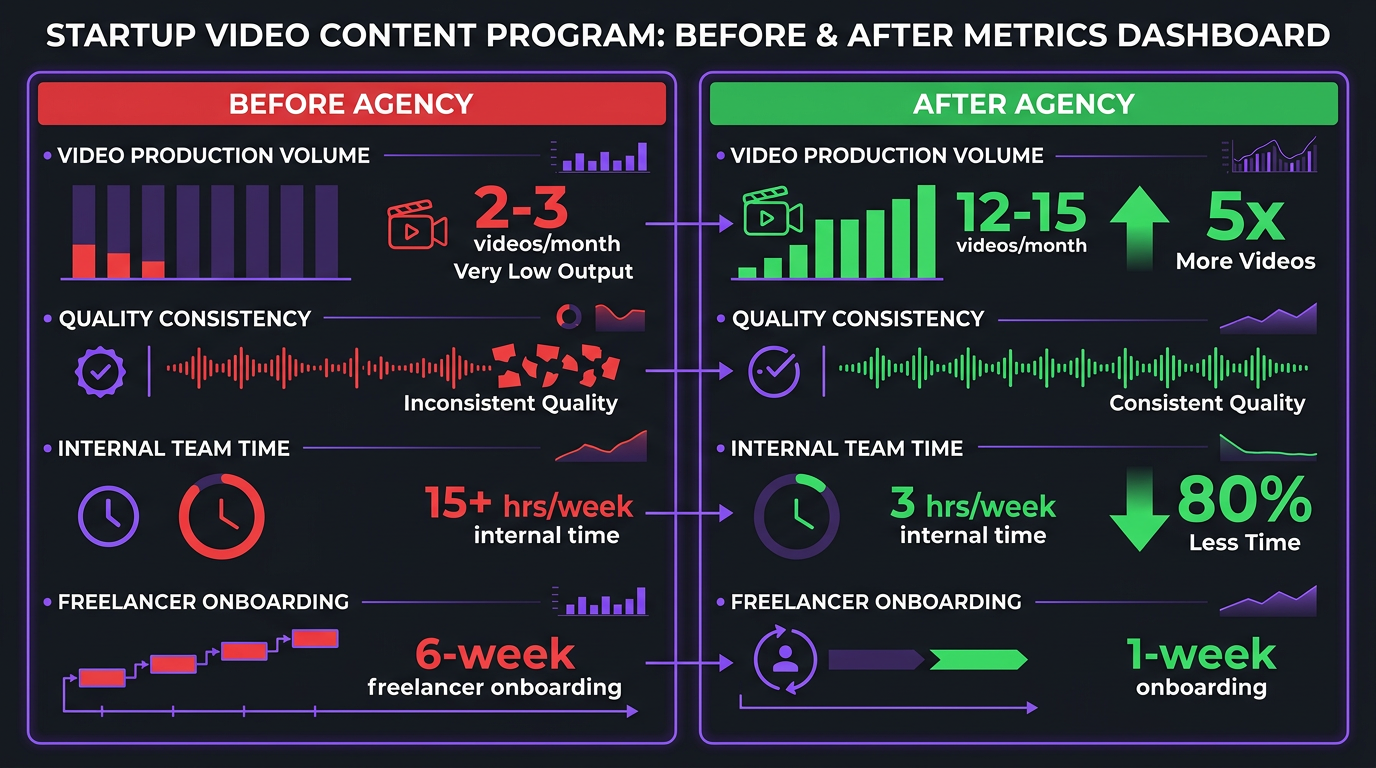
The result: TuMeke went from sporadic content production to a consistent pipeline of product demos, social clips, and marketing videos — all technically accurate, all brand-consistent, all without adding a single hire to their team. Their content velocity increased by 5x while their internal time spent on video production dropped to a few hours per week of recording and review.
Blue Zones Health: Content That Builds a Health & Wellness Brand
Blue Zones Health operates in the health and wellness space — a market where trust is everything and content quality directly impacts credibility. They needed video content that conveyed authority and warmth in equal measure: polished enough to be credible, authentic enough to be relatable.
The challenge for health and wellness startups is that their content needs to be more polished than the average startup’s. People making health decisions need to trust the source. A poorly edited product video doesn’t just look bad — it undermines the credibility of health claims and recommendations.
Working with Increditors, Blue Zones Health built a content system that included educational videos, expert interviews, product showcases, and social media clips — all edited with the warm, professional tone their audience expects. Our team applied consistent color grading that matched their brand identity: natural, health-conscious, premium but not clinical.
The editing also focused on accessibility — clear captions, intentional pacing for health content (not too fast, allowing absorption of information), and visual callouts for key health metrics and recommendations. This attention to the audience’s specific needs is something a generic freelancer would miss but a dedicated team learns over time.
For health and wellness startups specifically, the consistency of working with a dedicated editing team isn’t just a “nice to have” — it’s a compliance and credibility requirement. When every video maintains the same professional standard, the brand earns and keeps trust.
5 Mistakes Startups Make With Video Production
Mistake 1: Treating Video as a One-Off Project
Startups often approach video as “we need a product demo” — a single project. But video content marketing is a system, not an event. The startups winning with video are producing consistently, not sporadically. Commit to ongoing production, not one-off projects.
Mistake 2: Hiring Too Early
The reflex when you need more video is to post a job listing. But hiring makes sense only when you need 40+ hours/week of editing consistently — typically Series B and beyond. Before that, an agency gives you better output at lower cost with zero management overhead.
Mistake 3: Prioritizing Quantity Over Quality
In the rush to “be everywhere,” some startups push for maximum video volume with minimum editing investment. The result: 30 mediocre videos that damage brand perception. Better approach: produce 10 excellent videos that reinforce credibility and actually get watched.
Mistake 4: Ignoring Repurposing
Every long-form video you produce contains 5-10 short-form clips. Every webinar recording is an evergreen asset waiting to be polished. Every product demo can become a series of feature-specific social clips. If you’re only producing one output per recording, you’re leaving 80% of the value on the table. This is precisely where an agency excels — systematic repurposing is part of the workflow.
Mistake 5: Choosing on Price Alone
The cheapest editing option is almost never the cheapest when you factor in revision cycles, management time, and brand damage from inconsistent quality. A $50 video that requires 3 revision rounds and 2 hours of your feedback time is more expensive than a $200 video that arrives polished. Evaluate total cost of production, not sticker price.
Setting Up the Workflow: How It Actually Works Day-to-Day
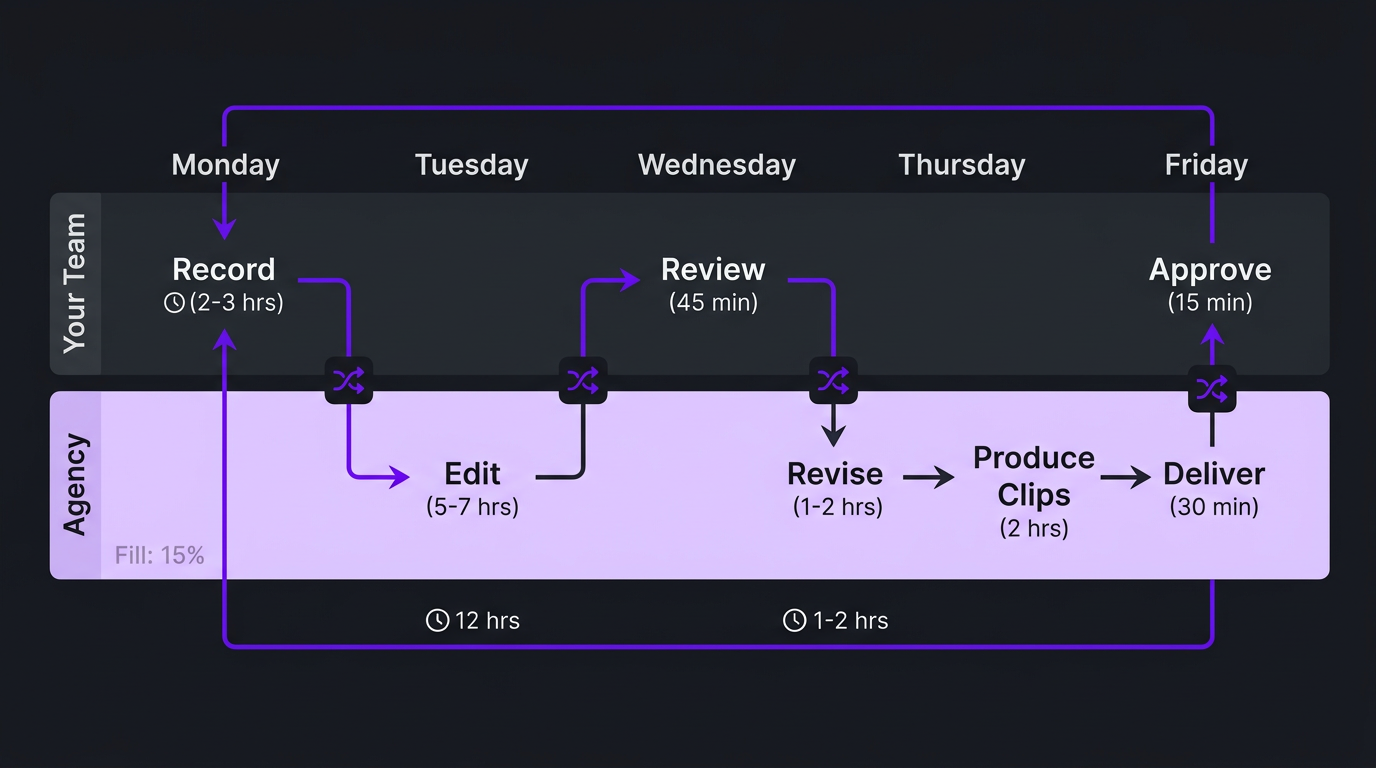
Here’s what a typical agency workflow looks like for a startup producing 12-15 videos per month:
Week Structure
| Day | Your Team’s Activity | Agency’s Activity | Time Investment (You) |
|---|---|---|---|
| Monday | Record 2 videos (YouTube + product update) | Edit last week’s footage, deliver first cuts | 2-3 hours |
| Tuesday | Review first cuts from agency, provide feedback | Begin editing Monday’s recordings | 45 min |
| Wednesday | Record social content (15-20 min quick clips) | Implement revisions, produce social clips from long-form | 30 min |
| Thursday | Approve final edits, schedule for publishing | Deliver finals, begin next batch | 30 min |
| Friday | Weekly planning call with PM (15 min) | QC review, prepare next week’s queue | 15 min |
Total weekly time investment: ~4-5 hours. Of that, 2-3 hours is recording (which you’d do regardless). The management, review, and feedback time is 1.5-2 hours per week — a fraction of what managing freelancers or an in-house editor requires.
Tools and Communication
Most agency-startup workflows use:
- File transfer: Google Drive, Frame.io, or Dropbox for footage upload and review
- Communication: Slack channel with your PM and editor for async updates
- Project tracking: Notion, Asana, or the agency’s internal tool for status visibility
- Review: Frame.io for timestamped feedback on edits (far more efficient than written notes)
At Increditors, we adapt to your existing tools. If your startup lives in Slack, we’re in Slack. If you use Notion for project management, we integrate there. The goal is zero friction — the agency fits into your workflow, not the other way around.
Frequently Asked Questions
Startups benefit from agencies because of: no recruitment costs or timeline (start in 1 week vs 6-12 weeks), no benefits overhead, instant access to a full team (editor + colorist + motion designer + PM), ability to scale up or down monthly, and no commitment to a full-time salary. A full-time editor costs $95,000-$170,000/year (including hidden costs). An agency retainer runs $30,000-$60,000/year with more capabilities. Learn more about our startup solutions.
Startup video editing agency retainers range from $1,500/month for basic packages (4-8 videos) to $5,000+/month for dedicated teams handling 15-40+ videos monthly. Per-video pricing typically runs $200-$600 depending on complexity. Most Series A startups invest $3,000-$5,000/month for a full content pipeline. See pricing details.
The essentials shift by stage. Seed-stage: product demos and explainers. Series A: add tutorials, testimonials, thought leadership content, social clips, and webinar recordings. Series B+: scale everything plus brand campaigns, event content, and podcast series. The right agency adapts to your stage and scales with you.
Allocate 15-25% of your content marketing budget to video editing. Seed-stage: $1,000-$3,000/month. Series A: $2,500-$8,000/month. Series B+: $5,000-$20,000+/month. The rule: if video is driving measurable results (leads, reduced churn, faster sales), increase the budget. Video content compounds — each piece continues working long after production.
Yes — if you choose an agency that invests in product onboarding. At Increditors, dedicated editors complete a product deep-dive before editing anything: they go through your onboarding, study your documentation, and understand your competitive positioning. This investment means technically accurate edits without constant hand-holding. Ask any potential agency: “What does your onboarding process look like?”
Switch when you need more than 6-8 videos per month, when quality inconsistency is hurting your brand, when managing freelancers takes more than 5 hours per week, or when you need capabilities beyond basic editing (motion graphics, color grading, multi-format delivery). The tipping point is usually around Series A when content volume requirements outgrow what a single freelancer can handle.
Scale Your Startup’s Content — Starting This Week
No hiring. No management. No overhead. Just a dedicated editing team that understands your product and ships polished content on your timeline.
Cost data reflects 2026 U.S. market rates. Salary estimates from Glassdoor and Payscale. For current Increditors startup packages, visit our startup page or schedule a call.