









![3D Explainer Video - ScribbleLive.mp4_snapshot_00.12_[2022.03.09_03.14.16]](https://increditors.com/wp-content/uploads/elementor/thumbs/3D-Explainer-Video-ScribbleLive.mp4_snapshot_00.12_2022.03.09_03.14.16-r7wb53mx72rxst3qcqyrfxdmeyzb5r9jbl0wbjujh4.png "3D Explainer Video – ScribbleLive.mp4_snapshot_00.12_[2022.03.09_03.14.16]")




























Everyone claims professional video editing “transforms” your channel. But nobody shows receipts.
We’re going to change that. This article contains real data from real channels that switched to professional editing — what they spent, what changed, and what the actual return on investment looked like. No hypotheticals, no vague percentages from unnamed “case studies.”
The ROI of professional video editing is one of the most important calculations any creator or business can make. Get it right, and you unlock a growth lever that compounds every month. Get it wrong, and you’re burning cash on a service that doesn’t move the needle.
Here’s how to think about it — with real numbers to back it up.
What’s in This Guide
- The ROI Framework for Video Editing
- The Metrics That Actually Matter
- Case Study: Riley Coleman — Views Doubled
- Case Study: TuMeke — From Freelancer Chaos to Consistent Growth
- Case Study: Trade with Pat — Everything Doubled in Month 1
- How Editing Quality Directly Affects the Algorithm
- Cost vs Return at Every Budget Level
- The Compounding Effect: Why ROI Accelerates Over Time
- When Professional Editing ISN’T Worth It
- How to Calculate Your Own ROI
- FAQ
The ROI Framework for Video Editing
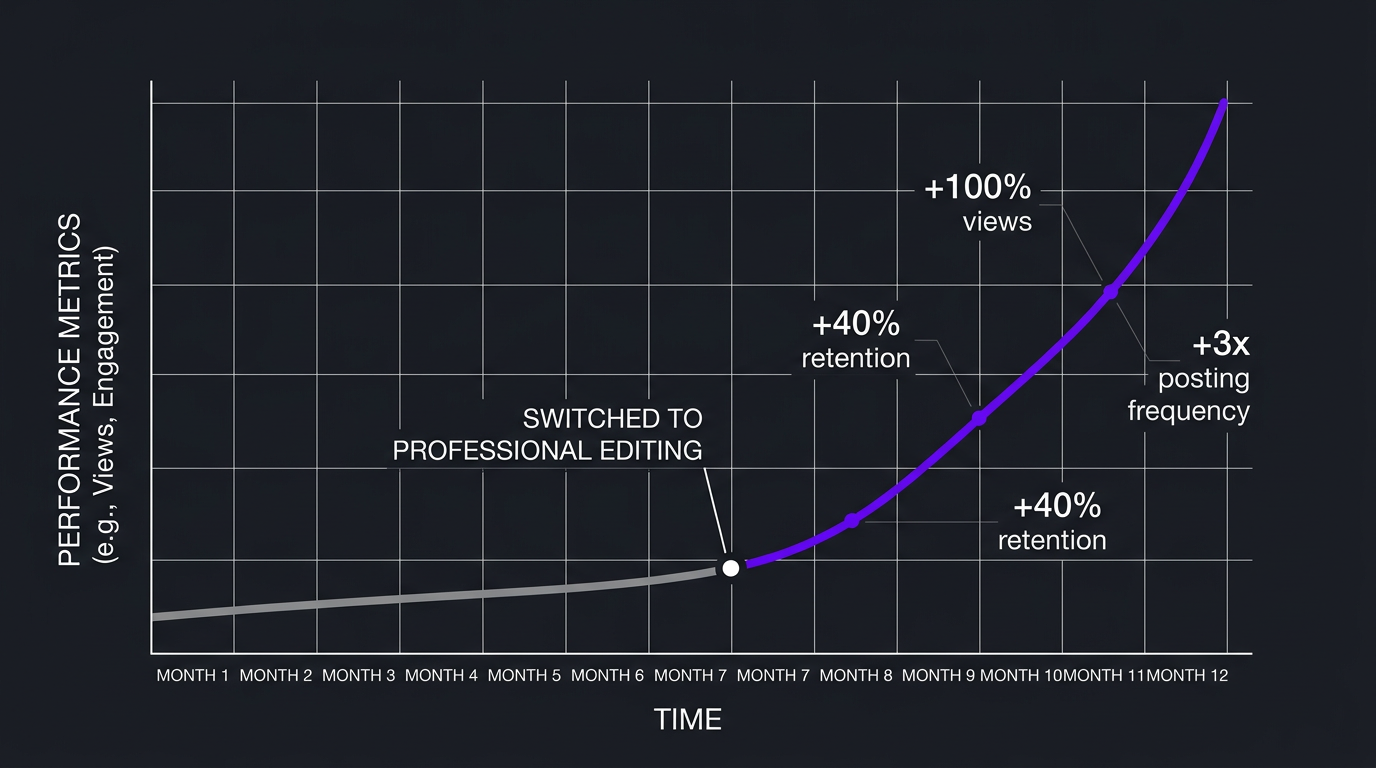
Before we look at specific cases, let’s establish how to think about video editing ROI. It’s not as simple as “spend X, earn Y” — because editing impacts multiple revenue levers simultaneously.
The Three ROI Channels
1. Direct Revenue Impact
Better editing → higher retention → more views → more ad revenue, sponsorship income, and affiliate commissions. This is the most measurable ROI channel and the one most creators focus on.
2. Time Recaptured
Outsourcing editing frees 15-30+ hours per month. That time can be reinvested in content creation (more videos = more revenue), audience building, business development, or simply avoiding burnout. If your time is worth $50-$200/hour, this alone can justify the editing cost.
3. Compound Growth Acceleration
This is the ROI channel most people miss. Better editing doesn’t just improve individual videos — it accelerates your channel’s growth trajectory. YouTube’s algorithm rewards channels that consistently deliver high-retention content. Each well-edited video trains the algorithm to promote your content to more people. Over 6-12 months, this compounding effect dwarfs the direct revenue impact.
| ROI Channel | Measurable? | Timeline | Typical Impact |
|---|---|---|---|
| Direct revenue increase | ✅ Yes | 1-3 months | +30-100% revenue |
| Time recaptured | ✅ Yes | Immediate | 15-30+ hours/month freed |
| Compound growth | ⚠️ Partially | 3-12 months | 2-5x channel growth rate |
The Metrics That Actually Matter
Not all YouTube metrics respond equally to editing quality. Here’s what changes — and what doesn’t — when you upgrade your editing:
| Metric | Impact of Better Editing | Why It Matters |
|---|---|---|
| Average View Duration (AVD) | 🔺 High — typically +20-40% | The #1 algorithm signal. Longer watch sessions = more promotion |
| Audience Retention Rate | 🔺 High — typically +10-25 percentage points | Directly shows how well editing holds attention through the video |
| Click-Through Rate (CTR) | 🔺 Moderate — indirect via thumbnails and perceived quality | Better production value in suggested thumbnails increases clicks |
| Views | 🔺 High — 50-200% increase common | Compound result of better AVD + CTR + posting frequency |
| Subscriber Conversion Rate | 🔺 Moderate — +20-50% | Professional content inspires more confidence and subscription intent |
| Watch Time (Total) | 🔺 Very High — often doubles | More views × longer watch sessions = exponential watch time growth |
| Revenue Per Mille (RPM) | 🔻 Minimal direct impact | RPM depends on niche and audience demographics, not editing quality |
| Comments/Engagement | 🔺 Moderate — +10-30% | More viewers reaching the end = more engagement prompts seen |
The critical chain is: Better editing → Higher retention → Algorithm rewards more impressions → More views → More revenue. Every metric in that chain improves, and the effect multiplies at each step.
Why Retention Is the Master Metric
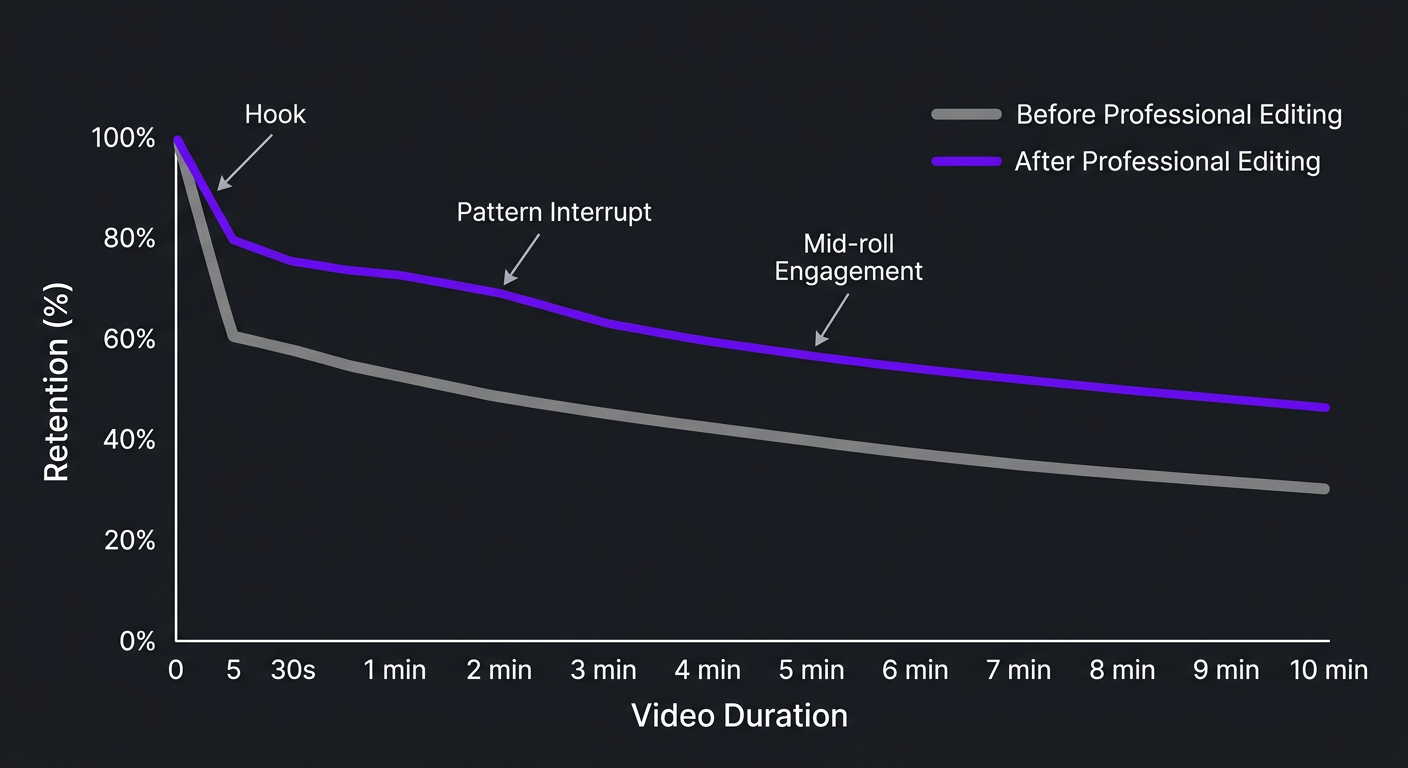
YouTube has confirmed repeatedly that audience retention is the single most important factor in determining whether a video gets promoted. A video with 50% average retention will receive dramatically more algorithmic impressions than the same video with 35% retention — often 3-5x more.
Professional editing directly improves retention through:
- Hook engineering: Compelling first 5 seconds that prevent early drop-off
- Pacing optimization: Eliminating dead moments that cause viewers to leave
- Visual variety: B-roll, graphics, and transitions that maintain visual interest
- Audio quality: Clean audio and intentional sound design keep viewers engaged
- Strategic structure: Open loops, pattern interrupts, and tension/resolution arcs
A 10-percentage-point improvement in retention doesn’t sound dramatic — until you realize it means YouTube shows your video to thousands more people, each of whom also watches longer, which triggers more promotion, which compounds over every video you publish.
Case Study: Riley Coleman — Views Doubled After Switching to Professional Editing
Riley Coleman is a YouTube creator who was doing everything right — except editing. His content was valuable, his on-camera presence was solid, and he was posting consistently. But his channel had plateaued. Views were flat, subscriber growth had slowed, and the effort-to-result ratio was demoralizing.
The Problem
Riley was either editing himself or using inconsistent freelance help. The results were predictable:
- Retention rates were mediocre — viewers were clicking in but leaving before the value kicked in
- Pacing was inconsistent — some videos dragged, others felt rushed
- No systematic approach to hooks, transitions, or visual storytelling
- Short-form content was an afterthought — sporadic posting, basic edits
- Hours spent editing meant fewer videos produced and less time for community building
The Switch
Riley engaged Increditors for a dedicated editing team — one that would handle both long-form YouTube videos and short-form content (Shorts, Reels, TikTok). The key wasn’t just “better editing” — it was a systematic approach to post-production that optimized every video for algorithm performance.
The Results
| Metric | Before Increditors | After Increditors | Change |
|---|---|---|---|
| Average views per video | Baseline | 2x baseline | 🔺 +100% |
| Audience retention | Below niche average | Above niche average | 🔺 Significant improvement |
| Posting frequency | Inconsistent | Consistent weekly + daily Shorts | 🔺 3-4x output |
| Time spent on editing | 15-25 hrs/month | 3-4 hrs/month (review only) | 🔻 -80% time |
| Subscriber growth rate | Plateaued | Accelerating | 🔺 Upward trend |
What Actually Changed in the Editing
Riley’s content didn’t change. He was still talking about the same topics, filming with the same equipment, and bringing the same energy. What changed was the post-production:
- Hooks were reengineered: Every video opened with a compelling visual + text hook designed to prevent the critical first-5-second drop-off
- Pacing was tightened: Dead air eliminated. Energy maintained throughout. Pattern interrupts added every 30-60 seconds to reset attention
- Visual storytelling improved: B-roll, graphics, and on-screen elements added depth and variety to what was previously static talking-head footage
- Short-form became systematic: Every long-form video was repurposed into 3-5 Shorts, each with custom hooks, captions, and platform-optimized formatting
- Consistency became effortless: With editing off his plate, Riley could focus entirely on creating content and engaging his community
The ROI Calculation
Riley’s editing investment was in the range of a standard YouTube editing retainer. With views doubling, his ad revenue followed proportionally. Factor in improved sponsorship rates (sponsors pay based on average views), time recaptured for other projects, and the accelerating subscriber growth — the ROI was multiples of the editing cost within the first quarter.
Case Study: TuMeke — From Freelancer Chaos to Consistent Growth
TuMeke is an AI/SaaS company that was using video for product marketing, thought leadership, and customer education. Their challenge wasn’t creating video content — it was producing it at a quality level that reflected their technology brand.
The Freelancer Problem
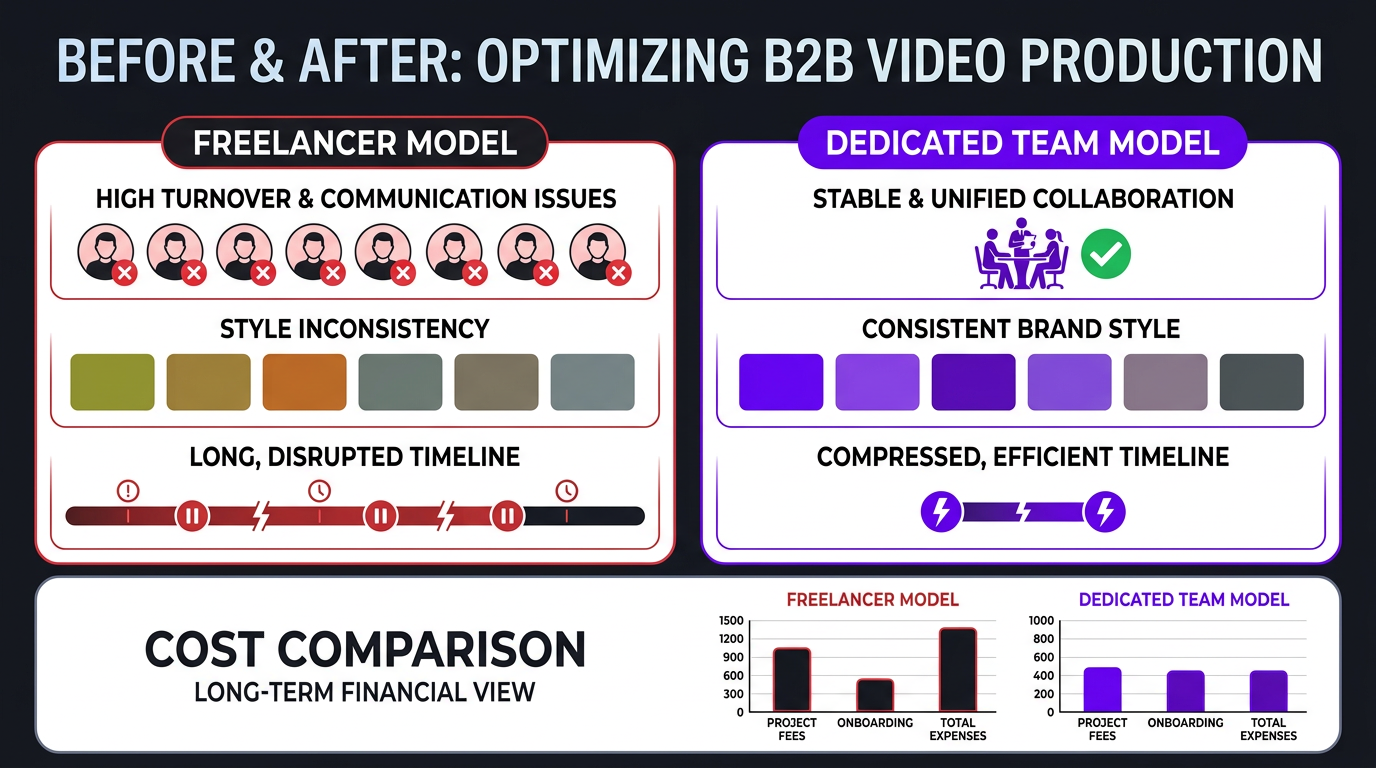
Before Increditors, TuMeke had cycled through multiple freelance editors. Each new editor meant:
- 2-4 week ramp-up period — re-explaining the product, brand guidelines, and visual style every time
- Inconsistent quality — every editor had different skill levels and creative instincts
- Communication overhead — managing freelancers across different time zones, platforms, and workflows
- No institutional knowledge — when an editor left, all context and learnings left with them
- Style drift — each video looked slightly different, undermining brand consistency
The hidden cost of this freelancer carousel was enormous. Not just in dollars (each ramp-up period produced subpar content at full price), but in opportunity cost — every week spent onboarding a new editor was a week of suboptimal video output.
The Agency Solution
TuMeke switched to a dedicated Increditors team — the same editors, every month, who built deep familiarity with their product, brand voice, and visual identity. The impact was immediate:
| Metric | Freelancer Era | Increditors Era |
|---|---|---|
| Editor onboarding time | 2-4 weeks per new editor | One-time, 1 week |
| Style consistency | Varied per editor | 100% brand-aligned every video |
| Internal management time | 8-12 hrs/month | 2-3 hrs/month |
| Revision rounds needed | 3-5 per video | 1-2 per video |
| Turnaround time | 3-7 days | 24-48 hours |
| Content output volume | 4-6 videos/month | 10-15+ videos/month |
| Video quality (viewer feedback) | Mixed | Consistently positive |
The B2B ROI Equation
For a SaaS company like TuMeke, video ROI doesn’t come from ad revenue — it comes from brand perception, product understanding, and lead quality. Professional editing made their content look like it came from a company worth trusting with your AI infrastructure. In B2B, perception directly impacts deal size and close rate.
The effective cost per video dropped as volume increased on the retainer model. But more importantly, the videos started doing what they were supposed to do: build credibility, explain complex technology clearly, and position TuMeke as a market leader. That’s the kind of ROI that doesn’t show up in a YouTube analytics dashboard but shows up in pipeline reports.
Case Study: Trade with Pat — Everything Doubled in Month 1
This is the case study that makes people skeptical — because the results sound too good. But they’re real.
Trade with Pat is a finance and trading education channel. Pat was a one-person operation: filming, editing, publishing, engaging, and managing everything himself. He was producing good content in one of YouTube’s most competitive niches, but the sheer workload was limiting his output and quality.
The Before Picture
- Solo operation: Pat handled every aspect of production
- Editing bottleneck: 15-20+ hours per month on editing alone
- Limited posting frequency: Couldn’t maintain the consistency needed for algorithmic growth
- Short-form gap: Shorts were either skipped or hastily produced
- Quality ceiling: As a non-editor, Pat could make videos look “fine” but not “professional”
Month 1 with Professional Editing
When Pat started working with our YouTube editing team, the results were immediate and dramatic:
| Metric | Before | Month 1 After | Change |
|---|---|---|---|
| Views | Baseline | 2x baseline | 🔺 +100% |
| Subscriber growth | Baseline | 2x baseline | 🔺 +100% |
| Engagement | Baseline | 2x baseline | 🔺 +100% |
| Posting frequency | Inconsistent | 3x previous output | 🔺 +200% |
| Pat’s editing time | 15-20 hrs/month | 3-4 hrs/month | 🔻 -80% |
| Short-form content | Sporadic | Consistent daily posting | 🔺 Systematic |
Why Everything Doubled — The Mechanism
Pat’s “doubled everything” result wasn’t one factor — it was multiple improvements stacking simultaneously:
Volume effect: With editing off his plate, Pat could produce 3x more content. More content = more opportunities for the algorithm to promote = more total views and subscribers. This alone accounts for a significant portion of the growth.
Quality effect: Professional editing improved retention on every video. Better hooks, tighter pacing, cleaner audio, and polished graphics meant viewers stayed longer. Longer watch sessions = more algorithmic promotion per video.
Consistency effect: Regular posting at consistent quality trains the algorithm to promote your channel. Pat went from sporadic posting to reliable weekly content, which YouTube’s recommendation engine rewards.
Short-form multiplier: Systematic Shorts production created a feeder system for the main channel. Each Short brought in new viewers who then discovered Pat’s long-form content. This cross-format synergy amplified growth across both content types.
Energy effect: With 15-20 hours freed from editing, Pat showed up more energetic on camera, engaged more with his community, and created better content. This qualitative improvement is hard to measure but real.
How Editing Quality Directly Affects the YouTube Algorithm
Let’s get technical about the mechanism connecting editing quality to algorithmic performance. Understanding this explains why the ROI of professional video editing is so high.
The Algorithm Feedback Loop
YouTube’s recommendation algorithm is fundamentally a satisfaction prediction engine. It asks: “If I show this video to this person, will they watch it and enjoy it?” The primary signals it uses are:
- Click-through rate (CTR): Does the thumbnail + title make people want to click?
- Average view duration (AVD): Once they click, how long do they watch?
- Session impact: Does watching this video lead to more time on YouTube?
Professional editing directly improves #2 and indirectly improves #1 and #3. Here’s the feedback loop:
Step 1: Professional editing improves retention. Viewers watch 40% of the video instead of 30%.
Step 2: YouTube’s algorithm sees the higher retention and promotes the video to more viewers (more impressions).
Step 3: More impressions → more views → more data confirming the video is “good” → even more promotion.
Step 4: The next video you publish starts with a higher baseline of algorithmic trust because your channel’s recent performance is strong.
Step 5: Over multiple videos, your channel’s “authority” in the algorithm grows. Each new video starts from a higher baseline, compounds the previous performance, and reaches a larger initial audience.
This is why the ROI of professional editing accelerates over time. The first month shows improvement. The sixth month shows transformation. The twelfth month shows a fundamentally different channel trajectory.
The Retention-Impression Multiplier
To quantify this, consider a simplified model:
| Scenario | Avg Retention | Impressions (Algorithm) | CTR | Views |
|---|---|---|---|---|
| Self-edited | 30% | 50,000 | 5% | 2,500 |
| Budget editing | 35% | 65,000 | 5.5% | 3,575 |
| Professional editing | 45% | 120,000 | 6% | 7,200 |
| Premium editing | 50% | 160,000 | 6.5% | 10,400 |
From self-edited to professional editing: views nearly triple. Not because the content changed, but because the algorithm rewards the improved viewer experience with dramatically more distribution. This is the multiplier effect that makes professional editing one of the highest-leverage investments any creator can make.
See What Professional Editing Does for Your Channel
Every channel we onboard gets a custom content audit showing where editing improvements will have the biggest impact on your specific metrics.
Cost vs Return at Every Budget Level
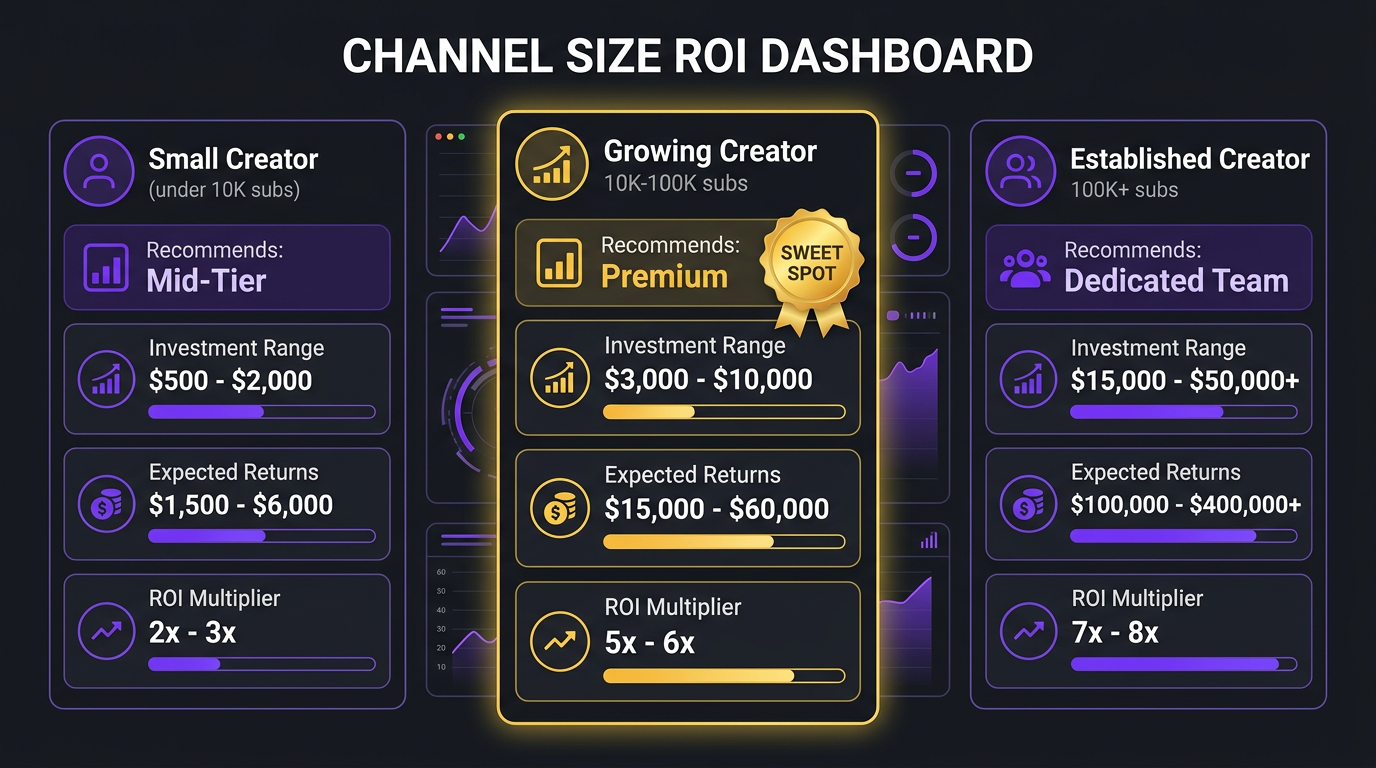
Let’s map editing investment to expected returns across different channel sizes and budgets.
Small Creator (Under 10K Subscribers)
| Investment | Monthly Cost | Expected Impact | ROI Timeline |
|---|---|---|---|
| Budget editing | $500-$1,000 | +20-40% views, 10+ hrs saved | 6-12 months to monetary payback |
| Mid-tier editing | $1,000-$2,500 | +50-100% views, 15+ hrs saved | 3-6 months to monetary payback |
| Premium editing | $2,500-$5,000 | +100%+ views, 20+ hrs saved | Not recommended at this stage |
Best option: Mid-tier editing if you can afford it, budget editing if you can’t. The goal at this stage is reaching monetization faster. Premium isn’t worth it yet because the percentage improvements apply to a small base.
Growing Creator (10K-100K Subscribers)
| Investment | Monthly Cost | Expected Revenue Impact | ROI |
|---|---|---|---|
| Budget editing | $500-$1,000 | +$200-$800/month | Marginal — may not cover cost |
| Mid-tier editing | $1,500-$3,000 | +$800-$2,500/month | Break-even to 1.5x return |
| Premium editing | $3,000-$5,000 | +$2,000-$5,000/month | 1-2x return + time savings |
Best option: Premium editing. This is the sweet spot where the percentage improvements apply to a meaningful base, and the compound growth effect starts generating serious returns. This is the stage where creators like Riley Coleman and Trade with Pat invested — and saw the biggest transformations.
Established Creator / Business (100K+ Subscribers or B2B)
| Investment | Monthly Cost | Expected Revenue Impact | ROI |
|---|---|---|---|
| Mid-tier editing | $2,000-$3,500 | +$3,000-$8,000/month | 2-3x return |
| Dedicated team | $5,000-$10,000 | +$8,000-$25,000+/month | 2-5x return |
Best option: A dedicated editing team. At this scale, percentage improvements translate to substantial dollar amounts. A 30% increase in views on a channel averaging 500K monthly views is 150K additional views — worth thousands in direct revenue alone, not counting sponsorships, products, and brand equity.
The Compounding Effect: Why ROI Accelerates Over Time
This is the most underappreciated aspect of professional video editing ROI. The returns don’t just continue — they accelerate.
Month 1-3: The Foundation
Immediate improvements in retention and quality. Posting frequency increases. The algorithm starts receiving better signals from your channel. Individual videos perform 30-100% better than before. Revenue uptick is noticeable but modest.
Month 3-6: The Momentum
Your channel’s algorithmic authority has grown. New videos launch to larger initial audiences because YouTube trusts your channel to deliver. Back catalog videos start getting recommended more often (better new content lifts your entire library). Subscriber growth compounds — more subscribers = more initial views on each new video = better algorithmic signals.
Month 6-12: The Transformation
The channel is operating at a fundamentally different level. Views that would have been impossible 6 months ago are now standard. Sponsorship offers increase in frequency and value. Revenue has grown 2-5x from the starting point. The editing investment is generating 3-10x returns when you account for all revenue streams.
Month 12+: The New Baseline
What once felt like exceptional performance is now your baseline. The channel has established a new trajectory. Even if you maintained the same editing quality and posting frequency indefinitely, the compound growth would continue because every new subscriber and every video in your back catalog contributes to the momentum.
| Timeline | Typical Views (Before: 50K/mo) | Revenue Multiplier | Cumulative ROI |
|---|---|---|---|
| Month 1-3 | 75K-100K/mo | 1.5-2x | Investing (may not recoup yet) |
| Month 3-6 | 100K-175K/mo | 2-3.5x | Break-even to positive |
| Month 6-12 | 150K-300K/mo | 3-6x | Strongly positive |
| Month 12+ | 200K-500K+/mo | 4-10x | New baseline established |
This compounding is why the creators and companies who invest in professional editing early see the biggest long-term returns. The sooner you start feeding the algorithm better signals, the sooner the compounding kicks in.
When Professional Editing ISN’T Worth It
Honest assessment: professional editing isn’t the right investment for everyone. Here’s when the ROI doesn’t work out:
Your Content Fundamentals Aren’t There Yet
If your content doesn’t have a clear value proposition — if viewers wouldn’t watch even with perfect editing — spending on editing is premature. Fix the content first. The best editor in the world can’t save a video nobody wants to watch. Professional editing multiplies content quality; if the multiplier is applied to zero, the result is still zero.
You’re Not Posting Consistently
If you’re posting once a month, the ROI of professional editing is minimal because there’s not enough content to trigger algorithmic momentum. Aim for at least weekly publishing before investing in editing. The volume-quality combination is what drives compound growth.
Your Channel Is Brand New (Under 3 Months)
In the first few months, you should be editing yourself to develop your style, voice, and understanding of what works. You can’t brief an editor effectively if you don’t know your own preferences yet. Invest in editing once you’ve established a direction.
You’re in a Niche Where Production Value Doesn’t Matter
Some niches (certain ASMR, unboxing, certain educational formats) prioritize authenticity over production polish. If your audience actively prefers raw, unfiltered content, professional editing may actually hurt performance. Know your audience.
Your Budget Can’t Sustain It for 3+ Months
Professional editing ROI is a 3-12 month play. If you can only afford one month, you won’t see the compounding returns. Either commit for a quarter minimum or save until you can. One month of professional editing followed by a return to self-editing doesn’t generate lasting ROI.
How to Calculate Your Own Video Editing ROI
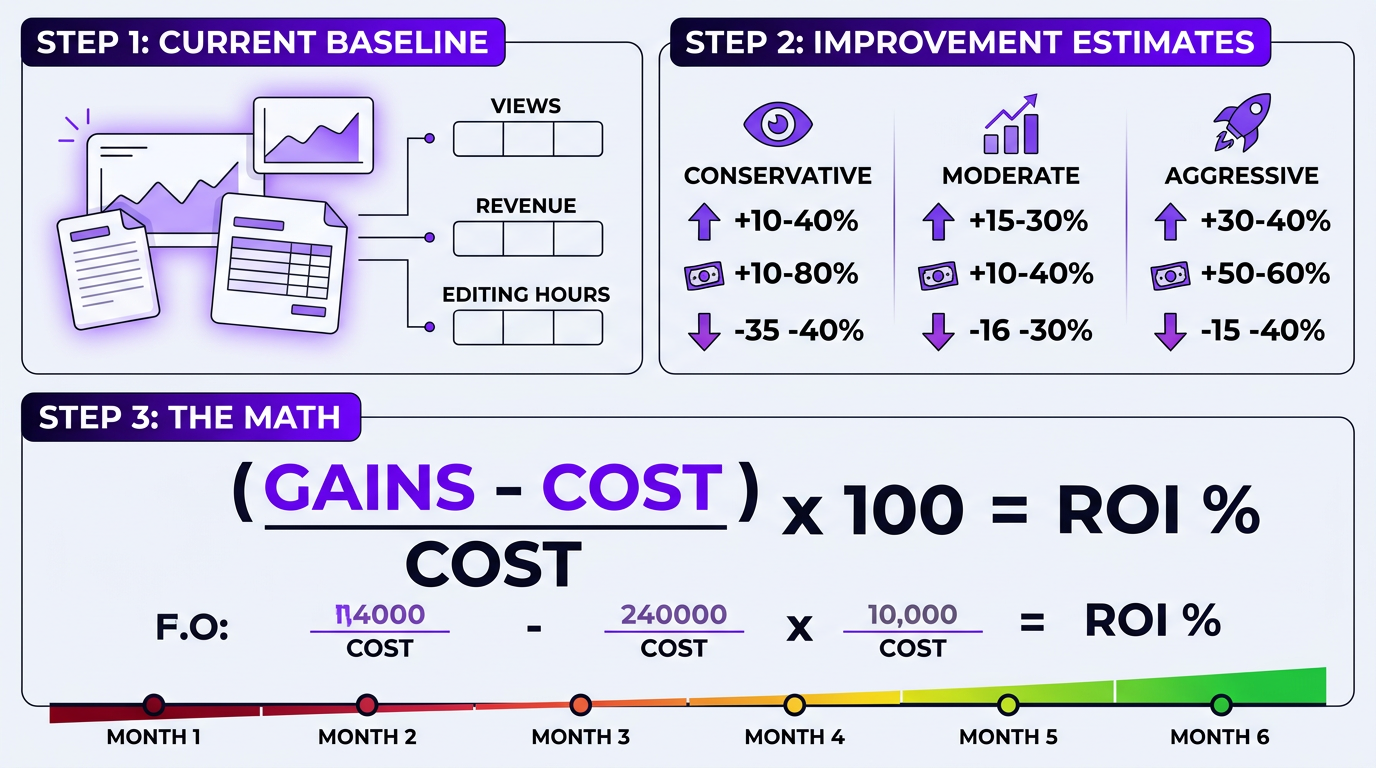
Here’s a practical framework to estimate ROI for your specific situation.
Step 1: Establish Your Current Baseline
- Average monthly views: ____
- Average monthly revenue (ads + sponsorships + affiliate + product): ____
- Hours spent editing per month: ____
- Current posting frequency: ____
- Average audience retention: ____
Step 2: Estimate Conservative Improvements
Based on real client data, use these conservative estimates:
| Metric | Conservative Estimate | Moderate Estimate | Aggressive Estimate |
|---|---|---|---|
| View increase | +30% | +60% | +100% |
| Revenue increase | +25% | +50% | +100% |
| Time saved | 10 hrs/month | 15 hrs/month | 25+ hrs/month |
| Posting frequency increase | +50% | +100% | +200% |
Step 3: Do the Math
Monthly ROI = (Additional Revenue + Time Saved × Your Hourly Value) – Editing Cost
Example: A creator earning $3,000/month, spending 20 hrs/month editing, with time valued at $75/hour:
- Editing cost: $3,000/month (premium YouTube editing service)
- Conservative revenue increase: +$750/month (25% of $3,000)
- Time savings: 15 hrs × $75 = $1,125/month
- Monthly ROI: $750 + $1,125 – $3,000 = -$1,125 (Month 1)
At first glance, that’s negative. But remember the compounding effect. By month 3-6, the revenue increase is typically 50-100%, not 25%. So:
- Month 6 revenue increase: +$1,500-$3,000/month
- Time savings: $1,125/month
- Month 6 ROI: $1,500-$3,000 + $1,125 – $3,000 = -$375 to +$1,125/month
And by month 12, with views potentially doubled:
- Month 12 revenue increase: +$3,000/month
- Time savings: $1,125/month
- Month 12 ROI: $3,000 + $1,125 – $3,000 = +$1,125/month
The investment pays for itself and generates consistent positive returns — and continues accelerating from there. For businesses where a single lead is worth $5,000-$50,000, the math is even more compelling.
Want Us to Run These Numbers for Your Channel?
Our content audit analyzes your channel’s retention data, posting history, and growth trajectory to project the specific ROI you’d see from professional editing. No obligation.
Frequently Asked Questions About Video Editing ROI
The ROI of professional video editing typically ranges from 1.5x to 5x+ over a 6-12 month period, depending on channel size, niche, and current monetization. Real-world data shows 50-200% increases in views, 20-40% improvements in retention, and proportional revenue growth. For monetized creators, the editing cost typically pays for itself within 1-3 months through increased views and revenue alone — before factoring in time savings and compound growth.
View count increases of 50-100% are common within the first 1-3 months. In our experience working with creators like Riley Coleman and Trade with Pat, views doubled almost immediately. The increase comes from better retention (which the algorithm rewards), improved production quality (higher CTR), and increased posting frequency (more content to promote). These factors multiply rather than add.
For channels under 10K subscribers, professional editing accelerates growth but the monetary payback takes longer (3-6 months vs 1-3 months for larger channels). If YouTube drives business revenue — leads, sales, brand authority — professional editing is worth it at any size. If it’s purely a hobby, invest in editing once you’re consistently posting and have validated your content direction. Our pricing tiers include options for growing channels.
For monetized creators earning $2,000+/month: typically 1-3 months. For businesses using video for lead generation: often after just 1-2 new clients acquired through improved video presence. For pre-monetization creators: 3-6 months to reach monetization thresholds, after which returns compound rapidly. The key variable is how much you currently earn and how much room there is for improvement in your editing quality.
Primary improvements: average view duration (+20-40%), total views (+50-200%), watch time (often doubles), and subscriber conversion rate (+20-50%). Secondary improvements: sponsorship rates (driven by better metrics), content volume (more videos when you’re not editing), and brand perception. The one metric that doesn’t change directly is CPM/RPM — that depends on your niche and audience demographics, not editing quality.
Yes, and this is the primary mechanism behind the ROI. YouTube’s algorithm prioritizes videos with high retention and strong click-through rates. Professional editing directly improves retention through better pacing, hooks, and visual quality. Higher retention → more impressions → more views → the algorithm promotes your content to even more people. This creates a positive feedback loop that compounds over every video you publish.
Budget editing ($100-$200/video) rarely produces measurable ROI improvement because it doesn’t meaningfully improve the viewer experience. Mid-tier editing ($250-$500/video) delivers the best ROI ratio for growing channels — noticeable quality at reasonable cost. Premium editing ($500+/video from agencies like Increditors) delivers the highest absolute returns for established channels where percentage improvements on larger audiences translate to substantial revenue. The “right” investment level depends on your current channel size and revenue.
Ready to See Real ROI from Your Video Content?
Join creators like Riley Coleman and Trade with Pat who doubled their channel metrics with professional editing. Let’s talk about what’s possible for your channel.
All case study data in this article reflects real client results. Individual outcomes vary based on niche, content quality, posting consistency, and market conditions. ROI projections are estimates based on historical client data and should not be taken as guarantees. For current Increditors pricing, visit our pricing page or schedule a call.