









![3D Explainer Video - ScribbleLive.mp4_snapshot_00.12_[2022.03.09_03.14.16]](https://increditors.com/wp-content/uploads/elementor/thumbs/3D-Explainer-Video-ScribbleLive.mp4_snapshot_00.12_2022.03.09_03.14.16-r7wb53mx72rxst3qcqyrfxdmeyzb5r9jbl0wbjujh4.png "3D Explainer Video – ScribbleLive.mp4_snapshot_00.12_[2022.03.09_03.14.16]")



























Choosing a video editing agency feels overwhelming because the market has no standardization. One agency charges $500/month, another charges $10,000, and their websites look equally polished. How do you tell who’s actually good before handing over your content and credit card?
We’re a video editing agency ourselves, so yes — we’re biased. But we’ve also heard every horror story from clients who came to us after bad experiences: missed deadlines, inconsistent quality, editors who disappeared mid-project, and “unlimited revisions” that took three weeks to get right.
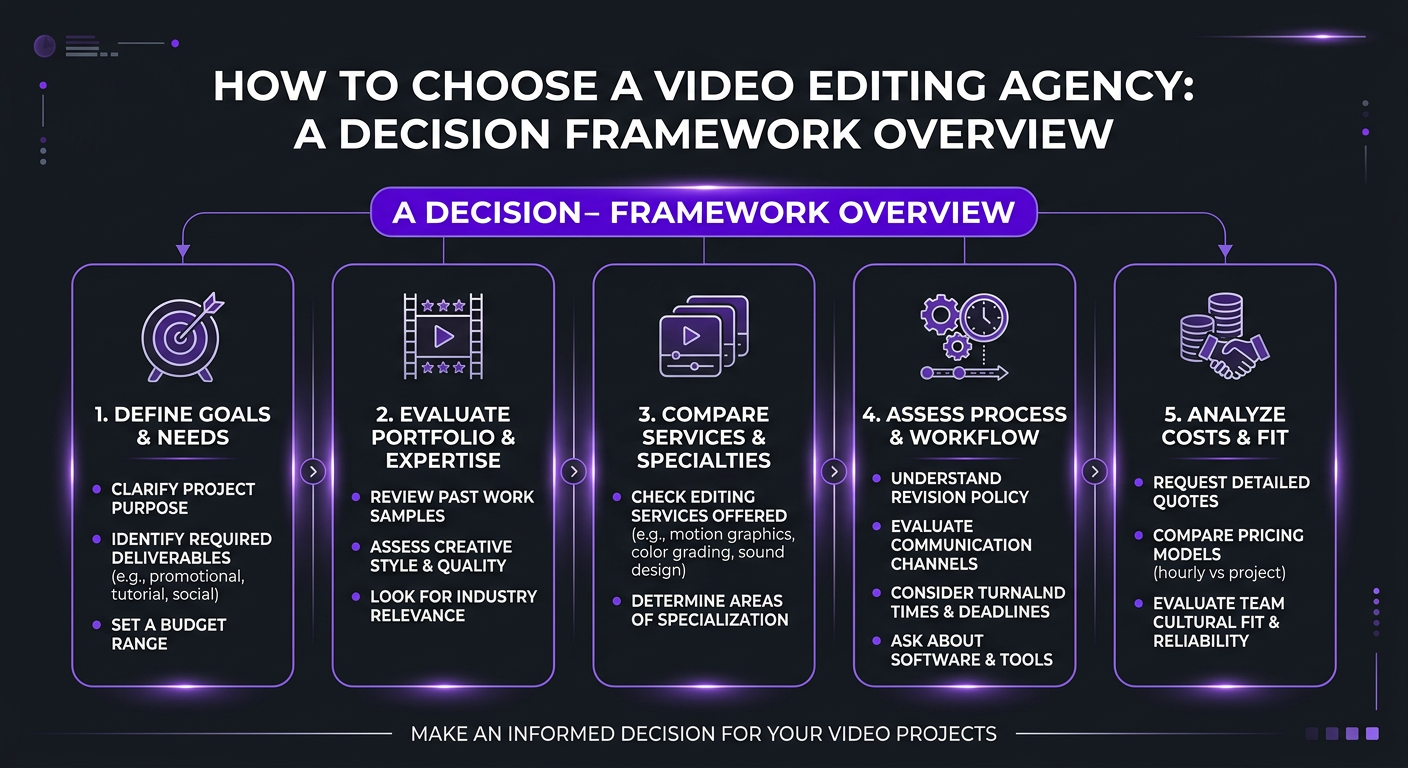
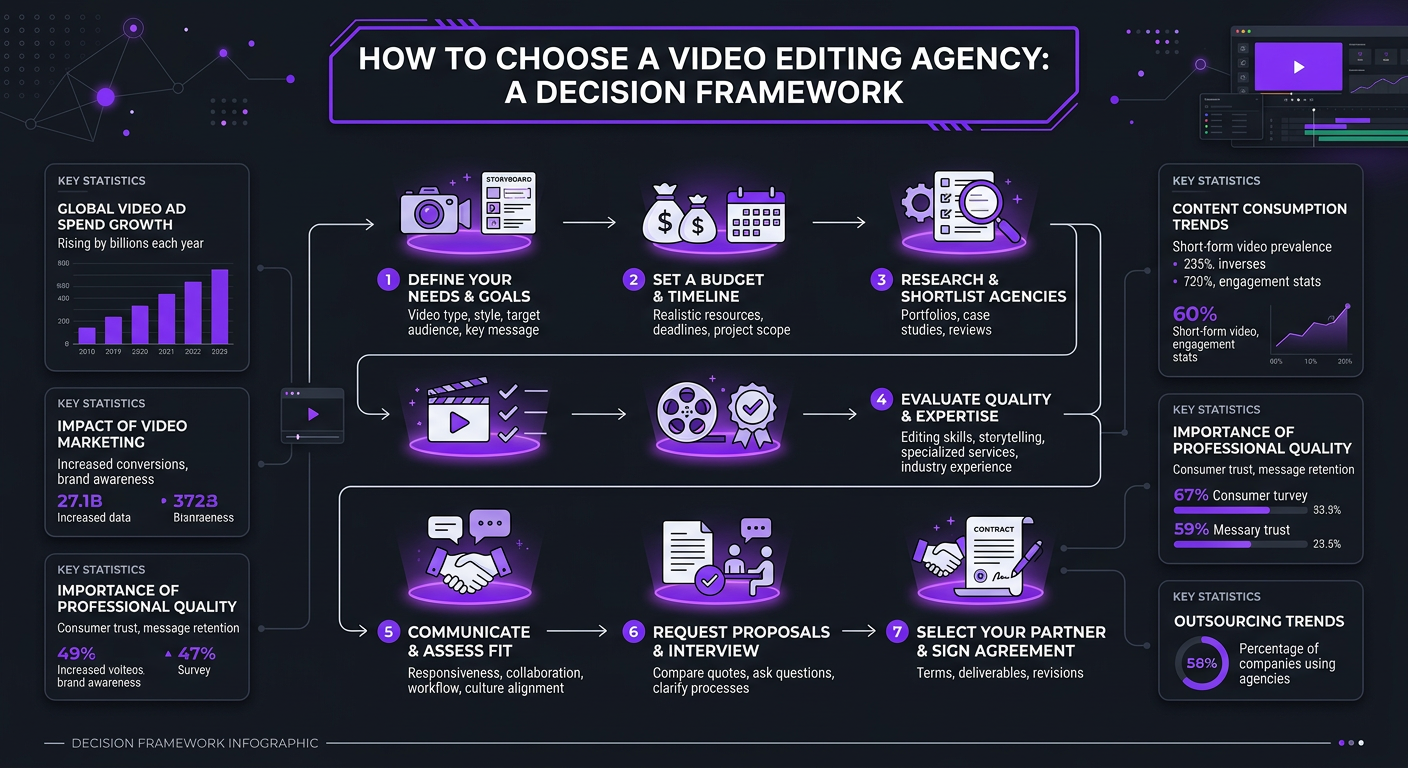
This guide gives you a systematic framework for evaluating and choosing a video editing agency. Whether you’re a creator, startup, or enterprise — the same principles apply. Use this as your checklist.
What’s in This Guide
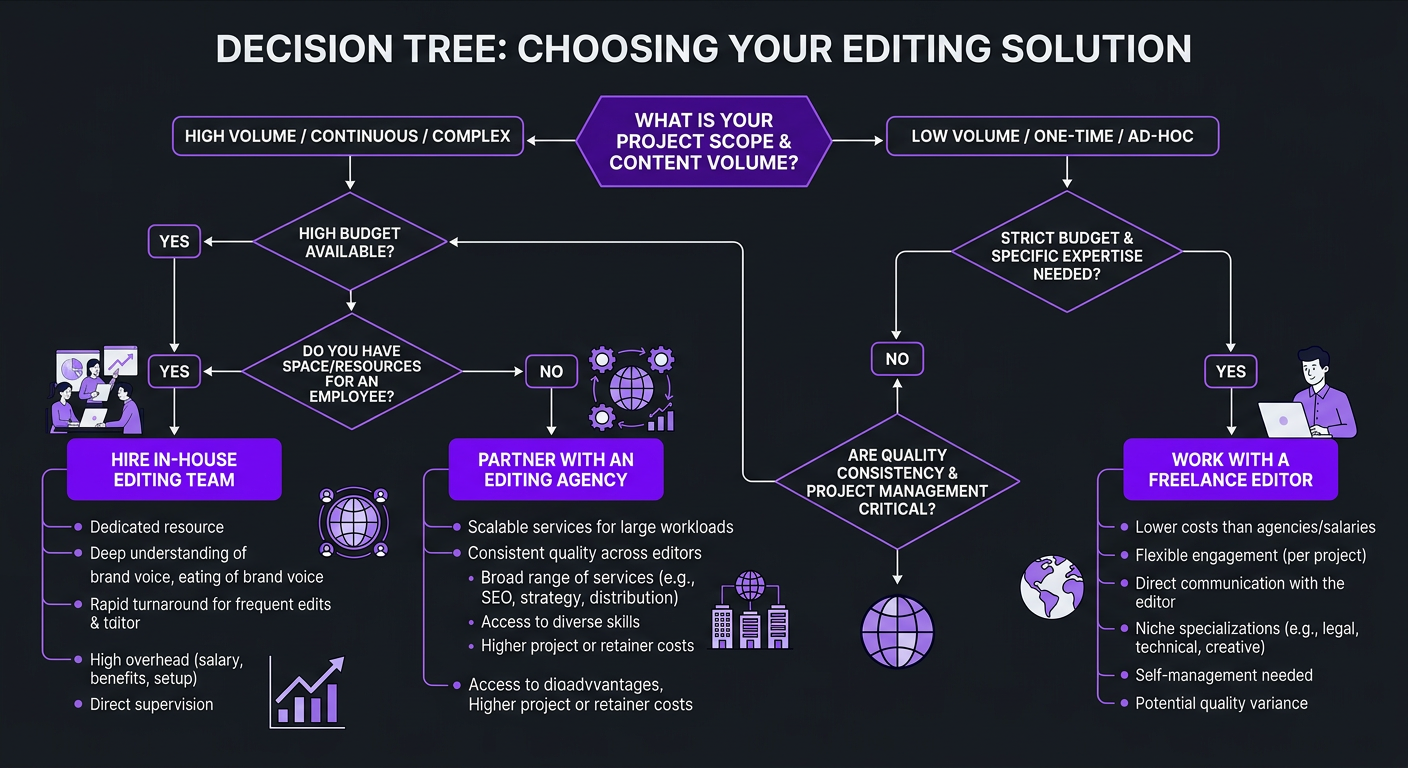
- Before You Search: Define What You Need
- The 5 Types of Video Editing Agencies
- The 8-Point Evaluation Criteria
- Understanding Pricing Models
- Red Flags That Should Kill the Deal
- Green Flags That Signal Quality
- Running a Test Project
- The Decision Matrix
- What Great Onboarding Looks Like
- Real Selection Stories
- FAQ
Before You Search: Define What You Actually Need
Most people start by googling “best video editing agency” and comparing websites. That’s backwards. You need to define your requirements first, then match them against agencies.
The Needs Assessment Checklist
Answer these questions before talking to any agency:
- Content type: YouTube long-form? Shorts/Reels? Podcasts? Corporate? A mix?
- Volume: How many videos per month? Will this increase?
- Complexity: Basic cuts or heavy motion graphics, VFX, color grading?
- Turnaround: How fast do you need deliveries? 24h? 48h? Weekly?
- Budget: What’s your realistic monthly editing budget?
- Involvement: Do you want full creative control or a “just make it good” partner?
- Growth: Where are you headed in 6-12 months?
The answers dramatically narrow your options. A creator publishing 4 YouTube videos per month needs a very different agency than an enterprise brand producing 40 videos across 6 platforms.
The 5 Types of Video Editing Agencies
Not all agencies operate the same way. Understanding the model helps you set the right expectations.
| Agency Type | Monthly Cost | Best For | Limitations |
|---|---|---|---|
| Subscription/Unlimited | $500–$2,000 | High volume, basic editing | Quality ceilings, generic style |
| Boutique Specialist | $2,000–$5,000 | Niche expertise (YouTube, SaaS, etc.) | Limited capacity |
| Dedicated Team Model | $3,000–$8,000 | Consistent quality at scale | Higher minimum commitment |
| Full-Service Production | $5,000–$20,000+ | End-to-end video production | Expensive, slow, overkill for most |
| Offshore/Budget | $300–$1,000 | Cost-sensitive, simple edits | Communication gaps, quality variance |
Subscription/Unlimited Services
Think Vidchops, VeedYou, and similar. You pay a monthly fee and submit editing requests. They work through a queue. Good for creators who need basic cuts and captions at volume. The model breaks down when you need creative sophistication — heavy motion graphics, narrative pacing, or platform-specific optimization.
Boutique Specialist Agencies
These focus on a specific niche or platform. A YouTube-focused agency understands retention curves, thumbnails, and pacing in ways a generalist never will. This is where you get the best ROI if your needs align with their specialty. The trade-off is limited capacity — they may have a waitlist.
Dedicated Team Model
You get an assigned editor (or team) who learns your brand and works with you long-term. This is the Increditors model. The editor becomes an extension of your team — they know your style, your audience, and your preferences. First drafts get better over time because of accumulated context.
Full-Service Production Houses
These handle everything from scriptwriting to shooting to editing. Excellent for brand campaigns, commercials, and high-end corporate video. Overkill (and overpriced) for ongoing YouTube or social content. If you already have raw footage, you’re paying for services you don’t need.
Offshore/Budget Services
Editors in countries with lower costs. Can work well for simple editing tasks, but communication barriers, time zone differences, and cultural gaps often create friction. Best for well-defined, template-based editing with minimal creative judgment required.
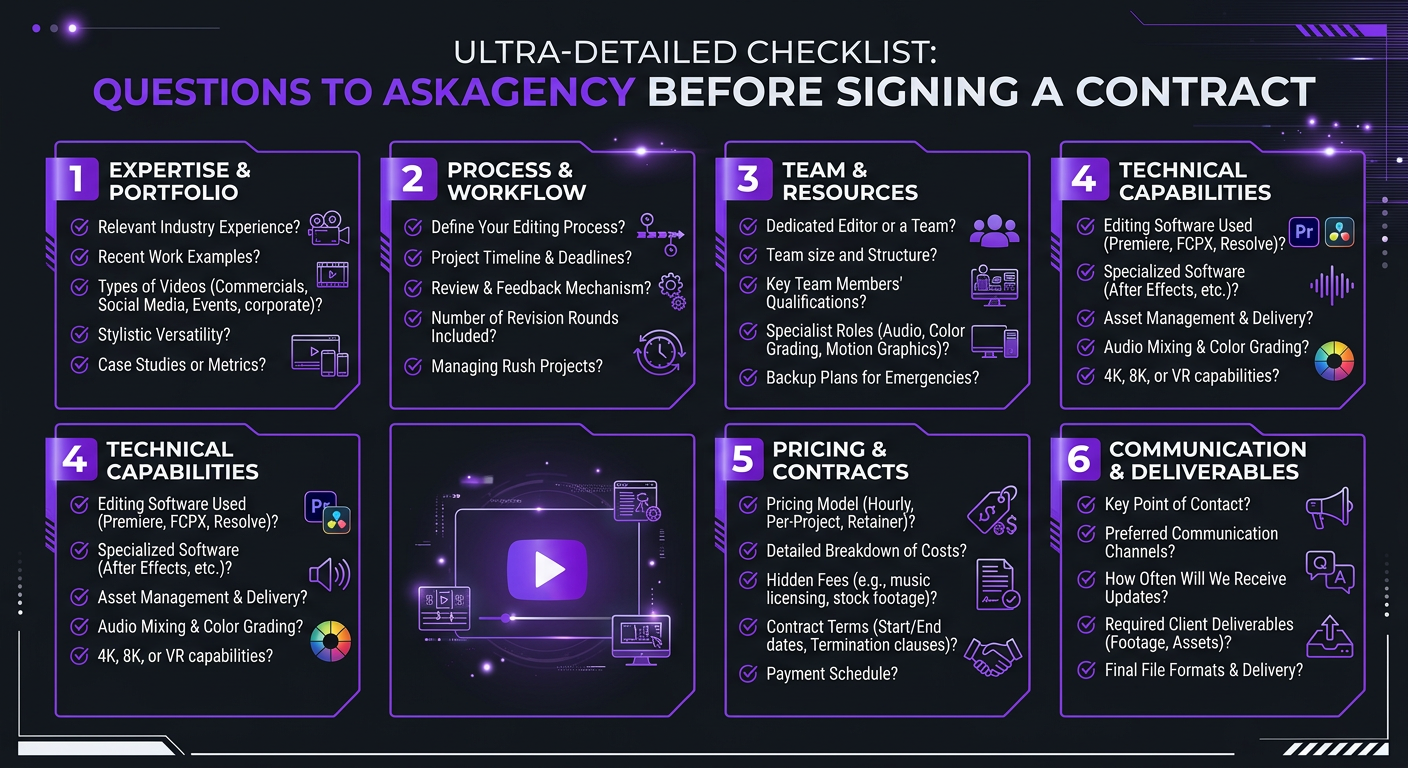
The 8-Point Agency Evaluation Criteria
Use these criteria to score every agency you’re considering. Rate each on a 1-5 scale.
1. Portfolio Relevance (Weight: High)
Don’t just look at their “best work” showreel. Ask for examples similar to what you need. If you’re a YouTube creator, their corporate brand reel is irrelevant. Key questions:
- Do they have work in your specific content type?
- Is the quality consistent across their portfolio or just in the highlights?
- Can they show before/after transformations?
2. Communication & Process (Weight: High)
The editing itself is only half the equation. How they communicate determines whether the relationship works. Evaluate:
- Response time during the sales process (if they’re slow now, imagine when you’re a client)
- Project management tools (Slack, Trello, Frame.io, custom portal?)
- Revision workflow clarity
- Single point of contact vs rotating team members
3. Turnaround Time (Weight: Medium-High)
Ask for their standard turnaround time, rush options, and what happens when they’re at capacity. Good answers include specific SLAs (e.g., “48-hour first draft for videos under 15 minutes”). Bad answers include “it depends” with no further detail.
4. Pricing Transparency (Weight: Medium-High)
If an agency can’t give you a clear price on the first call, that’s a yellow flag. The best agencies have published pricing pages or can provide a detailed quote within 24 hours. Hidden fees, vague “custom pricing,” and pressure to commit before seeing numbers are all red flags.
5. Team Structure (Weight: Medium)
Who will actually edit your videos? A dedicated editor, or whoever’s available? What happens when your editor is sick or on vacation? Understanding the team structure tells you a lot about consistency and reliability.
6. Revision Policy (Weight: Medium)
Standard is 2-3 rounds of revisions included. “Unlimited revisions” sounds great but often indicates that first-draft quality is low. The best agencies deliver 90% right on the first draft because they invest in understanding your brand upfront.
7. Scalability (Weight: Medium)
If you’re at 8 videos/month now but plan to be at 30 in a year, can the agency scale with you? Startup-focused agencies understand growth trajectories and build their teams accordingly.
8. Client References (Weight: High)
Ask for 2-3 references from clients with similar needs. Talk to them. The most important question: “Would you hire them again?” If the answer isn’t an enthusiastic yes, keep looking.
Understanding Agency Pricing Models
Agencies price their services in several ways. Each model has trade-offs:
| Pricing Model | How It Works | Pros | Cons |
|---|---|---|---|
| Per Video | Fixed price per deliverable | Predictable, pay for what you use | Gets expensive at volume |
| Monthly Retainer | Fixed monthly fee for X videos | Bulk discount, predictable budgeting | May waste budget in slow months |
| Hourly | Pay for actual editing time | Flexible, fair for complex work | Unpredictable costs, incentivizes slowness |
| Subscription/Unlimited | Flat monthly fee, “unlimited” requests | Simple pricing, high volume | Queue-based, quality limits |
| Dedicated Editor | Full-time editor assigned to you | Consistency, deep brand knowledge | Higher base cost, less flexible |
For most creators and businesses producing 8-20 videos/month, a monthly retainer is the sweet spot. It gives you a predictable cost, incentivizes the agency to be efficient, and typically includes a dedicated editor who learns your style over time.
If you’re unsure, ask the agency to recommend a pricing model based on your needs. Their recommendation tells you a lot about whether they’re trying to sell you a package or genuinely fit your workflow.
Want a Straight Answer on Pricing?
We publish our pricing transparently and tailor packages to your actual needs. No pressure, no hidden fees. See our work first, then let’s talk numbers.
12 Red Flags That Should Kill the Deal
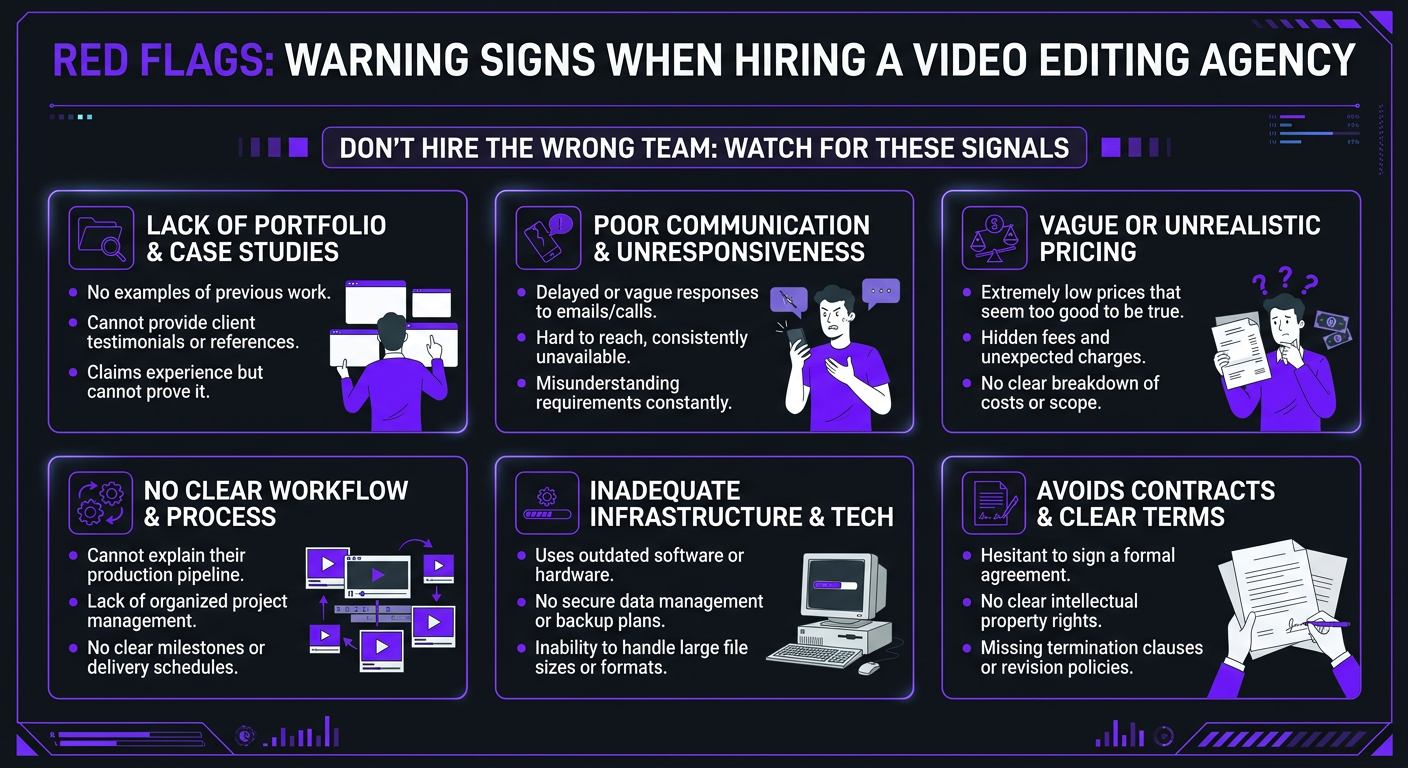
We’ve heard the horror stories. Here are the warning signs that predict a bad agency experience:
- No portfolio or only showreels: If they can’t show real client work, they either don’t have it or don’t have permission to share it (which means their clients aren’t proud of the results).
- Vague pricing: “We’ll give you a quote after a few calls” means they’re figuring out how much you can afford.
- Long-term contract required upfront: Any agency requiring 6-12 months before you’ve seen results isn’t confident in their quality.
- No dedicated editor: If your videos go to “the team” with no single point of creative ownership, expect inconsistency.
- Slow response time during sales: If they take 3 days to reply when they’re trying to win your business, imagine how fast they’ll respond when you’re locked into a contract.
- Generic “we do everything” positioning: Video editing, web design, SEO, social media management, and logo design? They’re a generalist — not a specialist.
- No revision process defined: If they can’t explain exactly how revisions work, you’ll be fighting for changes.
- Claim to be the “cheapest”: Leading with price means they compete on cost, not quality. That never ends well.
- No onboarding process: If they don’t ask about your brand, style, audience, or goals before starting — they’re going to deliver generic work.
- Can’t provide references: Either they have no happy clients, or they know the references wouldn’t be favorable.
- Overclaiming on turnaround: “Same-day delivery on any video” either means they have massive overcapacity (why?) or they rush everything.
- No QC process: Ask who reviews the work before it’s sent to you. If the answer is “the editor sends it directly,” there’s no quality control layer.
Green Flags That Signal a Great Agency
Now the positive signals — the things that predict a successful partnership:
- They ask more questions than you do: A great agency wants to understand your content, audience, and goals before quoting a price.
- They show work similar to yours: Not just their best showreel — actual client work in your niche.
- They have a clear onboarding process: Brand guide review, style matching, test edits, feedback loops — defined and documented.
- They recommend starting small: “Let’s start with 4 videos and see if the fit works” is more honest than “sign up for our annual plan.”
- They explain their team structure: You know who your editor is, who the QC person is, and who to contact if something goes wrong.
- They have platform-specific expertise: They know the difference between editing for YouTube retention vs TikTok virality vs LinkedIn authority.
- They give honest assessments: If they tell you “we’re not the right fit for wedding videos” or “your budget might be better served by a freelancer at your volume” — that’s integrity.
- They have a revision workflow: Clear tools (Frame.io, or similar), defined turnaround for revisions, and a process that doesn’t require back-and-forth emails.
How to Run a Proper Test Project
Never commit to a monthly retainer without a paid test project first. Here’s how to structure it:
Step 1: Choose a Representative Video
Pick a video that’s typical of your content — not your simplest and not your most complex. The test needs to reflect what 80% of your projects look like.
Step 2: Provide a Standard Brief
Give the agency the same brief you’d give for any video. Include reference videos, brand guidelines, and any specific instructions. Don’t over-explain — you want to see how much they can figure out from a standard brief.
Step 3: Evaluate the First Draft
The first draft is the most important moment in the evaluation. Ask yourself:
- Does it match the style references I provided?
- Is the pacing right for my content type?
- Did they catch details I didn’t explicitly mention?
- How’s the audio quality, color, and overall polish?
- Is it 90% there, or does it need a complete overhaul?
Step 4: Test the Revision Process
Even if the first draft is great, request 2-3 specific changes. This tests: response time, how well they interpret feedback, and whether the revisions introduce new problems.
Step 5: Assess the Full Experience
Beyond the video itself, evaluate the process. Was communication smooth? Did they meet the deadline? Were they proactive about anything? This is what your ongoing experience will be like.
The Decision Matrix: Score and Compare
Here’s a practical scoring framework. Rate each agency on a 1-5 scale for each criterion, multiply by the weight, and compare total scores:
| Criterion | Weight | Agency A | Agency B | Agency C |
|---|---|---|---|---|
| Portfolio Relevance | 3x | ___ | ___ | ___ |
| Communication Quality | 3x | ___ | ___ | ___ |
| Client References | 3x | ___ | ___ | ___ |
| Pricing Fit | 2x | ___ | ___ | ___ |
| Turnaround Time | 2x | ___ | ___ | ___ |
| Team Structure | 2x | ___ | ___ | ___ |
| Revision Policy | 1x | ___ | ___ | ___ |
| Scalability | 1x | ___ | ___ | ___ |
| TOTAL SCORE | /85 | ___ | ___ | ___ |
Agencies scoring 65+ are strong candidates. 50-65 is workable but check the low-scoring areas. Below 50 — keep looking.
What Great Onboarding Looks Like
The first week with a new editing agency sets the tone for the entire relationship. Here’s what good onboarding includes:
Week 1: Discovery & Brand Immersion
- Brand guide review (colors, fonts, logos, tone)
- Content audit of your existing videos
- Reference video review (videos you want yours to look like)
- Technical specs alignment (delivery formats, file sharing setup)
- Communication channels established (Slack, email, project tool)
Week 2: First Edit Cycle
- First project with detailed brief
- First draft delivery (expect 80-90% accuracy)
- Detailed feedback from you (be thorough — this trains the editor)
- Revised delivery
- Debrief on what worked and what needs adjusting
Weeks 3-4: Calibration
- Second and third projects with lighter briefs
- First-draft accuracy should improve to 90-95%
- Workflow optimization (file naming, delivery schedules, feedback formats)
By month two, a good agency requires minimal briefs. Your editor knows your style so well that they make creative decisions you agree with. That’s the goal — not just task execution, but creative partnership.
Real Agency Selection Stories
VYVE Wellness: From DIY to Dedicated Team
VYVE Wellness was editing all their content in-house — the marketing manager was spending 20 hours/week on video editing instead of strategy. They needed an agency but had been burned by a cheap subscription service that delivered generic, template-heavy edits.
Their selection process focused on three criteria: health/wellness portfolio work, understanding of YouTube long-form pacing, and a dedicated editor (not a queue). They evaluated five agencies, ran test projects with two finalists, and chose based on first-draft quality and communication speed.
The result: the marketing manager reclaimed 20 hours/week, video quality improved measurably (average retention up 34%), and the per-video cost was actually lower than their in-house time when valued at her salary.
eSafety: Enterprise Requirements, Agency Agility
eSafety needed enterprise-level service (SLAs, security compliance, brand governance) but didn’t want the slow turnaround and committee-driven process of a traditional production house. They needed an agency that could deliver both reliability and speed.
The key selection criteria were security protocols (NDA, data handling), multi-format delivery (YouTube, LinkedIn, internal training), and the ability to scale from 10 to 40+ videos/month during campaign periods.
They ran a 30-day pilot with two agencies before committing. The winning factor wasn’t price — it was the winning agency’s proactive communication and ability to handle feedback efficiently without endless revision cycles.
Frequently Asked Questions
Look for: relevant portfolio work in your niche, clear pricing models, defined turnaround times, a dedicated editor or team model, revision policies, communication systems, and client testimonials. The best agencies specialize in specific content types rather than claiming to do everything. Start with a paid test project before committing to any monthly retainer. Check our portfolio for an example of what niche expertise looks like.
Pricing varies widely: budget subscription services charge $500-$1,500/month for basic editing, mid-tier agencies charge $2,000-$5,000/month for dedicated teams, and premium agencies charge $5,000-$15,000+/month for enterprise-level service. Per-video pricing ranges from $100-$1,500 depending on complexity. See our detailed pricing breakdown for specific tiers.
Request a paid test project before committing. Review their portfolio for work similar to yours — not just highlight reels. Check consistency across their client work, and ask for references from clients with similar content types and volume. The test project should reveal first-draft quality, revision speed, and communication style.
Specialized agencies consistently deliver better results for ongoing content. A YouTube-focused agency understands retention, pacing, and thumbnails. A social media specialist understands platform-specific trends. Full-service agencies make sense for one-off brand campaigns, but for regular content production, specialization wins.
Start month-to-month. Any agency confident in their quality won’t require long-term contracts upfront. After 2-3 months of proven results, quarterly or annual commitments often come with 10-20% discounts. Avoid agencies that require 6-12 month minimums before you’ve experienced their work.
2-3 revision rounds is standard and healthy. “Unlimited revisions” often means the first draft quality is low and revision time is baked into pricing. The best agencies deliver near-final quality on draft one because they invest in understanding your brand during onboarding.
See If Increditors Is the Right Fit
We’re not the cheapest and we’re not the biggest — we’re a dedicated team model built for creators and brands who care about quality. Let’s start with a conversation.
This guide reflects agency evaluation best practices from industry research and direct client feedback. Pricing ranges reflect 2026 market rates. For current Increditors pricing and availability, visit our pricing page or schedule a call.