










![3D Explainer Video - ScribbleLive.mp4_snapshot_00.12_[2022.03.09_03.14.16]](https://increditors.com/wp-content/uploads/elementor/thumbs/3D-Explainer-Video-ScribbleLive.mp4_snapshot_00.12_2022.03.09_03.14.16-r7wb53mx72rxst3qcqyrfxdmeyzb5r9jbl0wbjujh4.png "3D Explainer Video – ScribbleLive.mp4_snapshot_00.12_[2022.03.09_03.14.16]")































You know you need video editing help. The question is: do you hire a freelancer, bring someone in-house, or use an agency? Every option has a different price tag — and the sticker price is never the real cost.
We’ve seen businesses make expensive mistakes in all three directions. Startups hiring full-time editors when they only need 6 videos a month. Creators cycling through freelancers every 3 months because nobody sticks around. Companies paying agency rates for work a freelancer could handle.
This guide breaks down the true cost of each option — including the hidden costs that don’t show up on invoices — so you can make a decision based on real numbers, not assumptions. We run a video editing agency, so we’re obviously biased. But we’ll be honest about when an agency is overkill and when the other options make more sense.
What’s in This Guide
- Quick Cost Comparison
- Freelancer: True Cost Breakdown
- In-House Editor: True Cost Breakdown
- Agency: True Cost Breakdown
- Hidden Costs Nobody Talks About
- Cost Comparison Calculator
- Cost by Volume: Finding Your Break-Even
- Quality Differences You’re Paying For
- Hybrid Models That Actually Work
- Case Studies: Real Decisions, Real Numbers
- Decision Framework: Which Is Right for You
- FAQ
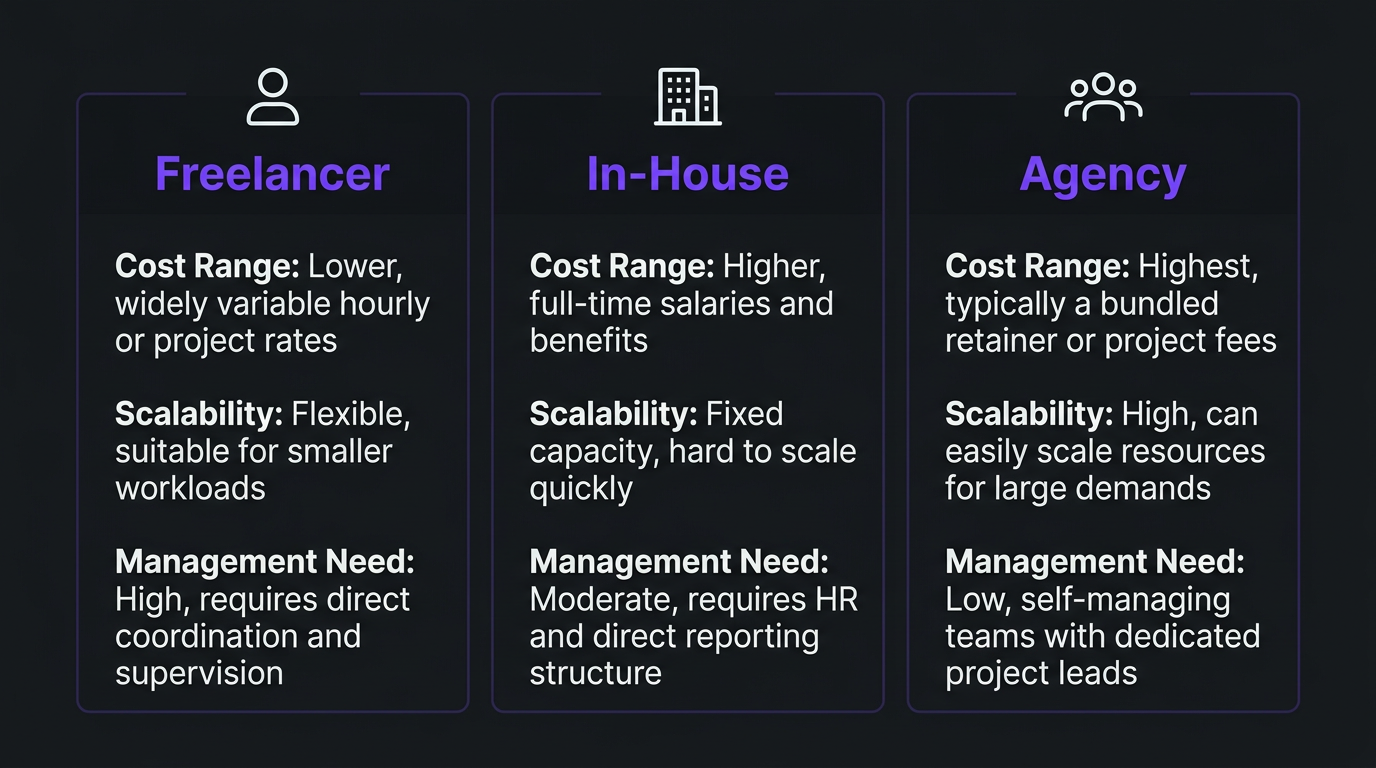
Quick Cost Comparison: Agency vs In-House vs Freelancer
Here’s the headline comparison before we get into the details. These are 2026 U.S. market rates:
| Factor | Freelancer | In-House Editor | Agency |
|---|---|---|---|
| Monthly cost (8 videos) | $1,600–$4,000 | $4,500–$8,000 | $2,500–$6,000 |
| Monthly cost (20 videos) | $4,000–$10,000 | $4,500–$8,000 | $5,000–$10,000 |
| Per-video effective rate | $200–$500 | $225–$400* | $250–$600 |
| Your management time | 5–10 hrs/week | 3–5 hrs/week | 1–2 hrs/week |
| Scalability | Limited | Fixed capacity | Flexible |
| Quality consistency | Variable | Consistent (one person) | Consistent (systems) |
| Backup if unavailable | ❌ | ❌ | ✅ |
| Multiple specialists | ❌ (one generalist) | ❌ (one generalist) | ✅ (editor + colorist + MG + PM) |
*In-house per-video rate assumes salary + benefits + equipment amortized across monthly output. Actual per-video cost decreases as volume increases — but so does quality if one person is overloaded.
Freelancer: The True Cost Breakdown
Freelancers look like the cheapest option — and at face value, they often are. But the sticker price doesn’t tell the full story.
Direct Costs
| Freelancer Tier | Per Video | Hourly Rate | Typical Source |
|---|---|---|---|
| Budget | $50–$150 | $10–$25/hr | Fiverr, offshore platforms |
| Mid-tier | $200–$400 | $30–$60/hr | Upwork, referrals |
| Senior/Specialist | $400–$800 | $60–$120/hr | Industry networks, cold outreach |
| Premium/Celebrity-tier | $800–$2,000+ | $120–$250/hr | Direct referrals, reputation-based |
Hidden Costs You’re Already Paying
Here’s where freelancers get expensive without you realizing it:
1. Your Management Time
You become the project manager. Briefing, reviewing, giving feedback, chasing deadlines, handling communication. For most creators and businesses, this eats 5-10 hours per week. If your time is worth $50-$200/hour, that’s $1,000-$8,000/month in management overhead that doesn’t show up on any invoice.
2. The Revision Tax
Freelancers without robust onboarding processes often need more revision rounds. Each round adds 1-3 days and additional cost (either included in a higher rate or charged extra). Industry data suggests freelancer projects average 2.5 revision rounds vs 1.3 for agency projects with dedicated PMs.
3. The Replacement Cycle
Freelancers leave. They get better offers, they burn out, they go back to full-time employment. The average freelancer-client relationship in video editing lasts 4-8 months. Every replacement costs you:
- 2-4 weeks finding and vetting a new editor
- 1-2 weeks of onboarding and calibration
- Dip in quality during the transition
- Risk of missed deadlines while you’re between editors
4. The Availability Gap
Your freelancer is on vacation. They’re sick. They took on too many clients and your project keeps slipping. There’s no backup editor, no PM to escalate to, no SLA guaranteeing turnaround. When your content calendar depends on one person’s availability, you have a single point of failure.
The Adjusted Freelancer Cost
| Cost Component | Monthly (8 videos) |
|---|---|
| Direct editing fees (mid-tier) | $2,400 |
| Your management time (7 hrs/wk × $75/hr) | $2,100 |
| Extra revision rounds (avg 1.2 extra × $100) | $960 |
| Replacement cost (amortized over 6-month avg tenure) | $300 |
| True monthly cost | $5,760 |
That $300/video freelancer actually costs $720/video when you factor in everything. Suddenly the “expensive” agency at $500/video with zero management overhead looks different.
In-House Editor: The True Cost Breakdown
Hiring a full-time editor feels like the “serious” option. And for some businesses, it absolutely is. But most companies dramatically underestimate the total cost.
Direct Salary Costs (2026 U.S. Market)
| Editor Level | Salary Range | Major Metro | Remote/Mid-Market |
|---|---|---|---|
| Junior (1-2 years exp) | $35,000–$50,000 | $45,000–$55,000 | $35,000–$45,000 |
| Mid-level (3-5 years) | $50,000–$70,000 | $60,000–$75,000 | $48,000–$62,000 |
| Senior (5+ years) | $70,000–$95,000 | $80,000–$100,000 | $65,000–$85,000 |
| Lead/Senior + Motion Graphics | $85,000–$120,000+ | $95,000–$130,000 | $80,000–$110,000 |
The Costs Beyond Salary
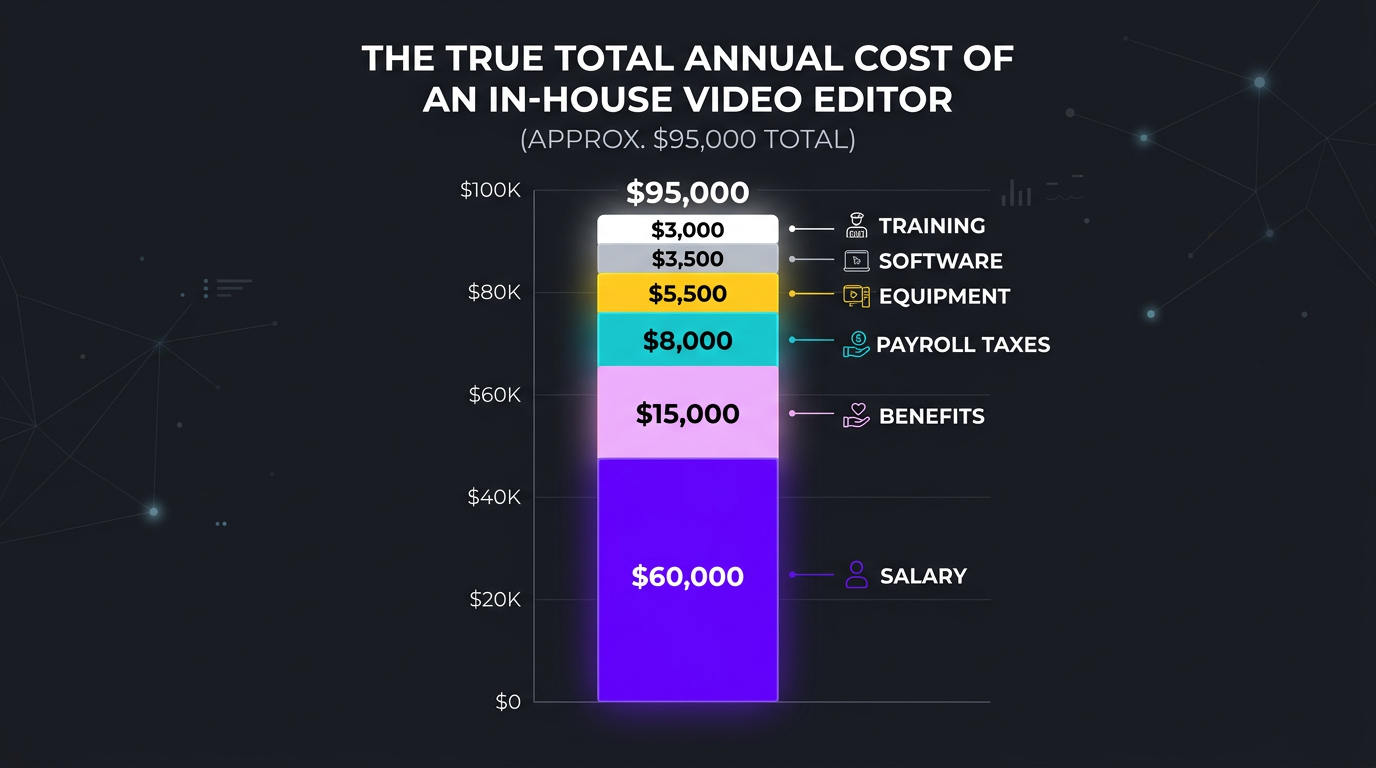
Salary is typically only 60-70% of the true cost of an employee. Here’s everything else:
| Cost Category | Annual Cost | Notes |
|---|---|---|
| Base salary (mid-level) | $60,000 | National average for 3-5 year experience |
| Benefits (health, dental, 401k) | $12,000–$18,000 | 20-30% of salary is standard |
| Payroll taxes | $4,600 | ~7.65% employer portion |
| Equipment (workstation) | $2,000–$5,000 | High-performance editing machine, monitors |
| Software licenses | $1,200–$3,000 | Adobe CC, DaVinci, stock assets, plugins |
| Training & development | $1,000–$3,000 | Courses, conferences, skill development |
| PTO coverage | Productivity loss | 2-4 weeks/year with no output |
| Recruiting cost (amortized) | $2,000–$5,000 | Job posts, interviews, onboarding |
| Total annual cost | $83,000–$100,000 | $6,900–$8,300/month |
What You Get for That Investment
To be fair, in-house has real advantages that cost money to replicate:
- Instant availability: Need a quick fix in 30 minutes? Your in-house editor can do it. An agency or freelancer can’t.
- Deep brand knowledge: After 6 months, they know your style, voice, and audience better than anyone external.
- Real-time collaboration: Sit next to them, review cuts together, iterate in real time. This is valuable for highly creative or experimental content.
- Cultural integration: They attend team meetings, understand company context, and can proactively suggest content ideas.
What You Don’t Get
- Backup coverage: When they’re sick, on vacation, or quit — you have zero editing capacity
- Specialist depth: One person can’t be an expert editor AND colorist AND motion graphics artist AND sound designer
- Scalability: If you need to double output for a launch, you can’t double an employee for one month
- Fresh perspective: After a year editing the same channel, creative fatigue is real
Agency: The True Cost Breakdown
Agency pricing is the most transparent of the three options — what you see is much closer to what you pay. But there’s still nuance.
Agency Pricing Models
| Pricing Model | Range | Best For | Watch Out For |
|---|---|---|---|
| Per-video | $200–$1,000+ | Low/variable volume | Costs spike with volume |
| Monthly retainer | $2,500–$10,000 | Consistent volume, predictable budgets | May overpay in slow months |
| Subscription/unlimited | $500–$5,000 | High volume, standardized content | “Unlimited” has practical limits |
| Dedicated team | $4,000–$12,000 | High volume, complex content | Higher commitment, best value at scale |
What’s Included (That You’d Pay Extra For Elsewhere)
The agency price typically bundles services that cost separate line items with freelancers or in-house setups:
- Project management: Worth $2,000-$4,000/month if hired separately
- Quality control: A second pair of eyes catches errors before you see them
- Multiple specialists: Editor, colorist, motion graphics designer, and sometimes sound designer — all under one retainer
- Backup coverage: If your primary editor is unavailable, another team member steps in
- Tools and infrastructure: Cloud storage, project management software, review platforms — all included
The Agency Management Advantage
The biggest hidden savings with agencies isn’t on the invoice — it’s your time. With a well-run agency, your weekly time commitment drops to 1-2 hours (reviewing cuts and providing feedback) compared to 5-10 hours managing a freelancer or 3-5 hours managing an employee.
If your time is worth $100/hour, that 4-8 hour weekly savings equals $1,600-$3,200/month in recovered productivity. This alone can cover the premium you’d pay an agency over a freelancer.
For a detailed look at how our pricing compares to other agencies, see our transparent pricing page.
The Hidden Costs Nobody Talks About
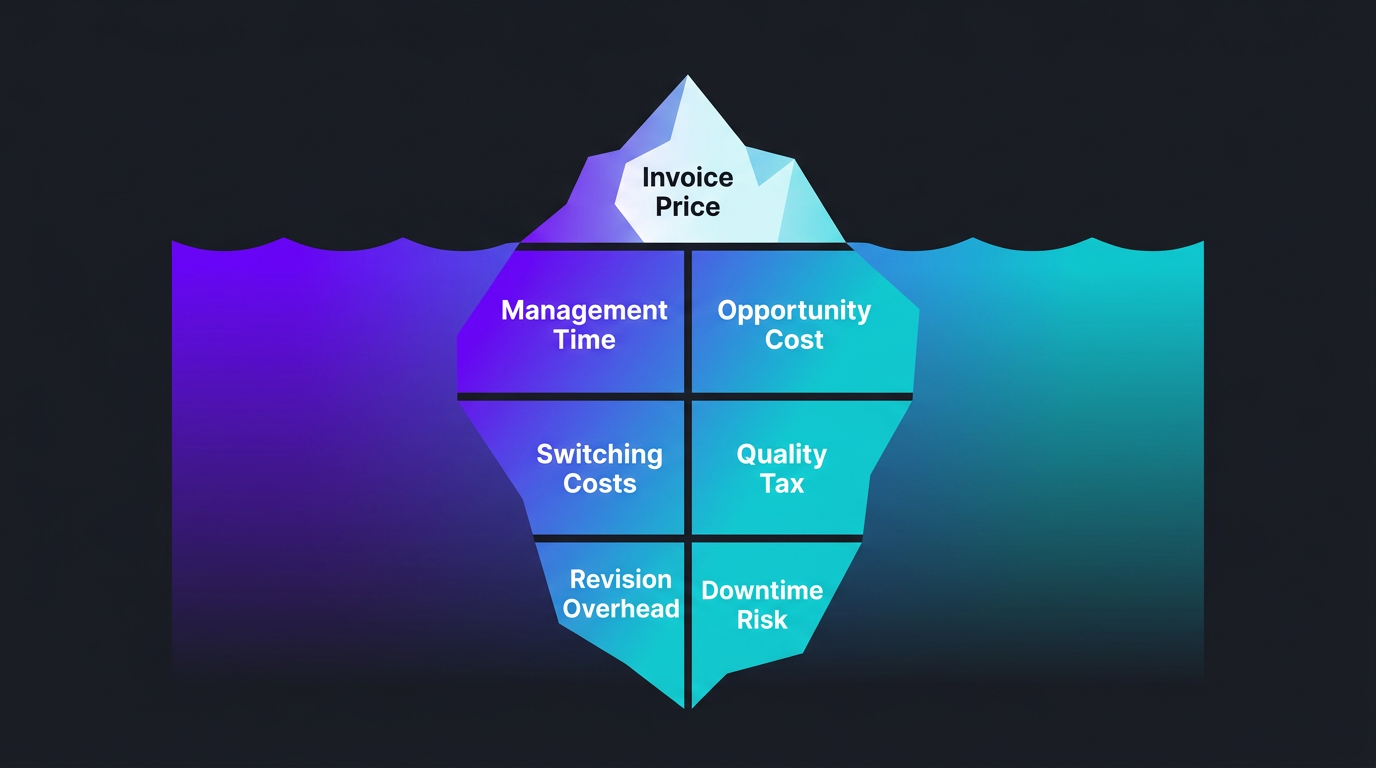
Every option has costs that don’t appear on invoices. These are the costs that make people regret their hiring decisions 6 months later.
Opportunity Cost (All Options)
The most expensive cost is what you’re NOT doing while managing editors. For a creator or business owner, every hour spent on editing operations is an hour not spent on:
- Creating new content
- Building partnerships and sponsorships
- Developing products or courses
- Strategic planning and audience research
- Actually running your business
The Switching Cost
Every time you change editors — whether freelancer to agency, one freelancer to another, or replacing a departed employee — you incur:
| Switching Cost | Freelancer → Freelancer | In-House → In-House | Any → Agency |
|---|---|---|---|
| Search & vetting time | 10–20 hours | 20–40 hours | 5–15 hours |
| Onboarding period | 2–4 weeks | 2–6 weeks | 1–2 weeks |
| Quality dip duration | 4–8 weeks | 4–8 weeks | 2–4 weeks |
| Estimated total cost | $2,000–$5,000 | $5,000–$15,000 | $1,000–$3,000 |
The Quality Tax
Cheaper editing doesn’t just look worse — it has measurable business impact:
- Lower retention rates: Poor editing directly correlates with viewer drop-off, which reduces YouTube algorithmic promotion
- Fewer sponsorship opportunities: Brands evaluate production quality when choosing creators to sponsor
- Reduced brand perception: For businesses, video quality signals company quality to prospects
- More revision rounds: Lower-skill editors need more feedback cycles, eating your time
Want to See the Real Numbers for Your Situation?
We’ll run a cost comparison specific to your volume, content type, and goals — with full transparency. See our client results first.
Cost Comparison Calculator: Run Your Own Numbers
Here’s a framework to calculate the true cost for your specific situation. Fill in your own numbers:
Step 1: Direct Costs
| Your Input | Freelancer | In-House | Agency |
|---|---|---|---|
| Videos per month: ___ | ___ × per-video rate | Monthly salary ÷ 12 | Monthly retainer |
| Your hourly value: $___ | × 7 hrs/week × 4 | × 4 hrs/week × 4 | × 1.5 hrs/week × 4 |
| Tools/software: $___/mo | Your cost | Their licenses | Included |
| Total monthly cost | Sum of above | Sum of above | Sum of above |
Step 2: Scenario Examples
Let’s run three realistic scenarios:
Scenario A: Small Creator (4 videos/month)
| Cost | Freelancer | In-House | Agency |
|---|---|---|---|
| Direct editing cost | $1,200 (4 × $300) | $7,000/mo total | $2,500/mo retainer |
| Your management time | $1,400 (5 hrs/wk × $70) | $840 (3 hrs/wk × $70) | $420 (1.5 hrs/wk × $70) |
| True monthly cost | $2,600 | $7,840 | $2,920 |
| Per-video effective rate | $650 | $1,960 | $730 |
| Best option | ✅ Winner | Way too expensive | Close second |
Scenario B: Growing Channel (12 videos/month)
| Cost | Freelancer | In-House | Agency |
|---|---|---|---|
| Direct editing cost | $3,600 (12 × $300) | $7,000/mo total | $4,500/mo retainer |
| Your management time | $2,800 (10 hrs/wk × $70) | $1,120 (4 hrs/wk × $70) | $420 (1.5 hrs/wk × $70) |
| True monthly cost | $6,400 | $8,120 | $4,920 |
| Per-video effective rate | $533 | $677 | $410 |
| Best option | Expensive with management | Most expensive | ✅ Winner |
Scenario C: Content Machine (30+ videos/month)
| Cost | Freelancer(s) | In-House (2 editors) | Agency (dedicated team) |
|---|---|---|---|
| Direct editing cost | $9,000 (30 × $300) | $14,000/mo total | $8,000/mo dedicated team |
| Your management time | $5,600 (20 hrs/wk × $70) | $2,100 (7.5 hrs/wk × $70) | $560 (2 hrs/wk × $70) |
| True monthly cost | $14,600 | $16,100 | $8,560 |
| Per-video effective rate | $487 | $537 | $285 |
| Best option | Unmanageable | Viable but rigid | ✅ Clear winner |
Cost by Volume: Where Each Option Breaks Even
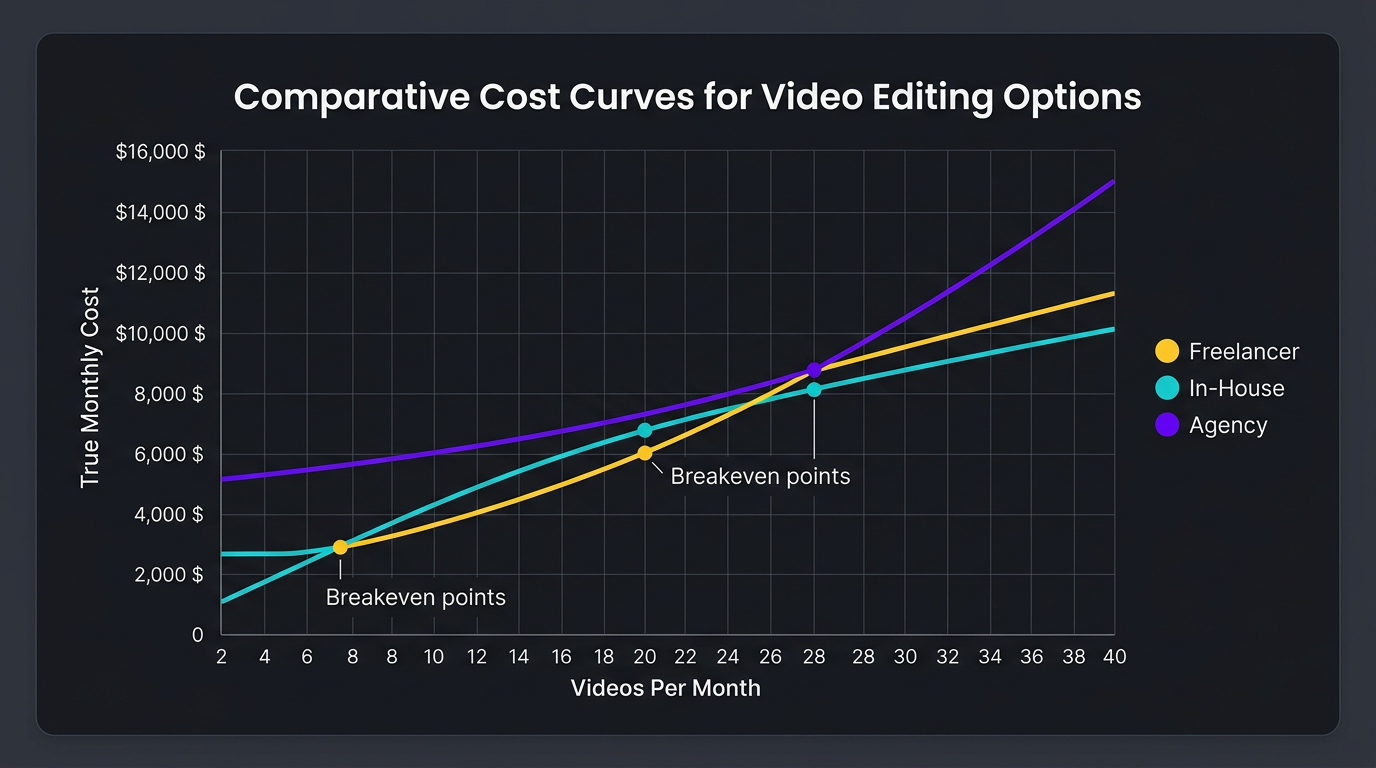
Here’s the crossover point where each option becomes more cost-effective than the others:
- 1-6 videos/month: Freelancer wins. Agency retainers and in-house salaries don’t make sense at this volume. Unless you value your management time very highly.
- 7-12 videos/month: Agency sweet spot. You need consistency and systems that freelancers can’t provide, but you don’t have enough volume to justify a full-time salary.
- 13-25 videos/month: Agency still wins on total cost. In-house becomes competitive if you need constant real-time iteration.
- 25+ videos/month: Agency dedicated team or in-house team. Often a hybrid: core in-house editor + agency for overflow and specialization.
Quality Differences You’re Paying For
Cost comparisons are meaningless if the quality isn’t comparable. Here’s what’s actually different in the output:
| Quality Factor | Budget Freelancer | Mid-Tier Freelancer | In-House Editor | Agency |
|---|---|---|---|---|
| Basic cuts & transitions | ✅ | ✅ | ✅ | ✅ |
| Color grading | ❌ Basic only | ✅ Good | ✅ Good | ✅ Specialist |
| Motion graphics | ❌ | ⚠️ Basic | ⚠️ If skilled | ✅ Dedicated MG artist |
| Sound design | ❌ | ⚠️ Basic | ⚠️ Basic | ✅ Included |
| Thumbnail creation | ❌ | ⚠️ Sometimes | ⚠️ Sometimes | ✅ Often included |
| Multi-format output | ❌ One format | ⚠️ Extra charge | ✅ If time allows | ✅ Standard |
| Brand consistency | ❌ Variable | ⚠️ Depends | ✅ Strong | ✅ Documented & enforced |
The quality gap matters most for channels and businesses where video is a primary revenue driver. If you’re producing internal training videos, a budget freelancer is fine. If your video content drives leads, sales, or ad revenue, quality differences have direct ROI implications.
For more on what quality levels look like in practice, check our portfolio of client work.
Hybrid Models That Actually Work
The smartest setups often combine options. Here are three hybrid models we’ve seen succeed:
Model 1: Agency Core + Freelancer Overflow
Use an agency for your primary content (YouTube long-form, brand videos) and a freelancer for overflow social clips. The agency maintains brand standards and handles the high-stakes content. The freelancer handles high-volume, lower-complexity work at a lower rate.
Best for: Businesses producing 10-15 premium videos + 20-30 social clips per month
Model 2: In-House Lead + Agency Specialization
Keep a junior/mid-level editor in-house for day-to-day quick-turn needs and real-time collaboration. Use an agency for VFX, color grading, and complex projects that require specialist skills your in-house editor doesn’t have.
Best for: Media companies and brands with daily content needs plus periodic high-production projects
Model 3: Agency Retainer + Per-Project Specialists
Use an agency retainer for consistent monthly volume. Bring in per-project freelance specialists (animation, 3D, sound design) for specific projects that require niche skills.
Best for: Agencies and production houses that need flexible specialist access without full-time overhead
Case Studies: Real Decisions, Real Numbers
Riley Coleman: From Freelancer Burnout to Agency Stability
Riley Coleman, a lifestyle and business content creator, went through four freelancers in 18 months. Each transition cost approximately 3 weeks of disrupted content and $2,000-$3,000 in search, testing, and onboarding. The total cost of freelancer instability over 18 months exceeded $10,000 — on top of the editing fees themselves.
After switching to an agency model, Riley’s editing costs increased by about 15% on paper. But the stability savings — no more editor searches, no more quality dips during transitions, no more managing revision cycles — reduced total cost by 25% and freed up 8 hours per week for content creation. Within 6 months, the increased upload consistency drove a 40% increase in monthly views.
TuMeke: Scaling from In-House to Agency for International Content
TuMeke, a tech-forward agricultural company, initially hired an in-house editor for their product videos and training content. The setup worked well for 12 videos per month. But when they expanded to multiple markets and needed content in different formats for different platforms, one editor became a bottleneck.
Rather than hiring a second full-time editor (adding $70,000+ in annual cost), they transitioned their overflow to an agency partner. The hybrid model — in-house editor for quick-turn internal content, agency for polished marketing and multi-format output — reduced their per-video cost by 30% and doubled their content capacity without adding headcount.
Ink Magnet: The Cost of Cheap Freelancers
Ink Magnet, a creative services brand, tried to save money by using budget freelancers from Fiverr for their video content. At $75-$150 per video, the direct cost was incredibly low. But the hidden costs were staggering:
- Average 4 revision rounds per video (vs. industry standard of 1-2)
- Founder spent 12+ hours per week managing editors and providing feedback
- Inconsistent quality damaged brand perception — they lost two prospective clients who cited video quality as a concern
- Three months of content had to be re-edited when they eventually upgraded
The “savings” of $1,500/month in editing fees cost an estimated $8,000+/month in management time, lost business, and rework. The lesson: below a certain quality threshold, cheap editing is the most expensive option.
Decision Framework: Which Is Right for You?
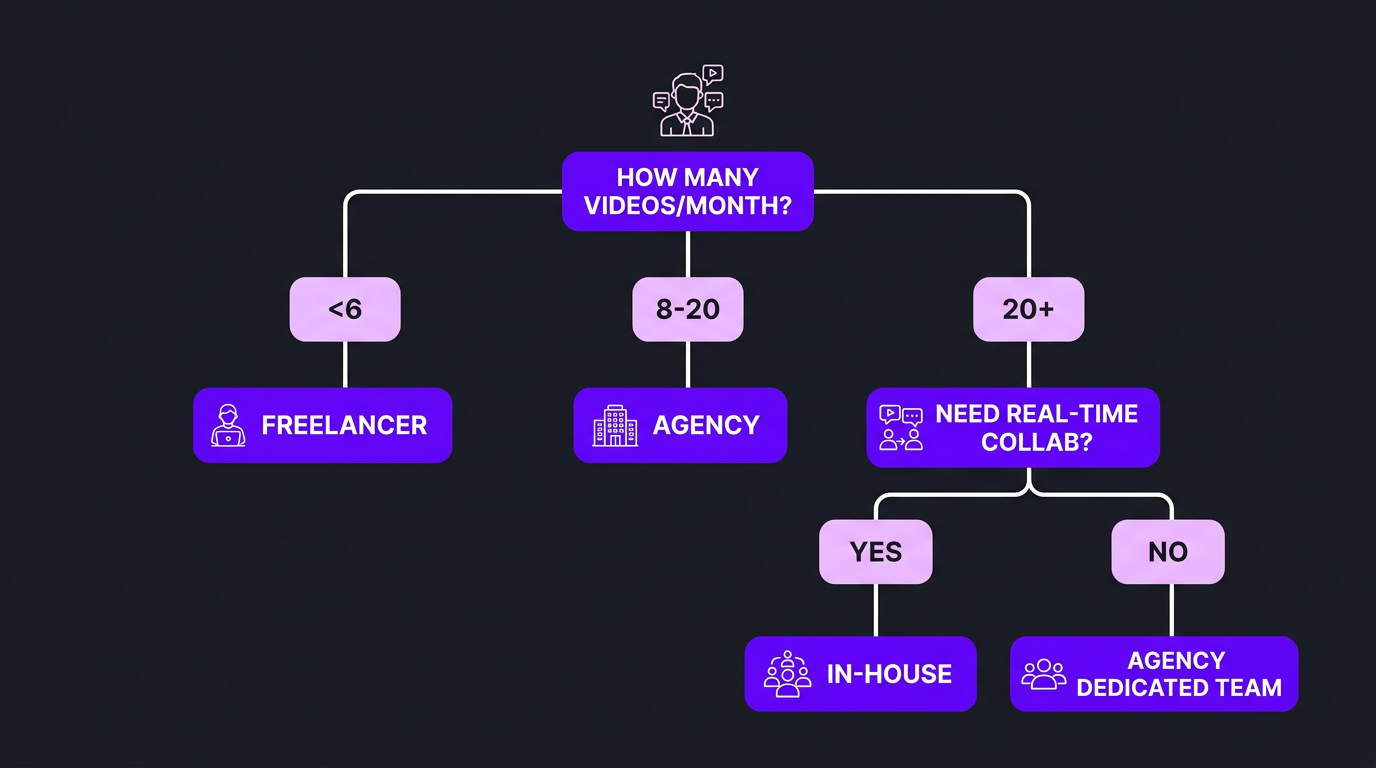
Use this framework to guide your decision:
Choose a Freelancer If:
- You produce fewer than 6 videos per month
- Your budget is under $2,000/month total
- You don’t mind managing the relationship yourself
- You have time to find and vet a good one
- You have a backup plan if they become unavailable
Choose In-House If:
- You produce content daily and need real-time collaboration
- Video editing is deeply integrated with your creative process
- You have HR infrastructure to hire, manage, and retain talent
- Your budget supports $80,000+/year total cost
- You can tolerate the risk of a single point of failure
Choose an Agency If:
- You produce 8+ videos per month and need consistency
- You want minimal management overhead
- You need multiple skills (editing + color + motion graphics + PM)
- Scalability matters — you need to ramp up or down flexibly
- Backup coverage and guaranteed turnaround are important
Still unsure? The best approach is to talk through your specific situation with a team that can give you an honest assessment — even if the answer is “you don’t need us right now.”
For startups specifically, agencies often provide the best balance of quality and cash flow management since there’s no long-term salary commitment.
Not Sure Which Model Fits Your Needs?
We’ll give you an honest recommendation — even if the answer is that you don’t need an agency yet. Let’s look at your numbers together.
Frequently Asked Questions
It depends on volume. Under 6 videos/month, freelancers are cheapest at $200-$500 per video. At 8-20 videos/month, agencies offer the best value at $2,500-$6,000/month because you get a full team for less than one salary. At 20+ videos/month, dedicated agency teams or in-house become competitive — but agencies typically still win on total cost when you include management overhead.
Total cost is $55,000-$100,000/year including salary ($40,000-$70,000), benefits ($8,000-$18,000), equipment ($2,000-$5,000), software ($1,200-$3,000), and recruiting costs. Senior editors with motion graphics skills can exceed $120,000/year in major cities. See our pricing page for agency alternatives.
Major hidden costs include your project management time (5-10 hrs/week), extra revision rounds, replacement cycles when freelancers leave (every 4-8 months on average), and zero backup coverage. These typically add 30-50% to the apparent freelancer rate, making a $300/video freelancer effectively cost $450-$700/video.
Key triggers: you need 8+ videos/month consistently, you’re spending 5+ hours/week managing your editor, quality is inconsistent, you need faster turnaround, or your freelancer has become a single point of failure. If any two of these are true, an agency will likely reduce your total cost while improving output quality.
Agencies bundle: dedicated project management, backup editors, quality control review, multiple specialists (editor + colorist + motion graphics), brand documentation, SLA-backed turnaround, and flexible scalability. With a freelancer, you provide all project management, quality control, and have zero backup — learn more about our team model.
Add: direct editing costs + your management time (hours × your hourly rate) + revision costs + tools/software + opportunity cost of delayed or lower-quality content. For freelancers, add 30-50% overhead. For in-house, add benefits (20-30% of salary), equipment ($3,000-$5,000/yr), and software ($1,200-$3,000/yr). Use the calculator framework in this article for your specific numbers.
Yes — hybrid models often work best. Common setups: agency for core YouTube content + freelancer for social clips, or in-house editor for daily quick-turns + agency for premium content and specialization. The key is clear ownership of brand standards and quality control. Talk to us about designing a hybrid setup for your needs.
Cost data in this article reflects 2026 U.S. market rates. Actual costs vary by region, content complexity, and specific provider. For current Increditors pricing, visit our pricing page or schedule a call.