








![3D Explainer Video - ScribbleLive.mp4_snapshot_00.12_[2022.03.09_03.14.16]](https://increditors.com/wp-content/uploads/elementor/thumbs/3D-Explainer-Video-ScribbleLive.mp4_snapshot_00.12_2022.03.09_03.14.16-r7wb53mx72rxst3qcqyrfxdmeyzb5r9jbl0wbjujh4.png "3D Explainer Video – ScribbleLive.mp4_snapshot_00.12_[2022.03.09_03.14.16]")




























The first 30 days with a new video editing team set the ceiling for everything that follows — quality, turnaround speed, and creative alignment. This guide gives marketing directors a structured, week-by-week onboarding framework: pre-work checklists, calibration milestones, feedback systems, and a repeatable playbook so every new editor hits the ground running and stays there.
- Why the First 30 Days Define Long-Term Video Quality
- Before Day 1 — Pre-Onboarding Essentials
- Week 1: Orientation and Workflow Alignment
- Weeks 2–3: Calibration, Feedback, and Brand Voice
- Week 4: Performance Baseline and Long-Term Playbook
- In-House vs. Agency Onboarding — What Changes
- The Onboarding Toolkit — Templates and Checklists
- Common Onboarding Mistakes That Kill Momentum
- FAQ
- Verdict
Why the First 30 Days Define Long-Term Video Quality
The quality ceiling of any video editing relationship — internal hire or external agency — is set in the first 30 days. Not the first quarter. Not after the second project. The first month is when mental models form: how the editor interprets your briefs, what “good” looks like in your organization’s eyes, and how much autonomy they can exercise before checking back in. Miss this window and you spend the next six months correcting habits that hardened into defaults.
Most marketing directors understand employee onboarding in the abstract — but video editing teams carry unique complexity. You are not just aligning someone to a culture or a process; you are aligning them to a visual language. Every decision they make — cut timing, color grade, motion graphic style, music mood — either reinforces or dilutes your brand. A poor brief creates a mediocre edit. A missing feedback framework creates a demoralized editor who stops asking questions and starts guessing. A missing style reference means every project starts from scratch.
Research published by the Society for Human Resource Management consistently finds that organizations with structured onboarding programs see meaningfully faster time-to-proficiency and better long-term retention compared to those that rely on ad hoc approaches. For creative roles — where subjective judgment, brand intuition, and client communication all overlap — that structure matters even more. The onboarding process for a video editor is not just HR paperwork; it is a quality system.
This guide is written for marketing directors at growth-stage and enterprise companies who are either hiring their first dedicated editor, scaling from one editor to a team, or onboarding an external video editing agency as a strategic partner. The framework below has been distilled from the operational patterns that consistently produce fast ramp-up times and high-quality output from the first delivery onward.
The Hidden Cost of Skipping Structure
When onboarding is unstructured, the costs are diffuse and hard to measure — which is exactly why they persist. Revision cycles run long because expectations were never stated precisely. Editors produce technically correct work that feels off-brand because no one showed them what “on-brand” actually looks like in motion. Deadlines slip because handoff processes were never documented. And eventually, a talented editor leaves because they never felt like they understood what success looked like in their role.
The framework in this guide addresses each of these failure modes directly. It is structured around four phases — pre-onboarding, week 1, weeks 2–3, and week 4 — with specific deliverables and checkpoints at each stage. It applies whether you are bringing someone in-house or starting a retainer with an external team.
Before Day 1 — Pre-Onboarding Essentials
Effective onboarding does not begin on the first day of work. It begins two to three weeks earlier, when you assemble everything the new editor or team will need to hit the ground running. If they arrive to find empty Dropboxes, unanswered access requests, and a vague project brief, you have already lost the first week to logistics. Here is what needs to be in place before Day 1.
Build Your Brand Reference Package
The brand reference package is the single most important document you can hand a new video editor. It answers the questions they will otherwise ask repeatedly — or worse, answer themselves incorrectly. A solid package includes:
- Logo files — all formats, with clear rules on minimum size, clear space, and what backgrounds they can appear on
- Brand color palette with hex and RGB codes — and explicit guidance on which colors are primary vs. accent in video contexts
- Typography guidelines — which fonts appear in lower thirds, titles, and credits; whether they animate in or appear static
- Motion language reference — 3–5 video examples that exemplify your brand’s pacing, energy, and transition style
- Audio guidelines — preferred music genres, tempo ranges, and any licensed music libraries you have access to
- What NOT to do — examples of off-brand work, even if hypothetical, are sometimes more instructive than the positive examples
💡 Pro Tip: If you do not have a formal video style guide yet, create one now — even a rough one. Use your three best-performing videos as the benchmark. Annotate what works in each: cut rhythm, color treatment, lower-third animation style. This document pays dividends for every editor you ever hire or work with.
Access and Tools Setup
Tool access is tedious to set up and catastrophic to forget. Create a pre-onboarding checklist that your ops or IT team completes at least five business days before start. For video editing teams, this typically includes:
- Project management tool access (Asana, Monday, Notion)
- File storage with appropriate folder permissions (Frame.io, Dropbox, Google Drive, or your DAM system)
- Video review platform invite (Frame.io, Vimeo Review, or similar)
- Communication channel access (Slack, Teams)
- Software licenses if relevant (Adobe Creative Cloud seat for in-house hires)
- Shared music library access (Artlist, Musicbed, Epidemic Sound)
Define the First Project Before They Start
The worst thing you can do to a new editor is give them downtime on day one. It signals disorganization. It wastes their energy. And it means their first impression is waiting, not creating. Define the first project — ideally a medium-complexity deliverable, not your most critical campaign — before they arrive. Write a complete brief in advance so you can hand it over immediately.
Week 1: Orientation and Workflow Alignment
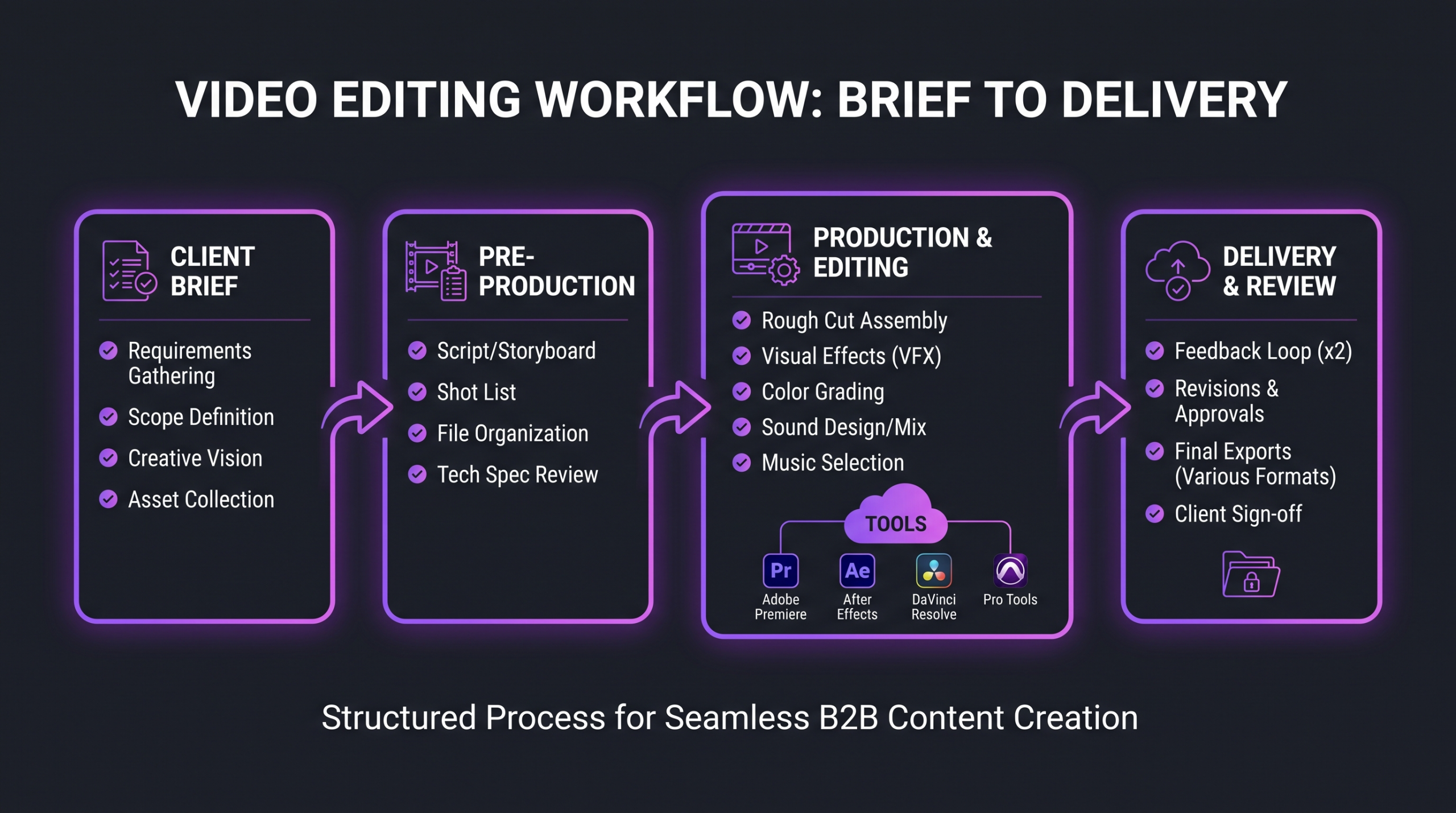
Week 1 has one job: eliminate ambiguity. By the end of Friday, every editor on the team should understand how work comes in, how it moves through review, and what good output looks like. Everything else — speed, creative autonomy, advanced brand intuition — comes later.
Day 1: Orientation Session
Block two hours on day one for a structured orientation session. This is not a culture presentation — it is an operational alignment meeting. Cover:
- Your content ecosystem — which channels you produce for, the purpose of each, and how they relate
- Who the stakeholders are — who writes briefs, who reviews, who has final approval, and what each of their feedback styles tends to be
- Revision protocol — how many revision rounds are standard, what constitutes a new revision vs. a minor fix, and how revisions are communicated
- Turnaround expectations — standard SLAs for different video types; what triggers a rush and how rush is communicated
- The brief format — walk through a real completed brief so they understand what level of detail you typically provide
Days 2–5: First Project Delivery
By Tuesday, the editor should be actively working on the first project. Your job this week is not to hover but to be available. Schedule a 15-minute check-in on day two and again on day four. Ask:
- Does the brief make sense? What is unclear?
- Do you have all the assets you need?
- Are there any technical questions about the workflow?
The goal is to surface friction before it causes a missed deadline or a bad first deliverable. When the first draft arrives, give detailed written feedback — not just “looks good” or “not quite right.” Explain your reasoning: why a specific cut feels slow, what the music choice communicates that you do not want, what the motion graphic timing is doing to the perceived energy of the piece. This feedback is curriculum. It teaches the editor how you think.
Weeks 2–3: Calibration, Feedback, and Brand Voice
By week two, the basics are in place. The editor knows the tools, understands the workflow, and has delivered at least one project. Now the real calibration begins. This is the phase where you move from “can they do the work?” to “are they doing it in the way that serves our brand specifically?”
Introduce Complexity Gradually
In weeks two and three, assign two to three projects of increasing complexity. If week one was a short social clip, week two might be a 90-second product video. Week three might introduce a multi-deliverable package — the same source footage cut for YouTube, LinkedIn, and Instagram Stories simultaneously. Increasing complexity stress-tests their judgment and reveals gaps in the brief or workflow that you will want to address before they become recurring problems.
Run a Structured Mid-Point Review
At the end of week two, block 30 minutes for a structured midpoint review. This is not a performance review in the HR sense — it is a calibration session. Cover three areas:
- What is working well — name specific technical or creative choices you appreciated in their recent work and explain why they worked
- What needs calibration — specific feedback on creative decisions that missed the mark, with clear articulation of what you were looking for instead
- Process friction — ask what is slowing them down or causing confusion; surface systemic issues you can fix now
💡 Pro Tip: Frame feedback in terms of audience impact, not personal taste. “This music makes the product look slow and enterprise-y — our audience is fast-moving startup teams, so we want something that feels agile” is more actionable and more educational than “I don’t like this music.” You are teaching the editor to think like your audience, not to read your mind.
Build the Feedback Loop System
One of the most common failure modes in video editing team relationships — whether in-house or external — is feedback that arrives too late, from too many sources, or in inconsistent formats. By week three, you should have a documented feedback protocol that everyone follows. A well-functioning system looks like this:
- Single point of contact — one person consolidates feedback from all internal stakeholders before it goes to the editor; editors should not be receiving conflicting notes from three different people simultaneously
- Timestamped, specific notes — use a video review platform (Frame.io, Vimeo Review) so feedback is attached to specific moments in the timeline, not vague email descriptions like “the middle section felt long”
- Clear revision round definition — define what constitutes round 1 vs. round 2 feedback in writing; round 1 covers structural issues (pacing, structure, music direction); round 2 is fine-tuning (color, text polish, audio levels)
- Turnaround confirmation — the editor confirms receipt of notes and provides an estimated delivery time before starting the revision; no silent delivery windows
Week 4: Performance Baseline and Long-Term Playbook
Week four is about institutionalizing what you have learned. By now, you have seen how the team approaches a brief, how they handle feedback, and where their creative instincts align or diverge from yours. The goal this week is to document those learnings so they inform every future project — and so new team members can onboard faster next time.
Establish a Performance Baseline
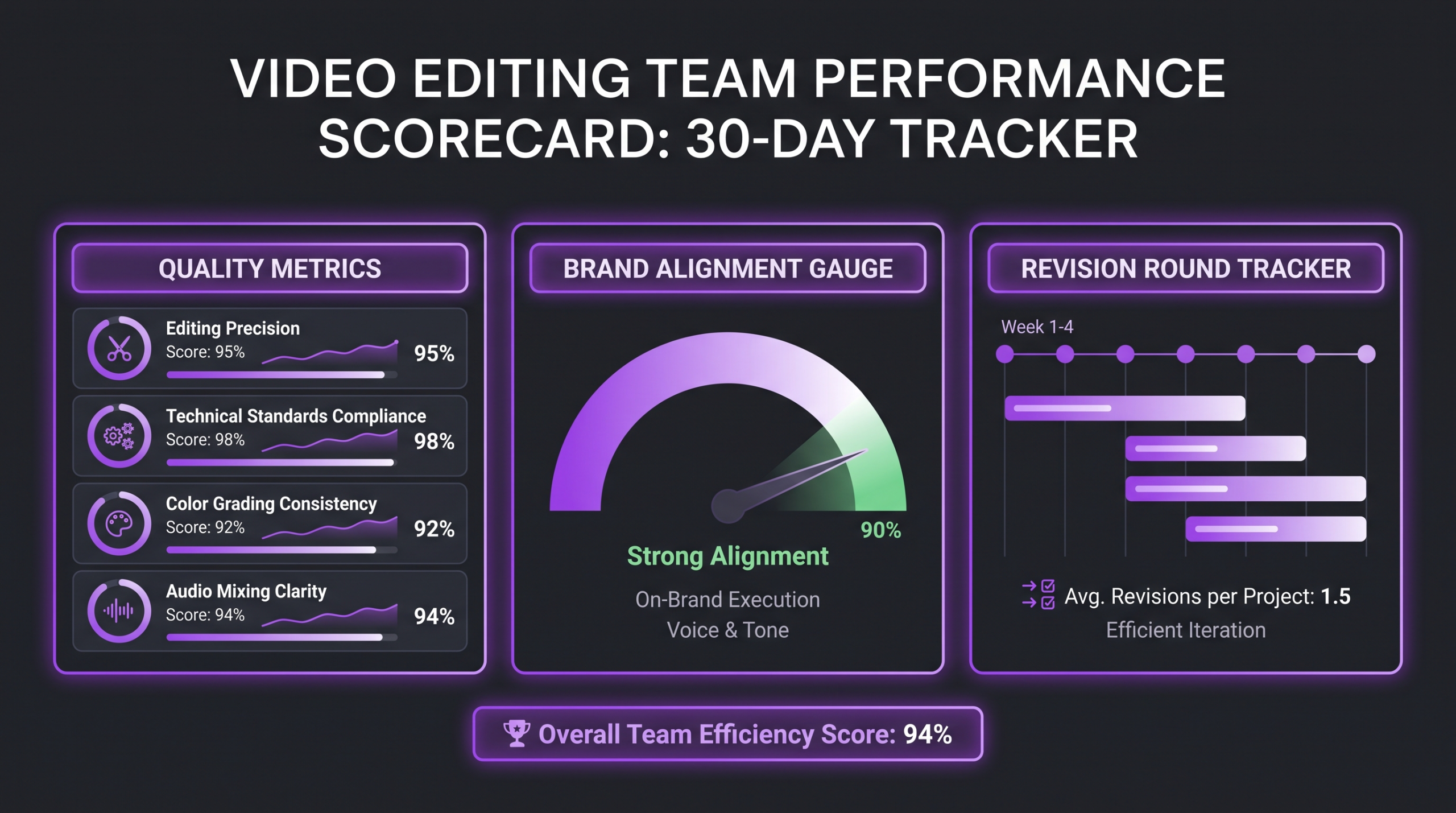
At the end of week four, review the first month’s output against three dimensions:
- Technical quality — were deliverables export-ready? Were there recurring technical errors (wrong resolution, incorrect frame rate, audio normalization issues)?
- Brand alignment — on a scale of 1–5, how consistently did the work feel on-brand without requiring major revision? Did the calibration sessions move this number up over the month?
- Process efficiency — how many revision rounds did each project require on average? Were deadlines met? Were briefs returned with questions that should have been in the brief?
Document this baseline in writing. It gives you a reference point for the 90-day review and a benchmark for comparing future team members. It also gives the editing team transparent visibility into how their performance is being evaluated — which is fundamental to retaining good talent. Understanding how much professional video editing costs relative to output quality is part of this ROI calculus.
Write the Editing Team Playbook
The playbook is the living document that captures everything you learned in the first 30 days about how your organization works with a video team. It should include:
- The brief template you use and the minimum information it must contain
- The revision round protocol with specific definitions
- The feedback system (platform, single point of contact, response SLA)
- Known brand decisions — “we always use X transition style, we never use Y” — that should not require a brief to communicate
- File naming conventions, export specs by deliverable type, and delivery folder structure
- Escalation path for when a project is at risk
In-House vs. Agency Onboarding — What Changes
The 30-day onboarding framework applies whether you are integrating an in-house hire or starting a retainer with a video editing agency vs. freelancer arrangement. But the dynamics differ in important ways. Understanding those differences helps you calibrate your time investment and expectations at each stage.
One important note on the agency side: not all external partners onboard the same way. A one-off freelancer relationship operates very differently from a dedicated agency retainer with a named team. With the latter — the model used by Increditors — the team assigned to your account builds institutional knowledge over time, meaning the calibration investment you make in month one continues to pay forward for the duration of the engagement, not just until the next project.
Adapting the Framework for Each Model
For in-house hires, the framework leans heavier on the culture and process dimensions. You are investing in a person who will grow with the organization. Spend more time in weeks two and three on career context — where they can develop their skills, what the path to senior editor looks like, and how video fits into the company’s long-term content strategy. This is not just good HR; it is retention strategy.
For external teams, the framework leans heavier on brief quality and communication systems. The agency brings the craft expertise; your job is to make it easy for them to apply that expertise correctly. The single biggest lever you control is brief quality. According to research on creative collaboration dynamics at Harvard Business Review, unclear directives are a primary driver of rework and scope creep in creative projects. A great agency will ask clarifying questions; a great brief means fewer questions needed and faster turnaround.
The Onboarding Toolkit — Templates and Checklists
Concrete tools eliminate ambiguity. Below is the core documentation set you should have in place by the end of the first 30 days. These do not need to be elaborate — a well-structured Google Doc or Notion page is sufficient. What matters is that they exist, are accessible, and are actually used.
The Standard Video Brief Template
Every project should start with a written brief. Adapt this structure to your organization:
- Project name and deliverable type (e.g., “Q4 Product Launch — 60-second hero video for YouTube”)
- Audience — who is watching this, what do they already know, what do we want them to feel or do
- Key message — the one thing the viewer should take away; not three things
- Assets provided — footage files, audio files, graphic assets, script or VO; with folder links
- Reference videos — 2–3 examples of the style, energy, or structure you want
- Do not do list — any elements explicitly off-limits for this project
- Export specs — resolution, frame rate, aspect ratios needed, codec
- Deadline — for first draft, for revisions, for final delivery
- Review and approval path — who reviews, in what order, who gives final sign-off
30-Day Onboarding Milestone Checklist
Common Onboarding Mistakes That Kill Momentum
Even well-intentioned onboarding can go wrong in predictable ways. These are the patterns that most frequently derail the first 30 days and how to avoid them.
Starting with Your Most Critical Project
The first project should never be your flagship campaign, your most visible deliverable, or anything with a hard external deadline you cannot push. The first project is a calibration instrument — its purpose is to reveal gaps, not to perform. Use a real project with real stakes, but one with buffer if something needs to be redone. Protect your most important work for week three, once calibration is underway.
Treating Feedback as Opinion, Not Curriculum
Feedback like “make it more exciting” or “it feels slow” communicates nothing the editor can act on systematically. The Gallup research on manager effectiveness consistently shows that new hires who receive clear, specific feedback in their first 30 days are significantly more likely to stay and develop into high performers. In video editing, this translates directly: vague feedback produces repeated guessing. Specific, reasoned feedback builds a model the editor can apply independently.
Letting Feedback Come from Multiple Directions
Nothing derails a new editing team faster than contradictory feedback. The CEO wants it snappier. The CMO wants it warmer. The brand manager wants less music. If all three communicate directly to the editor, the editor is in an impossible position and will lose confidence in the organization’s ability to know what it wants. Establish a single point of contact for feedback before day one. That person consolidates, resolves conflicts internally, and delivers one coherent direction.
Skipping the 30-Day Review
Many organizations let the first 30 days pass without a formal review, then wonder why six months later the editor still does not quite “get” the brand. The 30-day review is the mechanism for catching and correcting drift early. Schedule it in the first week’s calendar invitation so it cannot be deprioritized out of existence. According to LinkedIn Learning research on onboarding effectiveness, structured 30-day check-ins are among the highest-leverage investments a manager can make in a new creative hire’s development arc.
Failing to Document What You Learned
If the playbook does not get written, the institutional knowledge stays in the manager’s head — and disappears when that manager changes roles or leaves. Every discovery from the first 30 days, from the brand decisions you made to the feedback patterns that worked, should be documented. Platforms like Notion or Confluence work well for living playbooks. The goal is that a new marketing director joining the organization six months from now could hand this document to a new editor and have them onboard 50% faster than you did the first time.
Frequently Asked Questions
How long does it realistically take to onboard a video editing team to full productivity?
For in-house hires, teams commonly report 60–90 days before an editor is consistently delivering on-brand work with minimal revision rounds. With a structured 30-day onboarding framework, experienced professionals can reach effective calibration by the end of the first month — but true brand depth typically develops over three to six months. For agency teams with a dedicated model, the calibration window is often shorter because the agency brings process discipline; many clients report reaching comfortable output velocity by the end of week three.
What is the single highest-leverage thing I can do before the team starts?
Building the brand reference package — particularly the motion language reference with annotated video examples — has the highest payoff of any pre-onboarding investment. It answers the questions an editor will otherwise spend the first two weeks asking, and it gives them a visual vocabulary to work from rather than guessing. If you only have time for one pre-onboarding document, make it this one.
Should I give detailed briefs for every project, even once the team is calibrated?
Brief requirements typically decrease as calibration deepens, but they should never disappear entirely. For recurring formats — weekly social clips, templated product demos — a lightweight brief (audience, key message, assets, deadline) is usually sufficient. For new formats, new campaigns, or anything with unusual creative direction, a full brief is always worth the investment. The cost of a detailed brief is one hour; the cost of misaligned creative is an entire revision cycle.
What if the editor is technically skilled but consistently misses our brand voice?
This is a calibration issue, not a capability issue — and it is almost always traceable to insufficient reference material or inconsistent feedback. Before escalating to a performance conversation, audit your brief quality and your feedback specificity. Are you providing clear motion language examples? Are you explaining the why behind your feedback? Are there conflicting signals from different stakeholders? In most cases, improving the brief and feedback systems resolves the alignment problem within two to three additional projects.
When should we consider outsourcing our video editing instead of hiring in-house?
The in-house vs. outsourced decision depends on volume, consistency, and the depth of brand integration you need. If your video output is variable — heavy in some months, light in others — an agency retainer is often more cost-efficient than carrying a full-time editor through slow periods. If you need a broad range of styles across multiple channels and content types, an agency team with specialized expertise in different formats can deliver quality that would require multiple in-house hires to replicate. The decision framework for this is covered in depth in Increditors’ guide to video editing agency vs. freelancer options.
Verdict
The first 30 days with a video editing team are an investment in every project that follows. Organizations that approach onboarding with structure — a brand reference package, a clear workflow, deliberate calibration sessions, and a documented playbook — consistently reach higher output quality faster than those that wing it. The framework in this guide is not a bureaucratic overhead; it is a compounding asset.
For marketing directors at companies spending serious budget on video content, the 30-day onboarding period is the highest-leverage window you have. Use it well and the return is felt across every campaign for the next year. Let it drift into ambiguity and you will spend the next six months managing misalignment instead of scaling content that converts.
Whether you are building an in-house team or evaluating an external partner, the principles are the same: structure before speed, clarity before volume, documentation before delegation. The organizations that get video right at scale are the ones that invested in the foundation before they tried to build on it.
Ready for Video That Actually Converts?
Tell us about your project and we will put together a custom plan.