








![3D Explainer Video - ScribbleLive.mp4_snapshot_00.12_[2022.03.09_03.14.16]](https://increditors.com/wp-content/uploads/elementor/thumbs/3D-Explainer-Video-ScribbleLive.mp4_snapshot_00.12_2022.03.09_03.14.16-r7wb53mx72rxst3qcqyrfxdmeyzb5r9jbl0wbjujh4.png "3D Explainer Video – ScribbleLive.mp4_snapshot_00.12_[2022.03.09_03.14.16]")




























Video localization costs vary dramatically by method: subtitles typically run $1–$10 per minute of video, professional dubbing ranges from $200–$2,000+ per finished minute depending on language and talent, and full multi-language localization workflows for a 30-minute course can run $5,000–$50,000+. Dubbing costs the most per-method but delivers the highest retention in non-English markets. This guide breaks down every cost layer—subtitles, dubbing, voiceover, cultural adaptation, and QA review—so you can build a realistic localization budget before you start.
What Video Localization Actually Costs in 2026
The cost ranges below are directional planning ranges, not universal rate cards. For technical and accessibility context, compare W3C caption guidance and W3C transcript guidance; for machine-translation cost context, review Google Cloud Translation pricing and DeepL API plan information. Human review, timing, cultural adaptation, and video finishing are still separate production costs.
Video localization is not a single service with a single price. It is a stack of decisions—each one adding cost, reach, and audience quality—and the range between the cheapest and most expensive options spans two orders of magnitude. Companies budget anywhere from a few hundred dollars for basic subtitle files on a short video to several hundred thousand for enterprise-grade multi-language dubbing programs across dozens of markets.
The most common confusion is treating “localization” as a single line item. In practice, your localization budget has six distinct cost layers: transcription, translation, adaptation, subtitle/caption delivery, dubbing or voiceover recording, and quality assurance review. Understanding what drives cost at each layer is the only reliable way to forecast a budget that holds.
This guide focuses especially on dubbing and voiceover costs—the most expensive and most underestimated components—while also covering subtitles and the full end-to-end workflow. If your primary need is caption or subtitle pricing only, the Video Captioning and Subtitling Cost guide breaks that segment down in more depth. This post covers the full localization spectrum, with dubbing as the centerpiece.
The Four Main Localization Methods and Their Cost Positions
Before breaking down individual cost layers, here is where each method sits in the cost spectrum. These figures are hedged market ranges drawn from published agency rate cards, platform pricing pages, and common industry benchmarks—not precise quotes, as actual pricing depends heavily on language pair, volume, turnaround, and production quality level.
The numbers above are per-method costs only—they exclude transcription, project management, adaptation, and QA review, which can add 20–60% to the total depending on project complexity. Each of those layers is detailed in the workflow section below.
Subtitle and Caption Costs
Subtitles are the most affordable localization method and the logical starting point for teams entering new markets on limited budgets. Human translation into a single target language typically costs $3–$10 per source minute of video, with major variables being the language pair, translation complexity, and delivery format required.
What Moves Subtitle Pricing
Language pair difficulty. Translating English into Spanish or French costs less than translating into Japanese, Korean, Arabic, or Thai—language pairs with significantly different grammar structures, text expansion ratios, and smaller translator pools for specialized content (legal, medical, B2B SaaS). Common European language pairs often sit at the lower end of the range; Asian language pairs and RTL languages tend to sit at the upper end or above.
Subtitle formatting and file type. Delivering a plain SRT file costs less than delivering SRT + VTT + burn-in for multiple platforms. If you need subtitles embedded into multiple video versions (YouTube, LinkedIn, broadcast), that multiplies the encoding work even if the translation itself is identical.
Technical content density. A product demo full of UI labels, keyboard shortcuts, and brand names takes longer to translate accurately than a narrated brand story. Complex content typically carries a 20–40% rate premium over general business content.
For a more detailed breakdown of subtitle and caption pricing models—including per-word vs. per-minute billing, platform-specific caption requirements, and the cost difference between open and closed captions—see the dedicated Video Captioning and Subtitling Cost 2026 guide.
💡 Pro Tip: If you are distributing across multiple platforms (YouTube, LinkedIn, Meta, broadcast TV), plan subtitle delivery formats at the start of the project—not after translation is complete. Reformatting translated subtitle files from SRT to timed-text XML or burn-in costs extra and adds 2–5 business days to delivery.
Dubbing and Voiceover Costs: The Full Picture
Dubbing is the most expensive localization method—and the one most frequently misquoted in early budget conversations. The gap between a $200/finished-minute and a $2,000/finished-minute dub is not just quality; it reflects entirely different production models, talent tiers, and lip-sync requirements.
Voiceover vs. Dubbing: The Core Cost Distinction
Non-sync voiceover is a narrated read of translated content where the voice does not need to match on-screen lip movement. This is common for e-learning courses, corporate training, explainer videos, and documentary-style content where speakers are rarely on screen. Voice talent records to a translated script; timing flexibility makes recording sessions faster and less expensive. Published rate cards from major voiceover talent platforms suggest non-sync voiceover in common languages typically ranges from $50–$400 per finished minute, with the variance driven almost entirely by talent tier and studio fees.
Full dubbing with lip-sync requires the translated script to be adapted (“lip-sync adaptation”) so that mouth movements roughly match what is said. This adaptation work—separate from straight translation—adds a meaningful step before recording begins. Dubbing sessions are also slower than voiceover sessions because actors must match timing cues and emotional delivery. Depending on talent market, language, and content type, full dubbing commonly runs $200–$2,000+ per finished minute across published agency and studio rate structures.
What Drives Dubbing Costs
One budget item teams consistently underestimate is the minimum order floor. Many professional dubbing studios and agencies set project minimums of $500–$2,000 regardless of video length, which disproportionately affects short-form content. A 90-second social video that would cost $200 at standard rate may carry a $600 minimum. If you are localizing high volumes of short-form content, batching into combined sessions significantly reduces per-video cost.
AI Dubbing: Real Costs and Real Limitations
AI dubbing platforms—ElevenLabs, Papercup, Deepdub, HeyGen, and others—have reduced the barrier to entry for dubbed localization significantly. Published pricing from these platforms typically ranges from $20–$150 per finished minute of dubbed content, depending on the tier and language. The cost savings over professional human dubbing are real and meaningful, especially for high-volume internal content.
However, AI-dubbed audio still has audible characteristics that trained viewers notice—particularly in expressive content, complex emotional delivery, or dialogues with multiple overlapping speakers. For external-facing marketing, product demos, and executive communications, most teams that have shipped AI-dubbed content publicly report investing in at least a human review pass to correct the 10–20% of segments that AI gets wrong. That review pass often costs $0.50–$2 per finished minute, partially eroding the savings. For a detailed look at which video types are ready for AI dubbing and which are not yet, the AI Video Dubbing in 2026: What Is Actually Ready for Production Use covers the production readiness question directly.
💡 Pro Tip: AI dubbing works best for single-speaker narration, e-learning modules, and internal training. It is least reliable for multi-speaker interviews, content with heavy cultural idioms, or any video where the speaker’s face is prominently on screen and lip-sync quality will be scrutinized.
Full Localization Workflow Cost Breakdown
The method cost (subtitles, voiceover, dubbing) is only part of the total localization budget. Every project also involves upstream steps—transcription, translation, adaptation—and a downstream quality assurance cycle. These add-on costs are frequently omitted from early vendor quotes and emerge as surprises mid-project.
Below is a cost model for a 30-minute English-language video library (say, a SaaS product demo series) localized into three languages—Spanish, French, and Japanese—using professional human subtitles plus non-sync voiceover for each language. These numbers illustrate the cost layers involved, not a firm quote. Actual costs will vary by vendor, volume, and market.
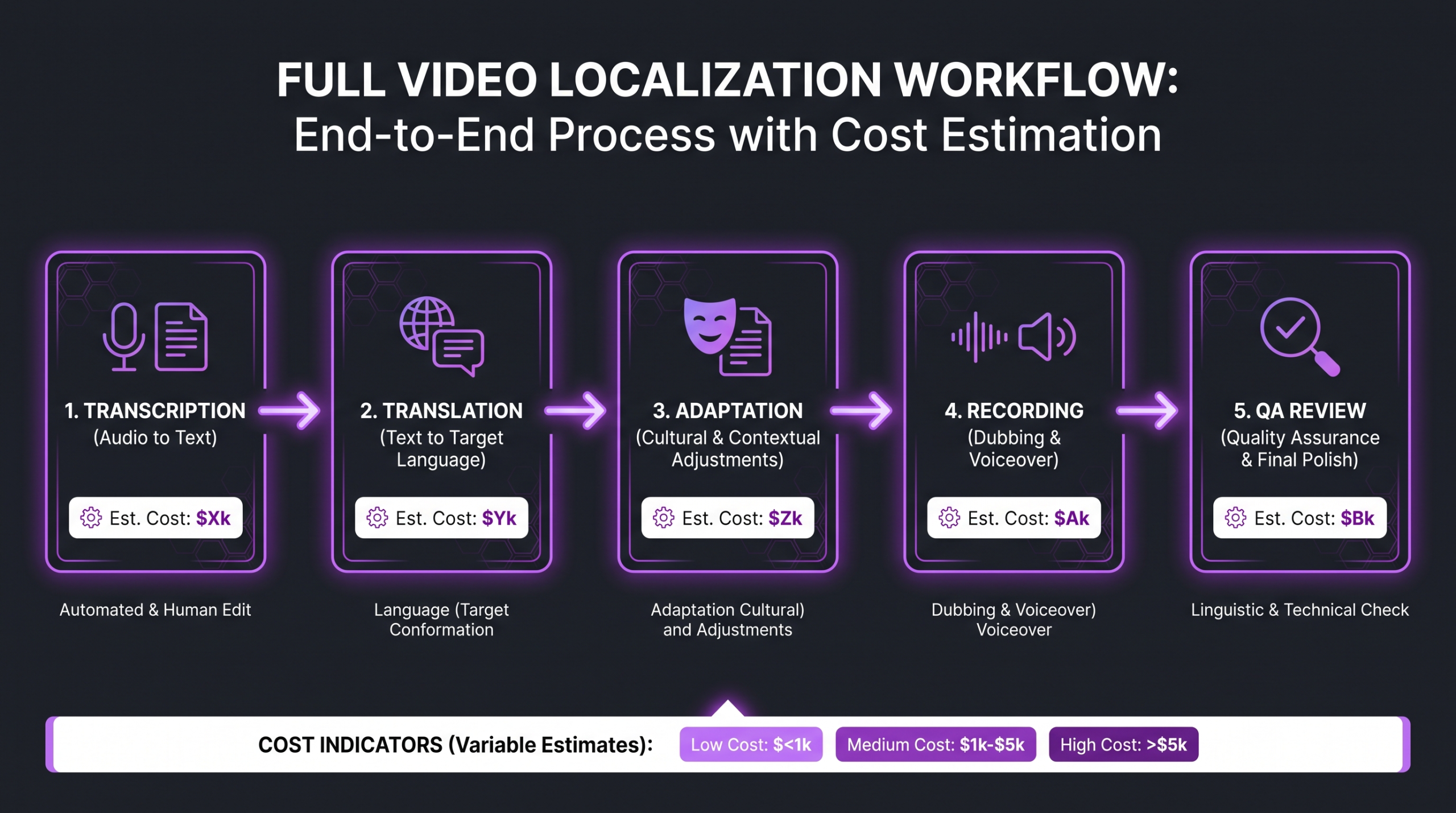
The wide range reflects the voiceover tier more than any other factor. If you choose AI voiceover for the same project (human review pass included), the illustrative range compresses to roughly $2,000–$8,000 for the same scope. The question is whether the audio quality level matches your audience expectations and distribution channel.
The QA Review Cycle: Where Budgets Slip
Quality assurance is the most frequently underbudgeted step in localization. Most vendor quotes include one round of internal QA, but client-side review often generates a second or third revision cycle. Each revision that requires re-recording adds studio time and talent fees—often at higher per-session rates than the original recording because the session is shorter and loses economies of scale.
Best practice from teams that localize at volume: invest in a native-market reviewer at the script stage—before recording—rather than at the audio-output stage. Catching a cultural misfire or brand term error in a Word document costs almost nothing. Catching it after a studio session has been billed means paying to re-record. That front-loaded review investment typically runs $100–$300 per language per project and returns many times its cost in avoided re-records.
Language-Specific Pricing Factors
Not all language pairs are priced equally, and the differences can be significant enough to reshape a localization strategy. Several structural factors drive language-specific pricing:
Translator and Voice Talent Pool Size
Languages with large global translator communities—Spanish, French, German, Portuguese—have more competitive pricing because supply is high. Languages with smaller global communities of trained localization professionals—Swahili, Tamil, Catalan, Icelandic—typically command rate premiums of 30–100% above common European language pairs. Voice talent availability follows the same pattern: many professional Spanish voiceover actors work remotely worldwide; finding a qualified professional native Icelandic voice actor for a two-day recording schedule is a materially harder and more expensive proposition.
Script Expansion Ratios
Some languages expand significantly when translated. German and Russian can run 20–30% longer than the equivalent English source. Finnish can expand 40–50% on technical content. For subtitle work this means more characters per subtitle card and potential readability issues; for dubbing with lip-sync it means more aggressive script adaptation to fit the original timing. Both scenarios add adaptation labor cost that is not immediately obvious when you are quoting off a per-word translation rate alone.
Asian languages, conversely, often compress compared to English—which sounds like a budget win but creates a different challenge: shorter vocal performance timing can feel rushed or unnatural if not carefully adapted, and the cultural cadence of delivery differs from Western speech patterns in ways that require adaptation expertise beyond linguistic competency.
Regional Variants and Dialect Requirements
Spanish for Spain and Spanish for Latin America are not interchangeable in a professional localization context—they have distinct vocabulary, idiomatic expressions, and voice casting requirements. Portuguese for Portugal vs. Brazil is similarly distinct. If you are localizing into a language with major regional variants and have specific target markets, budgeting for separate regional versions (or at minimum a regional review pass) is the correct approach. Trying to serve Spain and Mexico with a single voice track optimized for neither is a known source of audience disengagement in those markets.
For teams localizing into Arabic, be aware that Modern Standard Arabic (used across formal media) and the many regional colloquial dialects are meaningfully different. Most professional localization work in Arabic uses MSA as the safe default, but Egyptian Arabic, Gulf Arabic, and Levantine Arabic may be preferred for specific audience segments—each requiring different talent and different voice casting.
AI vs Human Localization: What Each Actually Costs
The AI versus human localization debate is not really about quality in the abstract—it is about which quality level is appropriate for which use case. Understanding where AI localization produces acceptable output (and where it does not) is a budget decision, not just a creative one.
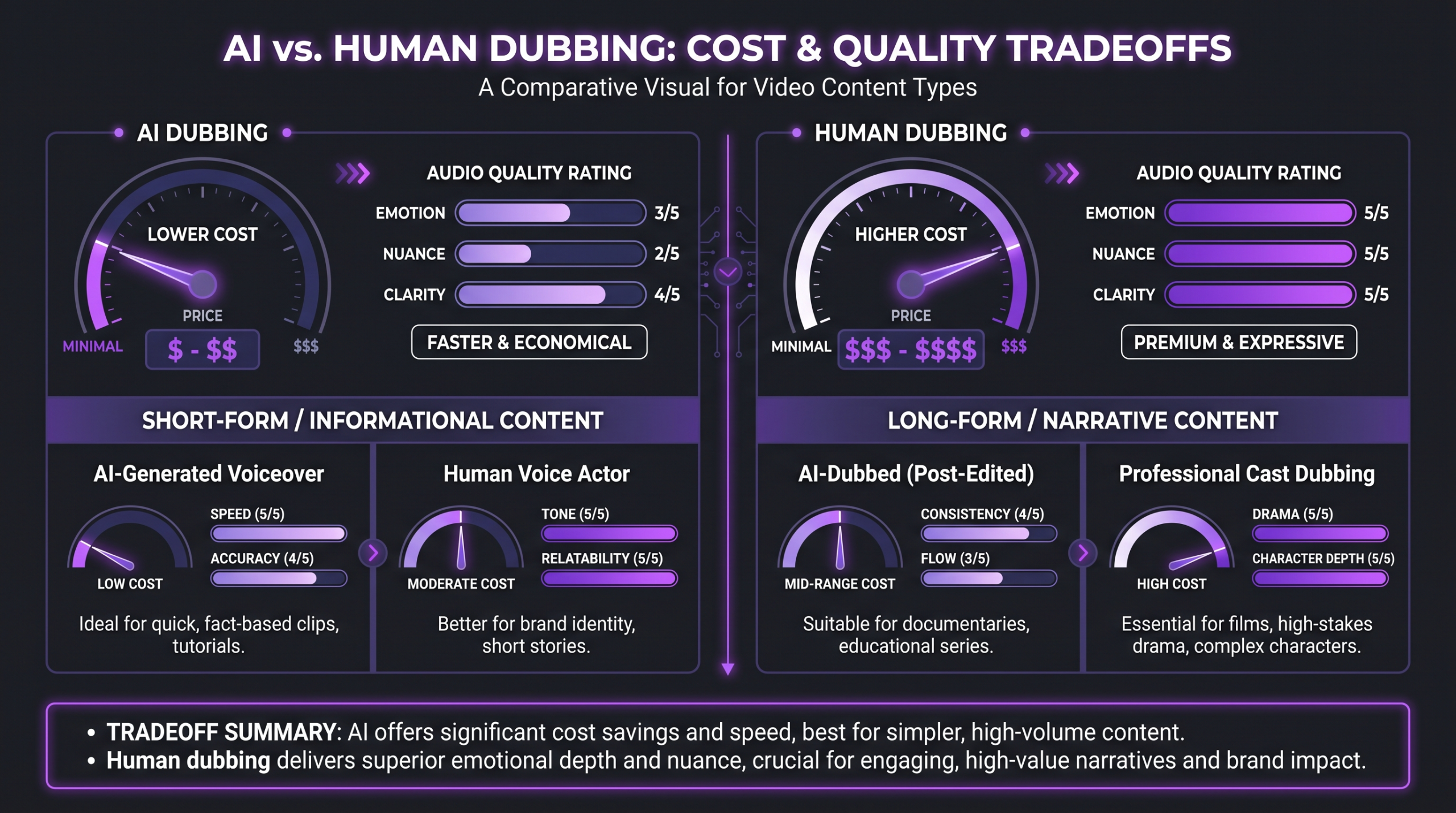
One pattern that has emerged among teams managing large localization programs: tiering content by audience and revenue impact, and allocating budget accordingly. High-stakes external content (product pages, executive keynotes, sales enablement videos shown in enterprise sales cycles) receives full human localization. High-volume internal content (HR communications, onboarding modules, internal product updates) goes AI-first with a review pass. That tiering strategy can reduce overall localization spend by 30–50% while protecting quality where it matters most commercially.
Working with a video editing agency that has localization experience can help you tier your content library correctly from the start and negotiate volume rates across language pairs—rather than making the same “we over-invested here, under-invested there” budget realignment that most teams make on their second localization cycle.
How to Build a Video Localization Budget
A realistic localization budget has four components: method cost (subtitle, voiceover, or dubbing), language count, content volume, and workflow overhead. The following framework helps you estimate before entering vendor conversations.
Step 1: Define Your Content Tier
Separate your video library into Tier 1 (customer-facing, revenue-linked), Tier 2 (partner/channel-facing), and Tier 3 (internal). Tier 1 content warrants full human localization; Tier 3 can tolerate AI-first workflows with review. This tiering step alone typically reduces the scope of full-cost localization by 40–60% in most enterprise video libraries, because internal content volume is usually much larger than external.
Step 2: Inventory Total Minutes by Tier
Count total finished minutes across each tier. This is simpler than it sounds and a step that many teams skip, resulting in budget shock mid-project. Total runtime drives every cost estimate that follows. Include not just what exists today but what will be produced in the next 12 months if you are planning an ongoing program rather than a one-time project.
Step 3: Prioritize Languages by Market Revenue Potential
Localize languages in order of TAM and current sales pipeline, not alphabetical order or anecdotal feedback. A common mistake is localizing into all EU languages simultaneously when 80% of European pipeline is in two countries. Sequencing language rollouts allows you to validate quality and refine workflow before committing the full budget. Published data from software companies that have documented their localization expansion programs (HubSpot, Atlassian, and others have published blog-level case studies on this) consistently shows phased language rollout outperforming simultaneous multi-language launches in both speed and budget efficiency.
Step 4: Add Workflow Overhead at 25–40%
Whatever your base method cost (subtitles, voiceover, or dubbing), add 25–40% for transcription, translation, adaptation, project management, and QA. This is not a rule-of-thumb padding; it is the consistent overhead ratio documented across localization project budgets at scale, and it is the figure that teams who start without it are most commonly surprised by.
Sample Budget Scenarios
A full breakdown of professional video production costs that precede localization—including editing, color, audio mixing, and graphics—is covered in the complete guide to professional video editing costs. Localization budgets should always be planned in conjunction with production budgets, not as an afterthought once production is already in post.
💡 Pro Tip: Shoot for localization from day one. Videos where the presenter speaks with a clean, deliberate cadence, avoids idioms and slang, and pauses between sentences are significantly easier and cheaper to localize than fast, colloquial, or culturally dense source material. Localization-friendly production can reduce per-language costs by 15–30%.
Understanding the full cost landscape for video localization is one of the most common topics Increditors helps clients navigate when they are expanding content programs into new markets. The pattern we see repeatedly is teams that underbudget the workflow overhead—specifically adaptation and QA—and end up with technically translated audio that does not land with the target audience. The fix is almost always to invest upstream: in a better translation brief, a native reviewer at the script stage, and a QA pass that actually checks the final output against the audience.
Frequently Asked Questions
How much does it cost to dub a 10-minute video into one language?
For non-sync professional voiceover in a common language (Spanish, French), expect a rough range of $500–$4,000 per finished 10 minutes depending on talent tier, studio format, and whether the project qualifies for volume pricing. Full lip-sync dubbing of the same 10 minutes can range from $2,000–$20,000+. Note that most professional studios apply minimum project fees—often $500–$2,000—so short-form content rarely benefits from per-minute math alone.
Are subtitles cheaper than dubbing?
Yes, consistently and significantly. Subtitles typically cost $1–$10 per finished minute; professional dubbing typically costs $200–$2,000+ per finished minute for the same content. The cost difference reflects the talent, studio, session management, and adaptation work involved in recorded audio versus a timed text file. The trade-off is audience experience: subtitles require reading; dubbing allows native-language immersion.
Is AI translation good enough for professional video localization?
AI translation has become production-quality for common language pairs in straightforward factual content. It still underperforms on idiomatic language, technical domain-specific vocabulary without a trained glossary, and creative content with tonal nuance. The industry-standard approach in 2026 is AI translation followed by a human post-editing pass—significantly faster and cheaper than full human translation while still catching the errors that matter. For legal, medical, or compliance content, full human translation remains the standard.
What is the most expensive language pair to localize video into?
Language pairs with small professional localization talent pools—Icelandic, Basque, Swahili, Catalan—typically command the highest rates relative to source content length. Among commercially common languages, Japanese and Korean generally sit at the higher end due to script complexity, the cultural adaptation requirements of business communication norms, and smaller global voice talent pools compared to Latin American Spanish or French. Arabic is also in the higher range, particularly when regional variant specificity is required.
How do I reduce video localization costs without sacrificing quality for key content?
Five approaches consistently deliver cost efficiency without quality compromise in real-world localization programs: (1) tier content by commercial impact and match method tier accordingly; (2) batch recording sessions—more content per session means lower per-minute cost; (3) invest in localization-friendly production from the shoot stage; (4) use AI translation with a human review pass rather than full human translation for Tier 2 and 3 content; (5) build and maintain a terminology glossary per language—translated brand terms and product names, reviewed once, save hours of QA per project iteration.
Verdict
Video localization is not one budget line—it is a stack of decisions, each adding reach and cost. Subtitles deliver the highest cost efficiency for initial market entry; professional dubbing delivers the highest audience quality for markets where native-language experience drives conversion. Most localization programs are not choosing one or the other: they are applying different methods to different tiers of content based on commercial impact, and they are getting that framework right before committing budget.
The most consistent budget mistake is treating workflow overhead—transcription, adaptation, QA review—as optional or negligible. It is neither. Building that 25–40% overhead into your model from the start is the difference between a localization program that delivers and one that is perpetually over budget and under-delivered.
For teams with significant video content libraries entering multiple markets, working with an experienced video editing agency vs freelancer comparison can help clarify the right production and localization structure. A dedicated post-production team can integrate localization planning into the production workflow—reducing the cost of localization by building for it at the source, rather than retrofitting it after the fact.
If you are evaluating providers for your localization program, the Best Video Localization Services 2026 guide reviews the major platforms and agencies by quality tier, language coverage, and pricing model. Use this cost guide first to understand your budget, then the provider guide to match that budget to the right partner.
Ready for Video That Actually Converts?
Tell us about your project and we will put together a custom plan.