








![3D Explainer Video - ScribbleLive.mp4_snapshot_00.12_[2022.03.09_03.14.16]](https://increditors.com/wp-content/uploads/elementor/thumbs/3D-Explainer-Video-ScribbleLive.mp4_snapshot_00.12_2022.03.09_03.14.16-r7wb53mx72rxst3qcqyrfxdmeyzb5r9jbl0wbjujh4.png "3D Explainer Video – ScribbleLive.mp4_snapshot_00.12_[2022.03.09_03.14.16]")

























Documentary editing typically costs between $2,000 and $50,000+ depending on run time, footage complexity, and who does the work. Short corporate documentaries often land in the $2,000–$8,000 range; full-length cinematic docs run $15,000–$50,000 or more for post-production alone. Freelancer hourly rates generally sit at $50–$150/hr while specialist agencies charge project rates tied to scope. This guide breaks down every cost driver so you can budget accurately before you go into production.
- Why Documentary Editing Costs More Than Standard Video
- The Key Variables That Drive Documentary Editing Cost
- Real-World Price Ranges by Documentary Type
- DIY vs. Freelancer vs. Agency: A Full Cost Comparison
- Hidden Costs That Inflate Your Documentary Budget
- Color Grading and Audio Post: Budget Separately or Bundle?
- How to Get Better Value Without Compromising the Story
- FAQ: Documentary Editing Cost
- Verdict
Why Documentary Editing Costs More Than Standard Video
Documentary editing is structurally harder than editing a branded promo or a YouTube explainer — and the price tag reflects that reality. The challenge is not just cutting clips together; it is building a story from often hundreds of hours of unscripted footage, interviews shot in the moment, archival material, and B-roll that wasn’t planned around a defined narrative arc. That is a fundamentally different skill set, and it takes far more time.
A typical branded video might arrive with a shot list, a script, and a clear beginning, middle, and end baked in before filming starts. Documentary footage almost never works that way. Subjects say things you didn’t expect. Sequences run long. Themes emerge in the edit suite, not on the shoot day. A skilled documentary editor is part storyteller, part archivist, and part therapist — they pull the coherent story out of the chaos of raw reality.
The footage-to-finished ratio is the clearest illustration of the cost gap. A 3-minute commercial might be assembled from 60–90 minutes of raw footage. A 30-minute documentary commonly draws from 30–150 hours of interviews and B-roll — a shooting ratio of 60:1 or higher. Every extra hour of footage that needs to be logged, transcribed, organized, and reviewed adds cost before a single edit point is placed.
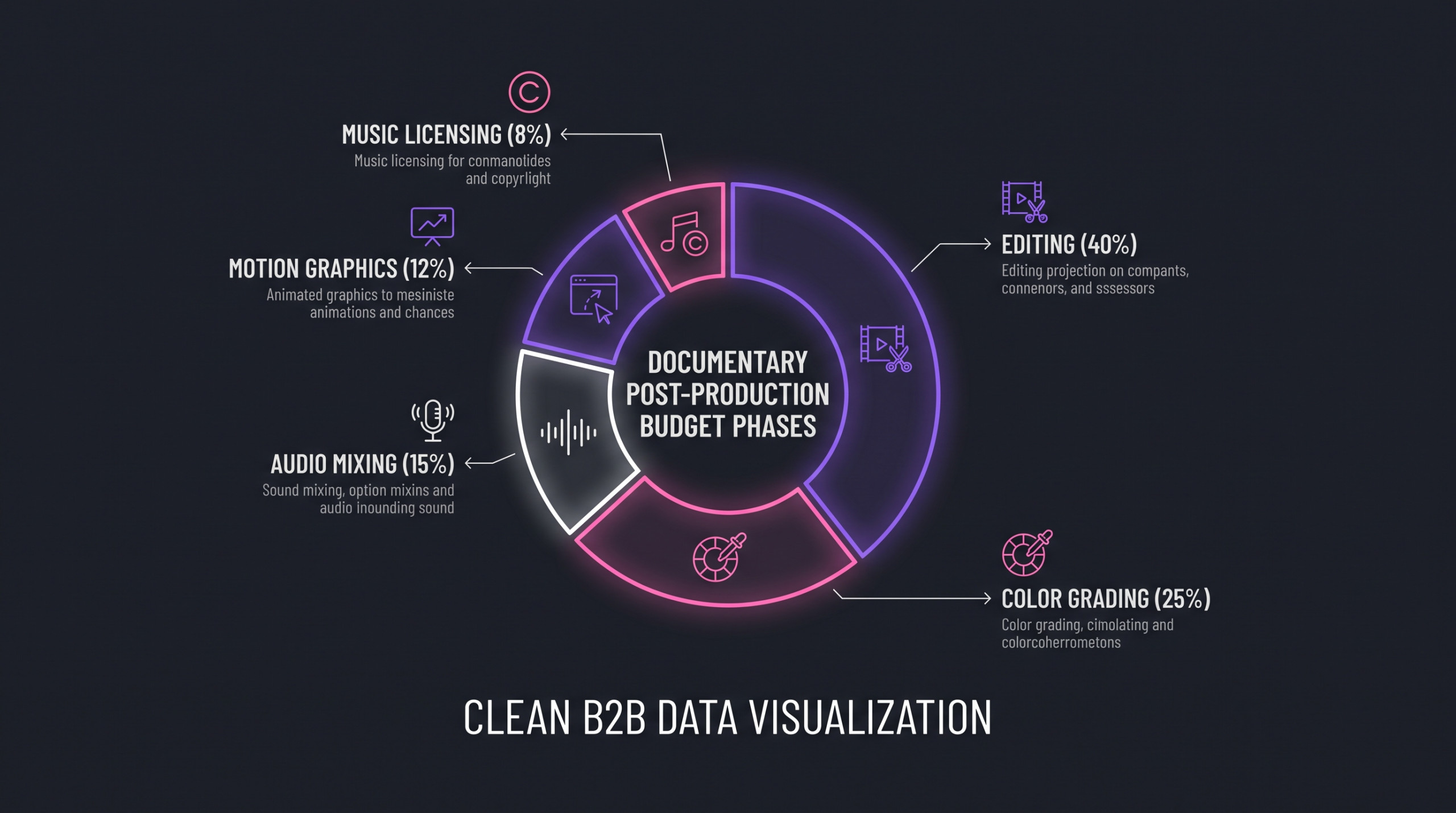
This is not a niche observation. the International Documentary Association has noted that post-production typically represents 30–50% of a documentary’s total production budget, a far larger share than in scripted or commercial work. For independent filmmakers and brand documentary teams alike, underestimating the edit is the single most common budgeting mistake.
💡 Pro Tip: When budgeting a documentary project, plan for post-production to consume at least 30% of your total spend — often more if you’re working with unscripted interview footage or archival material. Many first-time documentary producers underestimate this dramatically.
The Key Variables That Drive Documentary Editing Cost
Before you can get an accurate quote for documentary editing, you need to understand the six variables that move the number most. Every estimate you receive will be shaped by these factors — and understanding them lets you ask better questions of any editor or video editing agency you consider working with.
1. Finished Run Time
This is the most obvious driver. A 10-minute short documentary has a fundamentally different scope than a 90-minute feature. Most professional editors quote on a per-finished-minute or per-finished-hour basis, or they use an overall project fee once they understand the scope. Longer run times mean more assembly, more fine-cutting, more revision rounds, and more deliverables to output.
2. Raw Footage Volume
Even two documentaries with the same finished length can have very different editing costs if the raw footage volume differs significantly. A tightly shot interview-heavy film might arrive with 20 hours of footage. An observational documentary with multiple characters shot over months could deliver 300+ hours. The editor must log, organize, and review all of it — time that is rarely visible in the final cut but absolutely baked into the invoice.
3. Story Complexity
A single-subject, single-timeline story is far easier to cut than a multi-thread narrative with parallel timelines, multiple protagonists, or complex structural decisions to make. Non-linear documentaries — films that jump between time periods, interweave archival and contemporary footage, or use unconventional structures — take considerably longer to construct and typically cost more to edit.
4. Archival Research and Integration
If your documentary uses archival footage, historical photographs, or licensed third-party material, the editor must manage those assets: cataloguing, syncing, and integrating them into the cut while flagging what needs licensing clearance. This adds hours to the edit process and may require coordination with a clearance researcher — a separate line item in some budgets.
5. Revision Rounds
Most professional editors include a defined number of revision rounds in their project fees — commonly two to three rounds. Additional rounds beyond that are typically billed at an hourly rate. If you have multiple stakeholders who need approval, or if the narrative direction shifts significantly after the first rough cut, expect your revision costs to climb. This is one of the most common sources of budget overrun on documentary projects.
6. Deliverable Requirements
If your documentary needs multiple output versions — a broadcast master, a festival version, a web version, a trailer, and a 3-minute press reel — each additional deliverable adds editing and output time. Some editors bundle deliverables; others charge per additional cut. Clarify this before signing.
Real-World Price Ranges by Documentary Type
The table below provides hedged real-world ranges for documentary editing based on project type and scope. These figures reflect editing-only costs (rough cut through fine cut to picture lock) and do not include color grading, sound design, music licensing, or motion graphics — those are addressed separately below. If you want to see how these stack up across the broader video production landscape, our guide on professional video editing cost covers all formats in depth.
These are indicative ranges drawn from publicly discussed budgets in the documentary filmmaking community and from market positioning across the editorial services sector. They will shift meaningfully based on editor experience level, geographic market, and project complexity. A first-time editor will quote at the low end; a Sundance-credentialed editor with multiple feature credits commands significantly more. You can read about specific service providers in our separate post on best documentary editing services if you’re evaluating vendors alongside these cost benchmarks.
DIY vs. Freelancer vs. Agency: A Full Cost Comparison
The biggest single lever on your documentary editing budget is who does the work. There are three primary options, each with distinct cost structures, quality ceilings, and operational trade-offs.
DIY Editing
Editing your own documentary keeps cash costs low but is rarely actually free. You’ll invest in software — Final Cut Pro runs around $299 one-time, while Adobe Premiere Pro is subscription-based at around $55–60/month — plus storage hardware and potentially additional plugins. The real cost is your time. If editing your own footage takes 200 hours and your time is worth $75/hour, you’ve actually “spent” $15,000 in opportunity cost. For brand and marketing teams, DIY documentary editing rarely makes sense unless you have a professional editor on staff already.
The quality ceiling for DIY documentary editing is also real. Documentary storytelling is a craft that takes years to develop. Many brand documentaries that were edited in-house fail not because of technical execution but because the story structure is weak — the emotional arc doesn’t build, interview quotes are selected for informativeness rather than dramatic resonance, and the pacing doesn’t serve the viewer’s attention span. These are editor judgment calls that experience builds.
Freelance Documentary Editor
Freelance editors are the most common choice for indie documentary projects and lean brand doc budgets. Rates vary widely based on experience and market. Entry-level freelancers (1–3 years experience, limited documentary credits) typically charge in the $40–$80/hr range or offer flat project fees at the lower end of the ranges in the table above. Mid-tier documentary editors with a track record and festival credits commonly ask $80–$150/hr. Senior editors with broadcast and streaming credits tend to quote on project fees rather than hourly, and those project fees can be substantial.
The risk with freelancers is bandwidth and reliability. A single editor can only work so many hours per week, which can extend timelines. If the editor gets sick, takes another project, or simply doesn’t gel creatively with your vision, pivoting mid-project is painful. Revision management and communication also fall entirely on you as the client.
Documentary Post-Production Agency
A specialist post-production or video editing agency brings structured workflow, a team (editor + assistant editor, potentially a colorist and sound designer), and project management under one roof. You get a dedicated team rather than a single person, which reduces timeline risk and gives you expert hands at every stage of post. The cost is higher than a freelancer — but so is what you get.
Agency pricing for documentary editing is almost always project-based, scoped to the specific deliverables after a discovery call. For brand and corporate documentaries in the 10–30 minute range, agency pricing commonly starts around $4,000–$6,000 and scales with length and complexity. Feature-length documentary partnerships with a specialist agency can run $20,000–$60,000+ for the full post workflow.
For teams that need to deliver multiple documentary pieces per year — say, quarterly brand documentaries for a funded startup or an annual impact documentary for a nonprofit — retainer-based agency relationships tend to offer better economics and consistency than hiring freelancers project by project. The comparison between these options is worth exploring in depth; our guide on video editing agency vs. freelancer lays out the full trade-offs for ongoing work.
Hidden Costs That Inflate Your Documentary Budget
The editing fee is only part of what you’ll spend in post-production. Many documentary producers are blindsided by costs they didn’t anticipate. Here are the most common budget inflators — and how to plan for them before you sign anything.
Transcription and Logging
Before an editor can efficiently search through 50+ hours of interview footage, those interviews typically need to be transcribed and organized. AI transcription tools like Descript have dramatically lowered this cost in recent years — transcription that once cost $1–$3 per minute of audio can now be done automatically for pennies — but human-review and organization of transcripts still takes editor time, and many editors charge for this phase separately or bake it into their estimate. Plan for $200–$1,500 in transcription support depending on volume.
Licensing: Music and Archival Footage
Music rights are a perennial documentary budget shock. Festival and theatrical clearances can cost $500–$5,000+ per track; sync licenses for broadcast or streaming add further layers. Many documentary teams solve this with royalty-free or music-bed libraries, but even those have licensing tiers. If you’re cutting to temp tracks from commercial artists expecting to license them later, get a music supervisor involved early — the final bill may be larger than the editing fee itself.
Archival footage is similarly variable. Stock libraries charge per clip based on intended distribution; news archive footage from broadcasters can run $200–$2,000+ per clip for broad rights. These costs are outside the edit fee and can compound quickly on historically-rich documentaries.
Motion Graphics and Titles
Contextual lower-thirds, chapter cards, animated maps, and data visualization graphics are common in documentary work and almost always add to the edit budget. If these are included in your editor’s fee, confirm the scope — some editors include basic lower-thirds while charging extra for custom animated elements. For complex infographic sequences (common in historical and investigative documentaries), motion graphics can add $1,500–$8,000 or more.
Extra Revision Rounds
As noted earlier, revision rounds beyond what’s included in the contract are typically charged hourly — often at the same rate as the editor’s standard billing. If your stakeholder approval process is lengthy or your creative direction evolves during post, budgeting for one or two extra rounds is prudent. Each additional round on a 30-minute documentary might cost $500–$1,500 in editor time.
Hard Drive and Storage Costs
Documentary footage in 4K and beyond generates significant data. A 10-day shoot in 4K can easily produce 4–8 TB of raw footage. If the editor works with your data, storage, delivery drives, and cloud backup may be billed to you. This is a smaller line item but frequently missed — factor $200–$800 for drives and data management on a mid-scale project.
💡 Pro Tip: Before signing an editorial services contract, ask for a line-item breakdown of what is and isn’t included: transcription, revision rounds, deliverable versions, motion graphics, color grading, and audio finishing. The sticker price of an “editing quote” often doesn’t include three or four of those. Get clarity in writing before work begins.
Color Grading and Audio Post: Budget Separately or Bundle?
Color grading and audio post-production are distinct disciplines from picture editing, and they add meaningfully to the total post-production budget. For documentary work specifically, both are critical to the final film’s quality — and both are commonly underbudgeted or left out of initial estimates entirely.
Color Grading for Documentary
Documentary color grading serves two functions: technical correction (matching footage shot across different cameras, times of day, and environments) and creative grading (establishing the visual tone of the film). Because documentary footage is often shot in wildly inconsistent conditions — different lighting, different cameras, different colorists on different shoot days — the technical correction pass alone can be substantial.
Freelance colorists working on documentary projects typically charge $500–$3,000+ for a short documentary color grade; feature documentaries with complex looks or significant archival integration can run $5,000–$15,000 for a full DI (digital intermediate) pass. Many post agencies bundle color grading with editing; confirm whether your quote includes it. No Film School’s documentary color grading guide is a useful primer on what this phase involves technically.
Audio Post-Production
Audio is where documentaries most often fall short in self-produced work. Interview audio shot in varied environments (offices, homes, outdoor locations, noisy event spaces) needs professional noise reduction, EQ, and leveling to feel coherent and professional. On top of that, you need a music mix, ambient sound design, and in most cases a broadcast-compliant loudness mix (typically -23 LUFS for broadcast, -16 LUFS for streaming platforms like Netflix or Amazon).
Audio post for a 30-minute documentary commonly runs $800–$4,000 depending on the mixer’s experience and how much remedial noise reduction is needed. Feature documentaries with full sound design can cost $5,000–$20,000+ for audio alone. Sound Works Collection’s documentary sound features provide excellent context on what a professional audio finish looks like in practice.
How to Get Better Value Without Compromising the Story
Budget pressure is real. Here are practical strategies for managing documentary editing costs without sacrificing the story quality that makes a documentary worth watching.
Shoot Smarter to Edit Cheaper
The cheapest edit is the one that starts with organized, intelligently shot footage. Documentary editors often spend 20–30% of their total time on projects just organizing and ingesting chaotic rushes. If your production team shoots with naming conventions, logs their footage during the shoot, and provides rough interview transcripts before handoff, you can substantially reduce the editor’s assembly time. Some editors offer pre-edit consultations to help you structure your shoot around their workflow — this is worth the conversation before you go out.
Define Your Story Before the Edit Begins
Ambiguity at the start of post is expensive. If the client or director hasn’t decided what the film is actually about — what the main argument is, who the primary protagonist is, what the emotional resolution should be — the editor will make those decisions in the cut, and then you’ll revise them. Multiple times. The most efficient documentary edits are those where the director arrives with a clear (if rough) treatment of the story before assembly begins. This doesn’t mean the story can’t evolve in the edit — it will — but having a north star reduces revision cost dramatically.
Limit Stakeholder Approval Chains
Brand documentaries in particular suffer from approval-chain bloat: the creative director approves, then the marketing director, then the CEO, then legal. Each approver who hasn’t been part of the previous conversation will have different notes. Consolidate feedback into a single set of notes per round before sending them to the editor. This alone can cut your revision rounds by half.
Bundle Post-Production Services
If you need editing, color, and audio, getting all three from a single agency or editor who manages those services tends to cost less than hiring specialists separately. The integration is smoother too — a colorist working with the same team that cut the film doesn’t need a lengthy handoff meeting to understand the creative intent. Teams like Increditors approach brand documentary post-production with dedicated senior editors who can coordinate the full post workflow, which reduces the coordination overhead that inflates budgets when you’re managing three separate vendors.
Use the Right Tool for Rough Cuts
AI-assisted editing tools — including Descript and Adobe’s Sensei features — can accelerate the rough assembly phase significantly for interview-heavy documentaries. Some editors use these tools to produce a paper cut from transcripts before touching the timeline, which speeds up the assembly phase. This won’t replace editorial judgment, but it can meaningfully reduce the hours billed for the organization and assembly stage.
💡 Pro Tip: Ask your editor for a “paper cut” session before they begin assembly. Reviewing transcripts and selecting the best interview moments together takes 2–3 hours and prevents the costly situation where you receive a rough cut built around the wrong interview sections — then pay for another round of editing to fix it.
FAQ: Documentary Editing Cost
How much does it cost to edit a 30-minute documentary?
A 30-minute documentary typically costs $3,000–$10,000 in picture editing alone, depending on raw footage volume, story complexity, and editor experience. If you include color grading, audio post, and music licensing, the total post-production budget for a 30-minute documentary commonly runs $6,000–$20,000 or more. Agency-level work with a dedicated team sits toward the higher end; a mid-tier freelancer can often deliver at the lower end if the footage is well-organized and the creative direction is clear.
What is a typical hourly rate for a documentary editor?
Freelance documentary editors commonly charge $50–$175/hr depending on experience level and market. Entry-level editors with limited credits tend to work in the $50–$80/hr range; editors with festival experience and a strong reel typically ask $80–$150/hr. Senior editors with broadcast and streaming credits often prefer project fees, which can make direct hourly comparisons difficult. Many editors for short documentaries offer flat project fees instead of hourly rates — this is usually more predictable and often better value for the client.
Is documentary editing more expensive than commercial video editing?
Yes, in virtually every case — and for good reason. Documentary editing involves significantly more raw footage per minute of finished content, requires editorial judgment to construct a narrative from unscripted material, and typically involves more revision rounds because the story evolves during post. A 30-second commercial might be cut in a day or two; a 20-minute documentary might take three to five weeks of editorial work. The per-minute cost of documentary editing is meaningfully higher than commercial or social content editing, even at the same editor hourly rate. For a broader comparison of video editing costs across formats, see our guide on how much professional video editing costs.
Does color grading come included in documentary editing quotes?
Not automatically — and this is a common point of confusion. Many editing quotes cover picture editing only (assembly through picture lock). Color grading and audio finishing are often separate line items unless explicitly bundled. Always ask for a full post-production scope breakdown before signing. Some documentary post agencies offer all-inclusive packages; others price editing, color, and audio separately. If your editor isn’t a certified colorist, expect to hire one independently or through a recommendation from the editor.
How many revision rounds should I expect in a documentary editing contract?
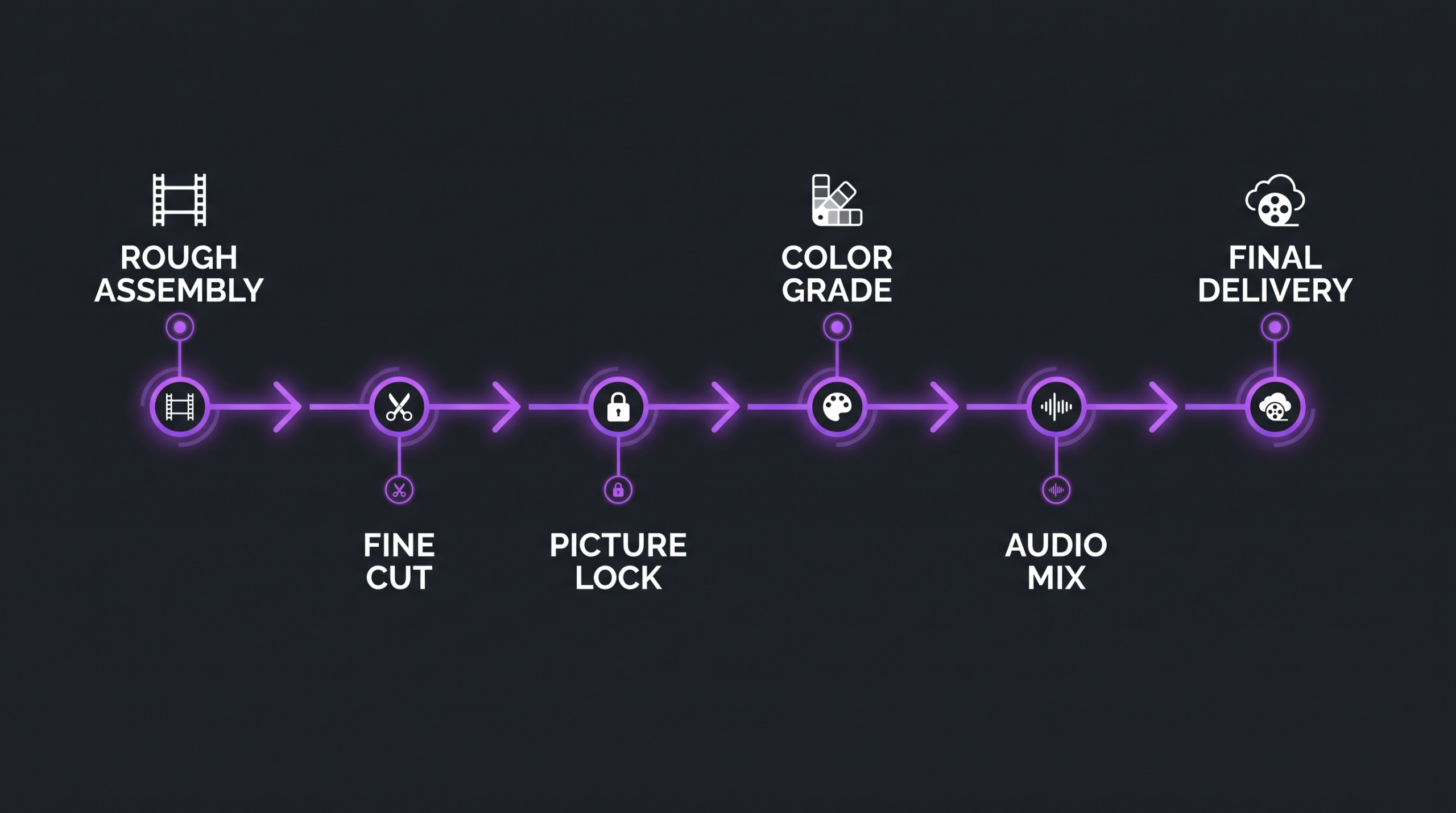
Most professional editors include two to three revision rounds in their standard contracts. This typically means a rough cut review, a fine cut review, and a picture lock review. Additional rounds beyond that are billed at the editor’s hourly rate. For brand documentaries with complex stakeholder approval chains, it’s common to need four or five rounds — budget for at least one or two extra from the start. Be explicit with your editor about who has approval authority to avoid conflicting notes arriving at different points in the process.
Verdict: How to Budget Your Documentary Edit
Documentary editing is one of the most technically and creatively demanding forms of post-production work, and the cost reflects that reality. The ranges in this guide — $1,500 to $10,000 for a short documentary up to $60,000+ for a feature-length project — are real-world figures, not aspirational ones. Every project within those ranges has earned its price through editorial complexity, footage volume, and the irreducible time cost of building a story from raw, unscripted reality.
The most important thing you can do before getting quotes is understand your own scope: how long is the finished film, how much footage will you shoot, how many revision rounds are realistic given your stakeholder environment, and what additional post services (color, audio, motion graphics) will you need? With that clarity, you can evaluate quotes apples-to-apples rather than comparing an all-in agency price to a bare-bones freelancer estimate and wondering why they look so different.
If you’re also evaluating which teams and services are best positioned to handle your documentary work, our companion post on best documentary editing services covers specific providers in depth. For brand and corporate documentary projects where quality and delivery reliability matter, working with a specialist team — rather than the cheapest quote you can find — consistently produces better ROI over the production lifetime of the piece. Documentaries that resonate build brand trust in ways that no amount of promotional video can replicate, and the editing is where that resonance is built or broken.
The International Documentary Association and Sundance Institute’s documentary film program both publish resources on budgeting and post-production that are worth reading if you’re preparing a festival submission or applying for grants — their budget templates give useful context on how professional productions allocate post-production spend relative to total budget. For further reading on the landscape of post-production pricing across all video formats, our broader guide on professional video editing costs gives a full market overview.
Ready for Video That Actually Converts?
Tell us about your documentary project and we will put together a custom post-production plan.