







![3D Explainer Video - ScribbleLive.mp4_snapshot_00.12_[2022.03.09_03.14.16]](https://increditors.com/wp-content/uploads/elementor/thumbs/3D-Explainer-Video-ScribbleLive.mp4_snapshot_00.12_2022.03.09_03.14.16-r7wb53mx72rxst3qcqyrfxdmeyzb5r9jbl0wbjujh4.png "3D Explainer Video – ScribbleLive.mp4_snapshot_00.12_[2022.03.09_03.14.16]")


















A Video Sales Letter (VSL) is a scripted, conversion-focused video that replaces a traditional long-form sales page. It leads viewers through a structured arc — hook, problem, solution, proof, offer — and drives a single action, typically a purchase or opt-in. VSLs consistently outperform static pages for high-ticket offers, complex products, and cold traffic when produced and edited correctly.
- What Is a VSL? The Definition That Actually Matters
- VSL vs. Other Video Formats: What Sets It Apart
- The Anatomy of a High-Converting VSL Script
- Types of VSLs: Which Format Fits Your Funnel?
- VSL Production: What Makes the Video Actually Work
- When to Use a VSL (and When Not To)
- How to Measure VSL Performance
- Getting Your VSL Produced: DIY vs. Professional
- FAQ
- Verdict
What Is a VSL? The Definition That Actually Matters
A Video Sales Letter (VSL) is a video-format replacement for a written sales page. It follows a persuasion script designed to move a cold or warm viewer from awareness to a buying decision — typically within a single sitting. The term combines “video” with “sales letter,” which is direct-response copywriting’s term for a long-form persuasion document aimed at one specific action.
VSLs emerged from direct response marketing in the late 2000s as broadband internet made video streaming viable for the average consumer. Early practitioners discovered that video could communicate tone, urgency, and social proof far more efficiently than text — and that removing the scroll bar (hiding the page length) increased viewer commitment. That design choice — auto-playing video with no visible timeline or scrubber — remains a hallmark of the format.
Today the term is used broadly across industries: online course creators use VSLs on checkout pages, SaaS companies embed them on landing pages, consultants put them at the top of webinar registration funnels, and e-commerce brands run them as Facebook and YouTube pre-roll ads. The format has adapted but the core mechanics have barely changed in fifteen years — which says something about how reliably they work when executed correctly.
The key distinction between a VSL and other marketing videos is intent architecture. Every element — the first sentence, the B-roll cut, the music swell — is chosen to advance the viewer toward one outcome. There is no brand awareness objective, no education for its own sake. A VSL exists to convert.
💡 Pro Tip: If your video has two or more CTAs, multiple desired actions, or a brand-building section before the problem statement, it is not a VSL — it’s a hybrid brand-response video. Both have value, but conflating them causes both to underperform.
VSL vs. Other Video Formats: What Sets It Apart
Understanding what a VSL is requires understanding what it is not. Marketers frequently mislabel explainer videos, product demos, and brand films as VSLs, then wonder why conversion rates disappoint. The table below maps the core differences.
The difference is not just in length or structure — it is in the relationship between the script and the viewer’s psychology. A VSL script is built around a decision journey: you need to move someone from “I don’t know if I need this” to “I’m buying this now.” Explainers and demos don’t need to do that — they serve viewers who are already curious or already evaluating. That’s why a VSL placed on a homepage typically underperforms, and a two-minute explainer placed on a checkout page leaves money on the table.
According to Wistia’s annual State of Video report, landing pages featuring video consistently outperform text-only pages for conversions — but not all video types are equal. The format and script structure matter as much as the presence of video itself.
The Anatomy of a High-Converting VSL Script
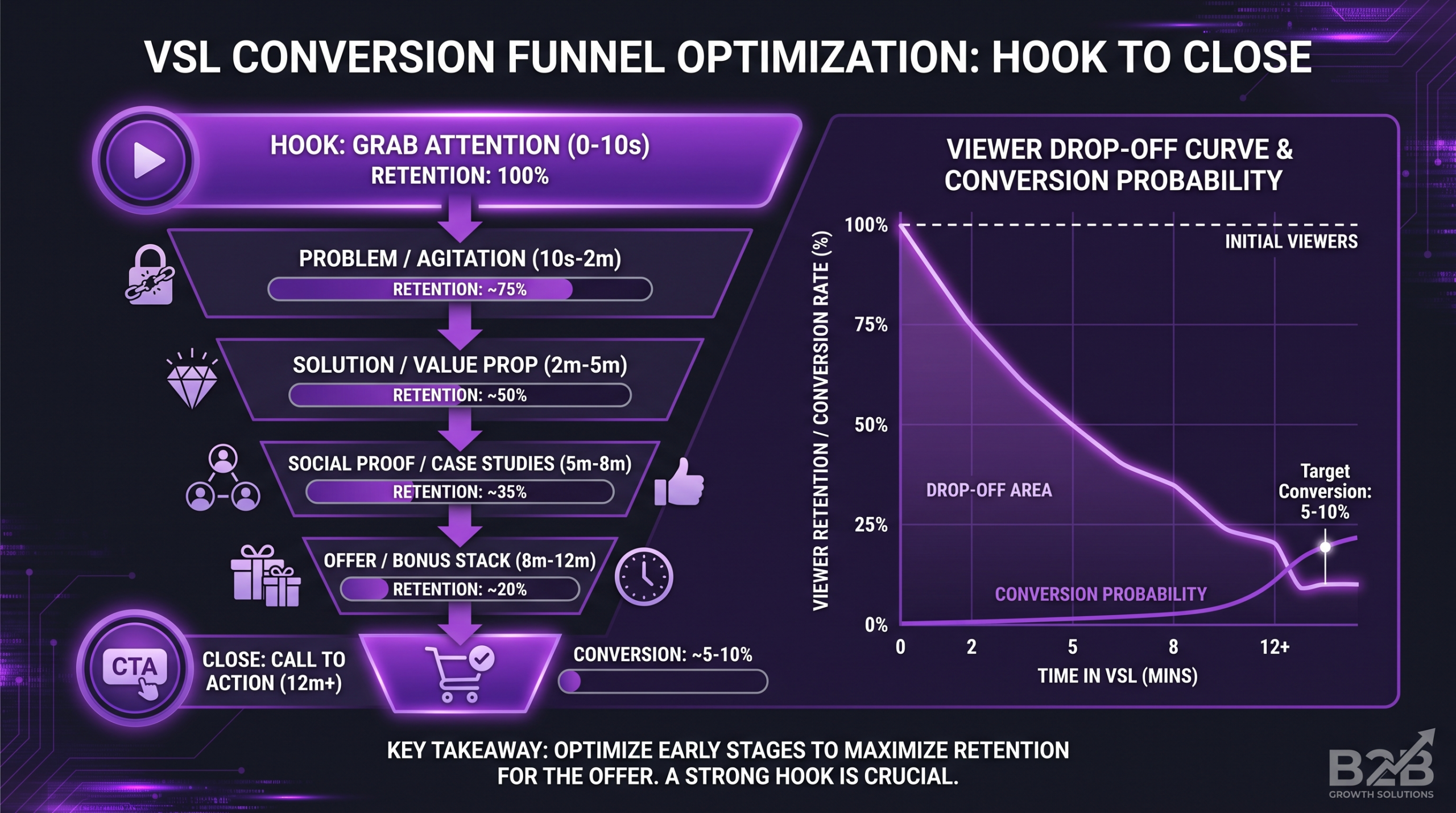
Every effective VSL follows a recognizable arc — adapted from direct response copywriting frameworks that have been refined since the 1960s. The digital format has added chapters (like screen recordings and countdown timers) but the skeleton remains: hook → problem → agitation → solution → proof → offer → close. Here is how each section functions.
The Hook: The First 30 Seconds
The hook has one job: stop the viewer from clicking away. It does this by making a promise so specific and relevant that the target viewer cannot ignore it. Effective hooks typically lead with a bold claim (“I went from 2% to 11% conversion on cold traffic in 90 days — here’s the one thing I changed”), a counterintuitive statement (“The reason your sales video isn’t converting has nothing to do with your offer”), or a vivid problem statement that the viewer immediately recognizes as their own.
The worst hooks are vague introductions (“Hi, I’m John and today I want to talk about something really important…”). Research from Nielsen’s video attention studies and platform-published engagement curves consistently shows that most drop-off happens in the first fifteen seconds. The hook determines whether the remaining 10, 20, or 45 minutes of your script will be seen by anyone at all.
Problem and Agitation
Once attention is locked, the script deepens the viewer’s awareness of the problem they came with. This section does not just name the problem — it agitates it. Agitation means describing the consequences of inaction, the emotional cost of staying stuck, and the secondary problems that compound the main one. This is not manipulation; it is empathy made visceral. The viewer needs to feel that you understand their situation precisely before they will trust your solution.
The Problem-Agitate-Solution (PAS) framework, popularized by direct response copywriters, is the structural backbone of most VSL middle sections. The ratio of problem-to-agitation depends on the audience’s awareness level: a cold audience who doesn’t fully recognize their problem needs more problem/agitation time; a warm audience who is actively searching for solutions can move faster to the solution.
The Solution and Mechanism
The solution section introduces your offer not as a product but as a mechanism. The “mechanism” is the unique process, method, or technology by which your solution produces results. Naming the mechanism with a proprietary name (“The 3-Day Revenue Reset” or “The Conversion Architecture Framework”) is a well-established direct response technique that positions your offer as categorically different from alternatives — even when the underlying service is similar.
This is where the scripting and the editing intersect powerfully: motion graphics, animated diagrams, or screen recordings can make abstract mechanisms tangible. A mechanism explanation that’s hard to follow in spoken word often becomes immediately clear with 10 seconds of motion graphic support.
Proof and Social Evidence
After the mechanism comes proof. This section has three tiers: testimonials (social proof — other people got results), case studies (story proof — a documented transformation arc), and credentials or data (authority proof — institutional backing, track record, or verifiable statistics). A strong VSL uses all three; a weaker one relies only on testimonials, which have become background noise for informed buyers.
Where testimonials appear in the edit matters: a single well-produced customer story cut mid-VSL (after the mechanism, before the offer) outperforms a cluster of five testimonials dropped at the end. Editors with VSL experience know this instinctively — timing social proof for maximum persuasive effect is a craft skill, not an afterthought.
The Offer and Close
The offer section is where the product, price, and terms are finally named. Classic direct response structures “stack” value before naming the price: here’s what you get, here’s what each component is worth independently, here’s what it costs as a bundle. This anchors perceived value before the number lands. The close then addresses the decision — it reframes inaction as the real risk, handles the most common objections (time, money, skepticism), and delivers a clear, urgent CTA.
In high-ticket VSLs, the CTA is often a call booking rather than a direct purchase. In e-commerce and SaaS VSLs run as paid ads, it is typically a buy or free-trial button. Either way, there is one CTA. Not two, not “visit our website to learn more.” One specific next step.
Types of VSLs: Which Format Fits Your Funnel?
VSLs are not monolithic. The format has evolved to serve different funnel positions, offer types, and traffic temperatures. Choosing the wrong VSL type for your context is one of the most common reasons good scripts underperform.
Short-Form VSLs (2–8 Minutes)
Short-form VSLs run 2 to 8 minutes and are optimized for paid traffic (Facebook, YouTube, TikTok) or warm audiences who have already seen some touchpoints. They compress the full persuasion arc into a faster cadence: hook is sharper, problem/agitation is condensed, social proof is one punchy testimonial, and the offer is presented without extensive value stacking. These work best for low-to-mid ticket offers (typically under $500) or for driving leads into a longer funnel rather than closing a sale directly.
Long-Form VSLs (15–60+ Minutes)
Long-form VSLs are the traditional format — the 20, 40, or even 60-minute video that replaces a sales call for high-ticket offers. They have more room for education (building belief in the mechanism), more proof (multiple case studies), and more thorough objection handling. High-ticket coaching programs, masterminds, software subscriptions above $1,000/year, and complex B2B services commonly use this format. The length is not padding — every minute is doing persuasion work. Cut 10 minutes from a tuned long-form VSL and you often see conversion drop, not rise.
Hybrid and Webinar-Style VSLs
Webinar-style VSLs (sometimes called “auto-webinars” or “evergreen webinars”) are long-form VSLs disguised as live educational events. They add a slide-presentation format, often a simulated live chat, and a countdown timer for a “special offer available for the next 30 minutes.” The educational framing lowers resistance in audiences who are skeptical of overt sales pitches. This is the dominant format for online course launches, coaching programs, and digital product sales in the $500–$3,000 range.
There are also VSL ads — 30 to 90-second paid social clips that are mini-VSLs running hook-to-CTA in compressed form, designed to drive traffic to a full VSL landing page. These are not standalone converters; they are traffic drivers into the longer format.
VSL Production: What Makes the Video Actually Work
A well-written VSL script handed to a bad editor produces a weak VSL. The editing and production choices are the delivery mechanism for the script’s persuasion logic. Here is what matters and why.
Pacing and Edit Rhythm
VSL pacing is tighter than most editors’ instincts. The standard cut-every-sentence or cut-on-breath-pause approach creates forward momentum — viewers rarely notice individual cuts but they feel the energy of a well-paced edit. Silence kills VSLs. Every dead second where the presenter is thinking, adjusting, or taking a breath is an opportunity for a viewer to click away. Good VSL editors remove all of that in the initial cut.
Within sections, the pacing changes intentionally: the hook is fast, the problem/agitation section slows slightly to let emotion land, the solution section picks up again, testimonials have their own natural rhythm. Editing a VSL like a flat-rate corporate video is how you get a technically clean video that converts at 1% instead of 4%.
Visuals and Motion Graphics
The original VSL format was deliberately minimal — a static slide deck with text bullet-points and a voiceover, sometimes with no presenter footage at all. That format still converts because it forces the viewer to focus on the words. But modern audiences are increasingly used to higher production quality, and in competitive markets, production quality signals credibility.
The practical approach: use motion graphics selectively at the mechanism explanation, proof stacking, and offer reveal stages. Animated text overlays during testimonials reinforce key points. But don’t let visual complexity distract from the message — a VSL is not a showreel. HubSpot’s video marketing research consistently shows that message clarity outperforms production polish as a conversion driver.
Voiceover and Sound Design
Audio quality in a VSL is non-negotiable. Muddy audio — room noise, inconsistent levels, plosives, or reverb — breaks the persuasion trance immediately. Listeners compensate cognitive bandwidth to decode poor audio, leaving less available for the message. Professional VSL editing always includes noise reduction, voice clarity processing, and level normalization across all audio sources.
Background music in VSLs is subtle — low enough not to be consciously registered, high enough to maintain emotional tone. Silence under a voiceover feels cold in long-form; music at 15–25% volume creates an emotional container without competing for attention. Bed music changes with section transitions: something slightly tenser during agitation, something that opens up during the solution reveal, something warm during testimonials.
On-Screen Text and Captions
Many VSL viewers watch with sound off, especially in the first few seconds of a paid ad context. Captions are not optional for VSLs that run in social environments. For dedicated landing page VSLs, auto-playing video typically starts with sound, so captions serve a different purpose: they reinforce key phrases by showing them on screen while the presenter says them — a dual-channel reinforcement technique that aids comprehension and retention.
When to Use a VSL (and When Not To)
VSLs are powerful but they are not the right tool for every context. Misapplying the format costs production budget and creates pages that confuse rather than convert. Here is a practical decision framework.
💡 Pro Tip: The highest-leverage VSL placement is usually not the top of the funnel — it’s the checkout page or thank-you-page upsell. A viewer who has already bought is the warmest possible audience. A short VSL offering the next product at that moment can outperform the original front-end VSL on pure ROI.
VSLs also have a contextual limitation: they require viewer commitment. A prospect who finds you via a Google search for a specific product comparison is in research mode — they want to scan, compare, and decide on their terms. A VSL that hides information behind 20 minutes of video will frustrate that user. The format works best when you control the traffic source and the audience is warm enough to invest attention.
How to Measure VSL Performance
A VSL that isn’t measured isn’t being optimized. The metrics that matter for VSLs are distinct from standard video analytics and require instrumentation beyond basic YouTube or Vimeo stats.
The Core VSL Metrics
View-to-offer rate: What percentage of viewers reach the moment the offer is presented? For a 30-minute VSL, if the offer appears at the 22-minute mark, you want to know how many people are still watching at minute 22. Industry benchmarks vary widely by traffic source and offer type, but teams commonly report that 20–40% of viewers reaching the offer moment is a strong signal for a well-tuned VSL. Below 10% suggests a hook or early-script problem.
Drop-off curve: Wistia’s engagement graph feature shows exactly where viewers leave. A sharp cliff at minute 3 points to a hook that didn’t deliver on its promise. A cliff just before the offer appears suggests the agitation built desire but the transition to the offer felt abrupt or unearned.
VSL page conversion rate: Of all visitors to the VSL landing page, what percentage complete the desired action? Most VSL pages don’t separate “viewers who started the video” from “visitors who never played it” — this separation matters for diagnosing whether a low conversion rate is a traffic problem, a headline problem, or a VSL problem.
Cost per acquisition (CPA) vs. video: When running VSLs as paid ads, track CPA by creative variant, not just by campaign. Two different VSLs for the same offer can produce CPA differences of 2–5x. Think with Google research on video ad performance highlights creative as the single largest driver of variance in video ad cost efficiency.
What to Test First
Most VSL optimization practitioners recommend testing hooks before anything else, because the hook determines whether all other sections get seen. A/B testing two hook variants (same body, different first 60 seconds) is faster and cheaper than reshooting the full VSL. Once the hook is proven, the next variable to isolate is the offer frame — same product, different price presentation or bonus structure.
Editing changes also count as tests. Cutting 5 minutes from the agitation section, reordering the testimonials, or adding a text overlay at the offer reveal are all edit-level tests that don’t require reshooting. This is why post-production quality and flexibility matters — a VSL locked into a rigid exported format can’t be optimized without a full re-edit.
Getting Your VSL Produced: DIY vs. Professional
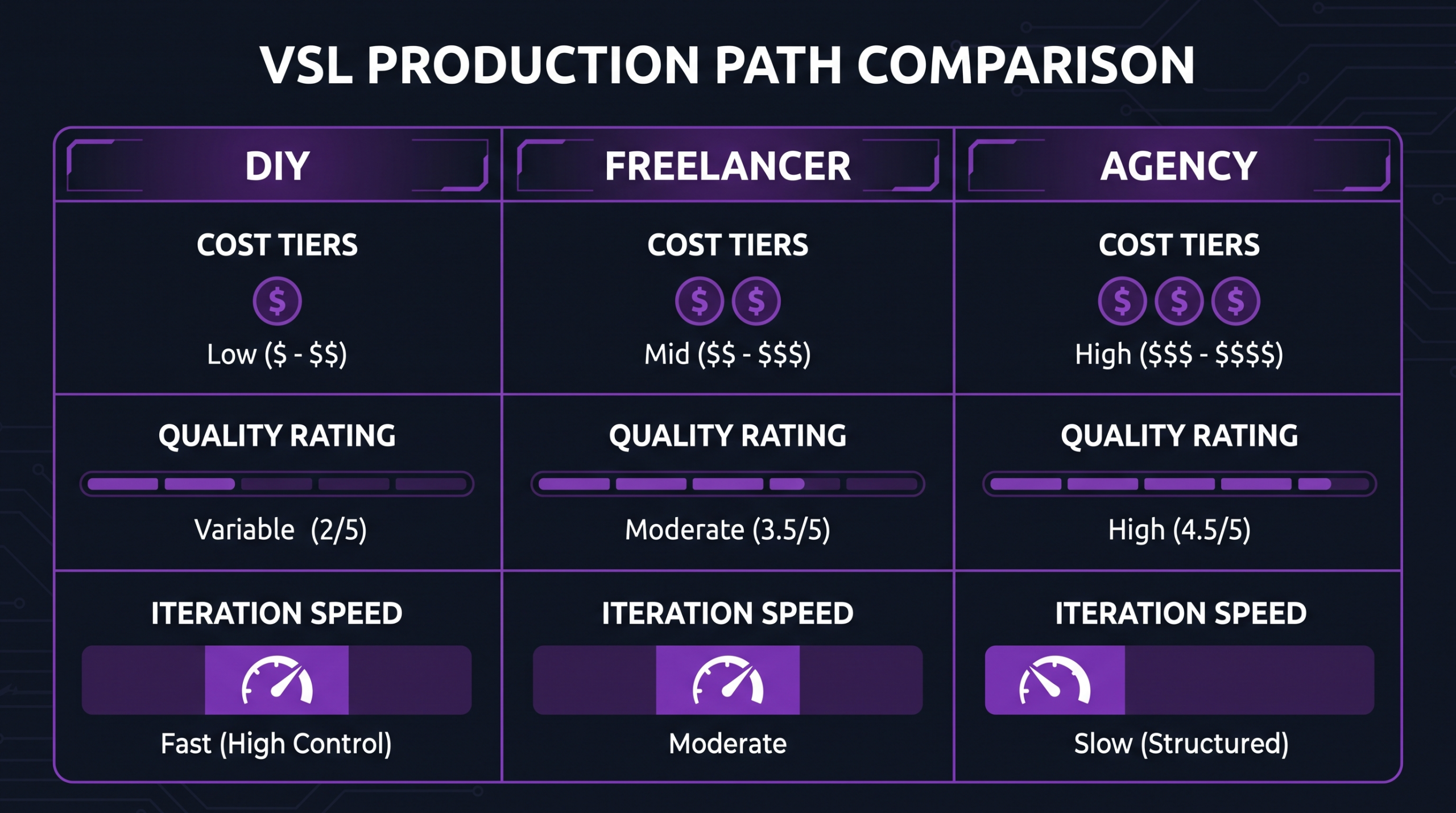
Once the script is written, the production decision breaks down into three paths: DIY, freelancer, or specialist video editing agency. Each has a different cost-quality-time profile, and the right choice depends on offer price point, traffic budget, and how much iteration you expect to do.
DIY VSL Production
DIY VSL production — record yourself, edit in DaVinci Resolve or CapCut, upload to Vimeo or Wistia — is viable for offers under $300 and audiences who trust the creator’s personal brand. The ceiling is lower because it’s hard to do audio cleanup, motion graphics, and tight pacing all at a professional level simultaneously. But for validated offers testing a new hook or going to a small warm list, DIY keeps costs manageable.
The risk is false economy: if a VSL sells a $2,000 coaching program and gets 0.5% conversion instead of 2% because of a pacing problem and rough audio, the per-unit cost of the production “savings” is enormous. Understanding how much professional video editing costs in real market terms often reframes the DIY vs. professional calculation quickly.
Freelance VSL Editors
Freelance editors on Upwork, Fiverr, or through referral range widely in VSL-specific skill. Many video editors are competent at general editing but have not internalized the persuasion logic of VSL pacing — they edit for watchability, not for conversion. When hiring a freelancer for VSL work specifically, ask for examples of VSL work they’ve edited (not just “corporate video” or “social content”), ask how they handle the offer reveal moment specifically, and look for someone who talks about drop-off curves, not just “clean cuts.” See our guide to top video editing services for a detailed breakdown of what to evaluate.
Specialist VSL Editing Teams
For high-volume VSL producers — information product businesses, SaaS companies running multiple paid traffic campaigns, coaches and consultants with large audiences — a specialist production partner changes the economics of iteration. Rather than re-briefing a new freelancer each time you want to test a new hook variant, a retainer relationship with a team that knows your VSL’s structure and style means changes turn around in 24–48 hours instead of a week.
At Increditors, we work with course creators, SaaS brands, and high-ticket coaches on exactly this type of ongoing VSL editing — producing initial cuts, iterating on tested hook variants, and maintaining a library of reusable assets (intros, testimonial cuts, motion graphic templates) that keep per-variant costs lower as the relationship matures. If you’re spending $10,000/month or more on paid traffic driving to a VSL, the editing is almost certainly the highest-leverage variable you can optimize. You can explore the full guide to video editing for SaaS companies and VSL editing cost breakdowns for more detail on what professional VSL production involves.
One additional consideration for teams choosing between options: also see the detailed comparison in our video editing agency vs. freelancer guide, which covers the trade-offs in more depth across different project types and budget levels.
FAQ: Video Sales Letters Explained
What is the difference between a VSL and a sales video?
The terms are often used interchangeably, but “sales video” is broader — it includes product demos, testimonial compilations, and brand films that have a loose sales goal. A VSL specifically refers to a structured, single-goal video that follows a direct response copywriting arc (hook → problem → solution → proof → offer → close) with one defined CTA. All VSLs are sales videos; not all sales videos are VSLs.
How long should a VSL be?
Length should be determined by the amount of work the script needs to do, not by a target runtime. A VSL for a $47 course to a warm audience might be 5 minutes. A VSL for a $3,000 coaching program to cold traffic might be 35 minutes. The right length is: long enough to handle every meaningful objection the target buyer has, short enough that no minute is wasted. If you find yourself padding with filler content to hit a length target, you’re writing for the wrong reason.
Can a VSL work without showing a face on camera?
Yes — the original VSL format was frequently a static slide deck with a voiceover and no on-camera presenter at all. Anonymous or faceless VSLs still convert in many niches, particularly where the mechanism and social proof are strong. However, for offers built around a personal brand, personal coaching, or any context where the buyer is choosing a specific person (not just a product), on-camera presence is generally more persuasive because it builds trust and allows body language to carry emotional weight.
Do I need professional editing for a VSL?
Professional editing becomes more important as the offer price and the paid traffic spend increase. For a $97 product being sent to an existing email list, rough but authentic editing can work and sometimes out-converts polished versions with cold audiences. For a $2,000+ offer, or any VSL where you’re spending $5,000+/month in traffic, the conversion rate differential from professional pacing, audio work, and motion graphics typically pays for itself many times over. The best VSL editing services understand conversion logic, not just technical editing, which is the distinction that matters.
What platform should I host my VSL on?
Wistia is the standard choice for VSL landing pages because it provides engagement graphs (showing exactly where viewers drop off), allows you to disable the scrubber/timeline (preventing viewers from skipping to the offer reveal), and integrates with marketing automation tools. Vimeo Pro is a solid alternative. YouTube is generally not recommended for primary VSL hosting — the recommendation sidebar, comments, and branding options pull viewers away from your page and into YouTube’s ecosystem instead of your funnel.
Verdict: Is a VSL Right for Your Offer?
A Video Sales Letter is the right format when you need to move a skeptical or unfamiliar buyer through a complete decision journey — from problem awareness to purchase readiness — without a live sales rep in the room. It is the highest-leverage direct response tool for complex offers, high-ticket products, and cold traffic campaigns when the script is solid and the editing is done by someone who understands conversion, not just craft.
It is not the right format for impulse purchases, brand awareness, or audiences who are already close to buying and need information rather than persuasion. Matching the format to the funnel position is the first decision — production quality is the second.
The VSL format has survived for fifteen-plus years because the underlying mechanism it exploits — human attention, narrative psychology, and decision-by-removal-of-objection — doesn’t change. Platforms, formats, and production styles evolve; the persuasion arc doesn’t. What does change is the expectation of quality. Audiences who watch polished content all day will disengage from rough audio and jumpy pacing faster than they would have in 2010. The script is the brain; the editing is the delivery system. Both need to work.
Ready for Video That Actually Converts?
Tell us about your VSL project and we will put together a custom editing plan — whether it is your first cut or a new hook variant for a running campaign.