









![3D Explainer Video - ScribbleLive.mp4_snapshot_00.12_[2022.03.09_03.14.16]](https://increditors.com/wp-content/uploads/elementor/thumbs/3D-Explainer-Video-ScribbleLive.mp4_snapshot_00.12_2022.03.09_03.14.16-r7wb53mx72rxst3qcqyrfxdmeyzb5r9jbl0wbjujh4.png "3D Explainer Video – ScribbleLive.mp4_snapshot_00.12_[2022.03.09_03.14.16]")



























Wedding video editing costs in 2026 typically run $300–$1,500 for a highlight reel and $800–$3,000+ for a full-length film when hiring a freelancer. Studio and agency packages commonly range from $1,500 to $5,000+. Videographers outsourcing post-production to subscription editing services generally pay $500–$2,000 per month for ongoing volume. The biggest price drivers: raw footage hours, turnaround window, number of cameras, and how many deliverables you need.
- The Real Range: What Wedding Video Editing Costs in 2026
- Tier-by-Tier Pricing: Freelancer, Studio, and Subscription
- 7 Factors That Move the Price Up or Down
- Highlight Reel vs Full Wedding Film
- For Videographers: When Outsourcing Post-Production Pays Off
- How to Compare Quotes Without Getting Burned
- Common Add-Ons and Hidden Costs to Watch For
- FAQ
- Verdict
Wedding video editing is one of the most misunderstood line items in any wedding production budget. Couples typically focus on the cost of hiring a videographer to show up and shoot — but the hours of post-production work that transform raw footage into a cinematic film they will watch for decades is a separate and often underestimated cost center. For wedding videographers themselves, post-production is frequently the single most labor-intensive phase of every project.
This guide covers what wedding video editing actually costs in 2026: realistic market ranges for both end clients and wedding videographers who outsource, the factors that push prices up or down, and how to evaluate what you are getting for the money.
The Real Range: What Wedding Video Editing Costs in 2026
Wedding video editing costs vary enormously based on who you hire, what you need delivered, and how complex the raw footage is. Rather than pointing to a single number, the market actually looks like this across different tiers and deliverable types.
Editors on platforms like Upwork and Fiverr commonly list rates from $25 to $75 per hour, which translates to roughly $300–$900 for a 3-to-5-minute highlight reel and $800–$2,500 for a full-length film covering the ceremony and reception. Boutique editing studios and specialist agencies typically charge higher — highlight reels from $600 to $1,500 and full-film packages from $1,500 to $4,500, with premium multi-deliverable packages reaching $5,000+.
For wedding videographers who outsource post-production rather than edit in-house, subscription-based editing services generally run between $500 and $2,000 per month depending on volume and turnaround SLAs. The effective per-video cost through these services typically falls lower than one-off freelancer rates once you factor in revision cycles and project management overhead.
These ranges reflect what editors across different market segments commonly quote as of 2026. Your actual number will depend on the factors covered below — the table above is a starting map, not a ceiling or a floor.
Tier-by-Tier Pricing: Freelancer, Studio, and Subscription
Wedding video editing sits in three distinct market tiers, and the differences go well beyond price.
Freelancers
Independent editors sourced through platforms like Upwork, Fiverr, or direct referrals are the most price-accessible option. Entry-level freelancers on these platforms commonly charge $25–$40 per hour, while experienced wedding specialists typically quote $55–$100 per hour. Per-project rates are usually negotiated separately from the hourly rate and tend to bundle an assumed footage volume.
The appeal is clear: you can engage a capable editor for a specific project without a retainer. The practical challenges are real too — communication overhead on every project, variable availability during peak wedding season (typically June–October in the Northern Hemisphere), and wide quality variance even within the same price band. According to the U.S. Bureau of Labor Statistics, film and video editors in the U.S. earn a median annual wage that translates to roughly $30 per hour — though experienced wedding specialists with strong portfolios typically command substantially more.
For couples, a freelancer makes sense when budget is the primary constraint and timeline is flexible. For videographers, a reliable freelance editor can work until they are unavailable during your busiest season exactly when you need them most.
Boutique Studios and Post-Production Houses
Studio-level editing for weddings typically starts around $800–$1,200 for a highlight reel and climbs meaningfully from there. Full packages at this tier — multi-cam ceremony, full reception edit, highlight reel, and social cuts — commonly run $3,000–$6,000+. These providers usually offer project management, consistent stylistic output, and formal revision rounds built into the price.
Local post-production houses often serve both consumer clients and other videographers. Their advantage is accountability — they are a business with a reputation to protect, not an individual who can go dark mid-project. Their limitation is often capacity: peak season bookings can fill months in advance, and rush windows are limited by their team size.
Subscription and Retainer-Based Services (for Videographers)
For wedding videographers who shoot multiple events per month, subscription-based post-production has become an increasingly practical model. These services offer dedicated editing teams, consistent style application, and turnarounds measured in days rather than weeks. Plans typically run $500–$2,000+ per month depending on the number of videos, deliverable length, complexity, and turnaround SLA. Many brands and content creators work with a remote video editing agency to handle volume, maintain consistency, and scale output without adding internal headcount.
When you calculate the effective per-video cost and factor in the hours a videographer saves on back-and-forth management, retainer-based video editing services often outperform the headline rate of cheaper freelancers. A premium editing partner that delivers fast, consistently-styled output often generates more per-booking revenue than a cheaper editor who requires significant oversight and multiple revision cycles. See how subscription plans stack up in our guide to unlimited video editing services compared for 2026.
7 Factors That Move the Price Up or Down
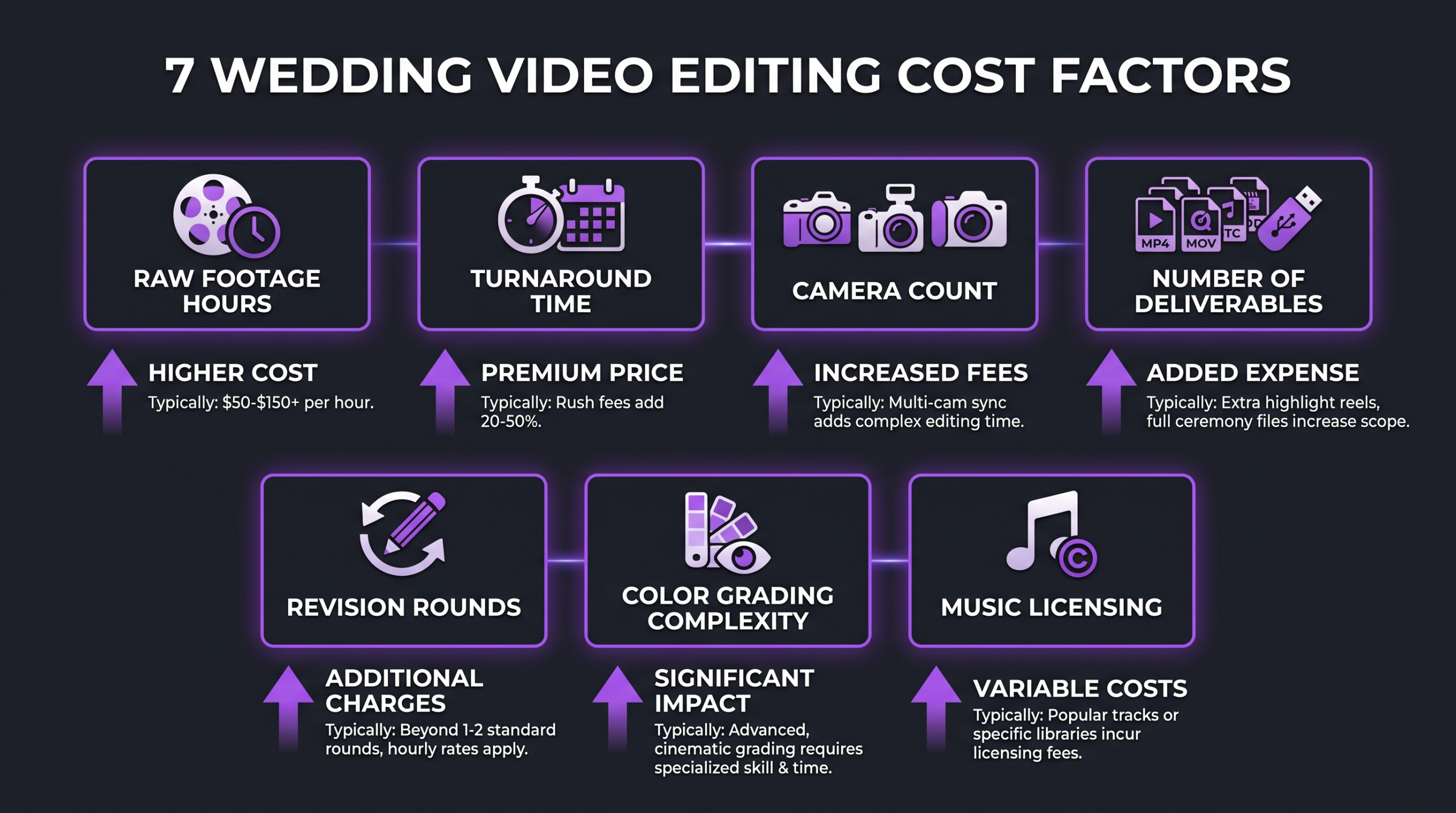
Wedding video editing quotes can vary by 2–3x even within the same tier. Understanding what editors are actually pricing gives you negotiating clarity and helps you scope your project accurately from the start.
1. Raw Footage Hours
This is usually the single biggest cost driver. A 4-hour wedding with one camera generates a very different editing workload than an 8-hour event shot across three cameras producing 24+ hours of raw material. Editors typically charge more — either a higher project rate or additional per-hour fees — when footage volume exceeds a stated baseline. Many editors include “up to 8 hours of raw footage” in their standard rate and charge $50–$150 for each additional hour beyond that threshold.
2. Turnaround Time
Standard delivery windows for wedding edits run 3–6 weeks from footage handoff. Rush turnarounds — 1–2 weeks — commonly carry a premium of 20–40% above the standard rate. Some editors charge a flat rush fee; others build it into an adjusted hourly rate. If you need to see your highlight before departing for a honeymoon, expect to pay for that speed explicitly.
3. Number of Cameras and Drone Footage
Multi-cam edits require syncing multiple audio and video tracks and making cut decisions across more angles simultaneously. Drone footage adds another integration layer: the editor must judge which aerial shots serve the story and weave them with ground-level coverage. Editors commonly charge an additional $100–$400 for drone footage integration and a similar or higher premium for each additional camera angle beyond the first two.
4. Number of Deliverables
A highlight reel, a full ceremony film, a full reception film, a teaser clip, and four social media cuts represent five distinct deliverables from the same footage. Each adds meaningful editing time. Packages that bundle multiple deliverables typically come at a discount compared to ordering each separately, but the total project cost is still substantially higher than a single highlight reel.
5. Revision Rounds
Most editors include two to three revision rounds in a standard project rate. Beyond that, additional revision requests commonly cost $50–$200 per round depending on scope. Major structural revisions — changing the narrative arc, swapping the music bed, re-cutting the ceremony sequence from scratch — are treated differently from minor color or trim adjustments and typically cost substantially more. Specifying your vision clearly upfront is the most reliable way to keep revision costs under control.
6. Color Grading Complexity
Standard color correction is usually included in base rates. Custom cinematic color grading — specific film emulation LUTs, stylized look development, heavy correction for mixed lighting in challenging venue conditions — requires additional hours. Editors who specialize in a particular aesthetic (golden-hour warmth, high-contrast dramatic blacks, muted European film style) often command higher base rates because their grading style is itself part of what clients are paying for.
7. Music Licensing
Many editors price projects assuming licensed music from platforms like Musicbed, Artlist, or Epidemic Sound — some include their platform subscription in the project rate, others pass the cost through separately. Using popular commercial songs requires sync licensing that can add hundreds or thousands of dollars. This is rarely included in standard editing quotes. Review licensing terms carefully before signing off on a music choice, especially if the film will be shared publicly online.
💡 Pro Tip: When comparing editing quotes, ask each editor to specify: footage hours included in the base rate, camera count assumed, revision rounds included, music licensing approach, and whether color grading beyond basic correction is part of the package. A lower headline price with narrow inclusions can easily become more expensive once extras stack up.
Highlight Reel vs Full Wedding Film: What You Are Paying For
The two dominant wedding video deliverables — the highlight reel and the full-length film — are fundamentally different editing challenges, which is why they carry different prices even when drawn from the same footage.
Highlight Reel (3–5 Minutes)
A highlight film is a curated narrative distillation of the entire wedding day — typically 3 to 5 minutes. It is the deliverable most likely to be watched repeatedly, shared on social media, and used by the videographer as a portfolio showcase. The editing challenge is creative rather than comprehensive: selecting the single best moment from each phase of the day, building an emotional arc, and matching the cut rhythm to the music bed. This requires editorial judgment that goes well beyond technical proficiency.
Because highlight reels require watching hours of footage to make selective decisions, the actual editing time is rarely proportional to the final length. A skilled editor typically spends 12–20 hours editing a 4-minute highlight. Hours per minute of finished output are higher than a full film, which partly explains why highlight reels often cost more per output minute than longer-form deliverables.
Full-Length Ceremony and Reception Film (60–90+ Minutes)
A full wedding film is a near-complete record of the day — ceremony from procession to recessional, reception speeches, first dance, and key moments throughout. It is less about creative selection and more about comprehensive documentation with coherent pacing. The editing task is longer but often more methodical: sync multi-cam footage, correct color and audio, ensure consistent quality throughout, add titles, and output at a watchable pace without losing the thread.
Full films typically take more total hours to edit than highlight reels but require a different flavor of editing skill. Many couples who commission both often find they engage with the highlight (shared and re-watched frequently) but would deeply regret not having the full film to revisit ceremony vows five or ten years later.
For a full breakdown of professional video editing costs across project types and billing models, see how much professional video editing costs — it covers hourly, project, and retainer structures in detail.
💡 Pro Tip: If you are choosing between highlight-only or highlight plus full film, consider this: the marginal cost to add the full film while an editor is already immersed in the footage is typically lower than commissioning it separately later. Negotiate both deliverables in the original agreement even if you are unsure — you can often lock in a better bundled rate before work begins than after.
For Videographers: When Outsourcing Post-Production Pays Off
If you are a wedding videographer reading this, you are facing a different version of the cost question: not what does editing cost to buy, but what does keeping post-production in-house actually cost you — versus what you would pay to outsource it reliably?
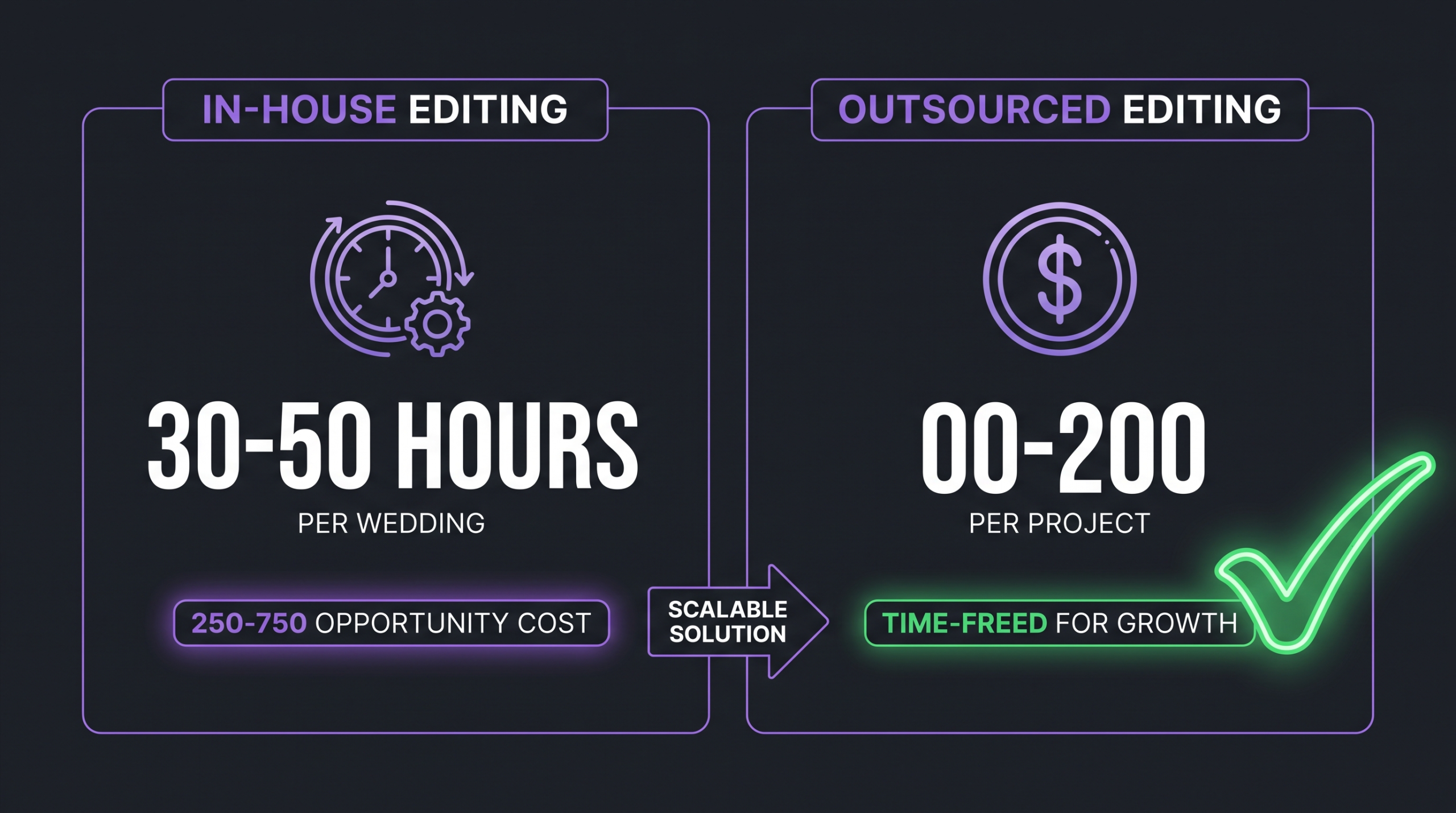
The math shifts when you count the full cost of in-house editing honestly. For a typical 8-hour wedding, a competent videographer might spend 30–50 hours in post-production editing a highlight, full film, and social cuts. At a conservative $75-per-hour opportunity cost — the rate at which they could be shooting additional projects, pursuing sales, or simply taking on another booking — that represents $2,250–$3,750 in time cost for every wedding edited in-house. Outsourcing the same project to a capable editing partner might cost $600–$1,200. The financial case for outsourcing often becomes clear at three or more weddings per month.
For the math to work reliably, the editing partner needs to clear a high bar: consistent stylistic output that matches your shooting style, reliable turnarounds that do not bottleneck your client delivery commitments, and a clear revision process that does not generate back-and-forth overhead. When those criteria are met, outsourcing post-production is not a cost — it is a margin decision.
The calculus shifts again at volume. A videographer booking four weddings per month is looking at 120–200 hours of editing per month if done in-house. That is not a part-time editing workload — it is a full-time hire or a serious outsourcing commitment. Subscription-based editing partnerships structured as retainers with volume-tiered pricing were built specifically for this scenario.
The key difference between a premium editing partner and a marketplace freelancer: a quality partner invests time upfront learning your shooting style, pacing preferences, and client delivery standards. That onboarding investment compounds over time — each successive wedding requires less correction feedback than the previous one. Increditors works this way for videographers who need senior editorial expertise applied consistently at volume. For a detailed framework on choosing between these options, see our guide to video editing agency vs. freelancer.
The Wedding and Event Videographers Association (WEVA) consistently identifies post-production and delivery management as among the most time-intensive aspects of running a wedding videography business, with many working members reporting that editing and administrative overhead represents 40–60% of total project hours.
How to Compare Quotes Without Getting Burned
Wedding video editing quotes are notoriously difficult to compare on headline price alone because editors scope their deliverables differently. Two quotes for $1,200 can represent wildly different scopes of work — one might include three revision rounds, full color grading, and licensed music; the other might be assembly-only with basic color correction and a single revision pass.
Before signing off on any editing agreement, request written answers to these specific questions:
- Footage hours included: What is the maximum raw footage covered in the base rate, and what does additional footage cost per hour?
- Camera count: Does the quote cover single-camera or multi-cam, and is drone footage included or a separate line item?
- Revision rounds: How many are included, what counts as a revision versus a structural change, and what is the cost beyond the included rounds?
- Music licensing: Is sync-licensed music included, or do you need to provide cleared tracks separately?
- Turnaround window: What is the standard delivery window, and what is the rush premium if a faster turnaround is needed?
- File format and delivery method: What formats are delivered, at what resolution, and through what channel?
For couples specifically, asking to see three recent wedding edits in a style similar to what you envision is the most important evaluation step beyond price comparison. An editor’s portfolio communicates more about stylistic fit than any rate card. The Knot’s wedding videographer cost data provides useful context on what couples typically spend on videography overall, which helps position editing costs within the total video production budget.
Common Add-Ons and Hidden Costs to Watch For
Even well-scoped projects frequently encounter additional charges. These are the most common places couples and videographers find unexpected costs after signing an editing agreement.
Same-Day Edit (SDE)
A same-day edit — a short film cut and screened at the reception on the wedding day itself — requires an editor on-site or on standby throughout the event. This deliverable is increasingly requested at premium weddings and typically adds $500–$1,200 to the project cost above the standard editing fee, depending on the length of the edit and the editor’s on-site time commitment.
Graphics, Titles, and Animation
Custom animated lower thirds (names, dates, venue titles), intro or outro animations, and stylized title cards are frequently extras. If a videographer has a signature graphic style that requires custom design work per project, expect an additional $150–$500 for the graphic design and compositing time beyond the base editing rate.
Audio Restoration and Noise Reduction
Wedding venues are notoriously unpredictable acoustic environments — outdoor ceremonies with wind noise, receptions with echo, speeches captured on a distant lavalier in a loud room. When audio requires substantial restoration beyond standard correction, editors commonly charge extra. Advanced audio work can add $100–$300 per deliverable depending on complexity and the tools required.
Subtitle and Caption Files
Couples who want SRT caption files or burnt-in captions for accessibility or social media distribution will rarely find this included in standard rates. Pricing typically ranges from $75 to $200 depending on the length of the deliverable and the level of quality review required.
File Archival and Long-Term Storage
Some editors include final file delivery but not long-term storage of raw project files. Others charge an annual archival fee. Understand clearly how long your editor retains raw footage and project files after initial delivery, and whether retrieval costs anything after the initial delivery window has closed.
For additional context on benchmarking editing costs across different formats and project types, the Thumbtack video editing cost guide and Vimeo’s video production learning resources offer useful market framing before you enter negotiations.
Frequently Asked Questions
How much does it cost to edit a wedding video?
Wedding video editing costs typically range from $300 to $5,000+ depending on the deliverable type, editor tier, and project scope. A highlight reel with a freelancer commonly runs $300–$900. With a studio, the same deliverable typically costs $600–$1,500. A full-length film with multiple deliverables from a premium editing studio usually runs $2,500–$5,500+. Raw footage hours, camera count, turnaround speed, and revision scope all move the final number significantly.
How long does it take to edit a wedding video?
Standard turnaround at most editing providers runs 3–6 weeks from footage delivery. Rush timelines of 1–2 weeks typically carry a 20–40% premium above the standard rate. A same-day edit screened at the reception requires an editor working during the event and is priced as a separate specialized service. Total project time including client review and revision cycles commonly extends the full delivery window to 4–8 weeks at most editing tiers.
Can I negotiate wedding video editing prices?
Yes, within reason. Most editors have flexibility on project rate when you provide well-organized footage with clear scene notes, reduce the revision scope, or bundle multiple deliverables in a single engagement. Rather than simply asking for a discount, ask what would need to change about the scope to hit a specific budget target — most editors respond better to that framing and it results in clearer expectations on both sides.
What is the difference between wedding video editing and color grading?
Editing refers to the assembly process: selecting and sequencing clips, syncing audio, building narrative structure, and pacing. Color grading is applied after the edit is locked: adjusting exposure, contrast, and color temperature and applying a stylistic look. Most editors include basic color correction in their base rate. Custom cinematic color grading with full look development is typically a separate line item. Many wedding editors do both, but they are genuinely distinct skills with distinct pricing.
Should wedding videographers outsource their editing?
For videographers booking three or more weddings per month, outsourcing editing is typically more economically rational than editing in-house once the full opportunity cost is counted. The critical question is not whether to outsource but who to partner with. A cheap platform editor risks your style consistency; a premium specialized partner maintains your output quality while freeing the time you need to grow the booking side of the business. See the complete framework in our video editing agency vs. freelancer guide.
Verdict
Wedding video editing costs in 2026 span a wide range, and the number you land on is almost always a function of what you need, who delivers it, and how fast. For couples, the sweet spot for most budgets sits between $800 and $2,500 for a highlight plus ceremony film from a specialist freelancer or boutique studio, with add-ons for social cuts or rush delivery where needed.
For wedding videographers running a growing business, the calculation is different. The hidden cost of editing in-house — the hours that could go toward client acquisition, shooting more weddings, or building the operational side of the business — often far exceeds the cost of a reliable editing partner. The math typically tilts toward outsourcing faster than most videographers expect, usually around the three-to-four-weddings-per-month mark.
In both cases, the decision comes down to what you are actually buying: a single edit at the lowest defensible price, or a consistent output partner who understands your creative standards and delivers reliably regardless of how many events you have shot that week. Those are two different products at two different price points, and the right answer depends entirely on what you are trying to build.
Ready for Video That Actually Converts?
Tell us about your project and we will put together a custom plan.