








![3D Explainer Video - ScribbleLive.mp4_snapshot_00.12_[2022.03.09_03.14.16]](https://increditors.com/wp-content/uploads/elementor/thumbs/3D-Explainer-Video-ScribbleLive.mp4_snapshot_00.12_2022.03.09_03.14.16-r7wb53mx72rxst3qcqyrfxdmeyzb5r9jbl0wbjujh4.png "3D Explainer Video – ScribbleLive.mp4_snapshot_00.12_[2022.03.09_03.14.16]")




























Music video production costs typically range from $500 for a simple indie shoot-and-edit to $150,000+ for a fully choreographed label production. Post-production alone — color grading, VFX, sound mix — commonly runs $1,500–$25,000 depending on complexity. This guide breaks down every cost tier, explains the variables that move the needle, and shows where experienced post-production partners save artists real money without sacrificing quality.
- What Drives Music Video Production Cost?
- Budget Tiers: From Indie to Label-Level
- Full Cost Breakdown by Line Item
- Post-Production Cost Deep Dive (Edit-Only Budgets)
- Per-Finished-Minute Pricing: What Editors Actually Charge
- Cost-Saving Strategies Without Killing Quality
- When You Already Have Footage: Hiring a Post-Production Partner
- FAQ: Music Video Budget Questions Answered
- Verdict
What Drives Music Video Production Cost?
Music video budgets vary more than almost any other video format — a DIY artist can produce something compelling for $600 while a label drops $300,000 on the same song length. The reason is that music video cost is not one number; it is a stack of decisions made across concept, shoot, and post-production, and each decision compounds. Understanding which decisions actually matter for your goals is the single fastest way to stop overspending.
Concept Complexity
A performance-only video shot in a single location with natural lighting keeps crew, equipment, and scheduling costs near their minimum. Add narrative storylines, multiple locations, costume changes, or extensive choreography and you are multiplying pre-production days, crew size, and shoot days in ways that cascade through every other line item. According to Music Gateway’s industry overview, concept scope is consistently the top variable separating $5,000 shoots from $50,000 ones.
Crew Size and Experience Level
A skeleton crew — director, DP, one assistant — can execute a performance video in a day. Professional narrative shoots commonly employ 10–25 crew members across art department, lighting, sound, and production management. Day rates for experienced department heads in major markets (Los Angeles, New York, London) typically run $600–$2,000 per person; regional and emerging-market rates may be 30–50% lower. The crew budget alone can easily exceed the cost of post-production on larger shoots.
Location and Permit Costs
Shooting in a private studio or on controlled private property keeps costs predictable. Public locations in most major cities require film permits ranging from a few hundred dollars to several thousand, plus location fees for commercial venues, landmarks, and licensed intellectual-property environments. Multiple-location shoots add travel, logistics, and schedule-buffer days that inflate total costs quickly.
Equipment and Technology
Camera and lens packages for music videos range from mirrorless setups (under $500/day rental) to cinema-grade packages with follow-focus, prime sets, and high-capacity media ($1,500–$4,000/day). Specialty gear — drones, gimbal rigs, motion-control systems, LED volume walls — adds $500–$5,000+ per item per day. Lighting packages for a properly lit two-camera narrative setup commonly run $800–$2,500 per day in equipment rentals alone before crew.
Budget Tiers: From Indie to Label-Level
The industry broadly organizes into four production tiers. Each tier reflects not just money spent but the infrastructure that money buys — crew scale, scheduling latitude, and post-production depth. Understanding where your project sits clarifies which cost trade-offs are genuinely available and which are just wishful thinking.
These ranges reflect shoot-through-delivery totals including post-production. Artists frequently discover that maximizing shooting days while underfunding post-production creates a mismatch — high-quality raw footage that never reaches its visual potential because the edit, grade, and mix were rushed or cut-rate. The tier that matters most for your audience perception is often determined more by post-production quality than by how much camera or crew you could afford on the day. Many brands and content creators work with a remote video editing agency to handle volume, maintain consistency, and scale output without adding internal headcount.
Full Cost Breakdown by Line Item
Breaking production cost into its constituent line items reveals where money concentrates — and where savings are genuinely available without compromising the final result. The ranges below reflect commonly reported market rates across US, UK, and comparable English-language markets. Rates vary substantially by city, season, and the specific relationships a production coordinator brings to a project.
💡 Pro Tip: Post-production is often the most underallocated line item in indie music video budgets. Footage shot on a cinema camera looks exactly as good as footage shot on a mid-range DSLR if both go through the same rushed, under-resourced edit. The inverse is also true — a skilled editor and colorist can make $5,000 of footage look like a $30,000 production. Budget post-production last and you are making the most expensive mistake in the production.
Pre-Production Costs Often Overlooked
Script and treatment development, storyboarding, location scouting, casting sessions, production design, and rehearsals all consume time and money before a single frame is captured. On micro-budget shoots these phases are compressed or self-handled, but on independent and mid-level projects they commonly represent 10–20% of the total budget. Skipping storyboarding on a concept-driven shoot tends to create expensive problem-solving on the shoot day itself — the worst possible time to discover a location does not work or a lighting setup is physically impossible in the time available.
Post-Production Cost Deep Dive (Edit-Only Budgets)
Many artists approach post-production as a single undifferentiated phase — “editing” — when in reality it comprises several distinct services that are quoted, staffed, and priced separately. Understanding the components helps you allocate budget accurately and identify where a specialist partner adds the most leverage over a generalist freelancer.
Offline Edit (Assembly and Rough Cut)
The offline edit is the structural phase — ingesting footage, organizing selects, building the rough cut, and refining pacing against the music track. For a 3–5 minute music video this phase commonly requires 15–40 hours of an editor’s time depending on the volume of footage shot (shoot ratios of 10:1 to 30:1 are common) and the complexity of the cut. At professional freelance rates of $75–$200/hour, this phase alone runs $1,125–$8,000 before color or effects work begins.
Color Grading
Color grading in a professional color suite (DaVinci Resolve with calibrated monitoring, hardware panel, and a dedicated colorist) typically runs $150–$500 per hour or $800–$5,000 for a half-day to full-day session for a music video. The resulting look — skin tone accuracy, contrast treatment, creative palette — is what separates productions that feel cinematic from those that look like raw footage with an Instagram filter applied. According to resources from Videomaker, professional color work adds measurably to perceived production value in ways that audience surveys consistently identify as linked to artist credibility.
VFX and Motion Graphics
Visual effects range from subtle clean-up work (removing equipment from reflections, sky replacements, logo removals) to full composite sequences, animated text, lyric overlays, and 3D environments. Simple clean-up and text animation on an indie music video commonly runs $500–$3,000. Complex composite work — digital crowds, environmental replacements, seamless transitions requiring tracked compositing — can run $3,000–$25,000 and beyond at specialist VFX facilities. For most music videos, targeted VFX used purposefully (not as decoration) at the $1,000–$5,000 range delivers the clearest return on investment.
Audio Mix and Mastering for Video
A dedicated audio mix session for a music video ensures the track levels correctly against any production sound, handles narration or voiceover if present, and produces the correct loudness standard for YouTube, streaming platforms, and broadcast. This is often bundled into a simple “use the master” approach on micro-budget productions, which technically works but misses platform-specific loudness normalization and stereo/surround considerations. Professional audio post for a music video typically runs $300–$1,500.
Per-Finished-Minute Pricing: What Editors Actually Charge
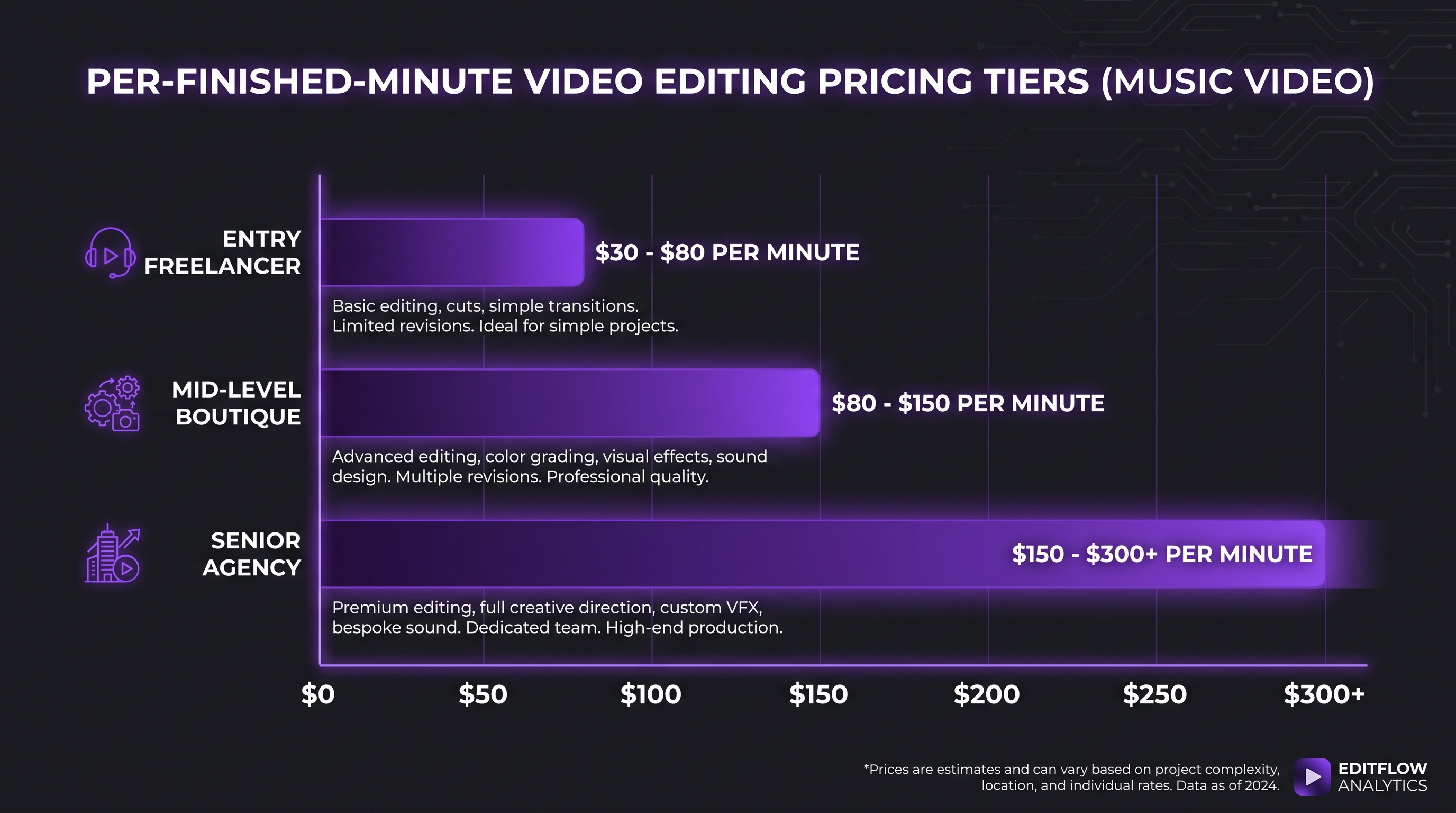
Per-finished-minute (PFM) pricing is a common way professional editors quote music video edit work, especially for edit-only engagements where the artist supplies footage and the editor delivers a finished, graded cut. This model ties cost to output length rather than time spent, which provides budget clarity upfront and rewards an efficient editorial process.
Typical per-finished-minute rates for music video editing (edit + basic color, no VFX) reported across professional freelance platforms and agency rate cards:
Per-finished-minute rates rise with shoot ratio: an editor handed 6 hours of footage to build a 4-minute cut faces meaningfully more labor than one handed 45 minutes of tightly culled selects. Some studios cap included footage at a standard ratio (commonly 10:1) and charge an organization fee for excess material. If you are supplying your own footage, agreeing on a footage cap upfront avoids billing surprises on delivery.
💡 Pro Tip: When comparing edit-only quotes, always confirm whether the rate includes color grading, how many revision rounds are covered, and what the deliverable format list looks like. A $1,500 “all-in” quote that produces only one 16:9 export is less valuable than a $2,200 quote that delivers the primary cut plus 9:16 and 1:1 social versions and a lyric cut — especially if your release strategy involves Instagram Reels and TikTok alongside YouTube.
Cost-Saving Strategies Without Killing Quality
Smart budget allocation consistently outperforms raw budget size in music video production. The decisions below are consistently cited by experienced producers as the highest-leverage ways to protect production value while managing costs — without the compromises that actually show on screen.
Concept to Location Match
Choosing a concept that works beautifully in one well-selected location — rather than an ambitious multi-location concept that stretches the budget thin across each — is one of the single highest-impact decisions available to a budget-conscious production. Many of the most iconic music videos in any genre are one-location shoots. The constraint of a single environment often forces creative solutions that would not have emerged with unlimited flexibility.
Tight Shot List and Storyboard
Shooting without a detailed shot list generates excess footage that must be organized and evaluated during post-production — adding hours to an editor’s work and therefore cost. A comprehensive storyboard reviewed and signed off before the shoot day allows a tight shot list that keeps the shoot on schedule and delivers the editor clean, organized selects rather than raw output from an exploratory approach to the camera.
Allocate 25–35% to Post-Production
As a practical guide, experienced producers commonly recommend allocating 25–35% of the total music video budget to post-production. On a $10,000 production, that means $2,500–$3,500 reserved specifically for editing, color, and audio — not as an afterthought but as a planned line item. Artists who treat post as a “whatever is left over” category consistently report dissatisfaction with the final product relative to the shoot quality they achieved. For a full breakdown of professional video editing cost ranges across project types, see Increditors’ dedicated pricing guide.
Hire Specialist Post Over Full-Service
Full-service production companies that handle shoot-to-delivery can add meaningful overhead compared to hiring specialist post-production partners independently. An artist who hires a director and DP for the shoot, then works with a dedicated video editing agency for post-production, often gets higher depth of expertise in the edit at comparable or lower cost than bundling everything through a single full-service company. This is because specialist post houses have editorial workflows and tooling optimized for exactly this type of work, not generalist production infrastructure that must be amortized across every project type.
Maximize Deliverables from One Edit
Once a finished cut is locked, the incremental cost of producing additional platform versions — a 9:16 vertical for TikTok and Reels, a square 1:1 for Instagram feed, a 30-second teaser — is a fraction of the original edit cost. Planning these deliverables upfront, and including them in the initial post-production brief, avoids expensive return-visit fees and ensures consistent visual treatment across formats. YouTube’s own content guidelines note that metadata and technical quality compliance directly affect discoverability — deliverables engineered for each platform perform measurably better than re-exported 16:9 content.
When You Already Have Footage: Hiring a Post-Production Partner
A significant share of music video post-production engagements begin with footage already captured. The artist or their team shot the project — sometimes with a professional crew, sometimes with a capable consumer or prosumer setup — and now needs a post-production partner to transform the raw material into a finished release. This edit-only model is a natural fit for specialist music video editing services that focus on post rather than production logistics.
What an Edit-Only Engagement Typically Covers
An edit-only brief typically includes: footage review and selects organization, assembly and rough cut build, structural refinement through feedback rounds, color grade for final look development, any agreed VFX or motion graphic elements, audio sync and level correction, and export of all agreed deliverable formats. The artist is responsible for supplying organized footage files and the final audio master; the post-production team handles everything from ingest to delivery. Choosing between a video editing agency and a freelancer for this work involves trade-offs in responsiveness, team depth, and accountability that go beyond hourly rate.
Briefing Your Post-Production Partner
The quality of a music video edit is significantly shaped by the quality of the brief the editor receives. A useful brief includes: the song’s intended emotional arc and key moments, reference videos that capture the desired look or energy, any location or performance moments the artist considers essential, the shoot’s coverage notes or a selects breakdown, and the target platforms and aspect ratios for deliverables. Artists who supply this brief before work begins consistently report fewer revision rounds and higher satisfaction with the final cut. The revision round count is the fastest driver of post-production cost overruns — clear briefing is the most effective cost control tool available.
The Increditors Approach to Music Video Post
Increditors works with artists and label teams as a dedicated post-production partner for music video editing — bringing experienced editors who understand pacing, emotional timing, and platform-specific delivery requirements to each project. Unlike a generalist freelancer, Increditors’ team maintains consistent availability, structured feedback rounds, and multi-format delivery as standard. For artists who have spent real money on their shoot and want that investment reflected in the final cut, a specialist video editing services partner provides the depth and accountability a solo freelancer cannot.
💡 Pro Tip: Before supplying footage to any post-production partner, create a selects folder with your best takes and make note of time codes for performances or moments you consider essential. Editors who receive organized selects over disorganized raw footage complete projects faster, with fewer surprises — which directly reduces your revision rounds and final bill.
FAQ: Music Video Budget Questions Answered
How much does a professional music video typically cost?
A professional music video — one that presents an artist in a credible, high-quality light — can be produced for as little as $3,000 on the independent end and commonly runs $15,000–$60,000 for the mid-market label-supported tier. “Professional” does not require a six-figure budget; it requires intentional decisions about where to concentrate resources, with post-production consistently ranked as the highest-leverage investment relative to cost. Berklee’s music business resources note that the return from a well-executed mid-budget video often exceeds that of a poorly planned high-budget one.
What percentage of my music video budget should go to editing and post-production?
Industry practice commonly suggests 25–35% of total production cost should be allocated to post-production. This means a $10,000 shoot should have $2,500–$3,500 reserved for editing, color grading, and audio post before the project is scoped. Artists who follow this allocation consistently report higher satisfaction with final outputs than those who treat post as an afterthought funded by budget overrun.
Can I hire a post-production company just for the edit if I already have footage?
Yes — edit-only engagements are a standard service offering from specialist post-production and music video editing services. You supply the footage and audio master; the team handles ingest, edit, color, and deliverables. These engagements are often more cost-effective than full-service production because you are paying only for the post-production expertise, not production infrastructure overhead.
What is a typical per-finished-minute rate for music video editing?
Per-finished-minute rates for music video editing typically range from $150–$350/minute at the entry-level freelance tier to $400–$750/minute at the professional boutique or mid-agency tier, and $1,000–$2,500/minute at senior specialist agencies. For a standard 3–4 minute music video, budget accordingly: mid-market edit plus color grade commonly runs $1,500–$4,000 at the boutique tier. VFX, additional platform cuts, and revision rounds beyond the included scope add to these base rates.
How do I get the best return on a limited music video budget?
The highest-leverage decisions for a limited budget are: (1) choose a concept that works in a single strong location, (2) storyboard and shot-list thoroughly before the shoot day, (3) allocate at least 25–30% of total budget to post-production, (4) plan all platform deliverables upfront rather than requesting additional cuts after delivery, and (5) work with a specialist edit partner rather than a generalist who does both production and post. Each of these decisions reduces waste and concentrates resources where they have the most visible impact on the finished product.
Verdict: Where to Spend, Where to Save, and What Actually Shows
Music video production cost is not primarily a function of how much total money you have — it is a function of how deliberately you allocate what you do have. The consistent lesson from artists who have built visible careers on indie budgets is that post-production quality is the dimension that correlates most clearly with how an audience perceives production value. A sophisticated color grade and a tight, emotionally intelligent edit read as “real” in a way that expensive camera equipment on a poorly cut project simply does not.
For artists approaching music video production: simplify the concept to maximize what you can do well within it, protect your post-production budget from being cannibalized by shoot-day decisions, and consider specialist post partners who work on music video content specifically — the pacing and visual language of music video editing is distinct enough from corporate or commercial video that specialist experience genuinely shows in the final cut.
For label A&R and marketing teams managing artist budgets: the post-production line item is where your quality control lives. Whatever the shoot budget, the edit and color grade are where the creative vision is either realized or lost. Treating post as a variable to compress when shoot costs run over is the single most common cause of expensive footage that underperforms on release. Leading video editing services for content creators maintain specialist focus on exactly this challenge — the gap between what was shot and what the audience ultimately sees.
Ready for Video That Actually Converts?
Tell us about your project and we will put together a custom plan.