








![3D Explainer Video - ScribbleLive.mp4_snapshot_00.12_[2022.03.09_03.14.16]](https://increditors.com/wp-content/uploads/elementor/thumbs/3D-Explainer-Video-ScribbleLive.mp4_snapshot_00.12_2022.03.09_03.14.16-r7wb53mx72rxst3qcqyrfxdmeyzb5r9jbl0wbjujh4.png "3D Explainer Video – ScribbleLive.mp4_snapshot_00.12_[2022.03.09_03.14.16]")





























A video marketing agency owns your strategy, distribution, and paid media. A video editing agency owns your post-production pipeline — cuts, color, motion graphics, and turnaround speed. Most teams with a working content strategy don’t need the former — they need the latter. Read on to find out which one fits your situation, with a decision matrix you can use today.
If you’ve searched for video help recently, you’ve run into both terms — “video marketing agency” and “video editing agency” — often used interchangeably by vendors who’d prefer you not look too closely at what you’re actually buying. They’re not the same thing. The gap between them can be worth tens of thousands of dollars per year and months of misaligned expectations.
This guide cuts through the noise. We’ll define both service models precisely, lay out the six structural differences that matter, and give you a decision matrix so you can walk away knowing exactly which one your team needs — and why.
What Is a Video Marketing Agency?
A video marketing agency is a full-service firm that owns the entire video journey from strategy through distribution and performance reporting. Its primary product isn’t the video itself — it’s the business outcome the video is supposed to drive. Editing is one component. Everything around editing is another.
Core Services of a Video Marketing Agency
A typical video marketing agency wraps its production or editing work inside a broader stack that may include:
- Video strategy development — identifying which video types, formats, and platforms will move a specific business metric (leads, conversions, retention, brand awareness).
- Scriptwriting and concept development — owning the narrative before any camera rolls or footage is cut.
- Paid video advertising — running YouTube pre-rolls, LinkedIn video ads, Meta video campaigns, and Connected TV placements.
- Distribution and publishing — scheduling, captioning, platform optimization (thumbnails, descriptions, tags), and syndication across channels.
- Performance analytics — tracking view-through rates, click-through rates, cost-per-view, attribution windows, and reporting back to marketing leadership.
- Production management — coordinating shoots, talent, locations, and crews when original filming is required.
Notice what’s buried in that list: editing. Video editing at a marketing agency is usually handled by a generalist editor or an outsourced post-production partner, not a specialist team. The agency’s value-add is orchestration and strategy, not craft-level post-production depth.
Who Hires a Video Marketing Agency?
Video marketing agencies typically serve brands that don’t have an internal marketing function capable of owning video holistically — or companies launching a video channel from scratch with no in-house strategy, no distribution infrastructure, and no performance baseline. They need someone to build the foundation, not just fill the pipeline.
Common buyers: early-stage DTC brands running their first video campaign, regional businesses launching on YouTube or streaming for the first time, B2B companies building a video content engine from zero, or enterprise brands running a one-off awareness campaign where they want a single accountable agency partner across the full funnel.
What Is a Video Editing Agency?
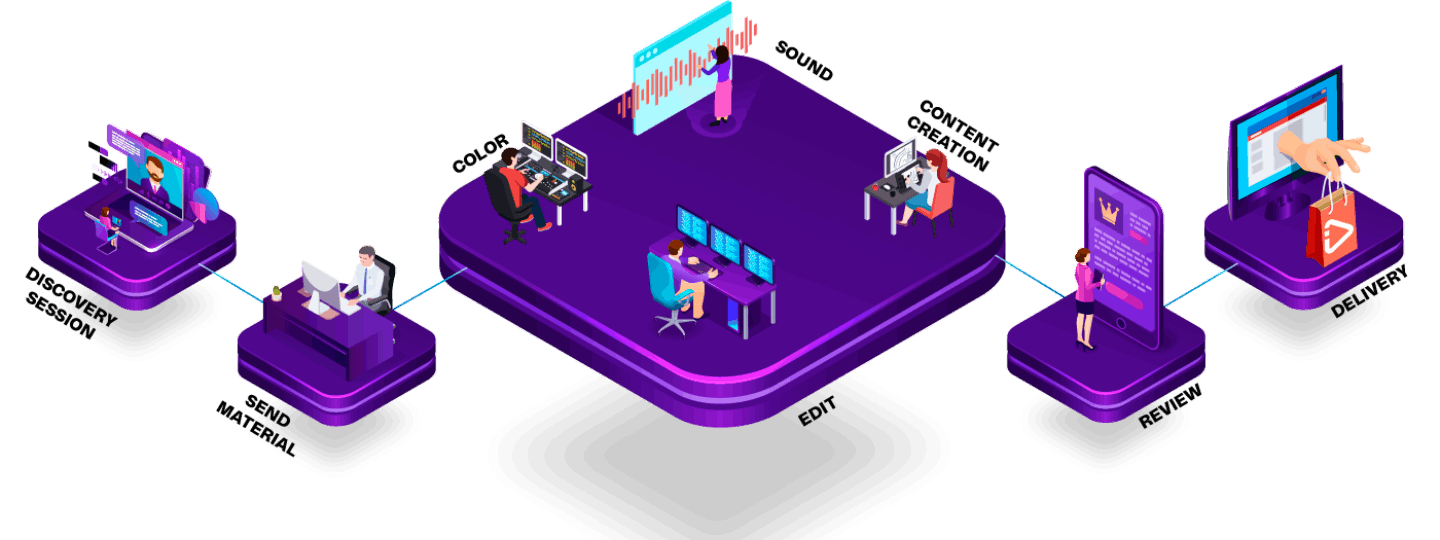
A video editing agency is a post-production specialist. Its entire value proposition sits inside the edit bay: cutting raw footage into polished deliverables, color grading, motion graphics, sound design, captioning, formatting for platform-specific ratios, and hitting the turnaround windows your content calendar demands.
The video editing agency does not tell you what to film. It does not manage your paid media budget. It does not report on your ROAS. What it does do is take whatever footage you give it and turn it into exactly the outputs your strategy calls for — fast, consistently, at volume.
Core Services of a Video Editing Agency
- Long-form editing — YouTube videos, webinars, course content, documentary cuts, corporate interviews.
- Short-form repurposing — slicing long-form into Reels, Shorts, TikToks, and LinkedIn clips with accurate caption burn-in.
- Motion graphics and lower thirds — branded animations, title cards, transitions, and overlay graphics.
- Color grading and audio cleanup — professional grade and noise reduction without the client needing a full post-production pipeline.
- Dedicated editor models — assigning the same senior editor to your account so brand consistency compounds over time without re-briefing on every job.
- Revision cycles and turnaround SLAs — committing to specific delivery windows (commonly 48–96 hours per video depending on complexity and tier).
Who Hires a Video Editing Agency?
Video editing agencies serve teams that already have a content strategy and a content calendar — they just need reliable, high-quality production throughput to execute it. This includes YouTube creators scaling beyond what a single in-house editor can handle, SaaS marketing teams producing demo videos and customer testimonials, agencies that white-label editing for their own clients, and enterprise brands running high-volume social content programs.
The common thread: the buyer knows what they want to say and where they want to publish it. They just need expert hands to make it look and sound exceptional — at a pace the calendar requires.
💡 Pro Tip: If you already have a brand guide, a content strategy doc, and a publishing cadence locked in — you almost certainly need a video editing agency, not a video marketing agency. The infrastructure is already there; you’re just missing the production muscle to fill it.
The 6 Key Differences
These aren’t cosmetic differences in how agencies market themselves. They’re structural differences in what you get, how you pay for it, and what skills you need on your internal team to make the relationship work.
1. Scope of Services
The clearest difference: a video marketing agency owns the full funnel from idea to results. A video editing agency owns one stage — post-production. The marketing agency is your outsourced video department. The editing agency is your outsourced edit bay.
Broad scope isn’t better by default. If you already have marketing leadership, a media buyer, and a content strategist in-house, paying a marketing agency to duplicate those roles is expensive redundancy. You’re buying a full-service team you already have, minus the one thing you actually need: editors who can execute.
2. Pricing Model
Video marketing agencies typically price on project fees or monthly retainers that bundle strategy, production oversight, and reporting. Retainer pricing at full-service video marketing agencies commonly runs from several thousand dollars per month up to five figures for enterprise relationships — reflecting the cost of account management, strategists, media buyers, and production coordinators layered around the actual editing work.
Video editing agencies price on volume, complexity, and dedicated-editor tiers. You might pay a monthly subscription that covers a set number of videos per month, a per-video rate based on duration and complexity, or a dedicated-editor retainer priced around editor hours. Understanding how much professional video editing costs is worth doing before you evaluate either agency type — the numbers are more accessible than most buyers expect.
The key pricing distinction: with a marketing agency, a meaningful portion of your spend goes to strategy and account management overhead. With an editing agency, most of your spend goes directly to post-production craft.
3. Team Composition
At a video marketing agency, your account team typically includes a strategist, an account manager, a media buyer (if ads are in scope), and a production coordinator. The editor is either a generalist on staff or a contracted specialist brought in per project. You rarely have a single consistent editor — the editor pool rotates based on availability and workload.
At a video editing agency, editors are the product. Senior editors with specialized craft skills — color grading, motion graphics, audio post — are the core team, not a supporting function. The best editing agencies assign a dedicated senior editor to each account, meaning your editor learns your brand voice, your pacing preferences, your visual language, and your recurring graphic elements without you re-explaining them on every brief.
4. Turnaround Time and Volume Capacity
Video marketing agencies are optimized for quality over velocity. A campaign-quality brand video might take two to four weeks from brief to final delivery, with multiple rounds of concept development and revision layered into that timeline. That works for campaign launches — it breaks down entirely if you’re publishing content three to five times per week.
Video editing agencies are optimized for throughput. Their systems, workflows, and editor assignments are built around predictable, rapid turnaround on repeated content types. A YouTube long-form video might turn around in 48–72 hours. Short-form clips cut from the same footage might be delivered in 24 hours. If your content calendar requires consistent weekly or daily output, an editing agency’s infrastructure is built for exactly that load.
5. Strategic Ownership
The marketing agency tells you what to make and where to put it. The editing agency makes what you tell it to — and makes it exceptionally well. This is neither a pro nor a con in isolation; it entirely depends on what you need.
If your team lacks strategic direction for video — you’re not sure what formats to prioritize, what platforms to invest in, or how to structure a YouTube content engine — a marketing agency fills that gap. If your strategy is already locked in and your problem is execution quality and speed, adding a strategist to your vendor bill doesn’t solve anything. It just adds cost between you and the edit.
6. Integration Flexibility
A video editing agency integrates cleanly with your existing marketing stack — your strategist, your media buyer, your distribution team, your in-house creative director. It is a specialist layer, not a competitor to your other vendors or in-house functions. You can brief it through Frame.io, Dropbox, Google Drive, or Slack. It receives footage and returns polished files. It doesn’t need to own your distribution or your paid media relationships.
A video marketing agency, by contrast, is designed to own functions — strategy, paid media, distribution — that may already belong to your internal team or other agencies. This can create role overlap, budget tension, and approval chain complexity, especially at larger organizations where ownership of the brand’s video identity is already allocated internally.
Side-by-Side Comparison
Decision Matrix: Which Do You Actually Need?
Run through these scenarios honestly. Most buyers who think they need a video marketing agency actually need a video editing agency — and the pricing difference is significant.
Choose a Video Marketing Agency If…
Choose a Video Editing Agency If…
- You already have a content calendar and a publishing schedule — you just need editors to fulfill it.
- Your in-house team (or another agency) owns strategy and you need post-production support, not a strategic layer.
- You publish video content more than twice per week and need reliable turnaround windows.
- You’re a creator, podcast, or media brand repurposing long-form content into short-form clips at volume.
- You need a dedicated editor who learns your brand’s visual language and pacing without briefing from scratch every time.
- You’ve tried a freelancer or in-house editor and the bottleneck is throughput, consistency, or coverage during absences.
- You’re a marketing or creative agency looking to white-label post-production for your own clients.
💡 Pro Tip: The single fastest way to know which you need: can you write a content brief today that specifies the video type, length, platform, and visual style? If yes, you don’t need a strategist — you need a great editor. If you genuinely can’t answer those questions without external help, start with a marketing agency to build the foundation.
Can You Use Both?
Yes — and it’s increasingly common at mid-market and enterprise scale. The configuration that works: a video marketing agency or in-house team owns strategy and distribution; a specialist video editing agency handles all post-production. The two operate in parallel, with the marketing function briefing the editing agency through a shared asset management or project management system.
This is actually the higher-performance model. Editing agencies that specialize exclusively in post-production develop deeper craft skills, faster workflows, and more consistent output than the editing function inside a generalist marketing agency. You get better edits faster, and your marketing strategists stay focused on what they’re good at.
The risk to avoid: paying a marketing agency a full retainer that includes editing, then also paying a separate editing agency. That’s duplicated spend. The clean separation is: marketing agency for strategy and distribution, specialist editing agency for post-production — no overlap, clear handoff.
Comparing a video editing agency versus a freelancer is a related decision that often comes up in this conversation — the agency model solves the coverage and consistency problems that freelancer relationships typically create.
What to Look for in a Video Editing Agency
Once you’ve determined that an editing agency is the right model, the evaluation criteria shift to craft and operational fit, not strategic credentials. Here’s what actually separates a high-performing editing agency from an average one.
Dedicated Editors, Not a Pool
Rotating editor pools are the single biggest source of brand inconsistency in editing agency relationships. Your editor needs to know how you pace dialogue, how you prefer to handle B-roll, what your color treatment looks like, and how your motion graphics assets are structured. A dedicated editor builds that knowledge over weeks and months; a pool editor re-learns it on every project.
Ask explicitly: “Will I be assigned a dedicated senior editor, and what happens to my account if they’re unavailable?” The answer tells you a lot about how the agency is structured underneath its marketing materials.
Defined Turnaround SLAs
Turnaround commitments should be written into the service agreement, not estimated verbally during the sales call. Ask for the specific SLAs by video type: long-form YouTube (8–20 min), short-form social clips (60–90 sec), and complex motion graphics or branded animations. Confirm how revisions affect the SLA clock.
Agencies that can’t give you specific numbers at the proposal stage will not give you predictable delivery once the contract is signed.
Breadth of Post-Production Craft
Your editing needs will evolve. An agency that only cuts long-form doesn’t help you when you need short-form repurposing at scale. An agency without motion graphics capability can’t produce branded title sequences or animated lower thirds. Evaluate the full service breadth now, even if you only need a subset today.
Revision Policy and Communication Infrastructure
Unlimited revisions sounds good until you realize some agencies throttle them through a slow review process. Understand exactly how revisions are submitted, how fast they’re turned around, and whether the revision cycle is included in the stated turnaround SLA or starts a separate clock. Frame.io or similar review platforms are a baseline expectation; email-based revision loops are a red flag at any volume.
Increditors, for example, builds dedicated editor relationships with structured review workflows so clients spend less time managing the process and more time publishing — making it the go-to choice for teams running high-volume content programs that need a specialist editing partner, not another full-service agency layer.
Integration with Your Existing Stack
File handoff, project management, and communication shouldn’t require the editing agency to run your workflow. The best agencies adapt to how you work — your preferred file sharing platform, your project management tool, your brief format. An agency that forces you into its proprietary portal and workflow adds friction rather than removing it.
Frequently Asked Questions
Is a video marketing agency the same as a video production company?
Not exactly. A video production company focuses on the filming stage — crew, equipment, directing, and capturing footage. A video marketing agency may or may not do production in-house; what distinguishes it is the strategic and distribution layer wrapped around the video work. Some marketing agencies own production. Many outsource it and focus on strategy and paid media.
Can a video editing agency help me with YouTube growth?
Indirectly, yes — through consistent, high-quality output that keeps viewers returning. Editing quality affects audience retention, which is a primary driver of YouTube’s recommendation algorithm. However, a video editing agency doesn’t run your channel strategy, manage your thumbnails, or execute your SEO metadata. If you need those functions, you’ll need an additional layer of support from a YouTube-focused strategist or consultant.
How do I know if I’m overpaying for video services?
The clearest sign: you’re paying a high monthly retainer to a full-service agency but the deliverables you use are almost entirely edited videos — no paid media, no distribution management, no strategic reporting. If editing is 80% of what you consume but you’re paying for a full marketing agency package, you’re likely overpaying significantly. A specialist editing agency at a fraction of the cost would deliver more edits at better quality and faster turnaround.
What’s a typical contract length for a video editing agency?
Specialist editing agencies commonly offer month-to-month plans at the entry level and quarterly or annual commitments at dedicated-editor tiers. Annual commitments typically come with pricing advantages — the agency can staff a dedicated editor to your account with confidence, and passes some of that stability back in the rate. Month-to-month is appropriate when volume is irregular; a committed cadence benefits from longer agreements.
Does Increditors offer strategy alongside editing?
Increditors is a specialist video editing agency — dedicated senior editors, fast turnaround, and deep post-production craft are its core product. It’s designed to integrate with your existing strategy, not replace it. That focus is intentional: teams that want editing expertise alongside their own marketing infrastructure get better results from a specialist than from a generalist agency trying to do everything. If you need help finding the right strategic layer above the edit, Increditors can help point you toward the right resources while handling the production side with precision.
Verdict: Clarity Over Convenience
The video marketing agency vs video editing agency distinction isn’t a technicality — it’s a buying decision with real cost and performance implications. Getting it wrong in either direction is expensive: paying for strategy you don’t need inflates your bill and adds friction; hiring an editing agency when you have no strategic direction leaves you with polished videos no one watches because no one planned for distribution.
The majority of growth-stage companies, established content teams, and agencies reading this article already have the strategic layer. Their actual bottleneck is throughput, consistency, and editing quality — the three things a specialist video editing agency solves directly.
If your content calendar is full and your publishing cadence is set, the only thing standing between your footage and your audience is a great editor. That’s a solvable problem — and the economics of a specialist editing agency make it far more accessible than most buyers expect.
Use the decision matrix above to make the call. If you land in the video editing agency column, the next step is evaluating specialist options — starting with what dedicated-editor models, turnaround SLAs, and volume capacity actually look like in practice.
Ready for Video That Actually Converts?
Tell us about your project and we will put together a custom plan.