








![3D Explainer Video - ScribbleLive.mp4_snapshot_00.12_[2022.03.09_03.14.16]](https://increditors.com/wp-content/uploads/elementor/thumbs/3D-Explainer-Video-ScribbleLive.mp4_snapshot_00.12_2022.03.09_03.14.16-r7wb53mx72rxst3qcqyrfxdmeyzb5r9jbl0wbjujh4.png "3D Explainer Video – ScribbleLive.mp4_snapshot_00.12_[2022.03.09_03.14.16]")

























Every year, some blog publishes a “video editing trends” list that’s 90% wishful thinking and 10% stuff that already happened three years ago. This isn’t that article.
We edit hundreds of videos every month for YouTube creators, DTC brands, and businesses across every niche. We see what’s actually changing in real editing workflows — not what looks cool in a product demo. Here are the trends that are genuinely reshaping how video content gets made in 2026, and what they mean for anyone producing video.
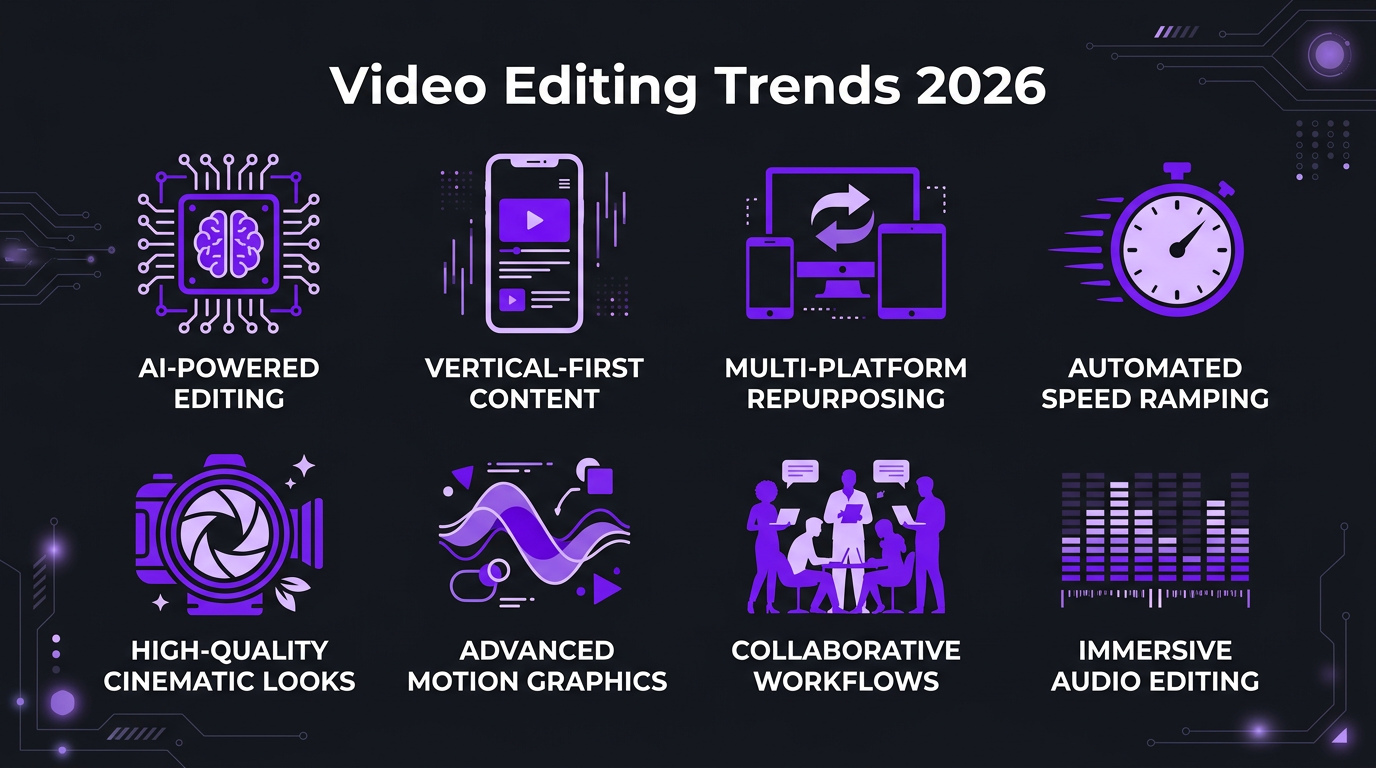
What’s in This Guide
- AI-Assisted Editing: What’s Real, What’s Hype
- Vertical-First Is Now Default
- Multi-Format Repurposing at Scale
- The Turnaround Time Arms Race
- Cinematic Standards for Every Platform
- Motion Graphics as Table Stakes
- Solo Editors → Editing Teams
- Sound Design Gets Serious
- Accessibility as Default, Not Afterthought
- What’s Coming Next
- FAQ
Trend 1: AI-Assisted Editing — What’s Real, What’s Hype
Let’s address the elephant in the editing suite. AI tools have been the biggest conversation in video editing for the last two years, and in 2026, the picture is finally clear enough to separate reality from marketing.
What AI Actually Does Well in 2026
AI editing tools have gotten genuinely useful for specific, repetitive tasks:
- Auto-captions and subtitles: Tools like Premiere Pro’s auto-transcription and CapCut’s caption engine produce 90-95% accurate captions that need minimal cleanup. This saves 30-60 minutes per video compared to manual captioning.
- Silence and dead space removal: Auto-cut tools that remove pauses, “ums,” and dead air from talking head footage. Saves 1-2 hours on a typical 30-minute raw recording.
- Rough assembly: AI can create a serviceable first cut from raw footage based on transcript analysis — identifying the best takes, removing mistakes, and arranging segments in order. This is genuinely useful as a starting point.
- Auto-reframing: Converting 16:9 horizontal footage to 9:16 vertical with intelligent subject tracking. It’s good enough for 70% of shots, requiring manual adjustment only for complex compositions.
- Color matching: AI-powered tools that match color between shots from different cameras or lighting conditions. Not as good as a skilled colorist, but dramatically better than nothing.
- Background noise removal: AI noise reduction has reached a level where it can rescue footage that would have been unusable 3 years ago.
What AI Still Can’t Do
Here’s where the hype breaks down. AI cannot currently:
- Make creative editorial decisions: When to cut, how to pace a sequence for emotional impact, where to place B-roll for maximum effect — these require understanding the content and the audience, not just the pixels.
- Maintain brand consistency: AI can’t understand your brand voice, your style guide, or the subtle aesthetic decisions that make your content recognizable across videos.
- Tell stories: Narrative editing — building an arc, creating tension, delivering payoffs — remains a fundamentally human skill. AI can assemble footage; it can’t craft a narrative.
- Handle complex multi-track projects: Music, sound effects, multiple video layers, motion graphics, and color grading all interacting — this level of complexity overwhelms current AI tools.
- Adapt to feedback: “Make it feel more energetic in the middle section” or “the opening drags” — this kind of subjective creative feedback requires human interpretation.
How This Affects Pricing and Workflow
AI-assisted workflows have compressed turnaround times by 20-30% without reducing quality. Editors who previously spent 3 hours on a rough cut now spend 45 minutes refining an AI-generated assembly. This has had two market effects:
- Turnaround expectations have tightened: Clients now expect 24-48 hour delivery on short-form content because they know AI makes it possible. This is putting pressure on slower editing services.
- Per-video prices haven’t dropped as expected: Because the time savings go toward higher-quality creative work (better motion graphics, more nuanced pacing, better color), not toward cheaper delivery. The output quality ceiling has risen, but the floor hasn’t dropped.
The editors and agencies adapting fastest are those using AI as a speed multiplier while doubling down on the creative skills AI can’t replicate. At Increditors, our editors use AI-assisted rough cuts as starting points, then invest the saved time into the motion graphics, pacing, and polish that differentiate professional content from DIY edits.
Trend 2: Vertical-First Is Now the Default
This shift has been coming for years, but 2026 is the year it became undeniable: vertical video (9:16) now accounts for more than 60% of all video content produced for digital platforms.
Think about what that means for editing workflows. For most of video history, horizontal 16:9 was the standard format. Vertical was an afterthought — you’d shoot horizontal and crop for mobile. That approach no longer works.
What’s Changed
- Instagram Reels now drive 3-4x more reach than feed posts for most accounts
- YouTube Shorts surpassed 70 billion daily views in late 2025
- TikTok remains the discovery engine for audiences under 35
- LinkedIn now prioritizes vertical video in the feed (a major 2025 shift)
- Even YouTube long-form is seeing increased mobile viewing in portrait orientation
How This Changes Editing
Vertical-first editing isn’t just cropping horizontal footage. It requires fundamentally different creative choices:
- Text placement: Vertical real estate means text overlays need to be larger, positioned in the center-third of the frame, and designed for thumb-scrolling attention spans.
- Composition: Subjects need to be framed for vertical viewing. Wide establishing shots that look gorgeous at 16:9 become meaningless at 9:16.
- Pacing: Vertical content is consumed faster. Average watch time on Reels is 3-8 seconds before the viewer either commits or scrolls. This demands front-loaded hooks and faster cuts than horizontal content.
- Graphics and lower thirds: Everything needs to be redesigned for vertical. Horizontal lower thirds don’t work. Side-by-side comparisons become top-bottom stacks.
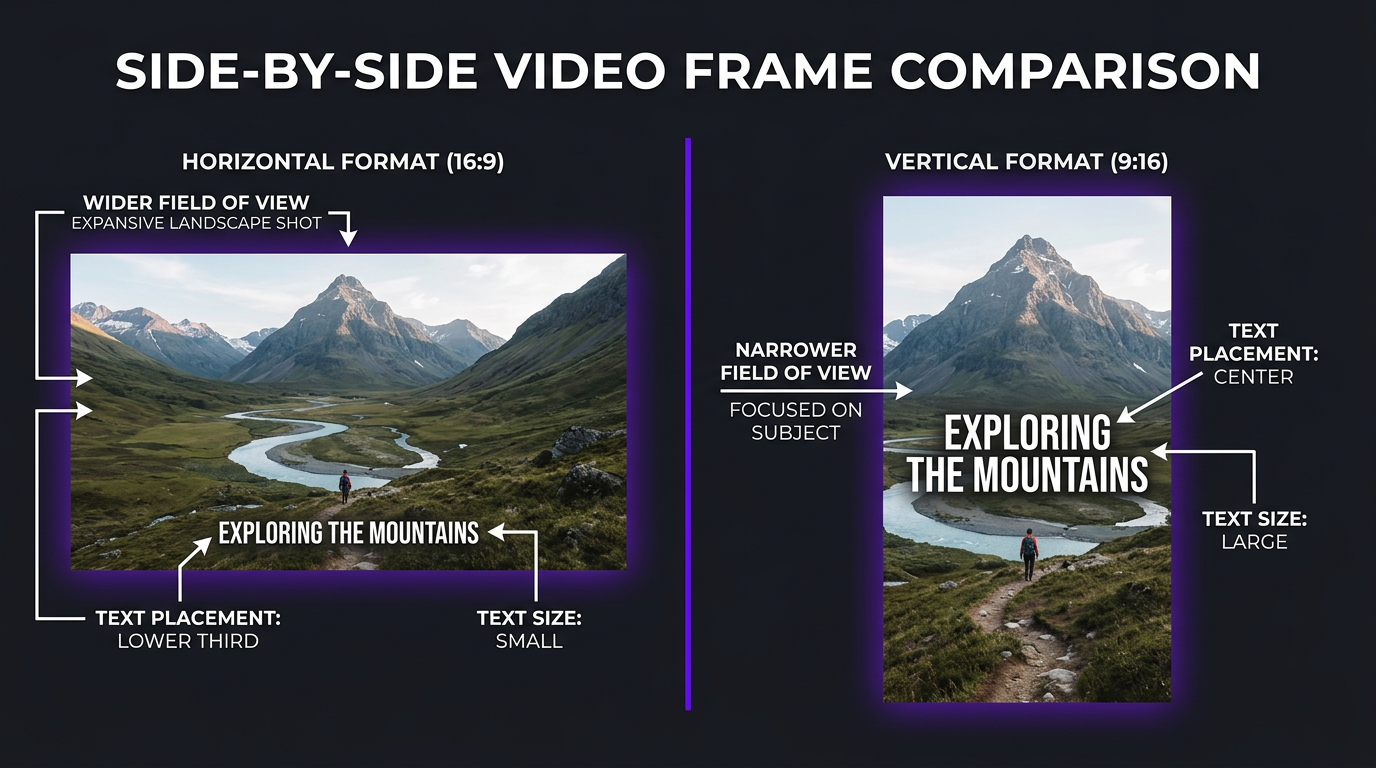
| Editing Element | Horizontal (16:9) | Vertical (9:16) |
|---|---|---|
| Text size | 24-36pt typical | 36-60pt for readability |
| Text position | Lower third standard | Center or upper third |
| Hook timing | First 5-10 seconds | First 1-3 seconds |
| Cut frequency | Every 5-15 seconds | Every 2-5 seconds |
| B-roll integration | Full-screen cuts | Split-screen, overlays, stacked |
| Comparison layouts | Side by side | Top and bottom stacked |
| Captions | Optional | Essentially mandatory |
The creators and brands winning in 2026 shoot with vertical in mind from the start — not as a reformatting exercise in post. This means editors need to be involved earlier in the production process, advising on framing and composition during the shoot, not just cutting footage after the fact.
Trend 3: Multi-Format Repurposing at Scale
The smartest content strategy in 2026 isn’t creating more content. It’s creating once and editing into multiple formats.
A single 20-minute YouTube video can become:
- 1 long-form YouTube video (16:9)
- 3-5 YouTube Shorts (9:16)
- 3-5 Instagram Reels (9:16, different hooks than Shorts)
- 3-5 TikTok clips (9:16, trending audio overlays)
- 1-2 LinkedIn clips (1:1 or 9:16)
- 1 podcast audio extract
- 5-10 quote cards and text snippets
From one shoot, a good editing team produces 15-25+ pieces of content. This is the content multiplication approach, and it’s becoming the standard expectation for anyone serious about video.
Why This Changes the Editor’s Role
Repurposing isn’t just cutting clips from longer videos. Each platform has different audience behaviors, algorithm preferences, and content norms. A clip that works on YouTube Shorts might bomb on TikTok because the pacing, captions, or hook style doesn’t match what that platform’s audience expects.
This means editors in 2026 need platform literacy — understanding not just how to edit, but how each platform’s audience consumes content. It’s a skill that separates modern professional editors from traditional post-production generalists.
Trend 4: The Turnaround Time Arms Race
In 2023, a 5-7 day turnaround for an edited YouTube video was standard. In 2026, it’s uncompetitive.
Market expectations have compressed dramatically:
| Content Type | 2023 Standard | 2026 Expectation |
|---|---|---|
| YouTube long-form (10-20 min) | 5-7 days | 2-4 days |
| Short-form social (Reels/Shorts) | 3-5 days | 24-48 hours |
| Ad creatives | 5-10 days | 2-3 days |
| Campaign/brand videos | 10-14 days | 5-7 days |
| Revisions | 2-3 days per round | Same-day or next-day |
Several factors are driving this compression:
- AI-assisted workflows make faster editing technically possible (see Trend 1)
- Platform algorithms reward recency — posting a trend video 3 days late means you’ve already lost 80% of its potential reach
- Competition among editing services — agencies and freelancers are competing on speed as a differentiator
- Creator volume expectations — many creators now publish 5-7 pieces per week across platforms, requiring a production velocity that didn’t exist three years ago
This has serious implications for how editing teams are structured. Solo freelancers who take on 4-5 clients can’t physically deliver 24-48 hour turnarounds for all of them. The speed expectation is one of the biggest drivers behind the shift from solo editors to team-based editing services.
Need Editing That Keeps Up with 2026a
Our teams deliver short-form in 24-48 hours and long-form in 2-4 days — with the quality to match. See why creators choose dedicated editing teams over solo freelancers.
Trend 5: Cinematic Quality Is Now Expected Everywhere
Five years ago, “cinematic” editing was reserved for music videos, short films, and big-budget brand content. In 2026, viewers expect cinematic quality on YouTube, and increasingly on social platforms too.
What “Cinematic” Means in Practice
It’s not just about shallow depth of field and dramatic music. Cinematic editing in the YouTube/social context means:
- Professional color grading: Not just slapping a LUT on footage, but intentional color work that creates mood and visual consistency across an entire video. Color grading is no longer a luxury — it’s a baseline expectation.
- Sound design: Subtle ambient sounds, whooshes on transitions, impact sounds on text reveals. The audio layer adds 30-50% to perceived production quality.
- Intentional pacing: Breathing room between information-dense sections. Knowing when to slow down and when to speed up for emotional effect.
- B-roll storytelling: B-roll that illustrates and enhances the narrative, not generic stock footage dropped in to cover jump cuts.
- Seamless transitions: Motivated transitions that serve the content rather than calling attention to themselves.
Channels like Veritasium, Johnny Harris, and Marques Brownlee have set viewer expectations so high that even mid-tier creators are measured against cinematic standards. If your editing looks like 2019 YouTube — jump cuts, minimal graphics, no color work — you’re at a competitive disadvantage regardless of your content quality.
The Cost Implication
Cinematic-quality editing costs more because it requires more skill and more time. But the gap is narrowing as tools improve and editing teams become more efficient. What cost $800-$1,500 per video in 2023 now costs $400-$800 through efficient agency workflows — still premium, but accessible to serious creators with the right pricing model.
Trend 6: Motion Graphics as Table Stakes
Motion graphics used to be a premium add-on. In 2026, they’re part of the standard editing package for any professional-grade content.
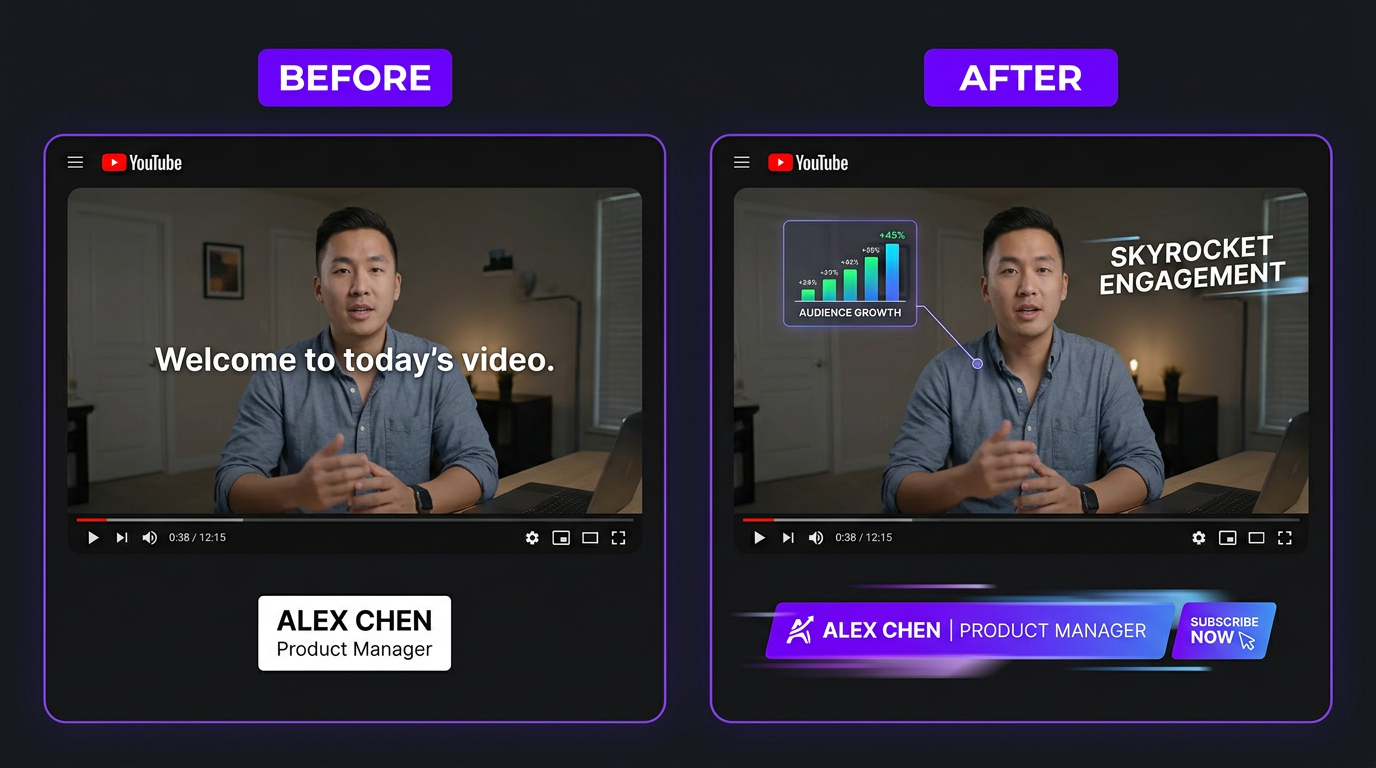
The proliferation of After Effects templates, motion graphic presets, and tools like MotionVFX and Motion Array has democratized motion graphics to the point where audiences expect them. A YouTube video without animated text, kinetic typography, or custom transitions looks under-produced to modern viewers.
Where Motion Graphics Matter Most
- Data visualization: Animated charts, statistics call-outs, and comparison graphics that bring numbers to life
- Kinetic typography: Key points emphasized through animated text — not just static lower thirds
- Custom transitions: Branded transitions that become part of your channel’s visual identity
- Intro/outro sequences: Professional channel branding that establishes credibility in the first 3 seconds
- Explainer animations: Concepts illustrated through simple 2D animation rather than described verbally
The editing skill profile has shifted accordingly. In 2020, an editor who could cut footage well was sufficient. In 2026, editors are expected to be comfortable with basic motion graphics — or work within a team where a motion designer handles that layer.
| Motion Graphics Element | 2023 Status | 2026 Status | Impact on Engagement |
|---|---|---|---|
| Animated text/titles | Premium add-on | Expected standard | +15-25% retention |
| Data visualizations | Rare (brand videos only) | Common in educational content | +20-40% comprehension |
| Custom transitions | Nice to have | Brand differentiator | Perception of quality |
| Animated thumbnails/end cards | Uncommon | Growing standard | +10-20% click-through |
| Explainer animations | Specialized studios only | Available from most agencies | +30-50% message clarity |
Trend 7: The Shift from Solo Editors to Editing Teams
This is one of the most significant structural shifts in the video editing market. The solo freelance editor model is breaking down, and team-based editing is becoming the standard for serious content operations.
Why Solo Editors Are Struggling
The demands on a video editor in 2026 are simply too broad for one person:
- Edit for multiple formats (horizontal + vertical)
- Create motion graphics and animated text
- Color grade professionally
- Handle sound design and audio mixing
- Deliver in 24-48 hours for short-form
- Manage client communication and revisions
- Stay current with platform algorithm changes
A solo editor handling 4-5 clients can’t realistically excel at all of these. Something always suffers — usually turnaround time or motion graphics quality.
The Team Model
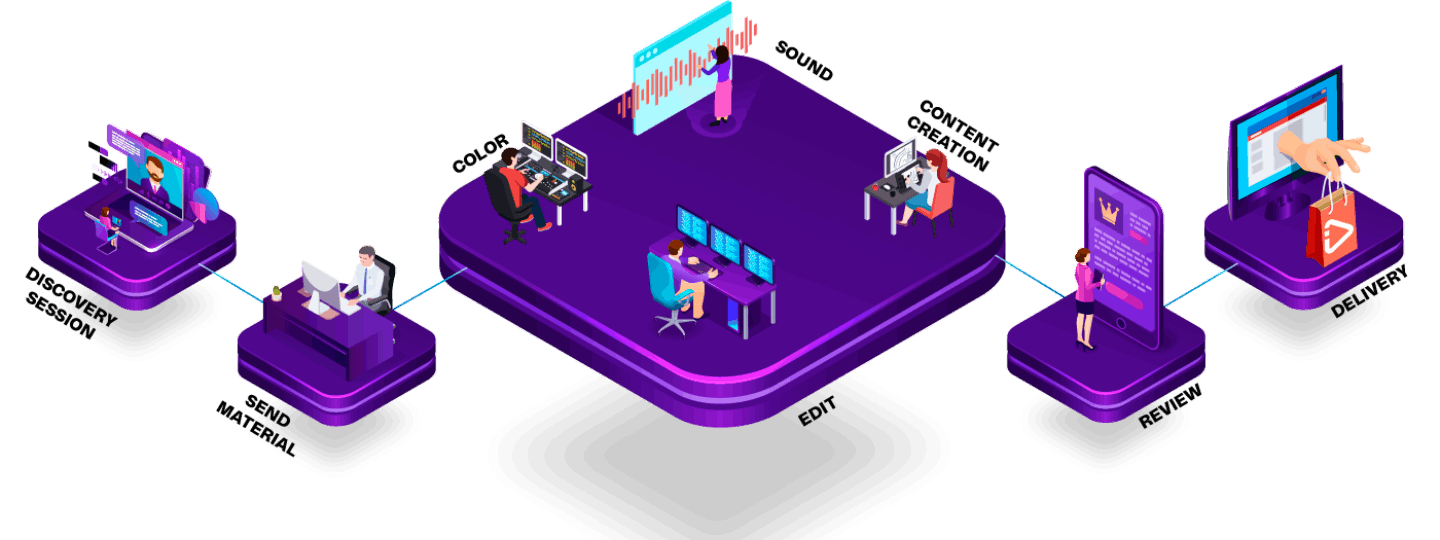
The alternative that’s gaining traction: small, specialized teams. A typical team structure at agencies like Increditors includes:
- Primary editor: Handles the core cut — pacing, story, B-roll integration
- Motion designer: Creates animated elements, lower thirds, data visualizations
- Colorist: Color grading and visual consistency
- Audio specialist: Sound design, music, mixing (often shared across projects)
- Project manager: Client communication, timeline management, quality control
This structure delivers higher quality, faster turnaround, and built-in redundancy (if one team member is out, others can cover). The cost is typically comparable to a senior solo editor because the team operates more efficiently through specialization.
We’ve written extensively about this shift in our guide to enterprise video editing — but it’s not just for enterprise anymore. Even creators with 50K subscribers are finding that team-based editing outperforms solo freelancers.
Trend 8: Sound Design Gets Serious
For years, sound design was the neglected child of YouTube editing. Creators and editors focused on visuals — color, graphics, pacing — while sound got a music track and basic leveling. That’s changing fast.
The Audio Renaissance
Several shifts are driving better audio in 2026:
- Podcast-influenced audiences: Viewers who listen to 2-hour podcasts have higher expectations for audio quality. Poorly mixed audio is an instant turn-off.
- ASMR and spatial audio trends: These have trained audiences to appreciate nuanced sound design, raising expectations across all content.
- Better tools: AI-powered audio cleanup (iZotope RX, Adobe’s AI denoiser) makes professional-grade audio accessible without expensive studio recording.
- Platform algorithm signals: YouTube’s algorithm uses watch time, and poor audio is the #1 reason viewers bounce in the first 30 seconds — before visual quality even matters.
What Good Sound Design Looks Like
- Transition sounds: Subtle whooshes, risers, and impacts that punctuate visual transitions
- Ambient beds: Low background tones that fill silence and create atmosphere
- Text reveal sounds: Pop, swoosh, or impact sounds on animated text and graphics
- Music ducking: Automated or manual volume adjustments that keep music present but never competing with dialogue
- Noise floor management: Consistent background noise levels that don’t draw attention to cuts
The difference between a video with and without sound design is impossible to unsee (unheara). Once you notice it, every video without sound design feels flat and amateur.
Trend 9: Accessibility as Default, Not Afterthought
Accessibility in video editing used to mean “add captions if someone asks.” In 2026, it’s a production standard — both because it’s the right thing to do and because it dramatically expands your audience.
What Accessible Editing Includes
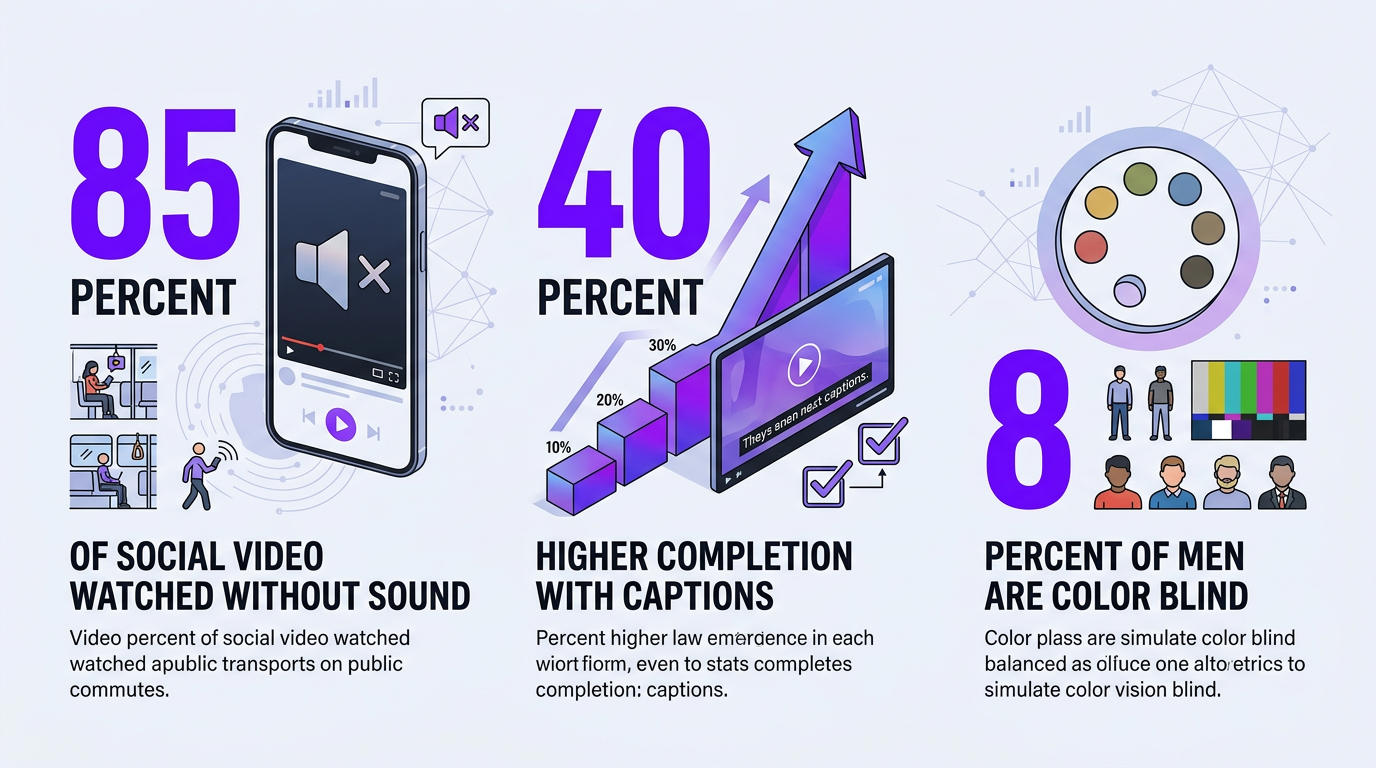
- Burned-in captions: Not just closed captions in the platform player, but styled, timed captions that are part of the video itself. Essential for social platforms where sound-off viewing is dominant.
- Visual descriptions of on-screen text: Key information presented both visually and verbally
- Color-accessible design: Graphics and charts that work for color-blind viewers (8% of men have some form of color vision deficiency)
- Readable text sizes: Mobile-first text sizing that’s readable even on small screens
- Audio descriptions: For content-heavy visual sequences, narration that describes what’s happening on screen
The Business Case
Beyond ethics, accessibility is smart business:
- Videos with captions see 40% higher view completion rates
- 85% of Facebook/Instagram video is watched without sound — captions are functional, not optional
- Captioned content is more shareable because viewers can consume it in any environment
- Search engines can index caption text, improving SEO discoverability
AI-generated captions have made this dramatically easier (see Trend 1), but quality captioning still requires human review. Auto-generated captions are 90-95% accurate — which sounds great until you realize that means 5-10 errors per 1,000 words, some of which can be embarrassing or misleading.
What’s Coming Next: 2027 and Beyond
Based on what we’re seeing in production workflows and emerging tools, here’s what we expect to gain traction over the next 12-18 months:
Interactive and Shoppable Video
YouTube’s shoppable video features and TikTok Shop integrations are making video directly transactional. This means editors will need to design content with clickable elements in mind — product callouts, shop links, and interactive overlays that are planned during the edit, not added afterward.
Real-Time Collaborative Editing
Frame.io and similar tools have made remote review and feedback seamless. The next step is real-time collaborative editing — multiple editors working on the same timeline simultaneously, similar to how Google Docs works for text. Adobe has been building toward this, and we expect it to become production-ready in late 2026 or early 2027.
AI-Generated B-Roll
AI video generation (Sora, Runway, Pika) is improving rapidly. While it’s not replacing live footage for hero content, AI-generated B-roll for illustrative purposes — abstract visuals, concept illustrations, atmospheric shots — is becoming viable. Editors who can integrate AI-generated footage naturally into human-shot content will have an edge.
Personalized Video at Scale
Dynamic video content that adapts to the viewer — different intros for different audience segments, personalized product recommendations, region-specific content — is moving from expensive enterprise tech to accessible tools. This will create entirely new editing workflows centered around modular content and conditional logic.
Spatial and 3D Content
Apple Vision Pro and Meta Quest have small but growing user bases. As spatial computing grows, editors will need to think about 3D space and immersive viewing. This remains a niche skill in 2026, but it’s the kind of niche that becomes mainstream suddenly.
What This Means for Your Content Strategy
If you’re producing video content in 2026, here’s the practical takeaway:
- Embrace AI tools for efficiency, but don’t mistake them for creative solutions.
- Plan for vertical first. If your editor treats vertical as an afterthought, find a new editor.
- Demand multi-format delivery. Every video you shoot should become 5-15+ pieces of content.
- Expect faster turnarounds. If your editing partner can’t deliver short-form in 48 hours, you’re at a competitive disadvantage.
- Invest in motion graphics and sound. These are the two areas where the quality gap between professional and amateur content is widest — and most visible to audiences.
- Consider a team over a solo editor. The breadth of skills required in 2026 is too wide for one person to master.
The creators and brands that adapt to these trends will produce better content, reach larger audiences, and build stronger brands. Those that don’t will wonder why their content “feels dated” compared to competitors who are investing in modern editing practices.
Want to see these trends in action Check out our portfolio to see how we apply modern editing techniques across YouTube, social, and brand content — or explore our approach to creator partnerships that keep your content ahead of the curve.
Future-Proof Your Content
Don’t let your editing workflow fall behind. Our teams stay ahead of every trend — from AI-assisted workflows to vertical-first editing to cinematic sound design.
Frequently Asked Questions
The major trends include AI-assisted editing workflows (for speed, not replacement), vertical-first content creation, multi-format repurposing from single shoots, compressed turnaround expectations, cinematic standards spreading to all platforms, motion graphics becoming baseline, the shift from solo editors to teams, sound design gaining importance, and accessibility becoming a default standard.
No. AI handles repetitive tasks like auto-captions, silence removal, and rough assembly, saving editors 2-4 hours per video. But creative decisions — pacing, storytelling, brand consistency, emotional impact — still require human editors. The best editing teams use AI as a speed multiplier while investing saved time into higher-quality creative work. Think of AI as spell-check: essential but not a substitute for writing ability.
Vertical video (9:16) now accounts for 60%+ of all social content. This requires different text placement (center-third, larger fonts), faster pacing (hooks in 1-3 seconds), redesigned graphics for mobile-first viewing, and dynamic reframing from horizontal footage. Smart editors now plan for vertical during shooting, not just in post.
Multi-format editing (long-form + short-form), motion graphics and kinetic typography, platform-specific optimization, professional color grading, sound design, and AI tool proficiency. Generalist “cut and trim” editors are being replaced by specialists who understand platform algorithms and audience behavior.
Short-form content (Reels, Shorts, TikTok): 24-48 hours. YouTube long-form: 2-4 days. Ad creatives: 2-3 days. Campaign/brand content: 5-7 days. Revisions: same-day or next-day. Agencies that can’t meet these timelines are losing clients to faster competitors who leverage AI-assisted workflows and team structures.
Understanding editing fundamentals is valuable, but outsourcing execution makes sense once you produce 4+ videos per month or earn revenue from content. At 8-15 hours per long-form edit, any creator whose time is worth $30+/hour will see positive ROI from outsourcing. The freed-up time for content creation and audience building compounds faster than cost savings from DIY editing.
DIY: $2,000-$5,000 workstation + $300-$700/year in software + $200-$500/year for stock assets. Outsourcing: $1,500-$5,000+/month depending on volume and complexity. For most serious creators, outsourcing is cheaper when factoring in time cost — and produces higher-quality output through access to specialized teams. Visit our pricing page for current rates.
Stay Ahead of the Curve
We apply every trend in this guide to client work every day. From AI-powered workflows to cinematic sound design, our teams deliver modern editing at scale.
Trend analysis based on direct production experience editing hundreds of videos per month across industries, supplemented by public data from YouTube, Meta, and industry reports. Specific metrics and statistics reflect 2026 market conditions. For how these trends apply to your content strategy, schedule a call.