








![3D Explainer Video - ScribbleLive.mp4_snapshot_00.12_[2022.03.09_03.14.16]](https://increditors.com/wp-content/uploads/elementor/thumbs/3D-Explainer-Video-ScribbleLive.mp4_snapshot_00.12_2022.03.09_03.14.16-r7wb53mx72rxst3qcqyrfxdmeyzb5r9jbl0wbjujh4.png "3D Explainer Video – ScribbleLive.mp4_snapshot_00.12_[2022.03.09_03.14.16]")























You spend 60-90 minutes recording a podcast episode. A handful of dedicated listeners hear it. Then it disappears into the archive, never to generate value again.
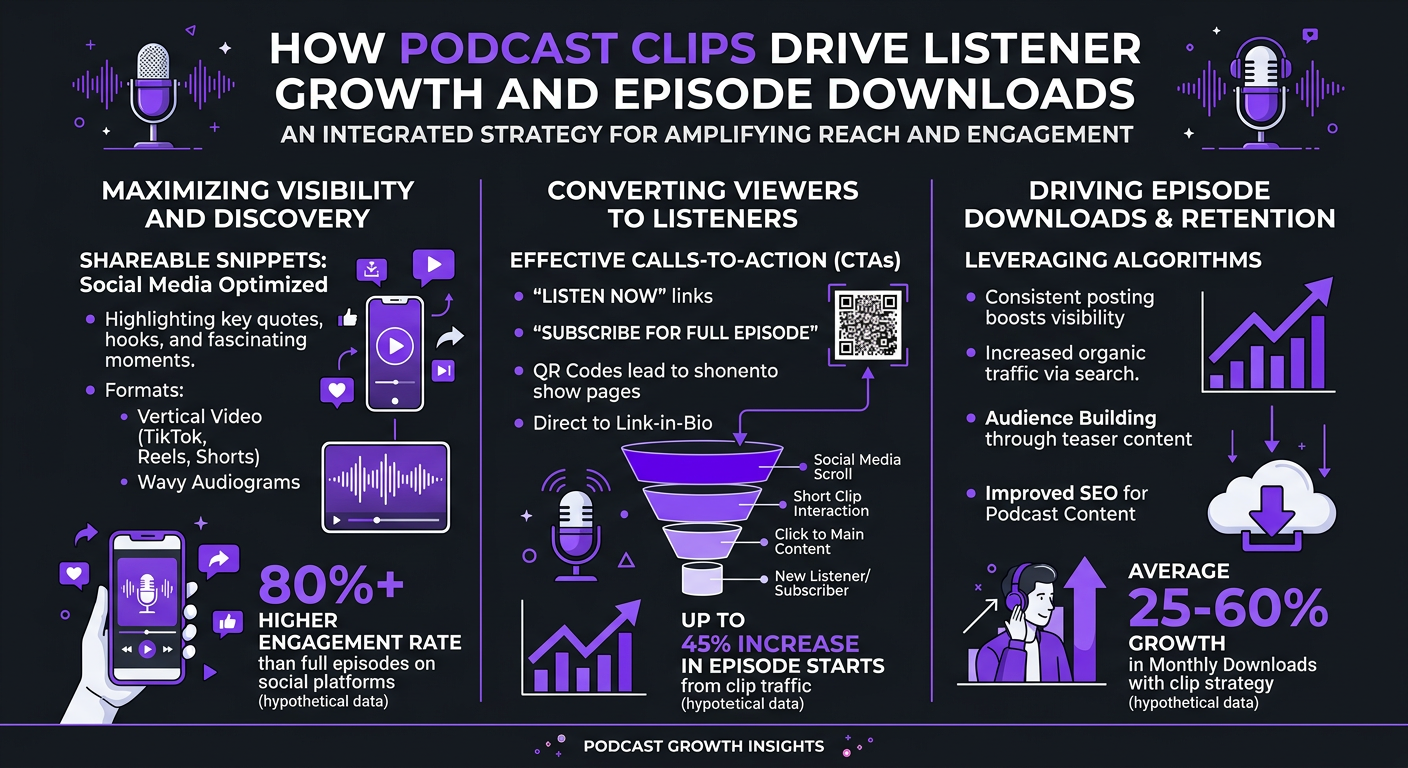
That’s the reality for most podcasters in 2026. And it’s a massive waste — because inside every episode are 5-10 moments that could each reach thousands (or millions) of people on YouTube, TikTok, Instagram Reels, and LinkedIn.
The problem isn’t the content. It’s the editing. Specifically, the lack of a systematic process for extracting, editing, and distributing podcast clips across platforms. This guide walks through exactly how professional podcast clip editing works, what it costs, and how the best podcasters are turning one recording session into 10+ pieces of content that grow their audience on autopilot.
What’s in This Guide
- Why Podcast Clips Are the #1 Growth Channel
- Anatomy of a Viral Podcast Clip
- Types of Podcast Clips and Where They Perform
- The Professional Podcast Clip Editing Process
- How Much Podcast Clip Editing Costs
- AI Clipping Tools vs Human Editors
- Building Your Podcast Repurposing Workflow
- Platform-Specific Optimization
- Real Results: Podcast Clients We’ve Worked With
- 7 Podcast Clip Mistakes That Kill Engagement
- FAQ
Why Podcast Clips Are the #1 Growth Channel for Podcasters
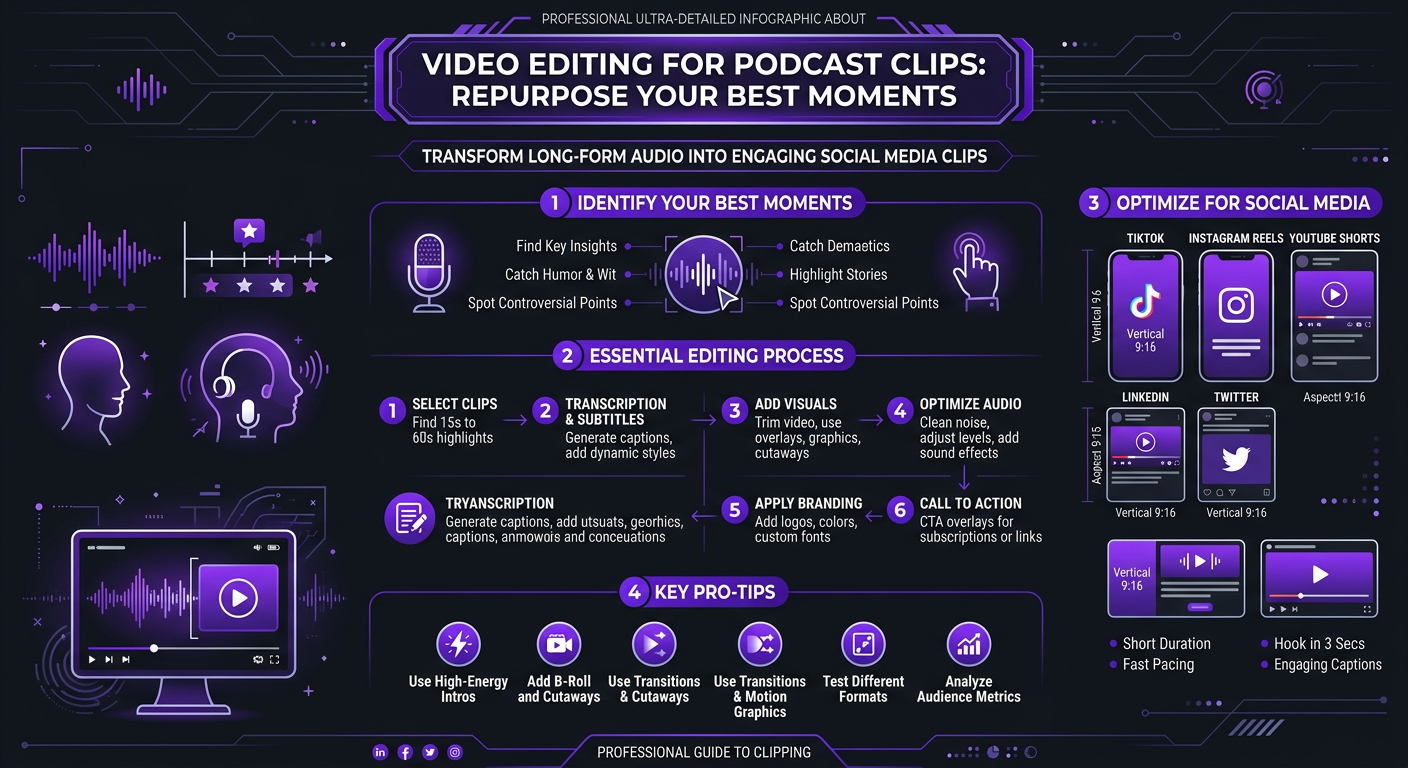
YouTube became the number one podcast consumption platform in 2024, and the gap has only widened since. According to Edison Research, over 31% of weekly podcast listeners now consume podcasts primarily through YouTube — more than Spotify or Apple Podcasts.
But here’s the nuance most podcasters miss: people don’t discover podcasts by browsing full episodes. They discover podcasts through clips. A 60-second clip goes viral on TikTok or Reels, the viewer thinks “I need to hear the full conversation,” and they subscribe to the podcast. That’s the growth flywheel.
The Numbers Behind Clip-Driven Growth
| Content Type | Avg Reach per Post | Discovery Potential | Conversion to Listener |
|---|---|---|---|
| Full episode (YouTube) | 500–5,000 views | Low (existing subscribers only) | N/A (already listening) |
| Full episode (Spotify/Apple) | 200–2,000 plays | Very low (search/browse only) | N/A |
| Short-form clip (Reels/TikTok/Shorts) | 5,000–500,000+ views | Very high (algorithm-driven) | 2-5% click through to full episode |
| LinkedIn clip (1-3 min) | 1,000–50,000 views | High (B2B audiences) | 5-10% click through |
| Audiogram | 200–2,000 views | Low (static visual) | 0.5-1% |
The math is clear: short-form clips have 10-100x the reach of full episodes. If you’re producing a podcast without a clip extraction strategy, you’re leaving 90% of your potential audience on the table.
Anatomy of a Viral Podcast Clip
Not every podcast moment makes a good clip. After editing thousands of podcast clips for our clients, we’ve identified the consistent patterns that separate clips that get 500 views from clips that get 500,000.
The 4-Part Structure
- The Hook (0-3 seconds): The most provocative, surprising, or emotionally compelling statement from the clip. This often means starting in the MIDDLE of the best moment, not building up to it. “I lost $2 million in 6 months” hits harder than “So, let me tell you about my business journey…”
- The Context (3-15 seconds): Just enough background for the viewer to understand what they’re watching. In podcast clips, this is usually the host’s question or a brief setup statement.
- The Payload (15-50 seconds): The core insight, story, or revelation. This is the reason the clip exists. It should deliver genuine value — a framework, a surprising fact, an emotional story, or a contrarian opinion.
- The Closer (last 5-10 seconds): Either a powerful final statement that sticks in memory, or a cliffhanger that drives viewers to the full episode. Never let a clip fizzle out.
Visual Elements That Boost Engagement
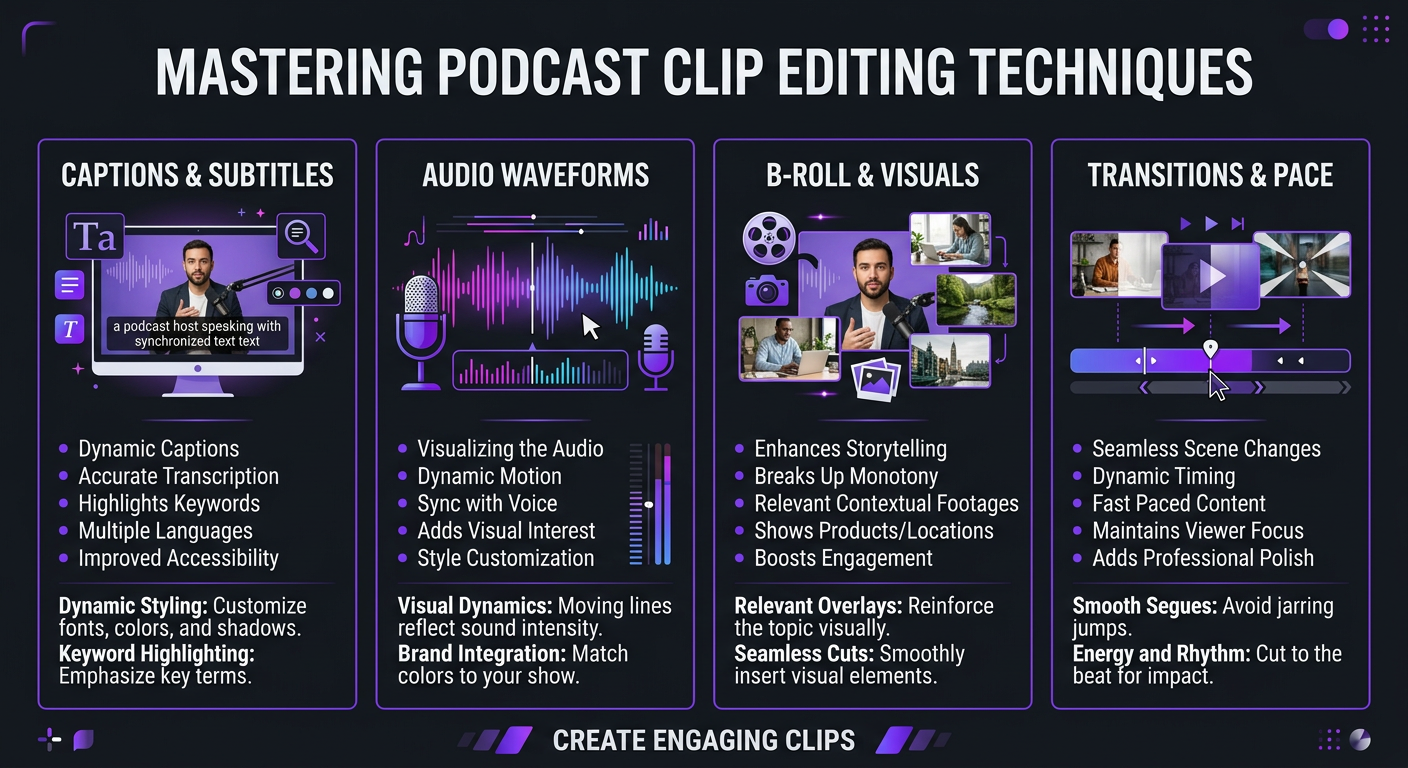
- Dynamic captions: Word-by-word or phrase-by-phrase animated captions are now standard. They increase watch time by 15-25% because viewers stay engaged even with sound off.
- Speaker identification: Name/title lower thirds for each speaker, especially for guest episodes where the audience doesn’t know the guest.
- Reaction zooms: Subtle zooms on the speaker during emotional peaks. Punch in 10-20% on the face during key statements.
- Progress bar: A subtle bar showing clip length. Viewers are more likely to finish a clip when they can see it’s only 45 seconds.
- Emoji reactions: Used sparingly, animated emoji at peak moments (😂 after a joke, 🤯 after a revelation) boost engagement metrics on TikTok and Reels.
Types of Podcast Clips and Where They Perform Best
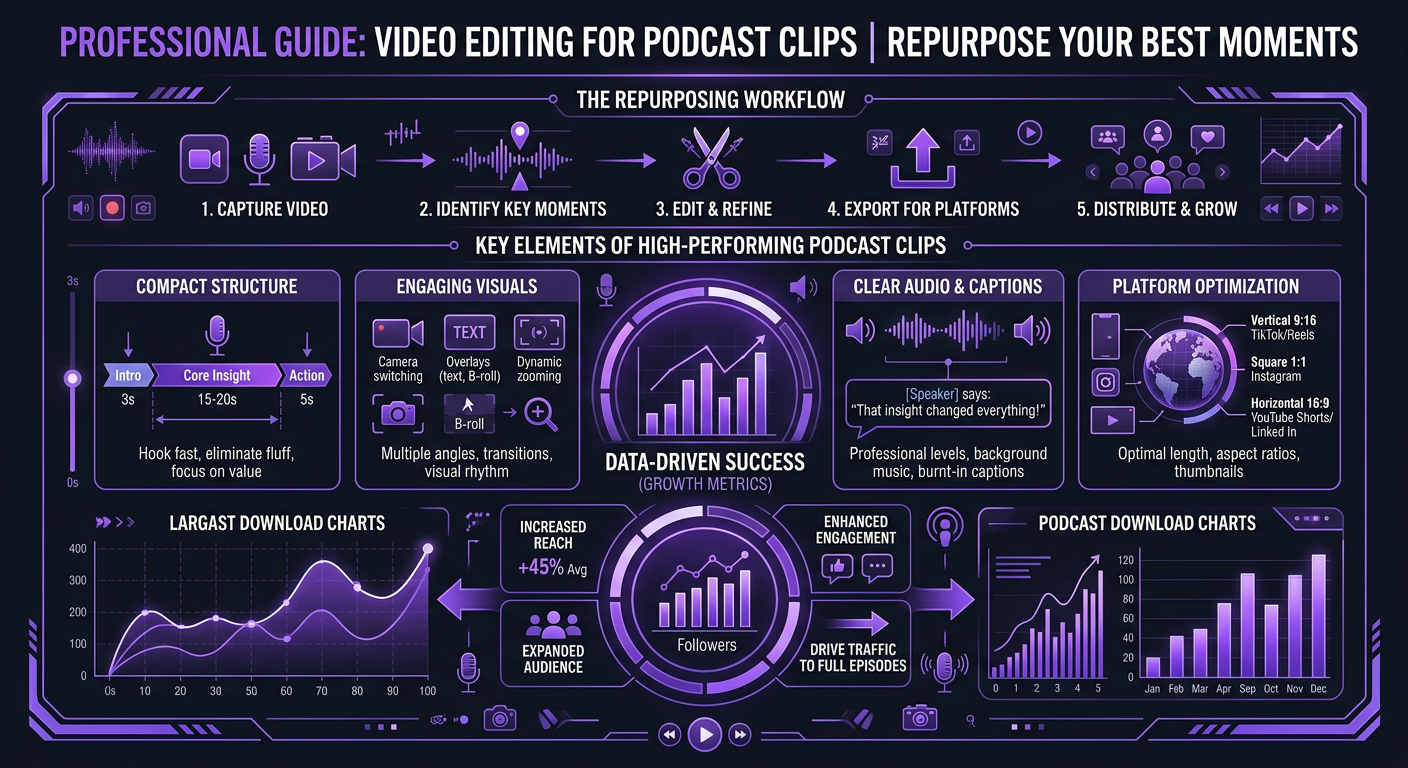
| Clip Type | Length | Best Platform | Editing Complexity |
|---|---|---|---|
| Hot take / controversy | 15-45 sec | TikTok, Reels | Low-Medium |
| Story / anecdote | 45-90 sec | TikTok, Reels, Shorts | Medium |
| Framework / how-to | 60-180 sec | LinkedIn, YouTube Shorts | Medium-High |
| Emotional moment | 30-60 sec | TikTok, Reels | Medium |
| Guest highlight reel | 2-5 min | YouTube, LinkedIn | High |
| Episode trailer | 30-60 sec | All platforms | High |
| Audiogram (audio + waveform) | 30-90 sec | X/Twitter, LinkedIn | Low |
The most successful podcasters we work with create a mix of clip types from each episode. A typical distribution from a single 60-minute episode:
- 2-3 short hot takes (15-45 sec) for TikTok/Reels
- 2-3 story/framework clips (60-180 sec) for YouTube Shorts and LinkedIn
- 1 guest highlight reel (3-5 min) for YouTube
- 1 episode trailer (30-60 sec) for all platforms
That’s 6-8 clips per episode, each optimized for a different platform and audience. Multiply that by 4 episodes per month and you have 24-32 pieces of content — from 4 recording sessions.
The Professional Podcast Clip Editing Process
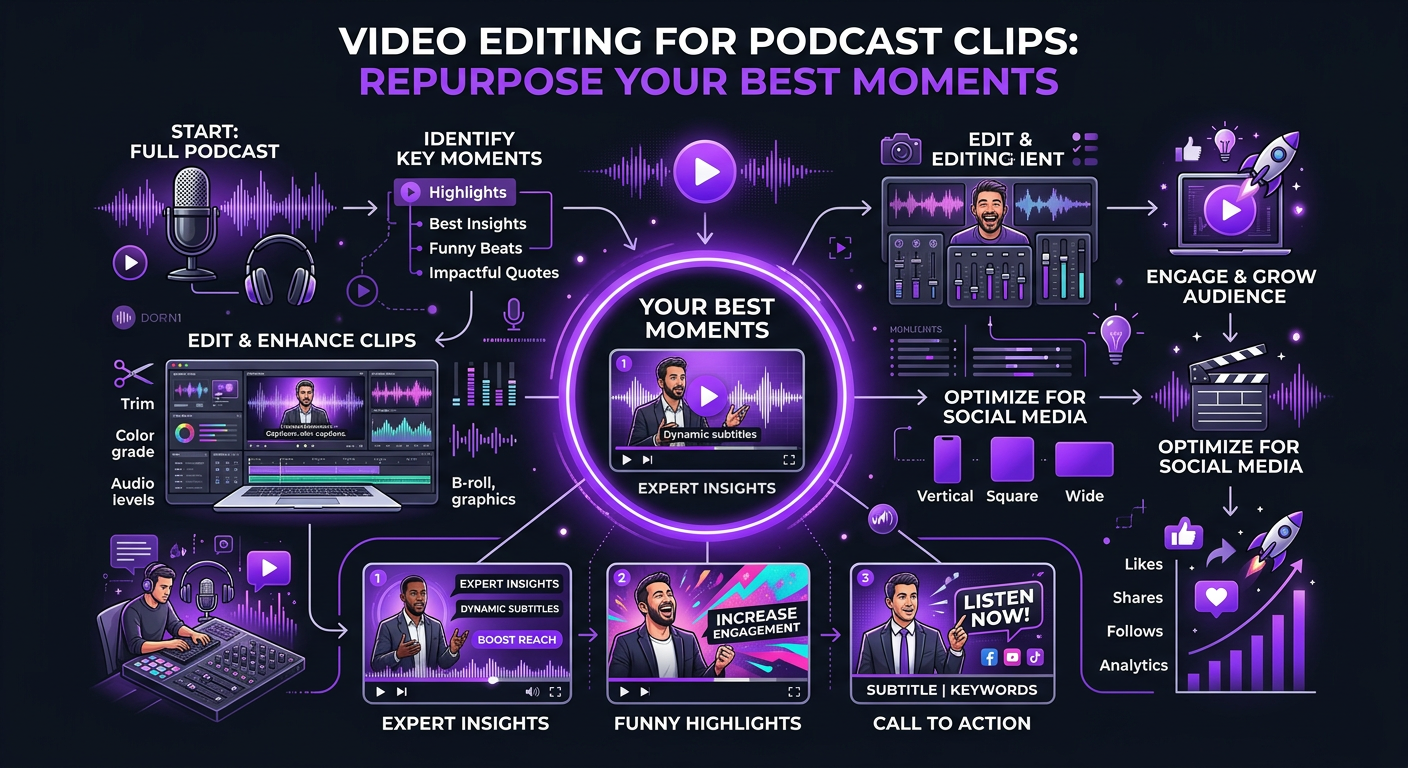
Here’s exactly how our team at Increditors handles podcast video editing and clip extraction:
Phase 1: Full Episode Edit (2-4 hours)
Before extracting clips, the full episode needs to be properly edited:
- Multi-cam sync: Align all camera angles (typically 2-3 cameras for a two-person podcast)
- Audio cleanup: Noise reduction, level balancing between speakers, removing pops/clicks
- Speaker switching: Auto or manual camera switching to show the active speaker
- Dead space removal: Cutting long pauses, “umms,” and false starts (maintaining natural flow)
- Lower thirds: Speaker names, episode title, timestamps for chapter markers
- Intro/outro: Branded intro sequence, end screen with subscribe CTA
Phase 2: Clip Identification (30-60 minutes)
This is the highest-skill part of the process. The editor watches the full episode and timestamps every potential clip-worthy moment, evaluating each for:
- Standalone clarity — does it make sense without context?
- Emotional intensity — does it provoke a reaction?
- Value density — does it deliver an insight quickly?
- Controversy potential — will people debate it in comments?
- Shareability — would someone send this to a friend?
Phase 3: Clip Editing (1-2 hours per batch)
Each clip gets individual attention:
- Re-framed for vertical (9:16) and horizontal (16:9) formats
- Dynamic captions added with brand fonts and colors
- Hook restructured (sometimes rearranging the clip to front-load the best moment)
- Reaction zooms and visual emphasis added
- Music bed added underneath (subtle, not overpowering)
- Speaker labels and context text overlaid
- Platform-specific formatting (safe zones, aspect ratios)
Phase 4: Delivery and Scheduling
Clips are delivered organized by platform with suggested captions, hashtags, and posting schedule. A typical delivery includes:
- Full episode (YouTube + audio platforms)
- 6-8 clips in vertical format (TikTok, Reels, Shorts)
- 3-4 clips in horizontal format (YouTube, LinkedIn)
- 1 episode trailer
- Suggested posting schedule spread over the week
Podcast Growing Slower Than Expected?
We help podcasters turn every episode into 8-10 clips that grow their audience across every platform. See what that looks like for your show.
How Much Does Podcast Clip Editing Cost?
Pricing depends on whether you need full episode editing, clip-only editing, or both:
| Service | Budget Tier | Professional Tier | Premium/Agency Tier |
|---|---|---|---|
| Full episode edit (60-90 min) | $150–$300 | $300–$500 | $500–$800 |
| Clip extraction + editing (5-8 clips) | $100–$200 | $200–$400 | $400–$600 |
| Full episode + clips bundle | $200–$450 | $450–$800 | $800–$1,200 |
| Per individual clip | $25–$50 | $50–$100 | $75–$150 |
Monthly Retainer Pricing
| Package | Monthly Cost | Included | Best For |
|---|---|---|---|
| Starter | $1,000–$1,500/mo | 4 episodes + 20 clips | Weekly podcast, starting to grow |
| Growth | $1,500–$3,000/mo | 4 episodes + 32 clips + thumbnails | Established podcast, multi-platform |
| Scale | $3,000–$5,000/mo | 8+ episodes + 50+ clips + motion graphics + scheduling | Multiple shows, media companies |
At Increditors, our podcast editing packages start at $1,500/month for weekly shows. This includes full episode editing, 6-8 clips per episode, dynamic captions, multi-platform formatting, and a dedicated editor who learns your show’s style and audience. For podcasters publishing twice a week or more, our dedicated team model provides better value and faster turnaround.
AI Clipping Tools vs Human Editors: What Actually Works
The podcast clipping space has exploded with AI tools — Opus Clip, Vizard, Descript, Riverside’s AI clips, and dozens more. They promise to automatically identify the best moments and create ready-to-post clips. Here’s the honest assessment:
What AI Clipping Tools Do Well
- Speed: Process a 60-minute episode in minutes, not hours
- Volume: Generate 20-30 candidate clips quickly
- Captions: Auto-generate accurate transcriptions and animated text
- Basic reframing: Crop horizontal to vertical with speaker tracking
Where AI Clipping Tools Fall Short
- Clip selection: AI identifies “energy peaks” in audio, but the best clips are often quiet, thoughtful moments with high narrative impact. AI consistently misses these.
- Hook engineering: AI doesn’t rearrange clips to front-load the hook. It starts where the moment starts, which is often the setup — not the payoff.
- Context awareness: AI can’t judge whether a clip makes sense without the preceding 5 minutes of conversation. Human editors intuitively add the right amount of context.
- Brand consistency: AI tools produce generic-looking clips. They don’t match your brand fonts, colors, lower third style, or visual identity.
- Platform nuance: The same clip needs different editing for TikTok vs LinkedIn. AI produces one version; humans produce platform-optimized versions.
| Factor | AI Tools | Human Editor | Agency (Human + AI) |
|---|---|---|---|
| Cost per episode | $20–$50 | $300–$600 | $500–$1,000 |
| Clip quality | 60-70% | 85-95% | 90-98% |
| Viral potential | Low (generic look) | High (crafted hooks) | Highest (optimized everything) |
| Brand consistency | ❌ Generic templates | ✅ Custom to brand | ✅ Full brand system |
| Time investment (yours) | 1-2 hrs reviewing/fixing | 30 min reviewing | 15 min approving |
The smartest approach — and what we do at Increditors — is using AI as a first pass to identify candidate moments, then having human editors select, re-structure, and polish the best ones. This hybrid workflow gives you the speed benefit of AI with the quality of human editorial judgment.
Building Your Podcast Repurposing Workflow
Here’s the workflow we recommend for podcasters who want maximum output with minimum personal time investment:
Recording Day (Your Time: 60-90 min)
Record your episode as normal. The only additional requirement: record video from at least 2 camera angles. One wide shot of both speakers, one close-up on the guest (or a separate camera for each speaker). Use decent lighting — it doesn’t need to be studio-grade, but consistent, front-facing light makes a huge difference in how clips look.
Upload & Brief (Your Time: 10 min)
Upload raw files to your shared drive. Include a brief note: “Guest was great on X topic around minute 30” or “The story about Y at minute 45 was the highlight.” These notes save your editor significant time in clip identification.
Full Episode Edit (Editor: 2-4 hours)
Your editor handles the full episode edit: multi-cam sync, audio cleanup, lower thirds, intro/outro, chapter markers.
Clip Extraction (Editor: 2-3 hours)
Editor identifies 8-10 clip-worthy moments, edits each for the appropriate platform, adds captions and branding.
Review & Approve (Your Time: 20-30 min)
You review all deliverables. Timestamped comments on anything that needs adjustment. One round of revisions.
Publish (Automated or VA)
Full episode published to YouTube, Spotify, Apple. Clips scheduled across platforms over the following 5-7 days.
Total time investment per episode: ~2 hours of your time. Total content produced: 1 full episode + 8-10 clips across 4-5 platforms.
Platform-Specific Optimization for Podcast Clips
YouTube Shorts
Maximum 60 seconds. Vertical format. YouTube’s algorithm favors Shorts that retain viewers to the end, so clip length matters — 30-45 seconds tends to outperform 55-60 seconds. Include a clear CTA in the caption linking to the full episode.
TikTok
Up to 10 minutes, but 30-90 seconds performs best for podcast clips. TikTok’s algorithm is more aggressive about testing content with new audiences, so controversial or surprising clips get the most initial reach. Use trending sounds as background music when appropriate.
Instagram Reels
Similar to TikTok but the audience skews older and more professional. Story-driven clips and professional insights outperform hot takes here. Reels up to 90 seconds perform well. Use Instagram-optimized formatting with your brand colors.
Horizontal format preferred (LinkedIn’s feed displays 16:9 better). Longer clips work here — 1-3 minutes of substantive business or career insight. Professional captions with no emoji or meme-style editing. LinkedIn’s algorithm rewards comments, so clips that provoke discussion perform best.
X/Twitter
2 minutes 20 seconds max for native video. The best podcast clips on X are highly quotable soundbites — the kind of thing people repost with commentary. Square (1:1) or horizontal format works best in the timeline.
Real Results: Podcast Clients We’ve Worked With
Trade with Pat: From Audio-Only to Multi-Platform Growth
Trade with Pat was running a successful trading and finance podcast but relying entirely on audio distribution through Spotify and Apple Podcasts. Growth had plateaued — new listener acquisition was flat despite consistently good content and loyal existing audiences.
We onboarded Trade with Pat on a full podcast repurposing package: professional episode editing for YouTube, plus 6-8 clips per episode optimized for TikTok, Reels, and LinkedIn. The finance niche is particularly well-suited to clip-based growth because financial insights and market commentary are inherently shareable.
The results exceeded expectations. Within three months, their YouTube presence grew from virtually zero to a meaningful audience driver. More importantly, their audio podcast downloads increased as viewers who discovered them through clips sought out the full episodes. The clips didn’t cannibalize the podcast — they amplified it.
Riley Coleman: Scaling Through Systematic Clip Production
Riley Coleman was already producing solid YouTube content when he came to Increditors, but his YouTube editing workflow wasn’t optimized for clip extraction. He was leaving potential viral moments on the cutting room floor because creating short-form clips from long-form content was an afterthought, not a built-in process.
By restructuring his editing workflow to prioritize clip-friendly moments during the full episode edit, we increased his content output by 3x without increasing his filming schedule. His short-form clips became the primary discovery channel for new subscribers, feeding directly into long-form viewership growth.
7 Podcast Clip Mistakes That Kill Engagement
1. Starting With the Setup, Not the Hook
The first 2 seconds determine whether someone watches or scrolls. Never start with “So today we’re going to talk about…” Start with the most compelling statement in the clip, then add context afterward.
2. Clips That Don’t Stand Alone
If a viewer needs to have heard the previous 30 minutes of conversation to understand your clip, it’s not a clip — it’s a fragment. Good clips deliver complete thoughts.
3. No Captions
In 2026, captions aren’t optional. 80%+ of mobile video is consumed without sound. A podcast clip without captions is invisible to most of your potential audience.
4. One Format for All Platforms
A horizontal clip dumped on TikTok with black bars looks lazy. Each platform has different aspect ratios, length preferences, and audience expectations. Platform-native editing isn’t optional — it’s the baseline.
5. Too Many Clips, Not Enough Quality
Posting 15 mediocre clips is worse than posting 5 great ones. Each bad clip teaches the algorithm that your content doesn’t engage — and that penalty carries forward to your next posts.
6. No CTA to the Full Episode
The whole point of clips is driving people to the full podcast. Every clip needs a clear path back: “Full episode link in bio” or an end card pointing to the YouTube episode.
7. Posting Everything at Once
Spread clips across the week. Posting all 8 clips on the same day competes with yourself in the algorithm. The ideal cadence: 1-2 clips per day, 5 days a week, with each episode’s clips spanning 4-5 days of content.
Frequently Asked Questions
Full podcast episode editing costs $200–$600 per episode depending on length and complexity. Individual clip extraction for social media costs $50–$150 per clip. Monthly retainers for podcast editing with clip extraction typically range from $1,500 to $4,000 at Increditors.
Aim for 5-10 clips per episode. The ideal breakdown: 2-3 clips under 60 seconds for Reels/TikTok, 2-3 clips of 1-3 minutes for YouTube Shorts or LinkedIn, and 1-2 longer highlight clips of 3-5 minutes. This maximizes reach across platforms without diluting quality.
Great clips have a strong hook in the first 2 seconds, deliver a complete thought in under 90 seconds, contain emotional intensity (surprise, humor, controversy), and end with impact. They must make sense without context from the full episode.
Both. Create vertical (9:16) for TikTok, Reels, and YouTube Shorts, and horizontal (16:9) for YouTube and LinkedIn. Professional editors create both from the same footage. The vertical version typically needs speaker-focused cropping with animated captions.
In 2026, video is essential for podcast growth. YouTube is the #1 podcast discovery platform. Video podcast clips get 3-5x more engagement than audiograms on social media. Even audio-first podcasts should record video for clip creation — it’s the highest-ROI growth strategy available.
AI tools like Opus Clip and Vizard are useful for initial clip identification and caption generation, but they miss nuanced editorial decisions — which moments truly resonate, how to restructure hooks, and platform-specific optimization. The best approach combines AI for speed with human editorial judgment for quality. See our editing services for details.
Turn Every Episode Into a Growth Engine
We’ll show you exactly how many clips your podcast should produce and what platforms to prioritize. No commitment — just a strategy conversation.
Pricing reflects 2026 market rates. For current Increditors podcast editing packages, visit our pricing page or schedule a call.