








![3D Explainer Video - ScribbleLive.mp4_snapshot_00.12_[2022.03.09_03.14.16]](https://increditors.com/wp-content/uploads/elementor/thumbs/3D-Explainer-Video-ScribbleLive.mp4_snapshot_00.12_2022.03.09_03.14.16-r7wb53mx72rxst3qcqyrfxdmeyzb5r9jbl0wbjujh4.png "3D Explainer Video – ScribbleLive.mp4_snapshot_00.12_[2022.03.09_03.14.16]")






























Management consulting firms that invest in professional video post-production — from tight thought leadership clips to polished case study reels — commonly report shorter sales cycles, stronger talent pipelines, and higher ROI on conference spend. This guide covers the 5 video types that move the needle for consultancies, real-world ROI frameworks, the end-to-end production workflow, and exactly what to look for when choosing an editing partner who can keep pace with a demanding content calendar.
- Why Video Is Now Mission-Critical for Consulting Firms
- Industry-Specific Video Types for Management Consultants
- ROI Cases: What Firms Are Actually Seeing
- The Consulting Video Workflow: End to End
- What to Look for in a Video Editing Partner
- Why Specialist Post-Production Matters at Consulting Budget Levels
- Editing Options Compared: Freelancer vs. Agency vs. Subscription
- Frequently Asked Questions
- Verdict
Why Video Is Now Mission-Critical for Consulting Firms
Management consulting has always been a relationship business. Partners win engagements on credibility, track record, and the ability to make a boardroom feel confident about a high-stakes bet. For decades, that credibility was built through white papers, conference keynotes, and word-of-mouth referrals. That playbook still works — but it now works significantly better when professional video content is in the distribution mix.
Procurement processes at large organizations increasingly include a digital due-diligence phase before a single RFP goes out. Buyers research partner profiles, watch thought leadership content, and form impressions before the first call is even scheduled. Firms that show up with polished video signal operational maturity and attention to detail — the same qualities clients are paying for inside the engagement. Firms that don’t show up at all in video searches are invisibly disqualified from conversations they never knew they could have had.
The Credibility Gap Video Creates — and Closes
A talking-head clip recorded on a laptop webcam with inconsistent audio and a distracting background creates a credibility gap. It doesn’t just fail to impress — it actively undermines the brand promise of a firm charging several hundred dollars per consultant hour. Buyers don’t consciously calculate “their recording setup is messy, so their deliverables will be messy,” but the subconscious signal runs in that direction and is difficult to override with content quality alone.
The gap between raw recorded footage and a polished, publishable asset is almost entirely a post-production problem. The content itself — the insight, the framework, the partner’s domain credibility — is already there. What’s missing is the editing layer that removes hesitations, tightens pacing, adds motion graphics for data visualizations, and delivers a file that looks and sounds like it belongs next to the leading firms’ LinkedIn channels. That is a solvable problem, and solving it consistently is what specialist post-production is for.
Budget Realities at Professional Services Firms
Consulting firms occupy a specific budget tier for video production. Marketing budgets are often modest relative to revenue — the model is built on relationships and reputation, not advertising spend. Sustaining a full in-house video production function — a senior editor, software licenses, storage, review tooling, a production coordinator — is rarely justifiable for the 4–12 videos per month a mid-sized firm actually needs. This makes the outsourced specialist editing model particularly attractive: you get senior-level production quality without the fixed overhead, and you scale the cost with your content volume rather than carrying it in headcount.
Industry-Specific Video Types for Management Consultants
Not all video formats serve a consulting firm equally. The playbook that works for a DTC brand (short product demos, influencer content) or a SaaS startup (product walkthroughs, onboarding tutorials) translates poorly to the consulting context. Consulting buyers are sophisticated. They want depth, nuance, and evidence of domain mastery — not a 15-second attention grab. The editing briefs for consulting video reflect that: tighter pacing, stronger data overlays, more careful sound design, and a brand aesthetic that communicates precision rather than energy.
Below are the video types that consistently drive measurable impact for consulting practices, from boutique strategy shops to large diversified advisory firms.
1. Thought Leadership and Insight Videos
These are the workhorse of consulting video content. A senior partner or practice lead presents a view on a market trend, regulatory change, or strategic framework — typically 6–12 minutes for a full-length piece, cut down to a 60–90 second highlight for LinkedIn distribution. The value is in the perspective, not the production spectacle, so the editing brief is precision over flash: tight cuts, lower-third titles that reinforce speaker credibility, data overlays that match the firm’s brand style guide, and clean audio that makes a 10-minute listen feel like 4.
Firms that publish consistent thought leadership content — even one or two clips per month per practice area — tend to build a compounding content asset. Each piece ranks for long-tail keywords, earns shares within closed LinkedIn networks, and gives business development teams a warm, relevant asset to include in follow-up sequences after a first meeting. The cumulative effect over 12–18 months is meaningfully different from zero.
2. Client Pitch and Proposal Videos
A short (2–4 minute) personalized video that accompanies or replaces the cover page of a written proposal is one of the highest-leverage uses of video in the consulting sales cycle. It communicates tone, urgency, and genuine understanding of the client’s problem in a way that no PDF introduction can match. Because these videos are usually produced in small batches — perhaps 2–5 per month for an active business development team — the editing requirement is fast turnaround with consistent quality rather than high creative complexity.
The editing brief for proposal videos typically includes: a clean talking-head cut with branded lower thirds, a brief animated title card, background music kept very low in the mix, and export in a format that plays inline in a client email without requiring a download or account login. Speed matters significantly here — a proposal video that arrives three days after the written document misses the window when attention is highest.
3. Case Study and Results Videos
Written case studies are table stakes. Video case studies are differentiated. A 3–5 minute video featuring a structured problem-approach-outcome narrative — edited with supporting data motion graphics and relevant B-roll — typically converts at higher rates on proposal pages and conference landing pages than text-only equivalents. The format allows the viewer to absorb the arc of the engagement in a way that requires active reading with text alone.
The central production challenge is client confidentiality. Many consulting engagements cannot be attributed or detailed publicly. The editing partner needs to understand how to produce a compelling case study that is descriptive enough to be useful while being sufficiently anonymized to pass legal review. This requires an editor who can work with a brief that says “reference the industry vertical but not the client name” and produce something that still feels specific and credible rather than vague and generic — a skill that separates professional services specialists from general-purpose shops.
4. Webinar and Conference Recordings
Consulting firms produce an enormous volume of recorded content through webinars, roundtables, and conference sessions — and most of it is severely underutilized. A 60-minute webinar recording, properly edited, can yield: a 6–8 minute highlight reel for YouTube, three or four 90-second LinkedIn clips, a 30-second promotional trailer for the next event, and a structured recap with chapter markers for gated distribution. The editing work is significant, but the raw material — a senior panel discussing a market challenge in depth — is often some of the highest-quality thought leadership content a firm produces in a given quarter, and it already exists.
💡 Pro Tip: Before your next conference or webinar, brief your editing partner on the session structure in advance. A 20-minute pre-production call — agenda review, key speaker timestamps, planned data moments — can reduce post-production time by 30–40% because the editor arrives knowing exactly what to extract rather than watching the full recording cold to find it.
5. Recruitment and Culture Videos
The competition for top consulting talent is intense. MBA programs produce a constrained supply of candidates who receive competitive offers from multiple firms. Culture videos — authentic, well-edited glimpses of what daily work actually looks like at the firm, featuring real team members rather than stock footage montages — have become a meaningful differentiator in recruiting campaigns targeting top programs. These videos don’t need to be long (2–3 minutes is a reliable optimal range), but they need to feel genuine and look professional simultaneously — a combination that requires careful editorial judgment about pacing, music selection, and the balance between polished production and authentic candor.
Poorly edited culture videos — stilted interviews, slow pacing, generic music beds — signal the same poor attention to detail as a mediocre thought leadership clip. Candidates evaluating top-tier offers are discerning. The quality of a firm’s recruiting video functions as a proxy signal for how much the firm invests in its people and its communication.
ROI Cases: What Firms Are Actually Seeing
ROI on marketing content is notoriously difficult to attribute with precision, and consulting video is no exception. What we can reference are the patterns of outcomes that firms — and the agencies that serve them — commonly report, framed honestly as directional evidence rather than controlled study data.
Pipeline Acceleration Through Proposal Video
Business development teams that use personalized proposal videos commonly report that prospects arrive at discovery calls more prepared and more bought-in than those who received only written proposals. The video pre-qualifies the relationship and establishes context that would otherwise consume the first 15–20 minutes of the meeting. When that time is recovered for substantive discussion, deal velocity tends to improve. Some firms anecdotally track the time from first proposal video sent to signed SOW as a proxy metric, and see it running meaningfully faster than written-only proposals — though this is self-reported and influenced by many confounding factors beyond the video itself.
Thought leadership videos on LinkedIn follow a different ROI path: they build the reputational foundation that makes inbound easier over time. A partner whose insights earn consistent organic reach is easier to book for a first meeting than one whose LinkedIn profile is blank. The pipeline return is real but measured in quarters, not weeks — it is a brand investment, not a demand generation tactic, and it should be resourced and evaluated as such.
Talent Acquisition ROI
Recruiting is where video ROI is often most tractable for consulting firms to quantify. A firm’s cost per qualified application through campus recruiting channels — advertising, event sponsorship, travel — can run several hundred dollars per candidate. If a well-produced culture video drives even modest increases in organic applications or reduces the number of recruiter-initiated outreach messages needed to fill a pipeline, the editing investment pays back quickly. Firms that run structured video recruiting campaigns typically track application volume and source attribution, giving them cleaner measurement data than they get from brand or business development video.
Conference ROI Multiplier
A consulting firm that invests meaningfully in sponsoring or hosting an industry conference event gets a one-day window of audience attention. Properly edited content from that event — published across 6–8 weeks following — extends that attention window dramatically. The per-view cost of reaching a qualified executive audience via repurposed conference footage is typically a fraction of what it costs through paid channels. The editing cost to transform one day of conference footage into a 10–12 week content stream is usually a small percentage of the event’s total budget, making it one of the highest-leverage post-investment opportunities available to a consulting marketing function.
The Consulting Video Workflow: End to End
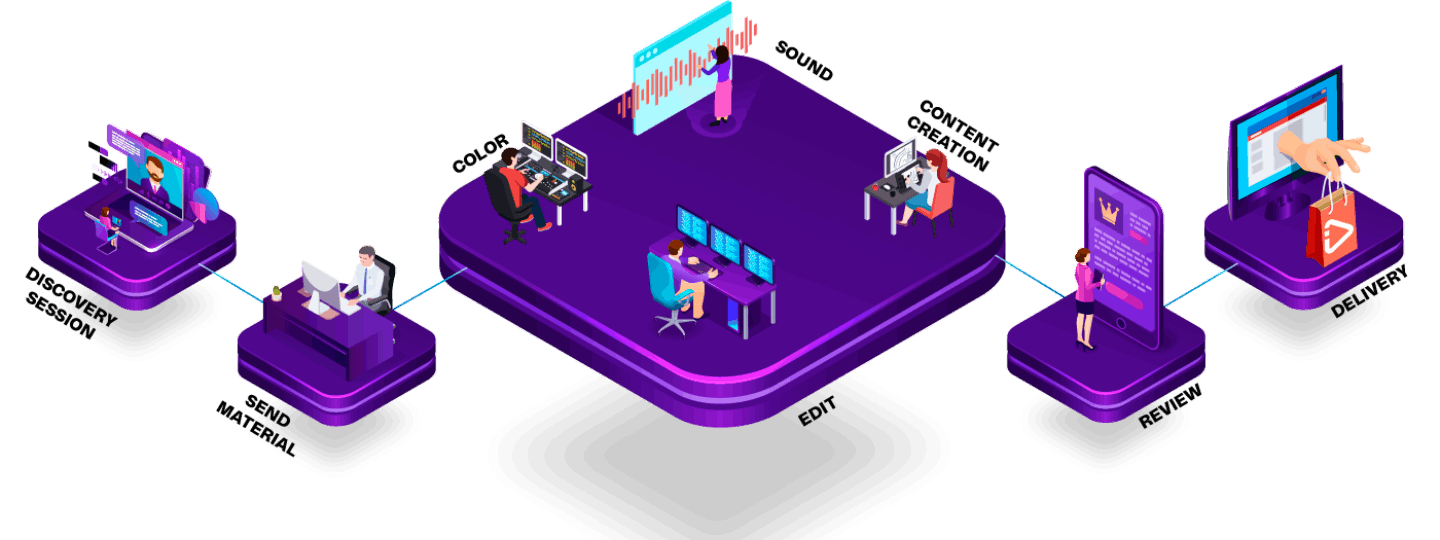
Understanding the full workflow — not just the editing step — helps consulting firms set realistic expectations, brief partners effectively, and avoid the delays that consistently emerge from undefined handoffs. Here is how a well-run consulting video project moves from idea to published asset.
Pre-Production: The Brief That Saves Everything Downstream
Pre-production for consulting video is usually lighter than for broadcast or brand film, but skipping it is a consistent source of expensive rework. A brief document — one page is sufficient — that specifies the video’s purpose (BD use vs. public thought leadership vs. internal training), the intended platform and format (LinkedIn 1:1 vs. YouTube 16:9 vs. gated portal), the expected length, key messages, and any compliance constraints (client anonymization, regulatory language, speaker approvals) saves significant back-and-forth in post-production.
For on-camera content, distributing a short recording protocol to partners before they hit record — stable tripod or stand, external lapel microphone, controlled lighting, clean background — dramatically improves the quality of raw footage that arrives at the editor. A 30-minute internal recording brief distributed firm-wide cuts post-production time per video and reduces revision rounds, both of which directly reduce cost and turnaround time.
Production: Equipment Realities for Consulting Teams
Most consulting firms do not maintain in-house production crews, and for the majority of video types they do not need to. Thought leadership talking-head content can be recorded effectively with a modern smartphone on a tripod, controlled window light or a basic LED panel, and a USB lapel microphone — a total kit investment under $500 that produces footage a professional editor can work with. For higher-stakes content — client case study videos, major conference keynotes, firm-wide culture campaigns — a single-day freelance videographer engagement (typically ranging from $800 to $3,000 depending on market and equipment) provides the production quality that justifies the premium editing investment downstream.
The principle to internalize is that post-production quality is bounded by production quality. An editor can improve a mediocre recording; an editor cannot repair a fundamentally flawed one. Investing a modest amount in production fundamentals before filming significantly expands the editor’s options during the creative cut.
Post-Production: Where Value Is Created or Destroyed
Raw footage arrives at the editing partner, who performs: rough cut (selection and sequencing of best takes), pacing refinement (removing hesitations, tightening redundant passages), color correction and grading, audio cleanup and normalization, motion graphics for titles and data visualizations, caption and subtitle generation, and final export in platform-appropriate specifications. For consulting content, the motion graphics layer is often the most brand-sensitive: lower-third titles, framework overlays, chart animations, and data callouts all need to match the firm’s existing visual language precisely.
Distribution strategy belongs in the post-production conversation. LinkedIn native video typically outperforms YouTube links in feed reach for B2B audiences. A highlight clip formatted for LinkedIn’s square or portrait aspect ratio will perform differently than the same content in widescreen. An editing partner who understands both the craft and the distribution mechanics — which platforms favor which format, how caption behavior affects completion rates, how chapter markers improve YouTube retention — provides meaningfully more value than one who delivers a single export and considers the brief complete.
What to Look for in a Video Editing Partner
Choosing the right video editing agency for a consulting firm involves a different evaluation framework than selecting one for a consumer brand or a YouTube creator. The variables that matter most are industry literacy, confidentiality practices, turnaround consistency, and the capacity to scale alongside a content calendar that is rarely linear.
Industry Literacy: Non-Negotiable for B2B Content
An editor who cannot distinguish between a strategy engagement and an implementation engagement, who doesn’t recognize what a Gantt chart overlay needs to communicate to a CFO, or who selects the “energetic” clip from a partner’s explanation rather than the conceptually dense one, will produce technically competent work that misses the audience. Consulting content requires editors capable of watching a partner’s 12-minute framework explanation and identifying the three sentences most worth isolating for a LinkedIn clip — not the most visually dynamic moments, but the analytically sharpest ones.
When evaluating partners, ask to see examples specifically from professional services, B2B advisory, or financial services verticals. Ask whether the account manager assigned to your work has domain familiarity. Ask how they handle a brief that says “this section should feel rigorous, not promotional.” The answers will quickly reveal whether a shop is positioned to serve your content type or learning on your budget.
Confidentiality and Data Handling
This is non-negotiable for consulting firms. Footage submitted for editing often contains references to client names, competitive intelligence, unpublished research, and market-moving views. Every person in the editorial chain — editor, colorist, audio engineer, project manager — who touches the footage is a potential confidentiality risk if proper processes are not in place.
What to require: a signed NDA at the engagement level (not just a terms-of-service click-through), documented data handling policies including where files are stored and who can access them, and a named senior editor assigned to your account rather than work distributed anonymously across a contractor pool. If a prospective partner cannot readily answer “where is our footage stored and who can access it,” that answer disqualifies them — not because the question is unreasonable, but because the inability to answer it confidently reveals the absence of the governance structure you need.
Turnaround Consistency and Surge Capacity
Consulting video content clusters around specific moments: post-conference publishing windows, pre-event promotional periods, pre-pitch video sequences, quarterly reporting seasons. A firm that produces 4 videos per month in a steady state may need 10–15 in a two-week burst before a major industry event. An editing partner that handles the steady state well but cannot flex for the burst is a constraint waiting to surface at the worst possible moment.
When evaluating partners, ask explicitly about surge capacity: how many concurrent projects can the team handle, what is the maximum throughput per week, and what is the escalation process when a tight-deadline request arrives? A credible partner has clear answers to these questions because they have thought through the operational architecture. A partner who responds with reassuring vagueness is telling you that surge capacity has not been stress-tested.
Why Specialist Post-Production Matters at Consulting Budget Levels
Management consulting firms occupy a specific and productive sweet spot in the video production market. The content investment is real enough to justify professional execution. The volume is consistent enough to develop an institutional editing relationship. But the headcount model — a full-time in-house video team — is rarely justified by the output volume. This is the exact scenario where specialist post-production services deliver asymmetric value: you get senior-level quality without fixed overhead, and expertise that scales with your content needs rather than your payroll budget.
The Senior Editor Difference
The difference between a junior editor and a senior editor is most visible in footage selection and pacing judgment — the decisions that define whether a video is genuinely watchable or merely technically adequate. A junior editor cuts everything that is not technically broken. A senior editor cuts everything that does not serve the audience’s attention, which is a considerably more demanding standard. For consulting content — where the viewer is a C-suite buyer with a full calendar who will close the tab at the first slow patch — that level of editorial judgment is not a luxury. It is the core value proposition of the edit.
The consulting day rate logic applies here as a direct sanity check. If a senior partner’s time is worth $600–$1,200 per billable hour, spending 4 hours internally struggling with video editing software to produce a mediocre result is not just a bad investment — it is destructive to utilization and to the firm’s content quality simultaneously. Outsourcing that work to a specialist who produces a better result in less time is one of the cleanest leverage calculations in professional services marketing.
The Strategy Layer That Separates Partners from Vendors
The best editing partners for consulting firms do not just execute briefs — they interrogate them. When a marketing coordinator submits a 45-minute panel discussion for a “highlight reel,” a strategically capable editing partner asks: what is the 60-second version for LinkedIn, the 4-minute version for YouTube, and the 12-minute version for the gated portal? What captions are needed for each? What call-to-action makes sense in each distribution context? These questions, if not asked upfront, result in a single output that is a compromise for every use case and optimized for none.
The agency vs. freelancer decision for consulting firms ultimately comes down to this strategy layer. A skilled freelancer can execute a brief with craft. A specialist agency built around professional services content brings the brief-building expertise that transforms raw footage into a content strategy — and that is what the consulting buyer’s time and the firm’s brand actually require.
Understanding the cost of professional video editing is part of building a sustainable content operation. For consulting firms, the per-video cost of specialist editing is typically a small fraction of what a single billing hour costs — a ratio that makes the investment straightforward to justify to any finance committee when it is framed correctly as a cost-per-qualified-impression rather than a production expense.
💡 Pro Tip: Build a quarterly video content calendar with your editing partner, not just a reactive request queue. Knowing what is planned 8 weeks out lets the editing team pre-load brand templates, prepare motion graphic libraries, and block surge capacity before conference seasons arrive — typically reducing per-video turnaround time by 30–40% compared to ad-hoc requests handled without advance notice.
Editing Options Compared: Freelancer vs. Agency vs. Subscription Service
Consulting firms evaluating video editing partners will typically consider three structural models: engaging a freelance editor, working with a generalist or specialist agency, or subscribing to an unlimited video editing service. Each has genuine merit and real trade-offs at the quality level and volume pattern that consulting firms typically need.
For most consulting firms producing 4–15 videos per month across thought leadership, recruiting, and business development use cases, the specialist agency or structured retainer model delivers the best quality-to-reliability ratio at their budget level. The per-video cost is higher than a freelancer, but consistency, accumulated institutional knowledge of the firm’s style, confidentiality infrastructure, and strategic input more than justify the premium when calculated against the consulting day rate. For firms closer to the 1–3 video per month range, a high-quality freelancer relationship is the more practical starting point — until volume and strategic need reach the threshold where a specialist partner becomes clearly optimal.
Frequently Asked Questions
How many videos per month does a typical management consulting firm need?
Volume varies considerably by firm size and content strategy. A boutique 10–20 person firm may produce 2–4 videos per month focused on thought leadership. A large multi-practice firm with active business development teams, recruiting campaigns across multiple programs, and several major conference appearances per quarter may need 15–25 videos per month across all use cases. Most firms find that needs are lumpy rather than linear — steady at 4–6 per month for most of the year, spiking to 12–18 around conference seasons and MBA recruiting cycles. An editing partner that can only handle the steady state is a strategic liability in the moments that matter most.
What is the right video length for consulting thought leadership content?
For LinkedIn native video, the reliable range for thought leadership in a B2B professional services context is 90 seconds to 3 minutes. Beyond 3 minutes, the video requires a strong hook and very tight pacing to retain completion rates. For YouTube and gated content portals, 6–12 minutes is the appropriate format — it allows for the depth that justifies the channel and format. The practical answer is: always produce at least two lengths from the same raw footage. A 2-minute social version and a 6–8 minute long-form version cover most distribution needs without requiring separate filming sessions.
How do we handle confidential client references in video content?
The standard approach is to describe outcomes in industry-generic terms (“a global financial services client,” “a Fortune 500 industrial manufacturer”) while focusing on the challenge and the methodology rather than client-specific details. The editing brief should flag any mentions of client names, financial figures, or market-sensitive insights for review before post-production begins. Many firms route all external-facing video content through legal review before submitting for editing — a reasonable practice for any high-stakes piece that references engagement work, even when anonymized.
What file formats and specifications should we request from our editing partner?
For LinkedIn native uploads: H.264 MP4, 1:1 or 4:5 aspect ratio, maximum 200MB file size. For YouTube: H.264 MP4, 16:9, 1080p minimum, 4K where available. For email or proposal delivery: compressed H.264 MP4 under 25MB, or a hosted Vimeo or Wistia link that does not require an account to view. Always request captions for all versions — either burned-in or as an SRT file. Captioned videos consistently outperform uncaptioned ones on LinkedIn due to the autoplay-without-sound behavior that dominates feed browsing. Specify these requirements in writing before the project begins; format negotiation at delivery is a friction point that delays distribution timelines unnecessarily.
How long does a typical consulting video take to edit?
A standard 3–5 minute talking-head edit with titles, color correction, and clean audio should take a professional editing team 24–48 hours after footage receipt. A more complex piece — multiple speakers, screen recording integration, custom motion graphics for data visualizations — may take 72–96 hours. An editing partner should be able to quote a turnaround SLA upfront for each content type your firm regularly produces; if they cannot, the operational structure to deliver consistently is likely absent. Rush requests — “we need this in 6 hours” — should come with explicit capacity confirmation and a defined rush premium, not a vague reassurance.
Verdict: The Business Case for Specialist Video Editing in Consulting
Management consulting firms operate in a trust economy. Every touchpoint — the partner’s LinkedIn presence, the proposal document, the conference keynote, the recruiting event — either builds or erodes the credibility that the entire business model depends on. Video, done well, is one of the most efficient trust-building mechanisms available. It conveys expertise, personality, and domain authority in a format that a PDF simply cannot replicate, and it does so asynchronously, working for the firm in all the conversations that happen before the first call is ever scheduled.
The case for professional post-production in consulting is not primarily a creative argument. It is an operational efficiency and brand risk argument. The content is already being created — partners are presenting, webinars are running, conferences are happening. The question is whether that content investment is being converted into durable, distributable assets that continue to generate value after the live moment passes, or whether it is effectively being discarded because the post-production step was skipped or handled inadequately.
The right editing partner for a consulting firm is one that combines professional services industry literacy, airtight confidentiality practices, consistent senior-level editing quality, strategic input on format and distribution, and the surge capacity to flex with a content calendar that is lumpy by nature. That combination exists — but it requires a deliberate selection process rather than defaulting to whoever is cheapest or most immediately available.
For firms ready to build a systematic video content operation — one that compounds over time rather than producing disconnected one-off pieces — the investment in finding the right specialist editing partner returns multiples of its cost in brand equity, pipeline velocity, and recruiting advantage over an 18–24 month horizon. The economics are favorable. The only real question is when to start building the system that makes it work consistently.
Ready for Video That Actually Converts?
Tell us about your project and we will put together a custom plan.