








![3D Explainer Video - ScribbleLive.mp4_snapshot_00.12_[2022.03.09_03.14.16]](https://increditors.com/wp-content/uploads/elementor/thumbs/3D-Explainer-Video-ScribbleLive.mp4_snapshot_00.12_2022.03.09_03.14.16-r7wb53mx72rxst3qcqyrfxdmeyzb5r9jbl0wbjujh4.png "3D Explainer Video – ScribbleLive.mp4_snapshot_00.12_[2022.03.09_03.14.16]")






























Management consulting firms sell invisible expertise. Video is now the most credible channel to turn partner authority into pipeline — but generic editing destroys the gravitas your brand depends on. This guide covers the video types that win consulting mandates, the editing approach that preserves authority, and an honest breakdown of what in-house, freelance, agency, and dedicated post-production teams actually cost and deliver.
Why Consulting Expertise Needs Video — and Why It Is Hard to Get Right
Management consulting is among the highest-stakes, lowest-tangibility purchases a company can make. A mid-market firm hiring a strategy consultancy for an operational transformation is committing seven figures based almost entirely on perceived expertise, trust, and cultural fit. There is no product to trial, no free tier to test, no demo environment to explore. There is, however, a LinkedIn feed — and the consultants who dominate it are winning deals before a discovery call is ever booked.
Video has become the most efficient trust-compression tool available to consulting firms. A three-minute partner interview, edited with precision, can convey the intellectual depth, communication quality, and personality that used to require an in-person pitch. A two-minute client case story, when produced correctly, does more to reduce buyer risk than five pages of anonymised results data in a slide deck.
Yet most consulting video content fails — not because the ideas are weak but because the editing undermines the authority the content is meant to build. Overcrowded graphics, consumer-grade transitions, wobbly captions, and pop-heavy music communicate exactly the wrong signal to a procurement committee or C-suite buyer evaluating a firm. The implicit message is: if this is the quality standard for their content marketing, what does that say about their project deliverables?
The Specific Challenges Facing Consulting Firms
Long sales cycles demand consistent presence. Enterprise consulting engagements routinely take six to eighteen months from first contact to signed agreement. Video allows a firm’s thinking to remain visible and credible throughout that window without requiring partners to attend every touchpoint personally. A buyer who has watched eight of your partner’s LinkedIn clips before the first meeting arrives pre-sold on intellectual fit.
Intangible services require proof substitutes. Consulting deliverables are confidential by nature, which makes client proof structurally harder to deploy than in most industries. Video allows for attributed thought leadership, carefully anonymised case narratives, and human testimonial in ways that a case study PDF cannot replicate. The medium itself signals confidence — firms that speak on camera are firms that back their own thinking.
Partner credibility is the product. In a boutique strategy consultancy, the partners are the brand. A recruiting video that makes the managing partner look wooden or unprepared damages the firm’s perceived calibre. Editing that tightens delivery, removes distracting filler, and maintains a composed visual rhythm is not optional — it is a direct investment in perception management.
The buyer has a high visual IQ. A CFO or Chief Strategy Officer making a consulting purchase decision has sat through hundreds of board presentations and investor briefings. They recognise the difference between professional production and an intern-edited Zoom recording. The quality threshold for consulting video is materially higher than for many B2C or SMB markets.
💡 Pro Tip: Before spending a dollar on production or editing, define the one thing you want a viewer to believe about your firm after watching. Every editing decision — pacing, graphics, music, colour grading — should serve that single perception goal.
Video Types That Actually Perform for Consulting Firms
Not all video formats serve consulting firms equally. The formats that generate the most measurable pipeline impact tend to be those that compress expertise, demonstrate outcome thinking, or reduce buyer risk — often all three at once.
Partner POV and Thought Leadership Videos
The highest-leverage format for most consulting firms. A partner speaks directly to camera on a specific strategic question — not a pitch, not a product overview, but a genuine point of view on a challenge that a target client is already losing sleep over. Well-edited, these become the most shared, saved, and commented pieces of content a firm produces. The editing job is to amplify the partner’s intellectual authority: tight cuts that remove hesitation without killing natural rhythm, clean captions for silent-scroll LinkedIn audiences, and motion graphics that illustrate frameworks without dumbing them down.
Client Case Stories
The consulting equivalent of a product testimonial, with considerably more complexity. Client case stories typically involve multiple stakeholders, confidential data, and outcomes that can only be partially disclosed. Skilled editing constructs a compelling narrative arc — the challenge, the intervention, the result — using only what can be shown, supplemented with animated data, b-roll, and on-screen text that carries the parts that cannot be said on camera. A three-minute case story, properly edited, reliably outperforms a ten-page PDF case study for deal acceleration.
Webinar and Event Repurposing
Most consulting firms run a steady cadence of client dinners, panel events, keynote presentations, and webinars that produce hours of raw expert content that never escapes a single Zoom room. Repurposing takes a ninety-minute webinar and extracts eight to twelve standalone clips, each optimised for a different distribution channel: three-minute deep-dives for LinkedIn, thirty-second provocations for Instagram Reels, highlight compilations for firm newsletters. The ROI of repurposing is exceptional because the expert time — the genuinely scarce resource — has already been spent.
Service Explainer Videos
A two-to-four-minute structured overview of a specific service line — operational transformation, M&A integration, digital strategy, organisational design — that combines screen-friendly animation, on-camera delivery, and data visualisation. Explainers serve a critical mid-funnel function: they answer “what do you actually do and how?” in a format that buyers can share internally with procurement or the board. The editing challenge is balancing conceptual rigour with enough accessibility for a non-specialist CFO to follow the narrative.
Sales Enablement Clips
Short, targeted clips that partners and business development leads embed in proposal follow-up emails, LinkedIn DMs, and RFP responses. These are among the highest-converting formats consulting firms rarely invest in — primarily because most marketing budgets focus on broadcast content rather than sales-motion content. Editing must be fast, credential-forward, and immediately on-point.
Recruiting Videos
Talent is a consulting firm’s only durable asset. A recruiting video that authentically represents the firm’s culture, intellectual intensity, and partner accessibility is directly material to analyst and associate hiring yield. These videos require a different editing register — more human, less polished, with genuine warmth from on-screen talent — while still maintaining the professional visual standard the firm’s brand demands.
Podcast and Interview Clips
Many consulting partners appear on industry podcasts, conference stages, and media interviews. Clip extraction, reformatting for vertical or square, caption burn, and micro-branding turns a single forty-minute podcast appearance into fifteen distributable assets that reach audiences the original recording never did.
LinkedIn Thought Leadership Series
Consulting firms that build a systematic LinkedIn video presence — two to four videos per week per partner or firm account — report measurably shorter sales cycles and higher inbound enquiry rates. Episodic series with consistent visual identity, recurring segment formats, and accumulated brand recognition outperform one-off uploads consistently. This requires a production workflow, not just one-time production effort.
What Makes Consulting Video Editing Distinctly Different
Editing for a consulting audience is a different discipline from editing for consumer brands or even most B2B verticals. The failure modes are specific, and the success standard is unforgiving.
Preserving Authority Without Sounding Stiff
The most common editing error in consulting video is overcorrecting for formality. A partner who sounds rehearsed or stilted loses credibility faster than one who occasionally pauses to think. Good consulting video editing finds the natural rhythm of expert speech — deliberate, precise, occasionally digressive — and tightens it without eliminating the humanity. Jump cuts, when used correctly, compress time without disrupting cognitive flow. When overused, they read as choppy and anxious.
The goal is a video that sounds like a very good edited interview, not a corporate announcement. The distinction matters: buyers trust people who think clearly under natural conditions, not people who appear to have memorised a script.
Simplifying Frameworks Without Dumbing Down
Consulting methodology is often complex by design. A video that tries to explain a full organisational transformation model in three minutes will either fail to communicate the methodology or talk down to an expert audience. The editor’s job is to identify which single layer of the framework — the core insight, the distinctive angle — most benefits from visual support, and to build graphics that illuminate that layer without oversimplifying the whole.
This requires an editor who understands B2B conceptual content well enough to recognise which part of a framework is the insight moment versus which parts are context. That editorial intelligence is rare and specific.
Turning Long Expert Recordings Into Sharp Assets
Partners rarely speak in sixty-second soundbites. A typical partner recording session produces twenty-five to forty minutes of raw footage per topic, dense with tangents, qualifications, and contextual asides. The editing task is extractive: identifying the single highest-value sequence, trimming to its clean start and clean end, adding context via captions or lower-thirds, and delivering a clip that stands alone without losing its source credibility.
Captions, Charts, and Supporting Graphics
The majority of LinkedIn video is consumed without audio. For consulting content — where the substance is in the argument — captions are not merely an accessibility feature; they are the primary delivery mechanism. Captions must be accurate (expert terminology mis-transcribed reads as incompetent), well-timed (drift ahead of or behind speech is jarring), and styled for on-screen readability at mobile scale.
Supporting charts and on-screen data, when inserted to reinforce a spoken point, dramatically increase comprehension and shareability. But these must be built from actual firm data or clearly attributed public sources — fabricated or decorative charts in consulting content erode exactly the credibility they were added to build.
Confidential Client Handling
Consulting engagements routinely involve NDA-covered client names, embargoed performance data, and unreleased strategic decisions. An editing partner handling consulting raw footage must have clear data handling protocols, work in secure environments, and understand that a frame mistakenly showing a client name on a whiteboard is not a minor error — it is a relationship-ending incident. NDAs covering editors and post-production teams are standard practice, not optional.
Consistent Partner and Firm Brand Voice
Multi-partner firms face a specific consistency challenge: different partners have different on-camera styles, recording setups, and communication registers. The editing layer must create a recognisable firm identity across these individual variations — through consistent colour grading, typography, motion template, and pacing norms — without erasing individual partner voice. This requires a style guide, version-controlled motion templates, and an editing team that understands why brand consistency matters to buyer perception.
💡 Pro Tip: Build a 20-slide visual brand guide specifically for video: approved colour palettes, font pairs, lower-third formats, approved music moods, and example frames for on-brand and off-brand. Give it to every editor who touches your content. One inconsistent video on a partner’s feed can undercut six months of brand equity work.
Building a Repeatable Video Engine for Your Consulting Firm
One-off video campaigns are expensive, time-consuming, and difficult to scale. The firms generating real pipeline ROI from video have built production systems — workflows that convert partner time into distributed content at predictable cost and quality with minimal ongoing friction.
Monthly Expert Recording Days
Block two to four hours once per month per partner for a structured recording session. Prepare three to six topic briefs in advance, each framed as a specific question or provocation rather than a broad subject area. Record in batches. Partners who record episodically — one topic every few weeks as inspiration strikes — produce inconsistent content and burn disproportionate mental bandwidth on logistics. Monthly sessions produce twenty to forty minutes of raw footage per partner per month, which, when repurposed correctly, generates twenty to thirty distributable clips.
Content Calendars and Approval Workflows
A content calendar assigns each clip to a publication slot four to six weeks in advance. This creates predictable pressure to produce and eliminates the most common consulting firm failure mode: the approach that results in irregular, low-volume output. Approval workflows should involve the partner and a brand or marketing reviewer, with a clear 48-hour SLA — not an open-ended review process that holds clips in partner queues for weeks.
Reusable Motion Templates
Every frame element that repeats across videos — name lower-thirds, title cards, section transitions, data callout frames, end screens — should be built once as a locked template and applied consistently. Reusable templates reduce editing time, enforce visual consistency, and allow a new editor to produce on-brand content without a lengthy onboarding process. Templates should be versioned: when brand guidelines evolve, update the template library rather than every historical clip.
Pillar-to-Microcontent Repurposing
Each long-form asset — a keynote, a webinar, a long-form interview — is a pillar from which microcontent is systematically derived. A sixty-minute panel discussion produces a three-minute highlight reel, six to eight standalone insight clips, three to five quote cards for image posts, and a short recap for the firm’s newsletter. The editorial strategy is written into the content calendar before recording begins: knowing that repurposing will happen changes how recording sessions are run and what questions are asked.
Versioning for Industries and Service Lines
A multi-practice firm serving financial services, healthcare, and manufacturing clients can produce a single core video and version it three ways with different b-roll, different on-screen data references, and different example framing for each vertical. Versioning multiplies the reach of a single recording investment without requiring partners to record the same point three times. This is only possible with a production partner that has a systematic versioning workflow — most one-off freelancers do not.
The True Cost of Consulting Video Production: What No One Tells You
The stated cost of any video production option is reliably misleading. The true cost includes time, coordination overhead, quality failure risk, and the opportunity cost of partner attention — all of which most firms dramatically underestimate when they first evaluate their options.
In-House Editor
A full-time mid-level video editor in a major consulting market — London, New York, Dubai, Singapore — typically costs somewhere between 60,000 and 90,000 USD per year in direct compensation, before employer costs, benefits, software licences, equipment, and management overhead. A single editor produces one to three finished pieces per day depending on complexity — insufficient volume for a multi-partner firm with an active content calendar. In-house editing also concentrates stylistic risk: one person’s aesthetic choices govern every piece of content, and departure or illness halts production entirely.
Freelance Editor
Freelancers offer flexibility and can be competitively priced for one-off or project-based work. However, for an ongoing consulting content programme, freelancers introduce significant systemic risk: inconsistent availability, varying quality across engagements, no institutional memory for brand standards, limited capacity to absorb sudden increases in volume, and — most critically — no strategic layer. A freelancer will edit what they are given; they will not tell you that the recording brief was wrong, that the pacing does not suit the LinkedIn algorithm, or that three of the past five clips have used the same structural formula and your audience is starting to tune out.
Generic Video Agency
General-purpose video agencies can produce technically competent work, but they are rarely set up for the specific requirements of consulting content. Agencies optimised for consumer advertising, event coverage, or product videos bring visual sensibilities — stylised colour grades, energetic music, fast-paced editing — that actively work against the authority and precision that consulting video requires. They also typically charge per project, making high-volume content calendars expensive and difficult to budget predictably.
Dedicated Post-Production Team
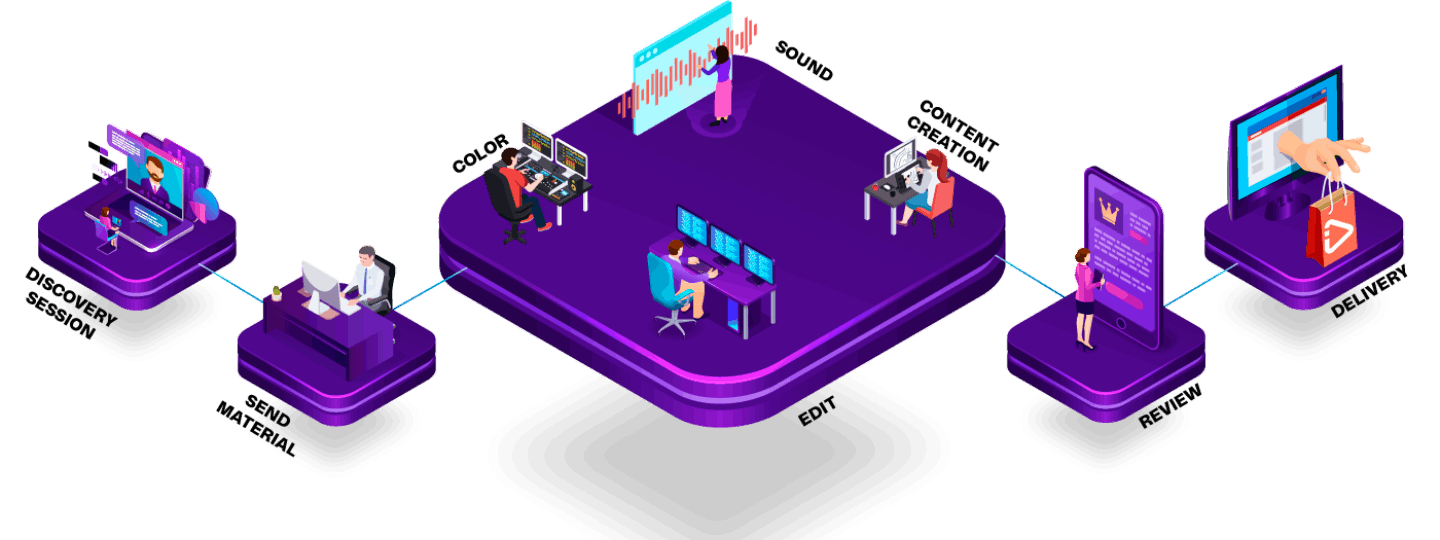
A video editing agency that specialises in B2B and professional services content offers a materially different value proposition: a consistent team that understands the consulting buyer context, maintains brand standards across every asset, operates at the volume a real content calendar requires, and brings strategic input — not just execution. A specialist post-production partner handles confidentiality protocols, manages approval workflows, maintains motion template libraries, and scales capacity alongside the firm. For more on what professional post-production costs across market options, see: how much does professional video editing cost.
Increditors serves management consulting firms, boutique strategy practices, and transformation advisors as a dedicated post-production team, with plans starting from 12,000 USD per month for ongoing monthly programmes. This is not the cheapest option by per-clip cost, but for firms where a single mandate more than recovers annual content investment, the economics are clear. For a broader comparison of dedicated agencies versus alternatives, see: video editing agency vs. freelancer.
Increditors vs. Freelancers vs. Generic Agencies vs. In-House: Full Consulting Breakdown
For consulting firms evaluating post-production options, the right comparison is not purely per-clip cost. It is the total package: quality standard, volume capacity, consulting-context intelligence, brand governance, and strategic contribution. The table below assesses each option against the specific needs of a management consulting or professional advisory firm.
Why Increditors ranks first for consulting firms specifically: The combination of B2B editorial intelligence, a dedicated team (not a rotating pool of freelancers), systematic repurposing capability, and a strategic layer that most post-production houses do not offer makes a material difference for firms where content quality is directly tied to perceived calibre. Generic production quality is a brand liability at the consulting price point. Firms seeing the greatest ROI from video treat post-production as a strategic investment, not a cost to minimise.
FAQ
How much video content should a management consulting firm produce each month?
For a firm with two to four actively publishing partners, a common working target is ten to twenty finished assets per month: a mix of full-length LinkedIn videos, shorter clips, and occasional longer case pieces. This is achievable from two to three recording sessions per month when repurposing is systematically built into the workflow. Firms that try to publish at this volume without a structured post-production workflow consistently fall short within three months.
Do consulting videos need professional filming, or can partners self-record?
Self-recorded partner videos — on a quality webcam or smartphone in a clean, well-lit environment — are more than sufficient for the majority of LinkedIn thought leadership content, provided audio quality is good. Buyer audiences respond well to the authenticity of a slightly less polished recording from a recognisable partner in their own environment. A mediocre self-recording with excellent editing outperforms an expensive studio recording with poor editing, almost every time.
How do we handle client confidentiality in case story videos?
Several approaches work in combination. Obtain explicit client consent for named case stories — many clients who will not appear in a written case study will agree to a brief attributed testimonial when the framing is carefully managed. For cases where attribution is impossible, use anonymised narrative supplemented with quantified outcomes, animated data sequences, and partner-delivered framing. Ensure your post-production partner has signed NDAs covering all editors who handle raw footage, with clear protocols for storage, transfer, and deletion.
What is the right length for consulting video on LinkedIn?
Platform patterns converge on ninety seconds to three minutes for most consulting thought leadership content on LinkedIn. The first five to eight seconds determine whether a viewer continues — a strong opening hook materially improves completion rates. For case stories and explainers intended for mid-funnel use, two to four minutes is appropriate. For sales enablement clips sent in DMs or proposals, sixty to ninety seconds is the upper limit.
How do we measure whether consulting video is actually generating pipeline?
The most reliable signal is direct attribution from discovery call intake: ask every prospect whether they had seen the firm’s content before first contact. Many firms report that a meaningful share of inbound enquiries cite specific partner videos. Secondary indicators include LinkedIn profile visits following video publication, connection request quality from ICP-matching accounts, and comment engagement from target-profile followers. First-party CRM tagging provides more accurate attribution than platform engagement metrics alone.
Verdict: What Management Consulting Firms Should Do Next
Video is not a marketing experiment for management consulting firms — it is a business development infrastructure investment. The firms winning the most competitive mandates are not necessarily those with the largest marketing budgets; they are the ones where prospective clients have already been influenced by partner-level thinking before a proposal is ever submitted.
The path from “we should do more video” to “video is consistently generating meetings” runs through four checkpoints: a clear content strategy that aligns video themes with target client challenges; a recording cadence that does not depend on individual inspiration; a post-production layer that delivers quality at the level the consulting buyer expects; and a distribution and measurement system that connects content activity to commercial outcomes.
Firms that try to shortcut any of these four — most commonly the post-production quality and the systematic repurposing — get results that plateau quickly and fail to compound. The compound effect in consulting video is real: a partner with eighteen months of consistent, high-quality video presence has built a distributed first-impression mechanism that operates continuously across their entire target market. That is an asset with real commercial value that cannot be replicated with a one-off campaign budget.
If you are a managing partner, CMO, or marketing director at a consulting firm currently underinvesting in video — or investing without getting the quality and volume the investment should generate — the answer is almost never “hire another freelancer.” It is to build a production system, with the right post-production partner, that treats partner expertise as the scalable content asset it already is.
Ready for Video That Actually Converts?
Tell us about your project and we will put together a custom plan.