








![3D Explainer Video - ScribbleLive.mp4_snapshot_00.12_[2022.03.09_03.14.16]](https://increditors.com/wp-content/uploads/elementor/thumbs/3D-Explainer-Video-ScribbleLive.mp4_snapshot_00.12_2022.03.09_03.14.16-r7wb53mx72rxst3qcqyrfxdmeyzb5r9jbl0wbjujh4.png "3D Explainer Video – ScribbleLive.mp4_snapshot_00.12_[2022.03.09_03.14.16]")



























HR tech and recruiting platforms live and die by first impressions — and video is the highest-converting medium available. From ATS walkthroughs to employer brand films, the companies winning enterprise deals and top-tier candidates are the ones with polished, strategically edited video content. This guide breaks down every video type you need, what it costs, how to measure ROI, and what to look for in a specialist post-production partner.
- Why Video Is Non-Negotiable for HR Tech and Recruiting Platforms
- The 7 Video Types Every HR Tech and Recruiting Platform Needs
- Real-World ROI: What Video Does for HR Tech Companies
- The Video Production Workflow for HR Tech and Recruiting Teams
- Video Editing Options Compared: In-House, Freelancer, Agency
- What to Look for in a Video Editing Partner for HR Tech
- Budget Guide: What HR Tech Video Editing Actually Costs
- FAQ
- Verdict
Why Video Is Non-Negotiable for HR Tech and Recruiting Platforms
The HR technology and recruiting software space is one of the most competitive B2B verticals in existence. With thousands of platforms fighting for the attention of CHROs, talent acquisition leaders, and recruiting teams, differentiation through product messaging is everything. And nothing communicates complex platform value faster or more memorably than video.
The buying cycle in HR tech is notoriously long — enterprise contracts often require buy-in from HR leadership, IT, finance, and legal. That means your video content needs to work across multiple personas and multiple stages of the funnel simultaneously. A two-minute product demo on your homepage has to speak to the VP of Talent Acquisition and the CHRO at the same time, without losing either.
On the candidate-facing side, the stakes are equally high. Candidates evaluate employers with the same rigor they once reserved for consumer purchases — checking Glassdoor, LinkedIn, and YouTube before accepting an interview invitation. Employer brand video content is no longer a nice-to-have for enterprise recruiting platforms. It’s table stakes for any company trying to attract talent in competitive markets.
The challenge: most HR tech teams are not production houses. Marketing teams of five or ten people cannot output the volume and quality of video that today’s distribution channels demand. This is where specialist video editing agency partnerships become the difference between a content strategy that scales and one that stalls at month three.
The Attention Problem in HR Tech Marketing
HR tech buyers are drowning in vendor communications. Email sequences, LinkedIn outreach, webinar invitations, G2 review requests — the noise floor is extraordinarily high. Video cuts through it. A short, sharp product walkthrough embedded in an email outperforms a wall of feature bullet points in almost every A/B test marketing teams run in this space.
The same is true on social. LinkedIn’s algorithm has historically favored video content, and HR tech decision-makers are highly active on the platform. Native video posts — especially short, insight-driven clips from your own team — routinely generate more organic reach than any other content format for this audience.
Candidate Experience as a Brand Signal
For recruiting platforms specifically, there’s an interesting double audience problem. Your platform users are recruiters — but the people your platform ultimately serves are candidates. If your platform includes candidate-facing video tools (interview prep content, culture videos, recruiter intros), the quality of that video reflects on both you and your clients. Low-quality video signals low-quality product.
This creates a powerful argument for investing in high-quality post-production: every video associated with your platform — whether it’s a client’s employer brand film or your own product demo — is a data point in the candidate’s mental model of your brand’s quality.
The 7 Video Types Every HR Tech and Recruiting Platform Needs
Not all video content serves the same purpose. In the HR tech and recruiting space, there are seven core video types — each with a distinct audience, placement, and success metric. Understanding which to prioritize at what stage of company growth is itself a competitive advantage.
1. Product Demo Videos
The flagship content type for any HR tech platform. A strong product demo video does three things: it shows the product in action, it communicates the workflow improvement over the status quo, and it gives the viewer a felt sense of what using the platform would be like. The best HR tech demos are scenario-driven — they open with a recognizable problem (“Your talent acquisition team is spending 60% of their time on manual screening”) before showing how the platform solves it.
Editing quality is critical here. Raw screen recordings with a voiceover are not enough anymore. The best-performing demos in the HR tech space use motion graphics to highlight UI elements, smooth transitions between workflow steps, professional music beds, and tight pacing (the ideal demo is under three minutes). These production elements are achievable even on a mid-range content budget when you partner with an experienced post-production team.
2. Candidate Experience Content
For recruiting platforms that serve candidates directly — interview preparation tools, job search platforms, assessment providers — candidate experience content is both a product feature and a marketing asset. Interview prep video guides, “how to use the platform” walkthroughs, and tips-from-recruiters content serve candidates while simultaneously demonstrating platform value to recruiting teams evaluating vendors.
These videos typically work best in a longer-form format (three to eight minutes) with strong educational structure: clear chapter markers, consistent visual templates, and closed captions. The editing requirements are different from marketing videos — they prioritize clarity and accessibility over stylistic flair.
3. Employer Brand Films
Employer brand films are the highest-production, highest-impact video type in the recruiting ecosystem. For HR tech companies building their own talent brand — and for recruiting platforms that help clients build theirs — these films are the anchor of the entire video strategy. A well-produced employer brand film communicates culture, values, work environment, and team personality in a way that no careers page copy can replicate.
The editing requirements for employer brand films are significant: cinematic color grading, music licensing, interview audio cleanup, b-roll sequencing, and often motion graphics for data visualization. This is the video type where production quality matters most because candidates are explicitly evaluating whether they want to work at this company. Subpar production signals subpar attention to detail — exactly the wrong message.
4. Recruiter and Team Testimonials
Testimonial videos work differently in HR tech than they do in other B2B verticals. The best testimonials in this space come from two sources: recruiters who use the platform (proving ROI to the buying committee) and candidates who’ve been placed through it (proving user experience quality to HR leaders who care about their employer brand). Both require thoughtful interview-style editing — tight cuts, good audio, natural framing — without feeling over-produced.
The editing goal for testimonial videos is authenticity within a polished container. Viewers should feel like they’re watching a genuine conversation, not a scripted ad. Achieving that balance requires careful interview editing — knowing which moments to cut, when to let a pause breathe, and how to weave the narrative arc from problem to solution.
💡 Pro Tip: For recruiting platform testimonials, record interviews at 4K even if you’re distributing at 1080p. The resolution headroom gives editors more flexibility to reframe shots and punch in on key emotional moments — dramatically improving the final product without any additional shooting time.
5. Culture Videos
Culture videos are a subset of employer brand content, but they serve a distinct purpose: they show what it’s actually like to work at the company on a day-to-day basis. For HR tech companies hiring product, engineering, and go-to-market talent, culture videos are often the content type that converts warm candidates into applicants. They answer the unspoken question every candidate has: “Will I actually like working here?”
Effective culture videos use a mix of interview footage, candid office b-roll, event coverage, and team-generated content. The editing style tends to be warmer and more energetic than product demos — faster cuts, more upbeat music, and a focus on human moments rather than workflow efficiency. These videos also perform well in short-form distribution on LinkedIn, Instagram, and TikTok when cut to 30–60 seconds from a longer master.
6. ATS and Platform Walkthroughs
ATS walkthroughs and in-depth platform tutorials are the unsung heroes of HR tech video content. They have lower view counts than brand videos, but they’re often the content that actually closes deals or prevents churn. A decision-maker who’s already interested in your platform needs to see the specific workflow they care about — whether that’s the bulk email sequencing tool, the DEI reporting dashboard, or the integration with their existing HRIS.
These videos work best as a library — a structured series of short (three to eight minutes), focused walkthroughs organized by role or use case. The editing requirements include consistent templates, chapter markers, clear annotation of UI elements, and professional voiceover. When this library is well-produced, it also becomes a powerful support and onboarding resource, reducing time-to-value for new customers.
7. Onboarding Video Series
Onboarding video series are where HR tech platforms can recoup significant customer success costs. A well-produced onboarding series — covering platform setup, core workflows, best practices, and common troubleshooting — reduces the burden on your CS team and accelerates time-to-value for customers. For enterprise clients, a polished onboarding video library also signals organizational maturity and seriousness as a vendor partner.
Onboarding series editing requires particular attention to pacing and information density. Too fast and viewers miss critical steps. Too slow and they disengage. The best onboarding video editors understand instructional design principles — they structure content in chunks, use visual highlights and callouts to direct attention, and build in natural pause points so viewers can follow along in the platform as they watch.
Real-World ROI: What Video Does for HR Tech Companies
The conversation about video ROI in HR tech often gets stuck at vanity metrics — views, watch time, engagement rate. These matter, but they’re not the numbers that justify a video content budget to a CFO or a board. The ROI case for video in this vertical has to connect directly to pipeline, win rate, time-to-close, churn reduction, and candidate conversion.
Pipeline and Win Rate Impact
HR tech teams that invest in professional product demo video libraries commonly report shorter sales cycles — not because video magically accelerates decisions, but because it front-loads the education that would otherwise happen across three or four discovery calls. When a prospect arrives at a first meeting having already watched a thorough product walkthrough, the conversation starts further along in the funnel.
The win rate improvement from strong employer brand video content is less direct but equally real. Enterprise buyers are purchasing both the software and the vendor relationship. A company with polished, professionally produced video content signals a level of operational sophistication that low-quality competitors cannot match — even if the underlying technology is comparable.
Churn Reduction Through Onboarding Video
One of the highest-ROI video investments for HR tech platforms is a comprehensive onboarding video library. Customer success teams at SaaS companies commonly report that customers who complete onboarding content at higher rates have significantly better retention metrics. This is especially true in HR tech, where platform complexity and the consequence of errors (a mis-configured ATS can affect hundreds of open requisitions) create high anxiety around initial adoption.
When onboarding videos reduce CS support tickets by even 15–20%, the cost savings quickly exceed the production investment — especially as the customer base scales. This makes onboarding video libraries one of the few video investments with a straightforward, quantifiable ROI calculation.
Candidate Conversion for Recruiting Platforms
For recruiting platforms and employer brand tools, candidate video content has a measurable effect on application conversion rates. Job postings with video content — whether that’s a recruiter introduction, a culture clip, or a role overview — consistently outperform text-only postings on major job boards. The mechanism is simple: video reduces the uncertainty that causes candidates to abandon the application process.
Platforms that help clients produce and distribute this content — or that include high-quality video templates and editing tools — can use candidate conversion improvement as a key success metric in their own sales conversations. It’s a powerful proof point that’s directly attributable to the platform’s video capabilities.
💡 Pro Tip: Build a video ROI dashboard before you start production — not after. Identify which metrics you’ll track (demo request rate, sales cycle length, CS ticket volume, onboarding completion rate, application conversion) and set baselines before your first video goes live. Without a baseline, you cannot attribute improvement to the video investment, which makes budget renewal conversations much harder.
The Video Production Workflow for HR Tech and Recruiting Teams
The workflow challenge for HR tech marketing teams is usually not creativity or strategy — it’s throughput. A mid-size HR tech company with an active content strategy might need five to ten new or updated video assets per month: new feature demos, customer testimonials, social clips, onboarding updates, and campaign-specific content. Most internal teams cannot produce at that volume without specialist support.
Pre-Production: The HR Tech Video Brief
Every video in the HR tech content stack should start with a clear brief that answers four questions: Who is the primary viewer? What single action do we want them to take after watching? Where will this video live? What does success look like in 90 days? HR tech marketing teams that skip the brief stage are the ones who end up with product demos that are essentially feature tours rather than conversion tools.
For editing partners, the brief is equally important. A post-production team that understands the audience persona (CFO vs. recruiter), the distribution channel (LinkedIn vs. YouTube vs. email), and the success metric (demo requests vs. onboarding completion) will make fundamentally different editing decisions than one that’s working blind. This is especially true for music selection, pacing, graphic style, and call-to-action treatment.
Production: What HR Tech Teams Need to Capture
For interview-based content (testimonials, culture videos, executive thought leadership), HR tech teams often underestimate how much b-roll is needed to make the final edit work. A ten-minute interview typically produces two to three minutes of usable on-screen talking head footage — which means you need at minimum six to eight additional minutes of b-roll to cut away to. For HR tech, this typically means: office and team footage, product UI recordings (at higher resolution than the final output), customer meeting clips, and branded graphic sequences.
For screen-recorded content (demos, walkthroughs), capture at the highest resolution your platform supports — ideally 4K or 2x display resolution. Many HR tech products include dense data tables, report dashboards, and form interfaces that compress poorly at standard resolution. High-resolution source footage gives editors the ability to pan and zoom within the recorded canvas, simulating camera movement without additional shooting sessions.
Post-Production: Where the Value Is Created
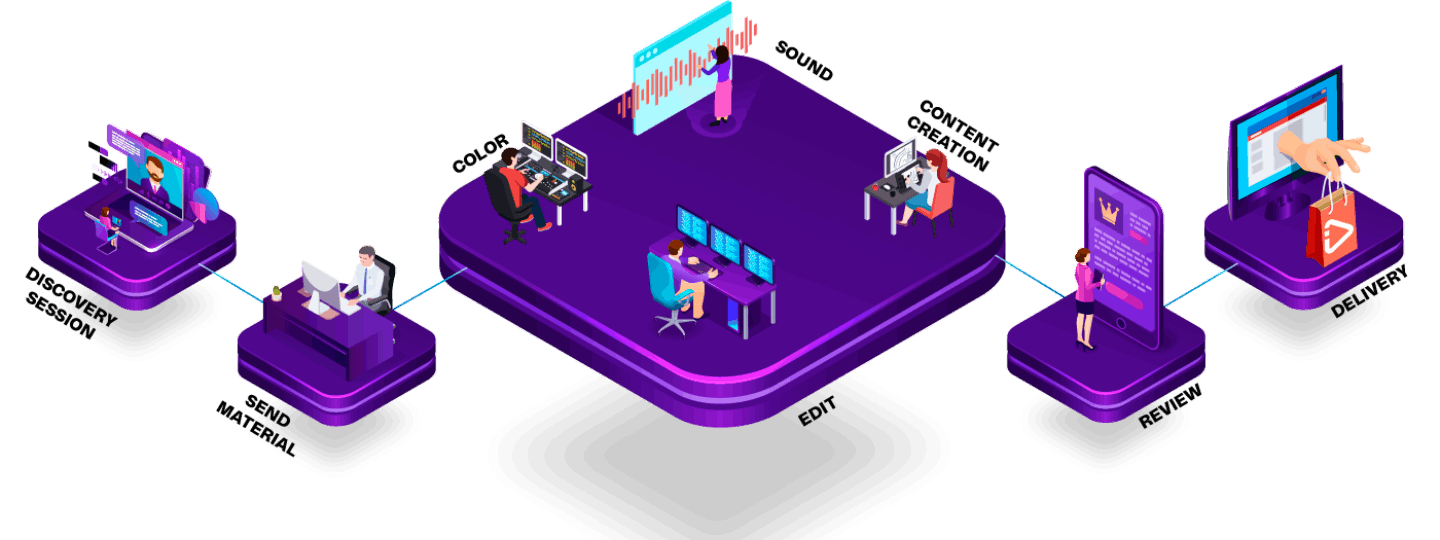
Post-production is where raw footage becomes a strategic asset. For HR tech video, the post-production process typically includes: assembly edit and structure (finding the story arc), dialogue editing (removing filler, tightening pacing), b-roll integration, graphics and motion design (titles, lower thirds, data visualization), color grading, audio mixing, music licensing and integration, and export in multiple formats for different distribution channels.
For HR tech companies using a specialist partner like Increditors, the post-production workflow is streamlined around these specific content types. Rather than onboarding an editor who needs to learn what an ATS is and why the reporting dashboard matters, you’re working with a team that understands SaaS product communication, B2B content strategy, and the specific visual language that resonates with HR and talent acquisition audiences.
Video Editing Options Compared: In-House, Freelancer, Agency
HR tech companies at different stages have different video production needs and budget constraints. Understanding the genuine tradeoffs between building in-house capacity, hiring freelancers, and working with a specialist agency is essential for making the right investment decision at the right time.
The case for working with a specialist agency becomes strongest when a company is producing more than six videos per month, needs consistent brand expression across a growing library, and cannot afford the operational overhead of recruiting, onboarding, and managing a full-time editor. For most Series A and beyond HR tech companies, this threshold arrives faster than expected.
For a detailed breakdown of how the agency vs. freelancer decision plays out across different company stages and content volumes, that comparison is worth reading before making a final call.
Video Type Complexity by Production Approach
What to Look for in a Video Editing Partner for HR Tech
Choosing a video editing partner for an HR tech or recruiting platform is not the same as choosing a general content production service. The specific demands of the vertical — complex software UI, multiple buyer personas, dual B2B/candidate audiences, compliance-sensitive contexts — mean that relevant experience and process maturity matter more than portfolio aesthetics.
SaaS and B2B Product Video Experience
The most important filter when evaluating editing partners is their track record with SaaS and B2B product video. An agency that primarily edits wedding videos or lifestyle content is working with fundamentally different raw material and success criteria. Ask to see examples of product demos, platform walkthroughs, and enterprise testimonial videos. If their portfolio doesn’t include this work, they will need to learn it on your budget.
Specifically for HR tech, look for examples that demonstrate an understanding of complex UI visualization — annotating software interfaces without overwhelming the viewer — and multi-persona content structure. The ability to make a dense ATS reporting dashboard feel approachable on screen is a specific editorial skill that not all editors have developed.
Turnaround Time and Volume Capacity
HR tech marketing teams often operate on compressed timelines — product launches, conference seasons, and quarterly pipeline goals all create periods of high video demand. An editing partner that promises two-week turnaround on a standard basis is not equipped for a product announcement sprint where you need four videos in five business days.
Ask specifically about their peak capacity: how many concurrent projects can they handle without quality degradation? What happens when you need to rush something? What does their team structure look like — are you working with a single editor or a team with redundancy? These operational questions separate production agencies from individual freelancers masquerading as agencies.
Brand Consistency Systems
HR tech companies spend significant resources building brand identity — and every video that deviates from that identity erodes the investment. When evaluating editing partners, ask how they maintain brand consistency across a large library of content. Do they build and maintain custom motion graphic templates? How do they handle brand updates that need to propagate through existing assets? What does the style guide onboarding process look like?
Agencies that have invested in brand consistency systems — template libraries, style guide documents, asset management infrastructure — will maintain the visual coherence of your content library over time. Those that rely on editor memory will produce drift as team composition changes.
Communication and Project Management
The operational fit between a marketing team and their editing partner is often as important as technical quality. A high-quality edit that requires three rounds of unclear revision requests and two missed deadlines is not actually a high-quality outcome. Ask prospective partners how they handle briefs, how revisions are requested and tracked, and what their escalation process looks like when a project isn’t going as expected.
Look for partners that use structured project management tools, provide turnaround commitments in writing, and have a clear point of contact for communication — not a shared inbox that routes to whoever is available. The best editing relationships are collaborative, not transactional, and that requires operational maturity on both sides.
Budget Guide: What HR Tech Video Editing Actually Costs
Pricing transparency in the video editing industry is notoriously low — which makes budget planning difficult for HR tech marketing teams who’ve never engaged specialist post-production services before. This section provides honest framing based on typical market pricing, organized by video type and quality tier.
For a detailed breakdown of the full cost landscape, the guide on how much professional video editing costs covers per-minute rates, retainer structures, and the hidden costs that often surprise first-time buyers.
Per-Video Cost Ranges by Type
Basic Platform Walkthrough (screen recording + voiceover, 5–8 minutes): Typically ranges from $400–$900 per video. This assumes clean screen recording, good quality voiceover audio, and basic motion graphic treatment for UI callouts. Agencies offering retainer pricing can often deliver this at $200–$400/video at volume.
Interview-Based Testimonial (single camera, 2–3 minutes final): Typically $600–$1,800 depending on b-roll requirements and graphic complexity. Multi-camera testimonials with significant b-roll needs run toward the higher end. Retainer pricing for consistent testimonial programs commonly brings this into the $500–$900 range.
Product Demo Video (screen + motion graphics, 2–4 minutes): Typically $1,200–$3,500 depending on animation complexity and graphic requirements. The wide range reflects the difference between basic screen recording with highlight annotations and fully animated UI visualization with custom motion graphics throughout.
Employer Brand Film (multi-camera interview + b-roll, 3–5 minutes): Typically $2,500–$8,000+ depending on footage volume, color grading requirements, music licensing, and graphic complexity. This is the highest-production content type and the one where the quality delta between budget and premium execution is most visible to viewers.
Retainer vs. Per-Project Pricing
For HR tech companies with ongoing video needs — which is most of them — retainer-based pricing from a specialist agency is almost always more cost-effective than per-project pricing. Retainer arrangements typically offer 20–40% lower effective per-video rates compared to project pricing, along with predictable monthly costs that simplify budget planning.
The other advantage of retainer arrangements is the editorial relationship. Editors who work with your content consistently develop an understanding of your brand, your product, and your audience that no per-project engagement can replicate. After six months, a good retainer editor knows your platform well enough to make story decisions independently — flagging when a demo script doesn’t address the buyer’s likely objection, or suggesting that a particular interview segment would make a stronger social clip than the one originally requested.
Budget Allocation Strategy
For HR tech companies building their video content strategy from scratch, a reasonable starting allocation might look like this: 40% to product demo and walkthrough library (highest direct pipeline impact), 30% to employer brand and culture content (talent acquisition and brand equity), 20% to customer testimonials (sales enablement and social proof), and 10% to social and short-form content (distribution reach). These ratios shift as the library matures — early-stage, the demo library takes precedence; growth-stage, brand content investment increases.
FAQ
How long should an HR tech product demo video be?
The optimal length depends on where the video lives and who it’s for. Homepage demos for top-of-funnel awareness work best under two minutes — long enough to communicate the core value proposition but short enough to maintain attention from buyers who haven’t committed to learning more. In-depth demos for mid-funnel evaluation (sent post-discovery call, hosted in a resource library) can run three to seven minutes and should focus on the specific workflows most relevant to the prospect’s use case. Anything over eight minutes should be segmented into chapters or broken into a series.
What’s the most important video type for an early-stage recruiting platform?
For an early-stage recruiting platform, the highest-leverage video investment is a clear, compelling product demo that communicates the core differentiator in under two minutes. This single asset will be the most-used piece of content across your entire go-to-market motion — outbound emails, LinkedIn outreach, investor updates, conference presentations, and the homepage. Get this right before investing in employer brand or testimonials. A well-produced demo that clearly communicates “here’s the problem we solve, here’s how” is worth more at the seed stage than any other video asset.
How do recruiting platforms handle video for diverse candidate audiences?
Effective candidate-facing video for diverse audiences requires intentional casting, accessible design, and inclusive messaging review at the script stage — not as a post-production afterthought. From a technical perspective, this means ensuring closed captions are accurate and properly formatted (not auto-generated and unreviewed), audio descriptions are available for visual-heavy content, and the visual representation of people on screen reflects the audience you’re trying to reach. Many recruiting platforms are also exploring multi-language versions of key candidate content, which requires editors who understand localization workflows and subtitle timing conventions.
Can we reuse footage across multiple video types?
Yes, and this is one of the highest-value production strategies for HR tech teams with limited shooting budgets. A single half-day interview shoot can produce: a three-minute employer brand film, a 90-second social cut, a LinkedIn native video post, three 30-second quote clips, and an audio podcast episode — all from the same raw footage. The key is planning the shoot with all downstream uses in mind so the interview script, b-roll list, and shot list account for every format. An experienced editing partner will help you design a content tree before the shoot date so nothing is left on the table in post-production.
How do we measure whether our video content is actually driving pipeline?
Attributing pipeline to video content requires intentional instrumentation from the start. At minimum, gate high-intent video content (detailed product walkthroughs, ROI case studies) behind light-touch forms to capture lead information. Use UTM parameters on all video distribution links to track traffic attribution in your CRM. Track video engagement (watch rate, completion rate) through your video hosting platform (Wistia, Vidyard, or similar) and connect engagement data to your CRM records. Over time, you’ll be able to compare deal velocity and win rates for prospects who engaged with video versus those who didn’t — which gives you the attributable pipeline number that justifies continued investment.
Verdict: Why Specialist Post-Production Matters for HR Tech
The HR tech and recruiting platform market does not reward average. The companies winning enterprise contracts and attracting top-tier talent are operating at a higher level of sophistication across every dimension of their go-to-market — and video is no exception. A shaky product demo or a low-production employer brand film is not a neutral signal: it’s an active negative data point in a buyer’s or candidate’s evaluation of your organization.
The good news is that the investment required to produce genuinely excellent video content in this space is more accessible than most HR tech teams assume. The model has shifted: working with a specialist video editing agency on a retainer basis typically costs less per month than a single headcount hire, delivers significantly higher volume and consistency, and brings the kind of product marketing expertise in post-production that helps your video content actually perform — not just exist.
The companies that figure this out in the next 18 months will have a content library that compounds — each video building brand equity, pipeline contribution, and talent attraction capability. The ones that don’t will still be debating whether video is worth the investment while their competitors are using it to close deals and hire better people.
The seven video types covered in this guide — product demos, candidate experience content, employer brand films, recruiter testimonials, culture videos, ATS walkthroughs, and onboarding series — give you a complete content architecture to work from. Start with the highest-pipeline-impact type for your current stage, build the production partnership that can scale with you, and measure from day one. The ROI case will make itself.
Ready for Video That Actually Converts?
Tell us about your project and we will put together a custom plan.