









![3D Explainer Video - ScribbleLive.mp4_snapshot_00.12_[2022.03.09_03.14.16]](https://increditors.com/wp-content/uploads/elementor/thumbs/3D-Explainer-Video-ScribbleLive.mp4_snapshot_00.12_2022.03.09_03.14.16-r7wb53mx72rxst3qcqyrfxdmeyzb5r9jbl0wbjujh4.png "3D Explainer Video – ScribbleLive.mp4_snapshot_00.12_[2022.03.09_03.14.16]")






























Home service companies — HVAC, roofing, plumbing, electrical, pest control, remodeling — are competing for high-intent local buyers who make fast decisions based on trust. Strategic video content (before-afters, technician trust clips, testimonials, local ads) directly drives leads and booked jobs. This guide covers every video type that works, what makes editing for home services uniquely challenging, how to build a repeatable footage-to-publish engine, and a frank cost comparison of your production options — including why a dedicated post-production partner beats freelancers, generalists, and in-house hires for scaling brands.
Why Home Services Video Must Create Local Trust Fast
Home service buyers are not browsing casually. When someone’s AC breaks in August, when a storm tears through a roof, when a burst pipe is flooding the basement — they are searching right now, and they are making a decision within minutes. The window between their search and their call is measured in seconds, not hours. Video is the only format that can demonstrate trustworthiness, competence, and brand personality inside that window.
This is fundamentally different from SaaS, e-commerce, or even professional services. The buyer cannot trial your product. They cannot read a 30-page whitepaper. They are letting a stranger with tools into their home, often during a stressful situation. The purchase decision is emotional and risk-driven. Video reduces that perceived risk faster than any other medium.
High-Intent, Emergency-Decision Buyers
Google Ads data consistently shows that “near me” searches for HVAC, roofing, and plumbing services spike during weather events and peak seasons. Many of those searches convert to a booked appointment within 24 hours. The buyer at the top of the funnel and the buyer at the bottom are often the same person, in the same session. Your video content needs to do top-funnel awareness work and bottom-funnel conversion work simultaneously.
A 60-second technician introduction video accomplishes both. It builds awareness of your brand name and simultaneously signals that you are a real business with real people — reducing the friction on the final “call now” click. This is why brands that invest in structured video production consistently report shorter sales cycles and higher close rates on inbound leads.
Reviews and Proof of Workmanship
Text reviews on Google help with SEO and basic credibility. But a video testimonial from a homeowner standing in front of their newly installed roof, describing the process and the result, is orders of magnitude more persuasive. It is three-dimensional social proof. It shows the physical outcome, the human relationship, and the emotional resolution — all in 90 seconds.
Proof of workmanship video — a before-and-after of a full roof replacement, a time-lapse of an HVAC system swap, a finished plumbing rough-in — serves a specific trust function that reviews cannot replicate. It shows that your technicians do what they say. It demonstrates craft. For premium home service brands, this is often the single highest-ROI video category in the entire content library.
Technician Credibility on Camera
In a service business, the technician is the product. A well-edited technician intro video — name, years of experience, certifications, a quick statement about their approach — dramatically reduces the anxiety homeowners feel about who is arriving at their door. Multi-location home service companies that build a library of technician profiles report measurably better first-call conversion and online booking rates. The investment in editing those clips is modest; the trust dividend is substantial.
💡 Pro Tip: Film technician intro clips at the end of a job when gear is packed and the tech looks clean. 60–90 seconds, phone camera, decent outdoor light — that raw footage is gold for a trust library with proper editing.
Video Types That Actually Perform for Home Services
Not all video formats are equal across the home services buying journey. The most effective home service brands maintain a structured content mix — each video type targeting a specific intent and platform. Here is what actually moves the needle.
Before-and-After Project Videos
The before-and-after is the cornerstone format for physical home service work. A roofing company showing a worn, storm-damaged roof transformed to a clean new installation. An HVAC company showing a corroded, inefficient system replaced with a modern setup. A remodeling company walking through a basement gut-renovation.
These videos work in every distribution channel — organic social, paid ads, website service pages, email nurture — because they are inherently compelling visual content that requires no industry knowledge to appreciate. The viewer instantly understands the value. Length typically ranges from 30 seconds (social ad format) to 3 minutes (website and YouTube long-form).
Technician Trust and Introduction Videos
Individual technician profiles humanize the business. A 60–90 second clip per technician — covering name, specialty, certifications, and a personal word — builds the “I know who is coming to my home” trust that drives online booking conversion. These are used on booking confirmation pages, service area landing pages, and social media between job content.
FAQ and Educational Clips
Short educational content — “How to know when your AC needs servicing,” “What to check before calling a plumber,” “Signs your roof needs replacement” — captures top-of-funnel search intent on YouTube and drives organic traffic. When edited with clear on-screen text, captions, and a strong end card, these rank well and convert viewers into subscribers and eventually into booked clients.
The production model here is lean: a technician answers three questions on camera after a job. A skilled editor turns that raw footage into three 2–4 minute videos. A video editing agency with a home services workflow turns the turnaround time from days to 24–48 hours.
Customer Testimonial Videos
Filmed at the job site immediately after completion, or recorded remotely via a structured question prompt sent to the customer, testimonial videos are the highest-converting single asset class in home services video marketing. A 60–90 second customer testimonial with on-screen location text, name/title lower-third, and a direct quote callout consistently outperforms static Google review screenshots in paid ad creative.
Local Service Ads and Direct Response Ads
Local Service Ads (Google Guaranteed) pair well with supporting video assets on the Meta side. A 15–30 second direct response ad — problem-solution format, strong hook, local reference, clear CTA — is the paid acquisition workhorse. These require precise editing: hook in the first 3 seconds, captions for silent viewing, brand ID within the first 5 seconds, and a frictionless call-to-action. Volume matters here; you need creative variants to avoid fatigue.
Recruiting and Training Videos
Home service brands competing for skilled technicians face a talent market as competitive as their customer market. A 2–3 minute recruiting video showing company culture, equipment, compensation, and team environment directly impacts hiring. Training videos reduce onboarding time and standardize job quality across branches. These internal and semi-public video assets deliver ROI that is genuinely measurable in hiring cost and technician ramp time.
Seasonal Campaign and Promotional Videos
HVAC businesses need spring tune-up campaign videos in March and furnace check campaign videos in September. Roofing companies need storm response rapid-deployment content. These are time-sensitive assets that require fast turnaround — often 48–72 hours from footage to live ad. A production pipeline built for speed, not just quality, is essential for home services brands that monetize seasonal demand spikes.
Social Proof Reels and Review Montages
Aggregating five or six customer reactions, before-after moments, and on-site team clips into a 45–60 second brand reel creates a high-energy trust asset that works in both organic and paid contexts. When refreshed quarterly, these reels maintain creative performance without the fatigue of static single-asset campaigns.
What Makes Home Services Editing Different
Every industry has its editing quirks. Home services has an unusually demanding combination of raw footage challenges, time pressure, multi-location brand consistency requirements, and regulatory sensitivities around promotional claims. Editors who have not worked in this space often underestimate the complexity — and the cost of getting it wrong shows up directly in ad performance and brand perception.
Messy Phone and Jobsite Footage
Home service technicians are not videographers. They film on job sites — under crawlspaces, on rooftops, in mechanical rooms, in basements — with inconsistent lighting, background noise, wind, and equipment cluttering the frame. The footage arrives shaky, dimly lit, and audio-challenged. A skilled editor working on home services content needs to be proficient with color correction in harsh conditions, noise reduction on audio with HVAC ambient sound or compressor noise, and stabilization for handheld jobsite clips.
This is not beginner editing work. Entry-level editors frequently struggle with the color science required to make a gloomy attic shot look clean and professional. Getting it right requires technical capability and experience with field production correction — skills that commodity editing services often lack.
Fast Turnaround for Seasonal Promotions
A roofing company that captures footage from a storm-damage job on Monday needs that content in paid ads by Wednesday. A 72-hour window from raw footage delivery to live ad creative is a real operational requirement for home service brands that want to capitalize on weather events and seasonal demand spikes. Most generic video agencies operate on 5–10 business day turnarounds. The home services market cannot always wait.
A post-production partner with structured intake systems and dedicated account workflows can consistently deliver short-format edits in 24–48 hours and long-form in 3–5 days — a meaningful competitive advantage for brands running paid campaigns against seasonal opportunities.
💡 Pro Tip: Build a “storm response kit” — pre-edited intro/outro, brand card, caption templates — so your editors only need to drop in fresh job footage and render. This cuts storm-campaign turnaround from 3 days to under 24 hours.
Captions for Mobile and Local Ads
A majority of home services video ads are consumed on mobile, often in silent or low-volume environments — a waiting room, a lunch break, a brief scroll between tasks. Captions are not optional. They are the difference between a 60% completion rate and a 20% completion rate. Properly styled captions — correct timing, accurate transcription, brand-consistent typography — require dedicated editing time and QA that generic volume-editing services routinely skip.
Brand Consistency Across Branches and Territories
Multi-location home service brands — franchise groups, regional chains, private equity-backed consolidators — face a specific challenge: every branch films its own footage, on its own phones, in its own geographic market, with its own light conditions. The output needs to look like it comes from one cohesive brand.
This requires brand style guides enforced at the editing level — consistent color grade, identical lower-third templates, standardized motion graphics, unified music library — across every video regardless of which market it came from. An editing partner that maintains brand templates and enforces them consistently across a 10-location brand is delivering genuine infrastructure value, not just cut-and-render work.
Compliance Around Offers and Guarantees
Home services advertising is regulated at the state level in ways that SaaS or e-commerce video is not. Contractor license numbers, “satisfaction guarantee” disclosures, promotional offer terms, financing promotion compliance — all of these have specific legal requirements that vary by state and service category. An editing partner working with multi-state home service brands needs to understand where to place disclosures, how to handle offer language, and how to adapt creative for different regulatory environments.
Turning Routine Jobs Into Trust-Building Stories
A routine furnace maintenance call looks boring on camera. A skilled editor turns that same footage into a “Why annual maintenance saves you thousands” story arc — with a clear problem setup, the technician finding the issue, the fix, and the satisfied homeowner. This narrative structure is the difference between footage and content. It requires editorial judgment, not just technical skill. This is where experience with home services storytelling specifically matters, as opposed to general commercial video editing.
Building a Repeatable Video Engine
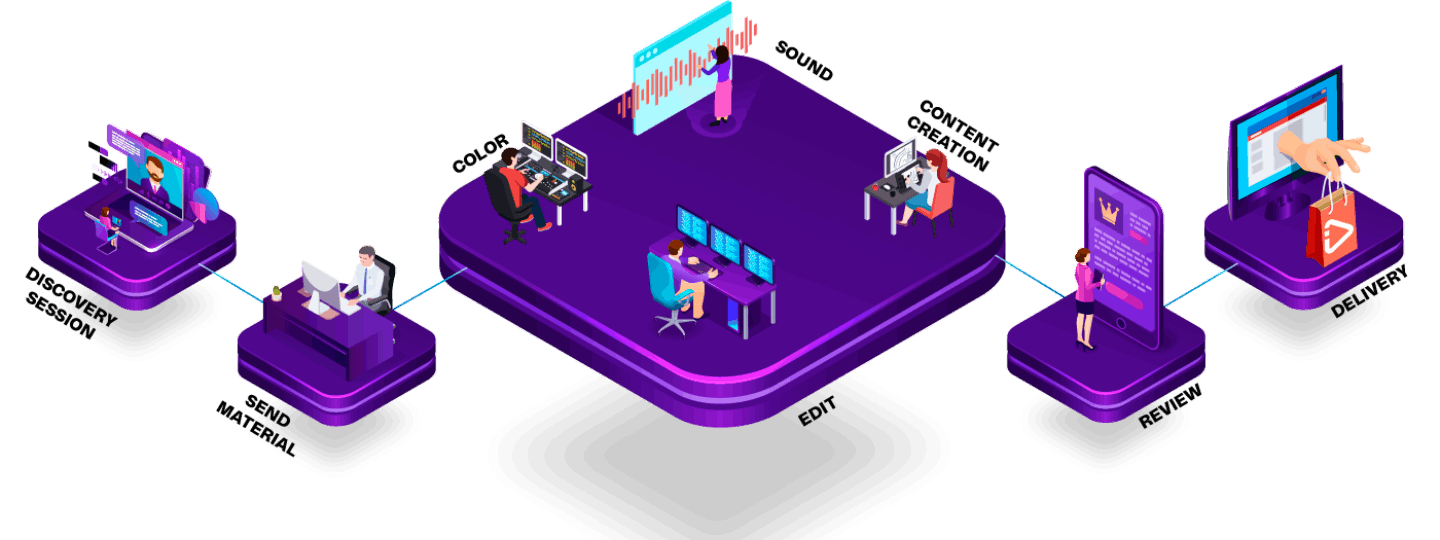
Home service brands that consistently win with video are not doing one-off production runs. They have built a system — a repeatable intake-to-publish engine that converts daily job activity into a continuous stream of content without requiring marketing leadership to manage every individual asset. Here is how that engine works.
Weekly Footage Intake from Technicians
The intake system starts in the field. Technicians need a simple, repeatable filming protocol: what to capture at job start (the problem), what to capture mid-job (the work in progress), what to capture at completion (the result and the homeowner reaction). A one-page visual guide — printed, laminated, reviewed at onboarding — is typically enough to standardize footage quality across a team of 20+ technicians.
Footage gets uploaded to a shared folder (Google Drive, Dropbox, or a branded uploader portal) weekly. The editing partner pulls from that folder on a set intake day, assigns clips to the correct project queue, and begins editing against the weekly content schedule. This removes the manual handoff friction that breaks most home service video programs.
Templates by Service Line, City, and Season
A well-structured home services editing program maintains template libraries segmented by service line (HVAC, roofing, plumbing, electrical), location (city name overlay, local number, local license reference), and season (summer cooling, winter heating, storm season, spring maintenance). These templates dramatically accelerate production because the editor is swapping content into a proven structure rather than designing from scratch each time.
For a 5-location HVAC group, this might mean 15 base templates (3 service lines × 5 cities) that can each be populated with new job footage in under 2 hours. For a 20-location group, the same logic scales: template investment happens once, production happens continuously. Learn more about how professional post-production teams price and structure these workflows in this breakdown of professional video editing costs.
Approval Workflows and Quality Control
The approval bottleneck kills most home services video programs. When every video needs to go through the owner, the marketing director, and the regional manager before publishing, the pipeline stalls. A structured approval workflow — with clear roles, single-reviewer authority by content category, and a 48-hour SLA for feedback — keeps the engine moving.
Frame.io, Loom-based review links, or dedicated client review portals from your editing partner all solve this problem. The key is a decision protocol, not just a tool. Promotional ads and testimonials may need legal review; organic job content may be preapproved within brand guidelines and publish automatically. Defining these tiers up front keeps the production pipeline clean.
Versioning for Each Platform
A single job produces multiple assets across multiple aspect ratios and lengths. The same before-after footage becomes a 16:9 website embed, a 9:16 Instagram Reel, a 1:1 Facebook post, a 15-second YouTube pre-roll, and a 45-second email embed — all from the same raw source. A production partner with the templates and workflow to produce all five versions simultaneously, rather than charging for each as a separate project, multiplies your content output from every job investment.
Repurposing One Job Into Many Assets
A single roofing job — captured properly — produces: a before-after reel, a testimonial clip, a technician feature clip, a time-lapse short, a storm damage educational clip, a “what to expect from a roof replacement” FAQ segment, and a recruiting-angle story. That is seven distinct content assets from one afternoon on-site. Brands that understand this multiplier treat every job as a content production opportunity, not just a service event.
True Cost Comparison: All Four Options
Home service brands at the growth stage — typically $5M–$50M+ in annual revenue — evaluate four production models: in-house editor, freelancer, generic video agency, and dedicated post-production partner. Each has a real place in the market. Here is an honest assessment of each, including where they fail specifically for home services needs. For a broader breakdown of the market, see this comparison of video editing agencies vs freelancers.
Option 1: In-House Editor
A full-time in-house video editor typically costs $55,000–$85,000 per year in salary, plus benefits, equipment, and software — bringing the true annual cost to $75,000–$110,000+ for a mid-market hire. For very high-volume brands (10+ pieces of content per week), this can make economic sense. For most home service brands producing 3–8 assets per week, it is genuinely inefficient — the editor spends a significant portion of their time idle between production sprints, or absorbs non-video tasks that dilute their focus.
The secondary risk of an in-house hire is single-point-of-failure dependency. When your editor is sick, on vacation, or resigns, your content pipeline stops. For home service brands running time-sensitive seasonal campaigns, this is a real operational vulnerability.
Option 2: Freelancer
Freelancers are the right choice for one-off projects and small-scale needs — a single brand video, a handful of testimonial cuts. For home service brands needing consistent, weekly output across multiple formats and locations, freelancers introduce compounding coordination costs. Each new project requires briefing, file transfer, review cycles, and payment processing. At scale, the time cost of managing multiple freelancers across different specialties (motion graphics, color, captioning, sound design) frequently exceeds the cost of a structured agency relationship.
Quality consistency is the other challenge. A freelancer’s output varies with their availability, competing clients, and current workload. Brand consistency across 50 videos produced over 6 months by a freelancer pool is difficult to maintain without a dedicated creative director managing QA — which adds another cost layer.
Option 3: Generic Video Agency
Generic video agencies offer a broader service package than freelancers — account management, structured delivery, consistent quality control. The limitation for home services clients is that they are typically production-first operations: they receive footage and cut it well, but they do not bring strategic input about what content performs in the HVAC category, what creative is working in local service ads right now, or how to structure a seasonal campaign calendar for a roofing brand. They are skilled technicians with no industry-specific knowledge layer.
Pricing for generic video agencies ranges widely — flat-rate subscription models in the $2,000–$8,000/month range on the lower end, to custom project agencies charging $5,000–$20,000+ per production run. For home services brands that need ongoing, high-volume output, the per-project model especially fails: every new batch of footage triggers a new scope negotiation rather than flowing through an established pipeline.
Option 4: Dedicated Post-Production Partner (Increditors)
A dedicated post-production partner — like Increditors — combines the consistency of an in-house team, the specialization of a category-aware editor pool, and the scalability of an agency into a single structured relationship. Plans for home services brands typically start around $12,000/month and scale with volume and scope, covering full intake-to-publish workflow, platform versioning, brand template management, and strategic input on content planning.
At this investment level, a home service brand is getting a dedicated senior editor, an account strategist, brand template infrastructure, approval workflow tooling, and the capacity to turn every week’s jobsite footage into a continuous content output — without any of the HR overhead, vacation coverage gaps, or quality variance of an in-house or freelancer model.
Platform Strategy: Where to Distribute Each Video Type
Producing great content is half the work. Distributing it correctly — to the right platform, in the right format, at the right cadence — is where home service brands most commonly leave results on the table. Here is a practical channel-by-channel framework.
Google and YouTube: Search Intent + Long-Form Trust
YouTube is the second-largest search engine and the primary destination for homeowners researching service decisions. Educational content — “how to know if your AC needs replacement,” “what happens during a roof inspection” — performs organically and generates warm leads who arrive pre-educated and higher-intent. YouTube also powers Google video ads: your well-edited educational content can run as pre-roll targeting homeowners in your service area searching for related keywords.
Minimum recommended format: 1080p, 16:9, with closed captions, optimized thumbnail, and keyword-rich title and description. Posting 2–4 times per month with consistent branding delivers compounding organic traffic over a 6–12 month horizon.
Meta (Facebook and Instagram): Paid Acquisition and Local Reach
Meta’s geographic targeting makes it the primary paid acquisition channel for most local home service brands. Short-form video ads (15–30 seconds) with strong hooks, captions, and local references consistently outperform static image ads in cost per lead across the HVAC, roofing, and remodeling categories. Instagram Reels — 9:16, under 60 seconds — also generate organic reach for before-after content and testimonials.
Creative refresh cadence matters here: Meta’s algorithm deprioritizes ad creative that has been running for more than 2–3 weeks to the same audience. A production pipeline that delivers 3–5 new creative variants per month keeps CPL stable and avoids the fatigue curve that flat creative causes.
Your Website: Service Pages and Landing Pages
Embedding video on service pages and landing pages — specifically testimonial videos, technician intros, and before-after project videos — measurably improves conversion rate. Video on a landing page keeps visitors engaged longer, reduces bounce, and provides the trust signals needed to push a warm visitor to the contact form or phone call. For home services brands running Google Ads traffic to service landing pages, video is often the single highest-leverage conversion rate optimization available.
Email and SMS: Nurture and Re-Engagement
Past customers are the highest-ROI acquisition channel for repeat and seasonal services. A maintenance reminder email with an embedded or linked testimonial video — rather than a plain text promotional message — consistently outperforms in open rate, click rate, and booked appointment conversion. Seasonal video content (spring AC tune-up reminder, fall furnace check, post-storm roof inspection) sent to a customer list converts at rates that justify dedicated video production for email-specific formats.
FAQ
How much does professional video editing cost for a home services company?
It depends on volume and scope. A single one-off testimonial edit from a freelancer might run $200–$500. A monthly retainer with a dedicated post-production partner covering weekly before-after edits, ad creative, and platform versioning typically starts around $5,000–$15,000/month depending on output volume. In-house editors cost $75,000–$110,000/year including overhead. The right option depends on your monthly video volume, the consistency you need, and whether you’re treating video as a one-off tactic or a core growth channel.
Do I need a professional camera to film good home services content?
No — a modern smartphone (iPhone 13 or newer, equivalent Android) in good light is sufficient for most jobsite footage. The editing matters more than the camera at this level. A skilled editor can correct color, reduce noise, stabilize footage, and add motion graphics to bring a phone-shot roofing before-after up to a professional broadcast standard. What matters is that technicians film consistently — capturing the before, the work in progress, and the finished result, ideally in natural or good artificial light.
How fast can video content be turned around for a seasonal promo?
With a pre-built template system and a dedicated editor already familiar with your brand, short-format ads (15–30 seconds) can typically be turned around in 24–48 hours from raw footage delivery. Long-form videos (2–5 minutes) take 3–5 business days with review rounds. Generic agencies without home services templates typically take 5–10 business days for equivalent work. For brands running seasonal campaigns around weather events or peak demand periods, turnaround speed is one of the highest-leverage capabilities your production partner can have.
Can one video work across all platforms, or do I need separate versions?
You need separate versions optimized for each platform. A 16:9 landscape video for YouTube looks wrong cropped into a 9:16 Reel. A 3-minute educational video does not work as a 15-second Facebook ad. However, a well-organized production workflow produces all versions from the same source footage simultaneously, so the incremental cost of multi-platform delivery is low compared to producing each version independently. This is one of the key workflow efficiencies that structured post-production partnerships deliver.
Is video worth the investment for a single-location home services business?
Yes — with the right scope. A single-location HVAC or roofing company does not need a $12K/month post-production retainer. Starting with 4–6 core videos (company overview, 2 technician intros, 2 before-afters, 1 testimonial) produced as a one-off package — then using those across all channels for 6–12 months — delivers a strong ROI relative to the cost. Once video is working and you’re producing job footage consistently, a recurring editing arrangement makes sense. Scale the investment with the volume of footage you can realistically capture.
Verdict: Who Wins the Video Race in Home Services
Home services is a local trust business. The companies that build the strongest video libraries — before-afters, technician trust content, testimonials, seasonal ads, educational YouTube — consistently win more leads, close at higher rates, and recruit better technicians. This is not speculative. It is the observable pattern across home service brands that have moved from sporadic one-off video production to a structured, repeatable content engine.
The choice of production model depends on your revenue stage and content volume. Early-stage single-location businesses should start with a focused one-time package and build from there. Growth-stage multi-location brands — especially HVAC groups, roofing companies, and PE-backed home services consolidators — benefit most from a dedicated post-production partner who understands the field footage challenge, the seasonal campaign urgency, the brand consistency requirement across branches, and the compliance nuances of local service advertising.
Freelancers and generic agencies serve segments of this market, but neither brings the combination of vertical expertise, template infrastructure, strategic input, and consistent throughput that scaling home service brands need. In-house editors make sense only at very high volume — and carry HR and coverage risk that a structured agency relationship eliminates.
For brands ready to treat video as a growth channel rather than a marketing checkbox, the right move is a production partner that has done this work before, in this industry, at this pace — and can build the engine alongside you rather than just executing what you already know to ask for.
Ready for Video That Actually Converts?
Tell us about your project and we will put together a custom plan.