








![3D Explainer Video - ScribbleLive.mp4_snapshot_00.12_[2022.03.09_03.14.16]](https://increditors.com/wp-content/uploads/elementor/thumbs/3D-Explainer-Video-ScribbleLive.mp4_snapshot_00.12_2022.03.09_03.14.16-r7wb53mx72rxst3qcqyrfxdmeyzb5r9jbl0wbjujh4.png "3D Explainer Video – ScribbleLive.mp4_snapshot_00.12_[2022.03.09_03.14.16]")


























Franchise video production is uniquely complex — brand control, local relevance, hundreds of operators, and approval bottlenecks collide in every campaign. The brands winning on video have built repeatable editing systems backed by dedicated post-production teams, not ad-hoc freelancers. This guide covers every video type franchises need, what separates specialist franchise editing from generic agencies, how to build a scalable content engine, and a full cost comparison of your production options.
- Why Franchise Video Is Harder Than It Looks
- Video Types That Actually Perform for Franchise Brands
- What Makes Franchise Editing Different
- Building a Repeatable Video Content Engine
- True Cost Comparison: Your Four Production Options
- Full Franchise Video Production Comparison Table
- Frequently Asked Questions
- Verdict
Why Franchise Video Is Harder Than It Looks
Every franchise brand faces the same uncomfortable tension: the national identity that makes your brand worth franchising is the exact thing that local operators want to modify to fit their market. That tension plays out nowhere more visibly than in video.
A single-location restaurant can shoot a phone video, slap on a filter, and call it content. A franchise with 80 locations cannot. The moment you have multiple operators producing video, you have multiple interpretations of your brand — different color grades, inconsistent logo usage, varying caption styles, and local offers that may or may not comply with regional advertising regulations. Left unmanaged, this creates brand dilution at scale.
The Local Relevance vs. Brand Control Dilemma
Franchisees need content that speaks to their local market. Customers in Phoenix respond to different cultural references, seasonal hooks, and price sensitivities than customers in Portland. Operators who rely entirely on corporate-produced video often find it too generic to cut through locally — while operators who produce their own video without oversight frequently drift off-brand in ways that create liability and brand inconsistency.
The solution is not choosing between local and brand-controlled. It is building a production system where both coexist — templated creative that enforces brand standards at the structural level while allowing for localized variables like operator name, location-specific offers, phone numbers, and regional footage.
Inconsistent Footage from Dozens of Operators
When you centralize video production for a franchise system, the footage coming in from 40 or 400 locations is wildly inconsistent. Some operators have a dedicated videographer on retainer. Others are submitting shaky phone footage shot in poor lighting. Your post-production team has to normalize all of it — matching color, audio levels, and pacing — while maintaining brand consistency across the final cut.
Generic video agencies that aren’t built for this workflow struggle here. They’re set up for single-client, single-style projects — not multi-location normalization at scale. Franchise brands commonly report that this is where their video production costs balloon: the editing overhead per location is far higher than anticipated when starting out with a non-specialist vendor.
Approval Bottlenecks at Scale
A typical franchise video approval cycle involves the operator reviewing a draft, the regional manager signing off, corporate marketing reviewing for brand compliance, and legal checking any pricing or offer language. With a single location this is manageable. With 50 simultaneous campaigns in progress, the approval queue becomes a production crisis that kills time-sensitive campaigns and destroys relationships between corporate marketing and operators who feel deprioritized.
This is not a creative problem — it is a systems problem. The brands that have solved it have invested in centralized intake, structured revision rounds, and production workflows designed to handle parallel campaigns rather than treating each one as a unique project.
💡 Pro Tip: Build your video approval workflow before you need it, not after a bottleneck crisis. Define who can approve at each level, set maximum round counts per video, and specify turnaround windows for each stakeholder. Document this in your FDD or brand standards manual so every operator enters the system understanding the process.
Video Types That Actually Perform for Franchise Brands
Not every video format delivers equal value across franchise systems. Some are foundational assets that every location needs. Others are high-ROI campaign types that, when templated correctly, can be rolled out across the entire network at minimal incremental cost. Here is a breakdown of what works.
Local Market Ads
Paid social and pre-roll ads are the most immediate revenue driver in franchise video. A local ad is most effective when it references something genuinely local — the neighborhood, a regional event, a market-specific offer — while still maintaining the visual identity of the national brand. The production model that works best here is a master creative with variable end-cards: the core edit is finished once, and each location gets a versioned output with their name, address, phone number, and offer localized.
For a 50-location network, this approach can reduce per-location ad cost by a significant margin compared to producing 50 unique spots. The savings compound across every quarterly campaign cycle.
Owner and Operator Story Videos
These are among the highest-performing franchise content types for both consumer trust and franchise development. A genuine operator story — why they chose the brand, what their day looks like, what success has meant for their family — builds the kind of local social proof that no national campaign can replicate. These videos perform well on Facebook, Instagram, and franchise recruitment landing pages. They also dramatically outperform generic testimonials in franchisor lead generation.
The production challenge is that these are genuinely different for each operator — they cannot be templated in the same way as ads. They require skilled interview editing, thoughtful pacing, and b-roll that captures the real texture of the business. Plan for these as premium assets in your content budget rather than volume productions.
Hiring and Recruitment Videos
Staffing is one of the top operational challenges for franchise businesses. A well-produced 90-second hiring video that showcases workplace culture, team energy, and growth opportunities consistently outperforms static job postings for attracting qualified applicants. These videos are particularly effective for service-industry franchises competing for the same local labor pool.
Like local ads, hiring videos benefit from a template approach: produce one master, localize the location name and contact details, and roll out across the network. Keep the visual energy consistent with brand guidelines while leaving room for footage that reflects the specific location’s team.
Training and Onboarding Videos
Training video is the highest-volume, most consistent use case in franchise video production — and one of the most under-resourced. When new hires or new operators need to learn brand standards, product knowledge, and service protocols, video dramatically reduces training time and standardizes the learning experience across markets. The operational ROI is significant: brands that have moved from print-and-trainer delivery to video-based onboarding commonly report measurable reductions in new hire ramp time.
Training videos do not need cinematic production values — they need clarity, good audio, and professional pacing. A dedicated post-production team can turn around high volumes of training content at a consistent standard that in-house teams or freelancers rarely maintain across dozens of modules.
Grand Opening Promos and Seasonal Campaigns
Grand opening content is time-critical and high-stakes — the weeks before and after opening set the customer acquisition trajectory for the entire location’s early operation. A well-produced opening campaign that includes a countdown teaser, a launch day reel, and a follow-up customer testimonial package can meaningfully affect early foot traffic and social following.
Seasonal campaigns — holiday promotions, back-to-school offers, summer specials — are the highest-frequency templated production need in most consumer-facing franchise systems. With a locked creative system in place, seasonal campaigns can be versioned and delivered to the full network in days rather than weeks.
Customer Testimonials and Social Proof Reels
Social proof video — real customers talking about real experiences — converts at a higher rate than polished promotional content in most franchise categories. The production bar here is authenticity: a professionally edited two-minute testimonial with clean audio and natural pacing outperforms an overly produced corporate-style piece. Testimonial reels that aggregate multiple customer voices across locations work especially well for franchise development pages targeting prospective franchisees who want evidence of brand strength.
What Makes Franchise Editing Different
Hiring any video editing agency is not the same as hiring one that understands franchise production. The technical skills required are largely the same — but the systems, processes, and editorial judgment needed for franchise work are fundamentally different from producing a single polished brand film or a creator’s YouTube channel.
Templated Creative Systems
The foundation of scalable franchise video is a properly built template system. This means motion templates in After Effects or Premiere that lock brand colors, font usage, logo placement, and animation style at the structural level — while leaving designated variable zones for location-specific elements. A well-built template system means a new location’s ad or opening promo can be versioned in hours rather than days.
Building these templates correctly requires deep understanding of your brand guidelines and production workflow. Shortcuts in template construction — hard-coded elements that should be variables, poor organization of comp layers — create compounding problems at scale that are expensive to fix retroactively.
Location-Specific Versioning
Versioning is the operational core of franchise video at scale. A national campaign that rolls out to 100 locations requires 100 versioned outputs, each with the correct location name, address, offer language, phone number, and in some cases footage specific to that market. Without a structured versioning workflow, this becomes error-prone and expensive. A dedicated franchise post-production team maintains a versioning database — a single source of truth for every location’s variable data — and uses it to drive batch rendering workflows that minimize manual error.
Captions, Disclaimers, and Regulatory Compliance
Offer advertising in many franchise categories — food and beverage, financial services, healthcare services, home services — is subject to state-level advertising regulations that require specific disclaimer language on any video that mentions pricing or promotional terms. Getting this wrong is not just a brand problem; it is a legal exposure. A specialist franchise editing team builds disclaimer versioning into the template system, ensuring that each location’s output carries the correct local language without requiring individual review of every final file.
Similarly, ADA-compliant captioning for all video assets is increasingly a requirement rather than a best practice. Closed captions add value for accessibility, social media performance (most video is watched without sound), and search indexing. A franchise video production system should have captioning built into the standard workflow — not treated as an optional add-on.
Brand Guideline Enforcement
Every franchise has a brand standards manual. Very few have a video-specific addendum that defines color grading standards, motion style, typography in video, audio branding guidelines, and acceptable footage aesthetics. This gap means individual editors — whether freelance or in-house — make inconsistent interpretations that accumulate into visible brand drift across the network.
A dedicated post-production partner for franchise systems builds your video brand standards as part of the onboarding process and enforces them through template architecture rather than editor discretion. This is the difference between brand consistency that depends on individual judgment and brand consistency that is structurally guaranteed.
Asset Organization Across Markets
Franchise video production generates enormous volumes of files: raw footage from dozens of locations, multiple draft versions per video, final exports in multiple aspect ratios for different platforms, and versioned outputs per location. Without structured asset management, this becomes chaos within six months of launching a video program — teams spend hours searching for the right version of the right file rather than producing new content.
A franchise-ready post-production team maintains a rigorous naming convention and folder architecture from day one. Project files are organized by date, campaign, and location. Finals are archived with clear version labeling. This alone can prevent the costly rework that results from teams accidentally distributing an unapproved or outdated version of a campaign.
💡 Pro Tip: Before you produce your first franchise video campaign, define your naming convention. A simple standard — BRAND_LOCATION_CAMPAIGN_VERSION_DATE_RATIO.mp4 — takes 30 minutes to set and saves hundreds of hours over a multi-year video program. Include this in your production partner brief on day one.
Building a Repeatable Video Content Engine
The brands that win on video at the franchise level have stopped thinking about video as individual projects and started thinking about it as an ongoing engine. An engine has inputs, processes, and outputs — and it runs at scale because the system design does the heavy lifting, not heroic individual effort.
Centralized Intake
Every video request across your franchise network should flow through a single intake point. This is typically a structured form or project management portal where operators submit footage, brief requirements, campaign details, and offer language. Centralized intake does three things: it standardizes the information your production team receives, it creates an auditable record of every request, and it prevents the operational chaos of ad-hoc video requests arriving through email, text, and informal Slack messages.
The intake form should capture: location name and ID, campaign type, target platform and format (9:16, 16:9, 1:1), offer or message details, deadline, and any location-specific footage being submitted. A good production partner will build or adapt to your intake system rather than expecting you to adapt to theirs.
Naming and Versioning Standards
Once intake is centralized, every project needs a unique identifier tied to your naming convention. This identifier travels through the workflow — from brief to raw footage to edit to approval to final export — so that every stakeholder at every stage is working from the same source of truth. Versioning should be sequential and unambiguous: V1, V2, V3 — not “Final,” “Final2,” “ActualFinal.” Anyone who has managed a multi-location video campaign knows how quickly undisciplined versioning creates expensive confusion.
Structured Approval Workflows
An approval workflow defines who reviews what, in what order, with what authority to request changes. For franchise video, a typical workflow is: editor submits V1 → operator reviews for local accuracy → regional manager reviews for market fit → corporate marketing reviews for brand compliance → legal reviews any offer language → final approved version released to locations.
The key design principle is limiting revision rounds. Unlimited revisions sound generous but they extend timelines indefinitely and demoralize production teams. Most franchise video programs operate most effectively with two structured revision rounds per video, with clearly defined scope at each round. Unlimited rounds are a sign of a brief that was not specific enough in the first place — fix the brief, not the revision count.
Understanding how professional video editing is priced helps franchise marketing directors structure service agreements that match volume needs with budget — avoiding both overpaying for simple versioning and underpaying for complex multi-location campaigns.
Monthly Content Calendars
An effective franchise video engine is driven by a content calendar that plans campaigns 60 to 90 days in advance. This forward planning window allows your production team to build templates before crunch time, identify which campaigns need location-specific footage, schedule approval rounds with adequate buffer, and batch similar projects for efficiency.
Monthly planning meetings between corporate marketing and the post-production team to review the upcoming calendar, confirm footage requirements, and flag any compliance issues before production begins are one of the highest-leverage activities available to franchise marketing directors who want to improve video quality and reduce stress across the team.
Reusable Motion Templates and Campaign Repurposing
The economic multiplier of franchise video production is repurposing. A single campaign — say, a summer promotion featuring a core 30-second spot — can generate 40 or 60 outputs when managed through a template system: 30-second versions for each location, 15-second cut-downs, 9:16 reformats for Stories and Reels, square formats for feed posts, silent-captioned versions for LinkedIn, and animated versions for email headers.
Most franchise brands are leaving this value on the table because their production setup — individual freelancers or project-based agencies — does not have the template infrastructure to make repurposing economically viable. A dedicated post-production team with a built franchise template system can produce this kind of volume at a per-output cost that makes multi-format, multi-location distribution financially rational.
For a detailed comparison of how these structured agency relationships compare to other production models, see our guide on video editing agency vs freelancer trade-offs — many of the considerations apply directly to franchise video buying decisions.
True Cost Comparison: Your Four Production Options
Franchise marketing directors typically evaluate four paths for video production: in-house editor, freelancer network, generic video agency, or dedicated post-production team. Each has a different cost structure, quality ceiling, and operational overhead. Here is an honest breakdown.
Option 1: In-House Editor
An in-house editor typically costs between $55,000 and $85,000 per year in salary plus benefits, software licenses, and hardware — bringing total annual cost commonly to $70,000–$110,000 depending on market and benefits package. This gives you one person, with one set of skills, working at one editing station.
For a franchise network producing consistent volume, one editor cannot keep pace with the demand — particularly during campaign season or new location openings. You either pay overtime and burn them out, or you accept delayed production timelines. In-house makes sense for a franchisor with fewer than 20 locations and very low video volume, but it rarely scales cost-effectively past that threshold.
Option 2: Freelancer Network
Freelancers offer flexibility and can be brought in at project-based rates that feel cost-efficient on a per-video basis. Rates typically range from $50 to $200 per hour depending on skill level and market, with project-based pricing for common video formats ranging from a few hundred dollars for simple edits to several thousand for produced brand spots.
The hidden cost of a freelancer network for franchise systems is management overhead: finding qualified editors, briefing each one on brand standards, managing inconsistent quality across different hands, handling availability gaps during campaign peaks, and rebuilding the relationship each time a preferred freelancer becomes unavailable. At scale, managing a freelancer network becomes a part-time job for someone on your marketing team.
Option 3: Generic Video Agency
Project-based creative agencies can deliver high-quality individual pieces, and some offer retainer structures. Monthly retainers at mid-size agencies commonly start in the range of $5,000–$15,000 per month for ongoing video work. The limitation for franchise clients is that generic agencies are structured for single-brand, artisan production — not multi-location volume. They often charge full project rates for each location variant, making the economics of versioning prohibitive at scale.
Generic agencies also typically lack the template infrastructure and versioning workflows specific to franchise production. They can produce excellent single assets, but they are not built for the systematic, repeatable volume production that franchise networks require.
Option 4: Dedicated Post-Production Team
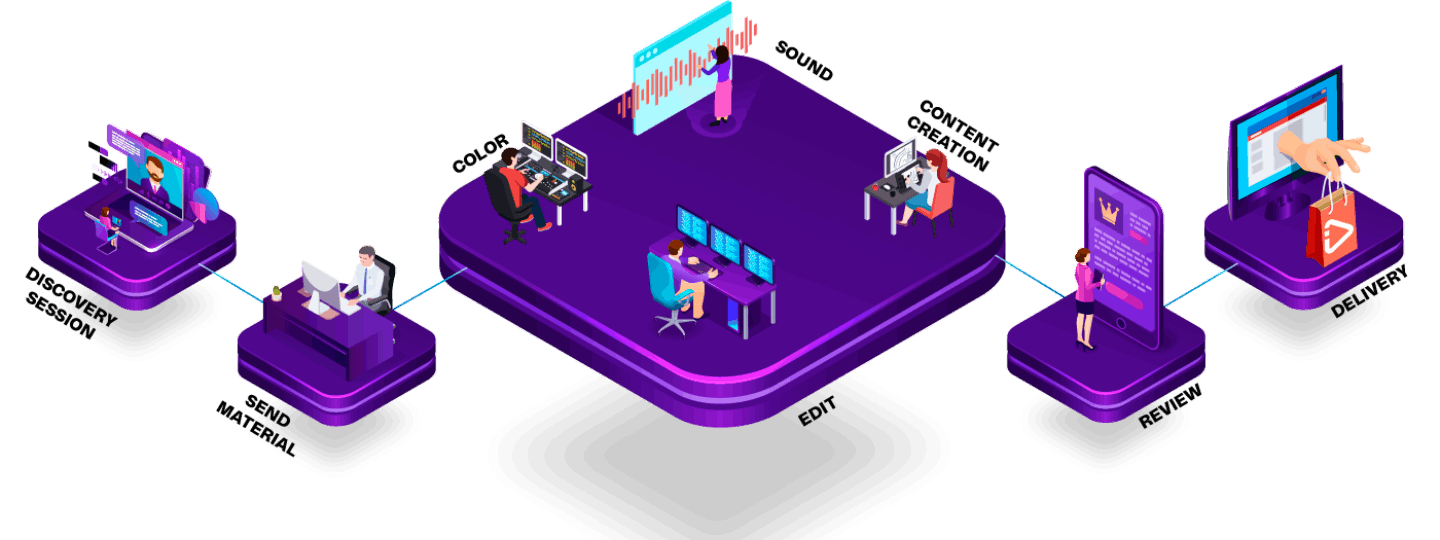
A dedicated post-production partner like Increditors brings a senior editing team, a strategic layer (brand standards management, content calendar planning, versioning infrastructure), and the volume capacity to handle multi-location campaigns without the overhead of managing individual freelancers or the limitations of project-based agency pricing. Plans from Increditors typically start around $12,000 per month, covering a defined volume of deliverables with consistent quality, structured revision rounds, and dedicated account management.
For franchise networks producing consistent monthly video volume across 30 or more locations, the math typically favors a dedicated partner over the combined cost of management overhead, freelancer coordination, and per-project agency rates. The break-even point varies by network size and volume, but franchise marketing directors with growing networks frequently find that the move to a dedicated partner reduces their effective per-video cost while significantly improving both quality consistency and production speed.
Full Franchise Video Production Comparison Table
Below is a detailed comparison of the four production options specifically evaluated through a franchise operator’s lens. Rankings reflect franchise-specific requirements — brand consistency, multi-location volume, versioning capability, and approval workflow support.
The honest case for ranking Increditors first in a franchise context is not that it is the cheapest option per deliverable in isolation — it is that it is the only option with franchise-specific infrastructure built in, which changes the effective cost per output dramatically at volume, while eliminating the management burden that erodes marketing team productivity in other models.
Video Volume Break-Even by Model
Frequently Asked Questions
How many videos should a franchise location produce per month?
This depends heavily on the category and market. Service-industry franchises competing actively in local paid social typically need four to eight individual video assets per month to maintain consistent campaign presence. Food and beverage franchises with strong seasonal and promotional calendars often produce 10 or more per location monthly when counting all format variants. The right number is the one that matches your campaign calendar and platform strategy — build the calendar first, then size the production capacity to meet it.
Should each location manage its own video production or should it be centralized at corporate?
Centralized production with localized variables is the model that delivers the best combination of brand consistency and operational efficiency. Fully decentralized production — each location handling its own video — produces brand drift and quality inconsistency at scale. Fully centralized production without local input produces content that feels generic and disconnected from the community context that makes local advertising effective. The templated creative system strikes the balance: corporate owns the brand architecture, operators provide local data and sometimes local footage, and a central post-production team produces all outputs.
How do you handle video for a franchise in a highly regulated advertising category?
Regulated categories — financial services, healthcare, legal, insurance-adjacent services — require that disclaimer language be built into every versioned output, not added manually post-production. The right approach is to include all required disclaimer variations in your template system as conditionally triggered elements: when an offer or regulated claim is present in the brief, the appropriate disclaimer layer renders automatically. Your production partner should have a documented QA step that verifies disclaimer presence before any final is released. This is exactly the kind of compliance infrastructure that a specialist franchise post-production team maintains and that ad-hoc freelancer models structurally cannot replicate.
What footage should franchise operators be expected to submit?
For most campaigns, operators can submit smartphone footage shot according to a simple brief — a shot list that specifies angles, lighting guidance, and content to capture. Modern smartphone cameras are capable of producing usable b-roll for most social video formats when the shooting brief is clear. For hero campaigns and premium assets like operator stories or grand opening packages, it is worth investing in a local videographer for at least the primary shoot day. The editing team handles color normalization and post-production — operators do not need to produce broadcast-quality raw footage for the majority of campaign work.
How long does it take to build a franchise video template system from scratch?
Building a comprehensive franchise template system — covering your core ad formats, operator story structure, hiring video format, and seasonal campaign templates — typically takes four to eight weeks in partnership with a dedicated post-production team. This includes brand standards documentation, initial template construction, a round of internal review and revision, and testing across location data variants. The upfront investment in this build phase is what enables the volume efficiency and consistency that makes the ongoing program economically compelling. Cutting this phase short to ship faster consistently produces template systems that require expensive rework at exactly the wrong time.
Verdict: The Franchise Brands Winning on Video Have a System, Not a Vendor List
The franchise brands producing the most effective local video content are not necessarily the ones with the biggest production budgets. They are the ones that have invested in a production system — templated creative infrastructure, centralized intake, structured approval workflows, and a dedicated post-production partner with the capacity and expertise to run at volume.
The choice of production partner is the single most consequential decision in that system. Freelancers cannot provide the consistency. Generic agencies cannot provide the volume economics. In-house teams cannot provide the capacity or the specialist expertise in franchise-specific production workflows. A dedicated franchise-ready post-production team — with template infrastructure, versioning capability, and a strategic layer — is what makes local video at franchise scale actually work.
For franchise marketing directors ready to move from ad-hoc production to a scalable video engine, the next step is a structured conversation with a post-production partner who understands franchise operations and can design a system around your network’s specific scale, compliance requirements, and campaign calendar. Increditors works with franchise brands to build exactly this kind of program — from template infrastructure to ongoing monthly production at volume.
Ready for Video That Actually Converts?
Tell us about your project and we will put together a custom plan.