









![3D Explainer Video - ScribbleLive.mp4_snapshot_00.12_[2022.03.09_03.14.16]](https://increditors.com/wp-content/uploads/elementor/thumbs/3D-Explainer-Video-ScribbleLive.mp4_snapshot_00.12_2022.03.09_03.14.16-r7wb53mx72rxst3qcqyrfxdmeyzb5r9jbl0wbjujh4.png "3D Explainer Video – ScribbleLive.mp4_snapshot_00.12_[2022.03.09_03.14.16]")




























Your app is brilliant. Your demo video looks like it was recorded on a Tuesday afternoon with zero post-production — because it was.
This is the paradox of tech companies and video: you build world-class products, then present them with screen recordings that have mouse cursor lag, dead air, and zero visual hierarchy. Your competitors ship polished product videos with smooth animations, clear UI highlights, and cinematic pacing. Prospects watch both. Guess who wins the deal.
Video editing for tech companies isn’t the same as editing a vlog or a wedding film. It requires editors who understand SaaS workflows, can make software interfaces look exciting on camera, and know how to structure a demo that drives action — not just explains features.
This guide covers everything: what types of videos tech companies need, what professional editing actually involves, real pricing, and how to build a video production workflow that scales with your product roadmap.
What’s in This Guide
- Why Tech Companies Can’t Ignore Video Anymore
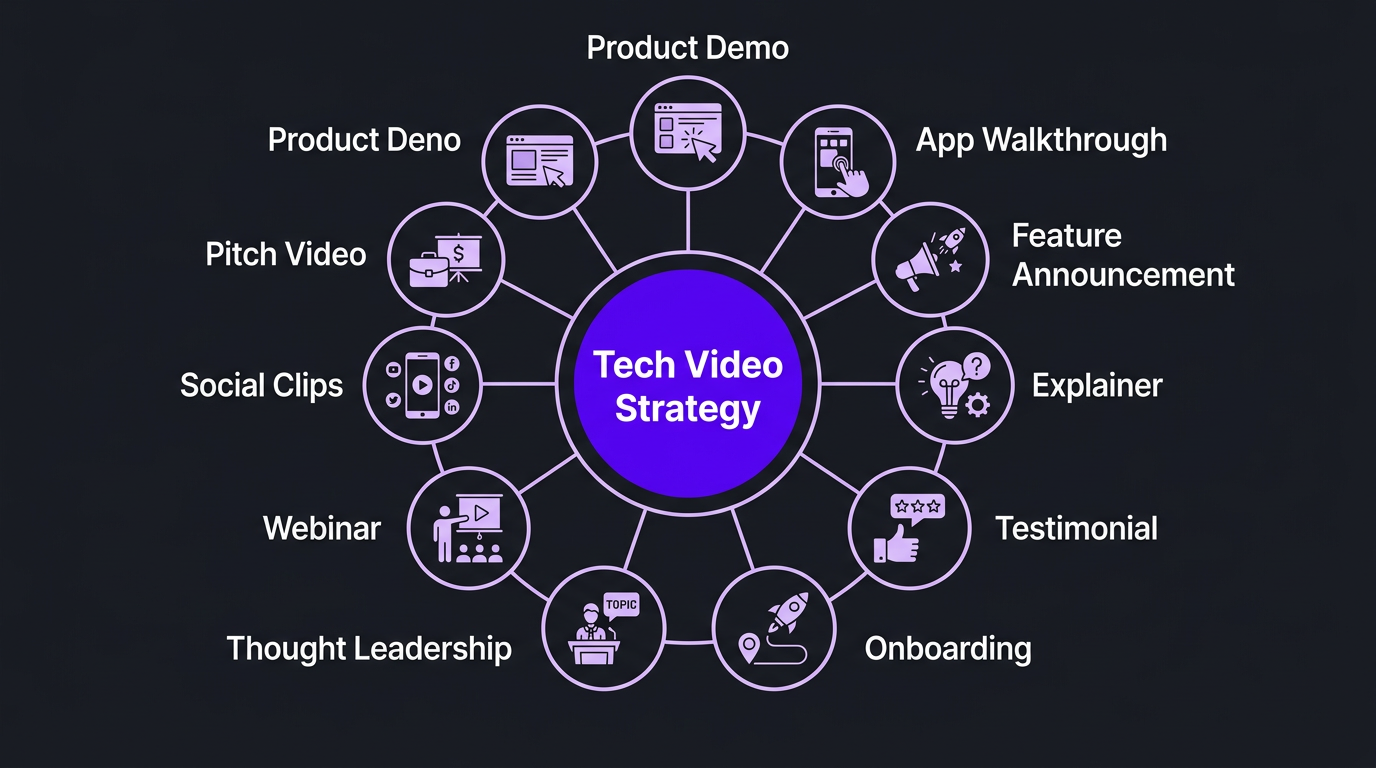
- 10 Types of Videos Every Tech Company Needs
- The Anatomy of a High-Converting App Demo Video
- What Professional Tech Video Editing Actually Involves
- Tech Video Editing Pricing Breakdown
- DIY vs Professional: When to Outsource
- Case Studies: Tech Companies That Got It Right
- Building a Scalable Video Production Workflow
- How to Choose the Right Video Editing Partner
- FAQ
Why Tech Companies Can’t Ignore Video Anymore
Here’s the reality: 96% of people have watched an explainer video to learn about a product or service. For B2B tech buyers, that number is even higher — Gartner reports that 70% of B2B buyers watch video content throughout their purchase journey.
But it goes beyond marketing stats. Video has become essential infrastructure for tech companies at every stage:
Pre-Sale: Video Closes Deals Faster
A prospect evaluating your SaaS platform against three competitors will spend an average of 17 minutes watching product videos before requesting a demo. If your videos are unedited screen recordings with no pacing, no highlights, and no visual storytelling, you’ve already lost ground before the sales call starts.
Companies with professional product videos report 40-60% shorter sales cycles. When a prospect can see how your product solves their problem — with smooth zooms into key features, annotated UI walkthroughs, and clear before/after comparisons — they arrive at the sales call pre-sold.
Onboarding: Video Reduces Churn
The #1 reason SaaS customers churn in the first 90 days isn’t product quality — it’s poor onboarding. Video tutorials that show users exactly how to get value from your product reduce support tickets by 30-50% and improve time-to-first-value metrics dramatically.
But only if those videos are actually watchable. A 12-minute unedited screen recording where the presenter says “um” 47 times and accidentally shows their email inbox doesn’t count as onboarding content.
Growth: Video Fuels Every Channel
LinkedIn organic reach for video posts is 3x higher than text. YouTube is the second-largest search engine. Product Hunt launches with video get 2x more upvotes. Twitter/X product demos go viral in ways that screenshots never do.
Every channel your tech company markets on performs better with video. But each channel needs different formats, different lengths, different aspect ratios, and different hooks. That’s where a dedicated video editing team becomes a force multiplier.
10 Types of Videos Every Tech Company Needs
Not all tech videos are created equal. Here’s the complete taxonomy, ordered by impact on revenue:
| Video Type | Purpose | Typical Length | Editing Complexity |
|---|---|---|---|
| Product demo | Show the product in action for prospects | 2–5 min | High |
| App walkthrough | Step-by-step feature tutorial | 3–10 min | Medium-High |
| Feature announcement | Launch new features with excitement | 30–90 sec | High |
| Explainer video | Explain what the product does and why it matters | 60–120 sec | Very High |
| Customer testimonial | Social proof from real users | 1–3 min | Medium |
| Onboarding tutorial | Help new users get started | 3–8 min | Medium |
| Thought leadership | CEO/founder insights, industry commentary | 5–15 min | Medium |
| Webinar recording | Repurpose live events into evergreen content | 30–60 min | Medium |
| Social media clips | LinkedIn, Twitter/X, Instagram distribution | 15–60 sec | Medium |
| Investor/pitch video | Fundraising, board presentations | 3–10 min | High |
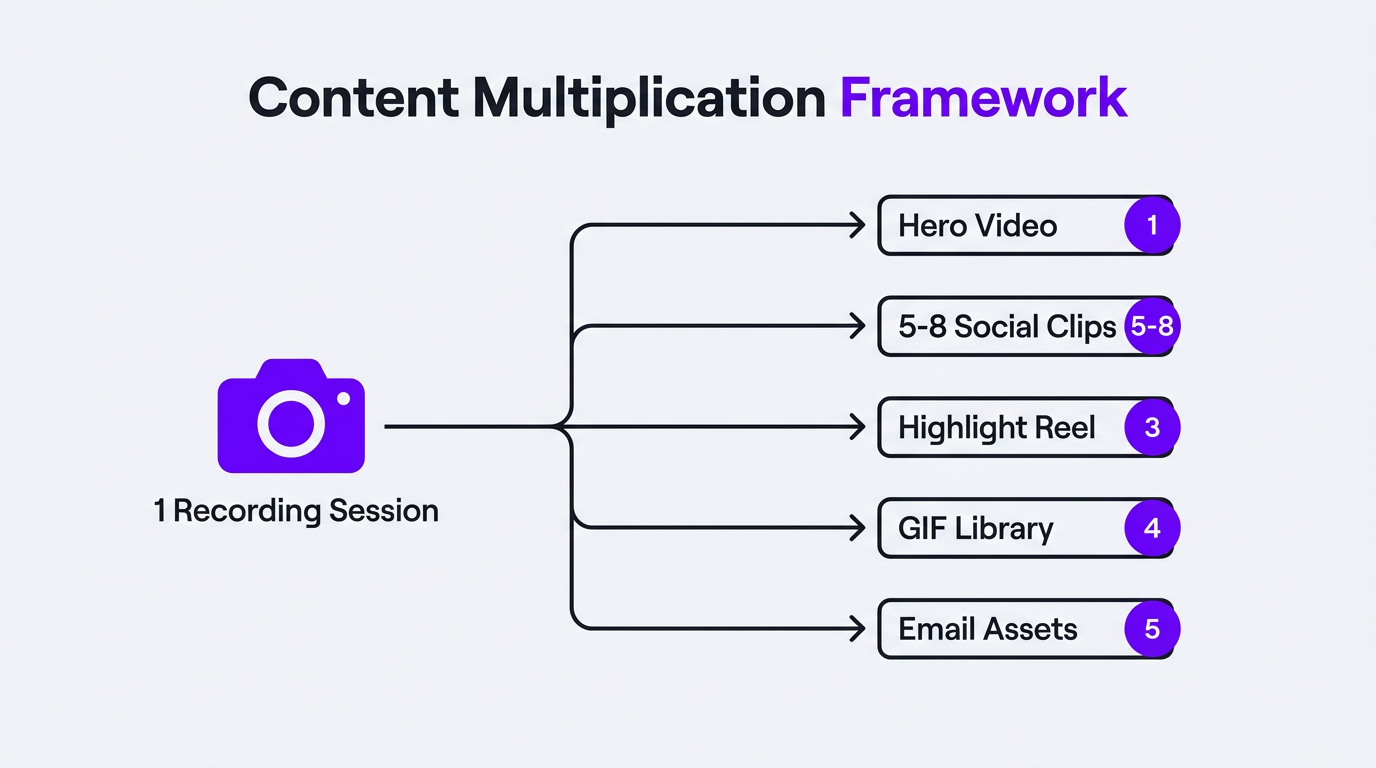
Most tech companies start with product demos and explainers, then expand into the full stack as they grow. The smart move is to build your content so that one recording session produces multiple video types — a 30-minute webinar becomes a polished recording, 5 social clips, and a highlight reel. That’s the kind of content multiplication that a skilled video editing team makes possible.
The Content Multiplication Framework
Here’s how high-growth tech companies maximize their video ROI:
- Record once: Film a 20-minute product walkthrough or thought leadership piece
- Edit the hero video: Polished long-form version for YouTube/website
- Extract 5-8 clips: Short-form cuts for LinkedIn, Twitter, Instagram
- Create a highlight reel: 60-second version for landing pages
- Build a GIF library: Quick product animations for email and docs
One recording session. 10+ content pieces. That’s efficient video production — and it requires an editing team that can think in formats, not just timelines.
The Anatomy of a High-Converting App Demo Video
App demos are the most important video type for tech companies — and the most commonly botched. Here’s what separates a demo that converts from one that gets skipped.
The First 10 Seconds: Hook With the Outcome
Don’t start with your logo animation. Don’t start with “Hi, I’m John and today I’m going to show you…” Start with the result. Show the end state — the dashboard with beautiful data, the report that took 2 clicks instead of 2 hours, the workflow that runs automatically.
Professional editing makes this possible by restructuring your raw recording. You filmed the walkthrough sequentially — but the edit should lead with the payoff and then show how you got there.
Screen Recording That Doesn’t Feel Like a Screen Recording
Raw screen recordings are boring. Professional tech video editing transforms them with:
- Cursor smoothing and animation: No jittery mouse movements. Smooth, deliberate cursor paths that guide the viewer’s eye
- Strategic zoom-ins: When showing a specific feature, zoom to fill the screen. Don’t make viewers squint at a full desktop screenshot
- UI highlighting: Subtle glows, outlines, or spotlight effects that draw attention to the element being discussed
- Transition animations: Smooth morphs between screens instead of jarring cuts
- Progress indicators: Visual cues showing where you are in the workflow
- Clean framing: Remove browser chrome, bookmark bars, and notification badges before recording — or edit them out in post
Pacing That Respects Viewer Time
The average viewer decides within 8 seconds whether to keep watching. For a tech demo, that means:
- Cut all navigation and loading time
- Speed up repetitive actions (2x or 4x with smooth motion)
- Use jump cuts between steps — nobody needs to watch you click through 3 menus
- Add chapter markers for longer tutorials so viewers can skip to what matters
A 20-minute raw recording should become a 4-minute polished demo. If your editor is delivering something close to the original length, they’re not editing — they’re exporting.
Audio That Builds Trust
Tech demos live or die on audio quality. Professional editing includes:
- Noise reduction and room echo removal
- Consistent audio levels throughout
- Background music that adds energy without competing with narration
- Sound effects for UI interactions (subtle click sounds, transition whooshes)
- Silence removal — cutting pauses and filler words
What Professional Tech Video Editing Actually Involves
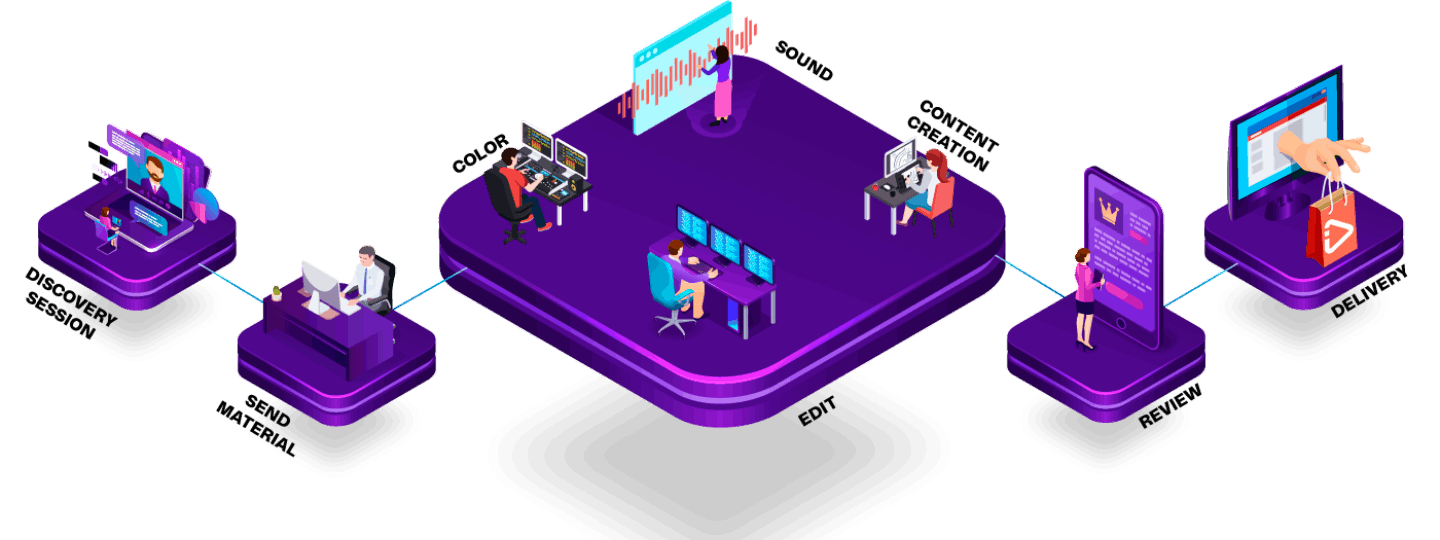
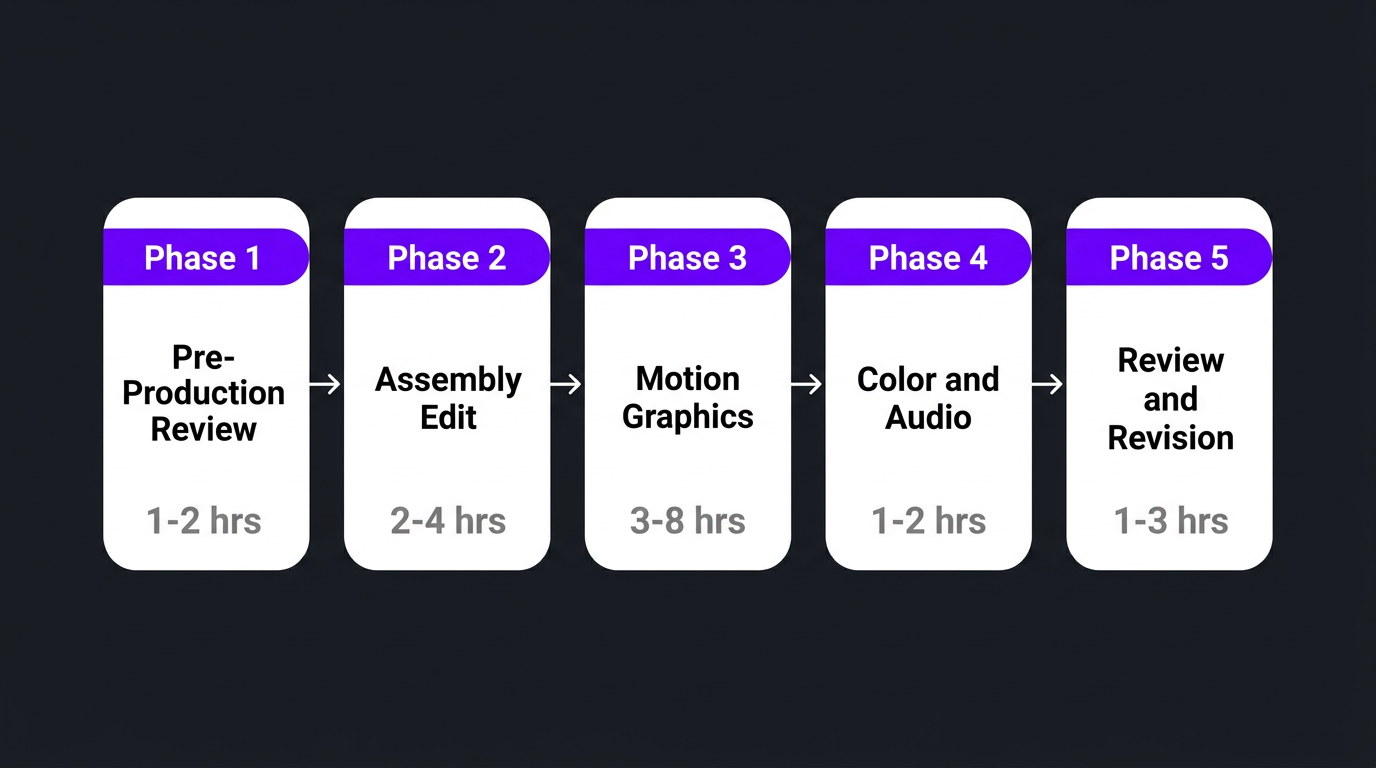
When tech companies hire video editors, they often underestimate what “editing” means in a technical context. Here’s the full production pipeline:
Phase 1: Pre-Production Review (1-2 hours)
Before touching the timeline, professional editors review your raw footage, understand the product context, identify the narrative arc, and flag any issues (bad audio, missing footage, unclear UX flows). For ongoing retainers, this phase gets shorter as the editor learns your product deeply.
Phase 2: Assembly Edit (2-4 hours)
The rough structure: selecting the best takes, arranging clips in narrative order, trimming dead space, and building the skeleton of the video. For screen recordings, this includes syncing voiceover with product footage and cutting navigation time.
Phase 3: Motion Graphics & Visual Polish (3-8 hours)
This is where tech videos diverge from other content types. Motion graphics for tech videos include:
- Custom lower thirds with brand-consistent typography
- Animated callouts highlighting features (“New!” badges, arrow pointers)
- Data visualizations — turning metrics into animated charts
- Transition effects between product views (device mockup transitions, screen morphs)
- Device mockups — placing your app inside a phone/laptop frame
- Logo animations for intro and outro
A simple product demo might need 2-3 hours of motion graphics work. A product launch video with full animation could require 8-15 hours.
Phase 4: Color Grading & Audio (1-2 hours)
Screen recordings need color consistency across different capture environments. Camera footage (founder interviews, office B-roll) needs professional color grading to match your brand aesthetic. Audio gets leveled, cleaned, and mixed with music and effects.
Phase 5: Review & Revision (1-3 hours)
Professional agencies provide structured review workflows — timestamped comments, frame-specific notes, and organized revision rounds. At Increditors, we use collaborative review tools so your team can leave feedback directly on the video timeline instead of writing paragraph-long emails describing “that part around 2 minutes where the thing happens.”
Tech Video Editing Pricing: What to Expect in 2026
Tech video editing costs more than standard content editing because of the motion graphics, screen recording polish, and product knowledge required. Here’s the honest breakdown:
| Video Type | Per-Video Cost | Editing Hours | Includes |
|---|---|---|---|
| App demo (basic) | $400–$700 | 4–8 hrs | Screen polish, zoom-ins, basic graphics, audio cleanup |
| App demo (premium) | $800–$1,500 | 8–15 hrs | Custom animation, device mockups, sound design, multi-format |
| Product explainer | $1,000–$3,000 | 10–25 hrs | Full animation, voiceover sync, cinematic quality |
| Feature announcement | $300–$600 | 3–6 hrs | Short-form, motion graphics, platform-optimized |
| Onboarding tutorial | $300–$600 | 3–6 hrs | Screen recording, chapter markers, clear callouts |
| Webinar repurpose | $400–$800 | 4–8 hrs | Polish recording, add graphics, extract clips |
| Social media cuts (batch of 5) | $250–$500 | 3–5 hrs | Platform-specific formats, captions, hooks |
Monthly Retainer Pricing for Tech Companies
| Package | Monthly Cost | Deliverables | Best For |
|---|---|---|---|
| Startup | $2,500–$4,000/mo | 4-6 videos + 10 social clips | Early-stage SaaS, product-led growth |
| Growth | $4,000–$6,000/mo | 8-12 videos + 20 social clips | Series A-B companies scaling content |
| Enterprise | $6,000–$10,000/mo | 15-30+ videos + unlimited social cuts | Large tech companies, multi-product |
Our pricing page has more detail on specific packages, but the key insight is this: tech video editing isn’t a commodity service. The difference between a $300 demo and a $1,000 demo isn’t just “better graphics” — it’s the difference between a video that sits on your website and one that actively drives pipeline.
Need a Video Editing Team That Understands Techa
We’ve edited for SaaS companies, AI startups, and enterprise platforms. We speak product — not just video.
DIY vs Professional Tech Video Editing: When to Outsource
Not every tech company needs a professional editing team from day one. Here’s the honest decision framework:
Keep It In-House When:
- You’re pre-revenue and producing fewer than 2 videos per month
- Your audience values authenticity over polish (some developer communities prefer raw, honest content)
- You have a team member who genuinely enjoys editing and has the skills
- Your videos are primarily internal (team training, internal demos)
Outsource When:
- Video is a customer acquisition or retention channel
- You’re producing 4+ videos per month
- Your founder/product team is spending 10+ hours per month on editing
- Competitors have noticeably better video quality
- You need multi-format output (long-form + social clips + ads)
- Product launches require polished announcement videos on tight timelines
| Factor | DIY / In-House | Professional Agency |
|---|---|---|
| Cost (8 videos/month) | $0 cash + 40-60 hrs labor | $3,000–$6,000/mo |
| Quality ceiling | Limited by internal skills | Professional-grade |
| Turnaround | Depends on availability | 24–72 hours |
| Motion graphics | Basic templates | Custom animation |
| Scalability | Hire more people | Upgrade package |
| Product knowledge | ✅ Deep (built it) | ⚠️ Ramp-up needed |
| Consistency | ⚠️ Varies by person/day | ✅ Style guides + QC |
The hybrid model works well for many tech companies: keep product knowledge and creative direction in-house, outsource the actual editing and post-production. Your product manager records the demo with clear narration. Your editing partner transforms it into a polished asset. Best of both worlds.
Case Studies: Tech Companies That Got Video Right
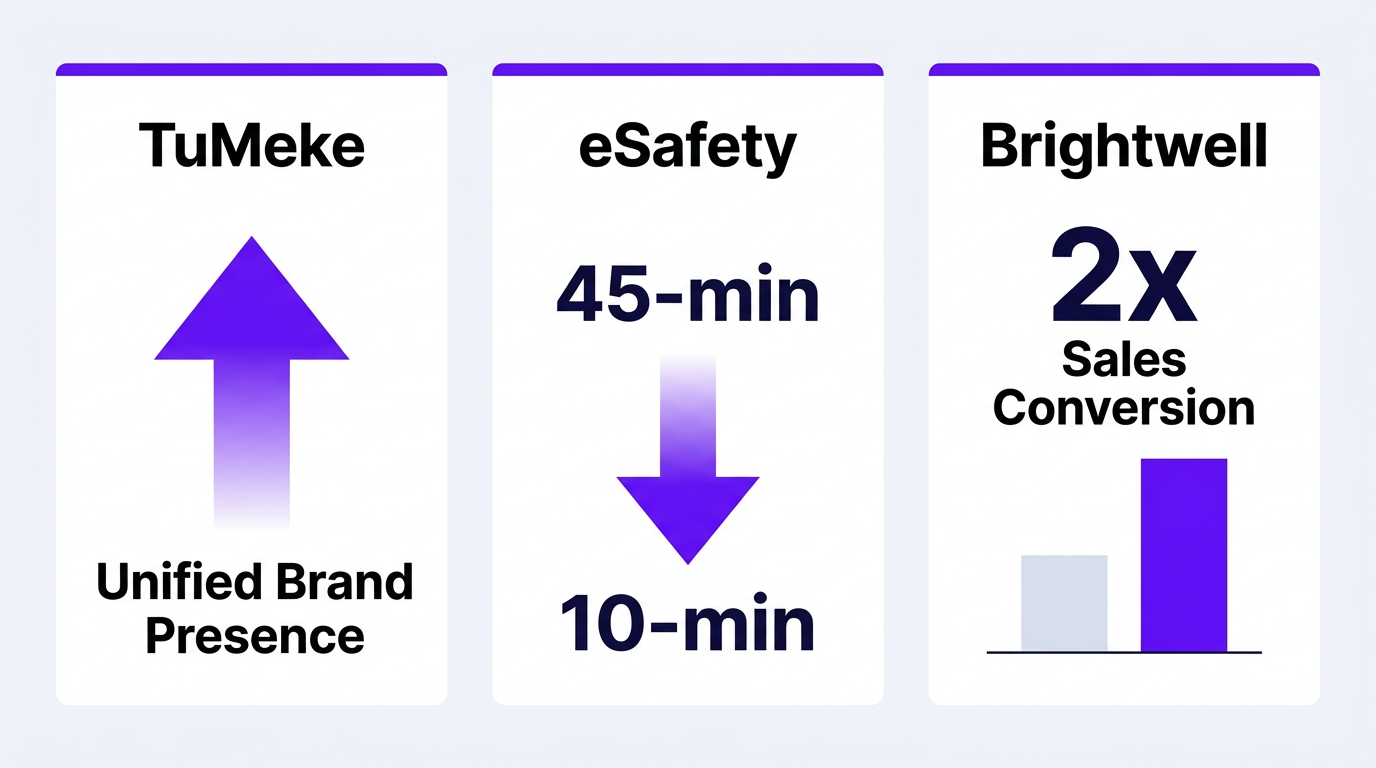
TuMeke: AI Safety Platform Goes From Inconsistent to Institutional-Quality
TuMeke, an AI-powered workplace safety platform, was struggling with video consistency. As a deep tech company, their product required careful visual explanation — you can’t just show a dashboard and expect viewers to understand AI-powered ergonomic assessment.
Their challenge: multiple stakeholders creating content (CEO, product team, marketing) with zero consistency in editing quality. Some videos had polished graphics. Others were raw Loom recordings posted directly to LinkedIn.
After partnering with Increditors, TuMeke got a dedicated editing team that learned their product deeply. Every video — whether it was a CEO thought leadership piece, a product update, or a customer case study — went through the same editing pipeline with consistent branding, motion graphics, and quality standards.
The result: a unified video library that made TuMeke look like a much larger company. When pitching to enterprise safety directors, having a professional video presence built instant credibility.
eSafety: Government Tech Meets Engaging Content
eSafety, focused on online safety regulation and technology, needed to make complex regulatory and technical content accessible to broad audiences. The editing challenge: take dense, policy-heavy presentations and transform them into videos that non-technical stakeholders would actually watch.
The editing approach: strategic use of motion graphics to visualize data, clear chapter markers for long-form content, and pacing that respected viewer attention spans. Instead of 45-minute unedited presentations, the team delivered 8-12 minute polished summaries with key data visualized and clear calls to action.
Brightwell: FinTech Product Demos That Close Deals
Brightwell, a payments technology platform, leveraged professionally edited product demos as a core part of their sales process. In FinTech, trust is everything — and unpolished video signals “startup that might not be around next year” to enterprise buyers.
Their edited demo library became their highest-performing sales asset. Prospects who watched the demo videos before sales calls converted at nearly double the rate of those who didn’t. The professional editing — device mockups, smooth transitions, branded consistency — built credibility before the first handshake.
Building a Scalable Video Production Workflow
The best tech companies don’t treat video as one-off projects. They build repeatable workflows that make video production as predictable as shipping code. Here’s the framework:
Step 1: Create Recording Templates
Standardize your recording setup for each video type. Product demos should always use the same screen resolution, same browser profile (clean, no personal bookmarks), same microphone settings. Create a checklist your team follows before hitting record.
Step 2: Build a Content Calendar Aligned to Product Releases
Map your video production to your product roadmap. Every feature release should have a video plan: announcement clip, full demo, onboarding tutorial, and social cuts. Plan this 2-4 weeks ahead so your editing team has lead time.
Step 3: Establish a Brand Style Guide for Video
Document everything: intro/outro templates, lower third styles, color palette, font choices, music library, transition types, caption styles. Your editing team should be able to produce brand-consistent content without asking questions about every decision.
Step 4: Set Up Efficient File Transfer
Don’t email WeTransfer links back and forth. Use a proper system: Frame.io, Dropbox Business, or Google Drive with clear folder structures. At Increditors, we set up custom intake workflows for each client — drop raw footage in one folder, drafts appear in another, feedback happens in a review tool.
Step 5: Batch Production
Record multiple videos in a single session. Film the CEO’s thought leadership content for the entire month in one 2-hour block. Record all product demos back-to-back. Your editing team processes the batch in parallel, and you get consistent output without constant context-switching.
How to Choose the Right Video Editing Partner for Your Tech Company
Not every video editing agency understands tech. Here’s what to look for and what to avoid:
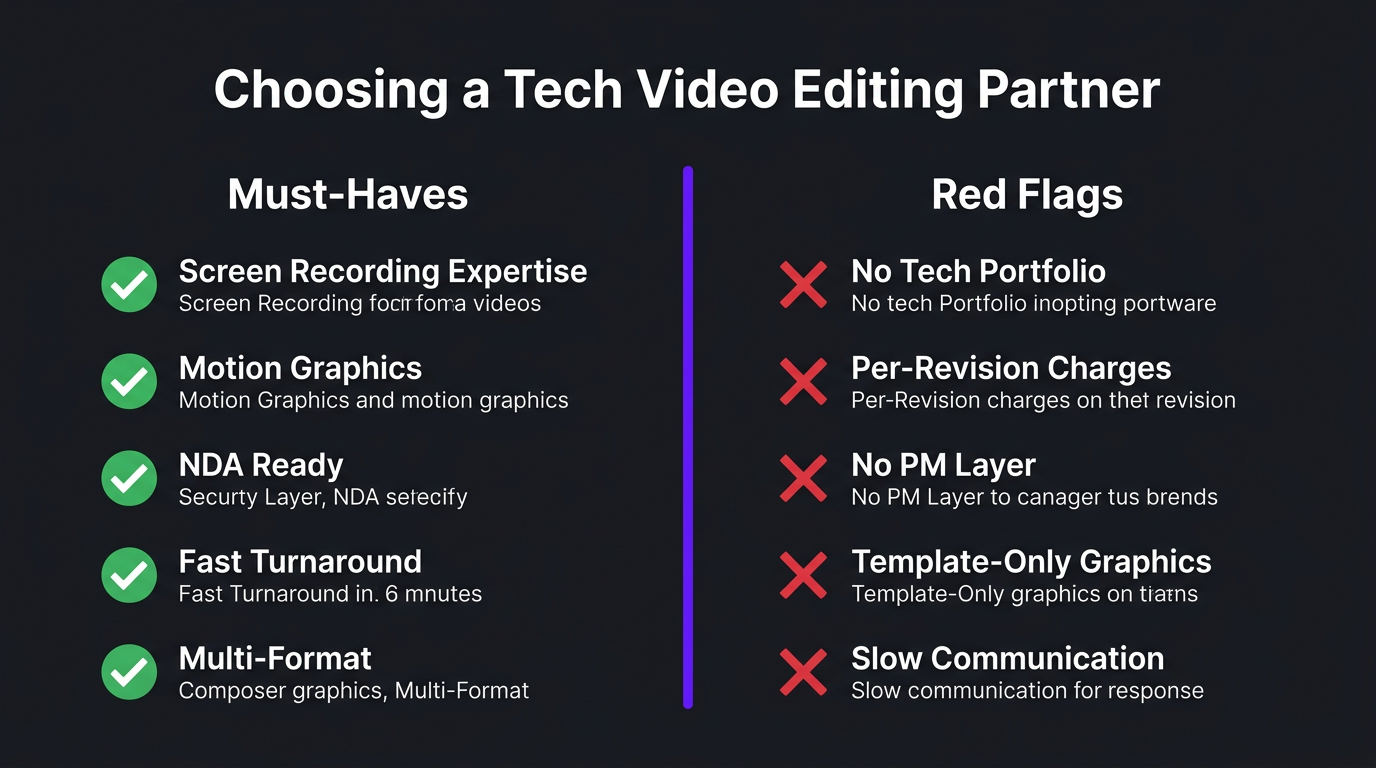
Must-Haves
- Screen recording expertise: Ask to see examples of polished app demos. If their portfolio is only vlogs and weddings, they’re not the right fit.
- Motion graphics capability: Tech videos need custom graphics, not just templates. Ask about After Effects/Cinema 4D capabilities.
- NDA willingness: If they hesitate to sign an NDA for pre-release product footage, walk away.
- Fast turnaround: Tech moves fast. Your editing partner should deliver drafts in 24-48 hours for standard content.
- Multi-format delivery: One recording should produce multiple formats. Ask about their repurposing workflow.
Red Flags
- No tech companies in their portfolio
- Can’t explain the difference between a product demo and an explainer video
- Charges per-revision instead of including reasonable rounds
- No project management layer (you communicate directly with the editor for everything)
- Can’t handle multiple aspect ratios and platform requirements
Questions to Ask Before Signing
- “Can you show me 3 examples of app demo or SaaS product videos you’ve editeda”
- “What’s your process for learning a new client’s producta”
- “How do you handle product launches that require fast turnarounda”
- “What’s included in your motion graphics — templates or custom worka”
- “How do you manage revisions and feedbacka”
At Increditors, we’ve built our enterprise workflows specifically for tech companies that need reliability, speed, and product-aware editing. Our editors don’t just make things look good — they understand what they’re editing, which means fewer revision rounds and better creative decisions.
Looking for a Video Team That Gets Techa
We edit for SaaS companies, AI startups, and FinTech platforms. Check our portfolio — then let’s talk about your product video strategy.
Frequently Asked Questions
Tech video editing typically costs $400–$1,500 per video depending on complexity. App demo videos with screen recordings and motion graphics run $500–$800, while full product launch videos with animation and VFX can reach $1,500–$3,000. Monthly retainers for ongoing SaaS video content range from $3,000–$8,000. See our pricing page for detailed packages.
The core video types are: product demos, app walkthrough tutorials, feature announcement clips, onboarding videos, customer testimonials, thought leadership content, webinar recordings, social media cuts for LinkedIn and Twitter, investor pitch videos, and product launch trailers. Most tech companies start with demos and expand from there.
For most SaaS companies producing 4–20 videos per month, an agency is more cost-effective. A full-time in-house editor costs $60,000–$90,000/year plus benefits and software. An agency retainer at $4,000–$6,000/month gives you a full team with backup coverage. The hybrid model — in-house recording with outsourced editing — often works best.
Effective app demo editing uses cursor animations, strategic zoom-ins, smooth transitions between screens, motion graphics highlighting UI elements, background music for energy, and aggressive cuts that skip boring navigation. The goal is to show value fast — a 20-minute recording should become a 3-5 minute polished demo.
Standard turnaround is 2–4 business days. Product launch videos or complex animations may take 5–7 days. With a dedicated team on retainer, most agencies deliver first drafts within 24–48 hours. Rush delivery is available at most agencies for a 25–50% premium.
Yes. Professional agencies sign NDAs and use secure file transfer protocols. At Increditors, all client footage is handled through encrypted channels with strict confidentiality agreements. We’ve worked with companies on unreleased features and pre-launch products without incident.
Well-edited product videos increase landing page conversion rates by 20–80%. Professionally edited demo videos reduce time-to-understanding, build trust through polished presentation, and address objections visually. Companies using video on landing pages see 86% higher conversion rates than those without, according to multiple industry studies.
Get a Custom Video Strategy for Your Tech Company
Whether you’re a seed-stage startup or a scaling enterprise, we’ll build a video editing plan that fits your product roadmap and budget.
This guide reflects 2026 market rates and best practices for tech video production. Pricing varies by project complexity and volume. For current Increditors pricing, visit our pricing page or schedule a consultation.