










![3D Explainer Video - ScribbleLive.mp4_snapshot_00.12_[2022.03.09_03.14.16]](https://increditors.com/wp-content/uploads/elementor/thumbs/3D-Explainer-Video-ScribbleLive.mp4_snapshot_00.12_2022.03.09_03.14.16-r7wb53mx72rxst3qcqyrfxdmeyzb5r9jbl0wbjujh4.png "3D Explainer Video – ScribbleLive.mp4_snapshot_00.12_[2022.03.09_03.14.16]")































You’ve decided to work with a video editing agency. Great choice. But now you’re staring at three fundamentally different ways to pay for the same service — and the wrong choice could cost you thousands per year in unnecessary spend.
Agency pricing isn’t just about the total cost. The structure of how you pay shapes the relationship, incentives, and ultimately the quality of what you receive. A per-video model incentivizes speed. An hourly model incentivizes thoroughness (sometimes too much). A retainer incentivizes consistency and partnership. None is universally “best” — each fits different situations.
We’ve operated under all three video editing agency pricing models over the years, and we’ve settled on the structures that work best for both sides. We’ve also helped dozens of clients switch between models as their needs evolved. This guide shares everything we’ve learned about which pricing model works when — with real numbers, not vague ranges.
What’s in This Guide
The Three Core Video Editing Agency Pricing Models
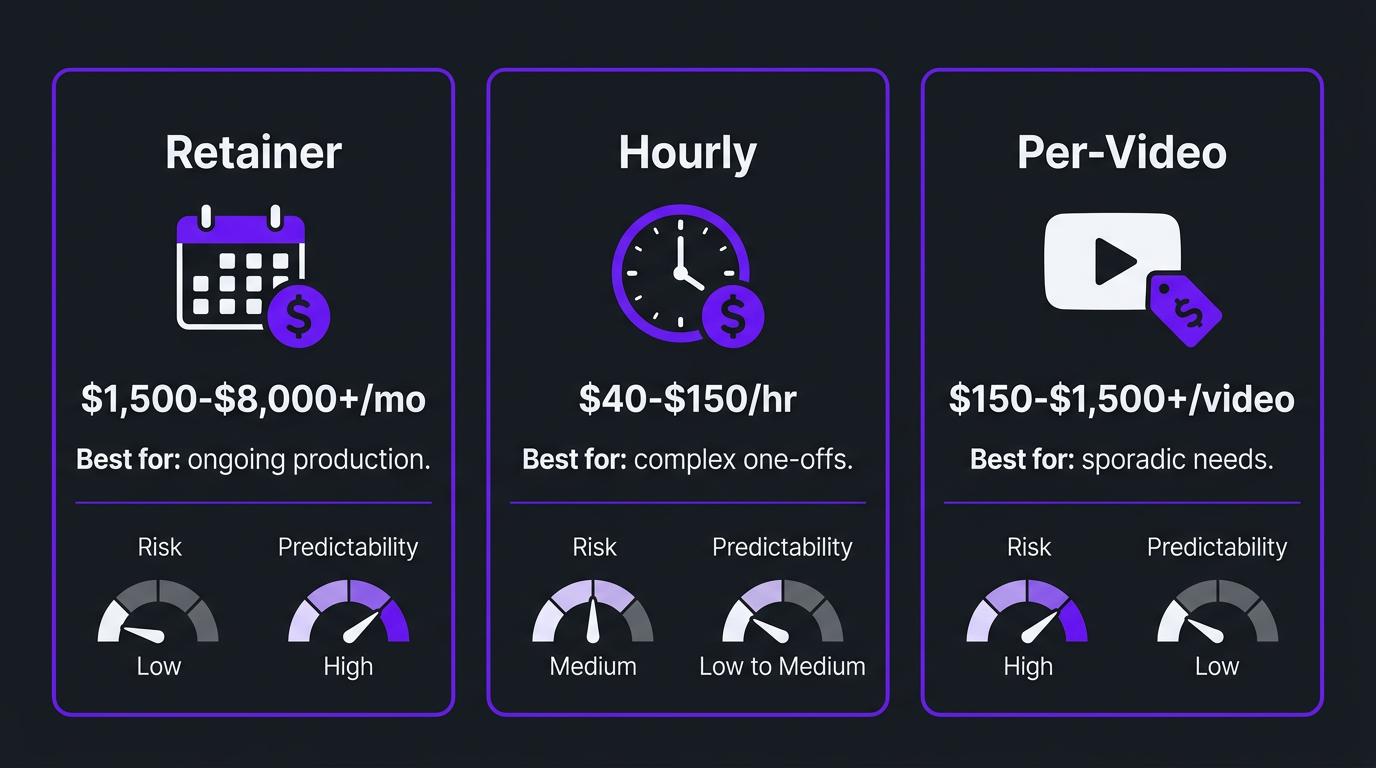
Before we deep-dive into each, here’s the landscape at a glance:
| Pricing Model | How It Works | Typical Range | Best For |
|---|---|---|---|
| Retainer | Flat monthly fee for agreed-upon deliverables/capacity | $1,500–$8,000+/month | Consistent, ongoing content production |
| Hourly | Pay per hour of editor time | $40–$150/hour | Variable-scope or one-off projects |
| Per-Video | Fixed price per deliverable | $150–$1,500+ per video | Sporadic production, testing new agencies |
Each model creates different incentive structures — and understanding those incentives is the key to choosing the right one. An agency billing hourly has no incentive to work faster. An agency billing per-video has no incentive to spend extra time on polish. A retainer creates the healthiest incentive alignment: the agency is motivated to produce great work efficiently, because both quality and efficiency determine whether you renew next month.
Retainer Pricing: The Partnership Model
How Retainer Pricing Works
You agree to a flat monthly fee in exchange for a defined set of deliverables, capacity, or both. For example:
- $3,000/month for 8 YouTube videos with 2 revision rounds each
- $5,000/month for a dedicated editor working 40 hours/week on your content
- $4,500/month for 6 long-form videos + 15 short-form clips + motion graphics
The deliverables are negotiated upfront, and the retainer renews monthly (or quarterly for discounted rates). Some retainers are deliverable-based (X videos per month), while others are capacity-based (X hours of editor time per month). The distinction matters:
Deliverable-Based Retainers
You pay for a specific number of finished videos. The agency manages how many hours it takes to produce them. This is the most common model and the easiest to budget for.
Advantages:
- Completely predictable costs — you know exactly what you’re paying
- Incentivizes agency efficiency (they keep margin by working smarter)
- Easy to evaluate ROI (cost per video is straightforward math)
Risks:
- If your videos are more complex than estimated, the agency may rush to maintain margin
- Scope changes require renegotiation
- Unused video slots don’t typically roll over
Capacity-Based Retainers
You pay for a block of editor hours per month. How those hours are used is flexible — some months you might produce 12 simple videos, other months 6 complex ones.
Advantages:
- Maximum flexibility in how capacity is allocated
- Adapts to variable content needs without renegotiation
- Agency doesn’t feel rushed on complex projects
Risks:
- Harder to predict exact output month-to-month
- Unused hours may or may not roll over (negotiate this upfront)
- Requires more trust — you’re paying for time, not deliverables
What Retainer Pricing Looks Like in 2026
| Retainer Level | Monthly Cost | Typical Deliverables | Team |
|---|---|---|---|
| Starter | $1,500–$2,500 | 4–6 videos/month, basic editing + color correction | Shared editor |
| Growth | $2,500–$5,000 | 8–15 videos/month, motion graphics, shorts + long-form | Dedicated editor + PM |
| Scale | $5,000–$8,000 | 15–30+ videos/month, full post-production pipeline | Dedicated team (editor, colorist, motion designer, PM) |
| Enterprise | $8,000–$15,000+ | 30–60+ videos/month, multi-format, multi-platform | Multiple dedicated editors + full specialist team |
At Increditors, our retainer model sits in the Growth and Scale tiers. Most of our YouTube creator clients start at the Growth level ($2,500–$5,000/month) and scale up as their content volume increases. Our enterprise clients typically operate at the Scale or Enterprise level with dedicated multi-person teams.
Hourly Pricing: Maximum Flexibility, Minimum Predictability
How Hourly Pricing Works
You’re billed for each hour an editor (or team) spends on your project. Rates vary by the seniority of who’s working on your content:
| Role | Agency Hourly Rate | Freelancer Rate (for comparison) |
|---|---|---|
| Junior Editor | $40–$60/hr | $15–$30/hr |
| Mid-Level Editor | $60–$90/hr | $35–$65/hr |
| Senior Editor | $90–$130/hr | $65–$100/hr |
| Motion Designer | $80–$120/hr | $50–$90/hr |
| Colorist | $70–$110/hr | $50–$85/hr |
| Sound Designer | $60–$100/hr | $40–$75/hr |
Agency rates are 30–50% higher than freelancer rates because you’re paying for the agency’s infrastructure: project management, QC processes, backup capacity, and operational reliability. Whether that premium is worth it depends on how much you value those overhead elements.
When Hourly Pricing Makes Sense
- Undefined scope: You’re working on a brand campaign where the deliverables and complexity aren’t clear upfront. Hourly billing ensures the agency doesn’t cut corners to stay within a flat fee.
- Experimental content: Testing new formats, styles, or concepts where you want the editor to explore and iterate without worrying about project scope limits.
- One-off projects: A single brand video, a conference recap, or a product launch piece that doesn’t justify setting up a retainer.
- Complex VFX or animation: Projects where the hours required are genuinely hard to estimate — hourly billing removes the risk of under-scoping for both parties.
The Hourly Pricing Trap
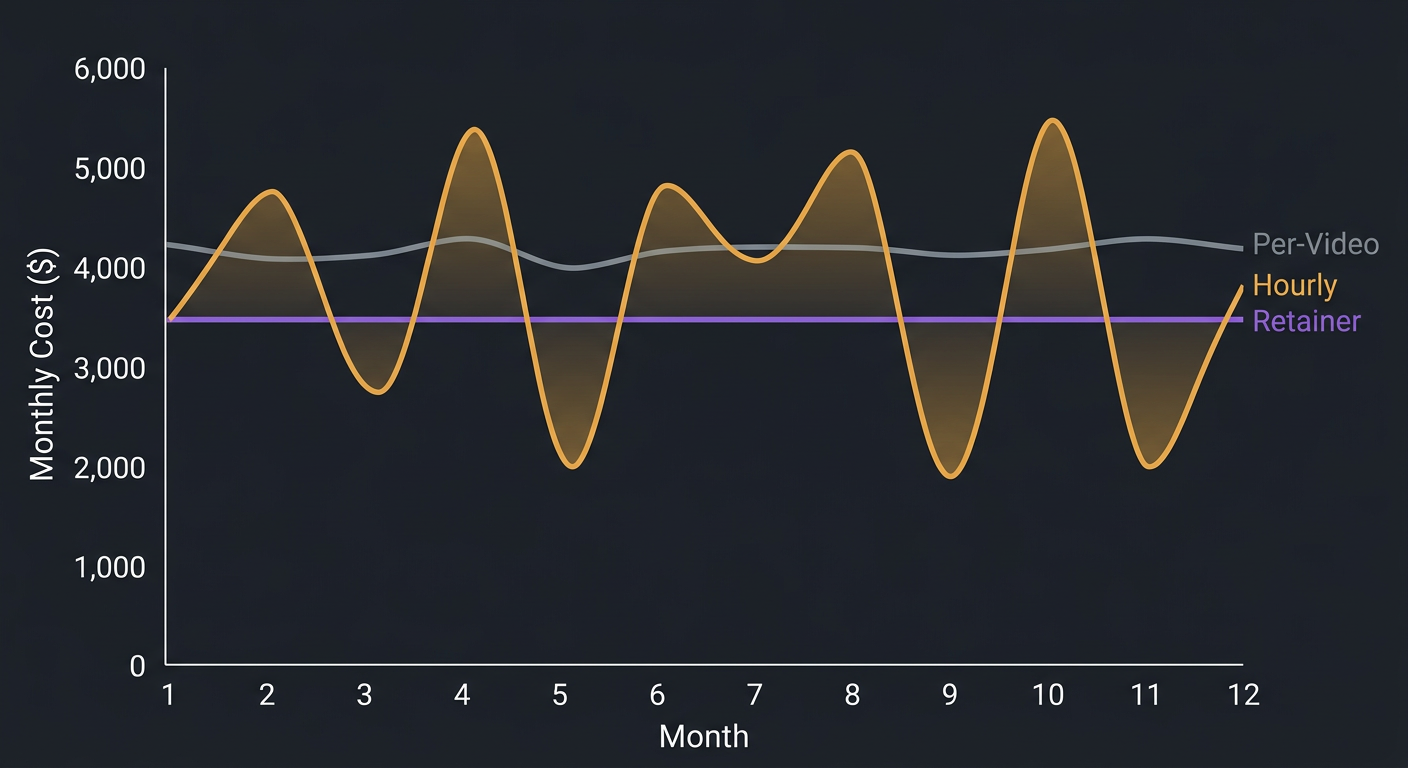
Hourly billing has an inherent incentive misalignment: the agency earns more when the project takes longer. Reputable agencies mitigate this with upfront hour estimates and regular check-ins, but the structural incentive remains.
A common scenario: you’re quoted 8 hours for a YouTube video edit at $80/hour ($640). The editor encounters unexpected issues with audio sync, decides the B-roll selection needs rethinking, and adds a motion graphics element you didn’t explicitly request. The final bill: 14 hours ($1,120). Was the extra work justified? Probably — the video is better for it. But you’ve now spent 75% more than expected.
Over a year of consistent production, these overruns compound. A client expecting to spend $2,500/month on hourly editing frequently ends up spending $3,500–$4,000 when actual invoices arrive. The unpredictability is the real cost of hourly billing, not the rate itself.
Per-Video Pricing: Simple Math, Simple Limits
How Per-Video Pricing Works
You pay a fixed price for each completed video. The price is determined by video type, length, and complexity tier. No monthly commitment — you order what you need, when you need it.
| Video Type | Budget Agency | Mid-Tier Agency | Premium Agency |
|---|---|---|---|
| YouTube long-form (10–20 min) | $150–$250 | $300–$500 | $500–$1,000 |
| Short-form (Reels/Shorts) | $50–$100 | $100–$200 | $200–$400 |
| Podcast video edit | $100–$200 | $200–$400 | $400–$700 |
| Brand/commercial video | $300–$600 | $600–$1,200 | $1,200–$3,000+ |
| Product demo/explainer | $200–$400 | $400–$800 | $800–$1,500 |
When Per-Video Pricing Makes Sense
- Testing a new agency: Before committing to a retainer, order 2–3 videos at per-video rates to evaluate quality, turnaround, and communication.
- Sporadic production: You publish 1–3 videos per month irregularly. A retainer would have you paying for capacity you don’t use.
- Supplementary content: You have an in-house team or primary agency but need overflow capacity for occasional projects.
- Budget-constrained start: You’re bootstrapping and need to control spend precisely, paying only for exactly what you produce.
The Per-Video Premium
Per-video pricing is always more expensive per unit than retainer pricing — typically 20–40% more. This premium exists because the agency can’t predict your volume, can’t allocate dedicated resources, and absorbs the operational overhead of onboarding each project individually.
For example, a YouTube video that costs $400 per-video would cost approximately $300 effective per-video on a $3,000/month retainer (10 videos). Over a year of 10 videos/month, that’s $12,000 in savings — enough to fund an additional month or two of content production.
The Per-Video Quality Concern
Per-video pricing incentivizes the agency to complete each video as quickly as possible — every additional hour spent on your project reduces their margin. For simple, well-defined videos (talking heads, standard podcast edits), this works fine. For complex content requiring creative problem-solving, the incentive to rush can impact quality.
Reputable agencies counterbalance this with internal QC processes, but the structural pressure exists. If you notice diminishing quality on per-video projects, it might be the pricing model — not the editor — that’s the problem.
Head-to-Head: All Three Pricing Models Compared
Let’s put all three models side by side for a creator producing 10 YouTube videos per month:
| Factor | Retainer ($4,000/mo) | Hourly ($80/hr × ~50 hrs) | Per-Video ($450 × 10) |
|---|---|---|---|
| Monthly cost | $4,000 | $4,000 (estimated) | $4,500 |
| Cost predictability | ✅ Fixed | ❌ Variable (could be $3,200–$5,600) | ✅ Fixed per video |
| Dedicated editor | ✅ Yes | ⚠️ Usually yes, but may rotate | ❌ Often pool-based |
| Brand consistency | ✅ High (same team monthly) | ⚠️ Medium | ❌ Low (editor may vary) |
| Scope flexibility | ⚠️ Within agreed scope | ✅ Maximum flexibility | ❌ Fixed scope per video type |
| Agency incentive | Quality + efficiency (retain the client) | Thoroughness (more hours = more revenue) | Speed (finish faster = higher margin) |
| Commitment level | Monthly (typically) | Per-project | Per-video |
| Volume discount built in | ✅ Yes (20–40% cheaper per video) | ❌ No | ❌ Rarely |
| Best for 10 videos/month | ✅ Recommended | ❌ Too unpredictable | ⚠️ Works but overpays |
The retainer model wins for consistent production at virtually every volume above 4 videos per month. Per-video is the safest choice for testing agencies or low-volume production. Hourly remains the best choice for complex, one-off projects where scope uncertainty is the primary risk.
Not Sure Which Pricing Model Fits Your Content?
We’ll analyze your production volume, content types, and budget to recommend the right structure. Most clients save 20–30% by switching to the optimal model.
Hybrid Models and Custom Pricing Structures
The three core models aren’t always used in isolation. Smart agencies — and smart clients — often combine elements to create structures that better match reality.
Retainer + Per-Video Overflow
The most common hybrid: a base retainer for your regular content (e.g., 8 YouTube videos/month for $3,500) plus per-video pricing for overflow or special projects (e.g., product launch videos at $600 each). This gives you predictable baseline costs with flexibility for spikes.
Retainer + Hourly for Complex Work
Your retainer covers standard editing, but VFX-heavy or animation-intensive projects are billed hourly on top. This protects both parties: you get predictable costs for routine work, and the agency doesn’t absorb unlimited hours on complex projects.
Tiered Per-Video with Volume Breaks
Some agencies offer per-video pricing that decreases at volume thresholds: $450/video for 1–5 per month, $380/video for 6–10, $320/video for 11+. This creates a pseudo-retainer effect where higher volume naturally reduces your per-unit cost without requiring a formal retainer commitment.
The “Dedicated Team” Model
This is the structure we use most at Increditors for our YouTube editing clients and content creator partnerships. You get a dedicated team (editor + colorist + motion designer + PM) for a flat monthly fee. The team works exclusively on your content during their allocated hours. It’s technically a capacity-based retainer, but it feels like having your own in-house team — without the employment overhead.
At our pricing level, this model provides the best unit economics for clients producing 8+ videos per month, because dedicated teams build brand fluency that eliminates revision cycles and accelerates turnaround.
Hidden Costs in Each Pricing Model
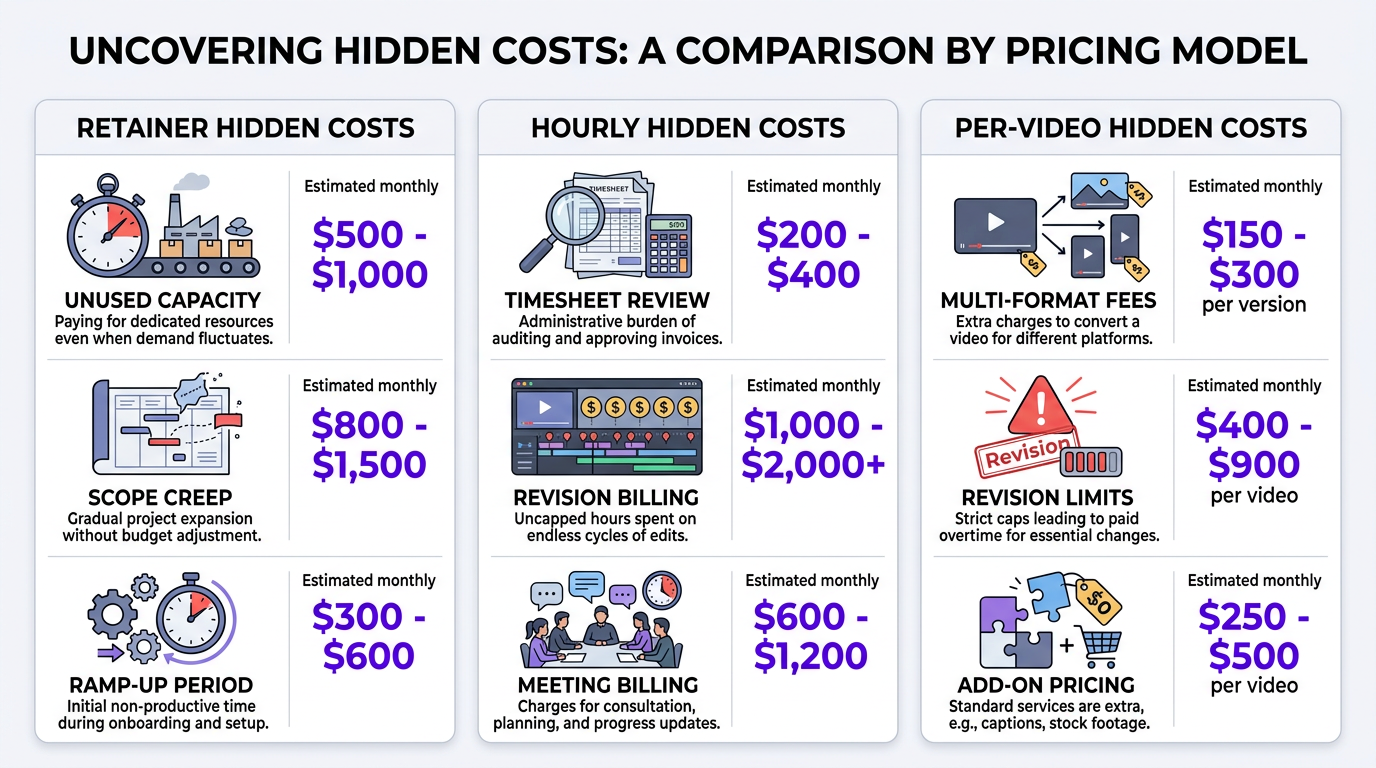
Every model has costs that don’t appear on the invoice. Knowing them prevents budget surprises.
Hidden Costs of Retainer Pricing
- Unused capacity: If you don’t use all your allocated videos in a month, those slots typically don’t roll over. On a 10-video retainer where you only produce 7 videos, you’ve effectively paid for 3 videos you didn’t need.
- Scope creep resistance: Retainers define a scope. When you need something outside that scope (a quick logo animation, a different aspect ratio, a rush project), it either requires an uncomfortable renegotiation or an add-on fee.
- Ramp-up period: The first month of a retainer is always less efficient. You’re paying full price while the team learns your brand. Factor in one month of below-peak output.
Hidden Costs of Hourly Pricing
- Time tracking overhead: You’ll spend time reviewing timesheets, questioning hours, and managing the billing relationship. This meta-work costs you 2–3 hours/month.
- Revision inflation: Every revision round consumes billable hours. A “quick change” that takes 5 minutes of your time to request might be billed as a 30-minute minimum. Three revision rounds at 1 hour each adds $240 at $80/hour to every video.
- Meeting time: Kickoff calls, progress check-ins, and review sessions are all billable. An hour-long kickoff at $80/hour is $80 before a single frame is cut.
Hidden Costs of Per-Video Pricing
- Scope definitions: “One video” sounds simple until you need three versions (16:9, 9:16, 1:1) for different platforms. Each version may be billed separately.
- Revision limits: Per-video quotes typically include 2 revision rounds. Round 3+ comes with additional fees — often $50–$150 per round.
- Add-on pricing: Motion graphics: $100–$300 extra. Color grading: $50–$150 extra. Sound design: $50–$100 extra. Subtitles/captions: $50–$100 extra. The base per-video price can double with add-ons.
How to Negotiate Video Editing Agency Pricing
Negotiating with agencies isn’t like haggling at a market. Pushing too hard on price either gets you lower quality (they assign junior editors) or damages the relationship before it starts. Smart negotiation focuses on structure, not discount percentage.
Effective Negotiation Strategies
- Commit to volume for lower per-unit rates. A 6-month commitment at 12 videos/month gives the agency predictable revenue. In return, they’ll typically discount 10–20% versus month-to-month pricing. You save money; they get stability. Everyone wins.
- Bundle formats for package discounts. Instead of negotiating YouTube edits and Reels separately, bundle them: “8 long-form + 20 shorts/month — what’s the combined price?” Bundled packages are 15–25% cheaper than ordering each format separately because the agency can optimize team allocation.
- Offer predictable workflows. Agencies love clients with organized briefs, consistent footage quality, and reliable upload schedules. If you commit to structured workflows (clear briefs, same-day feedback, consolidated revision requests), many agencies will lower rates because your projects cost them less in project management overhead.
- Start at standard rates, then negotiate at renewal. Pay full price for month one. If you’re happy with the quality, negotiate month two based on demonstrated volume. Agencies are more willing to discount existing clients they want to keep than new prospects they haven’t vetted yet.
- Ask for value-adds instead of discounts. Instead of pushing $4,000 down to $3,500, ask for $4,000 with an extra 2 shorts per month included, or faster turnaround, or thumbnail concepts. Value-adds cost the agency less to provide than a cash discount but may be worth more to you.
What NOT to Do
- Don’t compare agency rates to Fiverr. “I can get this for $100 on Fiverr” is not a negotiating position — it’s a signal that you don’t understand the value difference.
- Don’t negotiate turnaround time down. Asking for 24-hour turnaround at standard pricing means the agency is deprioritizing other clients to serve you. Rush work should carry a rush fee — asking to remove it creates resentment.
- Don’t pit agencies against each other transparently. “Agency X offered me $3,000 — can you beat it?” works in commoditized markets. In creative services, it signals that you view editing as interchangeable, which tells the agency you’re a price-sensitive client who’ll leave at the next lower offer.
Which Video Editing Agency Pricing Model Fits Your Business?
Decision Matrix
| Your Situation | Recommended Model | Why |
|---|---|---|
| 1–3 videos/month, irregular schedule | Per-Video | No commitment, pay only for what you produce |
| 4–8 videos/month, consistent schedule | Retainer (Starter) | Volume discount kicks in, dedicated editor relationship |
| 8–20 videos/month, multiple formats | Retainer (Growth/Scale) | Dedicated team, multi-format efficiency, best per-unit cost |
| 20+ videos/month, enterprise needs | Retainer (Enterprise) | Dedicated multi-person team, SLA-backed, maximum efficiency |
| Complex one-off project (brand film, event) | Hourly or Project-Based | Scope flexibility, no monthly commitment |
| Testing a new agency before committing | Per-Video (2–3 test videos) | Evaluate quality and fit with minimal risk |
| Consistent base + occasional spikes | Retainer + Per-Video overflow | Predictable base cost, flexible spike handling |
The Transition Path
Most clients evolve through pricing models as their needs mature:
- Stage 1: Per-video pricing to test quality (1–2 months)
- Stage 2: Starter retainer once quality is validated (months 3–6)
- Stage 3: Growth retainer as volume increases (months 6–12)
- Stage 4: Scale or Enterprise retainer for serious production operations (12+ months)
At each stage, the per-video effective cost decreases while quality and consistency increase. By Stage 3, most clients are paying 30–40% less per video than they were in Stage 1, with significantly better output.
Real-World Pricing Examples
Trade with Pat: From Per-Video to Retainer
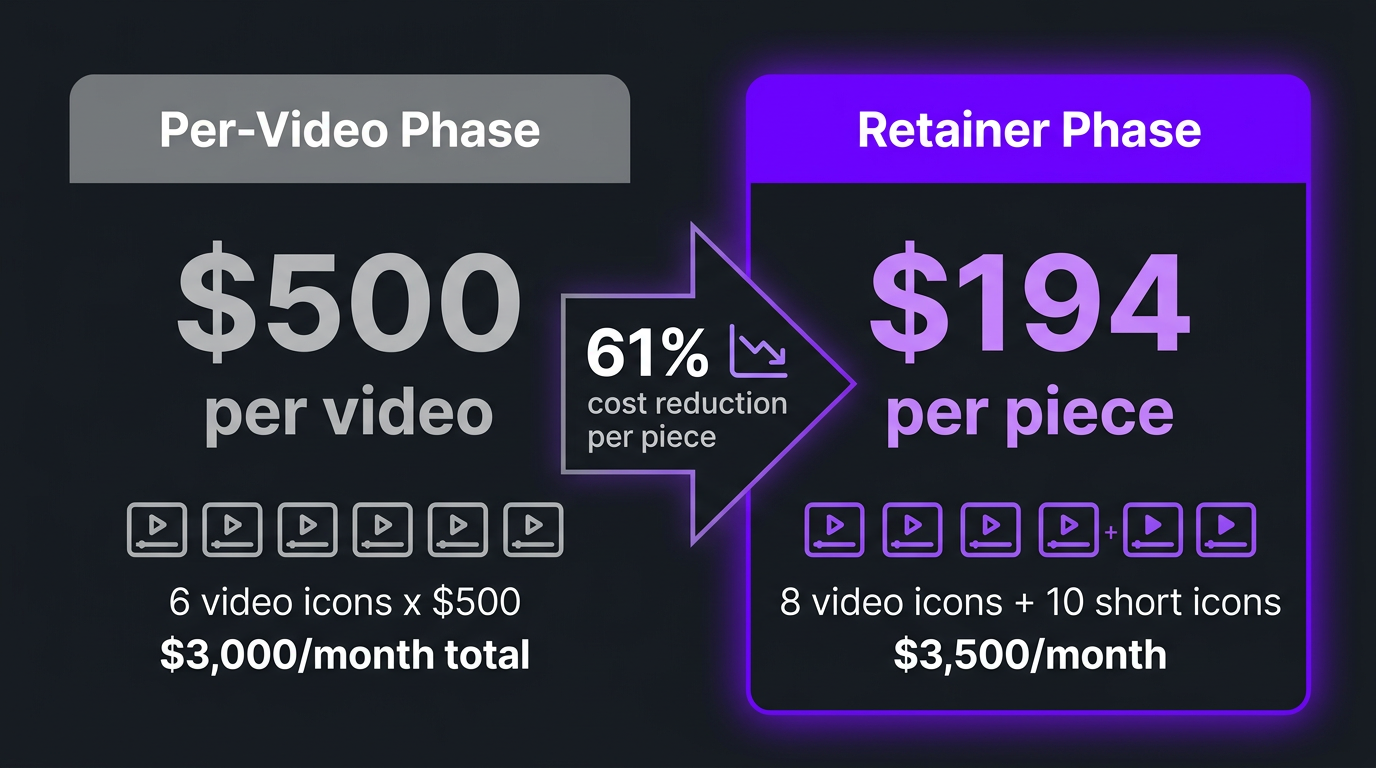
Trade with Pat, a financial education YouTube channel, started working with us on a per-video basis. Pat produced 6 YouTube videos per month and was paying $500 per video — $3,000/month total. The per-video model worked initially because Pat wanted to validate our quality before committing.
After two months, the quality was proven. We transitioned Pat to a Growth retainer at $3,500/month — but the retainer included 8 videos instead of 6, plus 10 short-form clips repurposed from the long-form content. The effective per-piece cost dropped from $500 to $194 — a 61% reduction. More content, better unit economics, and a dedicated editor who understood Pat’s financial content niche deeply enough to suggest structural improvements that improved audience retention.
The retainer also eliminated the per-project briefing overhead. On per-video pricing, Pat was spending 20–30 minutes per video on detailed briefs. On the retainer, with a dedicated editor who knew the format, brief time dropped to 5 minutes per video — saving Pat nearly 3 hours per month in administrative time alone.
Blue Zones Health: Hybrid Model for Variable Content
Blue Zones Health, a wellness and longevity brand, had an unusual content pattern: 8–10 standard YouTube videos per month (recipes, lifestyle content, interviews) plus 2–4 highly produced brand campaign videos per quarter that required motion graphics, custom animation, and cinematic color grading.
A pure retainer didn’t fit because the campaign videos were irregular and far more complex than standard content. A pure per-video model was too expensive for the regular YouTube content. The solution: a hybrid model.
We structured a Growth retainer at $4,000/month covering 10 standard videos with a dedicated editing team. Campaign videos were scoped and quoted individually on a project basis, typically $1,500–$3,000 each depending on VFX complexity. In campaign months, Blue Zones spent $5,500–$7,000 total. In standard months, they spent $4,000.
This hybrid gave Blue Zones predictable base costs for their content engine while maintaining flexibility for campaign peaks. The dedicated team handling regular content also provided continuity for the campaign work — they already knew the brand intimately, so campaign ramp-up time was minimal.
The alternative — pricing everything per-video — would have cost Blue Zones approximately $5,200/month for the same volume of standard content alone, before campaign work. The hybrid model saved them roughly $14,400/year while delivering better-quality output through dedicated team familiarity.
Frequently Asked Questions
The three main models are: retainer (flat monthly fee, typically $1,500–$8,000+/month), hourly ($40–$150/hour), and per-video ($150–$1,500+ per video). Some agencies offer hybrid combinations. Retainers are best for ongoing production, hourly for variable-scope projects, and per-video for sporadic needs or agency testing.
Retainer pricing is cheapest per video for 8+ videos/month, typically 20–40% lower than per-video rates. Per-video is cheapest for 1–3 videos/month where you’d underutilize a retainer. Hourly is rarely cheapest but provides maximum scope flexibility. Calculate your per-unit cost under each model with your specific volume to determine the best fit.
Monthly retainers range from $1,500 for starter plans (4–6 videos, shared editor) to $8,000+ for enterprise teams (30–60+ videos, multiple dedicated editors). Increditors retainers start at $2,500/month for short-form packages and $5,000/month for YouTube long-form with dedicated teams.
Per-video for predictable, standard content (YouTube episodes, podcast edits). Hourly for complex, variable-scope projects (brand campaigns, VFX-heavy work). For ongoing production, a monthly retainer that bundles deliverables is almost always more cost-effective than either hourly or per-video.
Quality retainers include: dedicated editor (or team), defined monthly capacity, revision rounds (2–3 per video), project management, and quality control. Premium retainers add color grading, motion graphics, sound design, short-form repurposing, and strategic content input. Always ask for a detailed scope document before signing.
Negotiate through volume commitment (longer terms = lower rates), format bundling (long-form + shorts together), and predictable workflows (structured briefs reduce agency costs). Avoid comparing to Fiverr, demanding rush turnaround at standard rates, or transparently pitting agencies against each other. Start at standard rates and negotiate at renewal based on demonstrated relationship value.
Most agencies accommodate model transitions. A common path: start per-video to test quality (1–2 months), then move to a retainer once confident in the fit. Good agencies proactively recommend the model that genuinely fits your volume rather than defaulting to the highest-revenue option. At Increditors, we advise on pricing structure during our initial discovery call.
Get a Pricing Structure That Actually Fits Your Content
We’ll analyze your production volume, content types, and budget to recommend the right model — retainer, per-video, or hybrid. No generic quotes.
Pricing data reflects 2026 market rates from publicly available agency websites and industry research. Rates vary by region, complexity, and agency tier. For current Increditors pricing, visit our pricing page or schedule a call.