










![3D Explainer Video - ScribbleLive.mp4_snapshot_00.12_[2022.03.09_03.14.16]](https://increditors.com/wp-content/uploads/elementor/thumbs/3D-Explainer-Video-ScribbleLive.mp4_snapshot_00.12_2022.03.09_03.14.16-r7wb53mx72rxst3qcqyrfxdmeyzb5r9jbl0wbjujh4.png "3D Explainer Video – ScribbleLive.mp4_snapshot_00.12_[2022.03.09_03.14.16]")






























Here’s a mistake we see creators and brands make constantly: they hire one editor and expect them to nail both their 25-minute YouTube deep dives and their 30-second TikToks. Then they wonder why one format always feels off.
Long-form and short-form video editing aren’t just different lengths — they’re different disciplines. The pacing is different. The tools are different. The psychology behind each cut is different. And yes, the pricing is different too.
Whether you’re a content creator trying to figure out where to invest, or a brand deciding which format to outsource first, this guide breaks down everything you need to know: the skills required, what each format actually costs, and how to make the right decision for your budget.
What’s in This Guide
- Core Differences Between Long-Form and Short-Form Editing
- The Skills Gap: Why One Editor Can’t Always Do Both
- Cost Breakdown: Long-Form vs Short-Form
- Monthly Spend Comparison
- Tools and Software Differences
- Which Format Should You Outsource First?
- The Hybrid Approach: Getting Both Done Right
- Real-World Examples
- Choosing the Right Editing Provider
- FAQ
Core Differences Between Long-Form and Short-Form Editing
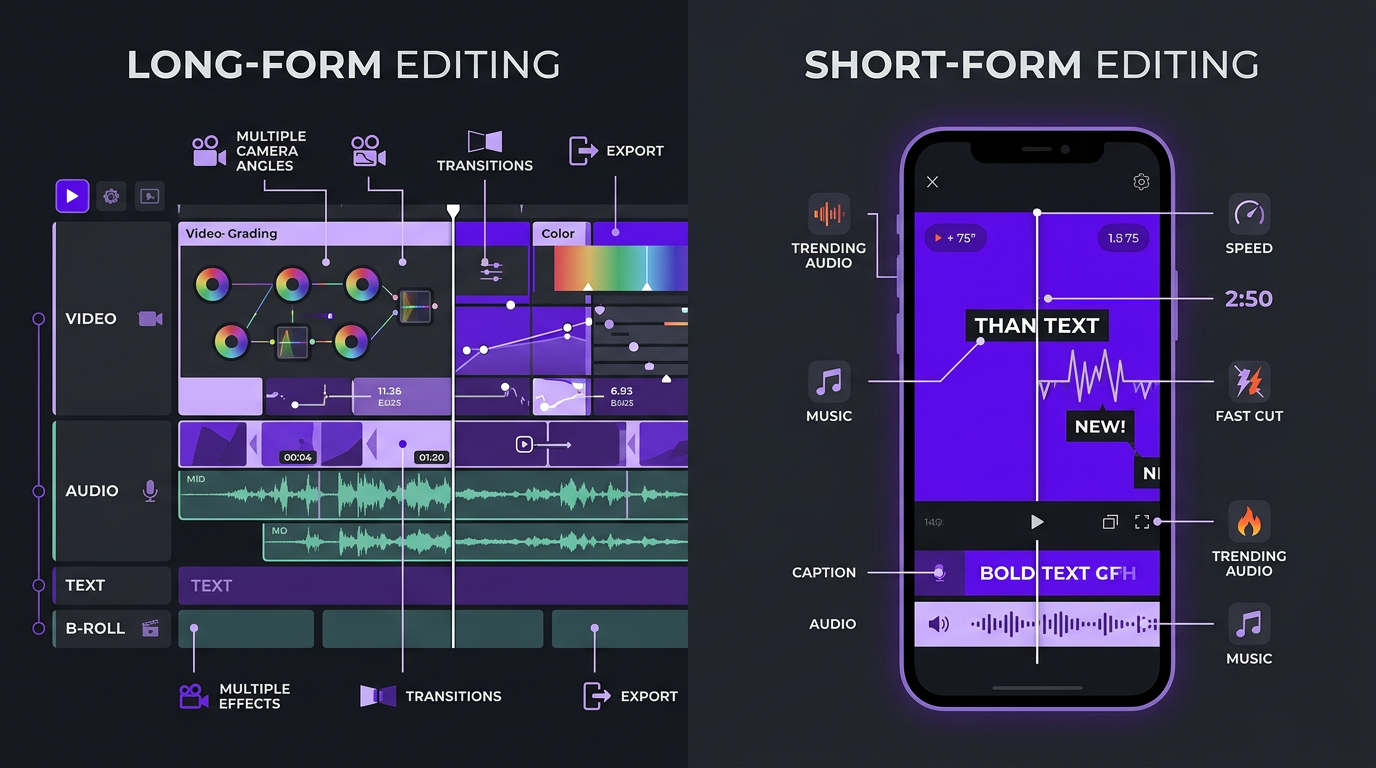
On the surface, video editing is video editing — you’re cutting footage together, adding graphics, and exporting a final product. But the moment you sit down to edit a 20-minute YouTube essay versus a 30-second Reel, you realize these are fundamentally different crafts.
Long-Form Editing: The Architecture of Attention
Long-form content (typically 10-60+ minutes) is about sustained engagement. Your editor needs to keep someone watching for 15, 20, sometimes 45 minutes. That requires an understanding of narrative structure, pacing variation, and what YouTube’s algorithm rewards in terms of audience retention.
A great long-form editor thinks like a filmmaker. They understand:
- Three-act structure — even a 15-minute talking-head video needs a hook, development, and payoff
- Retention pacing — knowing when to add a visual change every 3-5 seconds versus letting a moment breathe
- B-roll strategy — selecting and timing supplementary footage to reinforce points without distracting
- Audio layering — balancing voice, music, and sound effects across a 20-minute timeline
- Multi-camera editing — syncing and cutting between 2-4 camera angles for interviews and podcasts
- Color grading — maintaining consistent color across hundreds of clips and lighting conditions
Short-Form Editing: The Art of the Hook
Short-form content (15-90 seconds) is a completely different animal. You have roughly 0.5 seconds before someone swipes away. The editor’s job isn’t sustained engagement — it’s instant engagement followed by a dopamine hit every 2-3 seconds.
A great short-form editor thinks like a graphic designer crossed with a social media strategist. They understand:
- Hook design — the first frame and first word need to stop the scroll
- Pattern interrupts — zooms, whip pans, sound effects, and text reveals that prevent thumb-scrolling
- Trend awareness — which audio clips, transitions, and formats are trending right now
- Platform-specific formatting — 9:16 for TikTok/Reels, 1:1 for LinkedIn, safe zones for UI overlays
- Caption styling — animated captions that match brand guidelines and remain readable on mobile
- Compression optimization — export settings that preserve quality within platform upload limits
| Attribute | Long-Form Editing | Short-Form Editing |
|---|---|---|
| Typical length | 10–60+ minutes | 15–90 seconds |
| Primary platform | YouTube | TikTok, Reels, Shorts |
| Editing time | 8–25 hours per video | 1–4 hours per video |
| Key skill | Story structure & pacing | Hook design & trend fluency |
| Audience retention goal | 50%+ average view duration | 80%+ completion rate |
| Cut frequency | Every 3–8 seconds | Every 0.5–3 seconds |
| Audio complexity | Multi-track mixing | Trending audio sync |
| Color grading | Essential | Optional/basic |
| Motion graphics | Custom lower thirds, transitions | Templates, text overlays |
The Skills Gap: Why One Editor Can’t Always Do Both
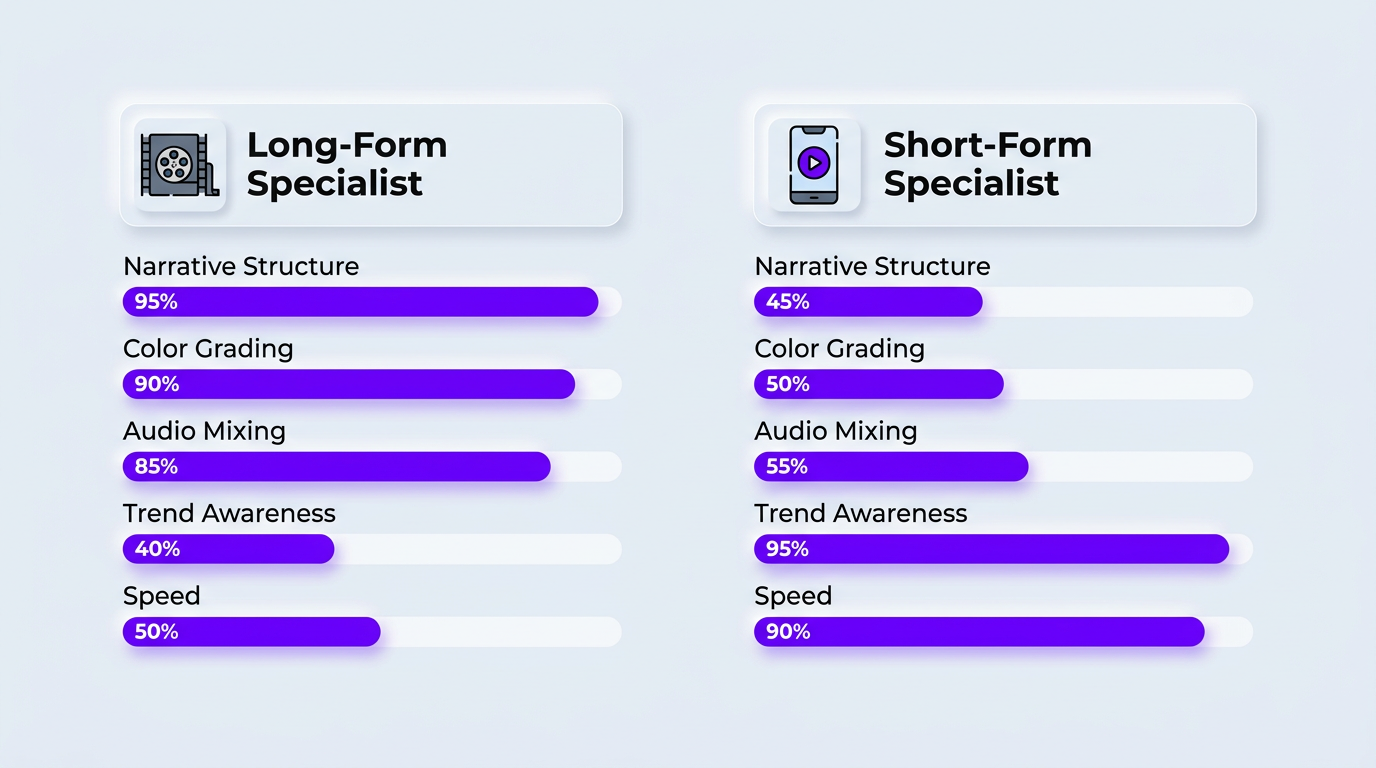
We’ve worked with hundreds of editors at Increditors, and here’s what we’ve learned: the Venn diagram overlap between a great long-form editor and a great short-form editor is smaller than most people think.
The Long-Form Editor Profile
Your ideal long-form editor has spent years working on documentary-style content, YouTube essays, or corporate video. They’re comfortable managing projects with 50+ clips on a timeline, they understand audio mixing at a semi-professional level, and they can look at a YouTube retention graph and explain exactly where viewers dropped off and why.
They tend to be methodical. They build organized project files. They think in minutes and arcs, not seconds and hooks.
What they’re often not great at: TikTok trends. The fast-twitch creativity required for short-form doesn’t come naturally to editors who’ve trained their instincts around deliberate pacing. Asking a long-form editor to make a punchy Reel is like asking a novelist to write a billboard ad — different muscle entirely.
The Short-Form Editor Profile
Your ideal short-form editor lives on TikTok and Instagram. They know which transitions are trending, which audio clips are blowing up, and exactly how to time a text reveal for maximum impact. They think in frames, not minutes.
They’re typically younger, digitally native, and can turn around a Reel in 45 minutes that gets better engagement than a video you spent three hours on. Speed is part of their DNA.
What they’re often not great at: sustaining a narrative. Give them a 30-minute interview and ask them to cut it into a compelling 15-minute YouTube video, and they’ll struggle with pacing, audio balancing, and the patience required for a complex timeline.
The Unicorn Problem
Yes, editors exist who genuinely excel at both formats. They’re rare, they know their value, and they charge accordingly. If you find one, expect to pay a 30-50% premium over specialists — and be prepared for the fact that they’ll eventually specialize in whichever format they enjoy more, leaving you scrambling for a replacement on the other.
This is exactly why agencies structure their teams with dedicated specialists. At Increditors, when a client needs both long-form YouTube content and short-form Reels, we assign different editors to each — with an executive producer ensuring brand consistency across both.
Cost Breakdown: Long-Form vs Short-Form Editing
Now let’s talk money. These are 2026 market rates based on what we see across freelance platforms, subscription services, and professional agencies.
Long-Form Video Editing Costs (Per Video)
| Complexity Level | What’s Included | Price Range | Edit Time |
|---|---|---|---|
| Basic | Jump cuts, simple transitions, background music, basic titles | $150–$350 | 4–8 hours |
| Mid-Tier | B-roll integration, custom lower thirds, multi-cam sync, color correction, sound leveling | $350–$700 | 8–15 hours |
| Premium | Motion graphics, VFX, cinematic color grading, sound design, custom animations, thumbnail | $700–$1,500+ | 15–25+ hours |
Short-Form Video Editing Costs (Per Video)
| Complexity Level | What’s Included | Price Range | Edit Time |
|---|---|---|---|
| Basic | Simple cuts, auto-captions, trending audio, basic text overlays | $30–$75 | 30–90 min |
| Mid-Tier | Custom captions, branded templates, transitions, sound effects, color filter | $75–$200 | 1.5–3 hours |
| Premium | Custom motion graphics, animated text, VFX, multi-clip editing, sound design | $200–$400 | 3–5 hours |
The per-video cost difference is significant — short-form runs roughly 50-80% cheaper than long-form at every tier. But the per-video cost only tells half the story.
Need Both Long-Form and Short-Form Editing?
Increditors assigns dedicated specialists for each format — so you get expert-level quality across YouTube, Reels, TikTok, and Shorts without juggling multiple freelancers.
Monthly Spend Comparison: The Real Math
Here’s where most cost comparisons go wrong: they only look at per-video pricing. In reality, brands typically need far more short-form pieces than long-form. When you calculate total monthly spend, the gap narrows dramatically.
Scenario 1: YouTube-Focused Creator
| Content Type | Volume/Month | Per Video Cost | Monthly Total |
|---|---|---|---|
| Long-form YouTube (15-20 min) | 8 videos | $450 | $3,600 |
| YouTube Shorts | 16 videos | $100 | $1,600 |
| Total | 24 videos | $5,200 |
Scenario 2: Brand Content Team
| Content Type | Volume/Month | Per Video Cost | Monthly Total |
|---|---|---|---|
| Long-form YouTube (10-15 min) | 4 videos | $600 | $2,400 |
| Instagram Reels | 20 videos | $125 | $2,500 |
| TikToks | 12 videos | $100 | $1,200 |
| Total | 36 videos | $6,100 |
Notice how the brand spends nearly as much on short-form as long-form, despite each short-form video costing a fraction of a long-form edit. Volume is the equalizer.
The Agency Retainer Advantage
When you’re producing 20-40 videos per month across both formats, per-video pricing from individual freelancers becomes a management nightmare. This is where unlimited or retainer-based editing services start making financial sense.
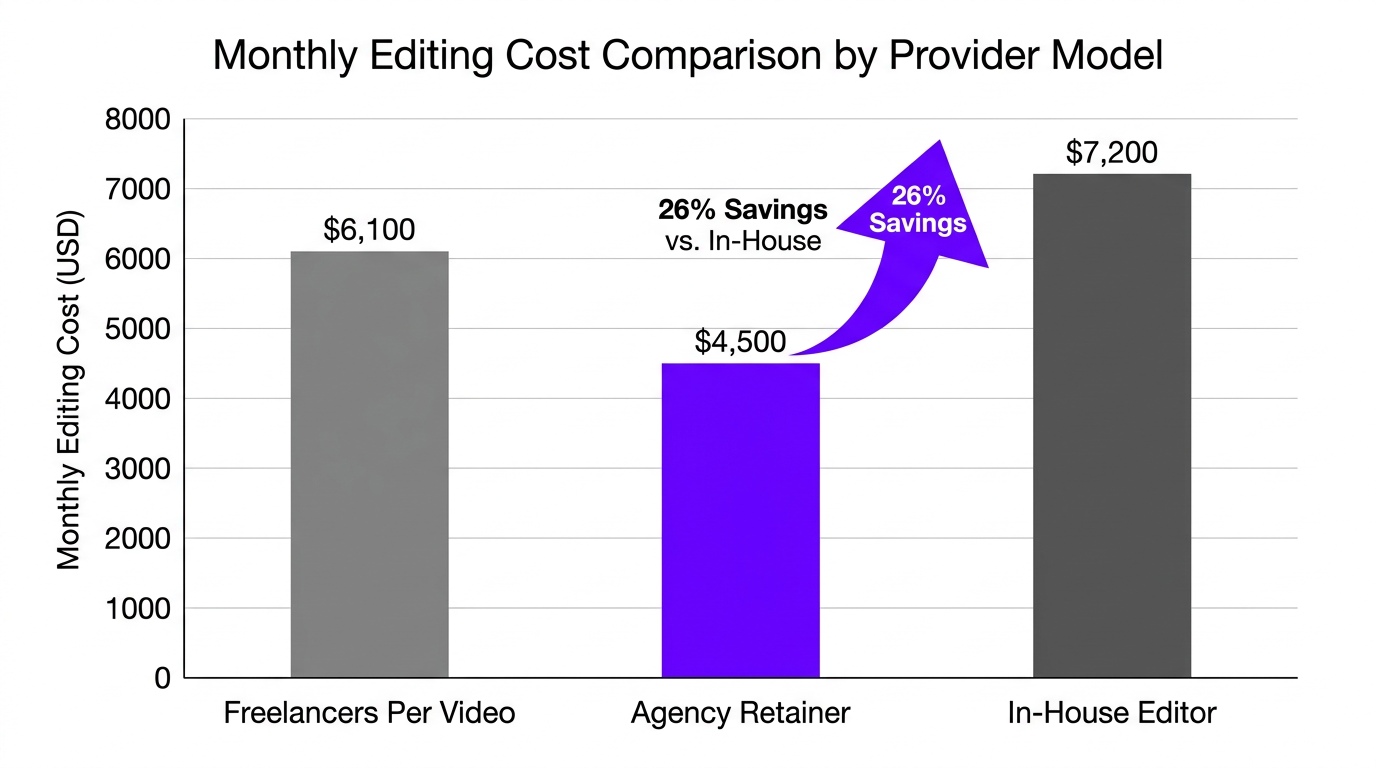
A typical agency retainer for mixed-format editing runs $3,000-$6,000/month — often 20-30% less than the sum of individual per-video rates, with the added benefit of project management, quality control, and consistent output.
Tools and Software Differences
The software your editor uses tells you a lot about their specialization — and it affects both quality and turnaround time.
Long-Form Editing Stack
- Adobe Premiere Pro — industry standard for complex timelines, multi-cam, and collaboration via Premiere Productions
- DaVinci Resolve — gold standard for color grading, increasingly popular for full editing workflow
- Final Cut Pro — preferred by Mac-based editors for its speed and magnetic timeline
- Adobe After Effects — for custom motion graphics, lower thirds, and animated intros
- Audition / Fairlight — dedicated audio post-production and noise reduction
Short-Form Editing Stack
- CapCut — increasingly the go-to for short-form with auto-captions, templates, and direct TikTok export
- Premiere Pro — still used by professional short-form editors who want more control
- After Effects — for premium motion graphics and animated text treatments
- Canva Video — for quick social media clips with branded templates
- Descript — text-based editing that’s fast for repurposing clips from long-form content
The tool choice matters because it affects speed. A short-form editor using CapCut can turn around a Reel in 30 minutes that might take 90 minutes in Premiere Pro. Conversely, trying to edit a 25-minute multi-cam YouTube video in CapCut would be a disaster.
| Software | Best For | Long-Form | Short-Form |
|---|---|---|---|
| Premiere Pro | Both (industry standard) | ✅ Excellent | ✅ Good |
| DaVinci Resolve | Color-heavy long-form | ✅ Excellent | ⚠️ Overkill |
| Final Cut Pro | Fast long-form editing | ✅ Excellent | ✅ Good |
| CapCut | Quick short-form | ❌ Limited | ✅ Excellent |
| After Effects | Motion graphics (both) | ✅ Graphics only | ✅ Graphics only |
| Descript | Repurposing & podcasts | ⚠️ Basic | ✅ Good |
Which Format Should You Outsource First?
If you can only afford to outsource one format, start with long-form. Here’s why:
The Time Argument
A single 20-minute YouTube video takes 10-20 hours to edit properly. That’s 2-3 full working days. If you’re publishing weekly, that’s 40-80 hours of editing per month — essentially a full-time job.
A single Reel takes 1-3 hours. Even if you’re posting 5 Reels per week, that’s 20-60 hours — significant, but more manageable alongside other work.
Outsourcing long-form first gives you the biggest time savings per dollar spent.
The Revenue Argument
Long-form YouTube content typically drives more direct revenue than short-form. YouTube pays creators through AdSense on long-form videos (mid-rolls on 8+ minute videos), and long-form content has a longer shelf life — a well-optimized YouTube video can generate views and revenue for years.
Short-form content has a shorter virality window and lower direct monetization (YouTube Shorts revenue sharing is still evolving, and TikTok/Reels monetization remains limited for most creators).
Investing in professional long-form editing directly impacts your highest-revenue format.
The Quality Argument
Viewers are more forgiving of rough short-form content — in fact, overly polished Reels can feel inauthentic. But a poorly edited 20-minute YouTube video with bad audio, inconsistent color, and sloppy pacing will tank your retention metrics and hurt your channel long-term.
The quality gap between amateur and professional editing is more visible — and more costly — in long-form content.
The Hybrid Approach: Getting Both Done Right
Most successful channels and brands eventually need both formats running simultaneously. Here’s how to structure it cost-effectively.
Option 1: Repurpose Long-Form Into Short-Form
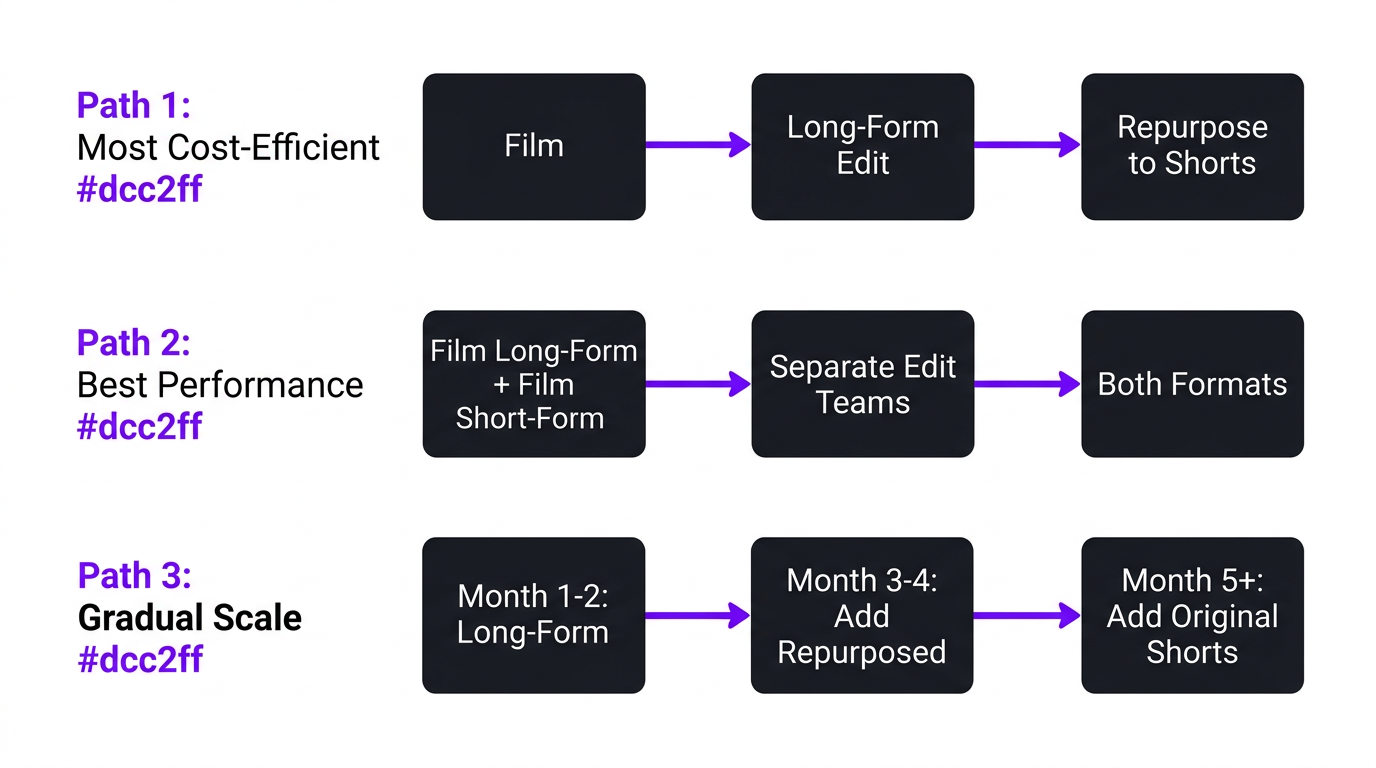
The most cost-efficient approach is producing long-form content first and repurposing it into short-form clips. A single 20-minute YouTube video can yield 5-10 Reels, Shorts, or TikToks.
This works because your long-form content already contains multiple “moments” — strong quotes, surprising data points, funny reactions — that work as standalone short-form hooks.
Cost comparison:
- Creating 10 original short-form videos: $750–$2,000
- Repurposing 10 clips from existing long-form: $300–$800
- Savings: 40-60%
Increditors offers social media editing packages that include repurposing as standard — you send us the long-form footage and we deliver both the YouTube cut and a batch of Reels/Shorts from the same session.
Option 2: Dedicated Teams for Each Format
If your short-form strategy requires original content (not just repurposed clips), you’ll want dedicated editors for each format. This costs more but produces format-native content that performs better.
Structure it like this:
- Long-form team: 1-2 editors handling 4-8 YouTube videos per month
- Short-form team: 1-2 editors handling 15-30 Reels/TikToks per month
- Creative director: One person maintaining brand consistency across both
An enterprise-level agency provides this structure out of the box. You get dedicated specialists without the overhead of building an in-house team.
Option 3: Phased Outsourcing
Start with long-form outsourcing (Month 1-2), add repurposed short-form (Month 3-4), then layer in original short-form content (Month 5+). This lets you test workflows, build trust with your editing partner, and scale spending gradually.
Real-World Examples: How Creators and Brands Handle Both Formats
Case Study: Riley Coleman — YouTube Creator Scaling to Multi-Platform
Riley Coleman came to us producing 4 long-form YouTube videos per month, self-edited. Each took him roughly 12-15 hours, leaving almost no time for filming, scripting, or growing his audience on other platforms.
We took over his long-form editing first — freeing up 50-60 hours per month immediately. Within two months, we added a short-form repurposing package, turning each YouTube video into 3-4 Shorts and Reels. His output went from 4 videos/month to 4 long-form + 16 short-form pieces without him spending a single additional hour on editing.
Results after 6 months:
- YouTube subscribers increased 40% (better editing quality improved retention)
- Instagram Reels drove 25% of new YouTube subscribers (cross-platform funnel)
- Total time spent on editing: 0 hours (down from 60+/month)
Case Study: TuMeke — B2B SaaS Company
TuMeke needed a different approach. Their startup marketing team was creating product demos (long-form, 8-12 minutes) and social proof clips (short-form, 30-60 seconds) but couldn’t maintain quality or consistency with a single freelancer.
We assigned a dedicated long-form editor for product demos — someone with VFX and motion graphics experience who could handle screen recordings, animated callouts, and professional voiceover integration. For their social clips, a separate short-form specialist focused on punchy testimonial edits and feature highlight Reels.
The result: their demo video completion rate increased from 35% to 58%, and their social clips started generating 3x more engagement than their previous in-house efforts.
Case Study: VYVE Wellness — Health & Wellness Brand
VYVE Wellness was spending $8,000/month with three separate freelancers — one for YouTube, one for Reels, and one for TikTok. The brand consistency was terrible. Each editor had their own style, their own caption format, their own color palette. Their social media looked like three different brands.
We consolidated everything under one retainer at $5,500/month. A dedicated long-form editor handled their weekly YouTube wellness guides, while a short-form specialist created platform-native content for Reels and TikTok — all overseen by a creative director who maintained brand guidelines.
They saved $2,500/month while getting better quality and consistent branding across every platform.
Struggling to Cover Both Long-Form and Short-Form?
Get dedicated specialists for each format under one retainer. Consistent quality, consistent branding, one point of contact.
Choosing the Right Editing Provider for Your Format Mix
Not every editing service handles both formats well. Here’s what to look for.
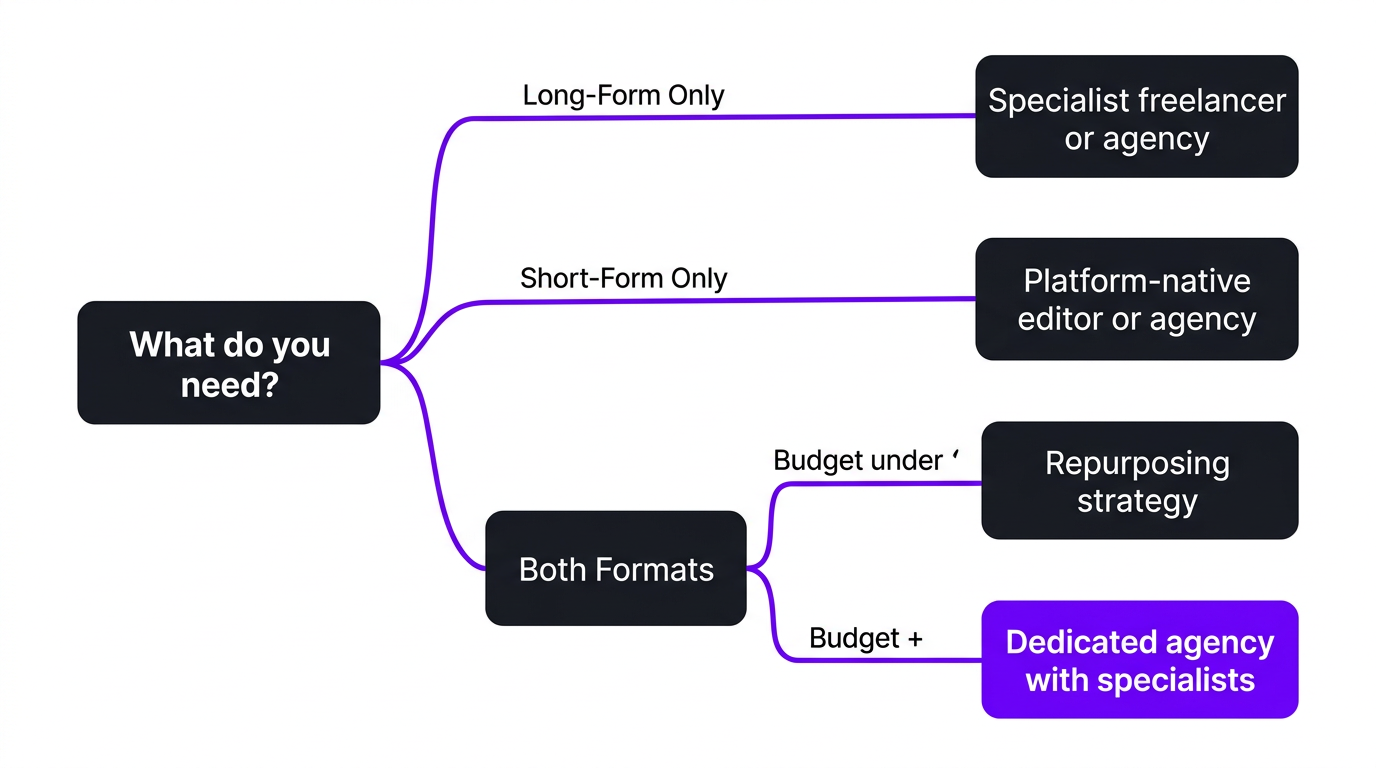
If You Only Need Long-Form Editing
Look for editors or agencies with a portfolio heavy on YouTube content, documentaries, or branded video series. Ask specifically about:
- Their approach to retention pacing (do they understand YouTube analytics?)
- Color grading capabilities (can they match a cinematic look?)
- Multi-cam experience (critical for interviews and podcasts)
- Revision workflow (how many rounds, what’s the turnaround?)
If You Only Need Short-Form Editing
Look for editors who are active on the platforms they’re editing for. If your TikTok editor doesn’t use TikTok, that’s a red flag. Ask about:
- Trend turnaround time (can they capitalize on trends within 24-48 hours?)
- Caption and text animation style (match your brand?)
- Platform knowledge (safe zones, aspect ratios, export specs)
- Volume capacity (can they handle 15-30 videos/month?)
If You Need Both Formats
This is where agencies have a clear advantage over individual freelancers. A single freelancer will almost always be stronger in one format. An agency can assign the right specialist to each format while maintaining brand consistency through creative direction.
| Provider Type | Long-Form Quality | Short-Form Quality | Monthly Cost (Both) | Brand Consistency |
|---|---|---|---|---|
| Single freelancer | ⚠️ Varies | ⚠️ Varies | $2,000–$4,000 | ⚠️ Medium |
| Two freelancers | ✅ Specialist | ✅ Specialist | $3,500–$6,000 | ❌ Low |
| Subscription service | ⚠️ Inconsistent | ✅ Template-based | $500–$2,000 | ⚠️ Medium |
| Dedicated agency | ✅ Specialist | ✅ Specialist | $3,000–$6,000 | ✅ High |
| In-house team | ✅ Specialist | ✅ Specialist | $8,000–$15,000 | ✅ Highest |
Questions to Ask Before Signing
Whether you’re evaluating a freelancer, subscription service, or agency, ask these questions to gauge their format expertise:
- Can I see examples of both long-form and short-form work? If they only show one format, they’re likely a specialist (which is fine — just don’t expect them to excel at both).
- Who specifically will edit my long-form vs short-form content? You want named individuals, not “whoever is available.”
- How do you maintain brand consistency across formats? Look for mentions of style guides, brand templates, or creative direction.
- What’s your turnaround for each format? Long-form should be 3-5 business days; short-form should be 1-2 business days.
- Do you offer repurposing packages? If yes, this usually signals mature experience with both formats.
The Hidden Cost of Getting This Wrong
We see creators and brands try to save money by forcing one solution across both formats. The result is almost always a mediocre presence on at least one platform. And in 2026, mediocre content doesn’t just underperform — it actively hurts you because algorithms reward engagement and punish low retention.
A YouTube video with poor retention from bad editing pushes your channel lower in recommendations. A Reel with a weak hook gets zero distribution. The cost of bad editing isn’t just the money you spent — it’s the opportunity cost of content that never reaches its potential audience.
The Content Repurposing Pipeline
For brands serious about multi-platform presence, the most efficient workflow looks like this:
- Film once — capture enough footage for both formats in a single session
- Edit long-form first — this is your flagship content, polished to the highest standard
- Extract short-form clips — identify the most engaging 15-60 second moments
- Reformat for each platform — different aspect ratios, caption styles, and pacing for Reels vs Shorts vs TikTok
- Create platform-native originals — supplement with content shot specifically for short-form (trends, behind-the-scenes, quick tips)
This pipeline produces maximum output from minimum input. A single filming session yields 1 YouTube video, 3-5 repurposed Shorts, and 2-3 original Reels — hitting every platform with format-appropriate content.
Cost Efficiency by Approach
| Approach | Videos Produced | Monthly Cost | Cost Per Video |
|---|---|---|---|
| All original content (separate shoots) | 20 total | $5,500–$8,000 | $275–$400 |
| Long-form + repurposed shorts | 20 total | $3,000–$4,500 | $150–$225 |
| Hybrid (repurposed + some original) | 20 total | $3,500–$5,000 | $175–$250 |
Future-Proofing Your Content Strategy
The line between long-form and short-form continues to blur. YouTube is pushing longer Shorts (up to 3 minutes). TikTok is pushing longer videos (up to 10 minutes). Instagram is testing longer Reels and re-emphasizing IGTV-style content.
What does this mean for editing? The middle ground — 2-5 minute videos — is becoming increasingly important. And editors who can handle this mid-form content need skills from both long-form and short-form disciplines: enough narrative structure to sustain 3-5 minutes, but enough hook energy to survive platform feeds.
When choosing an editing partner, ask how they handle mid-form content. The best agencies are already building workflows for this emerging format.
At Increditors, we’ve seen mid-form become the fastest-growing content category among our clients. Our editors are trained to apply long-form storytelling principles to short-form pacing — giving you content that works whether it’s 30 seconds or 30 minutes.
Frequently Asked Questions
Long-form editing (10-60+ minutes) focuses on narrative structure, pacing, retention curves, multi-camera syncing, and detailed color grading. Short-form editing (15-90 seconds) prioritizes hook design, fast cuts, trending audio, captions, and platform-specific formatting for TikTok, Reels, and Shorts. They require fundamentally different skills and sensibilities.
Long-form YouTube editing costs $150 to $1,500+ per video depending on complexity. Basic cuts with simple graphics run $150-$350, mid-tier productions with motion graphics and color grading cost $350-$700, and premium edits with VFX, sound design, and cinematic grading range from $700-$1,500+. Monthly retainers for 4-8 videos typically run $2,000-$5,000.
Short-form video editing typically costs $30 to $400 per video. Basic Reels or TikToks with captions and cuts run $30-$75, mid-tier shorts with custom graphics and transitions cost $75-$200, and premium short-form with motion graphics and sound design ranges from $200-$400. Monthly packages for 15-30 shorts typically run $1,500-$4,000.
Some editors can handle both, but they require fundamentally different skills. Long-form editors excel at storytelling and retention pacing, while short-form editors specialize in hooks and trend awareness. Agencies like Increditors staff dedicated specialists for each format to ensure quality across both without compromising either.
Outsource long-form editing first. It takes 5-15x longer than short-form per video, meaning it consumes the most of your time. A single 20-minute YouTube video can take 10-20 hours to edit, while a Reel takes 1-3 hours. Freeing up long-form editing time gives you the biggest return on outsourcing investment.
Per video, yes — short-form costs 50-80% less than long-form. But many brands need 15-30 short-form pieces per month compared to 4-8 long-form, so total monthly spend can be similar or even higher for short-form. A typical agency retainer covers both formats for $3,000-$6,000/month.
Long-form editing primarily uses Adobe Premiere Pro, DaVinci Resolve, and Final Cut Pro for their advanced timeline, color grading, and multi-track capabilities. Short-form editors often use CapCut, Premiere Pro, and After Effects for quick templates, auto-captions, and trend-ready effects. The tool choice significantly affects turnaround time and output quality.