










![3D Explainer Video - ScribbleLive.mp4_snapshot_00.12_[2022.03.09_03.14.16]](https://increditors.com/wp-content/uploads/elementor/thumbs/3D-Explainer-Video-ScribbleLive.mp4_snapshot_00.12_2022.03.09_03.14.16-r7wb53mx72rxst3qcqyrfxdmeyzb5r9jbl0wbjujh4.png "3D Explainer Video – ScribbleLive.mp4_snapshot_00.12_[2022.03.09_03.14.16]")































Most video editing contracts include 2–3 revision rounds, but revision scope — not count — is what drives cost overruns. This guide defines what a revision round really means, how to scope it in contracts, what triggers out-of-scope charges, and how to build a workflow that keeps your production budget predictable — whether you work with a freelancer, a subscription service, or a dedicated video editing agency.
You approved the brief. You received the first cut. Now the back-and-forth begins.
For marketing teams producing regular video content — product demos, social campaigns, event highlights — the revision process is where timelines slip and budgets quietly inflate. A “round” that was supposed to mean minor tweaks becomes a full structural rework. An “unlimited revisions” clause gets honored in letter but gamed in spirit. An internal stakeholder adds feedback after sign-off, triggering a fourth round nobody budgeted for.
This guide is written for marketing directors and content operations leads who want to stop losing hours and dollars to revision ambiguity. You’ll find working definitions, contract language, scope matrices, and tooling recommendations — practical, procurement-grade material that translates directly into vendor agreements and internal SOPs.
What a “Revision Round” Actually Means
A revision round is a single consolidated feedback cycle: you review a deliverable, gather all your team’s input, submit it in one batch, and the editor works through it and delivers a new version. One round = one feedback submission followed by one editor response.
That definition sounds obvious, but it breaks down in practice. The most common failure mode is feedback fragmentation: someone submits initial notes, then emails “one more thing” the next morning, then a VP adds comments after seeing the revised cut. From the editor’s perspective, that’s three rounds. From the client’s perspective, it was all one round.
The Three Dimensions of a Revision Round
Every revision clause should implicitly or explicitly address three dimensions:
Most contracts only address count. The scope and consolidation dimensions are where disputes — and cost overruns — actually originate.
💡 Pro Tip: Before signing any video editing contract, ask the vendor: “If we submit feedback, then one stakeholder adds a note the next day — does that count as two rounds?” The answer tells you whether their revision policy is client-friendly or a billing trap.
How Many Rounds Are Industry Standard?
There is no universal standard, but industry norms cluster around 2–3 included revision rounds for most professional video editing engagements. The specifics depend heavily on project type, relationship model, and whether the editor was involved upstream in creative direction.
Revision Norms by Engagement Type
The key insight here: “unlimited revisions” is a marketing phrase, not a technical specification. Every vendor who offers it has an implicit scope boundary — they’re betting you won’t push past it. Understanding that boundary before you sign is the whole game. For a detailed breakdown of how these models affect overall production costs, see our guide on how much professional video editing costs.
When More Rounds Indicate a Process Problem
If you’re consistently using all three revision rounds on every project, the issue is usually not the editor — it’s the brief. Strong creative briefs that include reference examples, clear messaging hierarchy, and an approved script or storyboard before editing starts typically result in higher first-cut approval rates. The revision round count is a lagging indicator of brief quality.
Marketing teams that invest in pre-production alignment — getting stakeholder sign-off on a detailed brief before a single frame is edited — commonly report needing fewer rounds overall. The upstream investment pays back in downstream speed.
Defining Scope: What Counts as a Revision
Scope is the single most important variable in revision management. Without a scope definition, “one revision round” can mean anything from swapping a music track to rebuilding the entire structure of a five-minute video.
A practical scope framework organizes requested changes into tiers based on estimated editor effort:
The Revision Scope Tier Framework
The most common contract dispute is a Tier 3 request framed as a Tier 1 ask. “Just restructure the beginning a bit” is not a minor revision — it typically requires re-evaluating pacing across the entire video, which ripples into B-roll placement, music sync points, and graphics timing.
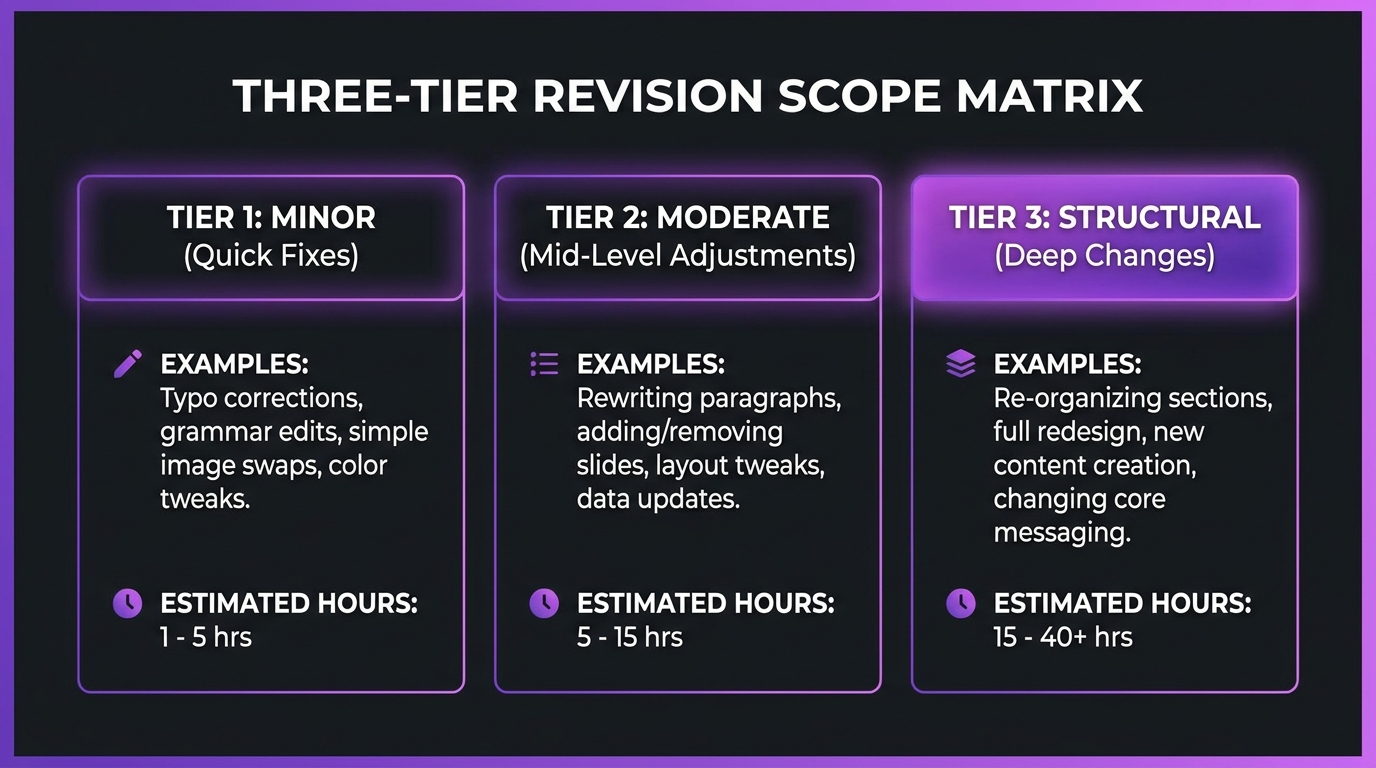
💡 Pro Tip: Include the tier framework in your creative brief template, not just in your contracts. When stakeholders understand that “restructuring the narrative” is Tier 3 — not a minor tweak — they tend to consolidate that feedback more carefully, and earlier in the process.
The Script Lock Principle
One of the most effective scope controls is a script lock policy: once the script or video outline is approved, any request to change what is said or shown in a video — beyond fixing errors — is automatically Tier 3. This prevents the most common escalation pattern, where late-stage messaging changes trigger a full re-edit that no one wants to pay for.
Script locks work best when paired with a more thorough pre-production approval process. If stakeholders know the script is going to lock after approval, they tend to review it more carefully upfront.
The Real Cost of Revision Creep
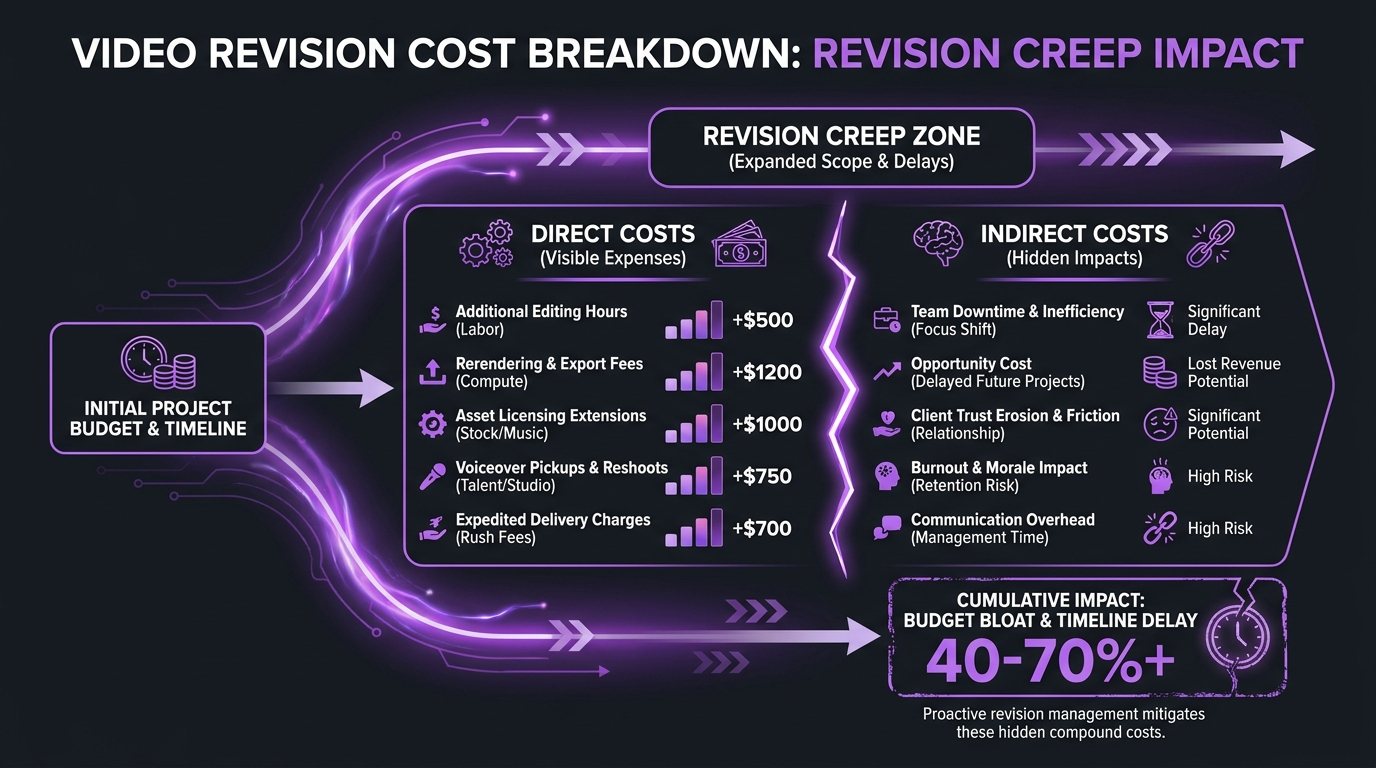
Revision creep — the gradual accumulation of unplanned change requests beyond original scope — is one of the most consistent budget-killers in video production. It rarely shows up as a single dramatic overrun; it compounds quietly across a project or a production quarter.
Direct and Indirect Costs
The direct cost of out-of-scope revisions is straightforward: overage charges from vendors, or additional billable hours. Vendors typically charge for extra rounds in one of three ways:
The indirect costs are often larger. When revision rounds exceed estimates, editorial calendars slip. A delayed product demo misses a launch window. A late campaign video loses two weeks of paid media runway. These downstream effects rarely appear in a vendor invoice, but they represent real costs absorbed by the marketing team.
Teams producing high video volume — ten or more pieces per month — often find that revision management is effectively a full-time coordination problem. At that scale, the difference between a well-scoped vendor relationship and an ambiguous one can represent substantial annual costs in overage charges and schedule delays combined.
The Hidden Cost of “Free” Extra Rounds
Some vendors absorb overage costs rather than charging for them — particularly in early relationships where they want to preserve goodwill. This appears to be a win, but it creates a different problem: the vendor begins deprioritizing your work to compensate for the unplanned hours, turnaround times stretch, and communication quality drops. Goodwill has a budget too, and it depletes faster than you’d expect.
A well-scoped contract that honestly accounts for revision costs tends to produce better long-term outcomes than one where overages are swept under the rug. Transparency benefits both parties.
Building a Revision Policy Into Your Contract
A solid revision policy has five components. You can implement all five in a standard SOW or vendor agreement. Most professional editing vendors will accept clean revision policy language without pushback — because clear policies benefit them too.
The Five Components of a Revision Policy
1. Round count and included scope. State explicitly how many rounds are included and what scope tier those rounds cover. Example: “Two revision rounds are included. Each round covers Tier 1 (minor) and Tier 2 (moderate) changes as defined in Schedule A. Tier 3 (structural) changes require a separate change order.”
2. Feedback consolidation requirement. Require that all feedback within a round be submitted as a single consolidated document, not via multiple email threads or messages. Example: “Revision feedback for each round must be submitted as a single document or timestamp-annotated list. Feedback submitted in multiple installments after the initial submission will be counted as subsequent rounds.”
3. Feedback window. Define how long the client has to submit feedback after receiving a deliverable. Example: “Client has five business days to submit feedback following delivery of each version. Feedback not submitted within this window constitutes approval of that version, and any subsequent changes will be billed as additional rounds.”
4. Overage pricing. Pre-agree on overage rates rather than leaving them for negotiation after a round count is exceeded. Example: “Additional revision rounds beyond those included are available at [rate] per round. Tier 3 changes are scoped and priced separately via a change order.”
5. Script or concept lock. Specify what constitutes an approved deliverable milestone and what triggers a new project scope. Example: “Following script approval, changes to the substantive content of the video — what is said or shown — beyond factual corrections constitute a Tier 3 revision and require a change order.”
💡 Pro Tip: Attach a one-page “Revision Scope Glossary” as a schedule to your SOW, listing specific examples under each tier. This single addition eliminates most revision disputes before they start, because both parties are referencing the same concrete examples when a change request comes in.
Working With Agencies vs. Freelancers on Revision Policy
There are meaningful operational differences in how revision policies work depending on your vendor type. Understanding these differences affects how you structure your contracts and internal workflows. We cover this in depth in our comparison of video editing agency versus freelancer engagements.
The short version: agencies typically bring structured revision processes with dedicated project management, which reduces the administrative burden on your team. Freelancers offer flexibility but often require the client to provide more process structure — including clear revision policy language — to avoid scope disputes.
At Increditors, every retainer engagement includes a defined revision matrix, a project manager who tracks round usage against scope, and an escalation process for Tier 3 requests — so clients have visibility into revision status without needing to manage it themselves.
Tools and Workflows for Managing Revisions at Scale
For teams producing video at volume, revision management is a workflow problem as much as a contract problem. The right tools reduce round count by improving the quality of feedback, reducing miscommunication, and keeping all stakeholders aligned on project status.
Video Review and Collaboration Platforms
The single biggest upgrade most marketing teams can make to their revision workflow is switching from email-based feedback to a purpose-built video review platform. Tools like Frame.io allow reviewers to leave time-stamped comments directly on the video, which eliminates the most common feedback problem: the comment without context. “Around the middle where it gets loud” becomes a precise timestamp with a clear note attached.
Vimeo Review offers similar functionality with easier sharing for clients unfamiliar with dedicated production tools. For teams already in the Adobe Creative Cloud ecosystem, Frame.io integrates directly into Premiere Pro, allowing editors to act on timestamped comments without switching applications.
These platforms also solve the consolidation problem. When all reviewers leave their feedback on one shared review page, the editor and project manager can see the full picture before starting a revision round — eliminating the “one more thing” email that arrives after the round has started.
Project Management Integration
Revision tracking should connect to your project management system, not live in a separate video review tool. At minimum, your project management workflow should track: which version is currently in review, when feedback is due, how many rounds have been used, and whether any Tier 3 requests are pending a change order.
Teams using Asana, Notion, or similar tools often build revision tracking into their project templates with a checklist: Round 1 submitted → Round 1 delivered → Round 2 submitted → Round 2 delivered → Final approval. This makes the round count visible to everyone on the team without requiring manual status updates.
Feedback Aggregation Before Submission
One underrated workflow improvement is designating a single feedback owner for each video project — usually the marketing manager or content producer, not the most senior stakeholder. Their job is to: aggregate all internal feedback before it’s submitted to the editor, eliminate contradictory notes, resolve differences internally rather than passing them on, and translate vague comments (“make it more exciting”) into actionable direction (“increase the pacing of the first 30 seconds and add a more dynamic music track”).
This single process change — a feedback aggregation step — commonly reduces round count by cutting down the volume of conflicting or vague notes that would otherwise generate back-and-forth communication between client and editor outside the formal rounds.
Revision Log Templates
For teams without a dedicated video review platform, a structured revision log template submitted with each feedback round reduces confusion and scope creep. A minimal template:
Sharing this template with all internal stakeholders before the first review cycle sets expectations about what “good feedback” looks like. It also reduces the volume of vague or contradictory notes — a persistent source of round inflation. Project Management Institute research consistently identifies scope creep as a leading factor in project overruns, and creative services projects are especially vulnerable given the subjective nature of feedback.
Wistia and Video Performance Data as a Revision Anchor
For teams that use video analytics — tools like Wistia provide engagement graphs that show exactly where viewers drop off — data can serve as a revision anchor rather than subjective preference. Instead of “the middle feels slow,” the feedback becomes “viewers drop off at 1:45, which lines up with the section where the voiceover goes abstract.” That’s actionable, data-backed direction that reduces back-and-forth.
Incorporating performance data into your revision workflow isn’t just more efficient — it tends to produce better video outcomes, because changes are driven by audience behavior rather than internal preferences. This approach is especially effective for evergreen content that’s been in production for one or more revision cycles already.
Frequently Asked Questions
What is the difference between a revision and a new version?
A revision modifies an existing approved deliverable based on feedback submitted within the included revision rounds. A new version — sometimes called an alternate or variant — is a distinct deliverable with a different purpose, format, or audience (for example, a 60-second cut for YouTube and a 15-second cut for Instagram from the same source footage). New versions are typically scoped and priced separately from revision rounds.
Does “unlimited revisions” actually mean unlimited?
No vendor can profitably offer truly unlimited changes of any scope. “Unlimited revisions” in subscription editing services typically means unlimited Tier 1–2 changes within the included scope. Structural reworks, new deliverable formats, or changes requiring new source material will hit the limits of the offer. Always ask the vendor to define what “unlimited” excludes — any reputable vendor will tell you clearly. If they don’t, treat it as a negotiation point.
How do I handle a stakeholder who keeps adding feedback after rounds are exhausted?
This is primarily a stakeholder management problem, not a vendor problem. The most effective solution is establishing internal approval protocols before work begins: define who has sign-off authority, require that all feedback be submitted within the window, and make the round count visible to all stakeholders during review. When stakeholders know the round count upfront, they tend to consolidate feedback more effectively. If additional rounds are genuinely needed, a transparent conversation about the cost — using the pre-agreed overage pricing — is more productive than letting the project stall.
Should revision rounds reset when a new project version is started?
Only if both parties explicitly agree. If a project reaches a Tier 3 change requiring a new scope of work, the new SOW should specify fresh revision rounds for the new scope — but revisions already used on the original scope do not carry over as credit. This is a common point of confusion; the cleaner approach is to treat Tier 3 changes as a new project with its own revision count from the start.
What is a reasonable turnaround time for revision deliveries?
Industry norms vary by complexity: Tier 1 revisions are commonly delivered within 24–48 hours; Tier 2 revisions typically take 2–3 business days; Tier 3 changes require a new timeline estimate. Actual turnaround depends on the vendor’s current workload, the size of your engagement, and whether your feedback was submitted on time. Both parties should agree on revision turnaround expectations in the contract alongside round counts.
Verdict: Scope First, Count Second
The number of revision rounds in a contract matters far less than the scope definition attached to each round. Teams that invest in building clear scope tiers, feedback consolidation protocols, and pre-agreed overage rates into their vendor agreements eliminate the majority of revision disputes before they begin.
The practical playbook:
- Define Tier 1, 2, and 3 changes in writing — with concrete examples — before any project starts.
- Require consolidated feedback submission; one round equals one batch.
- Implement a script lock milestone to prevent late-stage structural changes.
- Use timestamped review tools to make feedback concrete and aggregated.
- Pre-agree on overage pricing so there are no surprises when a round limit is exceeded.
- Designate a single feedback owner per project to own consolidation internally.
Marketing teams that produce consistent, high-quality video at scale tend to work with partners who build revision management into their production workflow rather than leaving it as a client responsibility. That operational structure is part of what separates a strategic video editing agency engagement from a transactional one. If you want to see how that looks in practice, our breakdown of agency versus freelancer workflows covers the structural differences in detail.
Ready for Video That Actually Converts?
Tell us about your project and we will put together a custom plan.