









![3D Explainer Video - ScribbleLive.mp4_snapshot_00.12_[2022.03.09_03.14.16]](https://increditors.com/wp-content/uploads/elementor/thumbs/3D-Explainer-Video-ScribbleLive.mp4_snapshot_00.12_2022.03.09_03.14.16-r7wb53mx72rxst3qcqyrfxdmeyzb5r9jbl0wbjujh4.png "3D Explainer Video – ScribbleLive.mp4_snapshot_00.12_[2022.03.09_03.14.16]")





























A video editing SLA is a contractual performance standard — defining turnaround windows, revision limits, quality benchmarks, communication response times, and financial remedies — that keeps a vendor accountable after the honeymoon phase ends. Most agency contracts omit at least half of these clauses. This guide tells you exactly what to demand, what red flags to watch for, and how to negotiate terms that protect your brand under real production load.
- What Is a Video Editing SLA (and Why Most Contracts Skip It)
- The 6 Core SLA Metrics Every Video Editing Contract Must Define
- Revision Cycles and Feedback SLAs: The Clauses That Get Misread Most
- Quality Standards: How to Define “Done” in a Video Editing SLA
- Delivery Infrastructure: Uptime, File Formats, and Handoff SLAs
- SLA Red Flags: Warning Signs in Standard Vendor Contracts
- How to Negotiate SLA Terms With a Video Editing Vendor
- FAQ
- Verdict
Your video editing vendor relationship will be tested — not during the sales call, but the third time a deadline slips, the fifth revision request triggers pushback, or the delivered file arrives in the wrong codec for your ad platform. Without a service-level agreement, you have no framework to resolve those moments except goodwill, which depreciates fast under real production load.
An SLA is not a luxury for enterprise clients. Any company running a content program — SaaS product demos, social reels, recruitment videos, webinar highlights — at meaningful scale needs one. The challenge is that most vendors present contracts structured to protect themselves, not to hold themselves accountable. Knowing what to demand requires understanding what an SLA should actually govern.
What Is a Video Editing SLA (and Why Most Contracts Skip It)
A service-level agreement is a documented commitment — embedded in or attached to a service contract — that specifies measurable performance standards and the consequences for missing them. In IT services, SLAs govern uptime, incident response, and resolution windows. In video editing agency relationships, they govern turnaround times, revision cycles, quality benchmarks, communication response standards, and remedies.
The reason most video vendor contracts skip detailed SLA language is structural: agencies are service businesses with variable production capacity, and vague commitments give them flexibility. “Best efforts” and “within a reasonable timeframe” are not SLA language — they are liability shields. A buyer who does not push for specifics gets the flexibility, not the protection.
The Difference Between a Scope of Work and an SLA
A scope of work (SOW) defines what will be produced — video types, quantities, lengths, technical specs, deliverable formats. An SLA defines how the production process will perform — how fast, how reliably, and what happens when it does not. Both documents are necessary; neither replaces the other. A contract with a detailed SOW but no SLA tells you what you will receive but gives you no recourse when delivery is consistently late or quality is inconsistent.
For procurement and legal teams accustomed to SaaS vendor agreements, the translation is straightforward: treat the SOW like a feature spec and the SLA like a performance commitment with measurable thresholds and defined remedies.
When an SLA Becomes Essential
An SLA is non-negotiable when any of these conditions apply: your video content is tied to a paid media calendar or product launch schedule; you process more than eight to ten videos per month with the same vendor; your brand guidelines are complex enough that first-draft quality materially affects revision volume; or your organization has multiple internal stakeholders whose sign-off chain adds latency to your side of the feedback loop.
At lower volumes or with well-established vendor relationships, informal expectations may suffice — but any retainer engagement at meaningful spend justifies the overhead of formalizing performance standards up front.
The 6 Core SLA Metrics Every Video Editing Contract Must Define
Not all SLA metrics carry equal weight. The six below cover the performance dimensions that, in practice, drive most disputes between clients and video editing vendors. Each requires a specific, measurable definition — not a general statement of intent.
1. Turnaround Time by Video Type
Turnaround time — the window from approved assets submission to first-draft delivery — must be defined per video category, not as a single blanket commitment. A 60-second social reel, a 10-minute product walkthrough, and a 3-minute brand film have fundamentally different editing complexity. Vendors who quote a single turnaround window are almost always anchoring to their simplest deliverable type.
Demand a turnaround matrix in your SLA: short-form (under 90 seconds), mid-form (90 seconds to 5 minutes), and long-form (5 minutes and above) at minimum. Motion graphics, animation, and multi-camera editing should be listed separately if your content mix includes them. Each tier should specify business days, not calendar days, and clarify the start trigger — typically when all raw assets and a completed brief are received in the agreed project management system.
2. First-Draft Delivery Rate
Separate from turnaround time is the first-draft delivery rate: the percentage of projects delivered on time against the committed turnaround window across a billing period (typically monthly). A vendor might hit their turnaround target 80% of the time in month one and 60% in month three as capacity tightens. Define an acceptable minimum delivery rate — teams commonly expect at least 90% on-time first drafts when measured monthly — and attach a remedy mechanism to sustained misses.
3. Revision Cycle Time
Once you have submitted a revision request, how long does the vendor have to deliver the updated cut? This is distinct from the first-draft turnaround and often gets shorter treatment in contracts. A revision cycle window of one to two business days is a reasonable baseline for short-form content; two to three days for longer or more complex edits. Revision cycle time should be measured from the vendor’s receipt of consolidated, actionable feedback — not from when you internally approved the revision request.
4. Revision Round Limits
Every SLA must define the number of included revision rounds and what happens when you exceed them. Two to three revision rounds per deliverable is the market standard for retainer relationships, though the definition of a “round” varies widely. Clarify whether each round is a single feedback session (one consolidated list of changes) or whether back-and-forth on a single change counts as multiple rounds. Unlimited revision promises in vendor proposals often carry implicit caps enforced informally — get the definition in writing.
5. File Delivery Standards
Delivery standards specify the technical parameters of the final file: codec (H.264, ProRes, DNxHD), container format (MP4, MOV, MXF), resolution, frame rate, color space, audio loudness standard (LUFS target for broadcast or social), and the delivery method (shared drive link, platform upload, FTP). These should not be left to discussion at project completion. A vendor delivering 1080p when your ad platform requires 4K, or H.265 when your publishing tool requires H.264, has technically completed the edit but failed the delivery standard.
6. Communication Response Time
Response time SLAs apply to project-level communication — questions, status updates, issue escalation — and should specify the channel (email, project management tool, Slack) and the response window by priority tier. A same-business-day response window for standard queries and a two-to-four-hour window for blocking issues (missed deadlines, technical failures) is a workable baseline. Define who the accountable contact is for each tier and whether a response requires resolution or only acknowledgement.
Revision Cycles and Feedback SLAs: The Clauses That Get Misread Most
Revision cycle language is the most commonly misread section of video editing agreements — and the source of the majority of mid-engagement disputes. The confusion is usually definitional. Vendors write in protections they do not explain; buyers assume a shared definition that does not exist in the contract.
Defining a “Revision” vs. a “New Deliverable”
The most important definitional boundary in revision language is the distinction between a revision and a new deliverable. A revision, as most vendors intend it, is a change that preserves the editorial intent of the original brief — a different music track, a tightened cut, an updated lower-third, a reordered sequence. A new deliverable is a request that requires reconstructing the editorial foundation: a different script, a change in format from horizontal to vertical, a full re-edit from source footage against a different brief.
Your SLA should contain explicit language defining where this boundary sits — ideally with examples. “Creative direction change” and “brief change” are reasonable triggers for treating a request as a new deliverable rather than a revision round. Without this clause, you are relying on informal judgment calls that erode vendor relationships and inflate scope.
Feedback Windows: Your Obligation, Not Just the Vendor’s
A functional SLA is bidirectional. If your vendor is expected to turn around a revision in one business day, your SLA should also define the maximum window in which you will provide feedback after a draft is delivered. Teams commonly report that slow client feedback is the most frequent cause of extended project timelines — and vendors know this. A well-structured SLA acknowledges the client-side obligation: typically two to three business days to provide consolidated feedback, with a clear process for what happens to the production queue if feedback is delayed beyond that window.
This benefits you as the buyer. When your stakeholder sign-off process takes longer than expected, having the mutual obligation documented means the vendor does not charge a “project reactivation” fee or deprioritize your work in their queue without notice.
Rush Delivery SLAs
If your content calendar includes live-event coverage, paid media launches, or other time-sensitive deliverables, negotiate rush delivery terms explicitly. Rush should be defined by a maximum turnaround window (same day or next business day depending on complexity), a clear lead time requirement for requesting rush, and the associated cost premium — commonly a percentage uplift on the standard rate. Having these terms pre-negotiated means you can activate rush delivery at launch time without a pricing conversation that costs you more time than the rush itself.
💡 Pro Tip: Request a written definition of what constitutes a “completed feedback submission” in your SLA — specifically whether verbal feedback in a meeting counts, or whether all revision requests must be submitted in writing through the agreed project management tool. Written-only feedback documentation protects both parties and creates a clear audit trail if disputes arise.
Quality Standards: How to Define “Done” in a Video Editing SLA
Turnaround time is easy to measure. Quality is harder — but it is equally important to define contractually. A video editing SLA without quality acceptance criteria leaves “done” as a judgment call that erodes the vendor relationship every time your team and their team disagree on whether a deliverable meets the standard.
Technical Quality Benchmarks
Technical quality benchmarks are objective and measurable, which makes them the easiest to write into an SLA. Include specifications for audio quality (integrated LUFS range, no clipping, consistent levels across chapters), color grading consistency (defined color space and any specified LUT or reference grading), motion graphics fidelity (pixel-accurate brand alignment, correct font rendering), and subtitle accuracy (if applicable, typically a maximum error rate per 100 words).
Technical failure against any of these specifications should be treated as a defect requiring correction within the standard revision cycle window, not as a revision round counted against the client’s included rounds. This distinction matters: the vendor is responsible for meeting technical delivery standards in the first draft, not the client.
For marketing teams procuring video at scale, understanding how much professional video editing costs across different quality tiers helps set realistic expectations for what technical quality standards different price points can sustain.
Brand and Creative Standards
Creative quality standards are harder to codify but not impossible. An effective approach is to attach a brand compliance checklist to the SLA as an exhibit — covering logo usage, color palette, typography, approved music or sound design libraries, and any mandated brand motion principles. First-draft output that deviates from a documented brand standard should trigger the same defect-correction process as a technical failure.
Creative quality beyond technical standards — pacing, narrative coherence, emotional tone — is harder to enforce contractually. The practical approach is to anchor creative quality to an approved reference reel or brand examples during onboarding, then include language that first drafts should “align with the approved reference standard.” This gives both parties a documented creative benchmark without requiring subjective language in the SLA itself.
Acceptance Criteria Language
Your SLA should define a formal acceptance process: how you communicate final approval, what constitutes implied acceptance (some contracts include a “deemed accepted after X business days of silence” clause — know whether yours does and negotiate it if it is too short), and what the consequences of rejection are. A deliverable that fails to meet the defined acceptance criteria should not clock as a completed project for billing purposes until it is accepted.
Delivery Infrastructure: Uptime, File Formats, and Handoff SLAs
The physical mechanics of how files get from the vendor to you are an under-examined part of the SLA conversation. When a file delivery link expires, a shared drive folder is reorganized without notice, or a proprietary platform goes down during a time-sensitive launch, the absence of infrastructure SLA language means you have no formal claim on resolution speed.
Platform Uptime Guarantees
If your vendor uses a proprietary review-and-approval platform (Frame.io, Wipster, Vimeo Review, or similar), the SLA should address platform availability. A commitment to 99% uptime on review infrastructure during business hours is reasonable and standard for business-grade tools. More importantly, the SLA should define the fallback delivery method if the primary platform is unavailable during a critical delivery window — typically direct file transfer via an agreed alternative (Dropbox, Google Drive, WeTransfer Business, or secure FTP).
According to Atlassian’s incident management framework, the difference between an SLA and an SLO (service-level objective) is that SLAs carry contractual consequences while SLOs are internal targets. Make sure platform uptime is framed as an SLA (with remedies), not merely an internal vendor target.
File Format and Codec Standards
Every deliverable type in your content program should have a corresponding file specification documented in the SLA or as a standing deliverable spec attachment. This includes: master file (lossless or near-lossless for archiving), distribution file (compressed for platform upload), and any additional cut-downs (15-second, 30-second versions). Specify whether the vendor delivers project files (Premiere Pro, DaVinci Resolve, After Effects) at project close, and if so, what version compatibility is guaranteed.
Many buyers discover mid-engagement that their vendor delivers only distribution-ready files without lossless masters, making future re-edits for new markets or platforms unnecessarily expensive. Negotiating master file delivery upfront is far cheaper than paying for source-footage re-edits later.
Archive and Asset Retention
Define the minimum period for which the vendor is obligated to retain your raw footage, project files, and delivered assets — and who bears storage costs after that period. A 12-month minimum retention obligation for project files, with the option to extend at a defined cost, is a workable standard. After that window, the vendor should be obligated to provide you with a complete file package before deletion, with a minimum advance notice period of 30 days.
Working with an established video editing agency vs. a freelancer often makes a meaningful difference here — agencies typically have structured asset management workflows and documented retention policies, whereas freelancers may store your footage on personal drives with no defined retention obligation.
SLA Red Flags: Warning Signs in Standard Vendor Contracts
Most video editing vendor contracts are written to be reviewed quickly and signed without negotiation. Knowing which clauses deserve scrutiny — and which absences are intentional — is the difference between a well-protected engagement and one where disputes are resolved by whoever argues longest.
⚠️ Watch for these red flags in vendor agreements:
1. “Best efforts” or “commercially reasonable efforts” turnaround language — These phrases have no measurable threshold. They are not SLA commitments; they are disclaimers dressed as promises.
2. Revision rounds defined by deliverable count rather than feedback sessions — If a vendor counts each video submitted for review as one revision “use,” you can exhaust your included rounds before receiving a draft you can actually work with.
3. No remedy clause for missed SLA targets — An SLA with no consequence for missing its targets is a statement of intent, not a performance commitment. Require a defined remedy: service credit, priority re-queue, or partial fee reduction.
4. Liability cap set at one month of fees — Standard in many contracts, but worth negotiating upward if your video content drives significant paid media spend or product launch timelines.
5. Deemed-acceptance windows shorter than 3 business days — Any clause that treats silence as approval within 24–48 hours is not written with enterprise review processes in mind.
6. No data or asset retention obligation stated — If the contract is silent on how long the vendor stores your assets, assume the answer is “indefinitely” means “until we decide otherwise.”
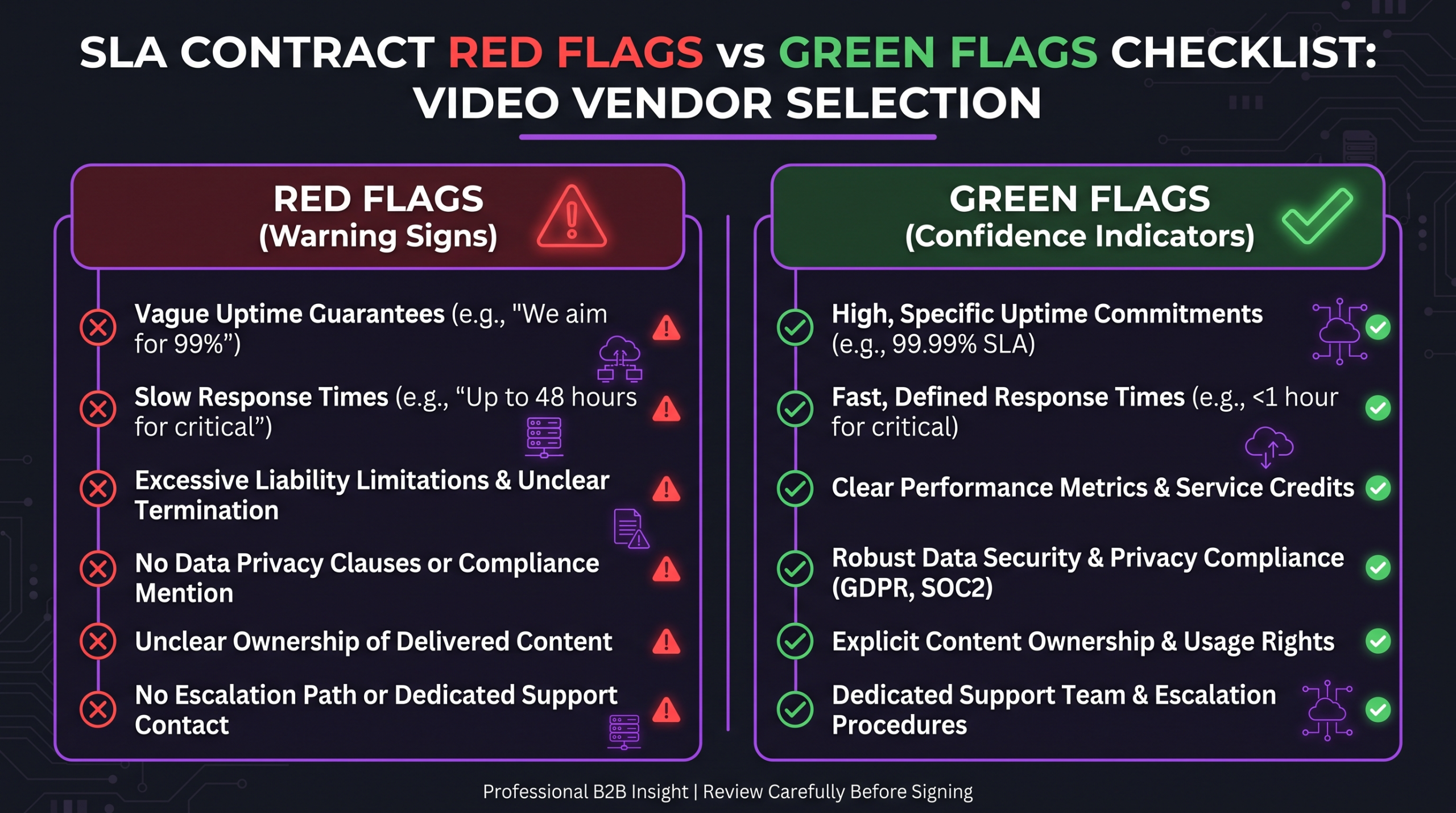
Beyond these specific clauses, pay attention to the overall structure of the contract’s accountability language. If every performance commitment is written in passive voice (“videos will be delivered”) rather than in active, accountable terms (“Vendor will deliver…”), that phrasing often signals a contract designed to preserve vendor flexibility rather than protect buyer performance expectations.
The standard SLA framework as defined by Forbes Advisor recommends that every SLA contain at minimum: a description of services, performance metrics, roles and responsibilities, issue management procedures, and remedies. A contract missing any of these sections is incomplete by the conventional standard — and should be returned for revision before signature.
How to Negotiate SLA Terms With a Video Editing Vendor
Most video editing vendors expect some level of SLA negotiation from enterprise buyers. The vendors who push back hard on all SLA language are usually the ones with the least confidence in their delivery consistency. Negotiating an SLA is not adversarial — it is the process of aligning expectations before they are tested under pressure.
Before the Contract: The Onboarding Audit
Before finalizing SLA terms, ask the vendor for three pieces of data: their average first-draft delivery rate over the past six months, their average revision cycle turnaround, and references from two clients running at a comparable volume to your program. A vendor who cannot or will not provide this data is asking you to sign performance commitments without evidence that they can meet them. That information asymmetry should be resolved before signing, not discovered in month three.
For buyers making initial vendor comparisons, Clutch’s video production directory aggregates verified client reviews with rating breakdowns that can inform your baseline expectations before you enter negotiation.
Key Negotiation Levers
The most productive SLA negotiation approach is to prioritize the clauses that matter most to your specific production context rather than trying to optimize every metric. For a team driving paid media campaigns where launch timing is business-critical, turnaround SLAs and rush delivery terms take priority. For a team building an evergreen content library where quality and brand consistency matter more than speed, quality standards and defect correction terms are the higher-priority clauses.
Practical negotiation levers that vendors are typically willing to adjust: the deemed-acceptance window (extend from 48 hours to 5 business days), the definition of a revision round (shift from draft count to feedback session), the fallback delivery method for platform outages, and the advance notice requirement before asset deletion. These adjustments carry low operational cost for the vendor and meaningful risk reduction for the buyer.
Remedies and Service Credits
A remedy clause is what transforms an SLA from a wish list to a contractual commitment. Service credits — partial fee reductions applied to the next billing cycle when defined SLA targets are missed by a threshold amount — are the standard remedy structure in service agreements. A typical structure: a 5–10% credit on the affected deliverable’s fee for a first miss, scaling upward for sustained misses, with a defined maximum credit cap per billing period.
The goal of a remedy clause is not to weaponize it — it is to create alignment between what the vendor commits to and what they are motivated to deliver. According to Harvard Business Review’s analysis of service business performance, the most effective service SLAs couple performance incentives with transparent measurement — both sides track the same metrics against the same definitions, which makes remedy application factual rather than adversarial.
💡 Negotiation tactic that works: Propose a 90-day SLA review clause — a meeting at the 90-day mark to assess actual performance data and adjust any commitments that proved unrealistic in either direction. This shows good faith, takes pressure off the initial negotiation, and gives both parties a structured process for refining the agreement based on real production data rather than pre-contract estimates.
For teams running high-output video programs, understanding the full scope of what a structured unlimited video editing service should contractually guarantee gives useful benchmarking data before entering vendor negotiations.
At Increditors, enterprise and retainer clients receive a documented SLA framework as part of every engagement — covering delivery timelines, quality standards, communication windows, and defined escalation paths. The video editing agency relationship is built to be measured, not just managed on goodwill. That is the baseline standard you should hold any vendor to when you sign a meaningful retainer.
FAQ
What is the difference between an SLA and a contract in a video editing engagement?
A contract governs the overall commercial relationship — payment terms, IP ownership, confidentiality, scope of work, and termination conditions. An SLA is a performance annex to the contract — it specifies measurable service standards and remedies for failing to meet them. Both are legally binding when properly structured, but they serve different governance functions. Many video editing contracts lack a formal SLA section, substituting vague “best efforts” language instead. Demanding a formal SLA section — or attaching one as an exhibit — closes that gap.
Can I add an SLA to an existing vendor contract, or does it require renegotiation?
In most cases, SLA terms can be added via a written amendment to an existing contract without requiring full renegotiation. The simplest approach is a signed addendum that references the master agreement and specifies the performance standards and remedies being added. Many vendors will accept SLA amendments at renewal time or when the contract is expanded — making a volume increase or renewal the natural point to introduce or strengthen SLA terms.
How do I measure SLA compliance if I do not have a dedicated vendor operations team?
The most practical approach for mid-market teams is to designate the project management tool as the system of record and require the vendor to log all submission timestamps, delivery timestamps, and revision cycle events within it. Most mature video editing vendors use Frame.io, Asana, Monday.com, or similar tools that timestamp every action automatically. A monthly SLA review meeting — 30 minutes, reviewing that month’s timestamp data — is usually sufficient to track compliance without a dedicated operations role.
What remedy is realistic to negotiate for missed turnaround SLAs?
A service credit of 5–10% of the affected deliverable’s fee for a first miss, scaling to 15–25% for three or more consecutive misses on the same deliverable type within a billing period, is a workable and commonly accepted structure. Cash remedies (refunds rather than credits) are harder to negotiate but appropriate when a delivery delay caused quantifiable downstream cost — for example, a missed paid media launch window. Establish which remedy type applies at contract stage, not when a dispute is active.
Are video editing SLAs standard practice, or are they unusual to request?
SLA language is increasingly expected in retainer agreements above a certain spend threshold, particularly among enterprise buyers accustomed to SLA-governed SaaS and professional services contracts. Vendors operating at the premium end of the market — those with structured production workflows, dedicated account management, and documented quality processes — will typically view an SLA request as a signal of a sophisticated, long-term buyer. Vendors who resist any SLA discussion are usually those whose delivery consistency would not survive objective measurement.
Verdict: What a Strong Video Editing SLA Should Guarantee
A video editing SLA that actually protects your content program covers six domains: turnaround time by video type with an on-time delivery rate commitment; revision cycle windows with a clear round definition; technical and creative quality acceptance criteria; file delivery infrastructure with fallback provisions; asset retention obligations; and a remedy structure with defined service credits.
Most vendor contracts in market today address at most two or three of these domains, and usually with language that protects the vendor rather than the buyer. The gap between what is standard and what is appropriate for a professional content program is significant — and it is entirely closable through informed negotiation before the contract is signed.
The practical starting point: take the six core SLA metrics from section two of this guide, the quality standards framework from section four, and the red-flag checklist from section six into your next vendor negotiation. You do not need to demand everything; you need to demand the clauses that directly govern the performance dimensions most critical to your specific content program. A vendor worth working with at scale will recognize that as a sign of a buyer who takes the partnership seriously — because it is.
For additional context on evaluating vendors beyond the SLA, Wistia’s video content strategy guide provides useful framing for how production quality and delivery reliability connect to downstream content performance — which ultimately drives the business case for investing in a premium, SLA-governed vendor relationship.
Ready for Video That Actually Converts?
Tell us about your project and we will put together a custom plan.