








![3D Explainer Video - ScribbleLive.mp4_snapshot_00.12_[2022.03.09_03.14.16]](https://increditors.com/wp-content/uploads/elementor/thumbs/3D-Explainer-Video-ScribbleLive.mp4_snapshot_00.12_2022.03.09_03.14.16-r7wb53mx72rxst3qcqyrfxdmeyzb5r9jbl0wbjujh4.png "3D Explainer Video – ScribbleLive.mp4_snapshot_00.12_[2022.03.09_03.14.16]")





























Investor pitch videos and IR communications have moved from nice-to-have to table stakes in modern fundraising and public company relations. Professional video editing — precise pacing, motion graphics, branded templates, and pristine audio — signals credibility before a single word lands. This guide covers every video format that matters for investor audiences, the production workflow that keeps IR teams on schedule, and the editing decisions that convert skeptical viewers into believers.
- Why Investor Relations Video Is Now a Baseline Expectation
- The Core Video Formats Every IR Team Needs
- What Professional Editing Actually Delivers for Pitch Videos
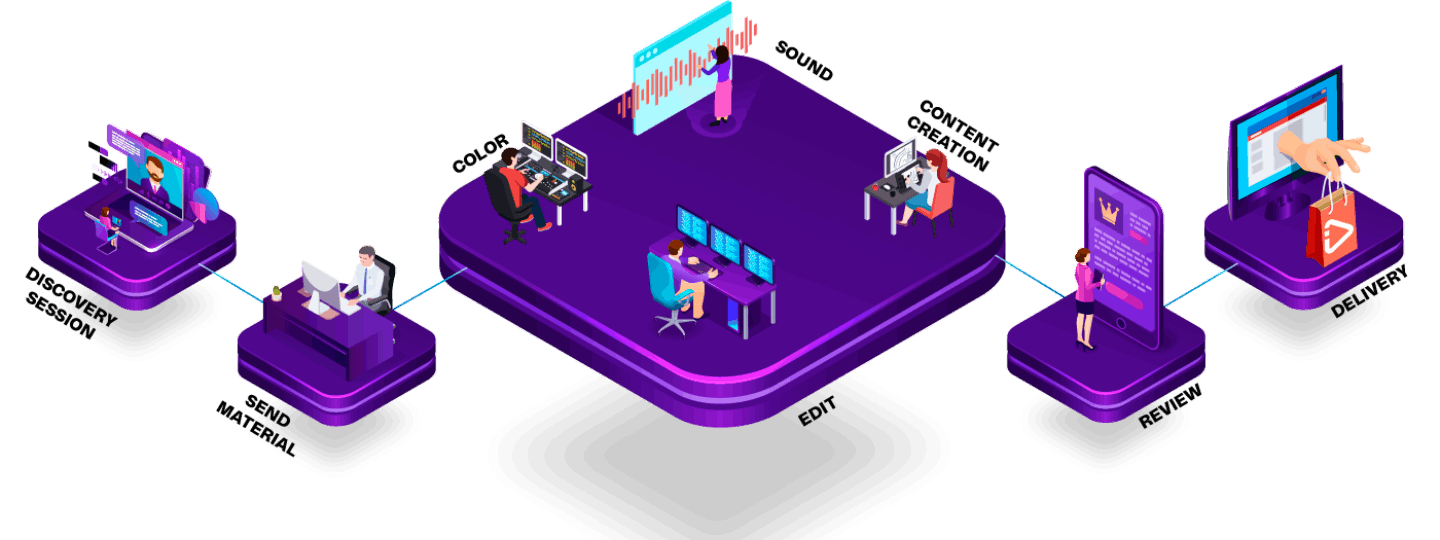
- The IR Video Production Workflow: Brief to Approved Asset
- DIY vs. Agency-Edited Investor Videos: A Realistic Comparison
- Common Mistakes That Sink Investor Pitch Videos
- Choosing the Right Video Editing Partner for IR Content
- FAQ
- Verdict
Why Investor Relations Video Is Now a Baseline Expectation
Capital allocators — venture partners, limited partners, institutional portfolio managers, and retail shareholders — consume more video per quarter than at any prior point in financial history. The shift is structural, not stylistic. A decade ago, a well-formatted PDF pitch deck was a competitive advantage. Today it is the minimum acceptable format. Founders raising a Series A and CFOs preparing for earnings season now share the same problem: how do you make a video that earns trust fast enough to survive a distracted viewer’s first thirty seconds?
The answer is not better camera equipment. Most investor-facing raw footage is already shot at broadcast quality on managed sets or polished Zoom recordings. The answer is editing — the decisions made in post-production that determine whether a 12-minute pitch video holds attention or loses it at minute three.
The Shift From Decks to Video in Capital Markets
Investor relations communications have always involved video — earnings call recordings, AGM broadcasts, roadshow presentations. What has changed is the expectation around production quality and the channels through which IR content is distributed. Investor relations pages now routinely host edited highlight reels alongside full-length event recordings. VC and PE firms share portfolio pitch videos with their LPs as part of the investment memo package. Public companies produce short-form ESG video summaries alongside their annual reports.
Published platform data from providers like Wistia’s annual state of video benchmarks consistently shows that engagement drops sharply for business video beyond the six-to-eight minute mark unless the pacing, visual variety, and chapter structure are handled carefully in post-production. Investor pitch content is among the highest-stakes video a company will ever produce — and it lives or dies on those same editing fundamentals.
What LPs, VCs, and Institutional Investors Actually Watch
The audience for investor pitch video is not passive. A general partner at a mid-market VC firm may review dozens of pitch decks and accompanying materials per week. In that context, a poorly paced video — shaky cuts, awkward silences, a founder’s “um” left in, a data slide held for twenty seconds without visual support — reads as disrespect for the viewer’s time and a proxy for operational sloppiness. Conversely, a polished, well-paced pitch video signals that the founder or IR team has the judgment to manage execution details, which is exactly what investors are trying to assess.
Public company IR teams face a different but equally demanding audience: analysts, institutional holders, and retail investors who compare your earnings call highlights against every other company competing for the same capital. The quality of the edit is not cosmetic — it is competitive positioning.
The Core Video Formats Every IR Team Needs
Not every investor-facing video has the same brief, audience, or distribution channel. Understanding the distinct formats — and the editing approach each one demands — is the prerequisite for producing IR video that actually works.
Pitch Videos and Company Overview Reels
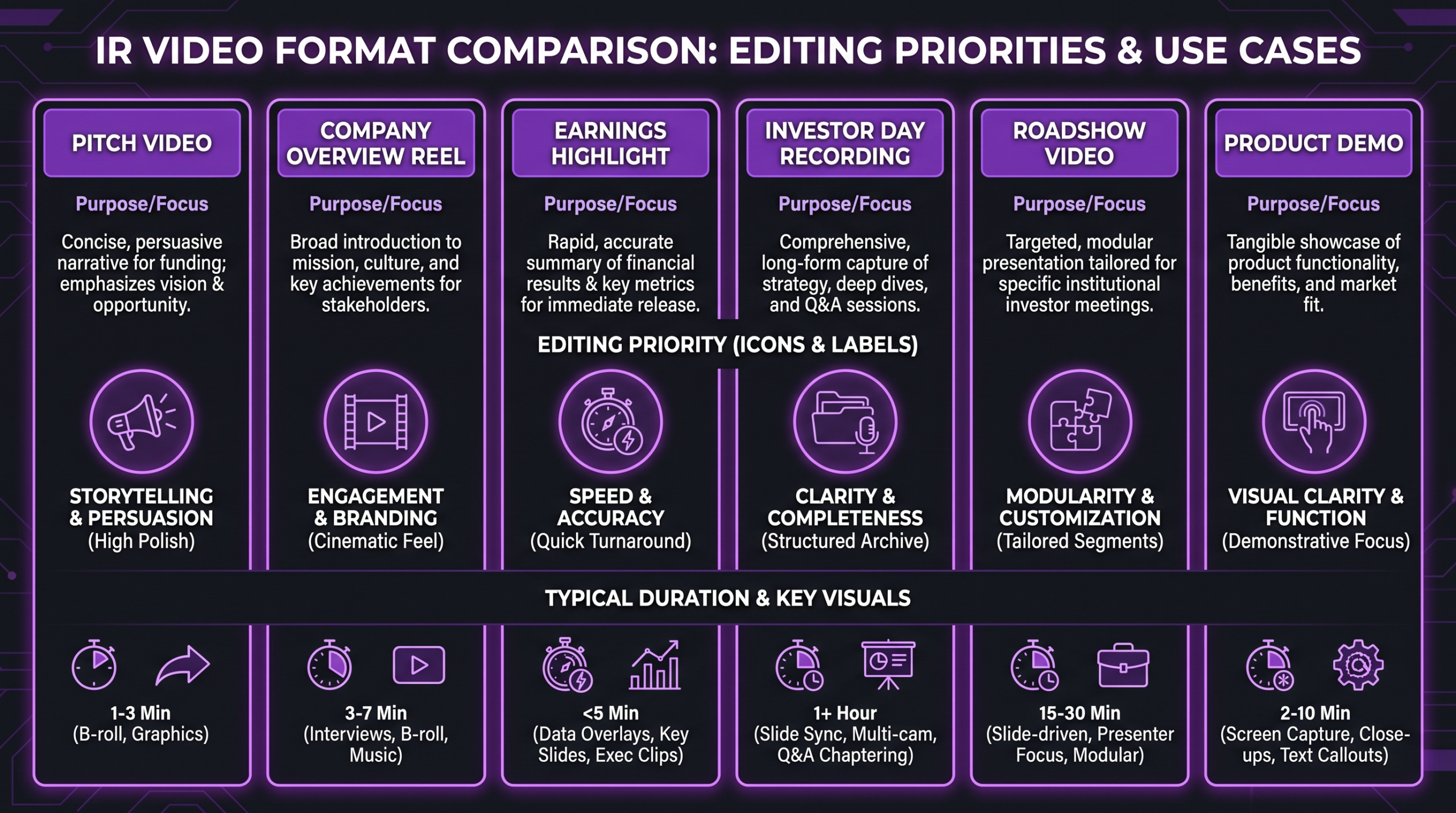
The pitch video is the highest-stakes format. Typically two to five minutes for early-stage companies (shorter gets cleaner), it must compress the problem, the solution, the traction, the team, and the ask into a single narrative arc that sustains attention without losing density. Editing priorities: ruthless cut on dead air and stumbles, clean lower-thirds identifying speakers, animated data slides replacing static screenshots, and a consistent brand frame that signals professionalism throughout.
The company overview reel serves a different moment — it lives on the website’s investor relations page, in email outreach sequences, and in LinkedIn campaigns. It is typically 60 to 90 seconds and optimised for silent autoplay, which means text overlays and animated graphics carry much of the narrative load. Editing for silent-first distribution requires a fundamentally different approach than editing for a presentation context where audio is guaranteed.
Earnings Call Recordings and Highlight Reels
Public companies are required under SEC guidance to make certain earnings communications available, and many now publish recorded calls alongside transcripts. Raw earnings call recordings are often 60 to 90 minutes of management commentary and analyst Q&A. The edited version that most investors actually watch is a 5-to-8 minute highlight reel: key guidance excerpts, notable analyst exchanges, and visually supported financial summary slides.
The editing challenge here is selection and framing — which moments convey the quarter’s narrative faithfully, without distorting context? IR teams that invest in professional editing for their earnings highlights reduce the risk of a carelessly selected quote landing out of context, which is both a regulatory concern and a communications one. Full guidance on earnings call disclosure requirements is available through the SEC’s investor relations disclosure guidelines.
Investor Day and Roadshow Content
Investor day presentations — long-form, multi-speaker events held annually or around significant company milestones — are among the most complex IR video productions. A full-day event produces six to ten hours of raw footage across multiple sessions, speakers, and presentation formats. Professional post-production converts that into a modular library: a full-event recording, per-session standalone videos, a 10-minute executive summary, and social-ready clips for LinkedIn and investor newsletters.
Roadshow videos serve a pre-meeting function: they give potential investors context on the company before a live call, which makes those conversations more efficient. Roadshow video editing typically involves tight pacing, heavy use of animated data visualization (revenue trajectories, market size, competitive positioning), and clean speaker graphics.
Product Demos for Financial Due Diligence
Increasingly, early-stage investor packages include edited product demo videos as part of the due diligence materials provided to serious prospects. These are distinct from the marketing-oriented demo reel — they are more technical, more detailed, and often include narrated walkthroughs of the product’s core workflows. Editing priorities: clean screen capture integration, voiceover sync, and chapter markers that let investors navigate to the sections relevant to their questions.
💡 Pro Tip: Structure your IR video library modularly from the start. A well-edited investor day becomes six different assets — full recording, per-session cuts, executive summary, social clips, IR page embed, and analyst highlight reel — without any additional shooting. The editing investment multiplies across every distribution channel you serve.
What Professional Editing Actually Delivers for Pitch Videos
Professional editing is not a cosmetic upgrade. For investor-facing content, it directly influences whether a viewer stays engaged long enough to act — requesting a meeting, reading the deck, or continuing through the due diligence process.
Signal Quality and Credibility
Production quality functions as a credibility signal in investor contexts in a way that has no direct parallel in consumer marketing. When a founder presents a polished, precisely edited pitch video, it communicates resource management competence — the team knows how to allocate limited resources (time, budget, attention) toward maximum effect. A video with jump cuts left in, colour inconsistency between clips, or a buzzing audio track signals the opposite.
This halo effect is well-documented in investor psychology literature. Harvard Business Review’s research on pitch effectiveness consistently surfaces first-impression cues as disproportionately influential in the initial investment decision — and video production quality is among the most visible of those cues.
Motion Graphics and Data Visualization
Investor pitch content is inherently data-heavy — revenue trajectories, market size models, unit economics, competitive positioning matrices. Static slide screenshots dropped into a video timeline do not communicate data effectively. Professional editors animate these transitions: numbers count up, graphs draw from left to right, bar charts build bar by bar. These are not decorative choices — animated data presentation has consistently been shown in UX research to improve comprehension and recall versus static equivalents.
Motion graphics for IR content also include consistent lower-third design for speaker identification, branded chapter cards between sections, and animated logos that signal corporate identity without consuming screen time unnecessarily.
Branded Templates for IR Consistency
Public companies and VC-backed startups alike benefit from a standardised IR video template — a set of branded frame elements, transitions, colour treatments, and typography that creates visual continuity across every investor-facing video produced throughout the year. This is not a luxury reserved for Series C and beyond. A well-designed template set, built once by a professional editor, serves every subsequent earnings call, roadshow video, and investor day reel at near-zero marginal design cost.
Working with a specialist video editing agency to establish this template early in a company’s growth stage pays dividends across every investor communication touchpoint for years. The consistency signals institutional-grade operations at a stage when many investors are still assessing whether the team executes reliably.
The IR Video Production Workflow: Brief to Approved Asset
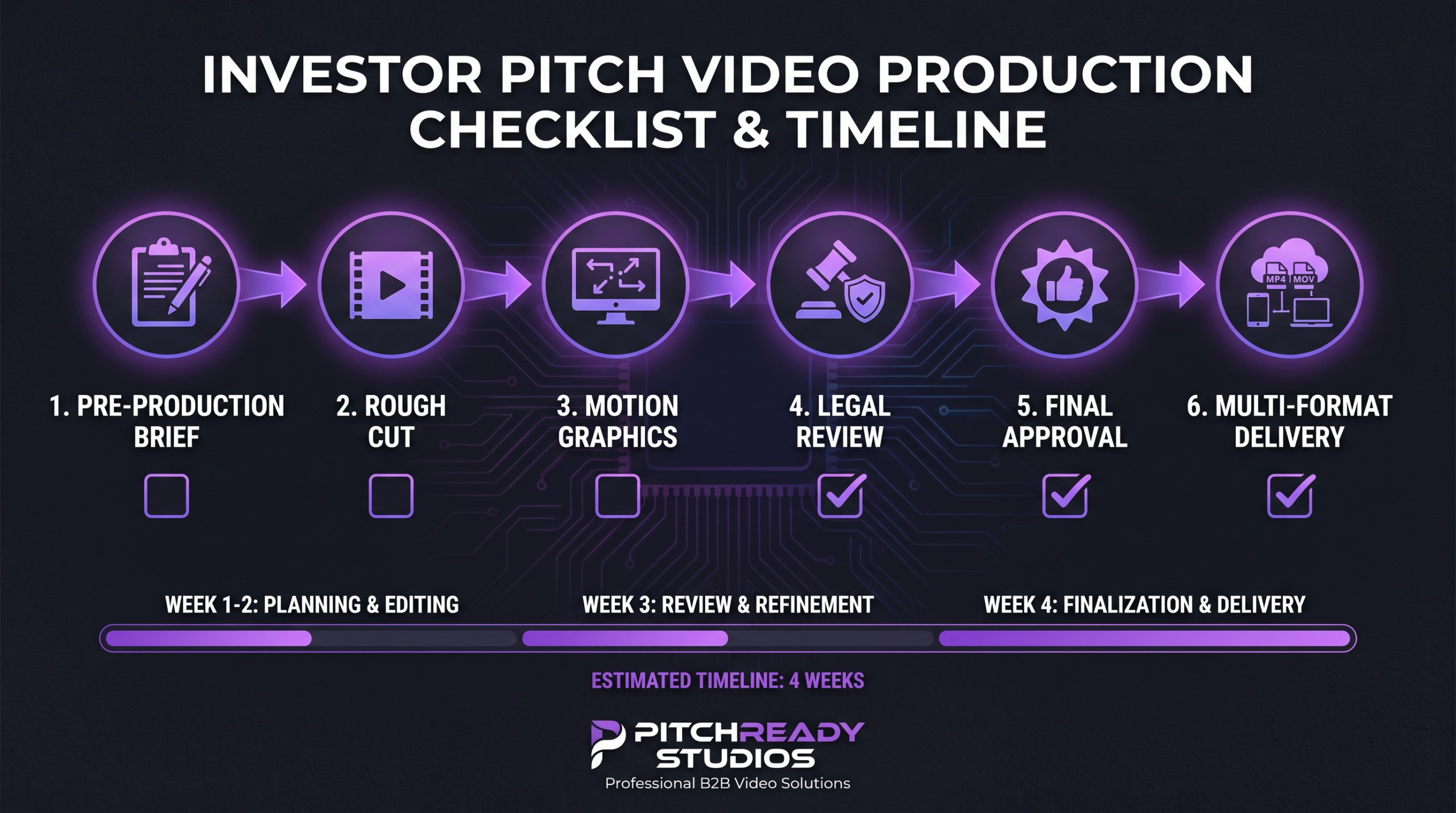
Investor relations video operates under tighter constraints than marketing video: regulatory sensitivity, approval chains that include legal and compliance, hard deadlines tied to earnings calendars, and zero tolerance for factual errors. A functional IR video production workflow accounts for all of these from day one.
Pre-Production: Brief and Asset Preparation
The brief for investor pitch video is more formal than a typical marketing brief. It should specify: the audience (early-stage investors, existing LPs, sell-side analysts), the deployment context (live presentation, async email, investor page embed), the approved data points and their exact sourcing, any legally sensitive language restrictions, and the approval workflow with named stakeholders at each stage. An editing partner who has worked on regulated-industry content will have a brief template for this; a generalist editor may not.
Asset preparation includes gathering all raw footage, transcript-approved speaker clips, final slide decks in their final approved versions, and any stock footage or graphics assets. IR editing projects with incomplete assets at brief stage routinely run 40-60% longer than necessary — the delay is almost always traced back to missing approved materials rather than editing time.
The Edit: Structure, Pacing, and Review Rounds
A professional IR edit typically follows a three-stage review structure. Stage one: rough cut with basic structure and clip selection — reviewed by the internal IR lead for narrative accuracy and completeness. Stage two: fine cut with motion graphics, lower thirds, and audio correction — reviewed by the communications team and legal/compliance for any sensitive language or data presentation concerns. Stage three: final approval cut — typically reviewed by a C-suite stakeholder before delivery.
Each review round should be managed through a platform that supports timestamped comments (Frame.io is the industry standard for professional video review). This eliminates the email thread problem — scattered feedback that arrives in five separate messages hours apart, creating version confusion and doubling revision time.
Delivery Formats and Distribution Requirements
IR video typically needs to be delivered in multiple formats simultaneously: a broadcast-quality master (H.264 or H.265, 1080p minimum), a web-optimised version for the investor relations page embed, a compressed version for email attachment or Dropbox link, and — increasingly — vertical-format cuts for LinkedIn and financial Twitter/X distribution. A professional editor who understands distribution requirements can export all versions from the same final cut without a separate project, saving the IR team meaningful time at the end of what is usually already a crunch period.
Understanding the full cost of professional video editing — including revision rounds, rush fees, and multi-format delivery — is essential for IR teams budgeting at the start of an earnings cycle. Surprises here tend to cascade into approval delays.
DIY vs. Agency-Edited Investor Videos: A Realistic Comparison
Many IR teams attempt to handle post-production in-house — either through a marketing generalist with some video experience, or through a subscription editing tool. Here is an honest comparison of what you trade off at each level:
The right answer depends on volume and stakes. For a startup producing one or two investor videos per year, a capable freelancer with IR experience is often the most efficient path. For a public company managing quarterly earnings releases, an annual investor day, and ongoing roadshow materials, a dedicated editing partner with a persistent template library is meaningfully more efficient — and the risk of the wrong freelance choice during an earnings-sensitive period is higher than the cost differential justifies.
Here is a quick reference for editing priorities by video format, to help IR teams brief their editors correctly from the first conversation:
Common Mistakes That Sink Investor Pitch Videos
Most investor pitch video problems trace back to a small set of avoidable editing errors. Understanding these before the project starts is more valuable than any amount of rework after delivery.
Pacing and Length Errors
The most common investor pitch video error is length: pitches that run 10, 12, or 15 minutes when the narrative content justifies five. The extra length typically comes from unedited pauses, repeated points, and data slides held on screen with no visual support while a founder explains numbers that are not changing. Professional editors cut to the minimum viable version first — the version that delivers the full narrative without padding — and then add back only what demonstrably improves comprehension or credibility.
Pacing errors are subtler but equally damaging. A pitch video that cuts too fast between ideas gives investors no time to absorb data points. One that holds on a talking head for forty seconds with no visual change loses attention by the third quarter. Professional editing calibrates pacing to the density of each section: fast cuts for context-setting montages, slower pacing for complex data points that require viewer processing time.
Audio Quality Failures
Investor pitch videos are frequently recorded in conditions that produce usable but imperfect audio: home offices with HVAC hum, conference rooms with reverb, Zoom recordings with compression artifacts. Investors tolerate a lot in the visual channel — they understand founders are not running a film studio. They tolerate very little in the audio channel. Difficulty understanding speech is the fastest route to abandonment.
Professional audio restoration (noise reduction, de-reverberation, normalisation, de-essing) is a standard component of investor video editing that is frequently skipped in DIY and inexperienced freelance production. The result is videos that sound amateurish even when the content is excellent. Audio post-production consistently delivers more ROI per dollar spent than any equivalent visual upgrade for text-and-speaker-dominated IR content.
Missing or Static Data Visualisation
Investor audiences are analytical. They respond to well-presented data and they notice when data is presented carelessly. Dropping a screenshot of a PowerPoint slide into a video timeline — especially a complex financial model or market size chart — is one of the most common investor pitch editing errors. At video resolution, the text on those slides is often illegible. The slide’s design language typically clashes with the video frame. And a static image held on screen has no natural endpoint, leading editors to hold it for too long and compound the pacing problem.
Professional editors rebuild key data slides as animated motion graphics: legible at video resolution, animated to guide the viewer’s attention through the data sequentially, and timed to the speaker’s narration. This is not a luxury for high-budget productions. It is a standard production practice for any investor-facing video that contains financial or market data.
💡 Pro Tip: Before your first edit review, send your editor the approved data slide files in their original format (PowerPoint or Keynote), not as screenshot exports. This lets the editor animate elements individually rather than treating the whole slide as a single static image — and the result is dramatically more professional at no additional production cost.
Choosing the Right Video Editing Partner for IR Content
Selecting an editing partner for investor-facing content requires different criteria than selecting one for a marketing campaign. The risk profile is different, the approval complexity is different, and the audience’s tolerance for errors — in data, in attribution, in tone — is substantially lower.
What to Look for in an IR Video Editing Partner
Experience with regulated or high-stakes content. Editors who have worked on financial services, legal, healthcare, or enterprise B2B content understand approval workflows, version control under legal scrutiny, and the kind of conservative data framing that keeps compliance departments comfortable. Ask for examples from similar industries; a showreel of consumer brand edits tells you very little about their IR capability.
Motion graphics capability in-house. Data-heavy IR content requires animated data visualisation as standard. If your editor outsources motion graphics or uses pre-built templates that cannot be customised to your brand, you will hit a quality ceiling quickly. Confirm that motion design is a core capability of the team, not an occasional add-on.
Structured review process. Ask specifically how they handle multi-stakeholder review cycles. Experienced partners will reference a specific platform (Frame.io, Wipster, or similar) and a clear versioning protocol. An editor who describes their review process as “I send you the file and you send back notes” is not set up for IR-grade approval chains.
Template and library management. For companies producing recurring IR content (quarterly earnings, annual investor day), ask whether the partner maintains a persistent template library. A partner who builds your branded template once and maintains it across every subsequent project saves the IR team meaningful briefing time and ensures visual consistency without re-briefing each quarter.
For B2B and enterprise video teams that need a dedicated senior editor, persistent brand templates, and a structured review workflow, a specialist partner like Increditors — with experience across high-stakes B2B video production — is worth evaluating against the freelance and in-house alternatives. Their approach to high-value B2B video editing translates directly to the investor communications context.
Questions to Ask Before Signing a Contract
Before committing to any editing partner for IR content, get clear answers to these questions:
1. How many revision rounds are included, and what defines a revision? IR content commonly requires more revisions than marketing content — legal and compliance will find issues in round two that were not visible in round one. Understand whether a single line of dialogue being recut counts as a revision.
2. What is your turnaround SLA during earnings periods? Earnings video deadlines are hard. An editor who can normally deliver in five days but cannot commit to a 48-hour turnaround for an urgent earnings highlight reel is a liability during the periods you most need them.
3. Who owns the assets — project files, motion graphics templates, brand elements? Ensure that your organisation retains ownership of all deliverables including project files, so that a change of editing partner does not mean rebuilding your entire template library from scratch.
4. How do you handle confidential pre-announcement data? Earnings data, M&A communications, and fundraising materials are frequently MNPI (material non-public information) at the time of editing. Confirm that the partner has a clear confidentiality protocol and that all team members with access to your content are under NDA.
Industry benchmarking reports from organisations like the National Investor Relations Institute (NIRI) and IR Magazine provide useful baseline standards for IR communications quality that can inform what you expect from your editing partner’s output. For reference on video engagement benchmarks across B2B contexts, LinkedIn’s B2B video research offers data directly relevant to the investor audience distribution channels most IR teams are now using. You can also review a broader set of video editing agency vs. freelancer trade-offs before finalising your resourcing decision.
FAQ: Video Editing for Investor Pitches and IR
How long should an investor pitch video be?
For early-stage companies pitching VCs or angels, two to four minutes is the standard for an async pitch video. The goal is to earn the meeting, not replace it. Roadshow videos for later-stage or public company contexts can run 8 to 15 minutes because the audience has opted in and expects a more thorough presentation. If your draft runs longer, edit for narrative density first — every minute that can be cut without losing essential information should be cut.
What is the difference between a pitch video and an IR video?
A pitch video is primarily used by private companies raising capital from VCs, angels, or strategic investors — it is a fundraising tool. Investor relations (IR) video encompasses a broader set of communications produced by public companies (or late-stage privates) for their existing and prospective shareholders: earnings highlights, investor day recordings, roadshow presentations, ESG summaries, and annual report video assets. The production and editing standards overlap significantly, but IR video carries additional regulatory and disclosure considerations that fundraising pitch video typically does not.
Does video editing quality actually influence investment decisions?
Directly, no — investors do not fund companies because their videos are well-edited. Indirectly, yes — production quality functions as a signal about the team’s operational standards and attention to detail. A rough, disorganised pitch video raises questions about execution quality that a founder then has to work harder to resolve in the live conversation. A polished, well-paced video removes that friction. The better question is: what is the cost of the edit versus the cost of a potential investor’s early negative impression?
How do I handle confidential financial data in investor pitch video production?
Any earnings data, fundraising round details, or unannounced financial results shared with an editing partner before public announcement should be governed by a signed NDA. Provide materials under NDA in a secure shared environment (not unencrypted email), and establish clear instructions about who has access to the project within the editing team. Professional agencies handling enterprise B2B content should have a standard confidentiality protocol already — if a prospective partner does not raise this topic proactively, that is a signal worth weighing.
What budget should we expect for professional investor pitch video editing?
Editing budgets for investor pitch and IR video vary widely depending on length, complexity, and turnaround requirements. A polished 3-minute pitch edit with motion graphics and audio restoration from a professional editor or agency commonly starts in the range of a few thousand dollars; a full investor day post-production package (multi-session editing, modular library, branded template creation, multi-format delivery) will be substantially more. The relevant reference point is not what the edit costs, but what the raise is worth — and how many meetings a stronger first impression unlocks. Detailed market benchmarks are covered in our guide to professional video editing costs.
Verdict: Editing Is Not Optional for High-Stakes Investor Content
Investor pitch videos and IR communications are among the highest-leverage content a company can produce. They reach audiences that make capital allocation decisions, and those audiences assess quality signals rapidly and often unconsciously. Professional editing — tight pacing, clean audio, animated data visualisation, brand-consistent templates, and a structured review workflow — is not a premium option for well-resourced companies. It is the baseline standard for any team that wants their video to do the job it was made to do.
The choice is not between polished and functional. It is between video that earns the next conversation and video that loses the viewer before it gets the chance. For IR teams managing quarterly earnings cycles and founders preparing to raise their next round, the editing decision is a strategic one — and it is worth getting right the first time.
Ready for Investor Video That Actually Converts?
Tell us about your investor pitch or IR video project and we will put together a custom production plan.