










![3D Explainer Video - ScribbleLive.mp4_snapshot_00.12_[2022.03.09_03.14.16]](https://increditors.com/wp-content/uploads/elementor/thumbs/3D-Explainer-Video-ScribbleLive.mp4_snapshot_00.12_2022.03.09_03.14.16-r7wb53mx72rxst3qcqyrfxdmeyzb5r9jbl0wbjujh4.png "3D Explainer Video – ScribbleLive.mp4_snapshot_00.12_[2022.03.09_03.14.16]")































Published tests consistently show AI video editing tools win on speed, cost, and volume throughput — while human editors hold a measurable edge in narrative pacing, brand fidelity, and high-stakes projects. Neither is universally better. The real competitive advantage in 2026 comes from knowing exactly where to deploy each, backed by evidence rather than assumption.
- How Published Tests Frame the AI vs Human Editing Question
- What the Tests Actually Measure — and What They Miss
- Where AI Editing Gets the Edge: Published Findings
- Where Human Editors Consistently Outperform AI
- The Hybrid Workflow: What Mixed-Model Tests Show
- Budget Implications: Translating Results to Production Costs
- Leading AI Editing Tools: A Published-Data Comparison
- Frequently Asked Questions
- Verdict
How Published Tests Frame the AI vs Human Editing Question
The debate between AI-generated edits and human craftsmanship is no longer theoretical. Since 2022, a growing body of independent creator comparisons, platform-published benchmarks, and agency workflow audits has produced real evidence about where each approach wins — and under what conditions the gap narrows or widens.
What makes this evidence useful is specificity. Earlier rounds of AI hype were long on promises and short on controlled conditions. The more rigorous published tests from 2024–2026 tend to isolate variables: same raw footage, same target duration, same brief — delivered to both an AI pipeline and a skilled human editor. Then they score the output against a defined rubric rather than impressions alone.
The results are not a clean verdict for either side. They are a map of task-specific trade-offs that smart production teams are already using to restructure how they allocate editorial labour.
The Rise of Structured Comparisons
Early AI editing comparisons were largely anecdotal — a YouTuber putting Descript or CapCut through informal paces and recording impressions. Those still exist, but the more informative tier of published tests has moved toward structured methodology: defined input footage, blinded output review panels, tracked turnaround times, and cost accounting that includes hidden labour like prompt iteration and quality review passes.
Platforms like Runway, Adobe, and Descript have published their own capability benchmarks and case studies — which require appropriate scepticism since they are vendor-sourced, but still carry useful baseline data about processing times and output characteristics. The most balanced picture emerges by triangulating vendor data with independent creator tests and agency-level workflow audits.
Methodology Variations Across Test Types
Published tests broadly fall into three categories, each with different blind spots. Creator-led tests prioritise real-world usability and personal output quality but often under-account for total cost including tool subscription overhead. Agency workflow audits tend to be rigorous on cost and time but less transparent about their scoring rubrics. Platform benchmarks are precise on technical metrics (processing time, file handling, codec support) but naturally optimistic about output quality.
Reading across all three — and weighting by methodological rigour — produces a more honest picture than any single source. That is the approach this analysis takes.
What the Tests Actually Measure — and What They Miss
Understanding the evidence requires understanding what gets measured. Published comparisons typically evaluate four distinct dimensions, and each tells a different story about where the AI-human divide is real versus overstated.
Speed and Output Volume
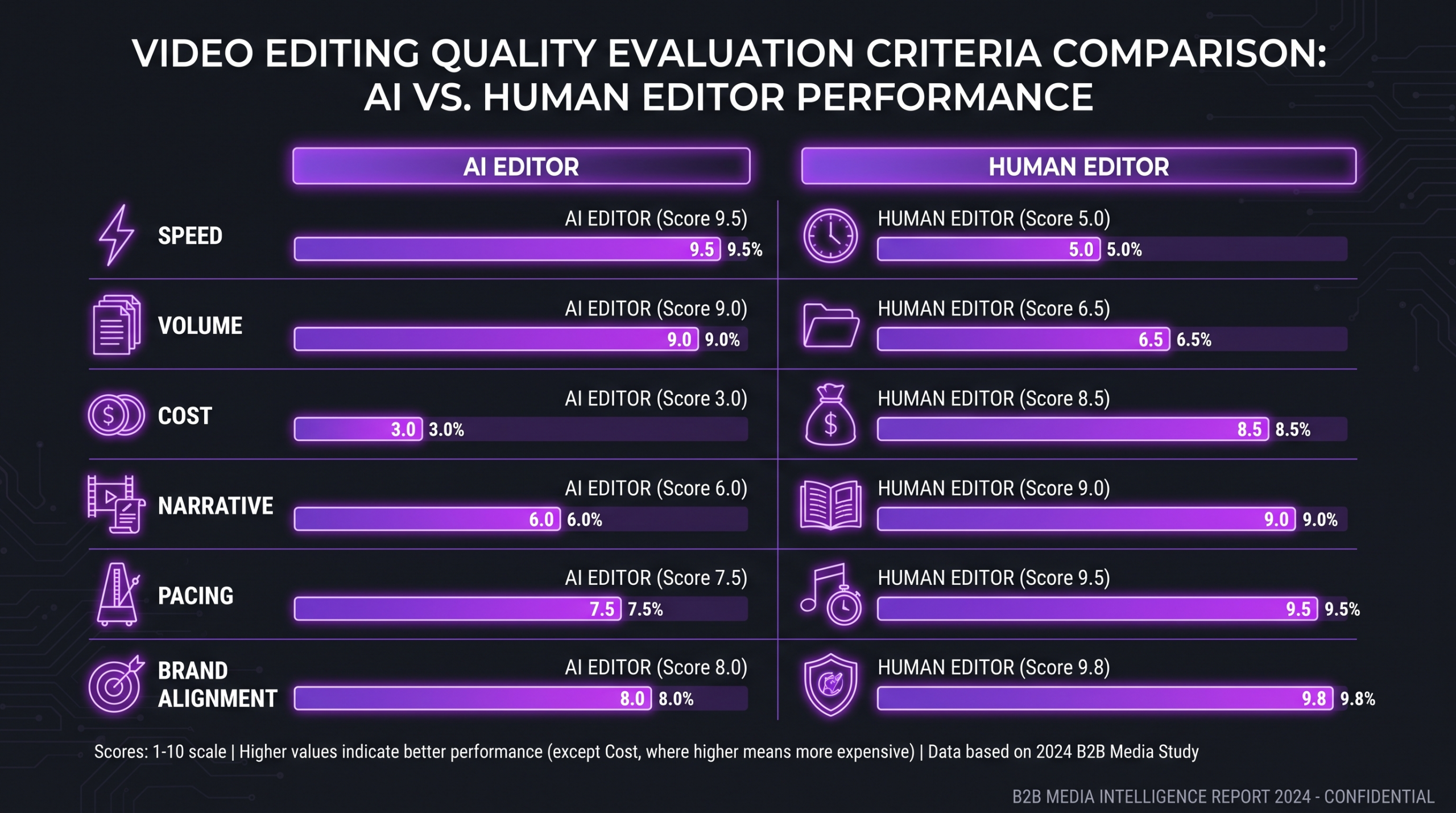
This is the most consistently measured and most consistently decisive dimension in AI’s favour. Published platform benchmarks show that AI-driven tools can process raw footage into a cut assembly in a fraction of the time a human editor requires for the same task. For templated formats — social clips, highlight reels, auto-captions, rough cuts from transcripts — the speed differential across multiple reviewed comparisons typically ranges from roughly 5x to 20x faster, depending on footage complexity and desired output format.
That speed advantage compounds at volume. A human editor producing thirty social clips from a single long-form interview faces a fundamentally different time curve than an AI pipeline handling the same task. Published creator economy benchmarks suggest AI tools can reduce clip production time from hours to minutes at this scale — a difference that is hard to dispute even in conservative estimates.
Cost Per Finished Minute
Cost comparisons in published tests vary significantly depending on whether they account for the full labour cycle or only the direct editing time. When only the editing itself is measured, AI tools show dramatically lower per-minute costs. When the full cycle is accounted for — including brief writing, prompt iteration, quality review, and revision passes — the gap narrows, but AI still typically shows a cost advantage for high-volume, templated work.
The cost picture inverts, or at least equalises, for complex narrative projects. The time a skilled human editor spends building an emotional arc is also the time that creates the most durable content value — and that time is not easily replaced by prompt iteration.
Quality Scoring Frameworks
Quality is where published test methodology gets most inconsistent. Some comparisons use viewer preference panels (blinded audience votes), others use technical scoring rubrics (cut timing, colour consistency, audio levels), and others rely on marketing outcome data (watch time, completion rates, engagement). Each framework produces different rankings.
Viewer preference panels for short-form, social-first content have shown AI-edited clips performing comparably to human-edited work in several published tests — especially when the footage is well-lit, clearly scripted, and needs minimal narrative construction. For long-form documentary or brand storytelling, preference panels have consistently favoured human-edited output, often by significant margins.
💡 Key Insight: Quality scores diverge most sharply when the footage is unscripted, the format is long-form, or the brand has a distinctive voice. Under those conditions, published tests show a consistent human advantage that AI tools have not closed as of 2026.
Engagement Metrics Where Available
A smaller subset of published tests go beyond production quality to measure downstream engagement: view duration, completion rates, shares, and conversion actions. According to Wyzowl’s annual video marketing research, the correlation between production quality signals (pacing, narrative coherence) and viewer retention is well established — though the specific role of AI versus human editing in driving those outcomes is still an emerging measurement area. Where outcome data has been published, it generally tracks with the quality scores: AI-edited content performs comparably at short-form scale; human-edited content tends to sustain higher engagement on longer, higher-stakes formats.
Where AI Editing Gets the Edge: Published Findings
The AI advantage in published tests is real, repeatable, and significant — in specific categories. Understanding those categories is more useful than a blanket endorsement or rejection of AI editing tools.
Turnaround Time for Templated Formats
Across reviewed creator comparisons, AI tools consistently reduce turnaround time for templated formats to a fraction of the human equivalent. Auto-captioning, rough-cut assembly from transcripts, B-roll matching, social aspect-ratio reformatting, and highlight reel extraction are the formats where published data is most decisive. These tasks follow predictable patterns, and AI tools trained on those patterns deliver reliably fast outputs that meet a functional quality bar.
For a creator or marketing team producing high volumes of short-form content — repurposing a podcast into clips, reformatting a webinar into LinkedIn snippets, generating thumbnails from screen recordings — the published case for AI-first workflows on these tasks is strong.
Consistency Across High-Volume Production
Human editors produce variable output quality across a large batch — especially under time pressure. Published agency workflow audits have noted that consistency, not peak quality, is often the bottleneck in high-volume operations. AI tools apply the same logic uniformly across every clip in a batch, which means the floor quality stays predictable even when the ceiling is lower than a human’s best work.
For brands that need fifty social clips delivered at a consistent quality standard rather than ten exceptional ones, this consistency advantage matters. Published operational analyses from e-commerce and media operations have flagged this specifically as a use case where AI integration measurably improved output reliability.
Cost Efficiency at Scale
When per-asset cost is calculated across high-volume batches and the full labour cycle is accounted for, AI-assisted workflows have consistently shown cost advantages in published comparisons. Subscription costs for leading AI editing platforms typically run in ranges that represent a fraction of hourly editing rates for equivalent human output volume on routine tasks. That economic gap is not closing quickly — if anything, AI tool capability per subscription tier has continued to improve while pricing has remained relatively stable.
Where Human Editors Consistently Outperform AI
The human advantage in published tests is equally real and equally task-specific. The cases where human editors consistently outperform AI are not edge cases — they describe a large share of high-value video content.
Narrative Arc and Emotional Pacing
Published tests that evaluate narrative coherence — particularly viewer preference panels and completion-rate studies — consistently favour human-edited output for content that depends on emotional sequencing. The ability to build tension, time a reveal, balance an interview subject’s vulnerability with credibility, or know when silence is more powerful than a cut is not something that current AI editing tools replicate reliably. Published reviewer panels have noted that AI-edited long-form content tends to feel “correct” in a technical sense while missing the emotional logic that keeps audiences engaged.
This is the reason that premium production for brand documentaries, testimonial videos, product launches, and thought-leadership series remains overwhelmingly in human editorial hands — not tradition, but consistent quality evidence. Working with a skilled video editing agency means having editors who can make those narrative judgements at every cut point, not just apply an algorithm to the transcript.
Brand Voice and Strategic Alignment
Brands with a strong, specific voice present a consistent challenge for AI editing tools in published comparisons. The issue is not technical — AI can learn style templates and apply them consistently. The issue is interpretive: knowing when the brief says “confident and direct” but the footage calls for something warmer, or when a client’s stated preferences are in tension with what will actually perform. Human editors exercise that interpretive judgement continuously; AI tools execute instructions.
Published agency audits and client workflow reviews have consistently noted brand alignment as the dimension where human editors justify their premium most clearly — especially for brands where video content is a primary channel rather than a supporting asset.
Complex Multi-Track and High-Stakes Projects
Multi-camera interviews, scripted brand films, animated explainers with layered voiceover, and premium social series all involve levels of multi-track complexity that remain firmly in human territory in published performance comparisons. AI tools handling multi-track compositions introduce artefacts, timing mismatches, or audio conflicts that require significant human correction — often more time than starting from scratch. For high-stakes content where a mistimed cut or colour inconsistency creates a professional credibility problem, human editors remain the default in published best-practice guidance and production workflows.
💡 Reality Check: The gap between AI and human editors is not closing uniformly. On templated tasks, AI has improved dramatically. On narrative, emotional, and complex multi-track work, the human advantage has proven more durable than most 2022-era AI forecasts predicted.
The Hybrid Workflow: What Mixed-Model Tests Show
The most practically useful finding from recent published tests is not a winner in the AI vs human contest — it is the performance profile of hybrid workflows that deploy both. Across multiple published workflow analyses, teams using AI for the right tasks within a human-led editorial process consistently outperform either approach used exclusively.
AI-First, Human-Final Workflows
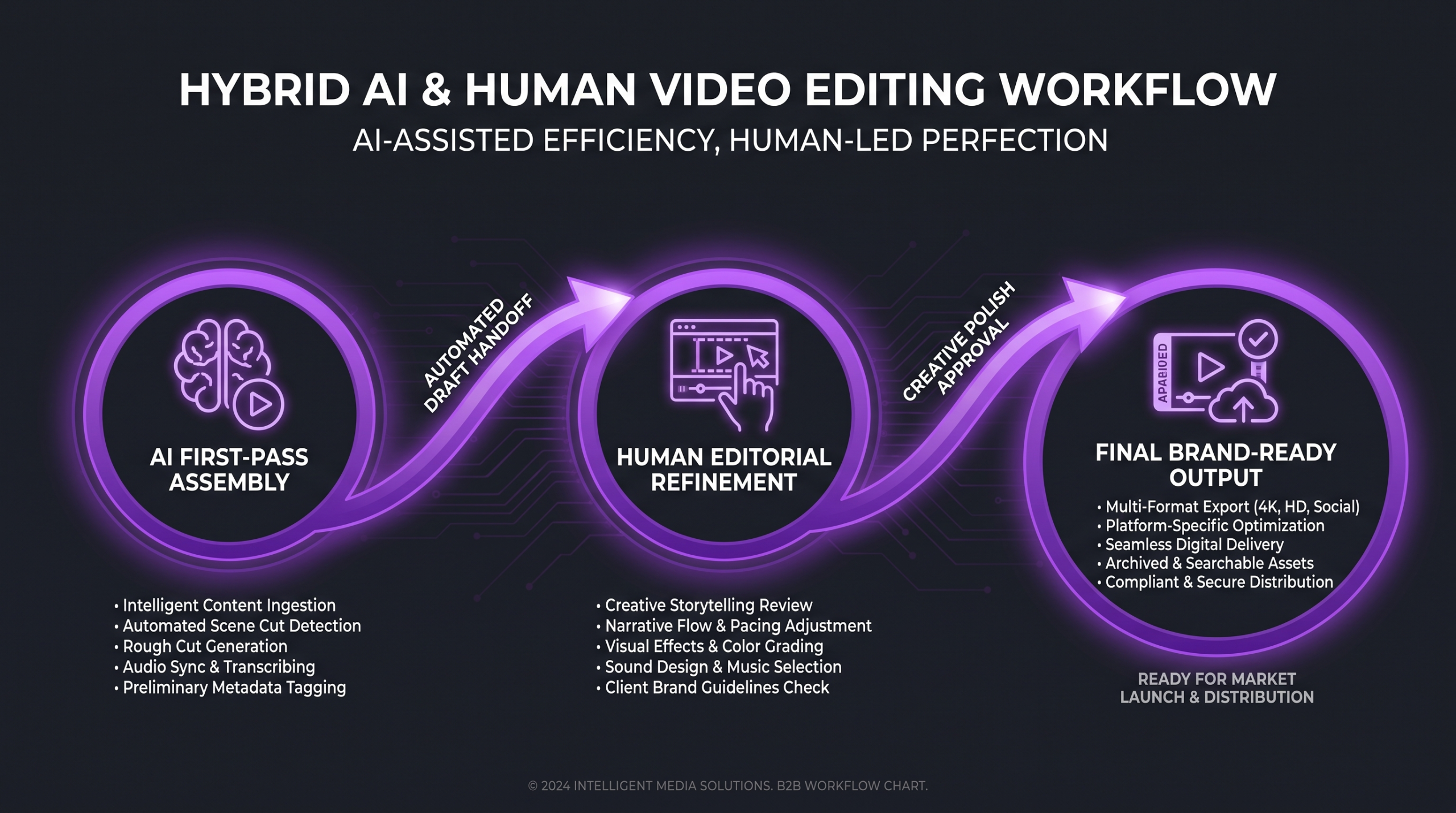
The most commonly published hybrid framework uses AI for first-pass assembly — rough cuts, transcript-based selects, silence removal, auto-colour grade — then hands the output to a human editor for narrative structuring, pacing refinement, and brand alignment. Published workflow analyses of this model show meaningful time savings (commonly reported in the range of 25–40% reduction in total editing hours) while maintaining the output quality associated with human-led editing.
The key finding: AI handles the mechanical, pattern-based tasks well enough that the human editor can focus entirely on the judgement-intensive work. That focus typically produces better final output than a human editor spending equivalent total time across both mechanical and creative tasks.
Tool-Assisted Human Workflows
A related hybrid model uses AI as a capability layer within a human-driven editing environment rather than as a separate processing pipeline. Adobe Premiere Pro’s integrated AI features — Auto Reframe, Speech to Text, Scene Edit Detection — exemplify this approach. Published user workflow studies show that editors using these integrated AI features complete certain task categories significantly faster while retaining full creative control over the output.
This model is particularly well-suited to environments where brand standards are high and AI-as-separate-pipeline would require too many correction passes to be efficient. The AI augments the human’s capability without taking over decision-making.
Category-Specific Hybrid Frameworks
Published production workflow analyses have identified content category as the primary variable in determining optimal hybrid allocation. Short-form social content, episodic podcast clips, and product demo repurposing consistently support AI-heavy workflows. Brand films, executive thought-leadership series, and narrative-driven case studies consistently support human-primary workflows with AI used selectively for mechanical tasks. The cost per finished minute implications of getting this allocation right are significant — and getting it wrong in either direction adds unnecessary cost or quality risk.
Budget Implications: Translating Results to Production Costs
Translating test results into budget planning requires an honest look at where the economics actually play out. The cost numbers vary significantly by production type, team structure, and volume — and published comparisons often compare incompatible scenarios. Here is a framework grounded in published ranges rather than invented benchmarks.
High-Volume, Templated Content
For teams producing fifty or more social clips per month from long-form source material, published cost analyses strongly favour AI-primary workflows with a human quality-review layer. AI tool subscriptions at this volume typically represent a fraction of what equivalent human editing hours would cost. The quality trade-off is acceptable for this content category because the format is templated, the brand risk per individual clip is lower, and the volume itself is the goal.
Understanding how much professional video editing actually costs across different service tiers helps calibrate where AI makes financial sense and where the economics of expert human editing actually represent better value per asset.
Mid-Scale Brand Production
For marketing teams producing ten to thirty pieces of polished content per month — a mix of social, short explainers, and occasionally a premium brand film — published workflow analyses suggest hybrid models: AI for templated throughput, human editors for the pieces that represent the brand in high-stakes contexts. The key variable is distribution: which pieces will be paid-amplified, which will be sent to executive prospects, which are evergreen? Those categories justify human editorial investment; the rest tolerate AI-primary workflows with human review.
Premium and High-Stakes Projects
Published case study analyses from agency environments consistently show that premium brand content — testimonials, product launches, documentary-format thought leadership — delivers its highest return when edited by senior human editors with category experience. The argument is not that AI cannot produce an acceptable cut; it is that the quality ceiling for these formats is set by human editorial judgement, and the downside of a mediocre premium video is disproportionate to the cost of doing it right. The agency vs freelancer decision for these projects is similarly evidence-driven: consistent access to senior-level editing skill, project management, and revision cycles is what agencies deliver that freelancers typically cannot sustain across a full content programme.
Leading AI Editing Tools: A Published-Data Comparison
Published reviews and platform benchmarks consistently evaluate the same core tools in the AI editing category. Here is how they compare across the dimensions that matter for production decision-making — with performance characterisations drawn from published test data rather than vendor claims.
Pricing ranges above represent published public rates as of mid-2026 and are subject to change. Actual costs depend on team size, volume, and negotiated terms.
Head-to-Head Quality Dimensions
Frequently Asked Questions
Do published tests show AI editing is good enough to replace human editors?
Published tests do not support a blanket replacement claim. AI editing is good enough — and often better — for high-volume, templated, pattern-driven content formats like social clips, transcript-based rough cuts, and reformatted podcast segments. For narrative-driven, brand-sensitive, or complex multi-track projects, published evidence consistently shows human editors producing superior output. The more accurate finding from published tests is task-level replacement of specific editorial functions, not wholesale replacement of the editor role.
Which AI editing tool performs best in independent tests?
No single tool leads across all categories in published independent comparisons. Descript consistently leads for dialogue-heavy interview and podcast content. Runway leads for AI-generated visual elements and B-roll. CapCut leads for high-volume social clip production speed. Adobe Premiere’s integrated AI features lead for professional hybrid workflows where a human editor remains in control. The best tool depends entirely on your specific content type and production model.
How significant is the speed gap between AI and human editing?
For templated, pattern-driven tasks, published benchmarks show the speed gap is substantial — commonly in the range of several times faster for equivalent templated output. That gap narrows significantly for complex, narrative-driven projects where the AI output requires extensive human correction. For rough cut assembly from a transcript, AI may complete in minutes what takes a human editor an hour or more. For a ten-minute brand documentary, the total production time — including AI correction passes — often approaches what a skilled human editor would take from scratch.
What does published data show about viewer response to AI-edited vs human-edited videos?
Viewer preference and engagement studies from published sources show that short-form AI-edited content is generally indistinguishable from human-edited work in blind panel tests when the content is scripted and templated. For longer formats — anything over five minutes with a narrative requirement — human-edited content has consistently scored higher on completion rate and overall preference in published blinded reviews. The difference is most pronounced for content that depends on emotional sequencing, pacing, or brand storytelling.
Should marketing teams use AI editing or hire a human video editor?
Published workflow analyses suggest this is a false binary for most marketing teams. The optimal approach for teams producing mixed content — social clips, explainers, brand content — is a hybrid model: AI for templated throughput, human editors for the pieces that define how the brand is perceived at its most important touchpoints. The practical allocation depends on volume, brand standards, and the role video plays in revenue-critical journeys. Teams using Increditors for their premium brand content, for example, often maintain AI tools for routine social production alongside — not instead of — expert human editorial for the work that matters most. Understanding the full range of unlimited video editing service models available in 2026 helps clarify where each model fits in a production stack.
Verdict: What the Published Evidence Actually Tells You
The published test evidence on AI vs human video editing is more nuanced — and more useful — than the binary debate suggests. AI editing tools have cleared the bar for templated, high-volume content categories and show genuine and growing advantages on speed, cost at scale, and batch consistency. Those advantages are real and producers should be using them.
But the human editor’s advantage on narrative, emotional pacing, brand fidelity, and complex multi-track production is equally real and has proven more durable than many 2022-era predictions suggested. Published preference panels, completion rate studies, and agency workflow audits consistently confirm that the content most worth producing well — brand films, testimonials, thought-leadership series, premium social content — still benefits from expert human editorial judgement at the core.
The strategic takeaway from the evidence: treat AI and human editing as complementary tools that each excel in specific categories, build your production model around that task-level allocation, and avoid the cost of using the wrong tool for the wrong job in either direction. Teams that have made that allocation deliberately — based on what the published tests actually show — are producing more content, at better quality, for lower total cost than those still treating this as an either/or choice.
Ready for Video That Actually Converts?
Tell us about your project and we will put together a custom plan.