










![3D Explainer Video - ScribbleLive.mp4_snapshot_00.12_[2022.03.09_03.14.16]](https://increditors.com/wp-content/uploads/elementor/thumbs/3D-Explainer-Video-ScribbleLive.mp4_snapshot_00.12_2022.03.09_03.14.16-r7wb53mx72rxst3qcqyrfxdmeyzb5r9jbl0wbjujh4.png "3D Explainer Video – ScribbleLive.mp4_snapshot_00.12_[2022.03.09_03.14.16]")





























Platform-optimal video lengths shifted again in 2026. YouTube Shorts now allows up to 3 minutes; TikTok’s algorithm rewards 30–60-second clips for discovery but 1–3 minutes for shares; LinkedIn B2B videos peak around 1–2 minutes; Instagram Reels sweet spot sits at 30–90 seconds; and Facebook favors under 2 minutes for organic reach. This guide breaks down every platform with benchmarks, a full comparison table, and a practical framework for choosing the right length before you hit record.
- Why Video Length Still Matters in 2026
- YouTube: Long-Form Wins—With Caveats
- TikTok: The Counter-Intuitive Length Data
- Instagram: Reels, Feed, and Stories—Three Games
- LinkedIn: B2B Video Length Sweet Spots
- Facebook: Shorter Is Still Smarter
- Full Platform Comparison Table
- What Changed in 2026 vs. Previous Years
- Applying These Insights to Your Strategy
- Frequently Asked Questions
- Verdict
Why Video Length Still Matters in 2026
The single most overlooked distribution decision in video marketing isn’t the hook, the thumbnail, or the caption. It’s duration. Get the length wrong and even a technically flawless video underperforms—because algorithms treat watch-time completion as a direct quality signal, and audiences on each platform have trained themselves to expect a specific format.
In 2026, every major platform has matured its recommendation engine to be acutely sensitive to completion rates, re-watches, and shares. A 12-minute video that loses 80% of viewers before the 90-second mark sends the algorithm a clear message—even if the remaining 20% loved it. Conversely, a tight 45-second clip with 85% completion and strong shares can outperform that longer video for reach in the same week.
This guide compiles the available platform documentation, publisher benchmarks from third-party research houses, and patterns that experienced video editing agency teams observe across client accounts to build a platform-by-platform picture of where length data sits today.
One important note before diving in: published platform benchmarks are averages across billions of posts in every niche and every audience maturity level. They’re a starting point, not a prescription. A B2B software company explaining a complex integration and a lifestyle creator sharing a morning routine both post to the same YouTube—but their audiences tolerate very different pacing. Use this data to set a hypothesis, then test it against your own analytics over 30–60 days.
💡 Pro Tip: Before optimizing length, check your own platform analytics for average percentage viewed. If your completion rate is consistently below 40%, length is almost never the first problem—hook and pacing are. Fix those first, then optimize for duration.
YouTube: Long-Form Wins—With Caveats
YouTube remains the only major platform where longer content has a structural advantage. Watch time is a direct input to the recommendation engine, and the platform’s ad monetization model rewards duration. But “longer is better” is a dangerous oversimplification—there’s a meaningful gap between what the algorithm rewards and what your specific audience will complete.
YouTube Shorts: 15–60 Seconds
YouTube Shorts expanded to allow videos up to 3 minutes in late 2024, but platform data consistently points to 15–60 seconds as the range where Shorts see the highest completion rates and repost behavior. Creator reports and third-party analytics tools like Tubics and Vidooly suggest that Shorts under 60 seconds complete at materially higher rates than those approaching the 3-minute ceiling.
The Shorts feed is designed for rapid consumption. Viewers swipe within seconds of making a quality judgment, so the 3-minute expansion is better understood as an emergency exit for creators who need just a bit more time—not a license to pad content. If you’re using Shorts primarily for channel-top-of-funnel discovery, keep them tight and make every second deliver.
Standard YouTube: 7–16 Minutes
For standard long-form videos, the range most frequently cited in creator analytics communities and third-party studies is roughly 7–16 minutes. This is the window that tends to balance ad placement eligibility (mid-rolls qualify at 8 minutes), watch-time accumulation, and realistic completion rates for engaged subscribers. YouTube’s creator documentation doesn’t prescribe a single ideal length, but the platform’s own research has repeatedly shown that the algorithm responds to relative watch time (how much of your video is watched) rather than absolute duration.
In practical terms, this means a 10-minute video with 65% average view duration outperforms a 20-minute video with 30% average view duration—even though the 20-minute video generates more raw watch time per view. For most creators and brand channels in 2026, the 8–12 minute range represents the best tradeoff unless the content genuinely demands more.
Long-Form and Documentary: 20+ Minutes
Educational deep-dives, documentary-style content, tutorials with complex workflows, and podcast-format uploads can sustain 20–60 minutes or more—but only when the audience is actively searching for that depth. These videos typically don’t win on the homepage algorithm; they win on search and on “up next” for viewers who just finished a related video. If your content strategy involves these formats, treat them as a different product category, not just “longer standard videos,” and optimize titles and chapters accordingly.
TikTok: The Counter-Intuitive Length Data
TikTok’s length data is counter-intuitive and frequently misread. The platform now supports videos up to 10 minutes and has been pushing creators toward longer content to compete with YouTube—but the underlying completion and share data still generally favors shorter clips for most content types. The nuance matters: length sweet spots differ significantly by goal (discovery versus shares versus follower conversion).
Discovery Content: 30–60 Seconds
For content intended to reach new audiences—what TikTok calls “For You Page” distribution—videos in the 30–60 second range consistently appear in creator analytics as the strongest performers. TikTok for Business has published guidance confirming that strong completion rates are a key distribution signal, and the compressed format forces high information density per second, which the algorithm treats favorably.
The most viral TikTok content often falls in this range because it’s short enough to re-watch (which multiplies the algorithm’s completion signal) and long enough to deliver one clear idea or narrative arc. Creators testing both ends of the spectrum regularly report that 60-second clips outperform 3-minute versions of the same content for pure reach—even when the longer version is higher quality.
Storytelling and Tutorial Content: 1–3 Minutes
For narrative-driven content—cooking tutorials, productivity walkthroughs, transformation stories, before-and-after reveals—1 to 3 minutes strikes a better balance between delivery depth and completion. These videos tend to drive higher save rates and comments than the shorter discovery content, which translates to stronger follower conversion among viewers who complete them. The tradeoff is narrower initial distribution; you’re trading reach for depth.
Instagram: Reels, Feed, and Stories—Three Different Games
Instagram now has three distinct video surfaces—Reels, in-feed video posts, and Stories—and each responds to different lengths. Lumping them together is one of the most common mistakes brands make when setting social video strategy, because what works in a Reel will hurt in a Story and vice versa.
Instagram Reels: 30–90 Seconds
Reels support up to 90 seconds (extended from 60 in 2023), and the platform’s own creator guidance—available through the Instagram Business resources—points to completions and shares as the primary ranking signals. Industry benchmark data from social media analytics firms consistently places the highest-performing Reels in the 30–60 second window, with a secondary cluster at 60–90 seconds for content that genuinely needs the extra time.
The key distinction: Reels are shown in both the dedicated Reels tab and the main feed, which means they’re reaching both discovery (cold) audiences and followers. A Reel that works for both needs a strong enough hook for the cold viewer and enough depth to engage an existing follower. That’s a harder brief to fill under 30 seconds, which is why the 30–60 second range outperforms the sub-30 bracket for most brand content.
In-Feed Video Posts: Under 60 Seconds
Static feed video posts (non-Reels) have been largely displaced by Reels for reach purposes, but they remain useful for evergreen content pinned to profiles. For these, under 60 seconds is the practical ceiling—the format doesn’t benefit from the Reels discovery engine, so reach comes from followers rather than algorithm push. Long feed posts tend to see sharp drop-off after the first 30 seconds.
Instagram Stories: 15 Seconds Per Card
Stories auto-advance every 15 seconds, which is still the de facto unit of Story content design. Multi-card Stories (3–5 cards total for 45–75 seconds of total runtime) work well for sequential narratives, product reveals, or step-by-step tutorials. Research from third-party analytics platforms including Sprout Social suggests that exit rates climb sharply after the fourth or fifth card, making 3-card Stories a reliable safe zone for most content types.
LinkedIn: B2B Video Length Sweet Spots
LinkedIn’s video environment is structurally different from every other platform on this list. Viewers on LinkedIn are typically in a professional browsing mindset—they’re between tasks, not in a scroll trance. Attention is available, but it’s rationed. LinkedIn also launched a TikTok-style short video feed in 2024, creating a two-tier video ecosystem: the short-form discovery feed and native videos shared directly in the regular feed.
LinkedIn Short Video Feed: 30–90 Seconds
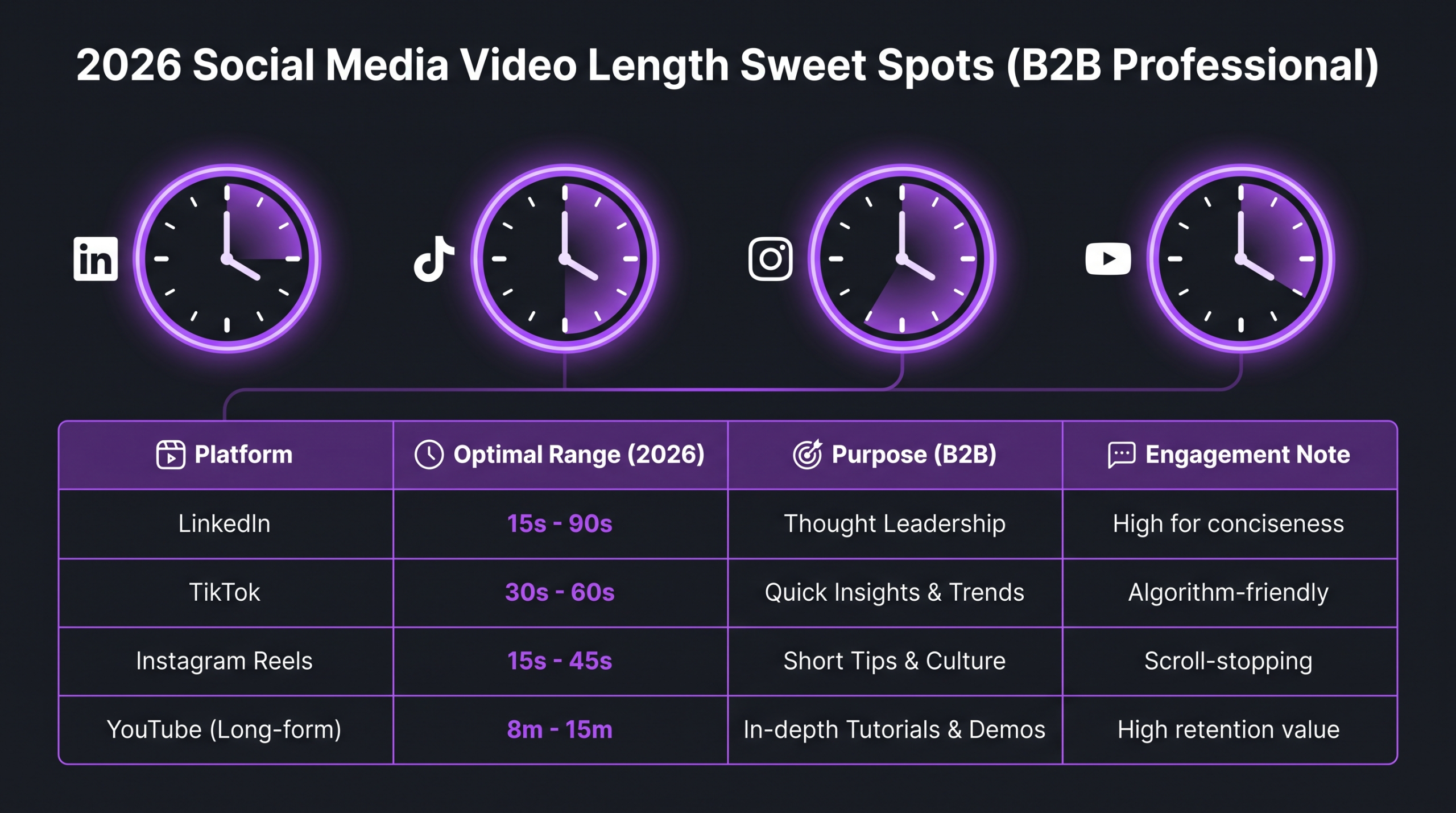
LinkedIn’s short video tab, while newer than TikTok or Reels, appears to reward content in the 30–90 second range based on creator reports and early data from social media analytics tools. The format is explicitly designed for professional insights, not entertainment—which changes the hook strategy significantly. Opening with a data point, a contrarian claim, or a professional insight tends to outperform entertainment-style hooks in this context.
Native Feed Videos: 1–5 Minutes
For native video posts in the main LinkedIn feed, LinkedIn Marketing Solutions data has historically indicated that videos between 1 and 5 minutes outperform both shorter clips and longer uploads for engagement metrics. Within that range, 1–2 minutes tends to win for thought leadership and opinion content, while 3–5 minutes works better for product demos, case study summaries, and process walkthroughs that benefit from a bit more breathing room.
LinkedIn’s organic video reach is notably more stable than on consumer platforms—follower distribution is a stronger driver than the pure algorithmic feed, which rewards consistency and professional relevance. For B2B brands using professional video editing to produce polished thought leadership content, LinkedIn remains one of the best-value platforms for organic distribution in 2026.
Facebook: Shorter Is Still Smarter
Facebook’s organic video reach has declined consistently over the past several years, but the platform still processes significant video volume—especially for brands targeting audiences 35+, running paid campaigns, or operating in community-driven niches via Groups. For organic posts in the main feed, under 2 minutes is the reliable benchmark for most content types.
Meta’s own video guidance for Facebook points to completion rate and shares as primary quality signals—which practically means that a shorter video with high completion beats a longer video where viewers drop off at the 30-second mark. For Reels on Facebook (cross-posted from Instagram), the same 30–90 second guideline applies.
Facebook Watch content—longer serialized video—is a different product and follows YouTube-style logic: depth and watch time matter more. But for standard feed posts, the data consistently supports keeping videos under 2 minutes, with a clustering of top-performing organic videos under 90 seconds in most published benchmark reports.
Full Platform Comparison Table: 2026 Length Benchmarks
The table below consolidates the platform data covered in this guide into a single reference. The “Optimal Range” column reflects the window most consistently associated with stronger completion rates and algorithmic distribution based on available industry benchmarks. “Max Allowed” is the platform’s technical ceiling. “Priority Signal” is the metric the platform weights most heavily when deciding to push a video.
What Changed in 2026 vs. Previous Years
Several meaningful shifts have occurred in the platform-length landscape over the past 18 months. Understanding what changed—and what stayed the same—is as useful as knowing the current benchmarks, because it reveals the direction platforms are heading.
YouTube Shorts Expanded to 3 Minutes
The most significant structural change was YouTube expanding Shorts to 3 minutes in late 2024. This was driven by YouTube’s strategic need to match TikTok’s 1–3 minute sweet spot for storytelling content—and by creator feedback that 60 seconds wasn’t enough for tutorial-style content. The change created a middle-format category that didn’t exist before: 60-second-to-3-minute content that’s searchable, completable, and doesn’t require a long-form production commitment. Many creators report treating this range as a “mini-documentary” format distinct from both traditional Shorts and standard uploads.
TikTok’s Push Toward Longer Content Has Had Mixed Results
TikTok aggressively promoted its 10-minute format through creator incentives starting in 2023, but published creator analytics data has been skeptical. Reports from social analytics platforms consistently show that TikTok’s algorithmic distribution advantage doesn’t scale cleanly with duration the way YouTube’s does. The result: longer TikTok videos tend to reach narrower audiences and drive higher save rates, but they sacrifice the viral reach dynamics that make TikTok valuable for discovery. The platform hasn’t abandoned the push, but most experienced TikTok creators treat anything over 3 minutes as a secondary format—not a primary distribution strategy.
LinkedIn’s Short Video Tab Changed the B2B Game
LinkedIn’s rollout of a dedicated short video feed throughout 2024 was a meaningful shift for B2B video strategy. Previously, LinkedIn video was almost entirely a “share to feed” format—you posted a video and hoped followers saw it. The short video tab introduced algorithmic distribution to LinkedIn for the first time, which means cold-audience reach is now possible without paid amplification. This changes the optimal length calculus for LinkedIn: brands now need a short-form strategy (30–90 seconds) for discovery, separate from their existing longer native video strategy for follower depth.
What Hasn’t Changed
Despite the format expansions, one principle has remained consistent across every platform update: completion rate is the most important quality signal. No platform has moved away from rewarding videos that audiences finish. This means the ceiling expansions (TikTok to 10 minutes, Shorts to 3 minutes) don’t change the strategic calculus for most brands—they just open up new use cases for creators who can genuinely hold audience attention for longer. If your completion rates are below 50%, adding minutes to your videos will hurt, not help.
💡 Pro Tip: The platforms with the most valuable 2026 short-video opportunities—LinkedIn’s new feed and YouTube Shorts’ extended window—both reward the same thing: tight, insight-dense content that delivers its core value in the first 10 seconds and doesn’t pad toward the duration ceiling. Build to that standard regardless of the length you choose.
Applying These Insights to Your Video Strategy
Benchmark data only becomes useful when you have a framework for applying it to your specific situation. Here’s a practical decision process for matching content goals to platform-length strategy.
Step 1: Define Your Primary Goal for Each Piece
Every video should have one primary goal: discovery (reach new viewers), nurture (deepen relationship with existing audience), or conversion (drive a specific action). The optimal length differs by goal, not just by platform. A conversion-focused testimonial on LinkedIn can be 45 seconds and work beautifully. A discovery-focused brand awareness Reel on Instagram probably needs a stronger hook and tighter pacing than a nurture-focused product walk-through shared with existing followers. Define the goal first, then match the length benchmark to that goal.
Step 2: Match Content Complexity to Duration
Content complexity is the honest arbiter of appropriate length. A single insight or product feature belongs in a 30–60 second clip. A comparison of three tools belongs in 2–5 minutes. A full onboarding tutorial for a complex software product legitimately needs 10–20 minutes on YouTube. The failure mode isn’t choosing the wrong length from a benchmark—it’s choosing a length that doesn’t fit the information density of the content. Padding a 45-second idea into a 4-minute video will destroy your completion rates regardless of the platform. Cramming a 10-minute workflow into 60 seconds will confuse viewers and reduce shares.
Step 3: Check Your Own Analytics Before Changing
If you already have video content performing on a platform, your own average view duration data is more actionable than any benchmark. If your 8-minute YouTube videos average 65% view duration, you don’t need to change your length—you’re already ahead of the benchmark. If your 3-minute TikToks average 20% view duration, shortening to 60 seconds will likely increase both reach and completion. The benchmarks in this guide are averages across billions of posts; your data is specific to your audience and content type.
Step 4: Consider Your Production Capacity
Optimal video length is also a production constraint, not just an algorithmic one. Brands that work with a dedicated video editing service for YouTube and multi-platform content can produce at a faster cadence, which changes the tradeoff: it becomes viable to produce one long-form YouTube piece per week and four 60-second Reels from the same shoot, rather than choosing between formats. Repurposing is a length strategy, not just an efficiency tactic. A well-edited 12-minute YouTube video contains three or four natural 60–90 second segments that can become Reels, TikToks, or LinkedIn clips with minimal additional work.
For benchmarks on platform-by-platform retention rates (not just optimal length, but how much of your video audiences are actually watching), see our companion piece on video retention benchmarks by platform—it covers completion data alongside the length recommendations here.
Length-by-Content-Goal Reference Table
Frequently Asked Questions
What is the ideal video length for YouTube in 2026?
For standard uploads, the 8–16 minute range performs well for most niches because it balances mid-roll ad eligibility, total watch time accumulation, and realistic completion rates. For YouTube Shorts, 15–60 seconds remains the strongest window even though the platform now supports up to 3 minutes. The most important variable isn’t absolute duration but relative completion rate—a 10-minute video with 65% average view duration outperforms a 20-minute video with 30% in algorithmic distribution.
How long should TikTok videos be for maximum reach?
For cold-audience discovery and viral reach, 30–60 seconds continues to be the strongest window based on available creator analytics data. Longer videos (1–3 minutes) drive better save rates and follower conversion among people who watch them, but typically reach narrower audiences. The platform now supports up to 10 minutes, but this format functions more like a YouTube alternative for committed audiences rather than a discovery tool. For most brands in 2026, treat TikTok as a 30–60 second platform for reach and use the 1–3 minute range strategically for deeper storytelling.
Does video length affect SEO on YouTube?
Indirectly, yes. YouTube’s search algorithm weights engagement signals including watch time, completion rate, likes, and comments—all of which are influenced by length. Longer videos that maintain high completion rates accumulate more absolute watch time per view, which is a positive signal. However, a shorter video with higher completion and engagement metrics will generally rank ahead of a longer video with poor retention. For search-first content, choose the length that fits the information complexity of the query—then edit ruthlessly to maximize completion.
What video length works best for B2B LinkedIn content?
For native feed videos aimed at existing followers, 1–2 minutes tends to outperform both shorter and longer formats for thought leadership and professional insight content. For LinkedIn’s newer short video discovery feed, 30–90 seconds aligns with the format’s mechanics and professional audience attention patterns. For product demos or process walk-throughs where depth matters, 3–5 minutes is defensible when the content genuinely requires that time. The key B2B distinction: lead with a data point or contrarian claim rather than an entertainment hook—professional viewers have different first-impression criteria than consumer platform audiences.
Should I post the same video length on every platform?
No—and cross-posting the identical file across all platforms without editing for length is one of the most common and costly video distribution mistakes. A 12-minute YouTube video cross-posted to TikTok will have catastrophic completion metrics. The right approach is to edit platform-specific cuts from your source footage: a full 10-minute YouTube video, a 60-second TikTok cut, a 45-second Reel, and a 90-second LinkedIn version can all come from the same shoot with efficient editing workflows. Working with an experienced video editing agency that handles multi-platform repurposing makes this sustainable at scale rather than a constant production burden.
Verdict
The 2026 platform-length landscape has more options and more nuance than ever—but the underlying logic is simpler than the format proliferation suggests. Every platform is optimizing for the same thing: how much of your video viewers actually watch and whether they share it. Length is the input; completion and shares are the output. Choose the length that maximizes those outputs for your specific content type, audience, and goal—not the length that fits some abstract benchmark.
The most actionable takeaways from this guide: keep YouTube Shorts under 60 seconds despite the new 3-minute ceiling; don’t chase TikTok’s 10-minute format unless you have an established audience that demands depth; treat LinkedIn’s new short video tab as a separate discovery channel from your longer native posts; and always check your own completion data before assuming a benchmark applies to your account.
For brands producing content across multiple platforms, the biggest leverage point isn’t choosing the right length for each platform—it’s building a production workflow that makes platform-specific editing sustainable. Repurposing done well means one strategic shoot produces five distribution-ready assets. Done poorly, it means a 12-minute video cross-posted everywhere and underperforming on all of them. Understanding where to find authoritative video length research and continuously monitoring your own data are both essential parts of that workflow. The broader social media video research landscape continues to evolve—treat the benchmarks in this guide as a starting hypothesis, not a final answer.
Ready for Video That Actually Converts?
Tell us about your project and we will put together a custom plan.