



![3D Explainer Video - ScribbleLive.mp4_snapshot_00.12_[2022.03.09_03.14.16]](https://increditors.com/wp-content/uploads/elementor/thumbs/3D-Explainer-Video-ScribbleLive.mp4_snapshot_00.12_2022.03.09_03.14.16-r7wb53mx72rxst3qcqyrfxdmeyzb5r9jbl0wbjujh4.png "3D Explainer Video – ScribbleLive.mp4_snapshot_00.12_[2022.03.09_03.14.16]")













Drone footage editing typically costs between $75 and $600 per finished minute depending on complexity, color work, and provider type. Freelancers commonly run $75–$250/min; professional agencies start around $250–$600/min for cinematic-grade output. Real estate drone edits often range $150–$450 per property video; commercial campaigns commonly run $800–$5,000+ per deliverable. This guide breaks down every cost driver so you can benchmark quotes accurately and avoid the two most expensive mistakes: overpaying for mediocre work or underpaying for footage that reflects badly on your brand.
- How Much Does Drone Footage Editing Cost in 2026?
- What Drives the Cost of Editing Drone Footage?
- Freelancer, Agency, or Subscription — Which Option Costs Less?
- Drone Footage Editing Costs by Project Type
- DIY vs Professional Drone Video Editing — Real Cost Analysis
- How to Get Accurate Drone Footage Editing Quotes
- FAQ
- Verdict
How Much Does Drone Footage Editing Cost in 2026?
Drone footage editing costs in 2026 typically range from $75 to $600 per finished minute, with the spread driven by output quality, post-production complexity, and the type of provider you hire. A simple real estate flyover with basic color correction sits at the low end. A cinematic brand campaign with advanced log grading, motion graphics overlays, stabilization, and multi-source composite work sits at the high end.
The “per minute” framing is useful for benchmarking, but most professional editors quote per project — because drone footage work rarely maps cleanly to a running clock. A 90-second real estate clip might require sorting through 40 minutes of raw 4K footage, correcting lens distortion, stabilizing shaky sequences, and grading through a property’s interior-to-exterior lighting transition. That’s not 1.5 minutes of actual work — it’s often 4–6 hours of skilled editorial and color work.
Per-Minute vs Per-Project Pricing
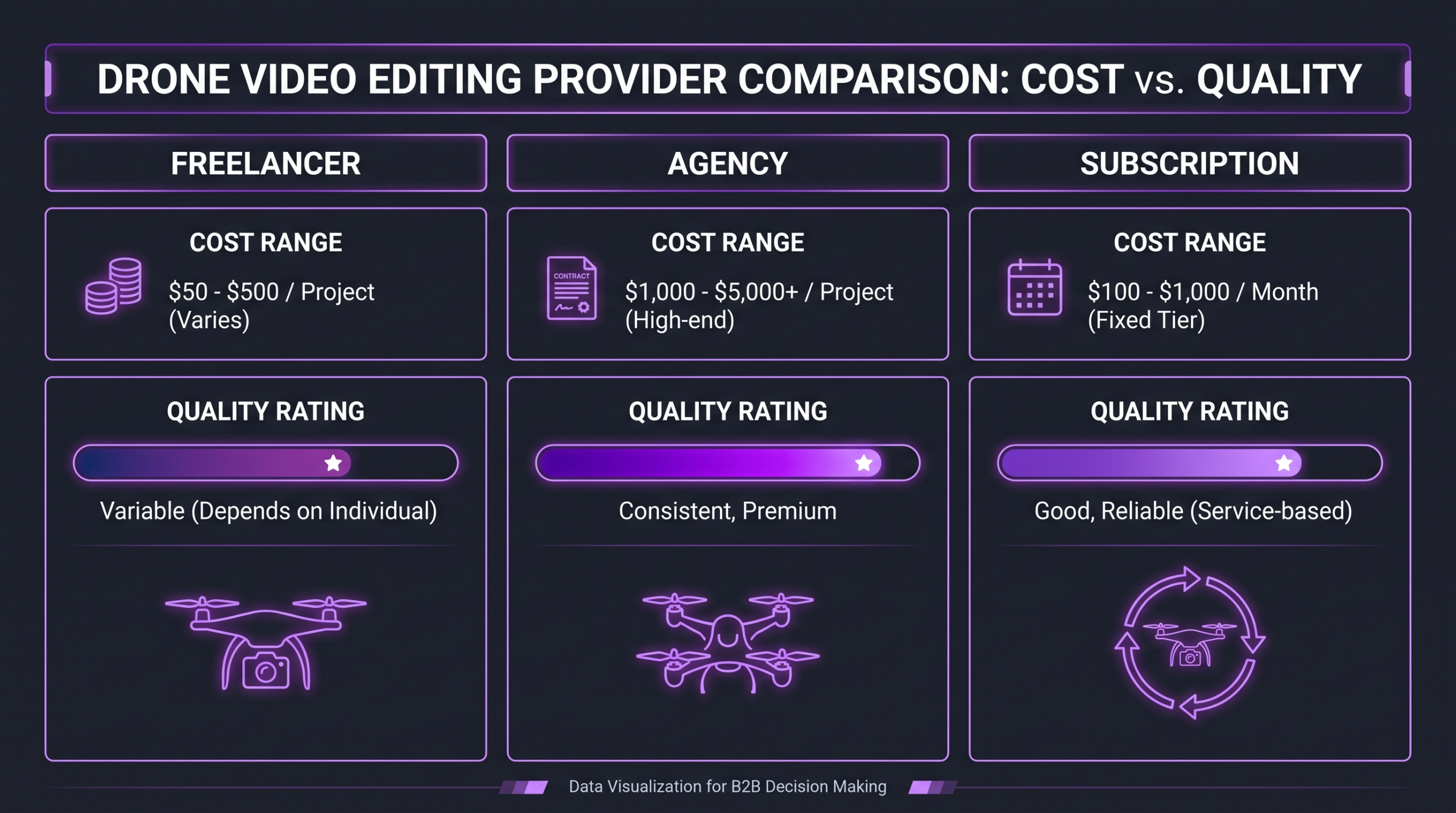
Most freelancers on platforms like Upwork or Fiverr advertise per-minute rates ranging from $75 to $250. Agencies and boutique studios more commonly quote per project, and the finished-minute equivalent often lands between $250 and $600 for cinematic-grade output.
The per-project model reflects how the work actually flows: editors must review, select, and cut from a raw-to-finished footage ratio that commonly runs 20:1 to 40:1 on drone shoots. Billing only for the final output minute ignores that selection, culling, and technical correction effort — which is why per-project pricing tends to be more honest and easier to scope accurately. When comparing quotes, translate everything to a per-project equivalent based on your actual footage volume and deliverable length before making a decision.
Quick Benchmark: Drone Editing Cost by Provider Tier
These ranges reflect active market pricing and are presented as indicative benchmarks — your specific quote will shift based on the factors covered throughout this guide. Use them to sanity-check what you’re being quoted, not as a fixed price list.
What Drives the Cost of Editing Drone Footage?
Drone footage editing is more technically demanding than standard ground-level video editing. Several factors push costs higher — and knowing which ones apply to your project lets you separate honest quotes from inflated ones and understand why two editors can quote very different numbers for the same deliverable.
Raw Footage Volume and Culling Complexity
A professional drone shoot generates enormous volumes of raw material. A single two-hour real estate shoot with a modern DJI platform can produce 60–120 GB of 4K or 6K footage. Every minute of that material must be reviewed, evaluated, and — mostly — discarded. Experienced editors charge for that review and culling time even if it never appears in the final cut. Culling commonly adds 30–60% to base editing time on complex drone shoots, and a quote that doesn’t account for it is a quote that will expand through “additional review” charges later.
Color Grading and Log Footage Handling
Most professional drone cameras — DJI Air 3, Mavic 3 Pro, Inspire 3, Autel EVO II — shoot in log color profiles (D-Log M, D-Log III, CineD) to maximize dynamic range. That flat, low-contrast log footage must be graded — not just color-corrected — to look natural and cinematic. Grading drone log footage adds $50–$200 per deliverable for a skilled colorist on top of the base editing fee.
If your footage mixes log and standard color profiles from different camera sources — drone and DSLR ground footage, for example — matching them convincingly is one of the more technically demanding tasks in post-production, and the cost reflects that. Professional colorists typically use dedicated tools like DaVinci Resolve for a dedicated color pass — the industry standard for cinematic grading. Editors working only in a single NLE without a dedicated color pass will typically produce flatter results at lower cost, and that tradeoff will be visible in the final output.
Stabilization and Technical Corrections
Even with gimbal-stabilized drones, footage frequently needs software stabilization, rolling shutter correction, and lens distortion removal — especially on wide-angle shots and fast lateral movements. These corrections are time-intensive and require skilled judgment: over-stabilizing aerial footage kills the natural “float” that makes drone video cinematically distinctive. Getting this balance right takes experience, and editors who have it charge accordingly. Expect stabilization and technical correction work to add 20–40% to the base edit time on footage that required aggressive maneuvering or was captured in windy conditions.
Music Licensing and Sound Design
Most finished drone videos require a music bed. For commercial or YouTube publishing, you need properly licensed music — not free tracks that trigger Content ID claims or create licensing liability. Royalty-free license fees commonly range $20–$200 per track depending on the library (Artlist, Musicbed, Epidemic Sound) and usage type. Some agencies include licensing in their project fee; freelancers may quote editing only and leave music sourcing and licensing to you. Clarify this explicitly before signing off on a quote — discovering it wasn’t included after delivery is an avoidable cost and delay.
Motion Graphics and Text Overlays
Real estate videos with branded lower-thirds, property detail callouts, and logo animations require motion graphics work that sits outside basic video editing. Simple templated lower-thirds add $50–$150 per deliverable. Custom-designed branded motion graphics packages — built from scratch or from a brand kit — can add $200–$600+ to the project cost and are usually quoted separately by editors who specialize in them. If your drone video will include any branded text elements, confirm whether your editor can produce them or whether you’ll need a motion designer alongside.
Turnaround Speed
Standard delivery for a 2–3 minute drone edit runs 3–7 business days. Rush delivery — 24–48 hours — typically adds 30–60% to the project fee. If you’re working against a listing date, event deadline, or campaign launch window, factor the timeline into your budget planning upfront rather than negotiating a rush fee after the footage is already in the editor’s hands. Building a consistent production calendar is the most cost-effective way to avoid paying premium rush rates repeatedly.
💡 Pro Tip: If your drone shoots in D-Log or a similar log profile, confirm your editor has colorist-level skills before booking. Sending log footage to an editor who only applies basic exposure corrections will result in a flat, desaturated final product — and you’ll pay to have it redone. Ask for a sample frame grade on one clip before committing to the project. That single step saves most color disappointments at delivery.
Freelancer, Agency, or Subscription — Which Option Costs Less?
The right model depends on your volume, consistency requirements, and how much of your production cycle drone footage editing consumes. There’s no single right answer, but there are clear tradeoffs at each tier that determine which option is actually cheaper for your specific situation — not just cheapest on paper.
Freelance Drone Video Editors
The freelance market for drone footage editing spans a genuinely wide quality range. Entry-level editors on marketplace platforms charge $75–$150 per finished minute and typically offer fast turnaround for simple social-first cuts — short real estate clips, basic travel reels, event highlights. Mid-level freelancers ($150–$250/min) bring stronger color work and more refined storytelling structure. Senior freelancers who specialize in aerial cinematography for commercial clients often charge $300+/min because their output quality — particularly in log grading and editorial pacing — genuinely justifies the premium.
The structural challenge with freelancers is availability, consistency, and accountability. A solo editor who gets sick, overbooks, or becomes unavailable mid-deliverable leaves you holding raw footage and a missed deadline. For one-off projects with flexible timelines, that risk is manageable. For ongoing campaigns or a real estate brokerage with multiple listings per week, it compounds into a production reliability problem. For a deeper look at this decision framework, see our comparison of working with a video editing agency vs freelancer.
Video Editing Agencies
A professional video editing agency brings a team — dedicated editor, colorist, quality reviewer — and charges for that infrastructure. Drone footage projects at the agency level commonly start around $800 for a polished 60–90 second deliverable and scale to $3,000–$8,000+ for multi-scene commercial productions with multiple deliverable formats. What you get in return: consistency across deliverables, defined revision protocols, a dedicated point of contact, and work that’s built to spec before delivery rather than discovered to be off-spec after you’ve approved it.
Agencies that specialize in video post-production — particularly those with editorial experience across real estate, commercial, and brand verticals — understand drone footage’s specific technical demands rather than treating aerial material as just another video file to cut. The difference shows in the final output, especially in log color handling and the editorial judgment around aerial reveal timing.
Subscription-Based Editing Services
Subscription editing services charge a flat monthly fee ($300–$2,500/month depending on volume and complexity tier) for unlimited or capped editing requests. These services work well for high-volume clients with predictable, repeatable drone video formats — a real estate brokerage shooting the same property flyover structure weekly, for instance. The budget predictability is genuinely valuable for planning.
The honest limitation: subscription services optimize for throughput, not craftsmanship. Complex drone edits that require significant creative judgment — a brand campaign with scene-by-scene editorial storytelling, a documentary sequence with emotional pacing — tend to get template-treated at volume operations, and the output reflects that. For one-off, high-stakes projects, a project-rate agency or highly specialized senior freelancer typically produces more differentiated results.
Drone Footage Editing Costs by Project Type
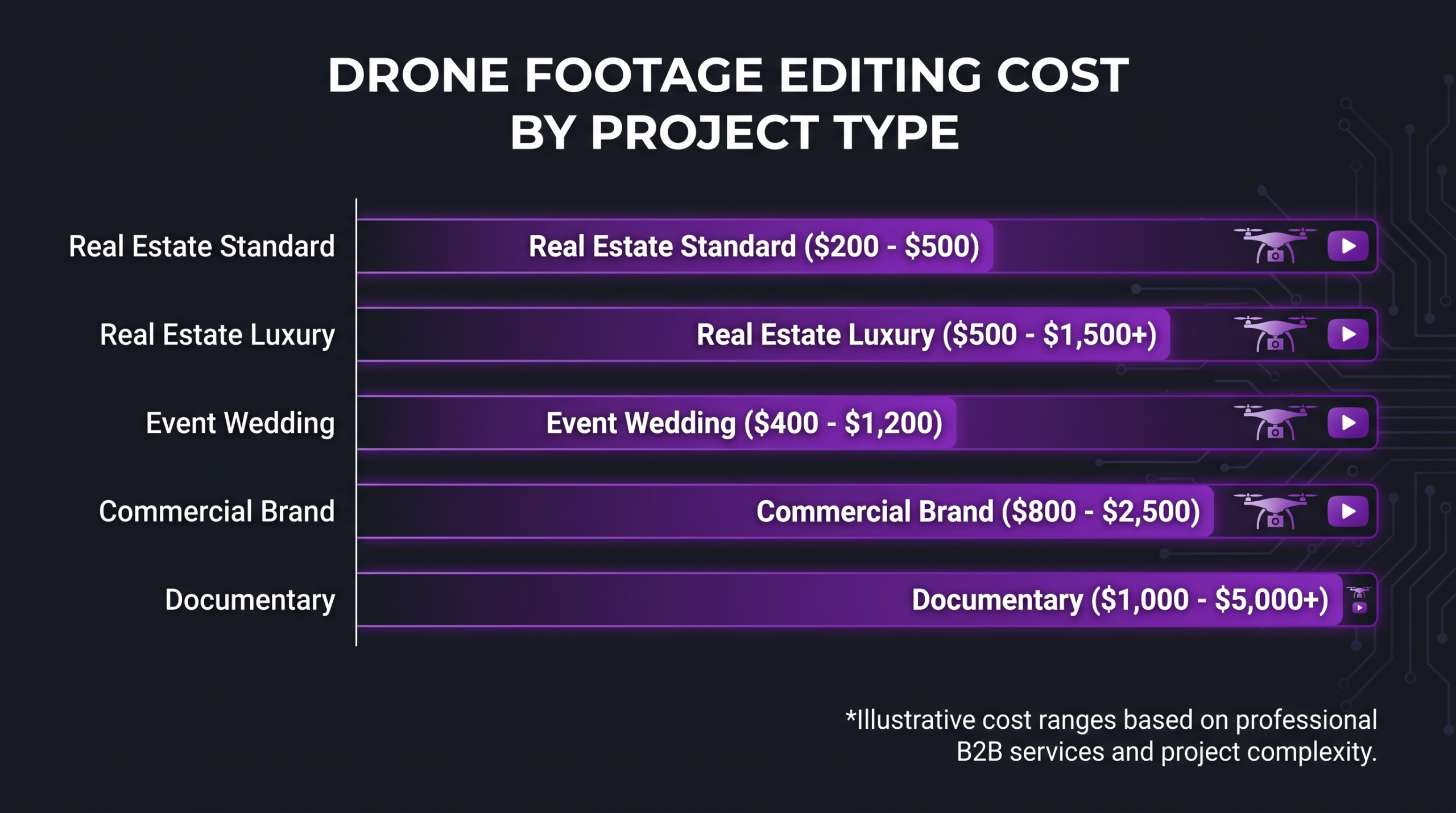
Project type is one of the most reliable predictors of final editing cost. The complexity, expected output polish, and raw footage volume vary significantly between a real estate walkthrough, an event highlight reel, and a commercial brand campaign. Here’s how typical ranges break down across the most common use cases.
Real Estate Drone Videos
Real estate drone videos are the highest-volume use case for aerial post-production — and one of the most price-competitive. A standard property flyover and exterior walkthrough runs 60–120 seconds finished; editing commonly costs $150–$450 per property for competent freelance work, and $400–$900 at the agency level when the deliverable includes professional color grading, branded lower-thirds, and multi-format delivery (landscape + vertical social cut).
High-end luxury listings where the video will be used across print, social, on-site marketing, and MLS placements push to $1,500–$3,000 for a cinematic premium edit. Research from the National Association of Realtors consistently shows that video-listed properties generate substantially more online engagement — which makes the editing investment more justifiable on higher-value listings where additional inquiries have a measurable dollar value.
Commercial and Brand Campaigns
Commercial drone edits for advertising, brand content, or investor presentations sit in a completely different cost category. These projects require the highest color quality, often involve multi-location footage integration, brand motion graphics, licensed music, and tight editorial pacing for 30–90 second cuts designed to perform across multiple distribution channels simultaneously. Project costs commonly range from $1,500 to $8,000+ depending on deliverable count, complexity, and the number of revision rounds required.
When drone footage is one component of a larger commercial shoot — integrated with studio interviews, product shots, and animated graphics — expect the editing quote to reflect the full production scope rather than just the aerial sequences. The real cost driver in commercial work is integration: making drone footage look like it belongs in the same visual world as the rest of the production.
Event and Wedding Drone Coverage
Event drone coverage — outdoor weddings, corporate conferences, concerts, sports events — typically involves integrating aerial footage with multiple ground-level camera sources. The editorial challenge is cohesion: matching color across drone and DSLR/mirrorless sources, syncing cuts to music, and building a narrative arc from footage that was largely unscripted and unpredictable during capture.
Editing a 3–5 minute wedding highlight that includes drone sequences commonly costs $400–$1,200 for freelance work. Multi-camera event films with significant aerial coverage range $800–$3,000+. The premium over a simpler single-camera edit reflects the multi-source color matching and the editorial skill required to make event footage feel coherent rather than just assembled.
Construction and Architecture Progress Films
Construction companies and architecture firms increasingly use drone footage for project progress documentation, investor updates, and completion showcases. These typically run 2–5 minutes and require consistent color grading across footage shot over weeks or months in varying light conditions — a technical challenge that entry-level editors frequently underestimate. Editing a professional progress film with proper color consistency and clean motion graphics commonly runs $500–$1,800 depending on footage volume and deliverable complexity.
Documentary and Film B-Roll
Documentary productions use drone footage as contextual b-roll — establishing shots, geographic transitions, scale-setting aerial sequences. Context-dependent editorial work of this kind requires an editor who understands narrative structure well enough to know where aerial footage adds meaning versus where it’s atmospheric filler. Documentary editors typically charge on a per-day or per-sequence basis; drone b-roll sequences within a longer production add $200–$800+ per scene, depending on footage volume and integration complexity with the rest of the cut.
⚠️ Watch Out: Quotes under $75 for a finished drone edit almost always mean one of three things: the editor hasn’t worked with log footage before, music licensing is your responsibility to figure out separately, or the “edit” is a single-pass rough cut you’ll need to pay to refine. Getting a real estate video redone after a disappointing first delivery typically costs 60–80% of the original quote — so the cheapest option is frequently not the cheapest outcome.
DIY vs Professional Drone Video Editing — Real Cost Analysis
Many drone pilots edit their own footage, particularly when starting out in commercial work. At some point, the question becomes whether the time cost of self-editing exceeds the money saved. For client work, the math is often less favorable to DIY than it appears at first glance.
Software Costs: Not the Real Issue
Adobe Premiere Pro runs approximately $57/month as a standalone subscription. DaVinci Resolve has a free tier that covers most editing needs, and Resolve Studio — with all features, including advanced noise reduction and Fusion visual effects — is a one-time $295 purchase. These are real, manageable costs. Software is not where DIY editing gets expensive relative to hiring out.
Time Investment: Where the Real Cost Lives
Where DIY drone editing gets expensive is time. An experienced drone footage editor completing a 90-second real estate edit typically bills 3–5 hours of work — culling, cutting, grading, audio mix, and output render included. A self-editing drone pilot without dedicated post-production experience commonly spends 8–15 hours on the same output — and often produces a noticeably less polished result.
At a conservative $150/hour opportunity cost (what your time is worth doing the drone operations or client acquisition that actually drives your business), a 12-hour DIY session costs $1,800 in opportunity terms before you’ve delivered the video. Against a $400 professional editing fee, that math rarely resolves in favor of DIY for client work. The calculation is different for passion projects, skill development, or very low-budget work where the alternative is no video at all.
The Quality Gap for Client Deliverables
Experienced drone footage editors develop a specific editorial vocabulary for aerial cinematography — knowing when to hold on a wide reveal shot versus cutting into motion, how to transition from aerial to ground level without jarring the viewer’s spatial orientation, how to grade sky and foreground detail simultaneously without clipping highlights or blocking shadows. That vocabulary takes years of dedicated work to build, and clients who have seen professionally edited drone footage can tell the difference.
For businesses using drone video as marketing content — real estate listings, brand campaigns, corporate communications — the quality gap between self-edited and professionally edited footage is usually visible and frequently measurable in audience retention and engagement metrics. For a broader cost context across all video types, our guide on how much professional video editing costs covers the full spectrum from social media clips to full brand films.
How to Get Accurate Drone Footage Editing Quotes
Getting a quote that reflects the actual scope of your project — rather than a low number that expands through revision fees and scope-creep charges — starts with the brief you send. Vague briefs produce vague quotes, and vague quotes produce surprises at delivery. This is almost entirely avoidable.
What to Include in Your Brief
A complete brief for drone footage editing should include: raw footage volume (total GB or total minutes of raw material), camera model and color profile (log or standard), intended finished length, number of deliverables needed (one master cut plus social formats?), music requirements (will you supply licensed tracks or is sourcing expected?), deadline, and how the video will be used (private presentation, YouTube, paid advertising, broadcast). The more specific your brief, the more comparable your quotes and the less room for post-approval scope expansion.
Understanding the FAA’s commercial UAS operator requirements is worth the time even as a client — it affects what drone operators can legally capture in your location and scenario, which shapes what footage is actually available for editing and what a re-shoot might cost if specific shots weren’t captured during the original session.
Red Flags in Drone Editing Quotes
Several patterns in quotes reliably predict post-delivery friction. Watch for quotes that don’t mention revision rounds (2 rounds is standard), don’t address music licensing, don’t specify color workflow or whether log footage will receive a dedicated color pass, or arrive without any clarifying questions back to you. A professional editor who asks nothing about your footage before quoting is either quoting a fixed-rate template regardless of scope, or hasn’t thought carefully about what the project actually requires. Either way, that communication pattern will reappear at delivery.
Industry publications like No Film School and Fstoppers regularly cover freelance rate benchmarks and workflow standards in video post-production — useful calibration points for assessing whether a quote you’ve received is reasonable for the deliverable you’re expecting and the market you’re in.
Questions to Ask Any Drone Footage Editor Before Hiring
Before committing to any drone footage editor, ask: Have they edited log footage from the specific camera model you’re using? Can they share a color-graded sample from a comparable project — not just a showreel? How do they handle footage that doesn’t have enough usable material to make the cut work? What revision rounds are included, and what defines an out-of-scope revision? How is music licensing handled and who is responsible for it? What format and resolution will they deliver, and do they provide multiple aspect ratios?
The answers to these questions reveal far more about working quality and reliability than a portfolio showreel alone. An editor who can answer all of them clearly and immediately is almost certainly worth the quote they’re offering.
FAQ: Drone Footage Editing Costs
How much does it cost to edit 1 minute of drone footage?
Editing one finished minute of drone footage typically costs between $75 and $600, depending on who you hire and what level of color grading, stabilization, and sound design is included. Freelancers on marketplace platforms commonly land in the $75–$250/min range; professional agencies with dedicated colorists and quality review processes typically charge $250–$600/min for cinematic-grade output. Most professionals quote per project rather than per finished minute — which is more accurate for drone work given high raw footage volumes.
Do drone footage editors charge per minute or per project?
Most professional editors quote per project rather than per finished minute, because drone work involves substantial time in footage review and culling that doesn’t appear in the final deliverable. Per-minute pricing is useful as a rough benchmark when comparing providers, but per-project quotes based on a detailed brief are more accurate and easier to hold vendors accountable to. When you receive per-minute quotes, always ask what raw footage volume is assumed — the number often changes when you share the actual shoot details.
What is the average cost to edit a real estate drone video?
A standard real estate drone edit — 60–120 seconds finished, exterior flyover and perimeter shots with basic branded lower-thirds — typically runs $150–$450 for competent freelance work and $400–$900 at the agency level with proper color grading and multi-format delivery. Luxury property videos with premium cinematic treatment and custom motion graphics commonly reach $1,500–$3,000. The editing investment generally scales sensibly with listing price bracket.
Does drone footage editing cost more than regular video editing?
Generally yes, for several concrete reasons. Drone footage commonly shoots in log color profiles requiring dedicated colorist work; raw-to-finished footage ratios are higher than most ground-level shoots; stabilization and technical corrections add meaningful time; and the culling workflow for aerial footage is more demanding than for scripted, controlled-environment material. Editors who specialize in aerial post-production charge a premium that reflects these genuine technical differences — not inflated positioning.
Can I edit my own drone footage to save money?
You can, and many drone pilots do — particularly for personal work, portfolio building, or projects where quality requirements are lower than client commercial standards. The honest consideration is time cost: self-editing a 90-second real estate clip typically takes 8–15 hours for someone without dedicated editorial experience, versus 3–5 hours for a skilled specialist. For client deliverables where quality directly affects retention, referrals, and repeat business, professional editing consistently pays for itself. For learning and skill-building, self-editing is genuinely valuable and worth the time investment.
Verdict: What Should You Budget for Drone Footage Editing in 2026?
Drone footage editing costs in 2026 break down clearly along two axes: output complexity and provider type. The decision is straightforward once you know where your project sits on both dimensions.
For a single real estate listing on a standard timeline, a mid-level freelancer at $200–$350 for the project typically delivers what you need. For brand content that will live in paid media, represent your organization in a high-stakes pitch, or anchor a marketing campaign with measurable performance targets — the quality ceiling matters, and so does having a team behind the work rather than a single contractor whose next availability is uncertain.
Volume is the final determinant. A brokerage editing 15–20 properties per month should model aerial editing as an operational cost — which means choosing a provider model (subscription, retainer agency, or a trusted senior freelancer with committed availability) that fits the volume rather than renegotiating scope project by project. The per-edit savings from that planning discipline compound meaningfully over a full year.
The benchmark ranges in this guide reflect active 2026 market pricing and are presented as indicative ranges, not fixed rates. Your actual quote will depend on your footage specifics, timeline, deliverable format requirements, and provider. The investment in writing a detailed brief — being specific about footage volume, color profile, intended distribution, and deadline — almost always produces a more accurate number and fewer expensive surprises at delivery.
Ready for Drone Footage That Converts?
Tell us about your project and we will put together a custom plan for your drone footage editing needs — with clear pricing and no scope surprises.