








![3D Explainer Video - ScribbleLive.mp4_snapshot_00.12_[2022.03.09_03.14.16]](https://increditors.com/wp-content/uploads/elementor/thumbs/3D-Explainer-Video-ScribbleLive.mp4_snapshot_00.12_2022.03.09_03.14.16-r7wb53mx72rxst3qcqyrfxdmeyzb5r9jbl0wbjujh4.png "3D Explainer Video – ScribbleLive.mp4_snapshot_00.12_[2022.03.09_03.14.16]")





























Sound design and audio post-production for video typically costs $300–$8,000+ per finished video depending on scope. The market prices dialogue editing, SFX design, music licensing, and final mix as separate line items — not one bundled service. This guide breaks down every layer, what drives the price up or down, and how to build an accurate budget before the brief goes out.
- What Sound Design and Audio Post Actually Cover
- Audio Post Pricing in 2026: Ranges by Service
- What to Budget by Video Type
- What Drives Audio Post Costs Up and Down
- Freelancer vs. Sound House vs. Subscription Service
- When to Bundle Audio with Video Editing
- Five Mistakes Buyers Make When Budgeting for Audio
- FAQ
- Verdict
What Sound Design and Audio Post Actually Cover
Most brands treat “audio” as a single line item on a production budget. Professional audio post studios and freelancers treat it as five to eight distinct disciplines, each with its own rate card and specialist skill set. That disconnect is where the majority of scope disputes and budget surprises originate.
Sound design for video encompasses every sonic element placed intentionally in the finished cut — from the texture of ambient world-building to the precise click of a UI element in a product demo. Audio post-production, the broader category, wraps around that and adds all the technical finishing work that makes those elements sit together coherently in the mix.
The full scope of audio post-production
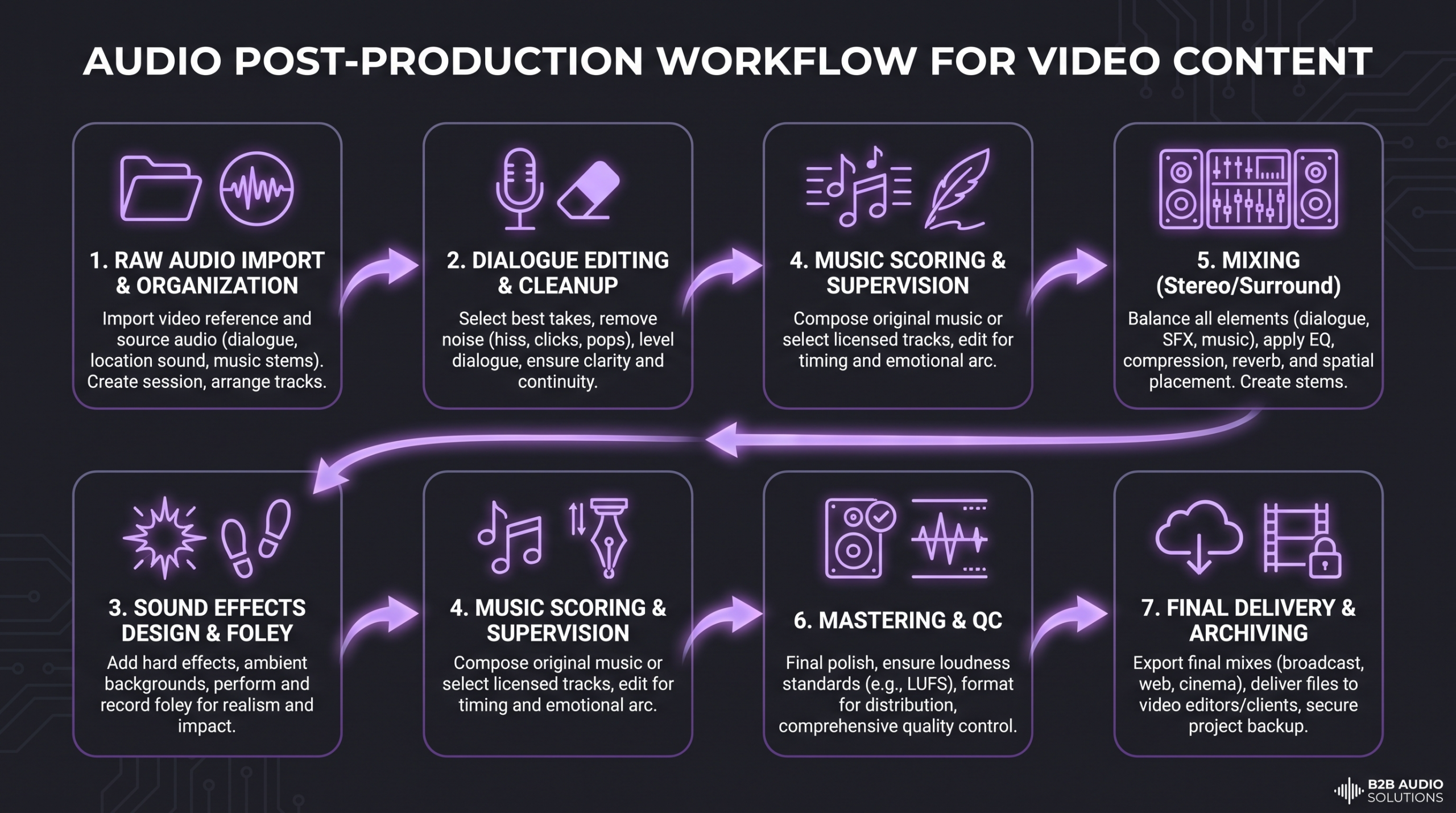
Here is what a complete audio post workflow typically covers — and how providers usually separate these into billable stages:
Dialogue editing and cleanup. Removing background hum, room noise, mouth clicks, plosives, inconsistent levels, and any technical artefacts from recorded speech. This is often the most labour-intensive step in the workflow, particularly when source material was recorded on location without a controlled acoustic environment. Professional audio repair tools like iZotope RX can recover a great deal from imperfect recordings — but every second of problematic audio still requires hands-on attention.
ADR (Automated Dialogue Replacement). When original sound is entirely unusable — lost to traffic, wind, equipment failure, or a location that was acoustically impossible — dialogue is re-recorded in a studio and synced to the original picture. ADR adds studio booking, session management, and the performance layer of re-recording to the cost picture, making it materially more expensive than dialogue cleanup alone.
Foley. Bespoke recording of synchronised sound effects — footsteps, clothing movement, object handling, physical interactions — that are performed live to picture in a Foley stage. Foley is standard practice in theatrical and long-form documentary work; it is less common in corporate and brand content, where library SFX typically serve the same purpose at lower cost.
Sound effects design (SFX). Designing, sourcing, layering, and placing sound effects that are not captured in the original recording — transitions, product sounds, UI elements, ambient world-building, and stylised accents. This ranges from simple library pulls to complex multi-layer design work for brand identity sounds.
Music licensing or original composition. Either sourcing and licensing a pre-existing track from a music library or commissioning an original score. These have entirely different cost structures: library licensing typically runs $50–$500 per placement depending on the platform and usage rights, while original composition starts at several hundred dollars for short pieces and scales significantly for long-form work.
Final mix and master for video delivery. Combining all audio layers — dialogue, SFX, music — into a coherent, balanced final mix delivered at the loudness target required by the distribution platform. YouTube, broadcast television, and social platforms each have different loudness standards (measured in LUFS), and a mix that sounds correct on one platform may be too loud or too quiet on another.
Stem delivery and platform versioning. Delivering separate audio stems — dialogue, music, SFX — for localization, future re-editing, or adapted platform variants. Stem delivery adds cost because it requires additional mix preparation and quality control beyond a single stereo master.
What is typically not included
Original location sound recording, music production from scratch as a standalone creative engagement, voiceover recording, and music video production each carry separate pricing structures. Many buyers conflate audio post with sound recording — they are adjacent disciplines, but a sound post engineer is not automatically a field recordist or a music producer. Understanding where the scope of audio post begins and ends prevents misaligned expectations at the briefing stage.
Audio Post Pricing in 2026: Ranges by Service
Pricing for audio post-production is quoted in three main models: per finished minute of delivered video, per hour of studio time, or as a flat project rate. Per-finished-minute is the most useful benchmark for buyers because it scales predictably with deliverable volume regardless of how the provider structures their day rate internally.
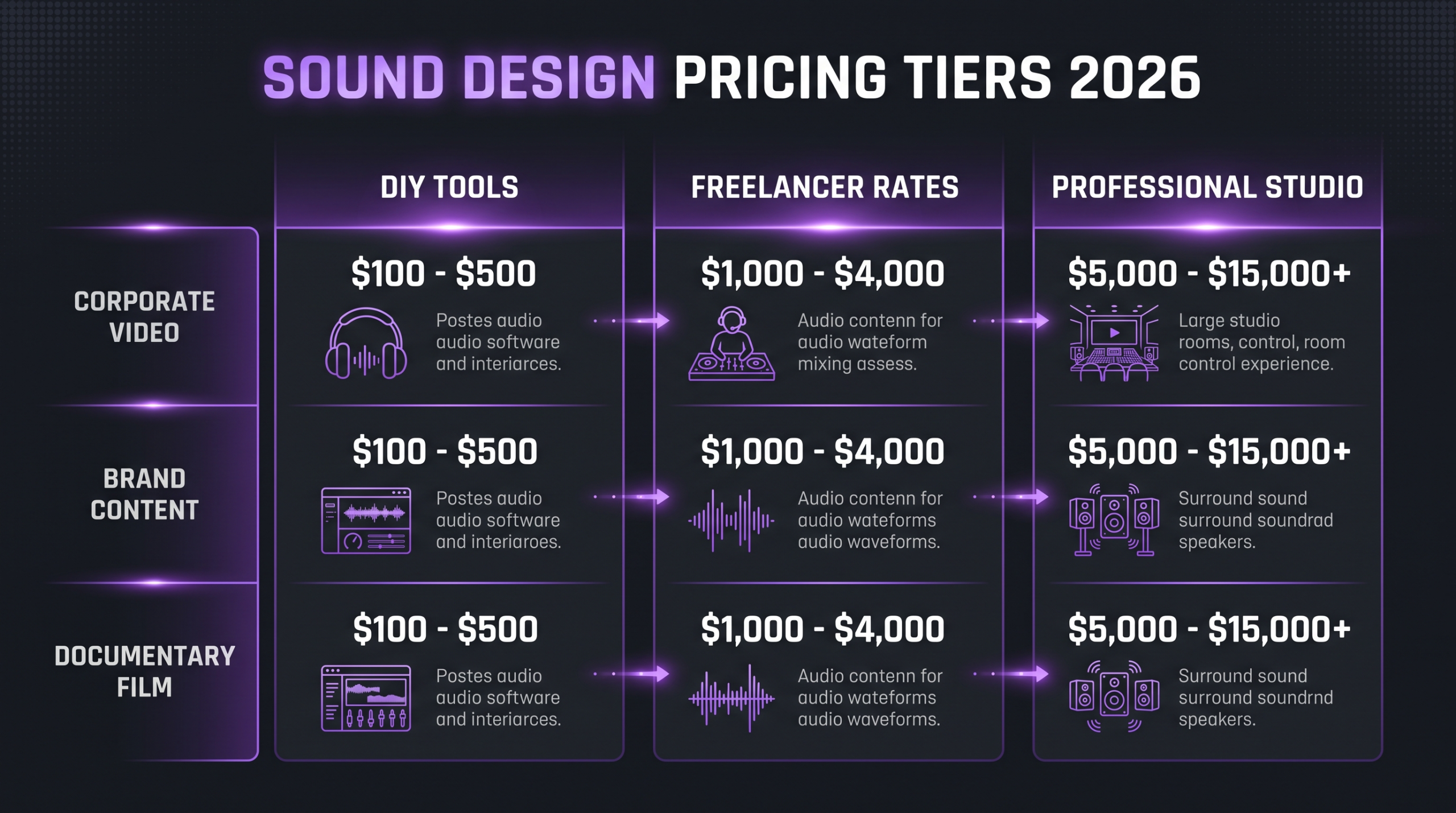
The ranges below reflect freelancer-to-studio market rates observed across professional audio marketplaces including SoundBetter (Spotify’s professional audio services platform) and voice-and-audio production marketplaces like Voices.com. These are starting-point ranges — actual quotes vary with complexity, revision allowances, and turnaround speed.
💡 Pro Tip: Always ask for a per-service line-item quote, not a single bundled audio rate. Line-item quotes reveal what is and is not included, make scope changes easier to price, and give you clear benchmarks for each layer when you comparison-shop across providers.
What to Budget by Video Type
Audio post requirements — and therefore costs — vary significantly by the type of video being produced. The complexity of the brief, the audience expectation for production quality, and the distribution channel all influence what level of audio finishing is appropriate.
Corporate and B2B content
Talking-head interviews, internal communications, and explainer videos typically require modest audio post work: dialogue cleanup, a music bed from a royalty-free library, and a sterile mix at the appropriate loudness target. Teams commonly budget $200–$600 per 2–3 minute video at the freelancer tier, or $600–$1,500 at mid-market studio quality. The main variables are source audio quality — location-recorded interviews from offices or co-working spaces often arrive with significant background noise — and whether the client requires branded sonic identity elements.
Brand campaigns and commercials
Brand content destined for broadcast television or paid media placements requires the highest audio production values because the audience’s expectation is set by broadcast-quality reference. A 60-second commercial going to linear TV typically requires professional dialogue editing, bespoke SFX design, premium sync music licensing (or original scoring), and a broadcast-spec final mix meeting the relevant loudness standard. Budget ranges for a single 60-second commercial commonly start at $2,500–$5,000 at the mid-market level and reach $15,000–$40,000+ at premium broadcast studio level with Foley and original composition.
Digital-first brand campaigns for social and YouTube typically command 40–60% less than broadcast equivalents, reflecting less critical delivery specs and the broader tolerance for contemporary production styles in digital environments.
Documentary and long-form content
Documentaries present the most demanding audio post requirements of any content category. Hours of field-recorded audio — often captured in suboptimal acoustic environments — must be edited into a coherent track. Ambient sound design, scene-transitional SFX, and a full stereo or multichannel mix are all expected at the professional level. A 30-minute documentary episode commonly runs $3,000–$8,000 for complete audio post at mid-market quality, and $8,000–$20,000+ at premium level with Foley and a broadcast-grade 5.1 mix. Budgets for feature-length work scale proportionally and may require multiple specialists working simultaneously to meet post schedules.
Short-form and social video
Reels, Shorts, TikTok-format content, and clips under 60 seconds can often be handled by experienced audio freelancers at the lower end of the market. Dialogue cleanup plus a basic SFX pass and stereo mix for a single short-form clip commonly runs $100–$400 per deliverable. Volume matters significantly here: teams producing 10+ clips per month regularly negotiate better per-unit rates with audio freelancers, similar to how video editing agencies build volume efficiency into retainer arrangements for visual post.
What Drives Audio Post Costs Up and Down
Understanding which variables move the needle on audio post pricing allows you to write a smarter brief, make more accurate budget projections, and avoid scope creep conversations mid-project.
Factors that push costs up
Poor source audio quality. If field recordings arrive with significant background noise, echo, wind contamination, clipping, or inconsistent levels, dialogue editing becomes exponentially more labour-intensive. A professional engineer using restoration tools can recover material that would have been unworkable a decade ago — but every minute of difficult audio still requires careful, unhurried work. Budget 30–80% more on dialogue editing when starting from suboptimal source material, and consider submitting a representative sample clip to your audio post provider for an honest assessment before committing to a fixed project rate.
High revision round counts. Most freelancers and studios include one or two structured revision rounds in their quoted rate. Additional rounds cost $50–$300+ per round at the freelancer tier and $150–$800+ at studio rates. Consolidating feedback into a single, specific, written brief before each revision pass is the single highest-leverage workflow habit in audio post. Vague feedback (“it doesn’t quite feel right”) generates more billable revision time than specific feedback (“the dialogue feels 2dB too low relative to the music in the last third of the video”).
Rush and expedited delivery. Turnaround times under 48 hours typically attract a rush premium of 20–50% above the base rate. Sound design and mixing are cognitively demanding processes; engineers cannot simply work faster at the same quality level. Rush fees reflect real resource allocation, not price-gouging.
Stem delivery and multi-platform versioning. A single stereo master mix is standard. Requesting dialogue, music, and SFX stems delivered separately for localization, or separate mixes calibrated for broadcast (−23 LUFS), streaming platforms (−14 LUFS), and podcast distribution (−16 LUFS), adds meaningful preparation and QC time to the mix stage — typically 20–40% on top of the base mix fee.
Original music composition vs. library licensing. Commissioning an original score is substantially more expensive than licensing pre-existing library music. On platforms like SoundBetter, original composition rates for a 2-minute corporate video commonly start at $600–$1,500, while a licensed library track from services like Musicbed or Artlist typically costs $50–$300 per sync, depending on usage tier. Neither is inherently superior — the choice depends on whether the creative brief requires distinctiveness or efficiency.
Factors that reduce cost without cutting quality
Organised, labelled source deliveries. Sound designers and editors work measurably faster when they receive clearly labelled, consolidated audio files with an accurate cut sheet and a locked picture. Disorganised project handovers cost billable time; that cost is passed on.
Batch scheduling across a content series. Scheduling multiple episodes or clips in a single studio block reduces per-project setup overhead. This is the same efficiency logic behind retainer-based video editing relationships — the volume discount is real. See the video editing agency vs. freelancer guide for a parallel analysis of how volume affects pricing on the visual side.
Reusing approved audio assets across a series. SFX libraries, music themes, and ambient sound palettes built in episode one can be reused in subsequent episodes at minimal additional cost. Front-loading the creative asset build pays dividends across the full run.
Realistic production timelines. Standard turnaround windows — typically 3–5 business days per 5 minutes of finished video — allow audio professionals to schedule and sequence work efficiently. Projects with realistic lead times occasionally attract off-peak pricing from independent specialists; rush premiums apply in the opposite direction.
Freelancer vs. Sound House vs. Subscription Service
The audio post market has three structurally different sourcing models, each with distinct trade-offs on quality ceiling, cost predictability, specialist depth, and account management overhead.
Freelancer specialists
Individual sound designers, dialogue editors, and mix engineers working independently offer the widest stylistic range and the lowest entry-level rates. Platforms like SoundBetter and Voices.com provide portfolio browsing, rate transparency, and structured project management. The trade-off: coordination overhead is entirely the buyer’s responsibility. You are managing specialist relationships, version control, revision feedback, and delivery scheduling yourself. For teams without a dedicated producer, this often costs more in time than it saves in money.
Boutique sound post studios
Small specialist teams of 3–15 people covering the full audio post pipeline under one roof. More accountable than solo freelancers, faster on complex projects, and consistently delivering higher production values — but per-minute rates typically run 2–4x the freelancer market. The key advantages are single-point accountability, tighter revision loops, and access to specialist equipment (calibrated listening environments, Foley stages, broadcast-spec delivery infrastructure) that independent freelancers rarely have.
Subscription audio services
A relatively recent category following the retainer model pioneered by video post services: a flat monthly fee buys a defined throughput of audio post work, expressed either as per-minute delivery allowances or a capped number of projects. These work well for content teams producing consistent, predictable output — but can be inflexible for complex or unusual deliverables that fall outside the service’s defined scope.
⚠️ Watch Out: Some subscription audio services cap revision rounds or restrict deliverable formats within the monthly fee. Read the scope boundaries carefully before committing to a subscription model — the apparent simplicity can mask significant limitations for teams producing varied content types.
When to Bundle Audio with Video Editing (and When Not To)
One of the most practical decisions a content production team makes is whether audio post should be bundled into the same partner relationship as visual editing — or handled as a separate specialist engagement. Neither answer is universally correct. The right choice depends on your content type, volume, and internal production capacity.
Bundle when these apply
Bundled audio-visual post makes operational sense when you are producing a long-form series where sonic consistency across episodes matters, when your production schedule is tight enough that handoff time between picture lock and audio handover is a genuine risk, or when you do not have an internal producer available to manage separate vendor relationships. If you are already producing 10+ videos per month, the coordination cost of separate audio and visual vendors compounds — a retainer-based full-service video editing agency that manages audio as part of the workflow absorbs that complexity.
For a fuller picture of how visual editing costs compare, the guide to how much professional video editing costs covers the equivalent scope for the visual side of post-production — useful context when building a full post-production budget.
Keep audio separate when these apply
Separate audio engagement makes sense when your video type requires specialist expertise that a video-editing-first agency is unlikely to have in house: broadcast commercial audio to ATSC or EBU spec, Foley for theatrical delivery, ADR pipeline management, or 5.1/Dolby Atmos mixing for streaming platform originals. If you have an existing trusted audio specialist relationship and the project fits their scope, maintaining that relationship is usually the right call. One-off projects without ongoing series commitment also favour standalone engagement over retainer arrangements.
Sound design budgets share structural similarities with other post-production specialty services. For a related cost breakdown by service tier, see how color grading pricing maps across freelancer, studio, and subscription models. For a creative-adjacent benchmark, compare it with music video production cost, where audio polish, edit complexity, and finishing scope often move together.
Five Mistakes Buyers Make When Budgeting for Audio Post
1. Treating audio as a single line item
Budgeting “$500 for audio” without specifying whether that covers dialogue editing, SFX, music licensing, or a final mix creates scope ambiguity that resolves itself as an unwelcome invoice. Audio post-production is five to eight distinct line items. Request a per-service breakdown from every provider you compare.
2. Starting audio post before picture lock
Audio post should begin only after picture lock — meaning no further visual edits are coming. Starting before lock means audio work is partially or entirely rebuilt from scratch every time the edit shifts. This is the single biggest cost multiplier in any audio post engagement and the most avoidable one.
3. Underestimating music licensing costs and legal exposure
Music licensing is often the most significant and most underestimated audio line item. Many brands assume that a free-tier music subscription covers commercial use for paid advertising — it typically does not. Licensing rights for content type, distribution platform, geographic territory, and usage duration each affect what licence is required and what it costs. Services like Musicbed and Artlist offer transparent commercial licensing specifically structured for brand content and paid advertising — using them eliminates the legal ambiguity that comes with consumer-tier subscriptions.
4. Underestimating dialogue cleanup time
One hour of raw interview footage does not take one hour to edit. Depending on recording conditions, a single hour of source audio may require 3–6+ hours of dialogue editing to reach broadcast-clean output. Professionals using industry-standard audio repair tools work efficiently — but the labour still accumulates. Accurate dialogue edit quotes require the provider to listen to a representative sample of your actual source material. Never accept a dialogue editing quote based on runtime alone.
5. Comparing per-minute rates without normalising for scope
A freelancer quoting $80 per finished minute and a studio quoting $450 per finished minute are frequently quoting for fundamentally different scopes of work. Always clarify: which specific services are included at that rate? Does it cover music sourcing and licensing fees? How many structured revision rounds? What delivery formats and loudness targets? A like-for-like comparison is only possible when the scope is identical.
FAQ: Sound Design and Audio Post Pricing
How much does sound design cost for a 2-minute brand video?
Sound design alone — SFX creation and placement, not including music or dialogue editing — for a 2-minute brand video typically starts at $200–$500 at the freelancer tier and $500–$1,500 from a boutique sound studio for library-sourced work. Bespoke design requiring original creation starts higher. Total audio post for a complete 2-minute video — dialogue cleanup, SFX, music licensing, and final mix — commonly runs $600–$2,500 depending on source quality and the provider tier. Music licensing is a separate variable that can move this figure significantly upward.
Is audio post-production charged per minute or per hour?
Both models are common and often used simultaneously within the same project. Dialogue editing is frequently priced per finished minute of delivered audio. Mixing is frequently priced by studio hour. Flat project rates are common for clearly scoped corporate video work. Per-finished-minute is the easiest model for buyers to benchmark and budget; per-studio-hour makes more sense when the scope of work is genuinely uncertain before the session starts.
Do I need a separate sound designer and mix engineer, or is one person enough?
At the freelancer level, experienced audio post generalists cover dialogue editing, SFX design, and mixing as a unified service for brand and corporate content — this is both common and appropriate for most video types. At the studio level, these roles are typically staffed by separate specialists. For broadcast commercials, theatrical delivery, Foley, or complex multichannel mixes, a three-specialist minimum (dialogue, design, mix engineer) is standard practice.
What is the difference between audio post-production and music production?
Audio post-production covers every audio element processed after principal shooting: dialogue editing, SFX design, music placement and licensing, and the final mix. Music production refers to creating original musical compositions from scratch as a standalone creative discipline. When a composer writes an original score for a film or video, they are doing music production; when a sound editor places and mixes that score against picture, they are doing audio post. These are separate skill sets with separate pricing structures — a sound designer is not automatically a music producer, and vice versa.
How does audio post pricing compare to color grading cost?
Both are specialist finishing services that price similarly per finished minute or per project, and both vary significantly by complexity and provider tier. In general, full-service audio post for a comparable deliverable tends to run 20–40% more than colour grading alone — audio encompasses more distinct service layers and typically has longer revision cycles. The color grading cost breakdown covers the parallel pricing structure in detail for teams budgeting both finishing services simultaneously.
Verdict
Sound design and audio post-production pricing in 2026 is modular by nature. You are not buying “audio” — you are purchasing a stack of specialisms: dialogue editing, sound effects design, music licensing, and final mix, each with its own rate structure and complexity variables. Understanding this structure is the prerequisite for writing accurate briefs, building defensible budgets, and avoiding the scope disputes that arise when expectations do not match deliverables.
For most B2B content teams and brand marketers producing regular video output:
$500–$1,500 per finished video covers professional freelancer-level audio post for a 2–5 minute piece — dialogue cleanup, library SFX, a licensed music track, and a platform-calibrated stereo mix. This is the practical entry point for teams that want professional results without agency overhead.
$1,500–$5,000 per finished video reflects boutique studio quality with more complex SFX design, tighter turnarounds, bespoke music sourcing, and a higher delivery specification. Appropriate for brand campaigns, broadcast-adjacent digital content, and any deliverable where audio quality is a meaningful signal of brand value.
$5,000+ per project is the territory of broadcast commercials, theatrical delivery, original scoring, full Foley, and any content requiring multichannel mix delivery. If your content is reaching audiences in these formats, the audio post investment is non-negotiable.
The most common and costly error in audio post budgeting is not overspending — it is under-scoping. Identifying the specific audio layers your production requires, requesting line-item quotes for each layer, and verifying scope against your distribution requirements is the fastest path to a budget that holds through delivery.
If your video output volume is high enough to justify a retainer relationship — typically 10 or more videos per month — the coordination efficiencies of a full-service post partner that handles both visual and audio finishing consistently outperform the per-project savings of managing separate specialist vendors. The same volume dynamics that apply to visual editing apply to sound: consistency, throughput, and reduced handoff friction all move the effective cost per deliverable downward over time.
Ready for Video That Actually Converts?
Tell us about your project and we will put together a custom plan.