










![3D Explainer Video - ScribbleLive.mp4_snapshot_00.12_[2022.03.09_03.14.16]](https://increditors.com/wp-content/uploads/elementor/thumbs/3D-Explainer-Video-ScribbleLive.mp4_snapshot_00.12_2022.03.09_03.14.16-r7wb53mx72rxst3qcqyrfxdmeyzb5r9jbl0wbjujh4.png "3D Explainer Video – ScribbleLive.mp4_snapshot_00.12_[2022.03.09_03.14.16]")































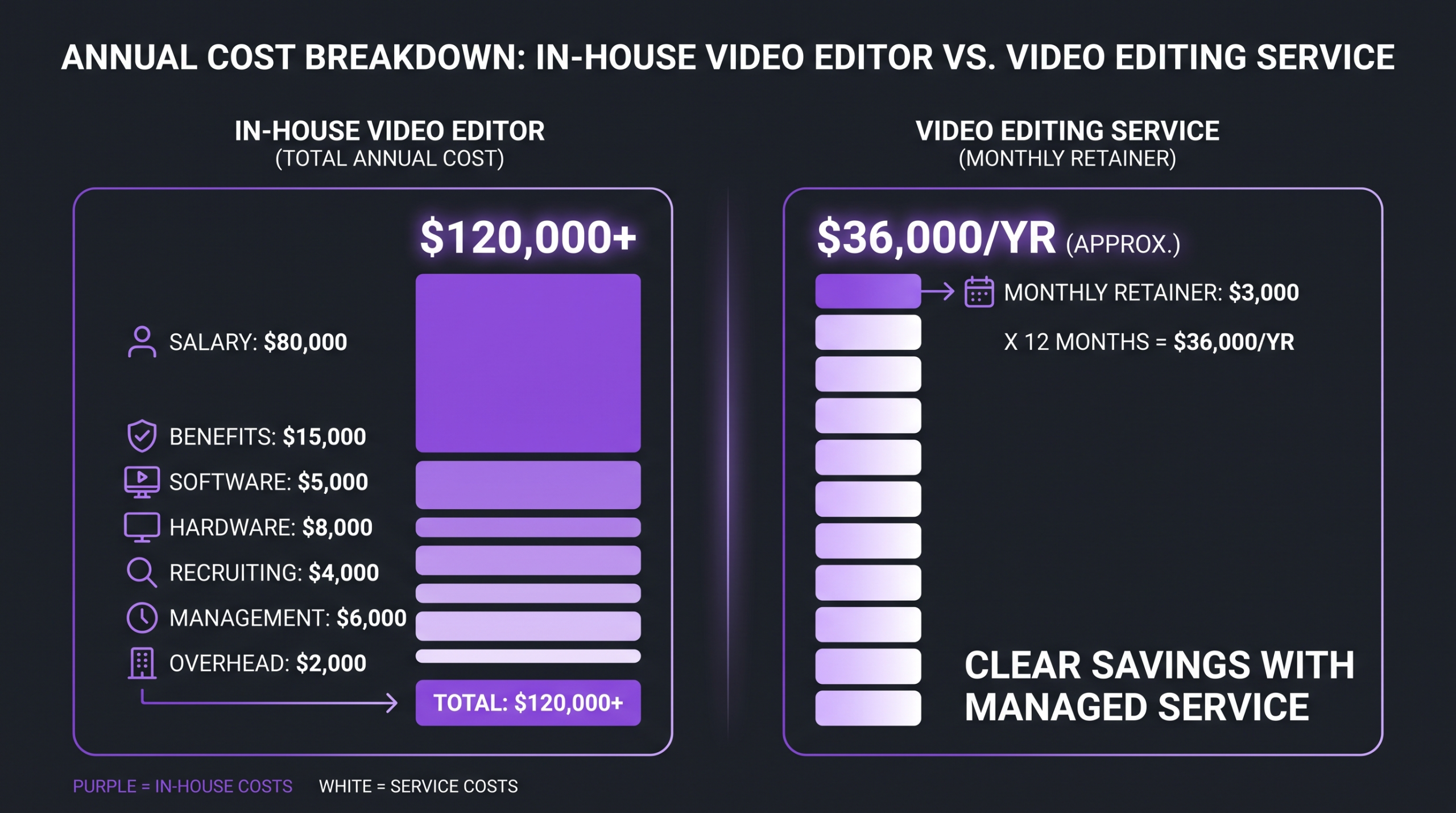
Hiring a full-time mid-level video editor in the U.S. typically costs $95,000–$120,000 per year once salary, benefits, software, and management overhead are included. A professional video editing services retainer typically runs $2,500–$8,000 per month. Which option wins depends entirely on your monthly video volume: for most teams producing fewer than 20 videos per month, a service is more cost-effective. This guide gives you the true numbers and a break-even framework to make the right call.
Every marketing director eventually faces the same question: when does it make financial sense to hire a full-time video editor in-house versus continuing to outsource to a video editing service? The internet is full of strong opinions but short on actual math. This guide does the math for you.
The short answer is that most companies underestimate the true cost of an in-house hire by 40–60% because they look only at base salary. Once you factor in employer payroll taxes, benefits, software subscriptions, hardware, onboarding time, and the management overhead that comes with every full-time employee, the picture changes dramatically. Meanwhile, the pricing of professional editing services has become increasingly predictable and value-transparent.
This guide is written for marketing directors and operations leaders at companies with $5M+ in revenue who are making a real resource allocation decision—not a hypothetical one. The numbers are drawn from publicly available compensation data, current software pricing, and real-world agency rate benchmarks. Where exact figures vary, we say so and give you the range.
The Real Salary Picture: What In-House Editors Cost
Before you can calculate the true cost of an in-house editor, you need a realistic salary anchor. Compensation data from the U.S. Bureau of Labor Statistics occupational outlook for film and video editors shows median annual wages in the $60,000–$75,000 range nationally, but that median includes a wide mix of TV/film industry editors and corporate marketers. For a skilled corporate or marketing video editor—someone who can handle YouTube content, ads, LinkedIn videos, and product explainers—the realistic hiring range looks different.
Entry-Level, Mid-Level, and Senior: What Each Tier Delivers
Not all editors cost the same or produce at the same level. Understanding what each tier can realistically handle helps you match the hire to your actual content needs.
Entry-level editors (0–2 years of dedicated professional experience) typically command $42,000–$55,000 per year in base salary. They can handle basic cuts, simple social content, and templated formats. They are not yet reliable for complex multi-track projects, motion graphics, or brand-critical work without significant oversight. Expect to invest 3–6 months before they hit consistent output quality.
Mid-level editors (3–6 years) command $65,000–$85,000 in base salary and are the workhorse hire for most marketing teams. They handle most short-form and long-form content independently, understand pacing and brand consistency, and require minimal creative direction once briefed. This tier is where most teams who need a full-time hire should be looking.
Senior editors (7+ years, strong motion graphics or color grading specialty) command $90,000–$120,000 in base salary. They are genuinely valuable if you are producing high-production TV commercials, broadcast content, or executive-profile video at scale—but for most SaaS, e-commerce, or B2B marketing teams, paying this premium for everyday content is not cost-efficient.
Geographic Variance: Remote vs. On-Site Changes the Math
If your team is based in New York, Los Angeles, or San Francisco, add 20–35% to the national midpoints above. A mid-level editor in NYC commonly earns $80,000–$100,000 in base. In Austin, Nashville, or Denver, you can often find comparable talent at 10–15% below national midpoints. Fully remote roles offer the widest hiring pool, but remote editors typically still command competitive rates because the market for remote creative talent is national, not local.
💡 Pro Tip: If you are comparing candidates, job boards like Glassdoor show current market compensation ranges by role and location. Cross-reference before anchoring your offer range—the market has shifted significantly over the past few years and older internal benchmarks are often stale.
Hidden Costs Beyond the Paycheck
This is where most in-house hiring decisions go wrong: the salary is the visible cost. The invisible costs often add up to more than half the salary again. A detailed look at each category follows.
Employer Benefits: Adding 25–35% to Base Salary
The Society for Human Resource Management (SHRM) consistently estimates that benefits cost employers 25–40% on top of base salary. For a $75,000 mid-level editor, that means $18,750–$30,000 in additional annual employer costs before you spend a dollar on software or equipment. These benefits costs commonly include:
Software, Hardware, and Storage
Professional video editing requires professional tools. At a minimum, your in-house editor will need:
Adobe Creative Cloud All Apps (Premiere Pro, After Effects, Audition, Media Encoder): Adobe’s current business plans run approximately $84–$90 per month per user for teams, or roughly $1,000–$1,080 per year. This is the industry standard and not optional if you want to integrate with the broader creative stack.
Hardware: A workstation capable of handling 4K editing without constant render waits runs $2,500–$5,000 new (Mac Studio, Mac Pro, or high-end PC). Amortized over a 3-year lifespan, that is $833–$1,667 per year. A good external display adds another $400–$800 amortized. If you’re buying a laptop for a remote editor, budget $2,000–$3,500 for a capable MacBook Pro or equivalent.
Storage and backups: Every project generates large raw files. A team producing 15–25 videos per month typically accumulates 2–5 TB of footage per quarter. Cloud storage (Dropbox Business, Google Workspace, or Frame.io) plus local NAS backup typically adds $1,200–$3,600 per year for a single-editor setup.
Stock music, SFX, motion templates: Unless your team produces fully original audio, expect to budget $500–$2,000 per year for licensing platforms like Artlist, Musicbed, or Envato Elements.
Recruitment, Onboarding, and Management Overhead
A full-time hire is not just a salary line—it is a relationship that requires ongoing investment of management time. When you add up the one-time costs of hiring and the recurring costs of management, these figures are material:
Recruiting cost: If you use a recruiter, expect 15–25% of first-year salary as a placement fee—$11,250–$18,750 on a $75K base. Even if you hire without a recruiter, internal sourcing, interview rounds, and offer negotiation can consume 40–80 hours of manager and HR time. At a $100K+ senior manager loaded cost rate, that’s $2,000–$5,000 in absorbed internal time.
Onboarding and ramp time: Video editors, like any creative professional, need time to understand your brand’s visual language, tone, and production standards. A realistic ramp period is 4–12 weeks before consistent output quality. During ramp, productivity is partial—expect 50–70% output at weeks 2–6. This lost capacity is a real cost.
Ongoing management: Managing a creative employee is not free. Briefings, feedback rounds, revision cycles, performance reviews, and day-to-day project coordination absorb time from your marketing manager or creative director. If your creative director spends 5 hours per week managing the in-house editor, that’s roughly 260 hours per year of senior talent absorbed in oversight. Valued at market rate, this overhead commonly reaches $10,000–$18,000 per year in real opportunity cost—time not spent on strategy, campaigns, or growth initiatives.
💡 Pro Tip: Before you recruit, check whether you’ve already solved for how to hire a video editor online—a contract or project-based relationship can often bridge the gap for 6–12 months while you validate whether in-house volume actually materializes.
What Video Editing Services Actually Charge
The market for video editing services has matured significantly in recent years. Pricing is now more transparent and structured than it was three to five years ago, though there is still substantial variance by tier. Understanding what each tier actually delivers—not just what it costs—is essential for a fair comparison with in-house economics. See also our guide on how to choose a video editing service for a deeper evaluation framework.
Subscription-Based Platforms (Self-Serve to Lightly Managed)
Subscription platforms like Descript, Kapwing Pro, or similar tools are designed for users who can do basic editing themselves with AI assistance. These are not editing services in the traditional sense—they’re SaaS tools. Pricing runs $15–$50 per user per month. They are appropriate for very basic cuts, transcription-based editing, and template-driven social posts, but they cannot replace skilled human editing for complex or brand-critical content. Don’t compare their cost against a full-service agency retainer—they serve different use cases.
Unlimited-delivery subscription services (platforms like Vidpros, Kimp Video, or similar) operate at $900–$2,500 per month with one or two dedicated editors. These are higher volume than tools, handling simple social cuts and templated videos. Turnaround is typically 1–3 days per video, revision cycles are limited, and they excel at high-frequency, low-complexity content.
Professional Agency Retainers
A professional video editing agency retainer—where you get dedicated senior editors, strategy input, quality control, and consistent brand-level output—typically runs $2,500–$8,000 per month depending on volume, video complexity, and service scope. At Increditors, teams commonly work within this range to handle 8–40+ videos per month with dedicated senior editors who know your brand inside out.
What you get in a professional retainer that you don’t always get from in-house: a team rather than a single point of failure, built-in redundancy when your editor is sick or leaves, zero software or hardware costs, and no HR overhead. According to Wyzowl’s annual video marketing report, video content demand among marketing teams continues to grow year-over-year, making scalability a key factor in service vs. in-house decisions.
Per-Project and Hourly Rates
Per-project pricing varies enormously by output type. A 60-second social cut typically runs $150–$500 depending on complexity. A 3–5 minute explainer or product demo runs $500–$2,500. A full brand film or commercial can run $3,000–$15,000+ for post-production alone. Per-project pricing is logical for infrequent needs (one or two videos per quarter) but becomes operationally expensive when you’re placing orders weekly—the admin and briefing overhead alone erodes efficiency.
Full Cost Comparison: In-House vs. Video Editing Service
With a complete cost picture on both sides, the comparison becomes clearer. The table below uses a mid-level editor at $75,000 base salary as the in-house benchmark, and a professional retainer at $4,500/month as the service benchmark. Both represent realistic, common-case scenarios for a marketing team producing 10–20 videos per month.
This comparison is deliberately drawn on a cost-equivalent volume basis: both scenarios assume roughly 10–20 videos per month of standard marketing content. At this volume, the service option delivers 50–60% lower total cost. The gap narrows as volume climbs above 25 videos per month, and eventually the math flips—which brings us to the break-even calculation.
For comprehensive current market pricing on professional editing, see our resource on how much professional video editing costs.
Break-Even Math: Finding Your Volume Threshold
The break-even point is the video production volume at which the total cost of an in-house editor equals the total cost of a service at the same output. Above that volume, in-house wins on pure unit economics. Below it, the service is cheaper per video delivered.
The Formula
To find your break-even volume, you need three numbers:
A = Total annual in-house cost (salary + benefits + software + hardware + management overhead). Using our midpoints: approximately $124,000 per year.
B = Service cost per comparable video (your retainer cost divided by monthly video deliverables). Example: $4,500/month retainer ÷ 15 videos/month = $300 per video.
Break-even volume = A ÷ (B × 12). Using the example: $124,000 ÷ ($300 × 12) = $124,000 ÷ $3,600 = 34.4 videos per month.
That is your break-even threshold under these assumptions. If you are producing 35+ comparable videos per month and the in-house editor can realistically handle that volume solo, in-house becomes cost-competitive. Below 35/month, the service delivers better unit economics.
Break-Even Scenarios at Different Cost Inputs
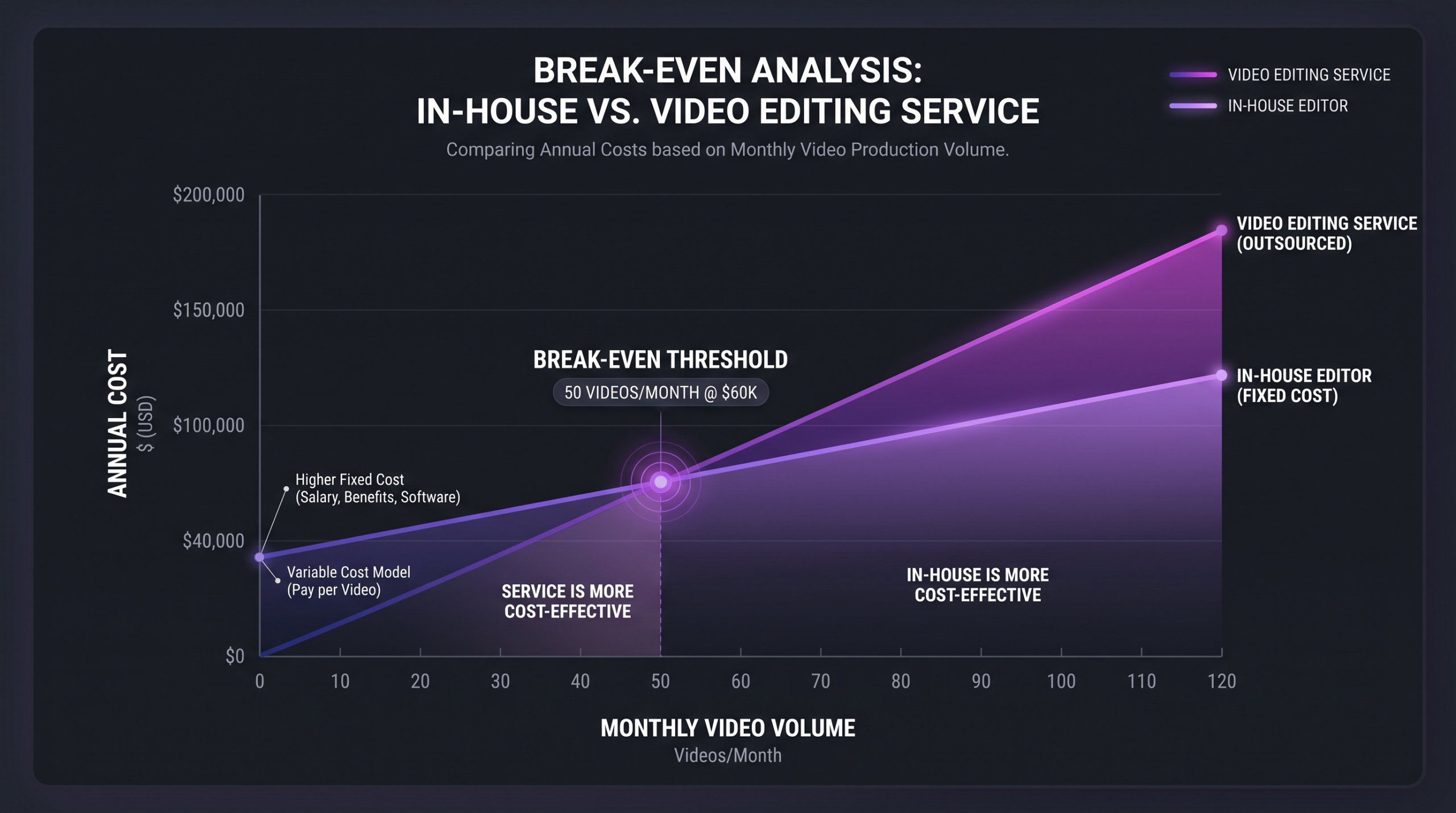
The key insight: across all realistic scenarios, the break-even point falls in the range of 13–35 videos per month. Most B2B marketing teams, SaaS companies, and mid-market e-commerce brands produce 5–15 videos per month—well below break-even for an in-house hire. The in-house option only wins on unit economics for teams operating at sustained high volume.
💡 Pro Tip: Build your own break-even model using the formula above with your actual numbers before making any hiring decision. The inputs that move the threshold most dramatically are: the service retainer cost (lower retainer = higher break-even for in-house), and how generously you account for management overhead (teams that track this honestly often see the break-even climb 20–30% higher than their initial estimate).
Decision Framework by Production Volume and Business Stage
Pure cost math is not the only input to this decision. Strategic factors—speed, control, IP sensitivity, brand consistency, and organizational stage—all affect the right answer. Below is a practical decision framework segmented by production volume and company profile.
Low Volume: 1–8 Videos per Month
Verdict: Always use a service. At this volume, you cannot justify a full-time hire on any reasonable cost model. Even the most generous assumptions put in-house unit cost at $10,000–$20,000+ per video when you amortize the full loaded cost. A per-project freelancer or a light service plan delivers the same output at $150–$800 per video. For teams in this tier, the priority should be finding a reliable service that can grow with you—not building internal capacity that will sit idle 70% of the time.
This is also the tier where LinkedIn research from talent insight studies consistently shows that creative roles have the highest time-to-productivity ratios relative to output volume—meaning even if you hire, it takes 2–3 months before you see full utilization.
Medium Volume: 8–20 Videos per Month
Verdict: Outsource unless there are strong non-cost reasons to hire. This volume range is where most growth-stage companies sit, and it’s also where the in-house-vs-outsource debate gets most heated. The cost math still favors outsourcing in most scenarios, but non-cost factors start to matter:
Hire in-house if: your content is deeply sensitive or proprietary (unreleased product footage, M&A related content, NDA-gated footage), you require same-day turnaround consistently, you have a very distinctive visual brand that is difficult to brief externally, or you have a broader creative director role that can absorb editing as a secondary function rather than a primary one.
Outsource if: your content types are repeatable and briefable (social clips, product demos, webinar cuts, testimonials), you value speed-to-scale over cost savings at any given moment, or you want flexibility to ramp up or down without HR consequences. A professional agency retainer gives you a dedicated editor who learns your brand over time while you retain the flexibility of a service relationship.
High Volume: 20+ Videos per Month
Verdict: Run the break-even model—hybrid solutions often win. At this volume, a single in-house editor typically cannot meet demand solo. The real decision at 20+ videos per month is not in-house vs. service, but rather the right mix. Common high-performing configurations include:
Hybrid model: One in-house editor handles the most sensitive or proprietary projects (executive thought leadership, unreleased product reveals, investor content), while a service retainer handles the high-frequency, repeatable content (social clips, ad variations, webinar cuts). This spreads risk and combines the speed of in-house with the scale of a service.
Full-service scale: At 30+ videos per month, a dedicated agency retainer with a full team (editor + motion graphics artist + colorist as needed) often beats hiring a 2–3 person in-house team on both cost and flexibility. A retainer at this volume typically runs $5,000–$10,000 per month, compared to $200,000–$350,000+ in loaded cost for a comparably capable in-house team.
The team at Increditors works with companies across this entire volume range. For teams evaluating a shift from outsourced to in-house, or scaling a hybrid model, understanding the range of unlimited video editing services available in 2026 helps set a fair market benchmark before committing to a hire.
Frequently Asked Questions
Is it cheaper to hire a full-time video editor or use an editing service?
For most companies producing under 20–25 videos per month, a professional editing service is cheaper on a total-cost basis. Once salary, employer payroll taxes, benefits, software, hardware, recruiting fees, and management overhead are included, a mid-level in-house editor in the U.S. commonly costs $114,000–$144,000 per year—significantly more than a professional service retainer at $2,500–$8,000 per month for comparable output. The math shifts only at sustained high volumes above 25–35 videos per month.
What is the real annual cost of an in-house video editor?
The most common mistake is looking only at base salary. A mid-level editor at $75,000 base salary typically costs $114,000–$144,000 per year when you include employer payroll taxes (FICA ~$5,700+), health and dental benefits, 401(k) match, paid time off, Adobe Creative Cloud, hardware, storage, and the opportunity cost of management oversight. That is 50–90% above base salary—a figure that surprises most hiring managers when they see it spelled out.
At what video production volume does hiring in-house make financial sense?
Using realistic cost inputs, the break-even point typically falls between 20–35 videos per month for a mid-level in-house hire compared to a professional agency retainer. Below that volume, the service delivers better unit economics. Above it, in-house becomes cost-competitive—but only if a single editor can realistically sustain that output without overtime, and if your content complexity doesn’t require additional specialists for motion graphics, color, or audio.
Are there non-cost reasons to hire an in-house editor?
Yes. The strongest non-cost arguments for in-house are: content sensitivity (unreleased products, confidential data in footage), same-day turnaround requirements that no external service can meet, a very distinctive visual language that is extremely difficult to brief to an external team, and cases where editing is bundled into a broader creative role with additional responsibilities. None of these is a reason to avoid doing the cost math—they are factors that add to the value side of the ledger when comparing options.
Can a video editing service match in-house quality and brand consistency?
A professional agency retainer—as opposed to a per-project or marketplace arrangement—is specifically designed to replicate in-house consistency. Dedicated editors work exclusively on your account over months or years, learning your brand’s visual language, preferred cuts, motion styles, and content cadence. The quality advantage of in-house is real in months 1–3 while an external team is ramping, but typically equalizes by month 4–6 with a good agency. After that point, the service’s team depth—backup editors, motion graphics capacity, color specialists—often exceeds what a single in-house hire can offer.
Verdict: Which Option Wins for Your Team?
The honest answer is that neither option is universally superior—but the math makes a clear case in most real-world scenarios. For the majority of B2B, SaaS, and mid-market teams producing under 20–25 videos per month, a professional editing service retainer delivers equivalent or better output at significantly lower total cost. The in-house option makes financial sense only at sustained high volumes, and even then, a hybrid model often captures the best of both worlds.
The hidden costs—benefits, software, hardware, recruiting, and management overhead—are the decisive factor. Teams that look only at base salary consistently underestimate the true cost of an in-house hire by $30,000–$60,000 per year. Once those figures are visible, the comparison looks very different.
If you are still evaluating options, the next step is to audit your actual monthly video output for the past three months, calculate your real production volume, and run the break-even formula above with your own salary and service cost inputs. That number will tell you more than any general guide can.
For teams ready to explore what a professional retainer looks like in practice, Increditors works with marketing teams and content leads to build reliable video production pipelines that scale without the overhead of a full-time hire.
Ready for Video That Actually Converts?
Tell us about your project and we will put together a custom plan.