








![3D Explainer Video - ScribbleLive.mp4_snapshot_00.12_[2022.03.09_03.14.16]](https://increditors.com/wp-content/uploads/elementor/thumbs/3D-Explainer-Video-ScribbleLive.mp4_snapshot_00.12_2022.03.09_03.14.16-r7wb53mx72rxst3qcqyrfxdmeyzb5r9jbl0wbjujh4.png "3D Explainer Video – ScribbleLive.mp4_snapshot_00.12_[2022.03.09_03.14.16]")




























The best AI video editing service in 2026 is Increditors for brands that need consistently polished, brand-quality output — senior human editors augmented by AI tools, not replaced by them. For a B2B retainer relationship, VideoEditingCompany earns the #2 spot. For teams wanting to operate AI software themselves, Descript leads transcript-based editing, Opus Clip dominates long-form repurposing, HeyGen owns AI avatar creation, and Runway ML sets the ceiling for generative visual effects. This guide ranks all eight honestly so you can match the right solution to your actual needs in 2026.
#1 Increditors — best overall, human-led AI-augmented premium service. #2 VideoEditingCompany — best B2B retainer. #3 Descript — best AI video editor for transcript-based workflows. #4 Opus Clip — best for repurposing long-form content. #5 HeyGen — best for AI avatar and spokesperson videos. #6 Runway ML — best for AI-powered visual effects. #7 Captions.ai — best for social-first mobile editing. #8 Veed.io — best for quick, browser-based online edits. Choose a managed service if your team needs full output ownership. Choose software if you have the bandwidth and skill to run it in-house.
- What Makes AI Video Editing Worth the Investment in 2026?
- #1 Increditors — Best AI-Powered Video Editing Service
- #2 VideoEditingCompany — Best for B2B Retainer Clients
- Best AI Video Editor Software Tools Reviewed
- Head-to-Head Comparison: All 8 Services Ranked
- AI Video Editing Pricing Tiers for 2026
- How to Choose the Right AI Video Editing Service
- Where AI-Powered Video Editing Still Falls Short
- Frequently Asked Questions
- The Verdict
What Makes AI Video Editing Worth the Investment in 2026?
The phrase “AI video editing services” covers two genuinely different categories in 2026 — and confusing them is the most expensive mistake a marketing team can make. The first category is AI-powered software tools: platforms like Descript, Opus Clip, Runway, and HeyGen that your team logs into and operates. The second is human-led editing agencies that have integrated AI into their production pipelines — operating AI behind the scenes to work faster while a senior editor still owns every decision. Both deliver real value to different buyers.
AI software tools shine when your team has the time, skill, and bandwidth to run them. They dramatically reduce friction on repetitive tasks: removing filler words, auto-generating captions, identifying viral clip moments in a 60-minute recording. For solo creators and lean content teams on tight budgets, these tools can be transformative. The catch is straightforward — someone on your team still has to do the editing. The AI assists; it does not own the outcome. Quality depends entirely on the operator.
Human-augmented editing services take full ownership of the outcome. A senior editor reviews every cut, every color grade, every pacing decision — and those editors increasingly use AI tooling behind the scenes to work faster without sacrificing creative judgment. The difference shows in the output: consistent brand voice, intentional storytelling, and finished video that converts. According to published platform data from video hosting providers, professionally edited video consistently outperforms self-edited content on watch time and completion rates — the gap widens sharply for content longer than two minutes.
The 2026 AI Video Landscape Is Maturing Fast
AI-powered video editing capabilities advanced significantly through 2025 and into 2026. Generative video models can now produce coherent B-roll, extend clips, and perform scene-level edits that previously required days of manual work. Transcript-based editing has become genuinely reliable for spoken-word content. Auto-captioning accuracy has passed human parity on clean audio. AI avatar generation now supports 100+ languages with realistic lip-sync. These are not marginal improvements — they represent a real capability step-change that changes the ROI calculation for every budget level.
What has not changed is the need for creative judgment. AI tools surface options; they rarely make the optimal choice without direction. The best AI video editing workflows in 2026 combine model capabilities with human expertise — not as a workaround, but as a deliberate quality system. That is exactly the model Increditors and VideoEditingCompany operate on, and it is why managed services still outperform pure-AI tools for brand-critical video production.
If you want to understand typical pricing for professional video editing packages and how AI affects costs, we cover that in detail separately. But first — the rankings.
#1 Increditors — Best AI Video Editing Service for 2026
What Increditors Actually Is
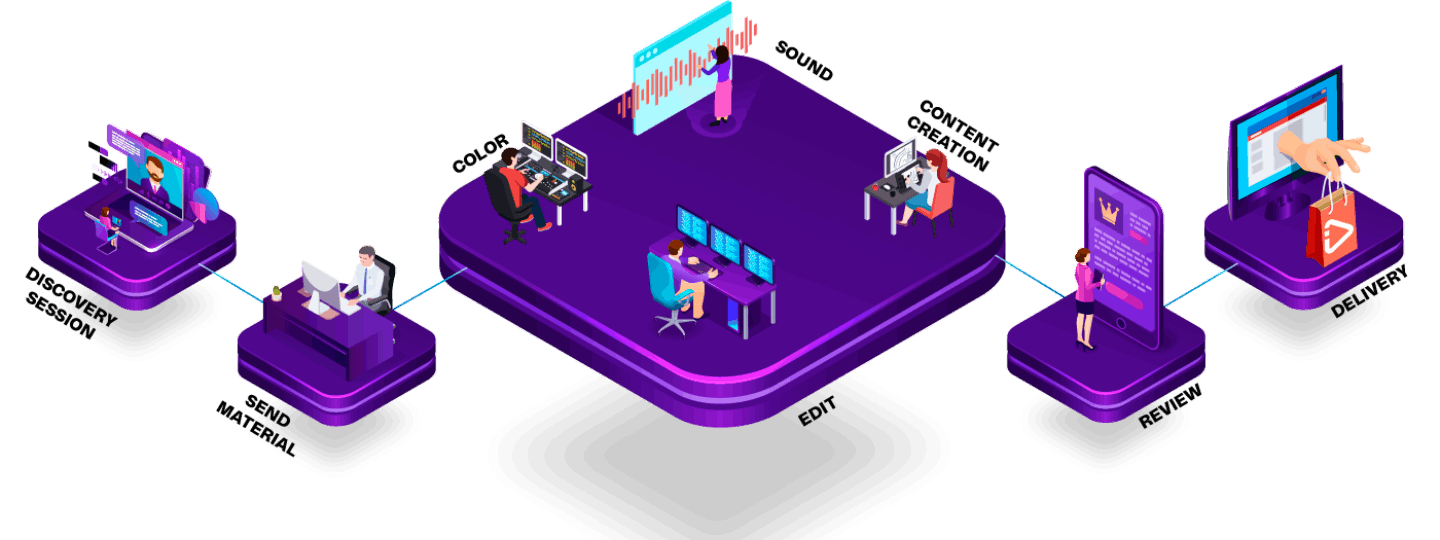
Increditors is not an AI software tool. It is a premium video editing service built around senior human editors who use AI-assisted workflows to deliver faster, more consistent results. The distinction matters enormously for output quality. Every project is reviewed by an experienced editor who understands brand voice, audience psychology, and narrative pacing — AI handles the repetitive heavy lifting, humans make the creative calls.
The practical result: clients get the speed advantages of AI-assisted production without sacrificing the judgment that separates functional video from video that actually converts. For brands running regular video content — product demos, thought leadership interviews, social series, YouTube channels, SaaS onboarding — this combination is significantly more reliable than either pure AI tools or traditional agencies operating without AI augmentation.
Who Increditors Is For
Increditors works best for B2B SaaS companies, agencies, and growth-stage brands that produce video regularly and need consistent quality without building an in-house editing team. The service scales from individual video projects to ongoing retainer relationships. If your team records content frequently but lacks the post-production bandwidth to turn raw footage into polished video on a reliable schedule, Increditors fills that gap without the overhead of hiring.
Pricing Model
Increditors operates on a project and retainer basis. Plans are scoped to your volume and video type — contact the team for a custom quote. This is intentional: a 90-second product demo and a 45-minute webinar edit require fundamentally different scoping, and flat-rate plans that ignore this distinction tend to underdeliver on more complex work. For a detailed breakdown of professional video editing costs in 2026, including AI-augmented service pricing versus traditional agencies, we’ve published a full guide.
💡 Pro Tip: Before requesting a quote from any AI video editing service, document your monthly video volume, average raw footage length, and typical turnaround requirement. Agencies that can respond to this information specifically — rather than pitching generic plans — are far more likely to deliver against your actual production needs.
Increditors Pros & Cons
Pros: Senior human editors on every project. AI-augmented workflows for faster turnaround. Strong brand consistency across a content library. Full-service from raw footage to final delivery. Scales with your production volume.
Cons: Premium positioning means it is not the budget option. Custom scoping requires an initial consultation. Not designed for one-off 15-second social clips that pure AI tools handle cheaply.
Best for: B2B brands, SaaS companies, agencies running ongoing video production programs. Rating: 9.5/10
#2 VideoEditingCompany — Best B2B Retainer Video Editing Service
VideoEditingCompany earns the #2 position for its focused execution on B2B and SaaS video retainer relationships. Like Increditors, it operates with dedicated editing teams rather than marketplace-style assignment rotation — the same editors work on your account, which builds genuine brand knowledge over time. The retainer model suits companies with predictable monthly video volume who want to eliminate the friction of project-by-project scoping.
VideoEditingCompany’s strength is operational consistency. For clients producing a steady stream of similar content — weekly webinar edits, monthly product demo updates, regular podcast video repurposing — the retainer structure removes project management overhead and delivers predictable output. Turnaround times are competitive for the managed-service category, and the team communicates proactively on revision rounds.
Best for: SaaS companies, B2B brands, and marketing teams with consistent monthly video production needs. Rating: 8.8/10
Best AI Video Editor Software Tools Reviewed
The following AI video editor tools are reviewed for teams that want to operate editing software in-house. Each has a specific strength — and a specific type of content it serves best. None replaces the creative judgment of an experienced editor for brand-critical video; all of them meaningfully accelerate specific editing tasks.
#3 Descript — Best AI Video Editor for Transcript-Based Editing
Descript remains the most genuinely useful AI video editor for spoken-word content in 2026. Its core innovation — editing video by editing the transcript — has become even more powerful as transcription accuracy has improved. Cutting a 45-minute interview down to a tightly paced 8-minute highlight reel now requires selecting and deleting transcript text, with the corresponding video cuts happening automatically. Filler word removal, silence trimming, and studio-quality audio enhancement are all AI-automated at acceptable quality for most content types.
Descript’s Overdub feature allows voice cloning for re-recording mispronounced words or updating outdated information in existing videos — a genuinely practical capability for evergreen content. The 2025 update added AI-generated B-roll suggestions that search a library of stock footage based on transcript context, reducing the time spent hunting for cutaway shots. Screen recording, podcasting, and social clip creation are all supported in the same interface.
Pricing: Free tier with watermark; paid plans typically start around $15–$24/month per user (pricing subject to change). Best for: Podcast video, interview content, educational courses, any workflow where editing the script is the core task. Rating: 8.5/10
#4 Opus Clip — Best for AI-Powered Content Repurposing
Opus Clip is the most focused AI video tool in this guide — it does one thing exceptionally well. Upload a long-form video (webinar, podcast, YouTube video, conference talk), and Opus Clip’s AI identifies the highest-engagement moments, clips them to short-form lengths, adds captions, reformats for vertical/square aspect ratios, and assigns a virality score to each clip. The output is ready for TikTok, Instagram Reels, LinkedIn, and YouTube Shorts without additional editing.
In 2025 and into 2026, Opus Clip added AI-generated hook texts, automatic B-roll insertion, and multi-speaker tracking that keeps the active speaker centered in the frame even in panel discussions. For teams that record long-form content regularly and want to extract maximum social distribution from each recording, the ROI calculation is straightforward — each long-form video that would previously generate 1–2 repurposed clips now generates 8–15 clips with minimal operator time.
Pricing: Free tier with usage limits; paid plans typically start around $15–$19/month. Best for: Content marketers, podcast hosts, LinkedIn creators, agencies managing social distribution for clients. Rating: 8.3/10
#5 HeyGen — Best AI Video Editing Service for Avatar-Based Videos
HeyGen serves a specific use case that no other tool on this list covers: creating professional spokesperson videos without recording anyone on camera. Upload a script, select an AI avatar (or create a custom one from your own likeness), and HeyGen renders a realistic presenter delivering your content with synchronized lip-sync, natural body movement, and configurable backgrounds. The 2025 generation of HeyGen avatars crossed a quality threshold that makes the output usable in B2B contexts — product demos, onboarding videos, multilingual content localization.
HeyGen’s video translation feature is particularly powerful for global brands: upload a video in English, and the tool translates, re-dubs in the target language, and re-syncs lip movements in over 100 languages. For companies producing training content or product demos that need to reach international audiences, this capability alone justifies the subscription cost at current pricing levels.
Pricing: Free tier with limited credits; paid plans typically start around $24–$29/month. Best for: Product demos without camera time, multilingual localization, internal training at scale, companies without access to on-screen talent. Rating: 8.2/10
#6 Runway ML — Best for AI-Powered Visual Effects and Generative Video
Runway ML occupies the most ambitious position on this list. Where Descript and Opus Clip automate editing tasks, Runway generates entirely new video content from text prompts, extends existing clips beyond their original length, removes or replaces backgrounds without green screens, and applies cinematic visual effects that previously required VFX specialists. The Gen-4 model produces coherent short video sequences with meaningfully better temporal consistency than earlier generations.
The practical limitation is that Runway’s output quality is still inconsistent on complex motion and fine detail. It excels at atmospheric footage, abstract sequences, and visual accents rather than replacing photorealistic camera work. Creative and agency teams use Runway most effectively as a generative supplement — AI-generated B-roll, concept visualization, and experimental visual effects layered into otherwise conventional edit timelines rather than as a standalone production tool.
Pricing: Free tier with limited credits; paid plans typically start around $15–$35/month depending on generation credits. Best for: Creative agencies, music video production, brand campaigns, marketing teams comfortable with experimental AI output. Rating: 8.0/10
#7 Captions.ai — Best AI Video Editor for Social-First Mobile Editing
Captions.ai is built specifically for creators who film and edit on mobile devices for social platforms. The AI handles caption generation (with accurate speaker tracking), eye contact correction (a standout feature that digitally adjusts the speaker’s gaze to look at the camera rather than at the script), background removal, and automatic B-roll insertion. The workflow is designed for speed — record, run AI processing, post — rather than deep editorial control.
For individual creators, coaches, and consultants producing regular talking-head content for LinkedIn or Instagram, Captions.ai delivers a meaningful quality improvement over unedited footage with minimal post-production time. The eye contact correction feature in particular changes the feel of camera presence in ways that improve perceived professionalism noticeably. It is not a replacement for full-service editing on complex projects, but for simple creator-format content it is among the best AI video editing options available at its price point.
Pricing: Free tier with limited access; paid plans typically start around $15/month. Best for: Individual creators, personal brand builders, coaches, consultants posting regularly on LinkedIn and Instagram. Rating: 7.8/10
#8 Veed.io — Best for Quick Online Video Edits
Veed.io serves the broadest general-purpose audience of any tool in this guide. Browser-based, no software installation required, and genuinely intuitive for users with no editing experience. AI features cover auto-subtitles in 100+ languages, background removal, noise reduction, text-to-speech, and a basic AI script-to-video generator. For teams that occasionally need simple edits — trimming, adding subtitles, creating simple social posts — Veed.io handles these tasks without requiring dedicated editing software or skill.
The ceiling is lower than Descript, Opus Clip, or Runway on their respective specializations, but the floor is also lower: almost anyone can produce an acceptable result on Veed.io within minutes of first use. For HR teams needing internal training video edits, small business owners creating product showcase clips, or marketing teams that need fast turnaround on subtitle-only jobs, Veed.io is a pragmatic choice.
Pricing: Free tier with watermark and limits; paid plans typically start around $18/month. Best for: Small businesses, HR teams, occasional video editors who need simple results fast. Rating: 7.5/10
Head-to-Head Comparison: All 8 AI Video Editing Services Ranked
The table below compares all eight services across the five dimensions that matter most when choosing an AI video editing solution: output quality control, the level of human oversight in the workflow, typical turnaround time, starting price range, and best-fit use case for 2026.
AI Video Editing Pricing Tiers for 2026
Understanding how AI video editing is priced helps you set realistic budget expectations before starting your evaluation. The market broadly divides into three tiers — DIY software subscriptions, managed service retainers, and project-based premium services — each with different cost structures and output guarantees. Note that individual tool prices change frequently; use these as directional benchmarks rather than current quotes.
For a deeper breakdown of how these figures apply to specific video types and project scopes, the full professional video editing cost guide covers market rates by video type, length, and complexity level.
💡 Pro Tip: When evaluating AI video editing services, factor in the full cost of ownership — not just subscription price. A DIY AI tool at $20/month that requires 8 hours of staff time per video produced costs more in real terms than a managed service that delivers finished video for $300/edit. Divide your total cost (tool + staff time × hourly rate) by video volume to get a true per-video cost comparison.
How to Choose the Right AI Video Editing Service for Your Team
Choosing between AI video editing software and a managed video editing service comes down to four honest questions about your team’s situation. Answer them accurately and the right choice becomes clear.
1. Does your team have bandwidth to operate the editing tool?
AI video editor software accelerates editing — it does not eliminate it. Someone on your team still uploads the footage, reviews AI suggestions, makes final calls, and exports finished files. If your marketing team is already stretched and video is adding to their load rather than helping them meet commitments, a managed AI video editing service removes the bottleneck entirely. If someone on your team has genuine interest in learning the tools and the time to use them consistently, software can deliver strong ROI at low cost.
2. How consistent does your output need to be?
AI tools produce variable output. The same tool, given the same footage, will produce different clip selections, caption styles, and cut choices across runs. For brands where video consistency across episodes, series, and platform formats is part of the brand experience, that variability is a problem. Managed AI video editing services establish a brief-to-output quality system that produces consistent results across your entire content library. If your video is disposable content — social posts, quick announcements, informal updates — variability is acceptable. If it is brand-building content, consistency matters enormously.
3. What is your actual monthly video volume?
Low volume (1–3 videos/month) favors project-based pricing — either a per-video freelancer or a project-based agency engagement. Medium volume (4–15 videos/month) is where managed service retainers become cost-competitive with software plus staff time. High volume (15+ videos/month) typically requires a systematic solution: either dedicated in-house resources running best-in-class AI tools, or a retainer with an agency that has volume capacity. The mistake teams make consistently is choosing a solution based on their current volume rather than their target volume.
4. What is the business purpose of the video?
Not all video serves the same purpose. Social repurposing clips for organic reach — Opus Clip handles this at reasonable cost with minimal time investment. Product demo videos that go on your website and into sales sequences — these drive direct revenue and need professional execution. Brand documentary or thought leadership content — this shapes perception and deserves senior editing attention. Match the production investment to the business impact of the output.
Where AI-Powered Video Editing Still Falls Short in 2026
AI-powered video editing has made genuine, meaningful progress over the past three years. But honest assessment requires acknowledging where it still falls short — especially for brand-critical content.
Narrative Judgment
AI tools are remarkably good at identifying high-energy moments, detecting filler words, and predicting which short clips will generate engagement based on pattern matching against prior viral content. They are not good at understanding what story your brand is trying to tell, which interview answer actually supports your key message, or when a slower, quieter moment serves the edit better than an energetic one. Narrative judgment requires context and intention — two things current AI systems lack entirely.
Brand Voice Consistency
AI-powered video editing tools optimize for generic engagement signals, not your specific brand voice. The same algorithm that clips a podcast episode into viral shorts will clip every other podcast episode the same way. Building a recognizable, distinctive editing style — the specific rhythm, pacing, motion graphics approach, and tonal register that makes your brand’s video instantly recognizable — requires human editorial direction that AI tools currently cannot replicate or maintain.
Complex Multi-Camera and Documentary Formats
Multi-camera interviews, event highlight reels, and documentary-style brand stories involve editorial decisions that depend on reading performance quality, emotional resonance, and visual storytelling principles. Current AI editing systems can sync multi-camera angles and identify scene boundaries, but they cannot evaluate performance quality between takes, read emotional subtext, or make editorial choices that serve a longer narrative arc. These formats still require human editors — and the best human editors use AI to handle the mechanical work so they can focus on the creative decisions that actually matter.
This is precisely why Increditors’ model — senior human editors augmented by AI tools, not replaced by them — continues to produce better output than pure AI approaches on brand-critical video formats. The video editing services that will win in 2026 and beyond are those that treat AI as a capability multiplier for skilled humans, not a replacement for editorial judgment.
Frequently Asked Questions
What is the best AI video editing service for small businesses in 2026?
For small businesses with limited budget and moderate video volume, Veed.io and Captions.ai offer accessible entry points for AI-assisted video editing. If you produce regular video for sales or marketing — product demos, testimonials, explainer content — and need consistently professional output, a project-based engagement with a service like Increditors typically delivers better ROI than the staff time consumed by DIY software at any meaningful volume.
What is the difference between best AI video editing and human-edited video?
The best AI video editing tools handle mechanical editing tasks — cutting on beats, removing silence, generating captions, stabilizing footage — at a speed and cost no human editor can match. Human editors add narrative judgment, brand voice consistency, and the ability to make creative decisions that serve a specific audience and strategic purpose. The best results in 2026 come from combining both: AI for mechanical tasks, humans for creative decisions. Pure AI editing produces acceptable results for disposable content; human-augmented editing produces brand-building results.
How much do AI video editing services cost in 2026?
AI video editing software subscriptions typically run $15–35/month per tool. Managed AI video editing services range from project-based pricing (typically a few hundred dollars per finished video) to monthly retainers in the $1,500–4,000+ range depending on volume and complexity. The most important factor is total cost including staff time: a $20/month tool that requires 6 hours of staff time per video costs more in real terms than a managed service charging $250 per video with a 24-hour turnaround.
Can AI video editing services handle long-form content like webinars?
Yes, and long-form content is where AI-powered video editing delivers some of its strongest ROI. Descript is purpose-built for editing long-form transcript-based content (interviews, webinars, courses) efficiently. Opus Clip specializes in repurposing long recordings into distribution-ready short clips. For managed services, long-form webinar editing is a core offering — a 90-minute webinar that would take a traditional editor a full day to cut can be turned around significantly faster with AI-assisted workflows without sacrificing editorial quality.
Is an AI video editor good enough to replace a professional editor for marketing video?
For simple, high-volume formats — social clips, caption-driven content, basic podcast repurposing — AI video editors in 2026 produce results that are good enough for their intended purpose. For marketing video that drives direct commercial outcomes — product launches, sales enablement content, brand storytelling, customer testimonials — an AI video editor alone does not yet produce results that match what an experienced human editor achieves. The winning approach is AI-augmented human editing: using AI tools to reduce mechanical editing time so human editors can focus on the strategic decisions that actually convert viewers into customers.
The Verdict: Best AI Video Editing Services for 2026
The best AI video editing services in 2026 are not a single category — they span a spectrum from fully managed premium services to lightweight mobile apps, and the right choice depends entirely on your team’s bandwidth, budget, content type, and quality requirements.
If you produce brand-critical video and need consistent, professional output without managing an in-house editing team: Increditors is the clear choice. Senior human editors, AI-augmented workflows, and a managed service model that removes post-production from your team’s plate entirely.
If you need a B2B retainer relationship with dedicated editors: VideoEditingCompany earns the second slot for its operational consistency and SaaS-focused positioning.
If your team will operate AI software in-house: Match the tool to your dominant content type. Descript for transcript-based editing. Opus Clip for content repurposing. HeyGen for avatar and localization needs. Runway for generative creative work. Captions.ai for mobile-first social content. Veed.io for quick general-purpose edits.
The most common mistake we see from brands evaluating AI video editing is treating it as a binary choice between “cheap AI tool” and “expensive agency.” The middle ground — AI-augmented managed services that deliver professional output at competitive cost — is where the real value is in 2026, and it is the model that will define the best video editing services over the next several years.
Ready for Video That Actually Converts?
Tell us about your project and we will put together a custom plan.