









![3D Explainer Video - ScribbleLive.mp4_snapshot_00.12_[2022.03.09_03.14.16]](https://increditors.com/wp-content/uploads/elementor/thumbs/3D-Explainer-Video-ScribbleLive.mp4_snapshot_00.12_2022.03.09_03.14.16-r7wb53mx72rxst3qcqyrfxdmeyzb5r9jbl0wbjujh4.png "3D Explainer Video – ScribbleLive.mp4_snapshot_00.12_[2022.03.09_03.14.16]")
























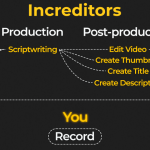







Outsourced post-production means contracting an external team — freelancer, subscription service, or agency — to handle video editing, color grading, audio mixing, and motion graphics after filming ends. In 2026, five distinct outsourcing models exist, ranging from $25/hour freelancers to premium dedicated-editor agency retainers. The right model depends on your monthly video volume, brand consistency requirements, and how much strategic support you need. This guide covers every model, real cost ranges, and what separates good vendors from expensive disappointments.
- What Is Outsourced Post-Production?
- Why Companies Outsource Post-Production in 2026
- The 5 Outsourcing Models Explained
- What Does Outsourced Post-Production Cost?
- How to Choose the Right Post-Production Partner
- Common Mistakes When Outsourcing Post-Production
- Outsourced vs In-House: Full Comparison
- Is Outsourced Post-Production Right for You?
- FAQ
- Verdict
What Is Outsourced Post-Production?
Post-production is everything that happens after you stop filming. It is the invisible labor that transforms raw footage into a finished, distributable video: assembling the timeline, color grading every shot to match, cleaning and mixing the audio track, animating titles and motion graphics, burning in subtitles, and exporting to the exact specifications each platform demands.
Outsourced post-production means contracting that work to an external team rather than employing in-house editors. The external team could be a solo freelancer hired on a marketplace, a subscription-based service with a rotating pool of editors, a project-based production agency, or a dedicated multi-editor team embedded continuously in your workflow.
The model you choose determines your cost structure, quality consistency, turnaround predictability, and how much bandwidth your internal team spends managing the relationship. Getting that choice right from the start saves significant time and money over a 12-month content calendar.
What Tasks Fall Under Post-Production?
The full scope of post-production services typically covers the following workstreams:
Rough and fine cut editing — assembling footage into a narrative arc that works, then refining pacing and timing until it flows. Color grading and correction — matching shots across different lighting conditions and establishing the visual tone that reflects your brand. Audio editing and mixing — dialogue cleanup, removing background noise, balancing music levels, and adding sound effects where needed. Motion graphics and titles — lower-thirds, animated intros and outros, branded transitions, and data visualizations. Subtitles and captions — burned in or delivered as SRT files for platform upload. Thumbnail creation — still frames optimized for click-through on YouTube and social platforms. Format exports — 16:9 for YouTube, 9:16 for Reels and TikTok, 1:1 for LinkedIn, plus broadcast specs where applicable. VFX and compositing — layered visual work for brands that need product animations, screen replacements, or background removals at scale.
Not every outsourcing model covers all of these. Understanding which workstreams you need — and at what volume — is the essential first step before comparing vendors or requesting quotes.
Who Uses Outsourced Post-Production?
Outsourced post-production serves a wide range of buyers in 2026. SaaS and technology companies producing onboarding videos, product demo reels, and explainer content are among the heaviest users. Media companies and digital publishers processing large volumes of interview and documentary footage depend on external teams to meet publication schedules. Marketing agencies managing multi-client video content calendars need reliable outsourced bandwidth to scale without proportional headcount growth.
YouTube and social media content creators who have grown beyond what one in-house editor can handle represent another major segment. Corporate learning and development teams converting recorded training sessions into polished e-learning modules, and real estate or e-commerce brands editing property tours and product videos at high volume, round out the primary user base.
The common thread across all of them: raw footage exists, there is a publication deadline, and no one on the internal team has the time or the specialized skills to process that footage to the quality standard the brand requires.
Why Companies Outsource Post-Production in 2026
The push toward outsourcing has accelerated sharply over recent years, and the 2026 market reflects a maturing ecosystem rather than a niche workaround. What was once a cost-cutting measure for smaller brands has become a strategic default for mid-market and enterprise marketing teams that value operational flexibility over headcount ownership.
Cost Efficiency Without Sacrificing Quality
Hiring a full-time senior video editor in a major Western market typically carries a fully loaded cost — salary, benefits, equipment, software licenses, and management overhead — that exceeds what most marketing teams budget for a single role. That headcount processes a fixed volume of footage per week regardless of whether the content calendar is full or quiet.
Outsourcing converts that fixed cost to a variable one. An agency retainer or subscription plan scales up during product launches and scales back during slower quarters. You pay for delivered output, not idle capacity — and that shift in cost structure alone justifies the transition for many organizations that analyzed the numbers honestly.
Access to Specialized Talent Across Disciplines
Post-production specializations are narrower than most buyers realize. The editor who is excellent at documentary rhythm and interview pacing may not have strong motion graphics skills. The colorist who can grade a cinematic brand film may not have experience with the fast, punchy style of social-first content. Freelance marketplaces and agencies maintain rosters of specialists — colorists, audio engineers, animators, VFX artists, subtitle specialists — that no single in-house hire can replicate.
When your video strategy evolves — say, from long-form educational YouTube content to short-form social-first clips — an outsourced partner with the right talent depth adapts without triggering a new hiring cycle, a learning period, or the risk of a wrong hire that costs months to unwind.
Faster Turnaround at Volume
A single in-house editor processes one project at a time. A well-structured outsourced agency assigns multiple editors in parallel across active projects. Teams producing 15 or more finished videos per month consistently find that volume becomes the bottleneck before quality does. Outsourcing decouples those two variables by multiplying editing capacity without multiplying management complexity on your side.
Focus on Core Operations and Strategy
Marketing directors, content leads, and founders who have managed in-house editors share a consistent complaint: the management overhead of an editing relationship consumes far more bandwidth than anticipated. Feedback loops, software troubleshooting, export spec errors, style drift over time, and unplanned PTO coverage are recurring friction points that accumulate into a meaningful productivity tax.
Handing post-production to a managed external team — especially one that owns its own project management, quality control, and delivery workflow — returns that bandwidth to your team for scripting, distribution strategy, and performance analysis. The work that actually drives growth gets more attention.
Global Talent at Competitive Economics
In 2026, a video editing team based in Eastern Europe, Southeast Asia, or Latin America routinely delivers broadcast-quality output with 24-to-48-hour turnaround windows. The quality gap between the best global editors and their Western counterparts has largely closed over the past decade. The price differential has not. Brands that structure their outsourcing around globally distributed teams access senior creative talent at economics that would not be achievable domestically.
The 5 Outsourcing Models Explained
Not all outsourced post-production is the same. Five distinct service models exist in the 2026 market, each with meaningfully different trade-offs around cost, quality consistency, turnaround speed, and how much control you retain over the creative output.
Model 1: Freelance Editors
Freelance editors are independent contractors hired on a project-by-project or ongoing retainer basis. You find them through platforms like Upwork, Fiverr Pro, and Contra, or through professional referrals from your network.
Best for: One-off projects, narrow budgets, and specific niche skills — for example, a colorist for a single short film or a motion designer for a one-time brand campaign. The freelance model gives you direct access to a specific person’s skill set.
Realistic trade-offs: Quality varies dramatically by individual, and there is no built-in backup if your editor takes on other clients, goes on holiday, or becomes unavailable. Communication and revision management fall entirely on you. Freelancers also rarely have an internal QC layer, so you are the quality check before the final asset goes live.
Model 2: Unlimited Video Editing Subscriptions
Subscription services charge a flat monthly fee and accept video editing requests through a task queue. You submit a project, an available editor picks it up, and you receive a draft within the plan’s committed turnaround window.
Best for: High volume, lower complexity output — social cuts from existing long-form content, simple talking-head cleanup, repurposed webinar recordings. The economics work well when the output specification is narrow and consistent.
Realistic trade-offs: “Unlimited” describes request volume, not simultaneous delivery. Standard plans typically allow one active request at a time, so a calendar with multiple concurrent projects creates a queue bottleneck. Editor consistency varies because requests rotate across a pool rather than landing with a single dedicated person who knows your brand deeply.
Model 3: Project-Based Agencies
Project-based agencies quote a fixed price per deliverable. You submit a creative brief, the agency assigns a team, work is delivered, and you pay on completion or by milestone. There is no ongoing relationship unless you commission the next project.
Best for: One-time campaigns, event recap videos, brand films, and any project with a defined scope and a hard deadline. The model works well when creative requirements are unique enough that a brief-specific team adds value.
Realistic trade-offs: Per-project pricing scales poorly for ongoing content programs. Because there is no continuous relationship, each new engagement requires full re-briefing — and the editor assigned to your next project may not be the editor who worked on your last one. Style continuity requires explicit documentation every time.
Model 4: Dedicated Team Retainers
Dedicated team retainers are the premium tier of outsourced post-production. You engage an agency that assigns a dedicated senior editor — or a small multi-discipline team — to your account on an ongoing basis. That team learns your brand, absorbs your style guide, and internalizes your feedback preferences over time. The result is a working relationship that behaves more like an embedded creative partner than a transaction-by-transaction vendor.
Best for: Brands producing consistent, brand-safe video at regular cadence — typically 8 or more finished videos per month across formats. The model is also the right choice when brand consistency and senior creative quality are non-negotiable, not just preferred.
Realistic trade-offs: Higher monthly commitment than subscription services. The first 2–3 weeks require active onboarding investment — sharing references, reviewing initial drafts, providing calibration feedback — before the team operates with the autonomy that justifies the retainer cost. That investment compounds over time as the team builds context.
Model 5: White-Label Post-Production
White-label providers fulfill post-production work silently under your brand. Marketing agencies, production companies, and creative studios use this model to serve their clients’ video needs without maintaining an in-house editing department. The end client never knows an external post-production team is involved.
Best for: Agencies that want to offer video editing as a service line without the overhead of building and managing an in-house team. White-label arrangements can also provide overflow capacity for production companies during peak periods.
Realistic trade-offs: Strong brief-writing discipline is mandatory. Because the provider never speaks directly with the end client, information can be lost in the relay between agency account manager and outsourced editor. Brief quality is the primary driver of output quality in this model.
What Does Outsourced Post-Production Cost?
Post-production pricing is driven by one underlying variable: editor hours. Editor hours, in turn, are driven primarily by the ratio of raw footage length to finished output length — a metric known in the industry as the shooting ratio. A 5-minute finished video assembled from 20 minutes of clean interview footage requires far fewer editorial hours than a 5-minute video built from 6 hours of multi-camera event footage. Before requesting quotes, document your shooting ratios, average raw footage volume per project, and the specific deliverable formats you need for each channel.
💡 Pro Tip: Before requesting quotes from any outsourced post-production vendor, prepare a one-page project specification: content type, average raw footage duration per video, number of finished formats needed, revision rounds expected, and your target turnaround time. Vendors who receive specific briefs return more accurate quotes — and vendors who quote without asking for these details are often anchoring on a number they will revise upward once work begins.
Freelancer Rates in 2026
Freelance editor rates vary considerably by platform, geography, experience level, and specialization. General video editors on platforms like Upwork commonly charge in the range of $25–$65 per hour. Senior editors with specific specializations — dedicated colorists, motion graphics artists with After Effects depth, audio engineers with mastering experience — commonly charge $75–$150 per hour. Top-tier freelancers with strong portfolios and established reputations can command $150–$300 per hour or more.
Platform-priced gigs on Fiverr are structured differently — typically by finished minute of video or by project tier, starting from $50–$200 per finished minute depending on complexity. The risk with package-based gig pricing is that undefined scope tends to create disputes over what falls within the package versus what constitutes an add-on.
Subscription Plan Pricing
Unlimited video editing subscription services typically offer multiple tiers with increasing features at each step. Entry-level plans — one active request, standard complexity, 3–5 day turnaround — commonly start around $500–$750 per month. Mid-tier plans that include motion graphics, faster turnaround, and slightly more complex work are frequently priced in the $900–$1,400 per month range. Pro plans with multiple simultaneous active requests and priority queuing commonly reach $1,500–$2,500 per month.
The key question to ask any subscription service before committing: what is the realistic throughput — not theoretical maximum — for your content type at the plan level you are considering? Ask for data on turnaround times for projects comparable to yours, not just headline averages.
Agency Retainer Pricing
Full-service agency retainers — where a dedicated team is assigned to your account — are structured around deliverable volume or committed editor hours per month. Entry-level retainers covering a moderate volume of 4–8 finished videos commonly start around $1,500–$2,500 per month. Mid-range retainers covering 10–20 finished pieces across multiple formats are frequently positioned in the $3,000–$6,000 per month range. Enterprise retainers for teams processing daily content across multiple distribution channels, with motion graphics, strategy oversight, and priority turnaround, often reach $8,000–$20,000 per month.
Per-project pricing from project-based agencies varies widely: a simple social cut with basic graphics can run $300–$800, while a polished long-form brand film with multi-day color grading and original motion graphics commonly reaches $5,000–$15,000 or more.
How to Choose the Right Post-Production Partner
Choosing between models is the first decision. Choosing between specific vendors within a model is an equally important second decision. The following criteria separate vendors who deliver consistent value from those whose output quality regresses the moment the onboarding phase ends.
Portfolio and Vertical Specialization
Generic portfolios containing a wide variety of content types — music videos, wedding films, corporate talking heads, and YouTube vlogs — signal a generalist service rather than a specialist. A vendor’s portfolio should contain examples that are 80% similar to your brief: product demo videos if you make product demos, SaaS explainers if you build software products, documentary-style content if that is your format.
Style and pacing sensibility transfer poorly between genres. The editor who cuts compelling hip-hop music videos may not intuitively understand the deliberate, trust-building rhythm of a B2B software onboarding video. Vertical specialization is a meaningful signal, not a marketing claim to gloss over.
Revision Policy and Turnaround SLAs
Before signing any agreement, request the vendor’s revision policy in writing and read it carefully. Key questions: how many revision rounds are included before additional charges apply? What constitutes a “revision” versus a “change of scope” that resets the deliverable? What is the committed turnaround time per revision round, not just for the initial delivery? Is expedited turnaround available, and at what premium?
Ambiguity in revision terms drives the majority of client-vendor disputes in outsourced post-production. Vendors with documented, transparent revision policies earn that confidence for a reason — their process is repeatable because it is defined.
Communication Structure and Project Management
Understand the vendor’s communication workflow before work begins. Do they use a dedicated client portal or a shared project management tool? What is the expected response time to feedback submitted during business hours? Who is your named point of contact, and what is their availability? What is the escalation path if the primary editor is unavailable?
An outsourced team that communicates worse than your in-house team creates a net negative across every metric you care about. The management layer in a well-run outsourced relationship should feel nearly invisible — your job is to submit footage and provide feedback; the vendor’s job is to handle everything in between.
Internal Quality Control Process
Ask every prospective vendor directly: what is your internal QC process before a file is delivered to a client? Premium agencies have a second editor or a creative director review each deliverable before client delivery. That second pair of eyes catches timeline continuity errors, audio pops and level inconsistencies, color mismatches between shots, export spec errors, and metadata issues before they reach your inbox.
Subscription services and lower-cost freelancers generally do not have a structured internal QC step. You become the QC layer, which means your time is spent on error-catching rather than strategic review. The price difference between a subscription service and a premium agency often reflects exactly this QC overhead — and for brands where a branded video going out with an audio artifact or color inconsistency is genuinely costly, that difference is material.
💡 Pro Tip: Every outsourced post-production relationship lives or dies by the quality of the onboarding brief. Before handing over your first project, build a visual style guide that covers: your target color grade with reference frame grabs, preferred music tempo and genre, graphic templates and font stacks, required export specs per distribution channel, and two or three reference videos that represent your target aesthetic at its best. Vendors who receive a brief this complete have everything they need to hit the mark on the first delivery — and the time you save on revision rounds across a year far exceeds the hour you spend writing the guide.
Intellectual Property and Data Security
Before transferring raw footage, confirm the vendor agreement covers three things: you own all final deliverables outright with no licensing carve-outs; the vendor’s raw footage deletion policy (ideally deletion within 30 days of final delivery unless storage is explicitly agreed); and NDA terms covering unreleased product footage, internal communications, or any confidential footage you are providing. Most reputable agencies include these provisions as standard. If a vendor hesitates to sign an NDA, treat that as a meaningful signal worth investigating before proceeding.
Common Mistakes When Outsourcing Post-Production
Skipping the Paid Test Project
The most expensive mistake buyers make when outsourcing post-production is committing to a long retainer before validating the vendor on a real project. A paid test project — a single complete video with multiple revision rounds — reveals the vendor’s actual workflow, communication style, turnaround consistency, and quality level far more accurately than any portfolio reel or onboarding call. Budget $200–$600 for a properly structured test before committing to a multi-month retainer agreement.
Relying on Verbal Style Direction
Describing your visual style verbally — “clean and modern,” “energetic but professional,” “cinematic” — produces inconsistent results because those terms mean something different to every editor. A style guide with annotated reference clips, actual color palette values, example music tracks, and annotated before/after frame grabs removes that ambiguity. Brands that invest 2–3 hours building a concrete visual brief consistently receive better first deliveries and require fewer revision rounds throughout the engagement.
Distributing Work Across Too Many Vendors
Running multiple editors across multiple platforms simultaneously — treating it as vendor portfolio diversification — produces visually inconsistent brand output. Color grades do not match between projects. Graphic style drifts. Music choices fragment. Audiences notice even when they cannot articulate why. A single dedicated vendor who deeply knows your brand and has internalized your visual identity is worth considerably more per deliverable than three cheaper vendors producing mismatched content that collectively undermines your brand coherence.
Ignoring Turnaround Variability
Headline turnaround times are typically best-case numbers. Ask every vendor for worst-case delivery examples: during their busiest periods, over holiday seasons, or when client revision rounds extend unexpectedly. Your content calendar has real publication deadlines, and a service that delivers 3 days late 20% of the time will eventually create a planning crisis at the worst possible moment. Build turnaround variability into your editorial planning calendar from day one.
Miscalculating the True ROI
First-timers often calculate outsourcing ROI as: vendor cost versus in-house editor salary. The complete calculation also includes the hours your team spends briefing projects, reviewing deliverables, providing structured feedback, and managing the communication overhead of the relationship. In the first 2–3 months with a new vendor, that total overhead is real and significant. It decreases substantially as the vendor builds context — but the early investment must be factored in honestly when comparing outsourced versus in-house economics.
Outsourced vs In-House: Full Comparison
The in-house versus outsource decision is not permanent, and for most companies it is not binary. Many mid-market brands operate a hybrid model: one in-house editor for reactive, fast-turnaround content — live event recaps, real-time social moments — and an outsourced partner handling all planned, calendar-driven volume. That split captures the responsiveness benefit of in-house without the cost and quality ceiling that a single in-house hire imposes on content volume.
For most companies producing 8 or more finished videos per month with consistent format requirements, the dedicated outsourced team model consistently beats in-house on cost-per-deliverable once you account for the full loaded employment cost, management overhead, equipment, and software. The math tips the other direction for companies producing 1–3 videos per month where creative variance is high and brand safety is not a primary concern.
Is Outsourced Post-Production Right for You?
Use the following decision framework to map your situation to the right model before committing to any vendor conversation.
Outsource if: You produce more than 4 finished videos per month. Your content follows a consistent format, style, and distribution cadence. Post-production is consuming internal bandwidth that should go to strategy and distribution. You cannot justify the full loaded cost of a full-time in-house editor at your current volume level.
Keep in-house if: You produce 1–2 spontaneous, format-varied videos per month. Your content requires real-time publication — live sports, breaking news, reactive social moments. Strategic IP sensitivity demands that no external team handles your footage. The internal editor relationship is a strategic creative partnership, not a production function.
Consider hybrid if: You have a mix of reactive and planned content with different quality and turnaround requirements. You need surge capacity on top of a baseline in-house capability during product launches or seasonal campaigns. You want brand knowledge to reside in-house but need to control the cost of volume production beyond what one person can deliver.
For marketing teams at growing companies navigating consistent video content at scale, a dedicated outsourced post-production partner is typically the highest-leverage answer. A video editing agency with a dedicated team model addresses the consistency, brand knowledge, and specialist access questions simultaneously — without the overhead of employment, benefits, and equipment provisioning.
Before entering vendor conversations, understanding how much professional video editing costs in the current market protects you from anchoring to an unrealistic number that will bias your vendor selection toward the wrong end of the quality spectrum.
If you are still weighing the freelancer path against a dedicated agency arrangement, the detailed video editing agency vs freelancer breakdown examines exactly where each model wins — and what the actual cost difference looks like when you account for revision overhead, management time, and quality consistency across 12 months of production.
FAQ
What is the difference between outsourced post-production and outsourced video production?
Video production covers the full lifecycle: pre-production (scripting, planning, casting, location scouting), production (filming), and post-production (editing, color, audio, graphics, delivery). Outsourced post-production is specifically the edit-through-delivery phase — everything that happens after raw footage exists. Many brands shoot their own content internally and outsource only the post-production side, which is the most labor-intensive and specialist-dependent part of the process.
How long does it take to onboard a new post-production partner?
A dedicated team typically needs 2–3 weeks of calibration — one or two complete projects that establish your visual preferences, feedback style, and revision rhythm — before operating with meaningful autonomy. Subscription services are faster to start (often same week) but take longer to produce consistent results because there is no dedicated editor accumulating brand context over time. Budget for a calibration period regardless of model and do not judge the partnership prematurely based on the first delivery.
Can outsourced post-production handle urgent same-day turnaround?
Some premium agencies offer expedited delivery SLAs — commonly 24-to-48-hour guarantees for standard-complexity projects — as a contracted feature of their retainer agreement. Standard plans at most services run 2–5 business days per project. If same-day or next-day turnaround is a regular operational requirement rather than an occasional exception, be explicit about that requirement in vendor conversations before signing, and request a documented expedited SLA in the contract rather than a verbal assurance.
Is raw footage safe when shared with an external post-production team?
Reputable agencies sign NDAs as standard practice and maintain documented data handling policies that typically cover: secure cloud-based file transfer protocols, limited editor access on a need-to-edit basis, and footage deletion within a defined period after final delivery. Always request the vendor’s data handling policy in writing before transferring any footage, and confirm explicitly that the terms cover your specific footage sensitivity — particularly if the content includes unreleased products, internal communications, or regulated data.
How many revision rounds should I realistically expect?
Well-structured outsourcing relationships — where a proper visual style guide exists and the vendor has completed at least 3–4 prior projects for the client — typically produce deliverables that reach final approval within 1–2 revision rounds. Without a style guide or during the initial calibration period, 3–4 rounds is more common. Premium agencies commonly guarantee client satisfaction within a defined number of revision rounds as a formal part of their service agreement. Ask for that guarantee explicitly rather than assuming it is implied.
Verdict
Outsourced post-production in 2026 is a mature, well-differentiated category with 5 distinct service models spanning every budget level and volume requirement. The right model is not the cheapest one — it is the one whose quality consistency, turnaround guarantees, revision policy, and communication structure match your content operation’s actual production demands.
For brands producing meaningful video volume — 6 or more finished pieces per month — a dedicated team retainer with a premium agency consistently delivers the best outcome on cost-per-deliverable when you factor in the full loaded cost of in-house employment, management overhead, specialist access, software, and equipment. The subscription model is the right economic choice for simpler, high-volume social content where editorial complexity is low and brand consistency stakes are manageable. Freelancers remain the right answer for genuinely one-off projects with narrow budgets and a specific skill requirement.
The practical actions that separate successful outsourcing relationships from expensive ones: build a visual style guide before your first project, run a paid test project before any retainer commitment, demand a documented revision policy from every vendor you evaluate, and check turnaround performance data — not just averages — before signing.
Increditors operates as a dedicated-team agency for brands that need senior creative quality, brand consistency, and strategic partnership — not a rotating pool of editors. If that model fits your production profile, a discovery call is the logical next step.
Ready for Video That Actually Converts?
Tell us about your project and we will put together a custom plan.