









![3D Explainer Video - ScribbleLive.mp4_snapshot_00.12_[2022.03.09_03.14.16]](https://increditors.com/wp-content/uploads/elementor/thumbs/3D-Explainer-Video-ScribbleLive.mp4_snapshot_00.12_2022.03.09_03.14.16-r7wb53mx72rxst3qcqyrfxdmeyzb5r9jbl0wbjujh4.png "3D Explainer Video – ScribbleLive.mp4_snapshot_00.12_[2022.03.09_03.14.16]")




















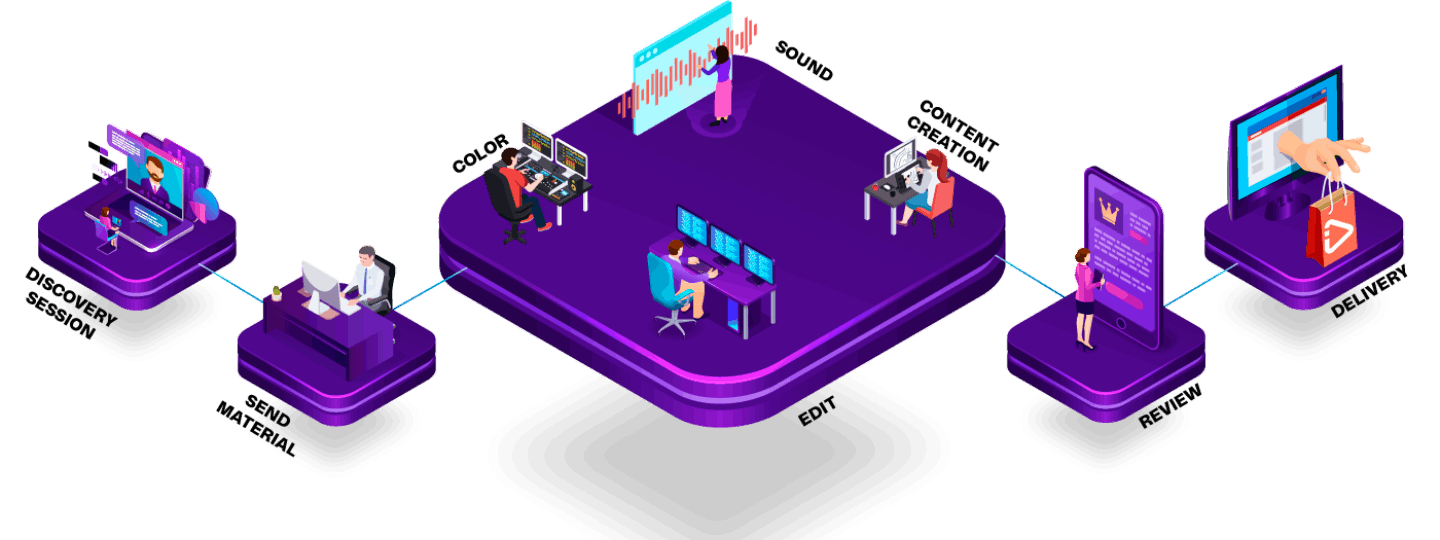










A managed video editing team bundles a senior editor, junior editor, project manager, and creative director into one contracted unit that plugs directly into your production workflow. It costs less than hiring in-house, moves faster than a traditional agency, and outperforms solo freelancers on volume and consistency. If you publish video regularly, this model is worth understanding in full before your next hire.
- What Is a Managed Video Editing Team?
- How It Differs from Freelancers, Agencies, and In-House
- Why SaaS and B2B Brands Are Adopting This Model
- How to Onboard and Integrate a Managed Team
- Cost Structure: What You Actually Pay For
- How to Evaluate Managed Video Editing Providers
- Frequently Asked Questions
- Verdict
What Is a Managed Video Editing Team?
The term gets used loosely, so let’s pin it down. A managed video editing team is a pre-assembled, dedicated unit that a brand contracts as a single service. Rather than hiring individual editors or routing projects through a faceless agency queue, you get a fixed group of people who learn your brand, own your production pipeline, and show up for your projects day after day.
The core unit typically looks like this:
- Senior Editor: The primary technical executor. Handles complex cuts, color grading, motion graphics, and output-ready finishing. This person sets the quality ceiling for your content.
- Junior Editor: Handles first-pass cuts, transcript-based rough edits, B-roll assembly, and file prep. This role exists to increase throughput without burning senior capacity on repetitive tasks.
- Project Manager (PM): Owns the queue. Takes in raw footage, logs revisions, communicates timelines, and shields editors from the coordination overhead that kills creative momentum.
- Creative Director (CD): The strategic layer. Reviews final outputs for brand alignment, escalates creative decisions, and acts as your single point of escalation when something isn’t landing.
Some providers include a dedicated motion designer or sound designer at higher tiers. But the four-person structure above is the standard baseline that makes the model functional. Remove any one role and the system starts to crack: pull the PM and editors drown in Slack; pull the CD and brand drift sets in quietly until a reel goes out that doesn’t sound like you.
The “Managed” Part Matters
What separates this from simply “a team of editors” is the managed layer. The provider handles hiring, training, quality control, tool licensing, and capacity planning. You don’t manage headcount. You manage outcomes. That’s the core value proposition, and it’s why the model resonates particularly well with heads of content, marketing directors, and founders who have creative output goals but no appetite for running an internal media department.
Think of it less like outsourcing a task and more like subscribing to a production capability. The team is yours—they know your brand guidelines, your preferred pacing, your motion style, your deliverable formats—but the operational infrastructure belongs to the provider. That split is what makes the model scalable.
Dedicated vs. Shared Models
Within “managed teams,” there’s an important distinction: dedicated versus shared. A dedicated team works exclusively on your account. A shared model pools multiple clients through a single team, routing projects based on workload. Dedicated teams are more expensive but produce faster brand fluency and more consistent output quality. Shared models cost less and work fine for lower-volume accounts or brands with very standardized deliverables. Know which model a provider offers before you sign anything.
How It Differs from Freelancers, Agencies, and In-House
Every hiring model has a ceiling. Understanding those ceilings is the fastest way to know which one fits your current situation.
The Freelancer Ceiling
Freelancers are fast to hire and cheap to start. But they’re single points of failure. If your editor goes on vacation, gets sick, or lands a better client, your production stops. You’re also managing a person, not a system—revisions happen over direct messages, timelines are informal, and brand consistency lives entirely in one human’s memory. For brands publishing one to two videos per month, a freelancer is fine. Above that threshold, the coordination cost starts eating the savings.
There’s also a skill ceiling. A single editor can’t reasonably hold deep expertise in long-form documentary cuts, punchy short-form social content, motion graphics, and sound design simultaneously. You either pay for a generalist who does everything acceptably, or a specialist who does one thing brilliantly and needs to be swapped out for everything else. The difference between a video editing agency and a freelancer becomes very real when your content strategy expands.
The Traditional Agency Ceiling
Traditional video production agencies are optimized for projects, not pipelines. They quote per campaign, assign whoever’s available, and move on to the next client once the deliverables are out. That model works beautifully for a brand film or a product launch video. It works poorly when you need 12 YouTube videos edited per month, consistent social cuts, and a partner who proactively catches when your B-roll package is running thin.
Agencies also layer on account management overhead that drives up margins. You’re paying for new business development, pitch decks, and creative strategists who may never touch your account directly. The ratio of people producing work to people administering work gets unfavorable fast.
The In-House Ceiling
In-house teams are the gold standard for brand fluency and responsiveness. Your editors live inside the company culture and can attend product walkthroughs, pull from institutional knowledge, and iterate faster than any external partner. But the cost structure is brutal. A senior video editor in a major market runs $75,000–$110,000 in annual salary, before benefits, software licenses, equipment, and management overhead. To build a true production unit with the four-role structure described above, you’re looking at $300,000+ per year in fully loaded headcount cost—before you consider that creative talent attracts and retains differently than engineering talent.
The managed team model exists precisely in the gap between “in-house is too expensive” and “freelancers can’t keep up.” It gives you the continuity and brand ownership of in-house with the operational flexibility and cost predictability of outsourcing.
Why SaaS and B2B Brands Are Adopting This Model
Video has become table stakes for SaaS and B2B marketing. Product walkthroughs, demo videos, customer testimonials, explainer content, thought-leadership clips—the content calendar is no longer optional. What’s changed recently is the volume required to actually move the needle. A single polished product video per quarter no longer drives meaningful top-of-funnel impact. The brands gaining organic traction are publishing consistently: weekly YouTube content, monthly case study videos, ongoing social clips repurposed from long-form interviews.
That volume requirement broke the project-based agency model for B2B brands. You can’t raise a purchase order for every 3-minute demo cut and every LinkedIn-optimized 60-second excerpt. The procurement cycle alone would kill the content calendar. The managed retainer model sidesteps that entirely.
The SaaS Content Flywheel Problem
SaaS companies in particular face a compounding problem: their product changes constantly. A new feature ships, and suddenly the product demo video from six months ago is showing a UI that no longer exists. In-house teams can pivot quickly, but most SaaS companies at the Series A to Series C stage don’t have the budget to build a full internal media department. Managed teams solve this because the dedicated structure means your editors already know the product—they can absorb a “feature drop” brief in a 20-minute call and start cutting the same week.
There’s also the documentation and enablement use case. Sales teams need demo cuts. Customer success needs onboarding walkthrough videos. Marketing needs social proof and testimonial content. Each of these has different technical requirements and creative treatments—exactly the kind of multi-format workload that a four-role managed team handles well, because the senior editor and CD can maintain visual coherence across formats while the junior editor handles volume work.
B2B Demand Generation and Video ROI
B2B buyers, particularly in mid-market and enterprise segments, increasingly vet vendors through video before they ever engage with a sales rep. A thoughtfully produced customer story or a clean product explainer can do the work of a 30-minute discovery call at scale. When video becomes a genuine revenue-adjacent asset rather than a brand awareness afterthought, the quality bar rises and the production consistency requirement becomes a business-critical constraint—not a nice-to-have.
Working with a professional video editing agency that operates on the managed team model means your marketing team can focus on messaging strategy, interview preparation, and distribution—while the editing infrastructure runs as a reliable, predictable service in the background.
💡 Pro Tip: Before you hire any video editing partner, map your content calendar for the next 90 days and count deliverables by format. If you’re producing more than 8 distinct deliverables per month across multiple formats, you’re already past the point where a solo freelancer can serve you well without cutting corners on either speed or quality.
How to Onboard and Integrate a Managed Team
Onboarding a managed video team well is the single biggest lever you control for long-term output quality. Providers can deliver a technically competent team, but the creative calibration is a shared responsibility. Here’s how to do it right.
Week One: The Brand Bible Transfer
The first deliverable in any onboarding should be a comprehensive brand document handed to the team—not a PDF deck, but an operational reference. This should include your brand guidelines (colors, typography, logo usage), your motion style preferences (fast cuts vs. slower editorial rhythm, use of text overlays, lower-third style), your audio branding (music genre, energy level, whether you use branded intros/outros), and examples of content you admire.
Critically, include examples of content you don’t want to look like. This negative reference set is often more instructive than positive examples because it forces explicit articulation of stylistic aversions that might otherwise only surface during revision rounds.
Week Two: The Pilot Project
The best managed team providers will build a pilot project into their onboarding—typically a single representative deliverable that runs through the full production cycle before the retainer begins proper. This serves two functions: it lets the team demonstrate their quality floor under real conditions, and it establishes a calibration artifact that the team can reference for all future work.
Give genuine, specific feedback on the pilot. Vague approval—”this is great, let’s go”—is a wasted opportunity. The pilot is the cheapest moment in the relationship to establish precise creative standards. Use it.
Workflow Integration: Where Things Actually Break
The operational integration is where most onboardings stall. You need to establish: how raw footage gets to the team (shared cloud drive, Frame.io, WeTransfer workflow), how briefs are submitted (a structured intake form is non-negotiable—”here’s the footage, make it good” briefs produce bad work), how revisions are communicated (timestamped comments in Frame.io or a similar review tool, not bullet points in email), and what the SLA looks like for standard versus rush deliverables.
Get all of this in writing before the first real project. Ambiguity in workflow logistics is the most preventable cause of friction in a managed team relationship.
Months Two Through Four: The Ramp Period
Expect the first 90 days to involve more revision rounds than steady-state operations. This is normal. The team is building a mental model of your brand preferences that no brief can fully transfer. Each round of feedback is deposit into that model. By month three or four, a well-onboarded managed team should be producing first-cut work that requires only minor polish-level revisions, not structural reworks.
If you’re still seeing structural misses past the 90-day mark, that’s a signal to escalate to the CD and revisit whether the brief format or the brand documentation is creating ambiguity.
💡 Pro Tip: Build a shared “best-of” folder with your managed team from day one. Every time a deliverable lands that nails your brand feel, add it to the reference library. Within six months, this folder becomes a living style guide that onboards new team members on both sides faster than any written document.
Cost Structure: What You Actually Pay For
Managed video editing teams are priced on retainer, typically structured as a monthly fee that covers a defined deliverable capacity. Understanding what drives the price—and what’s included versus excluded—is essential before you start comparing quotes.
The Core Pricing Drivers
Retainer pricing is primarily driven by three variables: the volume of deliverables per month, the complexity and length of those deliverables, and whether you’re on a dedicated or shared team model.
A baseline entry-level retainer with a shared team model, covering 8–12 social-format deliverables per month, typically starts in a range that a brand doing $3M–$5M+ in ARR can absorb without special budget approval. Dedicated team models at mid-volume (15–25 deliverables/month, mixed formats including long-form) are a meaningfully larger investment—but still a fraction of what fully loaded headcount would cost for an equivalent in-house capability. For a detailed breakdown of what professional editing costs across different formats and service models, see how much professional video editing costs.
What’s Typically Included
In a well-structured managed retainer, you should expect the following to be covered in the monthly fee: editing labor across the full team, revision rounds (typically 2–3 per deliverable), project management and communication, quality assurance review by the CD, and cloud-based delivery. Many providers also include licensed music from their catalog, basic motion graphics, and color grading at no extra charge.
What’s Usually Excluded
Watch the exclusions closely. Custom motion graphics or animation beyond simple text overlays are almost always billed separately or require a higher-tier retainer. Stock footage and premium music licensing may sit outside the retainer depending on the provider. Rush fees—deliverables needed faster than the standard SLA—are also common add-ons. And if you’re producing content that requires specialized technical delivery (broadcast specs, DCP mastering, specific codec requirements), confirm those capabilities before you sign.
The Real Cost Comparison: Managed Team vs. In-House
When brands do a genuine apples-to-apples cost comparison, the managed model typically shows a significant advantage for comparable output. In-house costs include: salary, benefits (typically 25–30% of salary), equipment and software licenses, training and professional development, management overhead, and recruiting costs when someone leaves. The managed retainer rolls all of that into a single predictable line item—and it doesn’t fluctuate when a team member takes maternity leave or gets poached by a larger company.
The inflection point where in-house starts to win on cost is typically when a brand’s content volume requires a full-time headcount regardless, and the brand is large enough to absorb the operational complexity of managing a media department. For most B2B SaaS companies below $50M ARR, that threshold hasn’t been crossed.
How to Evaluate Managed Video Editing Providers
The managed video editing space has grown quickly, and not all providers are built the same. Some operate as staffing agencies in disguise, pairing you with contractors under a managed service label. Others are genuine production operations with invested infrastructure and quality systems. Knowing how to distinguish them saves you a painful mid-contract switch.
The Eight Questions to Ask Any Provider
1. Who specifically will be working on my account? Get names and portfolios. If the provider can’t tell you who your senior editor is before you sign, they’re operating a shared or contractor pool, not a dedicated team.
2. What’s the backup plan when my primary editor is unavailable? A mature managed team provider has a coverage model for illness, vacation, and turnover. “We’ll find a replacement” is not a coverage model. A named backup with equivalent access to your brand assets and revision history is.
3. What review and QA process runs before deliverables reach me? The CD layer is the quality control mechanism. Understand exactly what that review looks like: is it a cursory watch, or is there a structured checklist against brand guidelines?
4. How do you handle brief quality? The best providers have an intake system that either structures your brief for you or flags when a submitted brief lacks sufficient direction. Providers that accept any brief and produce whatever they produce are offloading brief quality risk to you.
5. What’s your standard turnaround SLA by format? Get this in writing, broken down by deliverable type and length. Social cuts (under 90 seconds) should have faster SLAs than long-form edits (20+ minutes).
6. Can I see work produced for B2B or SaaS clients specifically? A reel full of wedding videos and music video content tells you nothing about whether the team can handle product demos, talking-head interviews, and corporate case studies. Ask for industry-relevant portfolio samples.
7. What happens to my assets and project files if we part ways? You should own everything produced under your retainer. Confirm that project files, not just rendered outputs, are transferable if the relationship ends.
8. How do you handle feedback loops that don’t converge? Occasionally, a deliverable goes through multiple revision rounds and still doesn’t land. A mature provider has a process for this: escalation to the CD, a reset brief, or a re-cut at no additional charge. Know what that process is before you need it.
Green Flags to Look For
Providers worth working with tend to share certain characteristics: they have a structured onboarding process they can walk you through in detail; they use professional review tools (Frame.io, Vimeo Review) rather than email and WhatsApp; they have case studies from clients who look like you (similar size, similar content type); and their team members have visible professional history—LinkedIn profiles, portfolio sites, credits. Opacity about team composition is a red flag.
Red Flags to Watch
Walk carefully around providers who can’t tell you who will work on your account, who don’t offer a pilot or sample project before committing to a long-term retainer, whose pricing is dramatically below market rates (which typically indicates high editor turnover or shared model hidden under a dedicated label), and who define deliverable capacity in vague terms like “unlimited” without clear format and length parameters. “Unlimited” video editing retainers exist, but they universally have throughput constraints buried somewhere in the terms.
Teams like Increditors are built specifically on the dedicated managed model, where account transparency, named team members, and CD-level quality review are structural components of the service—not premium upsells.
Frequently Asked Questions
How long does it take for a managed team to fully understand my brand?
For a team that starts with a strong brand brief and receives specific revision feedback on early deliverables, most brands report reaching a point where first-cut quality is consistently high by the 60–90 day mark. This timeline compresses significantly when the onboarding includes a structured brand document, a pilot project, and dedicated review sessions rather than just a PDF handoff and a hope-for-the-best approach.
Can a managed team handle both long-form and short-form content in the same retainer?
Yes, and this is actually one of the model’s strengths. A four-role managed team can assign long-form interview and documentary work to the senior editor while running social-format excerpts and repurposed clips through the junior editor in parallel. This parallel capacity is something a solo freelancer simply can’t offer without accepting quality compromises on one end or the other.
What if I need to scale up volume temporarily—say, during a product launch?
Most managed team providers offer flex capacity for temporary spikes. This might take the form of a higher-tier retainer for a defined period, a per-deliverable overflow rate above your base capacity, or a dedicated sprint package for launch periods. Confirm what the flex model looks like with any provider you’re evaluating—and confirm lead time requirements for activating it, since dedicated additional capacity typically requires a week or more of notice.
Is there a minimum contract length for managed video editing teams?
Most providers require a minimum of three to six months for dedicated team engagements. This isn’t purely commercial—it reflects the genuine time investment required for onboarding and brand calibration. A one-month retainer doesn’t allow enough time to recover that investment for either party. Monthly rolling options after the initial term are common and reasonable to request. If a provider won’t negotiate any flexibility in contract structure after the minimum commitment, that’s worth noting as a sign of inflexibility that may surface elsewhere in the relationship.
How is a managed video editing team different from a video production retainer?
A video production retainer typically covers end-to-end production—concept, scripting, shooting, and editing—billed as a package. A managed editing team is post-production only: you supply the raw footage (whether shot internally, by a hired camera crew, or repurposed from existing content), and the team handles everything from that point forward. The editing-only model is generally more cost-efficient for brands that already have footage acquisition handled and need to scale the post-production pipeline specifically.
Verdict: Is the Managed Team Model Right for You?
The managed video editing team model is not universally the right answer. If you’re publishing fewer than six videos per month and your formats are consistent and simple, a good freelancer or a per-project agency relationship may serve you better at lower cost. The managed model earns its premium when volume, consistency, multi-format requirements, or operational complexity makes the unmanaged alternatives break down.
If you’re a SaaS or B2B brand publishing 10 or more deliverables per month across multiple formats, operating with a lean marketing team that can’t absorb production management overhead, or building toward a content program that needs to scale without headcount growth—the managed team model is almost certainly worth a serious evaluation.
The questions to answer are: Do you need dedicated capacity or shared capacity? What’s your realistic deliverable volume over the next 12 months? And which providers in the market can credibly demonstrate the dedicated team structure, brand fluency track record, and operational maturity to deliver on what the model promises?
Start those conversations now, before you’re in a content crunch with no good options. The brands that get maximum value from managed team partnerships are the ones that onboard them before they desperately need them—not as a reactive fix, but as a strategic infrastructure investment. That mindset shift—from “we need more video” to “we need a scalable video production system”—is what separates brands that build lasting content advantages from brands that perpetually chase their own backlog.
Ready for Video That Actually Converts?
Tell us about your project and we will put together a custom plan.