








![3D Explainer Video - ScribbleLive.mp4_snapshot_00.12_[2022.03.09_03.14.16]](https://increditors.com/wp-content/uploads/elementor/thumbs/3D-Explainer-Video-ScribbleLive.mp4_snapshot_00.12_2022.03.09_03.14.16-r7wb53mx72rxst3qcqyrfxdmeyzb5r9jbl0wbjujh4.png "3D Explainer Video – ScribbleLive.mp4_snapshot_00.12_[2022.03.09_03.14.16]")






















Atlanta’s creative economy is booming, but local video editing studios charge a premium that most businesses don’t need to pay. This 2026 guide breaks down local rates, what Atlanta businesses actually get for their money, and why remote-first teams consistently deliver faster turnarounds at 30–50% lower cost — without sacrificing quality.
- Atlanta’s Media and Creative Industry in 2026
- Types of Video Editing Services Available in Atlanta
- What Local Atlanta Studios and Freelancers Charge
- Local Studio vs. Remote-First Agency: The Real Trade-Offs
- How to Choose the Right Video Editing Partner
- How Remote-First Agencies Serve Atlanta Clients
- Side-by-Side Comparison: Local vs. Remote Options
- FAQ: Video Editing in Atlanta
- Verdict and Final Recommendations
Atlanta’s Media and Creative Industry in 2026
Atlanta has quietly evolved into one of North America’s most significant media production cities. What began with film and television tax incentives in the 2000s has compounded into a dense ecosystem of production studios, post-production houses, creative agencies, corporate video teams, and an increasingly sophisticated pool of freelance talent — all concentrated in one of the South’s largest metros.
The city’s media infrastructure now rivals markets like Chicago and Austin. Pinewood Atlanta Studios (now Trilith Studios) in Fayetteville operates as one of the largest purpose-built film production facilities outside of Los Angeles. Tyler Perry’s 330-acre Ft. McPherson studio complex adds further industrial-grade capacity. These flagships have anchored a talent ecosystem where experienced colorists, motion graphics artists, and senior editors have made Atlanta home.
The Business Demand Side: Fortune 500s, Fintech, and Real Estate
Atlanta’s corporate density is often underappreciated. The city hosts more Fortune 500 headquarters per capita than most comparable metros — including Coca-Cola, Delta Air Lines, Home Depot, UPS, and NCR Voyix. Each of these companies runs sizable in-house content operations alongside agency relationships. For video editing vendors, that translates into steady enterprise demand: product launches, executive communications, internal training content, investor presentations, and brand campaigns.
Beyond the Fortune 500 tier, Atlanta’s mid-market is dense and growing. The fintech sector — anchored by companies like Kabbage (American Express), Greenlight, and Stax — has become a significant content consumer, funding explainer videos, product demos, and compliance training content at scale. Commercial and luxury real estate, both a staple of Atlanta’s economy and a perennial video content buyer, adds further demand. Aerial walkthroughs, neighborhood highlight reels, and developer brand stories are consistently produced for developments across Buckhead, Midtown, West Midtown, and the Atlanta BeltLine corridor.
The Creator Economy Overlay
Atlanta has also become a major hub for content creators, particularly in music, lifestyle, and sports. The city’s connection to the music industry — hip-hop especially — means music video production is a serious commercial segment, not a niche. Creator agencies representing talent with audiences in the millions operate locally, and the demand for fast, polished short-form editing (Reels, Shorts, TikTok) has made turnaround speed as critical as technical quality.
All of this adds up to a city with genuine, diverse, and growing demand for video editing services — at every quality tier and budget level. The challenge for buyers is navigating a market where pricing varies enormously and “local” doesn’t always mean better.
Types of Video Editing Services Available in Atlanta
The Atlanta market for video editing isn’t monolithic. Buyers encounter a wide range of service models, each with different strengths, limitations, and pricing structures. Understanding the categories helps you match your project type to the right vendor.
Full-Service Production Houses
These are the integrated studios that handle both shooting and post-production under one roof. Names like Moxie Pictures, 11:11 Media Group, and similar boutique studios offer end-to-end service — from creative development through color grading and audio mastering. For projects where the production and post-production must be tightly coordinated (broadcast spots, high-end brand films), this integration has genuine value. The trade-off is cost: full-service Atlanta studios typically charge premium day rates, and their post-production pricing reflects the overhead of maintaining physical facilities, full-time staff, and high-spec hardware.
Independent Post-Production Shops
These are editing-only or primarily post-focused operations. They typically work with footage shot by other parties and specialize in the editorial process: assembly edits, color work, motion graphics, sound design, and final delivery. Atlanta has a healthy number of these, particularly in areas like Midtown and the West Side. Rates are generally more competitive than full-service houses, but availability can be constrained since many operate as boutique shops with limited team depth.
Freelance Editors
Atlanta’s strong film and television production base has produced a deep bench of freelance editorial talent. Experienced freelancers often come from the feature film or TV side and bring high technical competence. However, the freelance model comes with known limitations: limited availability, single points of failure, no built-in project management, and typically no accountability for revisions beyond what’s specified upfront. For one-off projects where you have flexibility, a good freelancer can be the most cost-efficient option. For ongoing, volume-based, or deadline-sensitive work, the model tends to break down.
Remote-First Video Editing Agencies
This category has grown substantially in relevance over the past three years. Remote-first agencies like Increditors operate distributed teams — typically combining senior editors across time zones with structured project management, style guides, and systematic revision workflows. They serve clients in Atlanta (and across North America) without a local physical presence. Because they don’t carry the overhead of a physical Atlanta office, they can price more competitively while maintaining quality through process and team depth. For content-heavy businesses — SaaS companies, real estate brands, agencies, e-commerce — this model has become the default choice.
💡 Pro Tip: Before committing to any vendor, ask for a spec breakdown: what’s included in each deliverable, how revisions are handled, and what happens if a deadline slips. The answers reveal more about the working relationship than the portfolio does.
In-House Teams
Large Atlanta enterprises often maintain in-house video capabilities. These teams handle day-to-day content needs and partner with external vendors for peak volume or specialized work. If you’re operating an in-house team, your typical need from external vendors is overflow capacity, specialized skills (3D, VFX, high-end color), or a managed subscription model that keeps delivery predictable month-over-month.
What Local Atlanta Studios and Freelancers Charge
Pricing in the Atlanta video editing market spans a wide range depending on service tier, project complexity, and vendor type. The figures below are representative of what buyers typically encounter when sourcing local services — not hard ceilings or floors, but common reference points you’ll see in proposals.
Understanding how much professional video editing costs is foundational before you start getting quotes. Many buyers anchor to the wrong reference point and either over-pay for simple work or under-budget for complex deliverables.
Freelance Editor Rates in Atlanta
Entry-level and mid-career freelancers in Atlanta commonly quote day rates in the $300–$600 range for general editing work. Senior freelancers with feature film or broadcast credits often command $700–$1,200 per day. Hourly rates for shorter engagements typically range from $50 to $150 depending on experience and specialization.
For per-project pricing, a straightforward 2–3 minute promotional video with basic color and graphics commonly starts around $800–$1,500 from a competent freelancer. Music video edits with more complex cuts and visual treatments tend to start higher — often $1,500–$3,000 for a standard 3–4 minute deliverable.
Post-Production Studio Rates
Dedicated post-production shops in Atlanta commonly structure pricing around either day rates for editor time or per-deliverable project fees. Day rates for mid-tier studios often run $800–$1,500 for a full edit day. Project fees for a finished 60-second commercial spot — including color grading and audio mix — can range from $2,500 to $6,000 or more, depending on the complexity of the motion graphics work and the number of revision rounds built in.
Full-service production houses that handle both shoot and edit typically package these together, making direct rate comparisons harder. But it’s not unusual for an all-in brand film of 3–5 minutes from a full-service Atlanta studio to land in the $15,000–$40,000 range when you factor in crew, locations, and post-production.
Monthly Retainer Models
Some Atlanta agencies and freelancers offer monthly retainer arrangements for ongoing content needs. These plans typically start around $1,500–$3,000 per month for a set number of deliverables (often 4–8 short-form videos). The economics here are better than one-off project pricing for volume buyers, but local overhead still creates a floor that remote-first models can undercut while maintaining or improving delivery speed.
Local Studio vs. Remote-First Agency: The Real Trade-Offs
The question Atlanta businesses most commonly ask is whether proximity to their editing vendor actually matters. The honest answer depends heavily on what type of project you’re running and how your team works. Let’s break down the real trade-offs without the marketing spin.
Where Local Has a Genuine Edge
On-site collaboration requirements. If your project involves a director and editor working in close creative lockstep — making real-time cuts during a session with talent present — a local post facility with a proper edit suite makes operational sense. Live editing sessions, same-room creative reviews, and fast hardware-to-hardware transfers are still easier when everyone is in the same building.
Broadcast and film-grade finishing work. For projects that require specific hardware configurations — certified monitoring environments, physical DCP mastering, tape outputs for legacy broadcast — a local facility with that infrastructure is necessary. Most commercial content doesn’t require this, but if yours does, local wins by default.
Same-day or same-hour turnarounds. If you need a deliverable within hours of a live shoot — event recaps, same-day conference highlight reels — having a local editor embedded in the production is operationally simpler than attempting to transfer and edit remotely on that timeline.
Where Remote-First Wins
Cost structure. The overhead difference is real and significant. A local Atlanta studio pays rent in a market where commercial real estate hasn’t gotten cheaper. That cost appears in every rate card. Remote-first agencies running distributed teams eliminate that overhead entirely. For content-volume buyers, the savings compound quickly — teams commonly report 30–50% cost reductions when moving from local boutiques to managed remote editing services.
Scalability. A boutique local studio has a fixed team. When your volume spikes — a product launch, a quarterly content push — they may not have the capacity to absorb it. Remote-first agencies with team depth can flex. This matters more than most buyers anticipate until they hit their first capacity wall.
Turnaround speed for standard timelines. Counterintuitively, remote-first agencies often deliver faster on 24–72 hour turnarounds because they operate across time zones. Work submitted in Atlanta at end of day can be progressed overnight, arriving back in your inbox by morning — something no single Atlanta timezone team can match structurally.
Specialization depth. A local boutique with three editors has three editors’ skill sets. A remote-first agency with a larger team can route your motion graphics to a motion graphics specialist, your color work to a dedicated colorist, and your audio to someone who does that full-time. The specialization gap compounds into quality differences on complex deliverables.
For a deeper look at the structural trade-offs between agency and freelance models, the breakdown at video editing agency vs. freelancer covers the decision framework in detail.
💡 Pro Tip: Map your content calendar before picking a vendor model. If you publish 4+ videos per month consistently, a managed retainer with a remote-first agency almost always beats per-project local pricing — both on cost and on-time delivery rates.
How to Choose the Right Video Editing Partner
Most buying decisions in this category go wrong in the same ways: over-weighting proximity, under-evaluating process, and failing to scope the actual deliverables clearly before signing anything. Here’s a more systematic approach.
Step 1: Define Your Deliverable Type and Volume
Before approaching any vendor, know what you’re buying. “Video editing” describes everything from a 15-second Instagram Reel to a 40-minute documentary. Each requires different expertise, tooling, and time. Document: the typical length of your videos, the format distribution (short-form vs. long-form, social vs. web), the complexity level (talking head vs. multi-camera vs. motion graphics heavy), and your expected monthly volume. This information shapes every vendor conversation that follows.
Step 2: Evaluate Process, Not Just Portfolio
A good-looking portfolio proves a vendor can produce good work. It doesn’t prove they can produce it on your timeline, within your revision structure, or with your content team’s workflow. Ask direct questions: How do you handle file delivery? What’s your revision policy? How do you handle feedback — through a platform, email, or calls? What happens when an editor gets sick or leaves? Answers to these questions tell you whether the operation is built for reliability or built around individual talent.
Step 3: Request a Trial Project
Any credible vendor — local or remote — should be willing to take a real (paid) trial project before you commit to a retainer or ongoing relationship. A trial reveals turnaround accuracy, how feedback is interpreted, the quality floor on a first pass, and how the team communicates when something needs adjustment. Weight the trial outcome heavily. A smooth trial predicts a smooth relationship; a rough trial predicts a rough one.
Step 4: Evaluate the Economics at Scale
Run a projection: what does your current or target content volume cost per deliverable under each vendor option? Local one-off pricing often looks reasonable for a single project but becomes painful at 8–12 deliverables per month. Compare apples to apples: include revision rounds, project management time, file handling, and any format adaptation costs. The true per-deliverable cost under a structured retainer model is usually substantially lower than stacking per-project quotes from a local boutique.
If you’re evaluating unlimited video editing models, the 2026 guide to unlimited video editing services provides a current breakdown of what different subscription tiers actually deliver and where the catch typically is.
How Remote-First Agencies Serve Atlanta Clients
The model shift toward remote-first editing partnerships has been consistent across industries, but it’s worth being specific about what that actually looks like from an Atlanta client’s operational standpoint.
Onboarding and Style Alignment
A well-run remote agency builds a style guide specific to your brand before touching the first deliverable. This typically involves a kickoff call, review of existing brand assets and reference videos, pacing and tone documentation, and a first-project calibration round. The upfront investment in style alignment pays dividends: editors don’t need to re-interpret your preferences project by project, which is what happens when you’re working with freelancers or local shops without a structured onboarding process.
Workflow Integration
Remote agencies typically integrate into existing content workflows through cloud-based file systems (Frame.io, Google Drive, Dropbox), project management tools (Trello, Notion, Asana), and direct communication channels. For Atlanta teams already operating with distributed marketing or creative staff — which is increasingly common post-pandemic — the integration is seamless. There is no meaningful workflow difference between working with a local editor through a shared Dropbox and working with a remote team through the same system.
Communication and Feedback Cadence
The most common objection to remote editing partnerships is the perceived communication friction. In practice, structured agencies use timestamped feedback systems (often through Frame.io or similar review platforms) that make feedback more precise and actionable than an in-person “can we adjust that cut?” conversation, where the verbal direction gets interpreted differently by different editors.
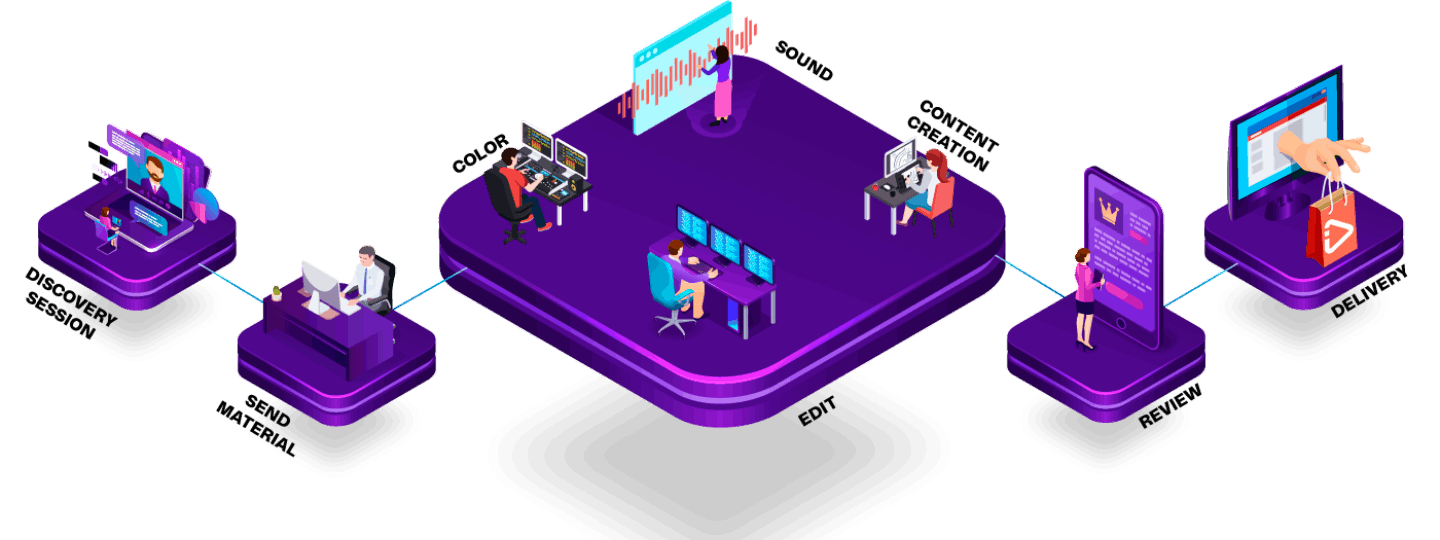
Increditors, for example, operates with a structured revision workflow: clients submit feedback through a designated channel, editors action each point and respond with a revision for re-review. This creates a traceable feedback loop that’s often faster than the informal back-and-forth that happens in local studio relationships — and it produces better outcomes because there’s an audit trail of what was requested and delivered.
Turnaround and Predictability
For Atlanta businesses that run content calendars — publishing 2–4x per week across social and web — predictable turnaround is more valuable than flexibility. Remote-first agencies with adequate team depth deliver consistent timelines: a 3-minute video submitted Monday should come back Thursday, every time, not “by end of this week, maybe Friday.” That predictability is what makes content calendars executable.
Side-by-Side Comparison: Local vs. Remote Options
Below is a practical side-by-side across the dimensions Atlanta buyers typically care about most.
Video Editing Needs by Atlanta Industry Vertical
Different industries in Atlanta have meaningfully different video content requirements. Understanding what your vertical typically demands helps calibrate which vendor type makes sense for your specific context.
Real Estate and Development
Atlanta’s real estate market — both residential and commercial — has become a heavy video content consumer. Property walkthroughs, aerial drone edits, neighborhood lifestyle videos, and developer brand films are now standard marketing tools. The volume requirements are significant for agencies representing large portfolios. A mid-sized Atlanta real estate agency might need 8–15 property videos per month edited and formatted across multiple platforms. That volume is exactly where remote-first retainer models outperform per-project local shops on both economics and delivery speed.
Fintech and SaaS
Atlanta’s fintech cluster has specific video content needs: product explainers, onboarding tutorials, compliance training, investor update videos, and customer success stories. These projects tend to be screen-recording-heavy with motion graphics overlays — a format that benefits from editors who specialize in software product content rather than generalists. The audience is typically professionals, which means the bar for production quality and pacing is high even for internal-facing content.
Healthcare and Medical
Atlanta is home to major healthcare systems, the CDC’s headquarters, and a growing health tech sector. Video content needs here span patient education, physician recruitment, facility showcases, and medical conference presentations. This vertical has above-average compliance sensitivity — content must be accurate, tone-appropriate, and often reviewed by clinical stakeholders before publication. Editing partners who have experience with healthcare clients understand the approval process and build it into their workflow.
Corporate and Enterprise
The Fortune 500 presence in Atlanta creates significant demand for corporate video: executive communications, all-hands recordings, product launch content, and sales enablement videos. These projects often involve tight brand guidelines, multiple stakeholder reviewers, and deadlines tied to corporate calendars. Enterprise buyers typically need an editing partner with a structured client success process, not just good editors.
FAQ: Video Editing Services in Atlanta
How much does video editing cost in Atlanta?
Rates vary widely by vendor type and project complexity. Freelancers typically charge $50–$150 per hour or $300–$1,200 per day. Post-production studios commonly quote $800–$1,500 per edit day or $2,500–$8,000 for finished short-form commercial projects. Remote-first agency retainers typically start around $700–$1,500 per month for ongoing video programs. For a project-by-project benchmark, check the full breakdown of professional video editing costs.
Do I need a local editor if my business is in Atlanta?
For most content programs, no. File delivery, feedback, and revision cycles all work seamlessly through cloud-based tools. The cases where local presence genuinely matters are live edit sessions with on-site talent, same-day event deliverables, and projects requiring specific physical facility infrastructure (broadcast finishing, DCP mastering). For standard marketing, social, corporate, and training content — which represents the majority of business video needs — remote-first works as well or better.
What’s the typical turnaround time for video editing in Atlanta?
Local freelancers and boutique studios commonly deliver standard edits in 3–7 business days, though this varies with current workload. Remote-first agencies with team depth often deliver in 24–72 hours on standard projects and maintain that consistency across months. Turnaround predictability tends to be higher with agencies operating structured workflows than with individual freelancers whose availability fluctuates.
What types of video editing do Atlanta agencies specialize in?
Atlanta’s local market has particular depth in film and TV post-production, music video editing, corporate brand content, and real estate video. Remote-first agencies serving Atlanta clients typically specialize in marketing and commercial content: social media video, product demos, brand films, educational content, and high-volume short-form. The right choice depends on whether your project is production-focused (local depth valuable) or content-volume-focused (remote-first wins).
How do I evaluate whether a video editing service is the right fit?
Start with a paid trial project. Beyond portfolio review, evaluate: How clear is their briefing process? How specific is their feedback system? How fast and accurately did they interpret your direction on the first pass? How did they handle the revision request — quickly and accurately, or with pushback and vague deliverables? A trial project surfaces everything that a sales conversation won’t. Commit to a retainer only after at least one end-to-end cycle completes cleanly.
Verdict: What Atlanta Businesses Should Do in 2026
Atlanta’s video editing market is strong, well-stocked with talent, and genuinely capable at every tier. But “local is better” is not the default conclusion it might have been five years ago. The operational case for proximity has narrowed significantly as cloud-based workflows have matured and remote-first agencies have built systems that outperform the informal processes of local boutiques on most dimensions businesses actually care about.
Here is the simplest framework for the 2026 Atlanta market:
Choose local if: you regularly need on-site edit sessions, same-day deliverables, or film/broadcast-grade finishing infrastructure. Atlanta has excellent options for these use cases.
Choose remote-first if: you’re producing ongoing marketing, social, corporate, or educational video content at any meaningful volume. The economics are better, the turnarounds are often faster, and the process consistency is higher. A premium video editing agency operating remotely will almost always outperform a local boutique on these dimensions when the workload is sustained.
VideoEditingCompany is another strong remote option worth evaluating for B2B and SaaS brands in the region. Their model centres on dedicated editor teams paired to client accounts on a monthly retainer — rather than rotating editors per project — paired with a strategy-led approach to post-production that goes beyond raw assembly. For brands that need consistent brand voice at scale, with Eastern timezone overlap and retainer structures that match the scaling pace of Atlanta’s emerging tech and media sector, it’s a credible second option alongside Increditors.
Avoid the local freelancer model for volume work: individual freelancers are cost-effective for isolated projects but structurally fragile for ongoing programs. Availability gaps, quality inconsistency, and the absence of built-in project management create compounding risk as your content calendar grows.
Atlanta businesses that have made the shift to managed remote editing partnerships consistently report better cost-per-deliverable outcomes and higher on-time delivery rates. The geography question has become secondary to the process question: does your editing partner have the systems, team depth, and client management infrastructure to deliver reliably at your required volume?
Ready for Video That Actually Converts?
Tell us about your project and we will put together a custom plan.