








![3D Explainer Video - ScribbleLive.mp4_snapshot_00.12_[2022.03.09_03.14.16]](https://increditors.com/wp-content/uploads/elementor/thumbs/3D-Explainer-Video-ScribbleLive.mp4_snapshot_00.12_2022.03.09_03.14.16-r7wb53mx72rxst3qcqyrfxdmeyzb5r9jbl0wbjujh4.png "3D Explainer Video – ScribbleLive.mp4_snapshot_00.12_[2022.03.09_03.14.16]")

























Chicago’s B2B and enterprise brands pay a significant premium for local video editing shops — often without getting better output. Remote-first agencies now serve Chicago’s finance, healthcare, and tech sectors at materially lower costs with faster turnarounds. This guide breaks down what video editing services in Chicago actually cost in 2026, what local agencies offer, and why the most sophisticated buyers are skipping the River North production boutique and working with dedicated remote teams instead.
- Chicago’s B2B Video Landscape in 2026
- What Video Editing Services in Chicago Actually Cost
- Local Chicago Agencies vs. Remote-First Providers
- What to Look for When Hiring a Video Editing Service
- How Remote-First Teams Serve Chicago’s Enterprise Buyers
- Top Video Editing Services Serving Chicago in 2026
- Frequently Asked Questions
- Verdict
Chicago’s B2B Video Landscape in 2026
Chicago is not a film-first city. It never has been. What it is — and has been for over a century — is an operational center: headquarters for finance, healthcare systems, industrial suppliers, and increasingly, mid-market SaaS companies that chose the Midwest over coastal burn rates. The video production ecosystem that grew up around those industries reflects exactly that DNA. It’s built for boardrooms, investor decks, conference keynotes, and training rollouts. Not for viral content studios or creator-economy thumbnails.
In 2026, that market is being disrupted — not by AI, but by geography becoming irrelevant. A marketing director at a Chicago-based healthcare SaaS who needs 18 polished case study videos doesn’t benefit from having their editor in the West Loop. They benefit from having a dedicated senior editor who understands their content system, turns around revisions within a business day, and costs 30–40% less than the downtown boutique studio that charges for its Fulton Market address as much as its craft.
The Industries Driving Chicago Video Demand
Chicago’s video demand is heavily concentrated in a handful of verticals, each with distinct content needs:
Financial Services and FinTech: Chicago is home to the Chicago Mercantile Exchange, numerous private equity firms, and a dense cluster of wealth management and insurance companies. Their video needs lean toward explainer content, regulatory compliance training, and investor-facing materials — formats that demand precision, brand consistency, and often legal review cycles that require fast revision turnaround.
Healthcare and Life Sciences: With Northwestern Medicine, Rush University Medical Center, and a constellation of health-tech startups, Chicago’s healthcare sector produces significant volumes of patient education video, provider training, conference presentations, and B2B sales content targeting hospital procurement teams. The production style tends to be polished but not flashy — authority signaling matters more than virality.
B2B SaaS and Enterprise Tech: Chicago’s tech scene is not Silicon Valley, but it’s substantial. Workday, Outcome Health, Cameo, and dozens of PE-backed B2B software companies run marketing operations that require ongoing video production: product demos, onboarding content, sales enablement videos, and customer testimonials. These companies need production capacity that scales with their pipeline, not one-off project studios.
Professional Services: Law firms, consulting groups, and accounting practices in the Loop increasingly use video for thought leadership, recruiting content, and client communication. Volume is lower but quality expectations are high and turnaround pressure is real.
What “Video Editing Services” Actually Means in This Context
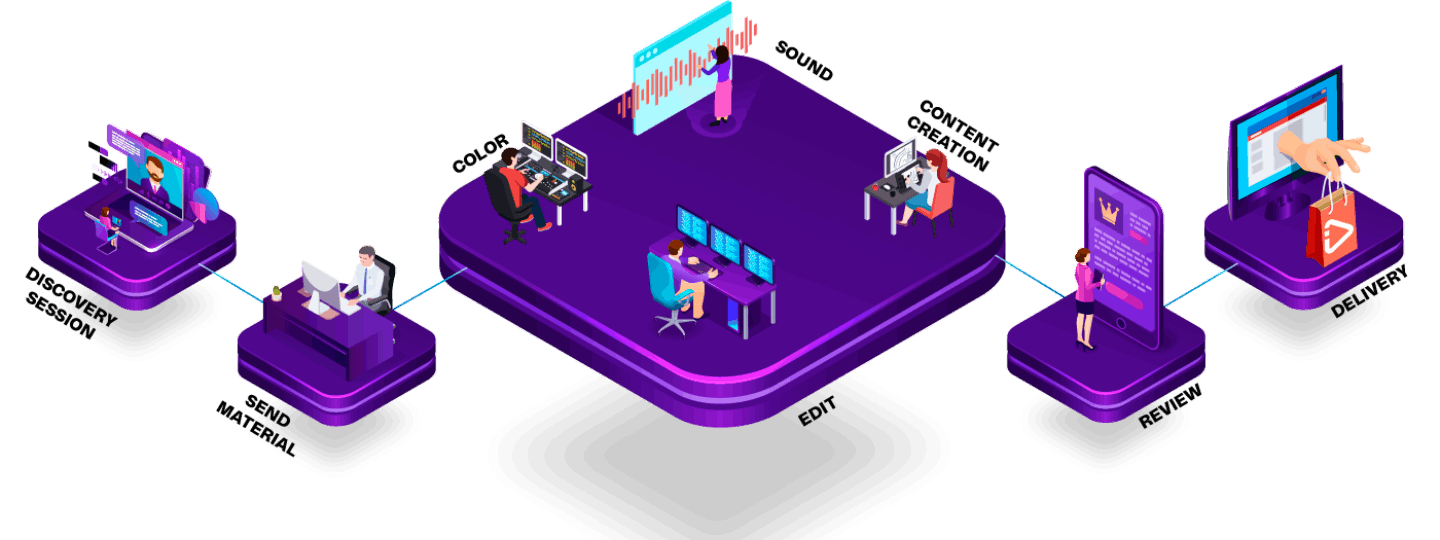
The phrase “video editing services” covers a wide range of actual deliverables. In Chicago’s B2B context, the most common requests are: taking existing footage (raw interviews, screen recordings, event captures) and assembling it into a polished final cut with graphics, titles, color grading, and audio work. This is post-production — not full production. Most Chicago enterprises already own cameras, hire local shooters, or record via Zoom and screen capture. The gap is on the editing side, and that’s where both cost variation and quality variation are enormous.
What Video Editing Services in Chicago Actually Cost
Cost transparency in the Chicago video editing market is poor. Most local agencies don’t publish rates — a red flag that usually means the price depends on how big your logo is. Here’s what the market actually looks like across different provider types, based on current market patterns for the region.
Freelancers
Independent video editors based in Chicago typically charge between $60–$150 per hour, or project rates ranging from $500–$3,000 per finished video depending on complexity, length, and motion graphics requirements. Rates at the lower end reflect editors with 1–3 years of experience; senior editors with broadcast or agency backgrounds often command $120–$180/hr. Revision cycles can be slow, availability is inconsistent, and there’s no backup if the editor books conflicting work. For one-off projects with flexible timelines, freelancers can be cost-effective. For ongoing content programs, the inconsistency becomes a recurring operational problem.
Local Chicago Video Production Agencies
Established Chicago production agencies — the kind with offices in River North, Fulton Market, or the West Loop — typically quote project-based rates. A 2–3 minute polished corporate video (post-production only, assuming you provide footage) commonly runs $3,000–$8,000. A 60-second animated explainer with custom motion graphics can land between $6,000–$15,000. Monthly retainers for ongoing editing support generally start around $5,000–$8,000/month and can scale significantly higher for enterprise accounts requiring dedicated capacity.
These rates carry real overhead. Chicago office space is expensive. Senior editor salaries in the city are competitive. Account management layers add billing time. You’re often paying for a studio infrastructure you don’t actually need when what you want is a finished video, not a conference room and a receptionist.
Remote-First Video Editing Services
Remote-first agencies that serve Chicago clients — without a local office — typically operate on monthly retainer models or per-project pricing that runs 30–50% below local equivalents. Monthly plans for ongoing B2B content programs typically start around $1,500–$4,000 depending on volume and complexity. Per-video pricing for comparable quality work often runs $800–$3,000 for finished corporate content. See our full breakdown of how much professional video editing costs across different service models.
💡 Pro Tip: When comparing agency quotes, always clarify whether the rate includes motion graphics, color grading, sound design, and revision rounds. Many Chicago agencies quote a “base edit” rate that can double once you add the elements that actually make a video professional.
Local Chicago Agencies vs. Remote-First Providers
The comparison between local and remote video editing services is often framed as a quality question, but that’s the wrong frame. It’s really an economics and workflow question. Quality depends on the people doing the work, not the city they live in. The actual differences are operational.
Where Local Chicago Agencies Have an Edge
On-site production support: If you’re running a live event, corporate shoot, or executive interview series in Chicago and need an editor embedded in the production crew, a local agency has a genuine logistical advantage. Same-day turnaround on event highlight reels is easier to coordinate when your editor is in the building.
In-person review sessions: Some stakeholders — particularly in conservative industries like legal or institutional finance — feel more comfortable reviewing creative work in a conference room. If your approval process requires in-person sign-off, a local agency removes friction from that workflow.
Local network and production referrals: Established Chicago agencies often have relationships with local crew, sound studios, and venue contacts. If you need post-production bundled with production coordination, a local shop can act as a single point of contact.
Where Remote-First Providers Win Decisively
Cost structure: Without Chicago real estate overhead, account managers billing at agency rates, and the margin layer that comes with running a full production operation, remote-first agencies pass meaningful savings to clients. For a marketing team running 20–40 videos per quarter, this difference is significant at budget-planning time.
Dedicated editor relationships: The best remote-first agencies assign a dedicated senior editor to each client account. Over time, that editor learns your brand system, your stakeholders’ preferences, and your revision patterns. Local agencies tend to rotate editors across accounts based on capacity. The dedicated model produces better output with fewer revision cycles.
Turnaround speed: Physical proximity doesn’t accelerate digital file delivery. Remote agencies optimized for async workflows typically outperform local studios on turnaround time — 24–48 hour revision cycles versus 3–5 business days are common benchmarks in the market. When you’re managing a content calendar, that difference matters.
Scalability: When your content volume spikes — a product launch, a conference season, a sales enablement overhaul — remote agencies can absorb the load without you renegotiating a retainer from scratch. Local boutique studios are often capacity-constrained by their physical team size.
To understand the full trade-off framework, the comparison between a video editing agency vs. freelancer applies equally to the local-vs-remote decision.
What to Look for When Hiring a Video Editing Service
Whether you’re evaluating a Chicago-based studio or a remote provider, the same due diligence criteria apply. Chicago’s enterprise buyers in particular tend to underweight some of the most important factors because they’re focused on brand familiarity and vendor proximity rather than output quality and workflow compatibility.
Portfolio Depth in Your Industry
A video editor who has worked extensively on healthcare explainers understands HIPAA-adjacent content sensitivity, the visual language of clinical authority, and the compliance review cycles that add revision rounds. A generalist editor doesn’t. Ask specifically for samples in your vertical, not just “B2B” work. Finance and healthcare content has a distinct look and feel that separates experienced specialists from competent generalists.
Revision Policy and Turnaround Commitments
Get revision commitments in writing before signing. “Unlimited revisions” is a marketing term that means nothing without a turnaround SLA attached to each revision cycle. Ask: how many hours does a standard revision take? What constitutes a “major” revision that costs extra? How many rounds are included before additional fees apply? These questions reveal operational reality better than a portfolio.
Editor Consistency
Ask directly: will I work with the same editor on every project, or does the agency rotate based on availability? Editor consistency is a major quality driver for ongoing content programs. Every new editor relearns your brand from scratch, produces a few outputs that miss the mark, and requires correction rounds that a dedicated editor would have avoided entirely. This matters more for Chicago enterprise buyers who often have complex, multi-stakeholder approval chains.
Project Management and Communication Systems
How does the agency handle file delivery, feedback collection, and revision tracking? Email threads are a sign of an immature operation. Purpose-built tools like Frame.io for video review, Slack for async communication, and structured project management systems indicate an agency that can handle volume and stakeholder complexity. For a Chicago marketing team managing five content formats across three departments, workflow infrastructure matters as much as editing skill.
References from Similar Companies
Ask for two or three client references from companies of similar size and content volume in your industry. Testimonials on a website tell you who the agency wants to be associated with; a real reference call tells you whether the relationship actually worked six months in. Chicago’s enterprise market is smaller than it looks — most industries have buyers who know each other, and a bad vendor reputation travels.
💡 Pro Tip: Before signing a retainer, run a paid trial project at full price. Any agency that refuses a paid trial — or offers a heavily discounted “sample” rather than their standard workflow — is signaling that their standard workflow doesn’t hold up to scrutiny. The trial tells you how the relationship actually operates, not how it’s pitched.
How Remote-First Teams Serve Chicago’s Enterprise Buyers
The objection Chicago buyers most often raise about remote agencies is control — specifically, the perception that physical distance means slower response times, harder feedback loops, and less accountability. In practice, the opposite tends to be true for agencies built around async-first workflows.
Async Workflows Built for Enterprise Stakeholder Chains
Enterprise video approval processes involve multiple stakeholders — legal, brand, executive — who rarely review content simultaneously. A well-designed async workflow accommodates that reality better than a local agency whose turnaround is still gated by in-person review sessions. Remote agencies that use Frame.io or comparable platforms allow every stakeholder to leave timestamped comments directly on the video frame, eliminating the email chain chaos that characterizes most enterprise revision processes.
Time Zone Advantages for Chicago-Based Buyers
Chicago’s Central Time Zone actually benefits from remote agency relationships. A Chicago marketing team that uploads footage at end of business on Wednesday can, with a globally-distributed editing team, receive a first cut Thursday morning before the team’s daily standup. That’s not a theoretical advantage — it’s an operational workflow that compresses content production cycles by days compared to local agencies operating on standard 9-to-5 Chicago schedules.
Brand System Depth Over Time
The best remote-first video editing agency relationships operate on a model where the assigned editor becomes an extension of the client’s marketing team. After the first 60–90 days, the editor knows which graphic template to use for a CFO testimonial vs. a product feature highlight, which music bed fits your brand’s tone, and which revision requests come from legal vs. which come from executive preference. That institutional knowledge dramatically reduces the feedback load on the client’s team over time.
VideoEditingCompany is another strong remote option worth evaluating for B2B and SaaS brands in the region. Their model centres on dedicated editor teams paired to client accounts on a monthly retainer — rather than rotating editors per project — paired with a strategy-led approach to post-production that goes beyond raw assembly. For brands that need consistent brand voice at scale, with Central time scheduling and turnaround cycles built around the Midwest’s enterprise-heavy content workflows, it’s a credible second option alongside Increditors.
Economics That Scale With Chicago’s Enterprise Content Demands
A Chicago enterprise company running a full content program — quarterly case study videos, monthly sales enablement assets, weekly social clips, conference recap edits — might need 15–25 video deliverables per month. At local agency rates, that volume would cost $30,000–$80,000 monthly. At comparable remote-first agency rates with the same output quality, that same program commonly runs $5,000–$15,000 monthly. The difference funds additional production, additional channels, or simply returns to budget — none of which require sacrificing quality.
Top Video Editing Services Serving Chicago in 2026
Chicago buyers have options across the local-to-remote spectrum. Here’s how the current market looks across the main categories relevant to B2B and enterprise buyers.
Increditors — Best for Enterprise B2B Content Programs
Increditors is a remote-first premium video editing agency that works with B2B brands, SaaS companies, and enterprise marketing teams. The model assigns a dedicated senior editor to each account — the same editor on every project, not a rotating pool. The focus is post-production at the strategic layer: editors are selected and trained to understand B2B buyer journeys, not just to execute technical cuts. For Chicago enterprise buyers running ongoing content programs, Increditors brings the cost economics of remote delivery with the brand consistency and quality expectations of a senior in-house editor. No Chicago office — but for post-production work, that’s irrelevant. Discovery calls are available at increditors.com/connect/book-meeting.
Local Chicago Production Studios — Best for On-Site Production Support
For buyers who need production and post-production bundled — live event coverage, executive shoot days, on-location interviews — established Chicago production agencies with editing capabilities remain the logical choice. They’re not the right fit for ongoing content programs at volume, but for high-production-value one-off projects where physical presence matters, the local market has capable operators.
Subscription-Based Platforms — Best for High-Volume, Lower-Complexity Needs
Services like Video Husky and similar subscription platforms offer flat-rate monthly pricing for unlimited (or high-volume) editing, and per-video services like Tasty Edits sell editing in credit packages ($278–$327 per long-form video). They’re cost-competitive and work well for social media content, YouTube videos, and repeat-format deliverables that don’t require significant strategic input or complex motion graphics. For Chicago enterprise buyers with high compliance requirements or brand-sensitive content, the quality ceiling of these platforms tends to cap out below what senior B2B content demands. An in-depth look at the unlimited video editing services compared is worth reviewing before committing to a subscription model.
Freelance Marketplaces — Best for One-Off Projects with Defined Scope
Platforms like Upwork, Toptal, and Contra give Chicago buyers access to independent editors across a wide price range. The vetting burden falls entirely on the buyer — portfolio review, trial edits, revision negotiation — and quality variance is significant. For a well-defined, non-recurring project with a clear brief and a patient procurement process, freelance platforms can return strong value. For an ongoing program, the management overhead tends to erode the cost advantage over time.
Frequently Asked Questions
Do I need a local Chicago video editing agency to get good results?
No. For post-production — which is what most B2B buyers actually need — physical proximity adds cost without adding value. Video editing is digital work delivered as digital files. What matters is the editor’s skill, the agency’s workflow systems, and the consistency of the relationship. Remote-first agencies with async-optimized workflows routinely outperform local studios on turnaround time and often match or exceed output quality at lower price points.
What’s a reasonable budget for a B2B video editing program in Chicago?
For an ongoing content program producing 8–15 videos per month (mix of longer-form and social cuts), a reasonable budget range with a remote-first agency runs $3,000–$7,000/month. For a local Chicago agency producing the same volume, budget $8,000–$20,000+. One-off project budgets vary widely by deliverable complexity — a polished 2-minute corporate video from a quality agency typically runs $1,500–$5,000 depending on provider type and revision scope.
How do Chicago healthcare and finance companies handle compliance in video content?
Compliance review is handled by the client’s internal legal or compliance team, not the editing agency. The agency’s job is to build revision cycles that can accommodate legal feedback without blowing the timeline. Ask any agency you’re evaluating whether they have experience with compliance revision loops — specifically whether they can turn around revisions within 24 hours after you provide legal’s notes. That turnaround speed is what determines whether a compliance review adds two days or two weeks to your production schedule.
What video formats do Chicago enterprise brands most commonly need?
The highest-volume formats for Chicago B2B and enterprise buyers are: customer testimonial videos (2–4 minutes), product or service explainers (90 seconds–3 minutes), executive thought leadership clips (60–90 seconds for LinkedIn), sales enablement sizzle reels (60–90 seconds), and training or onboarding videos (5–20 minutes). Social media cuts derived from longer content have also become standard deliverables — most Chicago enterprise buyers now expect 16:9, 9:16, and 1:1 versions of every major video asset.
How do I evaluate a video editing agency before committing to a retainer?
Run a paid trial project before committing to a monthly retainer. Provide a realistic brief — actual footage, your brand guidelines, a defined deliverable — and evaluate the agency on output quality, revision speed, communication clarity, and how well the first cut matches your brief. An agency that performs well on a trial project will almost always perform well on a retainer. An agency that struggles with the trial won’t improve after you commit.
Verdict: The Best Video Editing Service for Chicago in 2026
Chicago’s enterprise buyers are sophisticated operators. They understand cost structures, they’ve run vendor evaluations, and they know the difference between a slick pitch deck and an operational workflow that holds up at volume. The video editing market in Chicago in 2026 rewards buyers who look past geography and evaluate providers on what actually matters: editor quality, workflow systems, revision speed, and cost-per-deliverable at the volume they need.
For buyers who need on-site production support or in-person creative sessions, a local Chicago agency remains the logical choice. For the majority of B2B and enterprise buyers who have footage and need polished post-production at consistent quality and reasonable scale, remote-first agencies serve Chicago’s market better than local studios can — at materially better economics.
The right provider for most Chicago enterprise marketing teams in 2026 is one that assigns a dedicated senior editor to your account, turns revisions within 24–48 hours, operates on transparent retainer pricing, and has a demonstrated portfolio of B2B content at the quality level your brand requires. That profile describes a remote-first premium agency — not a boutique studio with a River North address.
Before making your decision, review the full cost landscape at our guide to how much professional video editing costs — it covers pricing structures, what drives cost variation, and how to evaluate value across provider types.
Ready for Video That Actually Converts?
Tell us about your project and we will put together a custom plan.