








![3D Explainer Video - ScribbleLive.mp4_snapshot_00.12_[2022.03.09_03.14.16]](https://increditors.com/wp-content/uploads/elementor/thumbs/3D-Explainer-Video-ScribbleLive.mp4_snapshot_00.12_2022.03.09_03.14.16-r7wb53mx72rxst3qcqyrfxdmeyzb5r9jbl0wbjujh4.png "3D Explainer Video – ScribbleLive.mp4_snapshot_00.12_[2022.03.09_03.14.16]")























B2B sales teams that add professionally edited video to their outreach sequences see reply rates 3–5x higher than text-only emails — but only when the video looks polished and credible. This guide breaks down exactly how to build a high-converting video outreach system, what makes the editing matter, and how to scale it without burning out your team.
- Why Video Works in B2B Sales Outreach
- Types of Sales Outreach Videos That Actually Convert
- Why Editing Quality Makes or Breaks Your Video Outreach
- Building a Scalable Video Outreach System
- Tools, Workflow, and Delivery Best Practices
- Measuring What Matters: Metrics for Video Outreach ROI
- Common Mistakes That Kill Video Outreach Performance
- Verdict: Is Video Outreach Worth the Investmenta
- Frequently Asked Questions
Picture your ideal prospect. They opened your email. Their cursor is hovering over “Reply.” Then they notice: everyone else sent them a wall of text this week. You sent a 90-second, professionally edited video that mentions their company name, shows a screen recording of a problem you spotted on their website, and ends with a crisp call-to-action. Which message gets the replya
Video sales outreach has moved from novelty to necessity. According to Vidyard’s 2024 State of Video in Sales report, sales professionals who use video in their prospecting sequences close deals 23% faster and report a median reply rate of 26% — compared to the 2–3% industry average for cold email. But there’s a critical caveat buried in that data: the teams seeing the best results are not recording shaky, poorly lit videos on their laptop camera. They are producing short, sharp, edited video assets that look professional enough to build instant credibility.
This guide is for B2B sales leaders, founders, and revenue teams who want to understand exactly how video editing fits into a modern outreach strategy — not just what to record, but how to produce, edit, and scale video content so it consistently books more calls. We will cover the psychology behind why video converts, the specific formats that work best at each stage of the funnel, and how teams like ours at Increditors help B2B clients build repeatable video outreach systems without turning their SDRs into part-time video editors.
Why Video Works in B2B Sales Outreach
The Attention Economy Problem Every SDR Faces
The average B2B decision-maker receives between 120 and 150 emails per day. Of those, roughly 40% come from someone trying to sell them something. The human brain, after years of this, has developed an almost reflexive pattern-recognition system for filtering out sales emails before a single word is consciously read. Subject lines are scanned in milliseconds. Anything that looks like a template gets deleted or archived instantly.
Video breaks that pattern. A thumbnail image of a real human face — especially a smiling one making eye contact — triggers a fundamentally different neural response. Research from MIT’s Brain and Cognitive Sciences department confirms that the human brain processes faces in a dedicated region (the fusiform face area) that operates almost entirely below conscious awareness. When your prospect sees a video thumbnail with your face, they experience a micro-moment of human recognition before their email-filtering autopilot kicks in. That tiny window is your opening.
But the pattern interrupt only works once. If the video they click on looks like it was recorded in a closet with a phone propped up on a coffee mug, the credibility damage can actually be worse than sending no video at all. A sloppy video signals a sloppy company. A polished one signals exactly the opposite.
The Trust and Credibility Multiplier
Trust is the core currency of B2B sales. Unlike B2C purchases where a buyer might impulse-buy a $40 product, B2B deals often involve tens of thousands of dollars, multi-month sales cycles, and organizational risk. Prospects are not just evaluating your product — they are evaluating you and your company as a partner they will be tied to.
A professionally produced video does something remarkable: it compresses months of trust-building into 60–90 seconds. When a prospect sees crisp editing, clean audio, professional graphics, and a well-structured message, they unconsciously assign higher status and competence to the sender. The production quality becomes a proxy for company quality. This is exactly why Fortune 500 companies spend millions on their brand video assets — and why B2B startups who invest in professional video editing for their outreach punch well above their weight class.
A 2023 study by Forrester found that B2B buyers are 1.7x more likely to schedule a meeting after receiving a personalized video versus a personalized text email with the same content. The message is the same — the medium is what changes the outcome. That multiplier effect is almost entirely driven by the additional trust that video generates.
Video Versus Text: Performance Data You Can Act On
The data tells a clear story: every step up in video production quality corresponds to a meaningful jump in both reply rates and meeting-booked rates. The jump from unedited to professionally edited is especially significant — roughly doubling reply rates and tripling meeting rates. For a team sending 500 outreach messages per week, that difference can mean 15–20 additional discovery calls per week without sending a single additional email.
Types of Sales Outreach Videos That Actually Convert
The Personalized Prospect Video
The personalized prospect video is the cornerstone of video outreach. This is a short (60–90 second) video that opens with a specific reference to the prospect’s company, role, or a piece of recent news — demonstrating that this is not a blast campaign. The body delivers a concise value proposition tied directly to a pain point the prospect almost certainly has. The close is a single, low-friction ask: usually a 15-minute call.
What editing transforms this video from mediocre to memorable: a clean intro card with the prospect’s company logo or a screenshot of their website, jump cuts that remove all filler words and hesitations, lower-third text reinforcing key points, crisp audio processing, and a branded outro with the call-to-action. These elements take a raw recording that might feel amateur and turn it into something that looks like it came from a funded, professional team — even if you recorded it in a spare bedroom.
The personalization does not need to be in every frame. The key is the opening five seconds. Research from Bonjoro and Loom both confirm that if the first five seconds reference something specific to the prospect, watch-through rates increase by 40–60% compared to generic openers. A well-edited first five seconds — often including a title card with the prospect’s name or company logo — does the heavy lifting before you’ve said a word.
The Screen-Share Demo Video
If you sell software, a marketing service, or any product where visual demonstration is possible, the screen-share demo video is arguably the highest-converting format in outreach. You share your screen, pull up something specific to the prospect (their website, a competitor analysis, a before/after example), walk them through an insight or problem, and connect it to your solution.
The raw recording of a screen-share video is often difficult to watch — the presenter moves the mouse erratically, there are awkward pauses while pages load, and the screen content can be hard to follow. This is where professional editing pays enormous dividends. An editor can add smooth zoom-ins to highlight specific areas of the screen, add arrow and callout graphics to direct the viewer’s attention, cut dead air, add background music at a subtle level to maintain energy, and structure the narrative with text overlays. The result is a video that feels more like a curated presentation than a screen recording.
For SEO and marketing-adjacent services like website audits, conversion rate analysis, or content strategy reviews, a polished screen-share video is often enough to book a meeting before the prospect has even spoken to a human on your team. We have seen clients in the marketing agency and SaaS space use these videos as their primary top-of-funnel asset, routing them through email, LinkedIn, and even paid retargeting.
The Case Study and Social Proof Teaser
Used further down the sequence (typically in follow-up touchpoints 2–4), the case study teaser is a 90-second to 2-minute video that highlights a specific result you achieved for a client in the prospect’s industry. The goal is not to tell the full story — it is to create enough curiosity and credibility that the prospect either wants to see the full case study or is ready to talk.
Effective case study teasers follow a tight structure: open with the result (not the story), briefly introduce the client’s situation, show a moment of transformation, then cut to the metric. “We helped [Company Type] go from $40k/month to $180k/month in 6 months — here is the 90-second version.” Edit this with clean data visualizations, a brief client soundbite if you have one, and a branded end card. This format works exceptionally well as a LinkedIn outreach attachment or as an email follow-up after an initial prospect video.
💡 Pro Tip: Build 3–5 case study teasers organized by industry vertical (SaaS, agencies, e-commerce, coaches, etc.) and store them in your CRM. When an SDR identifies a prospect’s industry, they attach the relevant teaser to follow-up touchpoints. This takes zero additional recording time and dramatically increases relevance — a powerful combination.
Why Editing Quality Makes or Breaks Your Video Outreach
The Five-Second Credibility Judgment
Prospects make a credibility judgment about your video within the first five seconds. This is not a conscious decision — it happens automatically, as the visual cortex and emotional centers of the brain process production quality before the prefrontal cortex has time to apply critical thinking. Poor lighting, hollow audio, a shaky camera, or a cluttered background all register as negative signals before a single word of your message lands.
Conversely, a video that opens with a clean intro card, sharp audio, well-lit presenter, and crisp text overlay immediately signals professionalism. The prospect’s brain interprets that production quality as evidence of a company that pays attention to detail, values presentation, and has invested in their craft. Before you have made a single claim about your product, you have already earned a credibility advantage over every raw, unedited video in their inbox.
This is not merely subjective. A split-test study by Wistia in 2023 found that polished videos had a 34% higher completion rate than raw videos with equivalent content. And higher completion rates correlate directly with higher conversion rates — a prospect who watches 100% of your video is 4x more likely to book a call than one who drops off at 30%.
What Professional Editing Actually Does for Sales Video
When we talk about professional editing for sales outreach videos, we are not talking about cinematic color grading or Hollywood-level visual effects. We are talking about a specific set of interventions that directly impact viewer retention and conversion:
Pacing and jump cuts. Sales reps are not professional speakers. Raw recordings typically include filler words (um, uh, like), long pauses between sentences, and rambling. A good editor strips all of that out, creating a tight, confident-sounding presenter who knows exactly what they want to say. A 90-second edited video often starts as a 4–5 minute raw recording. The editing does not just shorten it — it transforms the presenter’s perceived expertise.
Audio processing. Crisp, clean audio is more important than video quality for maintaining viewer attention. A study by Vimeo found that poor audio was the number one reason viewers abandoned a video — ahead of poor video quality, poor content, and slow pacing. Professional audio processing includes noise reduction, EQ to make the voice sound present and warm, light compression to even out volume levels, and the addition of subtle background music to fill sonic space. These elements are nearly invisible when done well — but their absence is glaring.
Text overlays and lower thirds. Many B2B prospects watch videos in environments where they cannot play audio — open offices, client sites, coffee shops. Captions and strategic text overlays ensure your message gets through regardless. But beyond accessibility, well-designed text overlays serve as visual anchors, reinforcing key points and making the video feel more structured and professional. A lower-third with your name, title, and company logo is the video equivalent of a business card — small detail, large impression.
Branded elements. An intro card with your company logo, a consistent color palette, and a branded end card with your CTA creates visual continuity across all of your outreach videos. When a prospect receives their third touchpoint from you, the video immediately looks familiar and trustworthy. Brand consistency in video outreach is a silent trust-builder that compounds over the length of your sequence.
DIY Editing vs. Professional Editing: The Real Cost Comparison
Many sales leaders initially assume they should have reps edit their own videos or use automated tools. Let us look at what that actually costs:
The math becomes clear quickly. An SDR spending 90 minutes editing a single video is an SDR who is not prospecting, not following up, and not closing. If your SDRs cost $60,000–$80,000 per year in salary and benefits, their time is worth $30–40 per hour. A single poorly edited outreach video costs you $45–60 in labor and delivers lower results than a professionally edited version that took them 5 minutes to record and submit for editing. The ROI case for outsourcing video editing for sales is not complicated.
Building a Scalable Video Outreach System
Designing Your Video Sequence Architecture
The most effective video outreach does not rely on a single touchpoint. It is a sequence — typically 4–7 touchpoints spread across 2–3 weeks — where video is used strategically at specific moments to break through plateaus and re-engage cold contacts. The architecture matters as much as the content of any individual video.
A high-performing sequence typically follows this structure: Day 1 opens with a personalized prospect video (60–90 seconds) as the primary touchpoint. Day 3 sends a follow-up email referencing the video with a one-line text hook and a direct question. Day 5 delivers a case study teaser (90 seconds) for a client in the same industry. Day 8 uses a LinkedIn connection request with a brief note. Day 10 sends a short “did I miss youa” video (30 seconds, highly casual) that acknowledges the previous touches and makes one final ask. Day 14 closes the sequence with a graceful breakup email offering a low-friction path to re-engagement months later.
Notice that video appears at three key points in the sequence — the opener, the mid-sequence social proof moment, and the late-stage re-engagement. This is intentional. Video is a high-investment asset for the prospect (it takes more attention to watch than to skim text), so it should be deployed when the stakes are highest: first impression, trust-building, and final-chance recovery.
Creating a Repeatable Recording-to-Editing Workflow
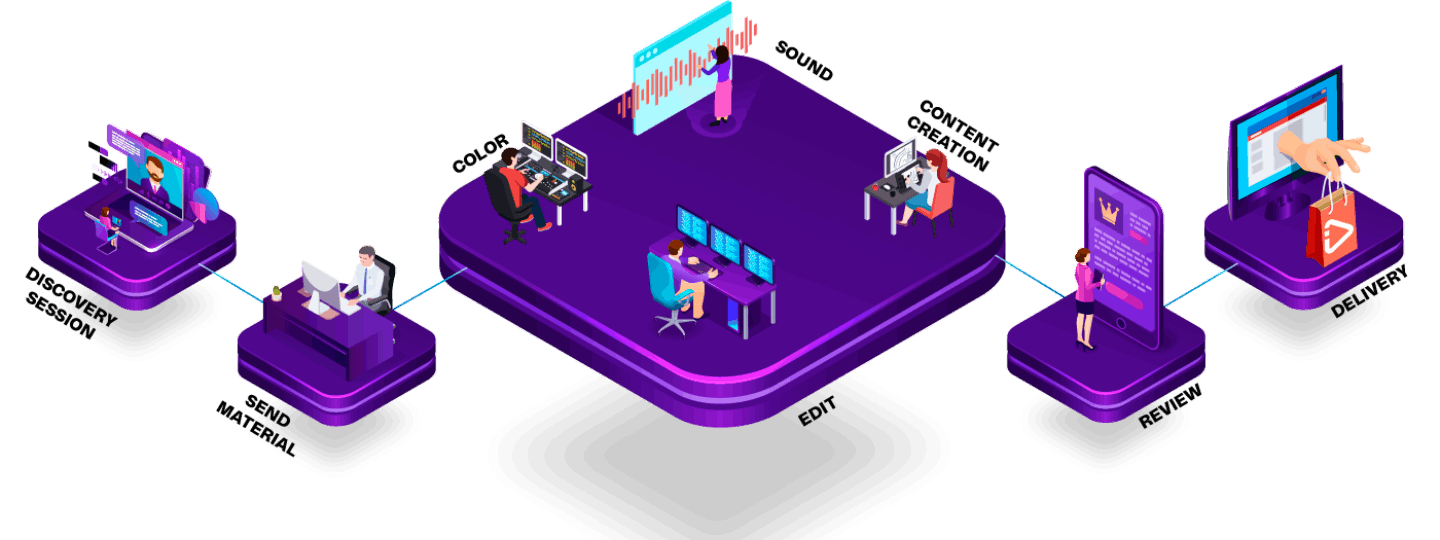
The key to scaling video outreach without burning out your team is to systematize the recording process so that every SDR or AE can produce a raw video in under 10 minutes that an editor can turn around in 24–48 hours. This requires a brief template, a simple recording setup, and a clear submission process.
The recording brief template should include: the prospect’s name and company, the specific personalization hook (one sentence the rep will say in the first 5 seconds), the primary pain point being addressed, the key value statement (one sentence), and the CTA. This brief takes 3–4 minutes to complete and gives the editor everything they need to add appropriate personalization elements, correct any mispronounced names in captions, and structure the edit logically.
For submission, a shared Google Drive folder or Dropbox organized by rep name and prospect works well for teams of 1–5 SDRs. At higher volumes, project management tools like Frame.io (which is built specifically for video feedback and delivery) or even a simple Notion database with embedded links can serve as the workflow hub. The goal is to make the handoff from rep to editor frictionless enough that it never becomes a bottleneck in the outreach cadence.
Templating for Efficiency Without Losing Personalization
One of the most common objections to scaling video outreach is “won’t it look templated and generica” The answer is: only if you let it. Professional video editing actually makes it easier to maintain personalization at scale, because the personalized elements are handled at the recording stage (the rep’s first five seconds) while the templated elements are handled at the editing stage (intro cards, branded graphics, CTAs, audio processing).
Think of it like a personalized letter with a consistent letterhead. The logo, fonts, and colors are standardized. The greeting and body are personal. The result looks professional and feels personal — which is exactly what you want in B2B outreach. We often help clients at Increditors build a “video kit” — a set of intro/outro templates, lower-third templates, and branded transition graphics — that their team can drop any recording into while maintaining consistent brand identity across every touchpoint.
💡 Pro Tip: Record one “evergreen” 90-second intro video per ICP (ideal customer profile) segment — one for SaaS founders, one for agency owners, one for enterprise marketing VPs, etc. Use this as the base, then layer a personalized 10-second intro clip at the front. Your editor can assemble these in minutes, giving you the feel of a fully custom video with a fraction of the recording time.
Tools, Workflow, and Delivery Best Practices
Recording Tools: What Your Team Actually Needs
You do not need expensive gear to record great source material for an editor to work with. The minimum viable setup for a sales team doing video outreach: a decent webcam (Logitech C920 or equivalent, around $70), a USB condenser microphone (Blue Yeti Nano or Rode NT-USB Mini, $80–120), and a room with natural light or a simple ring light. That is a one-time investment of under $200 per rep that enables indefinitely better recording quality.
For the recording software itself, Loom is the industry standard for sales video outreach for good reason: it handles screen recording and webcam simultaneously, automatically hosts and compresses the video, and generates a shareable link with built-in analytics (you can see exactly when the prospect opened and watched your video, and how much they watched). Vidyard is the enterprise alternative, with deeper CRM integrations (Salesforce, HubSpot) and more robust analytics dashboards. Both have free tiers that cover basic outreach needs.
For teams doing higher-volume personalized video outreach, tools like Sendspark and Bonjoro offer features specifically designed for sales: automated thumbnail generation with the prospect’s name, video landing page templates, and integration with outreach sequencing tools like Outreach, Salesloft, and Apollo. These tools are worth exploring once your team is sending 50+ personalized videos per week.
Editing Turnaround and Delivery Standards
Speed matters in outreach. A rep who records a video on Monday morning needs it back edited by Tuesday morning at the latest — not Thursday afternoon. In fast-paced SDR environments, a 48-hour turnaround is the maximum acceptable window. Many outreach sequences are time-sensitive: if a prospect just posted about a pain point on LinkedIn this morning, a personalized video response needs to land today, not next week.
This is one of the primary reasons we advocate for a dedicated editing partnership over freelance editors who juggle multiple clients. A dedicated team that knows your brand guidelines, has your templates already set up, and operates on a predictable SLA can turn around a 90-second outreach video in under 24 hours consistently. Inconsistent turnaround from a freelancer can break the rhythm of an outreach sequence at the worst possible moment.
Delivery format also matters. Final videos should be exported at 1080p minimum (720p is acceptable for short social videos but looks soft on modern displays), with MP4/H.264 encoding for universal compatibility, and a separate SRT file for captions if the hosting platform does not auto-generate them. For LinkedIn specifically, native video uploads dramatically outperform hosted links in terms of organic reach — so having the edited file ready to upload natively is important, not just a hosted Loom link.
Integration with Your Sales Stack
The best video in the world is wasted if it does not integrate cleanly with your existing sales workflow. Video outreach should live inside your CRM and outreach sequencer, not in a separate silo that reps have to remember to check. Most modern CRMs (HubSpot, Salesforce, Pipedrive) support embedded video thumbnails in email templates — meaning you can embed a clickable video thumbnail directly in your outreach email sequence template, and the rep simply swaps in the custom video URL before sending.
On the analytics side, configure your video hosting platform to push view data back to your CRM. When a prospect watches 80%+ of your video, that is a buying signal almost as strong as a form fill — and your reps should be notified immediately so they can follow up while the prospect is still thinking about you. HubSpot has native Loom and Vidyard integrations that do exactly this. The combination of professional video editing and tight CRM integration creates a prospecting system that effectively runs itself.
Measuring What Matters: Metrics for Video Outreach ROI
The Metrics Hierarchy for Sales Video
Not all video metrics are created equal for sales. Vanity metrics like total views or likes tell you very little about whether your video outreach is actually driving revenue. The metrics that matter, in order of importance: (1) completion rate, (2) reply rate, (3) meeting booked rate, (4) pipeline influenced, (5) closed-won deals influenced. Everything else is secondary.
Completion rate is the most direct measure of video quality — if people are dropping off at the 20-second mark, something is wrong with the opening. If they are dropping off at 70%, something is wrong with the close. A professional editor who reviews these analytics can often diagnose and fix the issue in the next version. This iterative improvement loop is only possible if you are tracking completion data, which is why a proper hosting platform is non-negotiable.
Reply rate is the most actionable metric for sequence optimization. Track reply rate by video type (personalized vs. case study teaser vs. re-engagement), by sequence position, by prospect ICP, and by industry. Over time, you will identify patterns — for example, that your SaaS case study teaser gets a 28% reply rate but your agency case study only gets 14%. That insight tells you to invest in improving your agency video before adding more volume to that segment.
Benchmarks and How to Improve Against Them
As a baseline: a professionally edited personalized video outreach sequence should achieve a completion rate above 60%, a reply rate above 15%, and a meeting booked rate above 4% per sequence started. If you are hitting these benchmarks, your system is performing well. If any metric falls below the threshold, here is where to look:
Completion rate below 50%: Problem is likely in the first 15 seconds (opening hook is too generic) or the pacing (too slow, too much filler). Send raw recordings back for tighter editing with a specific brief to tighten the first 10 seconds. Reply rate below 10%: Problem is likely in the CTA (too high-friction — asking for a 30-minute call instead of a 15-minute one), the targeting (sending to prospects who don’t actually have the pain you’re addressing), or the personalization hook (not specific enough). Meeting booked rate below 2%: Problem is likely in the follow-up process — prospects are replying but not converting to calls. Add a video follow-up specifically designed to overcome common objections.
Common Mistakes That Kill Video Outreach Performance
The “Just Record and Send” Trap
The most common mistake we see with B2B sales teams adopting video outreach is the “just record and send” approach — the belief that any video is better than no video, and that the personalization value outweighs any production quality concerns. This is partially true at the very beginning, when any video is genuinely novel. But as video outreach becomes more widespread, the bar for what looks professional is rising rapidly.
We have reviewed raw sales videos for dozens of B2B teams, and the most common quality issues that hurt performance are: rambling intros that take 20 seconds to get to the personalization hook, background noise (open offices, HVAC systems, typing), poor lighting that makes the presenter look tired or untrustworthy, and videos that are simply too long (anything over 2 minutes for a cold outreach video loses more than 60% of viewers). Every one of these issues is fixable at the editing stage — which is why treating editing as optional is leaving significant reply-rate gains on the table.
Inconsistent Branding Across the Sequence
Another critical mistake is inconsistent visual branding across the videos in a sequence. If video 1 has a clean branded intro card and video 3 is a raw recording with no graphics, the prospect’s experience of your company changes dramatically between touchpoints. Inconsistency communicates disorganization — the exact opposite of what you want to convey to a skeptical B2B buyer evaluating whether your team can be trusted to deliver results.
Building a standardized template library — intro cards, outro cards, lower thirds, branded transitions — and applying them consistently across every video in your outreach system is a one-time investment that pays compound returns. Every video looks like it came from the same professional team, which reinforces brand recognition and trust across every touchpoint in the sequence. This is something a dedicated editing partner can set up in a single onboarding sprint and maintain with zero ongoing effort from your sales team.
Ignoring Mobile Viewing Behavior
More than 60% of business emails are now opened on mobile devices first. This has significant implications for video outreach that most sales teams have not accounted for. Videos recorded and edited in standard 16:9 widescreen format display very small on a mobile phone screen — often so small that facial expressions and text overlays are difficult to read. Sound is also frequently off on mobile, making captions essential rather than optional.
The solution is to edit outreach videos with mobile viewing as the primary use case. This means large, bold text overlays, close-up framing that works on a 6-inch screen, captions baked into the video or generated by the hosting platform, and a thumbnail image where the presenter’s face and expression are clearly visible even at small size. For LinkedIn outreach specifically, vertical (9:16) or square (1:1) formats often outperform widescreen because they take up more screen real estate in the mobile feed.
Verdict: Is Video Outreach Worth the Investmenta
The answer is an unqualified yes — with one important caveat. Video outreach is worth the investment when it is done right. Raw, unedited videos that look unprofessional will underperform your expectations. They may still beat pure text outreach in some cases, but they will never achieve the 5–8x meeting-booked-rate multiplier that professionally edited, strategically sequenced video outreach can deliver.
The teams we see getting the best results from video outreach share three characteristics: they have built a systematic workflow (recording brief templates, submission process, editing SLAs), they have invested in consistent brand identity across all video touchpoints, and they are tracking performance metrics closely enough to iterate. None of these require a massive budget. They require intentionality and the right editing partner.
For a B2B sales team sending 500 outreach messages per week, moving from a 2% meeting rate to a 6% meeting rate means 20 additional discovery calls per week. At a typical B2B close rate of 20–30%, that is 4–6 additional deals per week from the same outreach volume. The ROI of professional video editing for sales outreach is not marginal — it is transformational.
The competitive advantage window is also narrowing. As of 2024–2025, video outreach is moving from “early adopter” to “mainstream” territory in most B2B verticals. The teams that build a professional, scalable video outreach system now will have a meaningful head start before the bar rises again. Waiting until video outreach becomes table stakes in your industry means competing with companies that have already built and optimized their system.
If your team is serious about using video to book more calls, the first conversation should be about editing infrastructure, not just recording equipment. What does your video brand look like How fast can you turn raw recordings into polished assets Do your SDRs have templates that make recording feel fast and easy At Increditors, we work with B2B sales teams to build exactly this infrastructure — a complete video editing system that integrates with your existing sales workflow and delivers consistently polished video assets on a turnaround timeline that keeps your sequences moving.
Frequently Asked Questions
How long should a B2B sales outreach video bea
For cold outreach, keep it between 60 and 90 seconds. Research consistently shows that completion rates drop sharply after the 90-second mark for cold prospects who have not opted in to watch your content. For follow-up videos (case study teasers, re-engagement videos) you can stretch to 2 minutes, but that should be the absolute maximum. The goal of a sales outreach video is not to replace a discovery call — it is to earn one. Treat every second as premium real estate.
Do I need expensive equipment to record sales videosa
No. A Logitech C920 webcam ($70), a USB microphone like the Blue Yeti Nano ($100), and a well-lit space (natural window light or a $30 ring light) will produce source material that a professional editor can turn into a polished, credible video. The editing is where the quality transformation happens — not the recording equipment. Do not delay starting video outreach because you feel you need a studio setup. Start recording with what you have, and let professional editing do the heavy lifting.
What is the best platform for sending video in sales outreacha
For most B2B sales teams, Loom (for ease of use and analytics) or Vidyard (for CRM integration at scale) are the go-to choices. Both platforms generate animated GIF previews of your video that display directly in email clients — giving prospects a moving thumbnail that catches the eye without requiring them to click through to a video player immediately. For LinkedIn outreach, upload videos natively rather than sharing a hosted link, as native video content gets 3–5x more organic reach in the LinkedIn algorithm.
How do you personalize videos at scale without re-recording every timea
The most efficient approach is the “modular video” system: record a single evergreen core video (60–90 seconds) for each ICP segment, then record a short personalized intro clip (10–15 seconds) for each prospect that references their specific situation. An editor combines the personalized intro with the evergreen body, adds the prospect’s company name to the intro card, and delivers a video that feels fully custom but required only 2–3 minutes of additional recording time. This approach scales to 50–100+ personalized videos per week without significant rep time investment.
What results should I expect from a properly executed video outreach campaigna
With professionally edited videos in a well-structured sequence, benchmarks to target are: 60%+ video completion rate, 18–26% reply rate on the initial sequence, and 5–8% meeting booked rate per sequence started. These numbers assume solid targeting (reaching the right ICP), a relevant value proposition, and consistent follow-up. Most teams see meaningful improvement in the first 2–4 weeks after switching from raw to professionally edited video outreach, with continued improvement as the sequence and messaging are iterated based on performance data.
Ready for Video That Actually Convertsa
Tell us about your project and we will put together a custom plan.