









• Short-Form & Long-Form
    Genuine, relatable content that get you clients on autopilot form social media
    Animation & Premium
    Exceptional animation and brand videos for you to use across your entire brand
    Entertainment & Services
    Anything related to post-production. You can’t find a higher quality online

    We craft by hand, but move fast through AI‑enablement and modern tools

    High-quality creative content. Managed end‑to‑end by a team that knows what’s up

  • For Technology & SaaS
    No post-production company on the planet has put in more reps for the tech sector than Increditors
    For Enterprise
    Enterprise love us. Besides a commitment to quality, we treat brand guidelines with respect
    For Creators & Agencies
    We love working with coaches and entrepreneurs, agencies and production houses

    We craft by hand, but move fast through AI‑enablement and modern tools

    High-quality creative content. Managed end‑to‑end by a team that knows what’s up

  • Results & ROI
    Enough results and testimonials to make you feel bad for not teaming up with us earlier

    We craft by hand, but move fast through AI‑enablement and modern tools

    High-quality creative content. Managed end‑to‑end by a team that knows what’s up

  • Company
    We produce content that’s creative and clear, helping brands tell their stories.

    We craft by hand, but move fast through AI‑enablement and modern tools

    High-quality creative content. Managed end‑to‑end by a team that knows what’s up

  • Clear pricing
    No hidden fees, no headache. Enjoy clear pricing with our pre-made subscriptions.

    We craft by hand, but move fast through AI‑enablement and modern tools

    High-quality creative content. Managed end‑to‑end by a team that knows what’s up

Back

Enterprise Video Production: How to Scale Video Marketing Without Building Internal Teams


Updated April 2026  ·  22 min read  ·  By the Increditors Enterprise Team

91% of Fortune 500 companies now use video as their primary content marketing channel, up from 72% just three years ago. Yet the majority of enterprise marketing teams still struggle with the same bottleneck: they can’t produce video fast enough to keep up with demand. According to Demand Gen Report’s 2025 B2B Content Preferences Survey, 62% of enterprise buyers say they consume more video now than at any point in the previous five years — and they rank video above whitepapers, case studies, and webinars as their preferred format for evaluating vendors.

The conventional response is to hire. Post the job listing, wait three to six months, onboard, equip, train. By the time your first internal editor ships a finished video, your competitor has published forty. The math doesn’t work, and increasingly, enterprise marketing leaders know it.

This guide lays out the alternative: how to build a scaled video production engine without adding headcount, without compromising quality, and without the organizational drag that internal hiring creates. It’s written for CMOs, Marketing Directors, and VPs of Marketing at companies with $10K–$50K+ monthly video budgets who need output, consistency, and speed — not another hire to manage.
6+
Years in Enterprise Video
1,700+
Projects Delivered
300M+
Video Views Generated
$50M+
Revenue Generated for Clients

Why Enterprise Video Scaling Matters in 2026

Video is no longer a nice-to-have in the enterprise marketing stack. It’s the centerpiece. B2B buyers in 2026 consume an average of 13 pieces of content before engaging a sales rep, and video accounts for a growing share of that consumption. Forrester’s research shows that a single minute of video communicates as much information as 1.8 million words of text — not because the statistic is scientifically precise, but because it captures a directional truth: video transfers complex ideas faster and more memorably than any other medium.

For enterprise brands, the implications go beyond marketing. Video now drives internal communications, investor updates, product training, customer onboarding, partner enablement, and compliance education. A single enterprise organization may need 20–50+ new videos per month across these channels. Most internal teams max out at 4–8 per month before hitting capacity constraints.

The Scaling Gap

The gap between what enterprise marketing needs and what internal resources can produce creates three measurable problems.

Speed-to-market delay. Product launches, campaign rollouts, and competitive responses all depend on video content being ready on time. When production is bottlenecked by a single internal editor or a two-person team, everything downstream slows. Sales teams present without demo videos. Campaigns launch with placeholder assets. Competitors who produce faster capture attention first.

Quality inconsistency. When internal teams are stretched thin, quality drops. The first video of the month gets full attention. The twelfth gets a rush job. Brand guidelines slip. Color grading becomes an afterthought. Motion graphics get reused without adapting to context. Audiences notice. And in B2B, where your content is your first impression with a $100K+ buyer, inconsistency erodes trust.

Opportunity cost. Every hour your marketing director spends managing video production, reviewing rough cuts, and chasing revisions is an hour not spent on strategy, pipeline, and growth. At enterprise scale, the management overhead of video production can consume 15–25% of a senior marketer’s time — that’s $30,000–$75,000 in implied annual cost from a $200K–$300K salary, spent on operational work instead of strategic work.

Executive Takeaway
The question for enterprise marketing leaders in 2026 is not whether to invest in video — it’s how to produce it at the volume and quality the market demands without building an internal production department.

Build vs Buy: The Full Cost Analysis

This is the decision that defines your video marketing economics for the next 2–3 years. Both paths have real advantages and real costs that extend far beyond the line items on a budget spreadsheet.

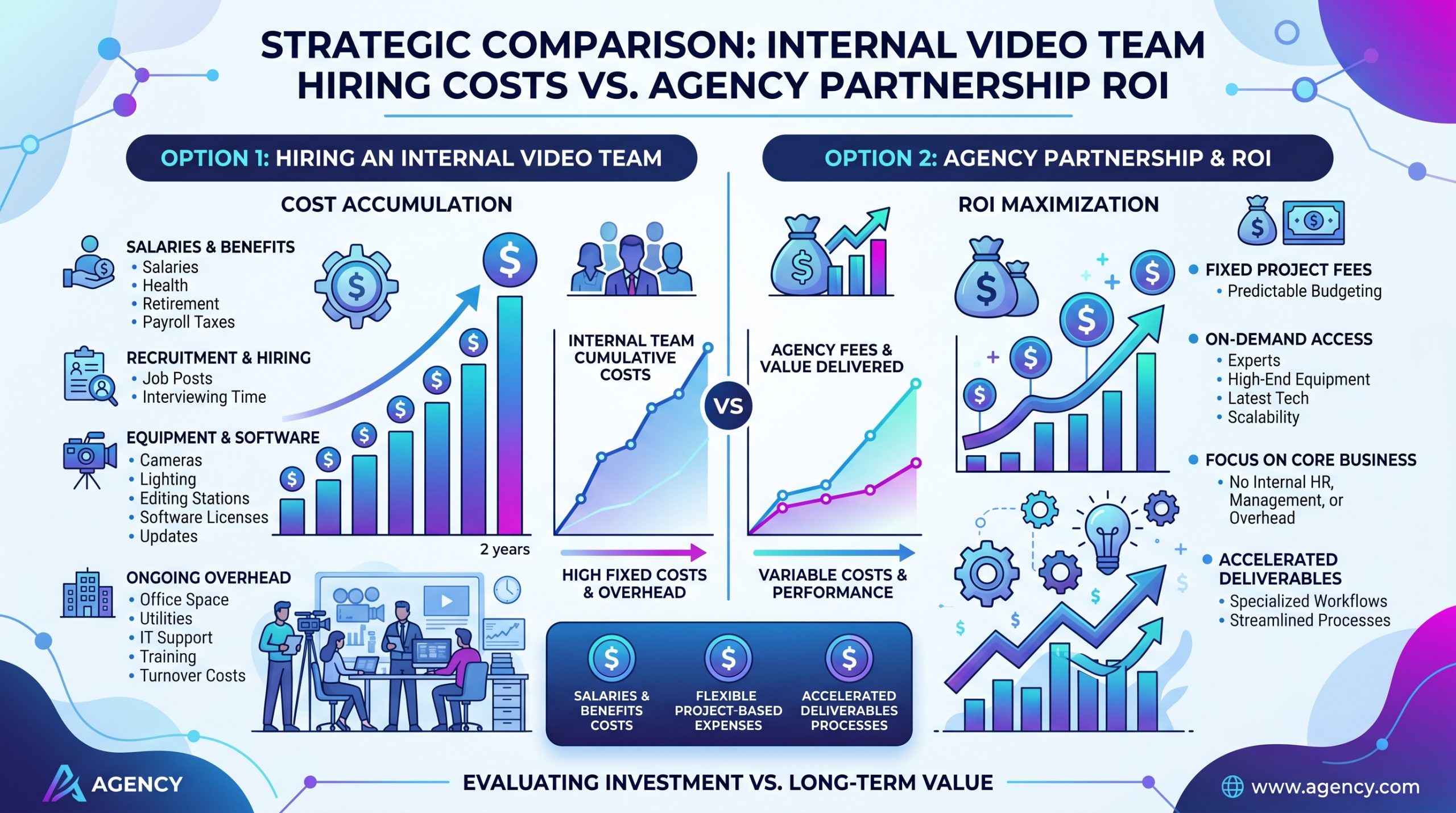
Building an Internal Video Team

The minimum viable internal video team for enterprise-quality output requires three roles: a video editor, a motion graphics designer, and a project coordinator or producer. Many organizations also need a colorist, a sound designer, and a creative director — but let’s model the lean version first.

Cost Category Annual Cost (US Market) Notes
Senior Video Editor Salary $65,000 – $95,000 Mid-to-senior level, 5+ years experience
Motion Graphics Designer Salary $60,000 – $90,000 After Effects, Cinema 4D proficiency
Project Coordinator Salary $45,000 – $65,000 Part-time or shared role possible
Benefits & Taxes (30%) $51,000 – $75,000 Healthcare, 401k, payroll taxes, PTO
Software Licenses $5,000 – $12,000 Adobe CC, DaVinci, stock subscriptions
Hardware $8,000 – $25,000 (Y1) Workstations, monitors, storage (amortized over 3 years)
Training & Development $2,000 – $5,000 Courses, conferences, skill upgrades
Management Overhead $15,000 – $40,000 Director/VP time spent on video operations
Recruitment Cost (Y1) $15,000 – $45,000 Recruiter fees, job postings, interview time
Total Year 1 $266,000 – $452,000 For a 3-person lean team
Total Year 2+ (Ongoing) $243,000 – $382,000 Minus recruitment, amortized hardware

And this lean team produces, at capacity, approximately 8–15 videos per month depending on complexity. That ceiling is structural — it moves only by adding more people, which restarts the hiring cycle.

Enterprise Agency Partnership

Cost Category Annual Cost Notes
Monthly Retainer (8–15 videos) $60,000 – $180,000 $5,000 – $15,000/month, volume-adjusted
Premium/Complex Projects (6–12/year) $12,000 – $60,000 Brand films, launch videos, animated explainers
Rush/Overflow Projects $5,000 – $15,000 Unplanned projects outside retainer scope
Internal Coordination Time $5,000 – $12,000 Briefing, reviews, approvals (minimal with agency PM)
Total Annual Cost $82,000 – $267,000 Comparable output to internal 3-person team

For equivalent output (8–15 videos/month), the agency model costs 35–55% less than building an internal team in Year 1, and 20–40% less on an ongoing annual basis. The savings compound when you factor in what the numbers above don’t capture: zero recruitment delays, zero HR burden, zero risk of turnover resetting your production capability.

The Decision Matrix

Factor Build Internal Agency Partnership
Year 1 Total Cost $266K – $452K $82K – $267K
Time to Full Capacity 3 – 6 months 1 – 2 weeks
Monthly Output Ceiling 8 – 15 videos (fixed) Scales on demand
Specialist Access Limited to hires Full team (20+ at Increditors)
Turnover Risk High (industry avg 18–24 months) None (team-based continuity)
Scaling Up Requires new hires (months) Adjusts within current billing cycle
Scaling Down Layoffs or idle salary Reduce retainer scope
Timezone Coverage Single timezone Multi-zone (US/UK/UAE)
Quality Control Self-managed Built-in QC process
Brand Immersion Deep (daily exposure) Strong (dedicated account team)
Executive Takeaway
Building internally makes sense only when you need 20+ videos per month AND require deep daily brand immersion that an agency cannot replicate. For most enterprise teams producing 8–20 videos monthly, agency partnership delivers equivalent output at 30–50% lower cost with zero ramp-up time.

The Hidden Costs of Building Internal Video Teams

The salary line items in Section 2 are the visible costs. The invisible ones are what make the build path significantly more expensive than most CFOs initially project.

Recruitment Drag

Finding a qualified senior video editor with enterprise experience takes 3–6 months in the current market. LinkedIn’s 2025 Talent Insights report shows that video production roles have a 23% longer time-to-fill than general marketing positions. During that window, your video output is either zero or handled by someone who isn’t specialized — both outcomes cost you. Factor in recruiter fees (typically 20–25% of first-year salary) and the internal time spent reviewing portfolios, conducting interviews, and negotiating offers, and recruitment alone adds $15,000–$45,000 per hire.

The Turnover Cycle

Creative professionals in post-production have among the highest turnover rates in marketing. The average tenure for a mid-level video editor at a non-media company is 18–24 months. When your editor leaves, you lose institutional knowledge about brand preferences, stakeholder quirks, and project history. You restart the 3–6 month recruitment cycle. And you lose production capacity during the gap. The fully loaded cost of a single turnover event — recruitment, onboarding, lost productivity, knowledge transfer — runs $40,000–$80,000 for a mid-senior role.

Skill Gaps

A single video editor, no matter how talented, is a generalist by necessity. Enterprise video demands are varied: motion graphics for product demos, cinematic color grading for brand films, sound design for training content, 3D animation for technical explainers, and rapid-fire social cuts for campaign content. No individual excels at all of these. Hiring specialists for each discipline creates the cost structure of a small production studio — $400K–$700K annually for a 5-person team — which is hard to justify unless video production is your core business.

An agency like Increditors maintains a team of 20+ specialists across editing, motion graphics, color, sound, and creative direction. Enterprise clients access the full roster without funding the full payroll.

Equipment and Infrastructure

Professional editing workstations capable of handling 4K+ footage, multi-layer motion graphics, and render-intensive workflows cost $5,000–$15,000 per seat. Add high-end monitors ($1,500–$4,000), external storage and backup systems ($2,000–$8,000), and you’re looking at $10,000–$25,000 per editor in hardware. This equipment depreciates and needs replacement every 3–4 years. Software licenses (Adobe Creative Cloud, DaVinci Resolve Studio, Cinema 4D, stock media subscriptions) add $2,000–$5,000 per person annually.

Management Overhead

Internal teams don’t manage themselves. Someone — usually a Marketing Director or Content Lead — must allocate projects, review timelines, provide creative feedback, manage revisions, and handle the interpersonal dynamics of a creative team. At enterprise organizations, this overhead absorbs 10–20 hours per week of senior leadership time. At a fully loaded cost of $100–$200/hour for director-level talent, that’s $50,000–$200,000 annually in implied management cost that never appears on the video production budget.

Executive Takeaway
When you add recruitment drag, turnover cycles, skill gaps, equipment, and management overhead to base salaries, the true cost of a 3-person internal video team is 40–60% higher than the salary line items suggest. Budget $350K–$650K annually for a fully functional, self-sustaining internal production unit.

The Agency Partnership Model for Enterprise

The agency model works for enterprise not because agencies are cheaper per hour — they’re often not. It works because agencies absorb the infrastructure, management, and risk that enterprises would otherwise have to build and maintain internally. You’re buying an outcome (finished videos at defined quality and timeline) rather than building a capability (hiring, equipping, and managing a creative team).

What Enterprise-Grade Agency Service Looks Like

Not all agencies operate at enterprise standard. Consumer-focused editing shops and freelancer collectives lack the processes, reliability, and communication rigor that enterprise clients require. Here’s what separates enterprise-grade service from the rest.

Dedicated account management. Your point of contact understands your brand, your stakeholders, and your approval workflows. They don’t ask the same briefing questions every project. At Increditors, enterprise clients have a named account manager backed by a project coordinator — you brief once, and the machine runs.

Multi-specialist team access. When your project needs motion graphics, you get a motion graphics specialist. When it needs color grading, you get a colorist. When it needs sound design, you get a sound designer. A team of 20+ specialists means the right person handles the right task every time — unlike an internal generalist who handles everything adequately but nothing exceptionally.

Guaranteed turnaround times. Enterprise campaigns don’t wait. Agency SLAs with defined turnaround windows (48-hour for standard edits, 24-hour for rush) create predictability that internal teams — subject to PTO, illness, and workload spikes — cannot match. Backup resources ensure that delivery happens regardless of individual availability.

Quality control systems. Every deliverable passes through a review process before reaching the client. This catches errors, inconsistencies, and quality dips that an overburdened internal editor might miss. QC adds a layer of reliability that protects your brand reputation.

Timezone coverage. With offices in the US, UK, and UAE, Increditors provides around-the-clock production capability. Your feedback submitted at 6 PM New York is actioned overnight and waiting in your inbox by morning. This effectively doubles your production velocity compared to a same-timezone internal team.

Compliance-ready workflows. Enterprise video content often requires legal review, executive approval, and brand compliance sign-off. An experienced agency builds these gates into the production timeline rather than treating them as afterthoughts. Revisions route through structured approval chains rather than ad-hoc email threads.

How Enterprise Pricing Works

Enterprise agency pricing is typically structured as a monthly retainer with flex capacity. You commit to a base volume (e.g., 10 videos/month) at a locked rate. Overflow projects beyond the retainer are billed at a pre-agreed per-project rate. This model gives budget predictability while maintaining the ability to surge for launches, campaigns, and seasonal peaks.

Retainers at Increditors’ enterprise tier start at $5,000–$15,000/month depending on volume, complexity, and specialist requirements. Annual contracts typically receive a 10–15% rate reduction. The result: predictable monthly costs with no hidden fees for project management, QC, or standard revisions.

Executive Takeaway
The agency model converts fixed headcount costs into variable production costs. You pay for output, not overhead. Scale up for a product launch, scale down during a quiet quarter — without touching your org chart.

Evaluating Whether to Build or Partner?

Our enterprise team will walk you through a cost comparison modeled on your specific volume, content types, and growth plans. No generic pitch — just the numbers that matter for your decision.

Book an Enterprise Strategy Call →

30 minutes · Tailored cost model · No commitment

Enterprise Case Studies

Case Study 1: TuMeke Ergonomics — B2B SaaS Scaling from 3 to 12 Videos/Month

TuMeke Ergonomics develops AI-powered workplace safety software for enterprise clients. As a B2B SaaS company selling into HR, safety, and operations departments, their sales cycle is long, technical, and multi-stakeholder. Video was identified as the highest-impact medium for compressing that cycle — but their internal team of one part-time editor could produce only 3 basic videos per month.

The Challenge

TuMeke needed to quadruple output without quadrupling cost. Their content roadmap required product walkthroughs, customer testimonial edits, animated explainers for complex ergonomic concepts, trade show reels, and social media cuts across LinkedIn and YouTube. One editor couldn’t handle the variety or the volume.

The Engagement

Increditors deployed a dedicated 3-person pod: a lead editor familiar with SaaS product content, a motion designer for technical animations, and an account coordinator who integrated directly into TuMeke’s Slack workspace and sprint cadence. Turnaround was standardized at 72 hours for standard edits, 5 business days for animated content.

The Results

Within 60 days of launch, TuMeke was producing 12 videos per month — a 4x increase in output. Internal management time dropped from 15 hours/week to 4 hours/week because the agency handled project coordination, revision routing, and quality control. Most significantly, TuMeke measured a 31% uplift in brand awareness through direct survey data within two quarters of launching the expanded video library. Their sales team reported that prospects arrived to demo calls better educated, asking deeper questions, and converting at a higher rate because the video content had already done the explanatory heavy lifting.

Cost comparison: Hiring two additional internal specialists would have cost TuMeke approximately $180,000–$250,000/year (salaries + equipment + management). The agency partnership delivered the same output for approximately $96,000–$144,000/year — a 40–45% cost savings with zero recruitment delay.

Case Study 2: eSafetyFirst — Enterprise Cybersecurity Education at Scale

eSafetyFirst operates in a fiercely competitive market: cybersecurity awareness training for enterprise organizations. Dozens of vendors compete for the same audience with similar messaging. Their challenge was not content creation — they had deep subject matter expertise and no shortage of material. The challenge was producing video content with enough polish and visual differentiation to stand apart from commodity competitors who relied on screen recordings and stock footage.

The Challenge

eSafetyFirst needed branded educational videos that established authority, custom graphics that simplified complex cybersecurity concepts, SEO-optimized thumbnails that won clicks, and the capacity to publish 6–8 videos monthly across multiple topics and audience segments. Their previous approach — a rotating cast of freelancers — resulted in inconsistent quality, missed deadlines, and a brand voice that shifted from video to video.

The Engagement

Increditors assigned a consistent editing team that learned eSafetyFirst’s brand language, visual style, and audience expectations. Custom motion graphic templates were developed once and reused across the series — maintaining brand consistency while reducing per-video production time. A dedicated thumbnail designer optimized every video for click-through rates with tested design patterns.

The Results

eSafetyFirst’s videos began ranking consistently on the first page of search results for their target keywords, driving organic traffic that reduced paid acquisition costs by a measurable margin. The visual production quality created a competitive moat — competitors could not replicate the look and feel without investing in a similar production partnership. Audience engagement metrics (average watch time, completion rates, subscriber conversion) improved across the board.

Operational impact: The eSafetyFirst content team reclaimed approximately 20 hours per week that had previously been spent managing freelancers, chasing deliverables, and reviewing inconsistent outputs. That time was redirected to content strategy, keyword research, and audience development — higher-value activities that compounded returns over time.

Executive Takeaway
Both case studies share a pattern: the agency partnership didn’t just reduce cost — it expanded capability. TuMeke went from 3 to 12 videos/month. eSafetyFirst went from inconsistent freelancer output to a branded content machine that drives organic growth. The ROI extends well beyond the production line item.

Process and Reliability Framework for Enterprise Clients

Enterprise organizations don’t fail at video production because of creative talent. They fail because of process — or the absence of it. A reliable production framework turns video from a chaotic, ad-hoc activity into a predictable operational function.

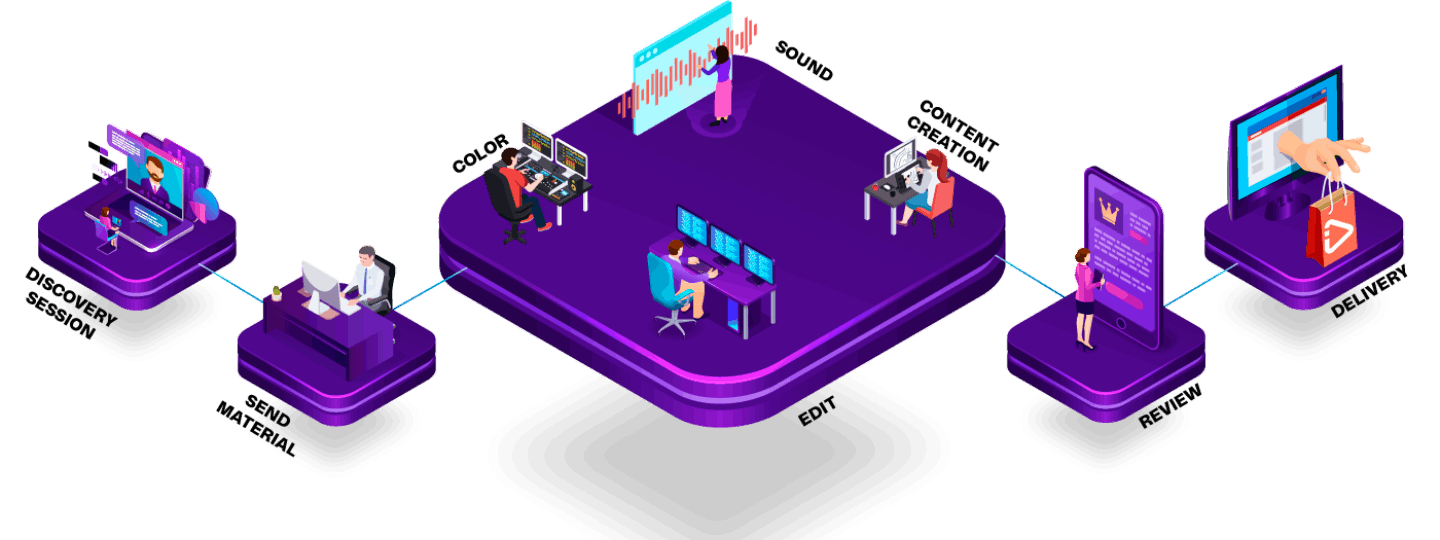
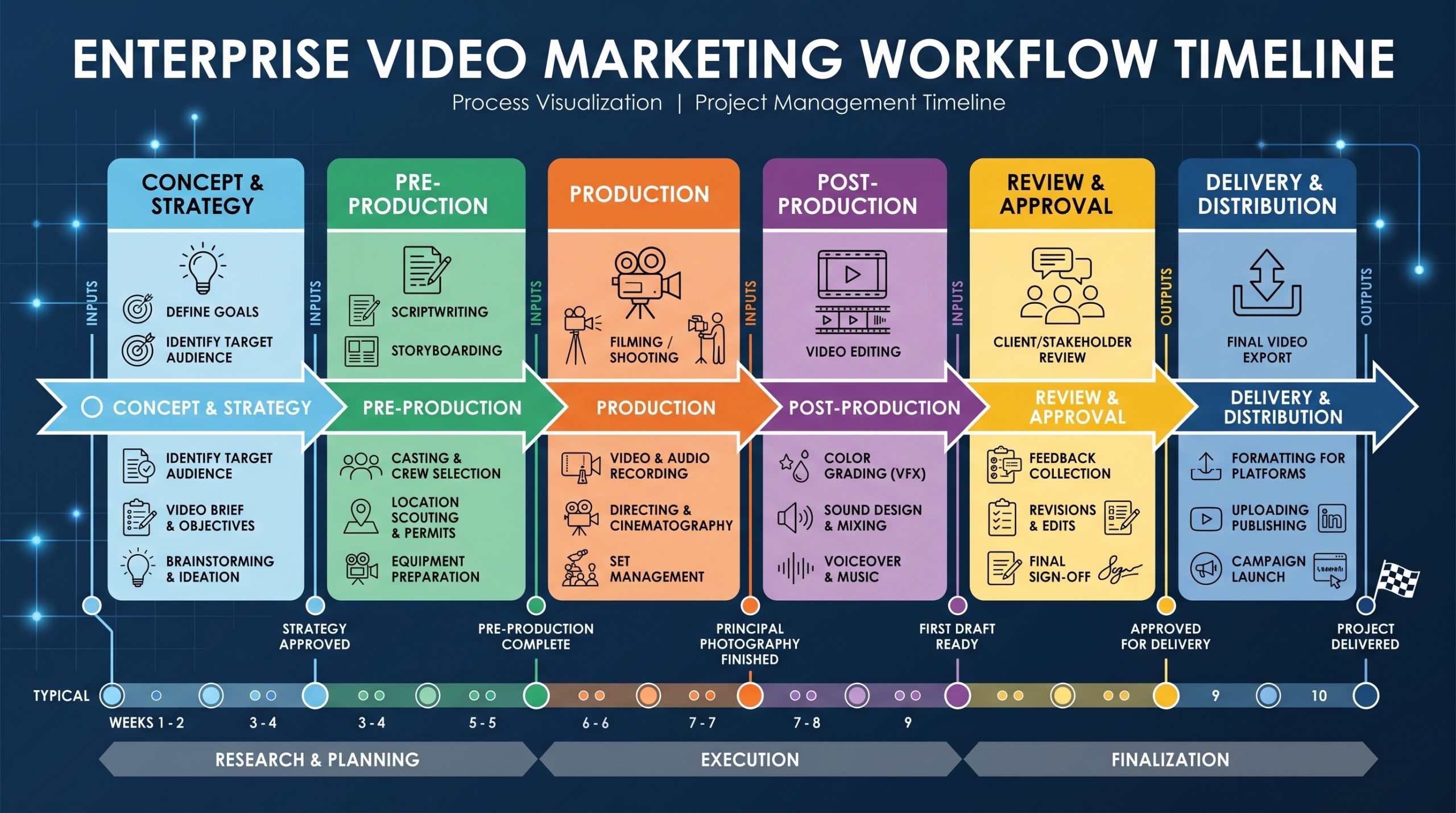
The Five-Stage Enterprise Production Process

Stage 1: Strategic Briefing. Every project begins with a structured brief that captures objectives, audience, key messages, visual references, and approval requirements. At Increditors, enterprise briefs follow a standardized template that eliminates ambiguity and reduces revision cycles by 40–60% compared to unstructured email-based briefing.

Stage 2: Pre-Production Planning. The account team confirms timeline, assigns specialists based on project requirements, identifies any assets needed (stock footage, music, existing brand elements), and maps the approval chain. Enterprise clients with compliance requirements get a documented approval workflow before editing begins.

Stage 3: Production and Edit. The editing team builds the first cut according to the brief. Internal QC reviews the cut for technical standards (color accuracy, audio levels, format specs) and brand consistency before the client ever sees it. This catches 90%+ of issues before they reach stakeholder review.

Stage 4: Client Review and Revision. Structured feedback rounds (typically 2–3 included) with consolidated notes from all stakeholders submitted through a single channel. This prevents the revision chaos of multiple people sending contradictory feedback through separate emails.

Stage 5: Delivery and Distribution. Final files delivered in all required formats (16:9, 9:16, 1:1, 4:5), platform-optimized for YouTube, LinkedIn, Instagram, internal LMS, and any other channels specified. Thumbnails, captions, and metadata included as standard.

Enterprise SLA Standards

Deliverable Type Standard Turnaround Rush Turnaround Included Revisions
Standard Edit (5–15 min) 3 – 5 business days 24 – 48 hours 2 rounds
Short-Form (under 60 sec) 2 – 3 business days 12 – 24 hours 2 rounds
Motion Graphics / Animation 5 – 10 business days 3 – 5 business days 3 rounds
Brand Film / Premium 10 – 15 business days 5 – 7 business days 3 rounds
Multi-Format Recut 1 – 2 business days Same day 1 round
Executive Takeaway
Process is what makes video production predictable at scale. Without it, every project is a unique adventure with unique risks. With it, video becomes an operational function that marketing leaders can plan around with confidence.

18 Strategies for Scaling Enterprise Video Production
  1. Centralize your creative brief template. One standardized brief format across all teams and stakeholders eliminates the ambiguity that causes expensive revision loops. Make it mandatory — no brief, no project kickoff.
  2. Separate “hero” content from “hygiene” content. Brand films and flagship campaigns deserve premium treatment. Weekly social clips and internal updates can be produced at a faster, leaner tier. Applying the same process to both wastes budget on the latter and under-serves the former.
  3. Batch similar content types. Editing 8 talking-head videos in one batch is 30–40% more efficient than editing them individually across a month. Group similar formats, styles, and templates to maximize throughput.
  4. Build a reusable asset library. Branded intros, outros, lower thirds, transition templates, music beds, and icon sets — create them once and deploy them across hundreds of videos. The upfront investment ($500–$2,000) saves $50–$200 per video in perpetuity.
  5. Establish a feedback protocol. All stakeholder notes consolidated into a single document per revision round. No phone calls that contradict written feedback. No “just one more small thing” outside the formal process. Structured feedback cuts revision cycles by half.
  6. Use an agency with timezone coverage. When your US team submits feedback at 5 PM EST and the edit is revised overnight by a team in the UK or UAE, you gain a full business day on every turnaround cycle. Over a month of projects, this advantage compounds to 5–10 extra production days.
  7. Invest in quality source material. Good lighting, clean audio, and well-framed shots reduce post-production time by 20–40%. A $500 investment in better microphones and lighting saves thousands annually in editing corrections.
  8. Implement approval automation. Use project management tools (Frame.io, Wipster, or even a structured Notion workflow) to route approvals. Manual email chains add 1–3 days to every review cycle.
  9. Repurpose strategically. A single 20-minute YouTube video can yield 8–12 short-form clips, an audio podcast episode, blog pull quotes, social graphics, and email newsletter content. Plan repurposing before production, not after — it changes how you shoot and edit.
  10. Negotiate annual commitments. Agency retainers with 12-month terms typically come with 10–15% rate reductions. If you know you’ll need video every month (and if you’re reading this guide, you do), lock in the annual rate.
  11. Create a content calendar aligned to production capacity. Don’t plan 30 videos in a month when your production pipeline handles 15. Align marketing ambitions with actual throughput — then scale the pipeline, then expand the calendar.
  12. Pre-edit with AI tools. Use auto-transcription (Descript, Otter), silence removal (CapCut), and rough assembly tools to reduce raw-to-first-cut time. Your human editor then focuses on craft, pacing, and storytelling — the parts that AI still cannot do well.
  13. Standardize your video formats. If 80% of your content follows 3–4 formats (talking head, product demo, customer story, social clip), templatize those formats. Templates reduce briefing time, editing time, and review time simultaneously.
  14. Track production metrics. Brief-to-delivery time, revision count per project, cost per video by type, and stakeholder satisfaction scores. What gets measured gets managed. Identify bottlenecks and eliminate them monthly.
  15. Designate a single point of contact. Internally, one person owns the relationship with the production partner. Not five people sending separate emails. One voice, one priority list, one feedback channel. This alone reduces project cycle times by 25–35%.
  16. Run quarterly production reviews. Sit down with your agency partner every quarter to review output quality, process efficiency, cost trends, and upcoming needs. Proactive planning prevents reactive scrambling.
  17. Build a testing framework for video content. A/B test thumbnails, intros, CTAs, and video lengths. Use performance data to inform production decisions — not opinions. Let your audience tell you what works, then double down on those formats.
  18. Plan for surge capacity. Product launches, rebrand rollouts, and event seasons require 2–3x normal output. Build surge capacity into your agency contract (pre-agreed overflow rates and priority scheduling) rather than scrambling when the moment arrives.
Executive Takeaway
Scaling video production is an operational discipline, not a creative one. Templates, batching, feedback protocols, and production metrics turn video from an unpredictable creative process into a reliable marketing function.

ROI Analysis and Cost-Benefit Breakdown

Enterprise video investment should be evaluated the same way you evaluate any marketing channel: by the measurable business outcomes it generates relative to its cost.

Direct Revenue Impact

At Increditors, our enterprise clients have collectively generated over $50 million in attributable revenue from video content over the past 6 years. That number spans course sales, SaaS subscriptions, product revenue, and service contracts that were directly influenced by video touchpoints in the buyer journey.

The mechanism is straightforward: video content educates prospects before they enter the sales funnel, reduces time-to-close by pre-answering objections, and increases conversion rates by building trust through visual proof (demos, testimonials, case studies). HubSpot’s 2025 data shows that landing pages with video convert at 86% higher rates than those without. For enterprise deals averaging $50K–$500K, even a modest improvement in conversion rate translates to significant revenue impact.

Indirect Value Drivers

Reduced customer acquisition cost. Video content that ranks organically for target keywords drives inbound traffic without paid media spend. eSafetyFirst’s first-page rankings for competitive cybersecurity terms generate traffic that would cost $30,000–$80,000/year to replicate through paid search. The video investment pays for itself through CAC reduction alone.

Compressed sales cycles. TuMeke’s experience is typical: prospects who consume video content before their first sales call require 30–40% fewer touchpoints to close. For enterprise sales teams handling 50–100 active opportunities, that compression frees up capacity equivalent to 1–2 additional sales reps — without the hiring cost.

Brand equity and competitive differentiation. In commoditized B2B markets, production quality becomes a trust signal. A brand that produces polished, authoritative video content is perceived as more established, more credible, and more invested in its market than a competitor relying on text-based content and stock images. This perception gap influences vendor selection even when product capabilities are comparable.

Internal efficiency gains. Training videos reduce onboarding time. Product update videos reduce support tickets. Process documentation videos reduce operational errors. These internal applications rarely make the marketing budget but generate measurable ROI through operational efficiency.

Enterprise ROI Model

Metric Conservative Estimate Moderate Estimate Aggressive Estimate
Annual Video Investment $100,000 $150,000 $250,000
Videos Produced/Year 80 – 120 120 – 180 200 – 300
Organic Traffic Value $25,000 $60,000 $120,000
Pipeline Influenced $500,000 $1,200,000 $3,000,000
Revenue Attributed to Video $200,000 $500,000 $1,500,000
Internal Efficiency Savings $15,000 $40,000 $100,000
Estimated ROI 140 – 240% 300 – 400% 500 – 700%
Executive Takeaway
Enterprise video production generates returns across revenue, acquisition cost, sales efficiency, and brand equity. The investment case strengthens with scale — more content creates more organic reach, more pipeline influence, and more internal efficiency. The question isn’t whether to invest; it’s how fast to scale.

Enterprise FAQ

How quickly can an agency partnership reach full production capacity?

Typically 1–2 weeks from contract signing. The onboarding phase covers brand immersion (reviewing existing content, style guides, and stakeholder preferences), setting up communication channels, and processing the first project brief. By week two, most enterprise engagements are operating at target volume. Compare this to 3–6 months for an internal hire to reach equivalent productivity.

How do we maintain brand consistency when working with an external team?

Through three mechanisms: a documented brand playbook (we create one if you don’t have it), a dedicated account team that learns your brand deeply over time, and an internal QC process that checks every deliverable against brand standards before it reaches you. Enterprise clients at Increditors also receive quarterly brand consistency audits to catch any drift.

What happens if our needs spike unexpectedly — can you handle a 3x surge?

Yes, and this is one of the primary advantages of the agency model. Our team of 20+ specialists provides surge capacity that a 2–3 person internal team cannot match. Enterprise contracts include pre-agreed overflow terms so there are no pricing surprises when volume spikes. Product launches, rebrands, and event seasons are handled within existing workflows.

How do you handle compliance and legal review requirements?

We build approval gates into the production timeline. Legal review, executive sign-off, and compliance checks are scheduled as defined milestones — not afterthoughts. We route review copies to designated approvers with clear deadlines and structured feedback forms. For regulated industries (finance, healthcare, government), we can accommodate additional review layers without disrupting the production schedule.

What’s the minimum commitment for an enterprise engagement?

Enterprise retainers typically start at $5,000/month with a 3-month minimum commitment. Annual contracts offer better rates (10–15% reduction). We recommend starting with a 3-month pilot to validate fit, process, and output quality before committing to an annual agreement. Visit our pricing page for detailed enterprise tier information.

Can you integrate with our existing tools and workflows?

Absolutely. We integrate with whatever project management, communication, and file-sharing tools your organization uses — Slack, Teams, Asana, Monday.com, Notion, Frame.io, Google Drive, Dropbox, and more. Our account team adapts to your workflow, not the other way around. Enterprise clients also receive access to a dedicated project portal for centralized brief submission, review tracking, and asset management.

How do you protect our proprietary content and intellectual property?

All enterprise engagements include NDAs and work-for-hire agreements. Your content, source files, and brand assets remain your property. We maintain strict access controls on project files, and team members working on your account are bound by confidentiality terms. We’re happy to review and sign your organization’s standard vendor agreements as well.

What makes Increditors different from other video editing agencies?

Three things. First, scale and specialization: a team of 20+ dedicated specialists across editing, motion, color, and sound — not a small shop that outsources half the work. Second, global presence: offices in the US, UK, and UAE providing enterprise-grade timezone coverage and market understanding. Third, track record: 1,700+ projects, 300+ million views generated, $50 million+ in client revenue attributed to our content. We work with brands like Netflix and Unilever alongside high-growth companies. See the portfolio for examples across industries.

Ready to Scale Your Video Production?

Book a 30-minute enterprise strategy call. We’ll model the cost comparison for your specific volume, audit your current production workflow, and map out a scaling plan that delivers more content at lower cost — without adding headcount.

Schedule Your Enterprise Strategy Call →

No pitch deck · No generic proposals · Just the numbers for your business

Image Generation Prompts

  1. Enterprise boardroom strategy: Modern glass-walled conference room, marketing team of 4-5 professionals reviewing video content on a large wall-mounted display showing an editing timeline, minimalist corporate interior, warm overhead lighting, photorealistic, 16:9 aspect ratio, enterprise SaaS aesthetic.
  2. Cost comparison infographic: Clean split-screen infographic: left panel labeled “Internal Team” with stacked cost blocks ($150K salary, $50K benefits, $25K equipment, $40K management) in red/gray tones, right panel labeled “Agency Partnership” with a single compact block ($82K–$267K total) in green/purple. White background, sans-serif typography, editorial data visualization style.
  3. Production team at work: Professional video post-production studio, team of 3-4 specialists at editing workstations with dual ultrawide monitors showing color grading panels and motion graphics timelines, ambient purple LED backlighting, modern creative workspace, cinematic photography style, 16:9.
  4. Scaling metrics visualization: Abstract 3D data visualization showing upward-trending production volume bars (3→12 videos/month) alongside descending cost-per-video line, dark charcoal background, purple and lime accent colors, floating data labels, futuristic enterprise dashboard aesthetic, 16:9.
  5. Enterprise performance dashboard: Sleek marketing analytics dashboard UI on a large monitor, showing video KPIs: views (300M+), revenue ($50M+), projects (1,700+), with line charts trending upward, dark mode interface, purple (#6f00ff) accent highlights, clean data visualization, enterprise software aesthetic, 16:9.

© 2026 Increditors — #1 Video Editing Services for Brands & Businesses
US · UK · UAE  |  20+ Specialists  |  1,700+ Projects  |  Clients include Netflix, Unilever, TuMeke, eSafetyFirst