








![3D Explainer Video - ScribbleLive.mp4_snapshot_00.12_[2022.03.09_03.14.16]](https://increditors.com/wp-content/uploads/elementor/thumbs/3D-Explainer-Video-ScribbleLive.mp4_snapshot_00.12_2022.03.09_03.14.16-r7wb53mx72rxst3qcqyrfxdmeyzb5r9jbl0wbjujh4.png "3D Explainer Video – ScribbleLive.mp4_snapshot_00.12_[2022.03.09_03.14.16]")

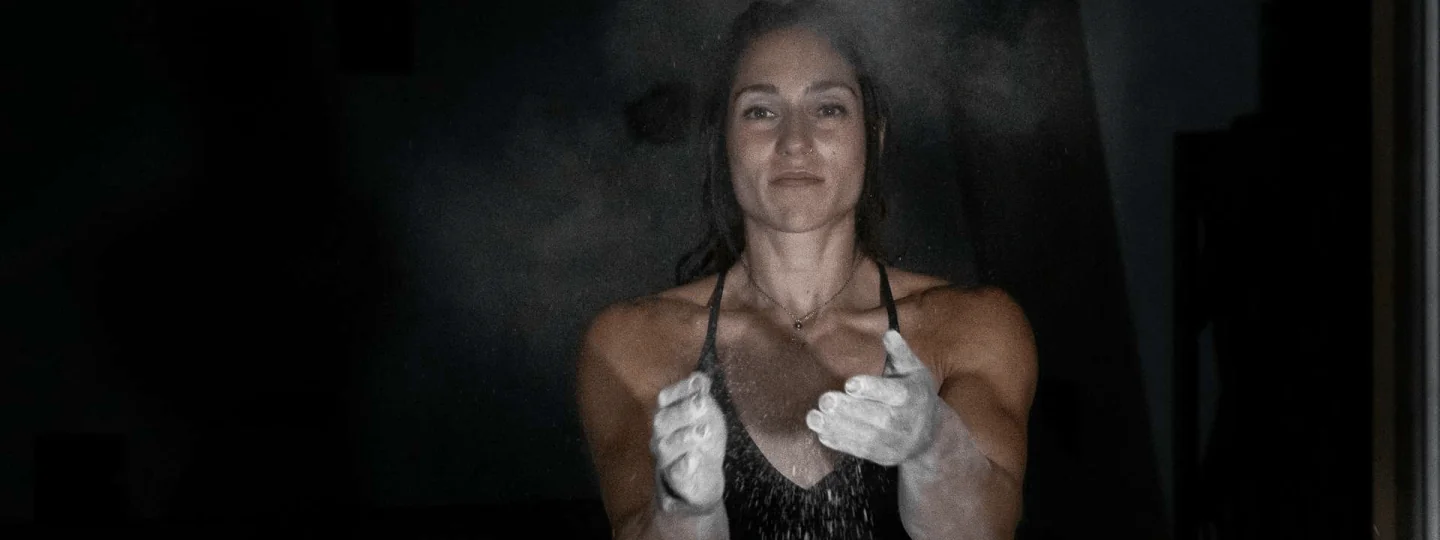
























Music video editing is a completely different discipline from YouTube editing, corporate video production, or social media content. The cuts sync to beats. The color grading sets the mood for an entire song. The VFX aren’t decorative — they’re part of the storytelling.
Yet most artists approach music video editing the same way they’d hire someone to cut a vlog: post on Fiverr, pick the cheapest option, and hope for the best. The result is usually a video that looks like it was edited by someone who’s never felt a song in their bones.
We’ve edited music videos across genres — hip-hop, indie, electronic, pop, R&B — through our music video editing service. We’ve also seen the full spectrum of what artists spend, from $200 lyric videos to $15,000+ concept-driven productions. This guide breaks down exactly what music video editing costs, what different styles require, and how to find an editor who actually understands the art form.
What’s in This Guide
- Why Music Video Editing Is Different
- Music Video Editing Styles Explained
- How Much Does Music Video Editing Costa
- What Drives the Price Up (or Down)
- Freelancer vs Agency for Music Videos
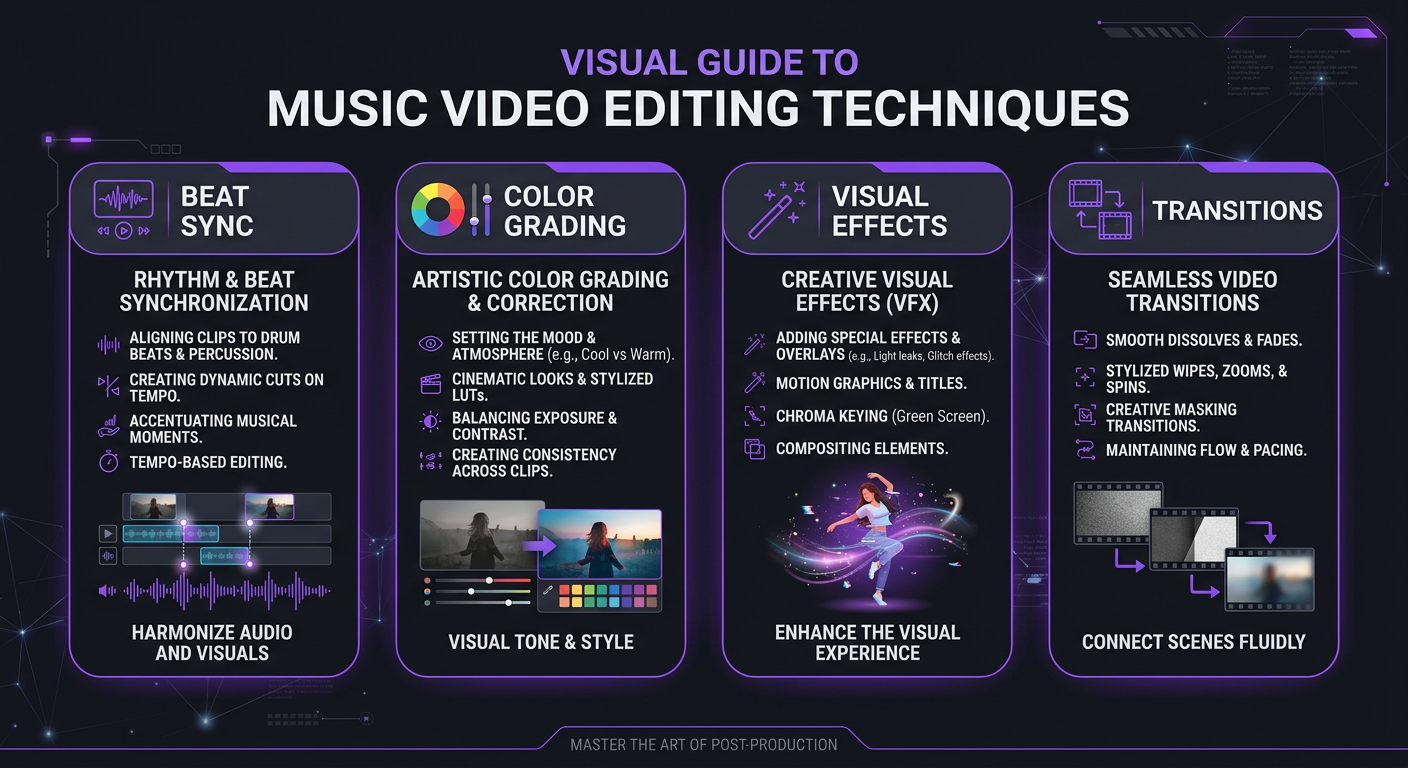
- VFX & Motion Graphics in Music Videos
- Color Grading: The Secret Weapon
- The Music Video Editing Workflow
- How to Hire the Right Music Video Editor
- 5 Mistakes Artists Make With Music Video Editing
- FAQ
Why Music Video Editing Is Fundamentally Different
If you’ve ever watched a music video and felt the visual rhythm of the cuts matching the drums, the slow-motion landing precisely on a lyrical climax, or the color shift that mirrors the emotional turn in a bridge — that’s not accidental. That’s a music video editor who understands musical structure.
Regular video editing is story-driven. You cut to advance narrative, maintain pacing, or hold attention. Music video editing is rhythm-driven. Every edit decision starts with the audio:
- Beat-matching: Cuts land on beats, kicks, or snare hits. The edit grid is the song structure, not a script.
- Energy mapping: Verses feel different from choruses. The editing pace, effects intensity, and visual density need to reflect those shifts.
- Lip-sync precision: Performance footage must align frame-perfectly with the audio. Sloppy sync is immediately noticeable and instantly cheap-looking.
- Emotional arc: A 3.5-minute song has a narrative — build, peak, release. The visual editing mirrors that arc through pacing, color temperature, and composition choices.
- Repetition with variation: Choruses repeat, and the editor must decide: same visuals Different angle Build in intensity Each repetition is a creative decision.
This is why a YouTube editor who’s great at jump cuts and retention hooks isn’t automatically qualified for music video work. The skill sets overlap — both need technical proficiency in Premiere or Resolve — but the creative instincts are entirely different.
Music Video Editing Styles: What’s Possible at Every Level
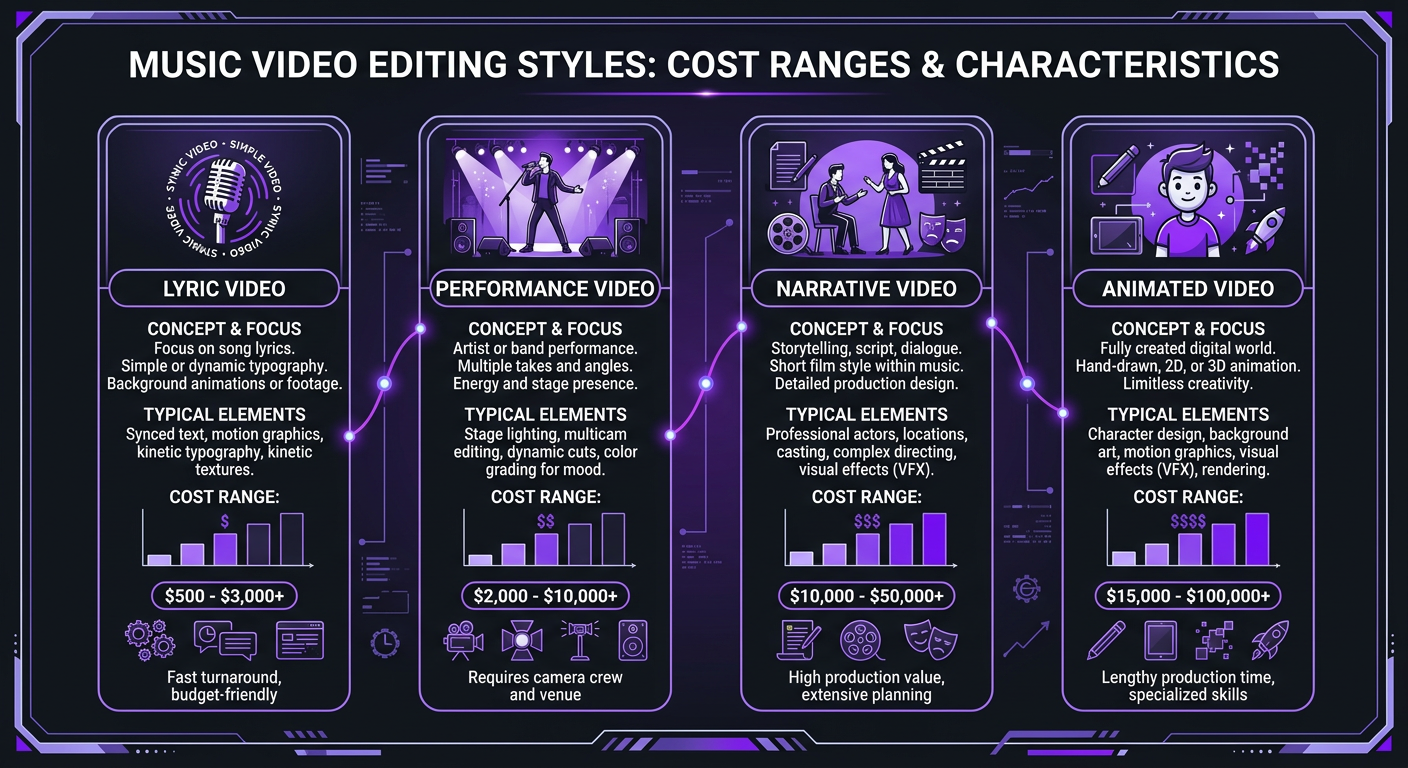
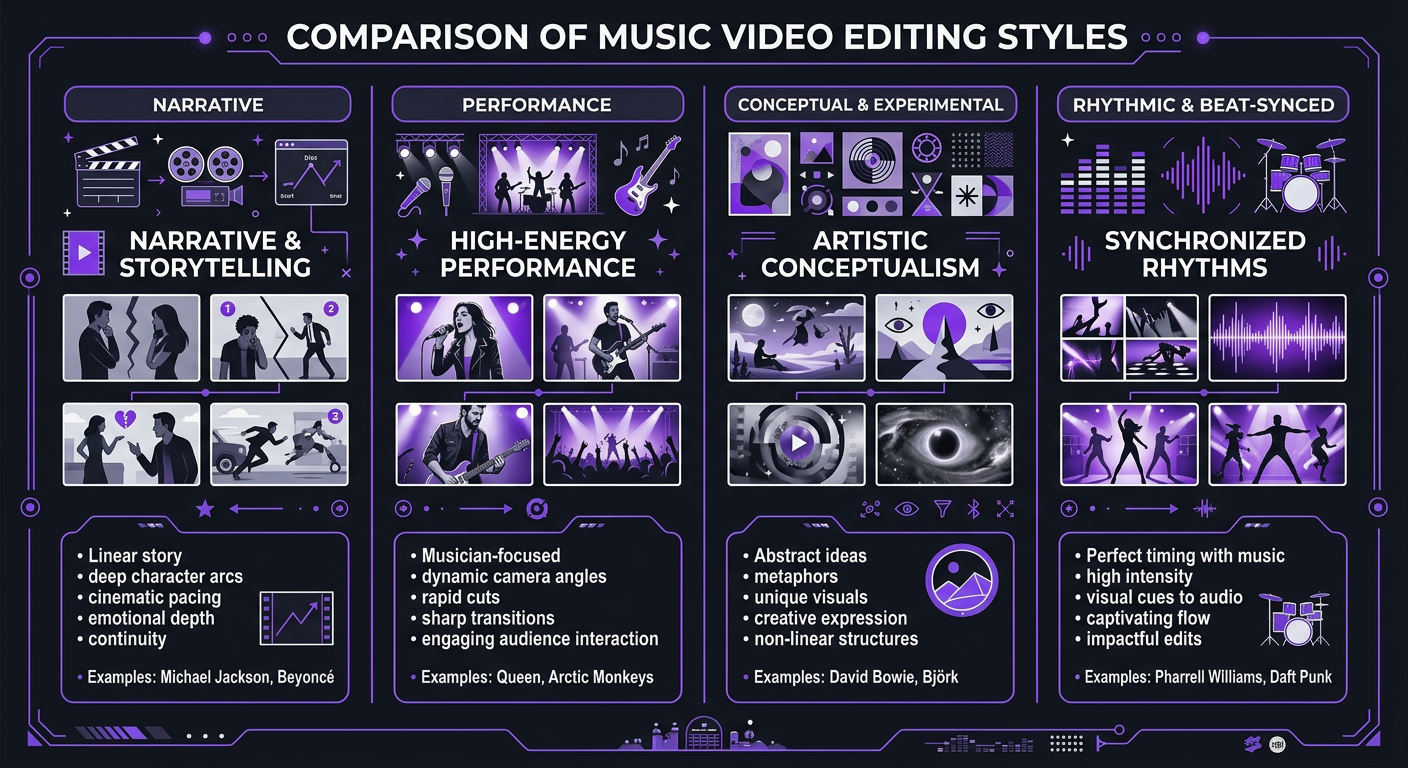
Music video styles vary enormously, and the editing approach changes with each. Understanding what style you’re going for determines your budget, timeline, and the type of editor you need.
Performance Videos
The artist performs the song — on a stage, in a studio, on a rooftop, wherever. The edit focuses on energy, angle variety, and lip-sync precision. This is the most common and accessible format.
Editing complexity: Low to medium. Multi-camera sync, beat-matched cuts, basic color grading. If you shot with 2-3 cameras, the editor has enough coverage to create dynamic pacing without needing B-roll or effects.
Typical cost: $500–$1,500
Narrative / Concept Videos
There’s a story being told alongside (or instead of) the performance. Think mini-films — characters, locations, plot arcs. The editor acts more like a film editor, balancing narrative with musical rhythm.
Editing complexity: Medium to high. Scene transitions, continuity management, potentially dialogue integration, pacing that serves both story and song. Color grading becomes crucial for establishing mood across different scenes.
Typical cost: $1,500–$5,000+
VFX-Driven / Experimental
Heavy visual effects, animation overlays, compositing, green screen work, surreal imagery. Think Travis Scott, Billie Eilish, or any video where reality bends. These require not just an editor but a VFX artist or a team with compositing skills.
Editing complexity: High to extreme. VFX integration, rotoscoping, 3D element placement, particle effects, environment extensions. Every effect needs to sync with the music — an off-beat visual effect feels jarring.
Typical cost: $3,000–$10,000+
Lyric Videos
Animated or kinetic typography over visual backgrounds. These range from simple text-on-screen to fully animated experiences. For artists releasing singles ahead of an official video, lyric videos maintain momentum.
Editing complexity: Low (template-based) to high (custom animation). The range is enormous — a templated lyric video can cost $200, while a custom-animated one can rival a full music video budget.
Typical cost: $200–$3,000
Visualizers
Abstract visual content synced to audio — waveforms, geometric animations, atmospheric footage loops. Common on Spotify Canvas, YouTube audio tracks, and social media teasers.
Editing complexity: Low to medium. Audio-reactive effects, looping visuals, mood-matched color palettes.
Typical cost: $150–$800
| Style | Edit Complexity | Typical Timeline | Cost Range |
|---|---|---|---|
| Performance | Low–Medium | 1–3 days | $500–$1,500 |
| Narrative / Concept | Medium–High | 5–10 days | $1,500–$5,000+ |
| VFX-Driven | High–Extreme | 7–21 days | $3,000–$10,000+ |
| Lyric Video | Low–High | 1–7 days | $200–$3,000 |
| Visualizer | Low–Medium | 1–3 days | $150–$800 |
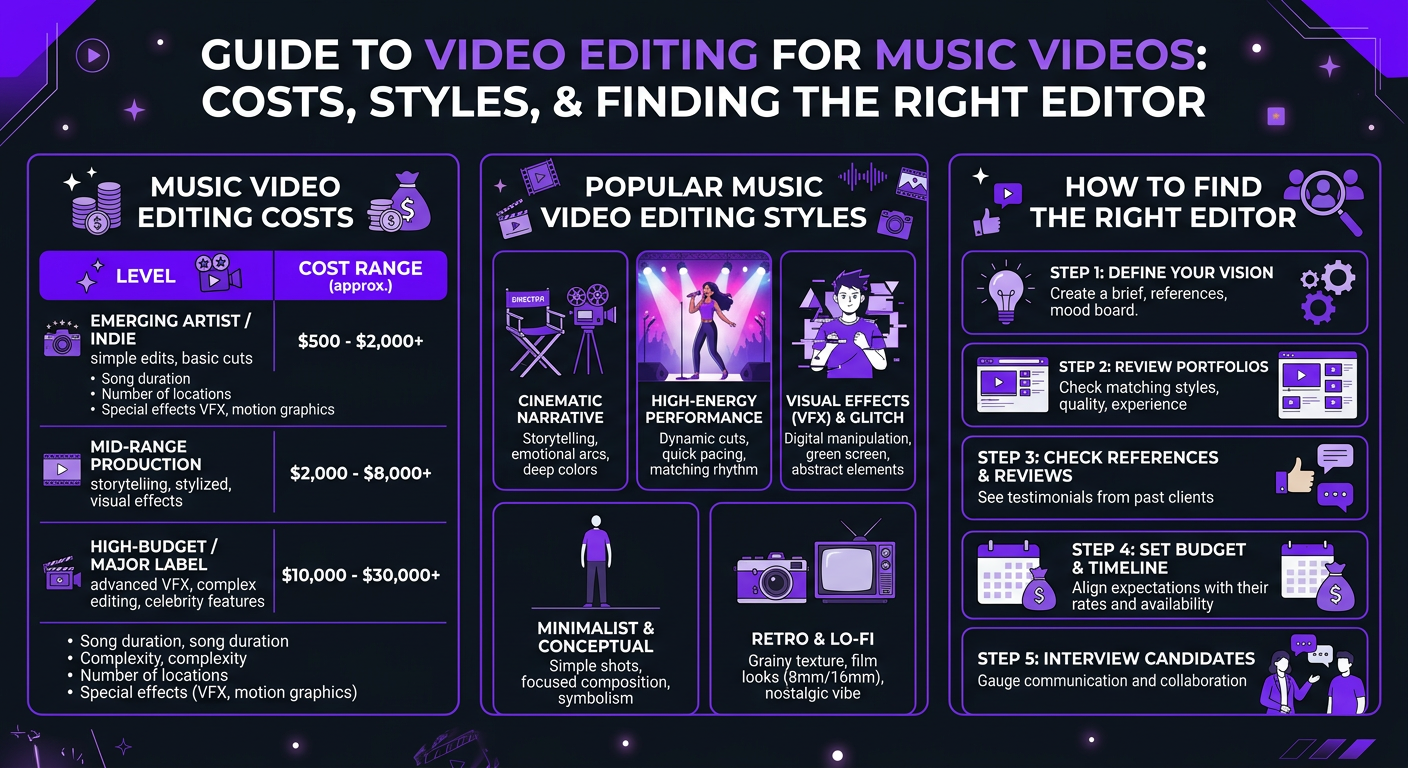
How Much Does Music Video Editing Cost in 2026a
Let’s get specific. These are real market rates, not aspirational numbers from a template website.
| Service | Budget Tier | Professional Tier | Premium / Agency |
|---|---|---|---|
| Basic performance edit | $300–$500 | $500–$1,200 | $1,200–$2,000 |
| Multi-location concept edit | $800–$1,500 | $1,500–$3,500 | $3,500–$7,000 |
| VFX / green screen compositing | $1,000–$2,000 | $2,000–$5,000 | $5,000–$15,000+ |
| Lyric video (custom animation) | $200–$500 | $500–$1,500 | $1,500–$3,000 |
| Color grading (standalone) | $100–$200 | $200–$600 | $600–$1,500 |
| Full package (edit + grade + VFX) | $1,500–$3,000 | $3,000–$6,000 | $6,000–$15,000+ |
Those budget tier numbers That’s what you’ll find on Fiverr and offshore freelancer platforms. It can work for visualizers and simple lyric videos. For anything with performance footage, narrative, or VFX, the budget tier often produces results that undermine the investment you made in the actual shoot.
Think about it: if you spent $5,000–$20,000 on a music video production day — location, crew, equipment, wardrobe, talent — then spending $400 on the edit is like buying a sports car and putting bicycle tires on it. The edit is where all that raw footage becomes an actual music video.
What Labels and Established Artists Spend
For context, label-backed music videos typically allocate 15-25% of the total production budget to post-production (editing, color, VFX, finishing). On a $50,000 video, that’s $7,500–$12,500 for post alone. On a $200,000 video, it’s $30,000–$50,000.
Independent artists obviously don’t operate at those numbers. But the ratio still applies: if you spent $3,000 on your shoot, budgeting $500–$1,000 for post-production is proportional and will deliver a result that does justice to your production investment.
What Drives Music Video Editing Costs Up (or Down)
1. Amount of Raw Footage
A single-camera, single-location shoot might produce 30-60 minutes of footage for a 4-minute song. A multi-location shoot with 3 cameras can produce 6-10 hours. The editor still needs to watch, organize, and select from all of it. More footage = more hours = higher cost.
2. Number of Locations and Scenes
Each location typically means different lighting, different color profiles, different energy levels. Matching these in post-production — making them feel like one cohesive video — is skilled work. A two-location video costs noticeably more to edit than a single setup.
3. VFX Requirements
Even “simple” VFX adds significant time. Removing a logo from a wall, adding a light leak, compositing a background — each effect can take 30 minutes to several hours depending on complexity. Green screen compositing for a full video can add 20-40+ hours of work.
4. Color Grading Expectations
Basic color correction (making footage look natural and consistent) is part of any professional edit. Cinematic color grading — creating a specific look and mood — is a specialized skill. Some editors include it; many charge separately. The difference between corrected and graded footage is the difference between “this looks clean” and “this looks like a real music video.” For more on this, see our color grading services breakdown.
5. Turnaround Time
Standard music video editing turnaround is 5-10 business days for the first cut. Rush delivery (48-72 hours) typically adds a 30-50% premium. If your single drops in two weeks and you haven’t started post yet, expect to pay for urgency.
6. Revision Rounds
Most professional editors include 2-3 revision rounds. Music video revisions tend to be more extensive than other formats because the creative stakes are higher — artists are particular about how specific moments look and feel. If you anticipate 5+ rounds (and some artists do), negotiate that upfront.
7. Deliverable Formats
One master file is standard. But you probably also need: a vertical 9:16 cut for Instagram/TikTok, a 60-second teaser, a 15-second snippet, and possibly a clean version. Each additional deliverable adds editing time. Smart artists request these upfront as a package rather than paying à la carte later.
Planning a Music Video Let’s Talk Post-Production
We’ll scope your project, give you a real number, and build a post-production plan that matches your budget and release timeline.
Freelancer vs Agency: Who Should Edit Your Music Videoa
This decision depends on three factors: your release frequency, your production complexity, and how much creative guidance you need.
| Factor | Freelancer | Agency |
|---|---|---|
| Best for | One-off videos, clear creative vision | Ongoing releases, multi-format needs |
| Cost per video | $500–$3,000 | $1,000–$5,000+ |
| Color grading | ⚠️ Often extra or basic | ✅ Dedicated colorist |
| VFX capability | ⚠️ Limited, or outsources | ✅ In-house VFX team |
| Multiple deliverables | ⚠️ Extra cost each | ✅ Bundled packages |
| Turnaround | 5–14 days | 3–7 days |
| Brand consistency | ❌ Varies per project | ✅ Same team, same look |
| Backup if editor flakes | ❌ You’re stuck | ✅ Team coverage |
For independent artists releasing a single every 3-4 months, a freelancer makes sense. You can shop for the right creative fit each time, pay per project, and keep overhead low.
For artists on a release cycle — monthly singles, accompanying lyric videos, visualizers, social clips — an agency relationship becomes more cost-effective and consistent. You build a visual identity across releases because the same team handles every piece.
When Trade with Pat, a content creator who blends educational finance content with high-energy branding, came to us, the challenge wasn’t just editing individual videos. It was creating a consistent visual language across all content — from long-form to short clips to promotional material. A freelancer might nail one video, but the next editor would bring a completely different aesthetic. Our dedicated team at Increditors provided the consistency that turned individual videos into a recognizable brand.
VFX & Motion Graphics in Music Videos: When You Need Them
Not every music video needs VFX. But the ones that use effects well can create moments that define an artist’s visual identity.
Low-Budget VFX That Punch Above Their Weight
- Light leaks and lens flares: $50–$150 to add. Instantly creates warmth and cinematic texture.
- Speed ramping: Included in most edits. Slow-motion on a beat drop or quick-speed during energetic sections creates dynamic rhythm.
- Glitch and distortion effects: $100–$300. Works especially well for hip-hop, electronic, and experimental genres.
- Split screens and picture-in-picture: $100–$200. Useful for showing multiple angles or locations simultaneously.
- Text integration: $100–$400. Lyrics, credits, or artistic text elements woven into the visual.
Mid-Budget VFX
- Environment extension: $500–$1,500. Expanding a set digitally — adding a city skyline through a window, extending a room, creating a world beyond what was physically shot.
- Particle effects: $300–$800. Sparks, smoke, rain, snow, floating particles. Can transform a basic set into something atmospheric.
- Basic compositing: $500–$2,000. Placing the artist in a different environment, combining separate shoots, or layering visual elements.
High-Budget VFX
- Full green screen compositing: $2,000–$8,000+. Replacing entire backgrounds, creating fantasy environments, placing artists in impossible locations.
- 3D elements and animation: $3,000–$15,000+. 3D objects, environments, character animation integrated with live footage.
- Morphing and transformation: $2,000–$5,000+. Face morphs, object transformations, reality-bending effects.
Our VFX editing team regularly works with artists who want effects-heavy videos but have independent budgets. The key is being strategic — knowing which effects deliver the most visual impact per dollar. A single well-executed environment extension can be more impressive than dozens of cheap overlays.
When we produced content for Blue Zones Health, a wellness brand with a strong visual identity, the VFX weren’t flashy — they were purposeful. Subtle motion graphics reinforced key messages, clean transitions matched the brand’s calm aesthetic, and every effect served the content rather than competing with it. The same principle applies to music videos: the best VFX are invisible until you try to imagine the video without them.
Color Grading: The Secret Weapon of Music Video Post-Production
If you only have budget for one post-production upgrade beyond the basic edit, spend it on color grading. Nothing transforms footage more dramatically for the money.
Color grading in music videos goes far beyond making footage “look nice.” It:
- Establishes genre identity: Warm, desaturated tones for indie. High-contrast, teal-and-orange for hip-hop. Neon-saturated for electronic. Moody shadows for R&B. The grade tells viewers what kind of music this is before they hear a note.
- Creates emotional shifts: Verses can sit in cooler tones, choruses can warm up, the bridge can desaturate. These shifts mirror the emotional arc of the song.
- Unifies multi-location footage: Different locations, different lighting, different times of day — color grading makes them feel like one cohesive world.
- Adds production value: Well-graded footage shot on a $2,000 camera can look more cinematic than poorly graded footage shot on a $50,000 camera. It’s the single biggest production value multiplier in post.
| Grading Level | What You Get | Cost | Impact |
|---|---|---|---|
| Color correction only | Exposure, white balance, basic matching | Included in most edits | Footage looks clean and natural |
| Standard grade | Correction + creative look (LUT-based) | $100–$300 | Footage has a consistent mood |
| Cinematic grade | Scene-by-scene grading, custom looks, skin tone optimization | $300–$800 | Footage looks like a real production |
| Premium grade | Shot-by-shot grading, power windows, secondary corrections, HDR | $800–$2,000+ | Film/broadcast quality |
For more detail on what each level involves, see our complete guide to video color grading services.
The Music Video Editing Workflow: What Actually Happens
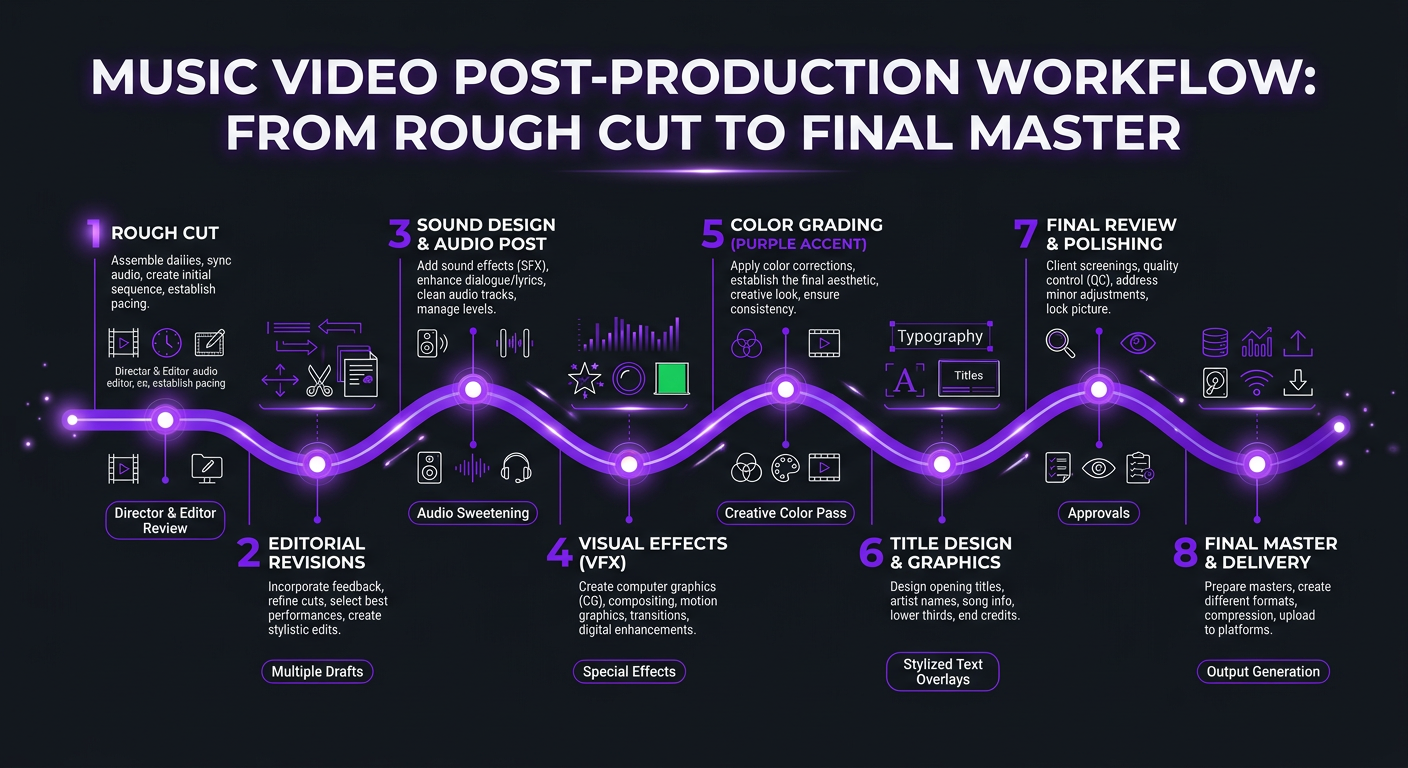
Understanding the workflow helps you plan budgets, timelines, and communication with your editor. Here’s what a professional music video edit looks like step by step:
Step 1: Ingest and Organization (2-4 hours)
All raw footage is imported, organized by scene/setup, synced to the master audio track, and proxied if necessary. This prep work is invisible but critical — a well-organized project means faster editing and fewer mistakes.
Step 2: Assembly Cut (4-8 hours)
The editor lays the song on the timeline and begins selecting the best takes for each section. This first pass is about structure — which performances go where, how the narrative unfolds, where the energy peaks land. No effects, no polish, just the skeleton.
Step 3: Rough Cut (4-8 hours)
Beat-matching is refined. Transitions are placed. The pacing is dialed in. B-roll and alternate angles are woven in. This is where the video starts to feel like a music video. Artists typically review the rough cut and provide creative feedback.
Step 4: Fine Cut + Effects (4-12 hours)
VFX are composited, speed ramps are refined, graphics are integrated. Every cut is frame-accurate. The video is essentially “done” creatively — revisions from here are about tweaks, not restructuring.
Step 5: Color Grading (2-8 hours)
The footage moves to grading (sometimes a separate colorist). Scene-by-scene correction, creative looks applied, skin tones optimized, shots matched. This is where flat footage becomes cinematic.
Step 6: Audio Finishing (1-3 hours)
Final audio sync check, mastered audio integration, any sound effects or ambient layers added. The master audio from your mixing/mastering engineer is laid in for the final version.
Step 7: Delivery (1-2 hours)
Export in all required formats — YouTube (4K ProRes or H.264), Instagram (9:16 1080p), broadcast (if applicable), and any additional cuts (teaser, clean version, etc.).
Total timeline: 18-45+ hours of work depending on complexity, spread across 5-14 calendar days with review cycles built in.
How to Hire the Right Music Video Editor
The music video editor market is flooded with generalists calling themselves music video editors after cutting one friend’s track on CapCut. Here’s how to find someone who actually knows what they’re doing:
Look at Their Reel, Not Their Portfolio Page
Anyone can put pretty thumbnails on a website. Watch their actual work. Check for:
- Beat-sync precision — are cuts landing on beats or randoma
- Color consistency — does the grade hold across the entire videoa
- Pacing — does the energy shift with the song structurea
- Genre range — have they edited your genre beforea
Ask About Their Audio Workflow
A real music video editor can explain their audio sync process, how they handle multi-camera audio, and what format they need your master audio in. If they can’t answer these questions confidently, they’re not specialized in music video work.
Request a Test Edit
For major projects ($3,000+), it’s reasonable to offer a paid test — send 30 seconds of footage and see how they handle it. A $200-$300 test edit is cheap insurance against a $5,000 mistake.
Check Their Revision Process
Music video revisions are notoriously subjective. Ask: How many rounds are included How do they handle notes Do they use Frame.io or similar review tools A good editor expects detailed feedback and doesn’t get defensive about creative notes.
Verify Their Technical Specs
Can they deliver in the codec and resolution your distributor requires Do they understand YouTube’s HDR specs Can they export multiple aspect ratios Technical delivery failures are surprisingly common with less experienced editors.
When Ink Magnet, a creative brand working across multiple content formats, needed editors who could maintain visual consistency across varied content types, the hiring challenge wasn’t finding technical skill — it was finding creative alignment. They needed editors who understood brand identity at a visceral level. That’s the same challenge music artists face: technical competence is the baseline, creative alignment is the differentiator.
5 Mistakes Artists Make With Music Video Editing
1. Spending the Entire Budget on Production, Nothing on Post
We see this constantly. An artist drops $10,000 on a shoot day — incredible location, full crew, hair and makeup, the works — and then has $300 left for editing. The raw footage is stunning. The final video looks like it was cut on iMovie. Budget 15-25% of your total music video budget for post-production. Always.
2. Not Planning the Edit During Pre-Production
Shot lists should be informed by how the video will be edited. If your editor knows during pre-production that the chorus needs three distinct angle options and the bridge needs slow-motion coverage, the shoot can provide exactly that. Editors who receive footage without context waste hours figuring out what goes where.
3. Sending Unmastered Audio
Your editor needs the final mastered audio from day one. Editing to a rough mix and then swapping in the master later causes timing issues, level mismatches, and unnecessary rework. Get your audio finished before post begins.
4. Giving Vague Feedback
“I don’t know, it just doesn’t feel right” is not actionable feedback. “The energy in the second verse feels too slow — can we try faster cuts starting at 1:23a” is. Reference other music videos you like. Timestamp your notes. Your editor isn’t a mind reader.
5. Treating the Editor Like a Button-Pusher
A good music video editor is a creative collaborator, not a technician executing your instructions. The best results come from giving creative direction — “I want this to feel anxious and claustrophobic during the verses, then open up in the chorus” — rather than prescriptive notes — “put a jump cut every 2 seconds.”
If you want to learn more about collaborating effectively with editors, our guide on how we work with clients covers the communication framework we use for all creative projects.
Frequently Asked Questions
Music video editing typically costs $500–$2,000 for a standard performance video and $2,000–$10,000+ for concept-driven videos with VFX, color grading, and motion graphics. Budget lyric videos start at $200–$500. The biggest cost factors are footage volume, VFX complexity, color grading level, and turnaround time.
The industry standards are Adobe Premiere Pro and DaVinci Resolve for cutting and color grading, After Effects for motion graphics and VFX, and Pro Tools or Logic Pro for audio sync. Most professional editors use a combination depending on project requirements. Resolve has become increasingly popular for music videos because it combines editing and color grading in one application.
A simple performance video takes 1–3 days. Concept-driven videos with multi-location footage and VFX take 5–14 days. Complex narrative or animation-heavy projects can take 2–4 weeks. These timelines include review cycles — the editor works for a few days, you review, they revise, repeat.
For one-off videos with a clear vision, freelancers work well at $500–$3,000 per video. For artists releasing regularly (monthly singles, lyric videos, social clips), an agency provides consistency, bundled deliverables, and access to colorists and VFX artists without hiring separately. Agencies like Increditors are ideal for artists who need a full post-production team.
Music video editing is rhythm-driven — every cut syncs with beats, tempo changes, and the song’s emotional arc. It requires understanding musical structure, beat-matching, lip-sync precision, and creating visual motifs that reinforce lyrics. A YouTube editor optimizes for retention metrics; a music video editor optimizes for emotional and rhythmic impact.
Not necessarily. Many successful music videos rely on strong cinematography, creative editing, and color grading without VFX. However, even simple effects — light leaks ($50–$150), glitch transitions ($100–$300), speed ramps (included in most edits) — can add significant production value. The key is using VFX purposefully, not decoratively.
Ready to Make Your Next Music Video Hit Differenta
From performance edits to VFX-heavy concepts, our team edits music videos that match the energy of the music. Tell us about your project.
Pricing data reflects 2026 market rates gathered from industry research, freelancer platforms, and direct production experience. Rates vary by region, genre, and project complexity. For current Increditors music video editing pricing, visit our music video page or schedule a call.