










![3D Explainer Video - ScribbleLive.mp4_snapshot_00.12_[2022.03.09_03.14.16]](https://increditors.com/wp-content/uploads/elementor/thumbs/3D-Explainer-Video-ScribbleLive.mp4_snapshot_00.12_2022.03.09_03.14.16-r7wb53mx72rxst3qcqyrfxdmeyzb5r9jbl0wbjujh4.png "3D Explainer Video – ScribbleLive.mp4_snapshot_00.12_[2022.03.09_03.14.16]")






























There’s a tipping point every growing brand hits: you need more videos than any single editor can handle. Maybe you’ve scaled to 4 videos per week and your freelancer is drowning. Maybe you’re an e-learning company launching 30 courses simultaneously. Maybe you’re an agency managing video for 8 different clients.
Whatever the trigger, the math is the same. You need bulk video editing services — not a slightly busier freelancer, but a fundamentally different production model built for volume.
We’ve operated at this scale for years. When eSafety First Canada came to us with 30 safety training courses — each requiring 3 promotional ads — we didn’t assign one overworked editor and hope for the best. We built a dedicated pipeline that delivered 90+ video assets on schedule without a single quality dip. That’s what real bulk editing looks like.
This guide covers everything you need to know before committing to high-volume video editing: how pricing works, what team structures deliver, where quality breaks down (and how to prevent it), and how to evaluate whether a service can actually handle your volume.
What’s in This Guide
- What Bulk Video Editing Actually Means
- Who Needs 20+ Videos a Montha
- Volume Pricing: How Bulk Editing Costs Work
- Team Structures That Scale
- Workflow Optimization for High Volume
- Quality Control at Scale
- Case Studies: Bulk Editing in Action
- 5 Mistakes Companies Make With Bulk Editing
- How to Choose a Bulk Editing Partner
- FAQ
What Bulk Video Editing Actually Means
Let’s define the term clearly, because “bulk” gets thrown around loosely in the editing world.
Bulk video editing services are production operations designed to process 20 or more videos per month at consistent quality, with structured workflows, dedicated teams, and volume-based pricing. It’s not the same as asking your regular editor to work faster or hiring three uncoordinated freelancers.
The distinction matters because high-volume editing creates problems that simply don’t exist at lower volumes:
- Consistency across dozens of videos: When you publish 4 videos a month, minor style variations are unnoticeable. At 30+ videos, inconsistent color grading, different text styles, and varying audio levels become obvious and erode brand perception.
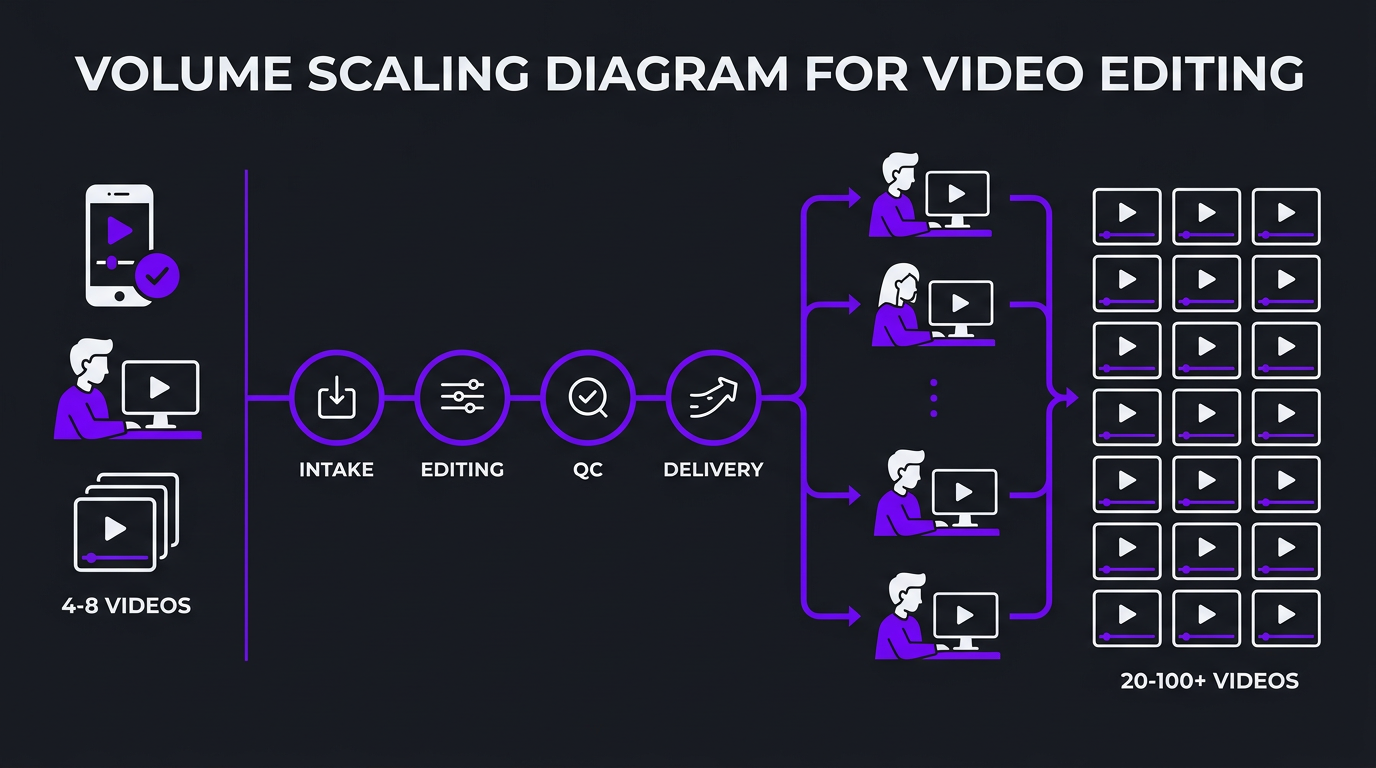
- Parallel processing: You can’t edit 30 videos sequentially with a 3-day turnaround per video — that’s 90 business days. You need multiple editors working simultaneously, which requires coordination systems.
- Bottleneck management: At volume, the editing itself is rarely the bottleneck. It’s asset delivery, feedback loops, revisions, and approvals. Bulk services need process design, not just editing skills.
- Quality variance: With multiple editors, quality naturally varies. Without active QC systems, your worst video becomes your brand standard in viewers’ eyes.
A true bulk video editing partner addresses all four problems simultaneously. If a service just promises “unlimited videos” without explaining how they handle consistency, parallelism, and QC — they’re probably just queuing your requests behind everyone else’s.
Who Needs 20+ Videos a Montha
More organizations than you’d think. If any of these describe your situation, you’ve already outgrown single-editor models:
E-Learning and Course Creators
Online education is the most obvious bulk editing use case. A single course might contain 20-50 video lessons. If you’re launching multiple courses per quarter — or maintaining a library of hundreds of modules that need periodic updates — you’re looking at 30-100+ edits per month.
eSafety First Canada, one of our clients, produces workplace safety training content. When they needed 30 complete courses edited — each with lesson videos and 3 accompanying promotional ads — the total came to well over 90 individual video assets. That’s not a project for a freelancer with a good work ethic. It’s a project for a dedicated production team with systematized workflows.
SaaS and Tech Companies
Modern SaaS marketing requires a constant stream of video: product demos, feature announcements, customer testimonials, webinar recordings, onboarding tutorials, and social media clips. A mid-size SaaS company easily produces 15-30 video assets per month across marketing, product, and customer success teams.
Marketing Agencies
Agencies managing video for multiple clients face a compounding volume problem. Five clients each needing 8 videos per month means 40 videos — each with different brand guidelines, target audiences, and quality expectations. White-label bulk editing partnerships are how smart agencies scale without bloating headcount.
E-Commerce Brands
Product videos, unboxing content, comparison clips, social ads, and UGC-style testimonials. A brand with 50+ SKUs that needs video for each product launch can generate 20-40 editing requests in a single sprint.
Multi-Channel Content Creators
Creators who produce weekly long-form content and daily shorts across YouTube, TikTok, Instagram, and LinkedIn can easily hit 25-40 edits per month. When you add podcast clips, highlight reels, and collaborative content, the volume gets unwieldy fast.
Real Estate and Property Management
Agencies producing virtual tours, listing videos, and neighborhood showcases for dozens of properties per month need systematic editing processes. Each video follows a similar template, making this an ideal use case for bulk editing efficiency.
| Industry | Typical Monthly Volume | Common Video Types | Complexity Level |
|---|---|---|---|
| E-Learning | 30–100+ | Course lessons, promos, recaps | Low–Medium |
| SaaS / Tech | 15–40 | Demos, tutorials, testimonials | Medium–High |
| Marketing Agencies | 30–80+ | Client videos across verticals | Varies |
| E-Commerce | 20–50 | Product videos, social ads, UGC | Low–Medium |
| Content Creators | 20–40 | Long-form, shorts, podcasts | Medium–High |
| Real Estate | 20–60 | Property tours, listings, promos | Low–Medium |
Volume Pricing: How Bulk Video Editing Costs Work
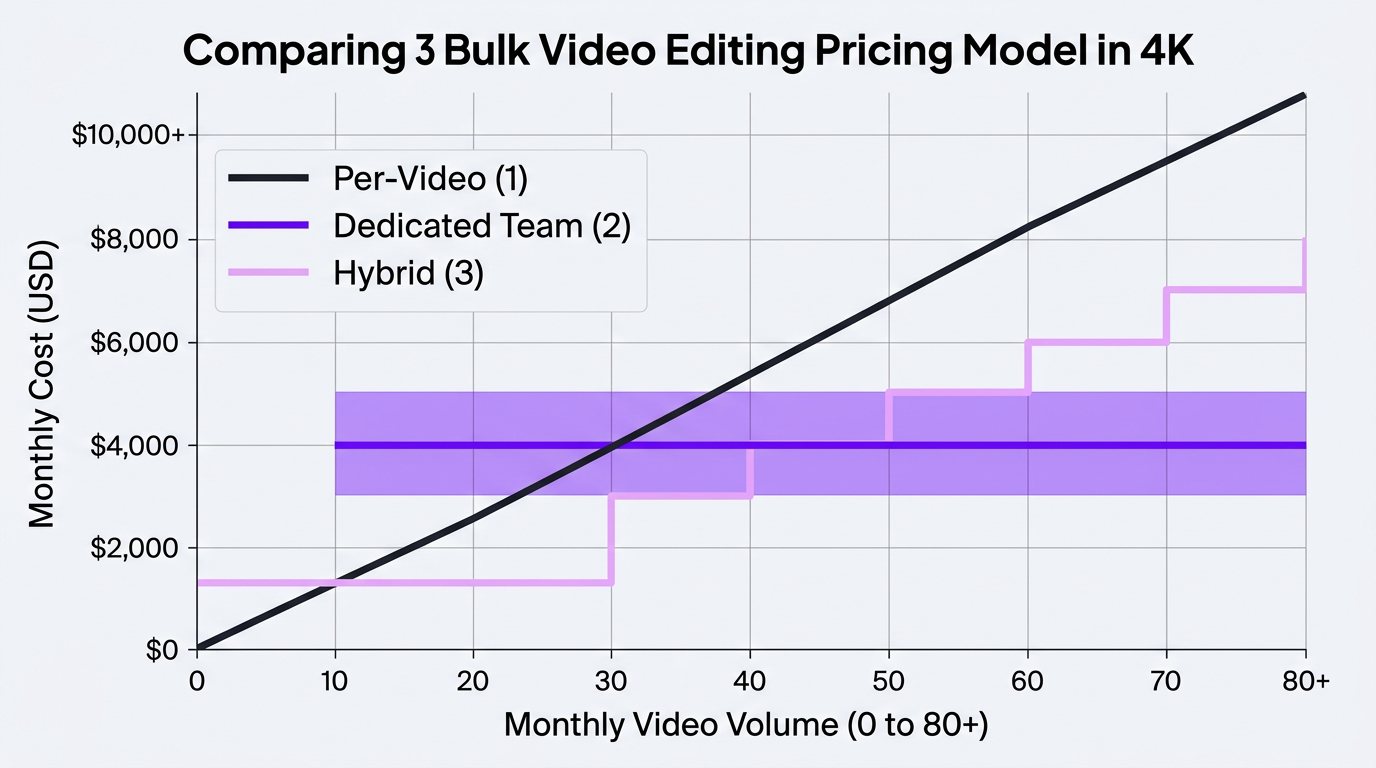
Pricing for bulk video editing services follows different models than standard per-video rates. Understanding each model helps you avoid overpaying — or, worse, choosing a pricing structure that creates perverse incentives.
Model 1: Volume-Discounted Per-Video Pricing
The simplest approach: lower per-video rates as your monthly commitment increases. This model works well when your videos are relatively uniform in complexity.
| Monthly Volume | Per-Video Rate (Simple) | Per-Video Rate (Complex) | Monthly Total Range |
|---|---|---|---|
| 1–5 videos | $200–$350 | $400–$800 | $200–$4,000 |
| 6–15 videos | $150–$275 | $300–$600 | $900–$9,000 |
| 16–30 videos | $100–$200 | $200–$450 | $1,600–$13,500 |
| 31–60 videos | $75–$175 | $175–$375 | $2,325–$22,500 |
| 60+ videos | $50–$150 | $150–$300 | Custom enterprise |
The per-video discount at high volumes can be significant — 40-60% lower than one-off rates. But watch out for minimum commitments. Some services lock you into 6-12 month contracts with volume floors. If your production schedule fluctuates, this can mean paying for videos you don’t produce.
Model 2: Dedicated Team Retainer
Instead of paying per video, you hire a dedicated editing team on a monthly retainer. The team works exclusively (or primarily) on your content for a fixed monthly fee.
| Team Configuration | Monthly Retainer | Approximate Output | Includes |
|---|---|---|---|
| 1 Editor + PM | $3,500–$5,000 | 15–25 videos | Editing, basic graphics, QC |
| 2 Editors + PM | $6,000–$9,000 | 25–50 videos | Editing, graphics, parallel processing |
| 3 Editors + Motion Designer + PM | $9,000–$14,000 | 40–80 videos | Full post-production, animation, QC |
| Full Production Unit | $14,000–$25,000+ | 60–120+ videos | Everything + color grading, sound design |
The dedicated team model is what we use at Increditors for high-volume clients. It’s more cost-effective at scale because you’re buying capacity, not individual units. If your team finishes the planned 30 videos in three weeks, they use the remaining week for additional content, revisions, or next month’s pre-production — no extra charge.
Model 3: Hybrid (Base Retainer + Per-Video Overflow)
A base retainer covers your guaranteed monthly volume, with per-video pricing for anything beyond. This works well for brands with predictable base needs but occasional spikes — like an e-commerce brand that normally needs 20 videos but jumps to 40 during product launch season.
What Drives the Per-Video Cost Down at Scalea
Volume discounts aren’t charity — they reflect real efficiency gains:
- Template leverage: After editing your first 10 videos, the team has reusable templates, presets, graphics, and workflows. Video #30 takes 40-60% less time than video #1.
- Brand familiarity: No ramp-up cost. Your editors know your fonts, colors, pacing preferences, and audience expectations.
- Batch processing: Rendering, exporting, and delivering 30 videos at once is significantly faster per unit than handling them individually.
- Dedicated resources: A team assigned to your account full-time doesn’t context-switch between clients, eliminating the productivity tax of multitasking.
- Reduced management overhead: One onboarding process, one set of brand guidelines, one feedback cadence — spread across 30+ videos instead of 4.
Team Structures That Scale
The biggest misconception about bulk editing is that you just need “more editors.” That’s like saying a restaurant gets more efficient by hiring more chefs but no servers, no dishwashers, and no floor manager. The system matters as much as the headcount.
The Minimum Viable Bulk Team
For 20-30 videos per month, here’s the leanest team that works:
- 2 Video Editors: Your core production capacity. Two editors working in parallel can produce 20-30 videos per month while maintaining quality. They specialize by video type — one might handle long-form while the other focuses on short-form and social.
- 1 Project Manager: The critical role most clients undervalue. The PM handles intake (receiving footage and briefs), assignment (routing work to the right editor), timeline management, client communication, and delivery tracking. Without a PM, you become the PM — and that defeats the purpose of outsourcing.
- 1 QC Reviewer (part-time): A senior editor who watches every deliverable before it reaches the client. This role catches the 10-15% of videos that need tweaks before delivery, preventing revision cycles that waste everyone’s time.
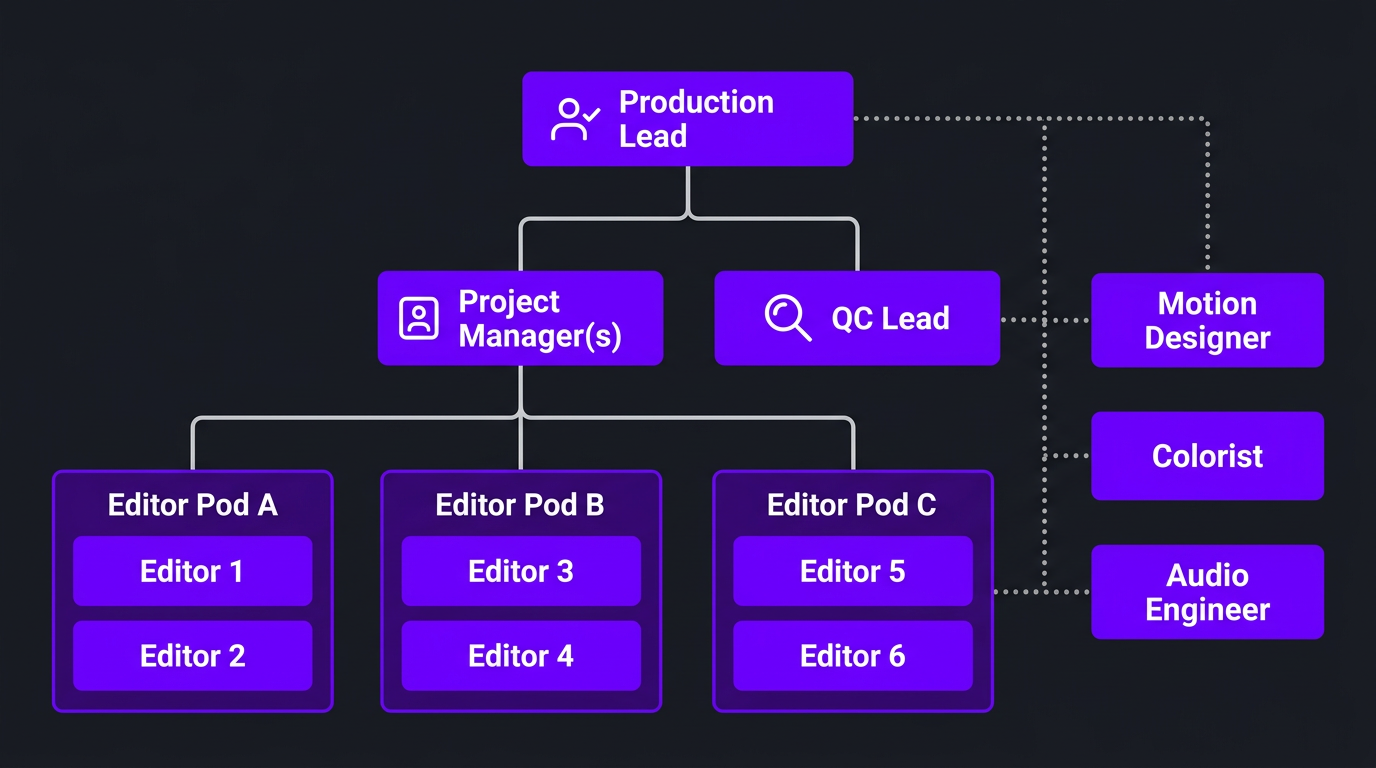
The Full-Scale Production Team
For 40-100+ videos per month, the team expands:
- 3-5 Video Editors: Organized by content type, complexity, or client (for agencies).
- 1-2 Motion Designers: Dedicated graphics and animation support that editors can call on without leaving their timelines.
- 1 Colorist (shared): Handles color grading across all videos for visual consistency.
- 1 Audio Engineer (shared): Audio mixing, noise reduction, and music selection at scale.
- 1-2 Project Managers: Possibly segmented by client or content type.
- 1 Production Lead: Oversees the entire operation, handles capacity planning, and serves as the escalation point.
This is the model we built for eSafety First Canada’s 30-course project. With 90+ video assets to deliver, we assembled a team of 4 editors, a motion designer, a PM, and a QC lead. Each editor owned specific course categories, ensuring they developed deep familiarity with the subject matter — workplace safety, chemical handling, emergency protocols — rather than context-switching between unrelated topics.
| Monthly Volume | Minimum Team | Ideal Team | Cost Range |
|---|---|---|---|
| 20–30 videos | 2 Editors + 1 PM | 2 Editors + PM + QC | $4,000–$7,000/mo |
| 30–50 videos | 3 Editors + 1 PM | 3 Editors + Motion + PM + QC | $7,000–$12,000/mo |
| 50–80 videos | 4 Editors + 1 PM | 4 Editors + Motion + Color + PM + Lead | $11,000–$18,000/mo |
| 80–120+ videos | 5+ Editors + 2 PMs | Full production unit (8-12 people) | $16,000–$30,000+/mo |
Need a Dedicated Editing Teama
We build custom teams based on your volume, content types, and quality requirements. From 20 videos to 100+ per month — the infrastructure scales with you.
Workflow Optimization for High Volume
At 20+ videos per month, workflow isn’t a nice-to-have — it’s the difference between hitting deadlines and missing them. Here’s how professional bulk editing operations are structured.
The 5-Stage Bulk Editing Pipeline
Stage 1: Intake & Triage (Day 0)
Raw footage and briefs arrive through a centralized system — typically a project management tool (Monday.com, Notion, Asana) connected to cloud storage (Frame.io, Google Drive, Dropbox). Each submission is logged, categorized by type and complexity, and assigned a priority level.
At this stage, the PM reviews the brief for completeness. Missing footage Unclear instructions Better to catch it now than after 4 hours of editing. We’ve found that a 15-minute intake review saves an average of 2 hours per video in revisions down the line.
Stage 2: Assignment & Pre-Production (Day 0-1)
The PM assigns each video to an editor based on: specialization (long-form vs. short-form), current workload, and familiarity with the content type. For brands with established templates, the editor pulls the relevant preset package — intro animations, lower thirds, brand fonts, color LUTs — before opening the footage.
Stage 3: Editing (Day 1-3)
The actual edit. For bulk operations, editors work from detailed style guides that specify everything from transition types to text animation timing. This isn’t creative restriction — it’s creative efficiency. When an editor doesn’t have to make 50 micro-decisions about styling on every video, they can focus their creative energy on pacing, storytelling, and audience engagement.
Stage 4: Quality Control (Day 3-4)
Every video passes through QC before client delivery. The QC reviewer checks against a standardized checklist:
- Audio levels consistent (target -14 LUFS for YouTube, -16 for broadcast)
- Color grading matches brand LUTs
- Text free of typos and formatted correctly
- Transitions and pacing meet brand standards
- Export settings correct for target platform
- Thumbnail/preview frame captured
- Captions/subtitles accurate (if applicable)
Videos that fail QC go back to the editor with specific notes. This loop typically catches 10-20% of videos before the client ever sees them — dramatically reducing client-facing revision cycles.
Stage 5: Delivery & Feedback (Day 4-5)
Completed videos are delivered through a review platform (Frame.io is industry standard) with timecoded commenting. Clients approve or request changes, which feed back into Stage 3 for revisions. Approved videos are exported to final delivery specs and organized in the client’s preferred storage system.
Parallel Processing: The Volume Multiplier
The key to throughput isn’t faster editors — it’s concurrent work. In a well-structured bulk operation:
- Editor A is editing videos 1-3 (long-form YouTube content)
- Editor B is editing videos 4-8 (short-form social clips)
- Editor C is revising videos 9-11 based on client feedback
- Motion designer is creating graphics for videos 12-15
- QC is reviewing videos 16-18 completed yesterday
With this parallel structure, a 4-person team can maintain a throughput of 6-10 completed videos per day — meaning 30+ videos per week with buffer for revisions.
Tools That Make Bulk Editing Possible
| Function | Tool Options | Why It Matters for Bulk |
|---|---|---|
| Project Management | Monday.com, Notion, Asana | Tracks 20-100 active projects simultaneously |
| Video Review | Frame.io, Wipster, Vimeo Review | Timecoded feedback eliminates “at around 2:30ish” notes |
| Cloud Storage | Google Drive, Dropbox Business, Backblaze B2 | Centralizes terabytes of raw footage across team |
| Template Systems | Premiere Pro MOGRTs, After Effects templates | Standardizes 70% of styling decisions |
| Communication | Slack, Teams, Discord | Real-time coordination between editors and PM |
| Asset Libraries | Brandfolder, Air, Playbook | Single source of truth for logos, fonts, music, B-roll |
Quality Control at Scale: The Hard Part
Here’s an uncomfortable truth: quality naturally degrades at volume. Not because editors stop caring, but because the systems that maintain quality at 4 videos/month simply don’t work at 40. The founder who personally reviewed every cut can’t watch 40 videos a month. The “I’ll know it when I see it” quality standard can’t be communicated across a team of 5 editors.
Solving quality at scale requires three things: standards, systems, and accountability.
Standards: The Brand Style Guide
Every bulk editing engagement should start with a comprehensive brand editing style guide. Not a 2-page brand kit — a genuine editing reference document that covers:
- Visual identity: Exact fonts (with weights and sizes), color codes, logo placement rules, intro/outro specifications
- Editing style: Preferred transition types, pacing guidelines (cuts per minute), text animation styles, B-roll usage rules
- Audio standards: Target loudness levels, music genre preferences, sound effect usage, voiceover treatment
- Platform specifications: Aspect ratios, safe zones, caption styles, export settings per platform
- Examples: 3-5 “gold standard” videos that represent the ideal output
Creating this document takes 4-8 hours upfront. It saves hundreds of hours in revisions, inconsistency, and miscommunication over the life of the engagement.
Systems: The QC Checklist
Every video passes through a standardized QC process before delivery. At Increditors, our bulk editing QC checklist has 25+ checkpoints across visual, audio, technical, and brand categories. Videos are scored, and any video falling below threshold gets sent back before the client sees it.
The result: our first-pass approval rate for bulk clients averages 85-90%. That means 85-90% of videos are approved by the client without any revision request — because our internal QC already caught the issues.
Accountability: Metrics That Matter
At scale, you need data to maintain quality. Key metrics for bulk editing operations:
| Metric | Target | Why It Matters |
|---|---|---|
| First-pass approval rate | 85%+ | Measures edit quality before client review |
| Average revisions per video | <1.5 | More revisions = misaligned expectations or poor quality |
| On-time delivery rate | 95%+ | Late videos break content calendars |
| QC fail rate | <15% | Internal catch rate before client sees issues |
| Client satisfaction score | 8+/10 | Overall quality perception |
| Editor consistency score | 90%+ brand match | How closely output matches the style guide |
Case Studies: Bulk Video Editing in Action
eSafety First Canada: 30 Courses, 90+ Video Assets
eSafety First Canada produces workplace safety training content for Canadian businesses — everything from WHMIS chemical safety to workplace harassment prevention. When they approached Increditors, they had a massive production challenge: 30 complete training courses needed editing, and each course required 3 promotional ad videos for marketing distribution.
The scope: 30 multi-lesson courses (varying from 5 to 15 lessons each) plus 90 promotional ads. Total asset count exceeded 100 individual video deliverables.
The challenge wasn’t just volume — it was consistency. Safety training content has zero tolerance for errors. Incorrect on-screen text in a WHMIS course isn’t a brand issue — it’s a liability issue. Every statistic, every procedure, every safety protocol had to be verified and presented accurately across all 30 courses.
Our approach:
- Team assembly: 4 editors, 1 motion designer, 1 PM, 1 QC lead — all dedicated to the eSafety project for the engagement duration.
- Course clustering: We grouped the 30 courses into 6 thematic categories (chemical safety, physical safety, workplace conduct, emergency procedures, etc.) and assigned editor pairs to each cluster. This built subject-matter familiarity that improved accuracy and speed.
- Template system: We created a master After Effects template for course lessons and a separate template for promotional ads. Editors customized within the template framework, ensuring visual consistency across all 30 courses while allowing content-specific variations.
- Parallel production: At peak, 4 editors were simultaneously working on different courses. The PM managed the pipeline so completed courses flowed to QC while new courses entered editing — no idle time, no bottlenecks.
- Tiered QC: Editor self-check → peer review → QC lead review → client approval. The three internal reviews caught 95% of issues before eSafety ever saw a draft.
Result: All 30 courses and 90 promotional ads delivered on schedule, with an average of 0.8 revision rounds per video — well below industry average. eSafety’s internal team reported that the editing quality was “indistinguishable between courses,” which was exactly the goal.
TuMeke: AI/SaaS Product Content at Scale
TuMeke, an AI-powered workplace ergonomics platform, needed a steady stream of product content: demo videos, feature explainers, customer case study videos, and social media clips. Their previous approach — cycling through individual freelancers — created inconsistency that undermined their brand positioning as a sophisticated AI company.
The problem with freelancer rotation at scale: every new editor needs 2-3 weeks to understand AI product positioning. They’d describe features incorrectly, use the wrong terminology, or frame the product in ways that didn’t match TuMeke’s market position. By the time an editor was trained, they’d leave for another project.
Our solution was a dedicated 2-editor team assigned exclusively to TuMeke’s account. These editors learned the product deeply — not just what it looks like, but how it works, who uses it, and why it matters. After the initial 2-week onboarding, they operated with minimal supervision, producing 15-20 videos per month with consistent quality and accurate product messaging.
The compounding advantage: By month 3, TuMeke’s editors were proactively suggesting visual approaches for new features, anticipating revision feedback before it came, and delivering drafts that needed almost no changes. That kind of embedded expertise is impossible with rotating freelancers — it only happens with dedicated teams working at volume over time.
5 Mistakes Companies Make With Bulk Video Editing
Mistake 1: Choosing “Unlimited” Plans for Bulk Needs
Unlimited video editing subscriptions market themselves as the answer to high-volume needs. The pitch sounds perfect: flat monthly fee, no per-video limits, submit as many requests as you want.
The reality: “unlimited” services typically limit active requests to 1-2 at a time. Each video enters a queue. At a 2-3 day turnaround per video, maximum throughput is 10-15 videos per month — not the 20-50 you actually need. These plans are designed for small businesses producing 4-8 videos monthly, not for genuine bulk production.
If a service offers “unlimited” videos at $500-$2,000/month, ask a simple question: “How many videos have your highest-volume clients actually received in a single montha” If the answer is under 15, it’s not a bulk solution.
Mistake 2: Hiring Uncoordinated Freelancers Instead of a Team
Some companies try to create bulk capacity by hiring 3-5 individual freelancers from Upwork. Each gets assigned different videos. Costs less than an agency, righta
In theory. In practice, you become the project manager, quality controller, and brand enforcer — simultaneously managing 5 different editing styles, 5 different communication preferences, and 5 different reliability levels. The management overhead typically consumes 10-20 hours per month, which, valued at even $50/hour, adds $500-$1,000 to your “savings.”
Mistake 3: Skipping the Style Guide
We covered this in the QC section, but it’s worth emphasizing as a standalone mistake. Companies that invest $5,000-$15,000/month in bulk editing but won’t spend 8 hours creating a style guide are building on sand. Every revision, every “that’s not quite right,” every inconsistency between videos traces back to this gap.
Mistake 4: Optimizing for Cost Per Video Instead of Cost Per Result
A $75 video that nobody watches costs more than a $200 video that generates leads. At bulk scale, this math is amplified. If 30% of your cheap videos underperform because of quality issues, you’re effectively wasting 30% of your production budget and diluting your brand with subpar content.
The right metric is cost per outcome: cost per view, cost per engagement, cost per lead. Track these across your video library and you’ll often find that slightly higher per-video costs dramatically improve per-result costs.
Mistake 5: Not Planning for Fluctuation
Most businesses don’t produce exactly 30 videos every month. There are launch months (50+ videos), quiet months (15 videos), and everything in between. Locking into rigid volume commitments — or, worse, choosing a provider that can’t flex — creates waste during slow periods and bottlenecks during busy ones.
The best bulk editing arrangements include flex capacity: a base commitment with the ability to scale up 50-100% during peak periods without renegotiating contracts or onboarding new editors.
How to Choose a Bulk Video Editing Partner
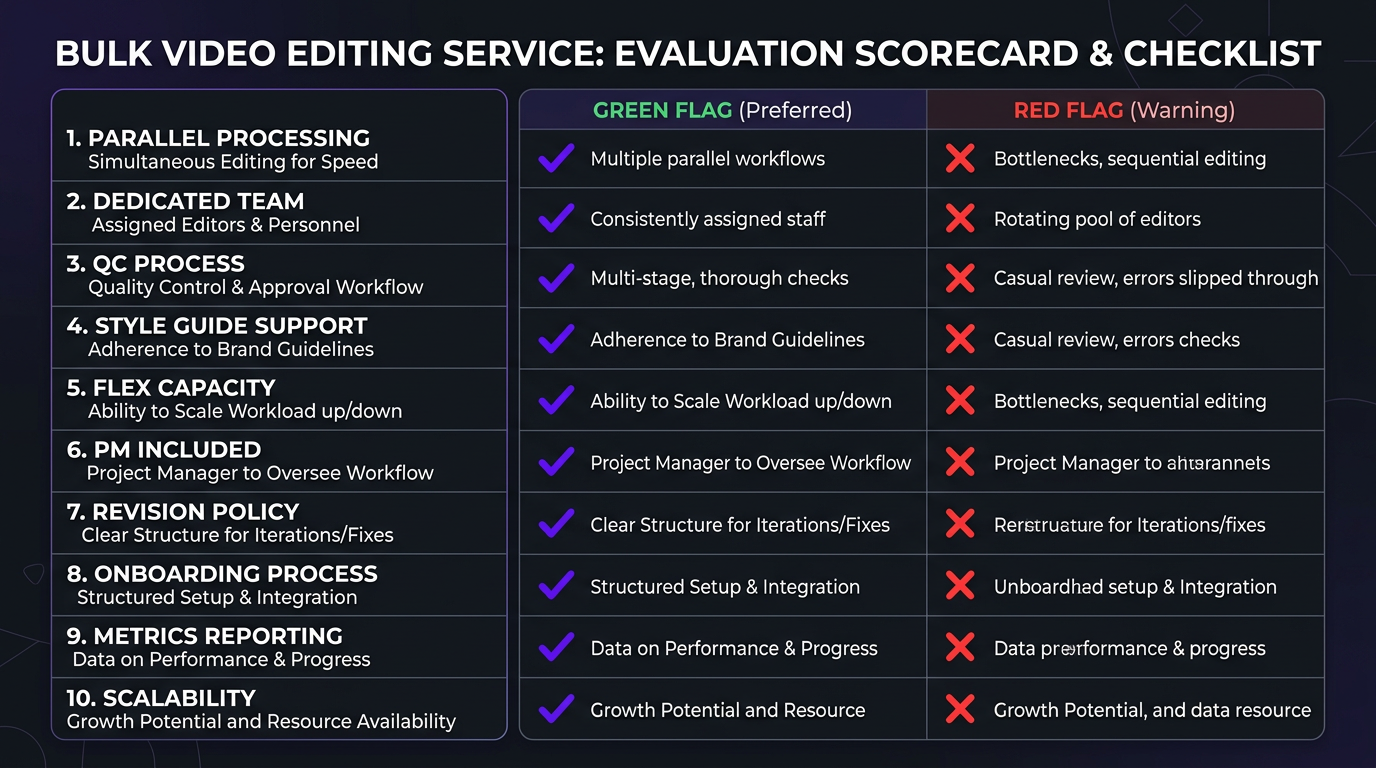
Not every video editing service can handle genuine bulk volume. Here’s what to evaluate:
Ask About Maximum Concurrent Capacity
“How many videos can you actively edit simultaneously — not sequentiallya” If the answer is 1-3, they’re a small operation pretending to be bulk-capable. For 20+ videos/month, you need a partner who can run 5-10 edits concurrently.
Request Case Studies at Similar Volume
Ask for examples of clients receiving 20+ videos per month. Any legitimate bulk service can show portfolio examples and reference volumes without breaking confidentiality. If they can’t produce evidence of operating at your required scale, they’re learning on your dime.
Understand the Team, Not Just the Company
Who will actually edit your videos How many editors will be assigned Will they be consistent month-to-month A company might have 50 editors total, but if they’re rotating different editors through your project every week, you lose the consistency advantage that makes bulk editing work.
Evaluate the PM Layer
At bulk volume, the project manager matters as much as the editors. Ask how PM communication works: Do you get a dedicated PM How are briefs submitted How is feedback tracked What’s the escalation path for urgent requestsa
Test at Scale Before Committing
Don’t sign a 12-month contract based on a 2-video trial. Ask for a 30-day pilot at your actual projected volume. If you need 25 videos/month, test with 20-25 — not 5. The operational challenges only appear at real volume.
Review the QC Process
Ask specifically: “What happens between the editor finishing a video and me seeing ita” If the answer is “nothing,” there’s no QC layer. You’ll be the quality control, and at 20+ videos/month, that becomes a part-time job.
| Evaluation Criteria | Red Flag | Green Flag |
|---|---|---|
| Concurrent capacity | “We process 1-2 requests at a time” | “We run 5-10 edits in parallel for bulk clients” |
| Team assignment | “You’ll get our next available editor” | “You’ll have dedicated editors assigned to your account” |
| QC process | “Our editors review their own work” | “Every video passes through a separate QC reviewer” |
| Scale evidence | “We can definitely handle that” (no examples) | “Here are 3 clients we serve at that volume” |
| Flexibility | “12-month minimum at fixed volume” | “Base commitment with flex capacity for peaks” |
| Onboarding | “Send us your footage and we’ll get started” | “We’ll build a style guide and run a calibration phase” |
Producing 20+ Videos a Month Let’s Talk.
We’ve built bulk editing teams for e-learning companies, SaaS brands, and agencies processing 30-100+ videos monthly. See our portfolio and let’s design a team for your volume.
Frequently Asked Questions
Bulk video editing services handle high-volume post-production — typically 20 to 100+ videos per month — through dedicated teams, streamlined workflows, and volume-based pricing. Unlike per-video freelancer arrangements, bulk services assign consistent editors who learn your brand and deliver at scale with built-in quality control processes.
Bulk video editing typically costs $75–$250 per video depending on complexity, with monthly retainers ranging from $3,000 to $10,000+ for 20-100 videos. Volume discounts of 25-50% compared to per-video pricing are standard. Dedicated team models at Increditors start around $4,000/month for a full-time editor with project management.
Quality at scale requires multi-layer QC processes: editors follow brand style guides and templates, senior editors review every deliverable, project managers track consistency metrics, and clients approve through structured feedback loops. Our first-pass approval rate for bulk clients averages 85-90%, meaning most videos need zero revisions.
It depends on complexity. A single full-time editor can handle 20-30 simple videos (talking heads, basic cuts) or 10-15 complex videos (motion graphics, VFX, multi-cam). For 20+ complex videos, you need a team of 2-4 editors plus a project manager and QC reviewer working in parallel.
Unlimited subscriptions promise infinite revisions but typically limit active requests to 1-2 at a time, creating a throughput bottleneck. Actual output is usually 8-15 videos/month. Bulk editing services commit to specific monthly volumes with parallel processing — multiple editors working simultaneously — so you actually receive 20-100+ finished videos per month.
Expect a 1-2 week onboarding period where the team learns your brand guidelines, editing style, and workflows. During this phase, the team creates or refines your editing style guide and runs 3-5 calibration videos. By week 3-4, a well-structured team should be operating at full speed with minimal supervision.
E-learning companies, SaaS brands producing product content, real estate agencies with property tours, e-commerce brands needing product videos, multi-channel content creators, marketing agencies managing multiple clients, and franchise businesses with multiple locations all commonly require 20-100+ videos per month.
Scale Your Video Production Without Scaling Your Headcount
Whether you need 20 videos or 200 per month, we’ll build the right team and workflow for your specific needs. No long-term lock-ins — just reliable, high-quality output at volume.
Pricing data reflects 2026 market rates based on industry research and Increditors’ direct experience with high-volume clients. Actual costs vary by video complexity, turnaround requirements, and team configuration. For current pricing, visit our pricing page or schedule a call.