










![3D Explainer Video - ScribbleLive.mp4_snapshot_00.12_[2022.03.09_03.14.16]](https://increditors.com/wp-content/uploads/elementor/thumbs/3D-Explainer-Video-ScribbleLive.mp4_snapshot_00.12_2022.03.09_03.14.16-r7wb53mx72rxst3qcqyrfxdmeyzb5r9jbl0wbjujh4.png "3D Explainer Video – ScribbleLive.mp4_snapshot_00.12_[2022.03.09_03.14.16]")































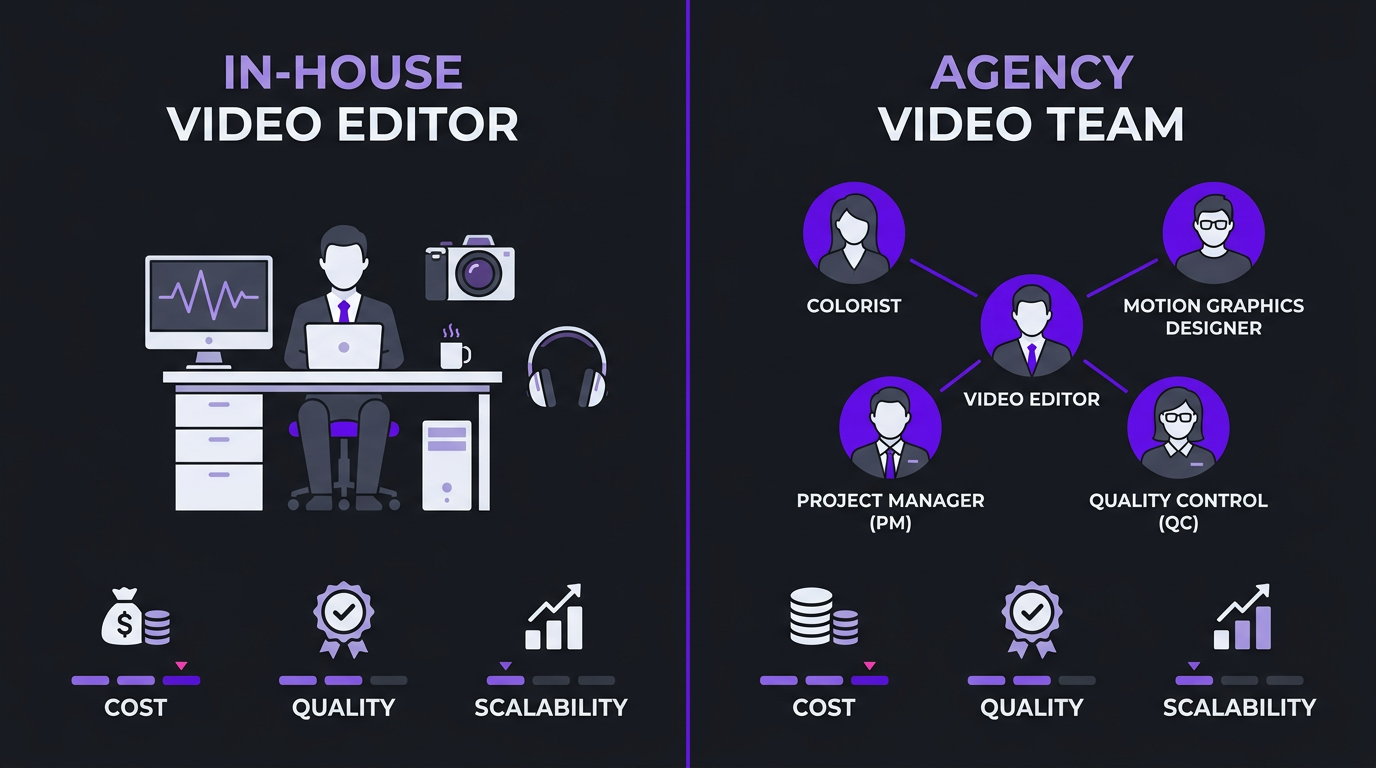
You’ve hit the point where editing your own videos isn’t sustainable. Content is stacking up, deadlines are slipping, and you’re spending more time in Premiere Pro than actually running your business. Now you’re facing the classic fork in the road: do you hire an in-house video editor, or do you bring in an agencya
Both paths have rabid advocates online. Freelance communities swear that an in-house editor is the only way to maintain creative control. Agency owners obviously push the team model. The truth — as always — sits somewhere in the middle, and it depends heavily on your volume, budget, and growth trajectory.
We’ve seen this decision play out hundreds of times. As a video editing agency that works with creators, startups, and enterprises, we’ve onboarded clients who tried in-house first, clients who came from other agencies, and clients who were still editing everything themselves at 50K subscribers. Each situation taught us something about when each model actually works — and when it quietly drains your budget.
Here’s the honest breakdown, with real numbers.
What’s in This Guide
The Real Cost of Hiring an In-House Video Editor
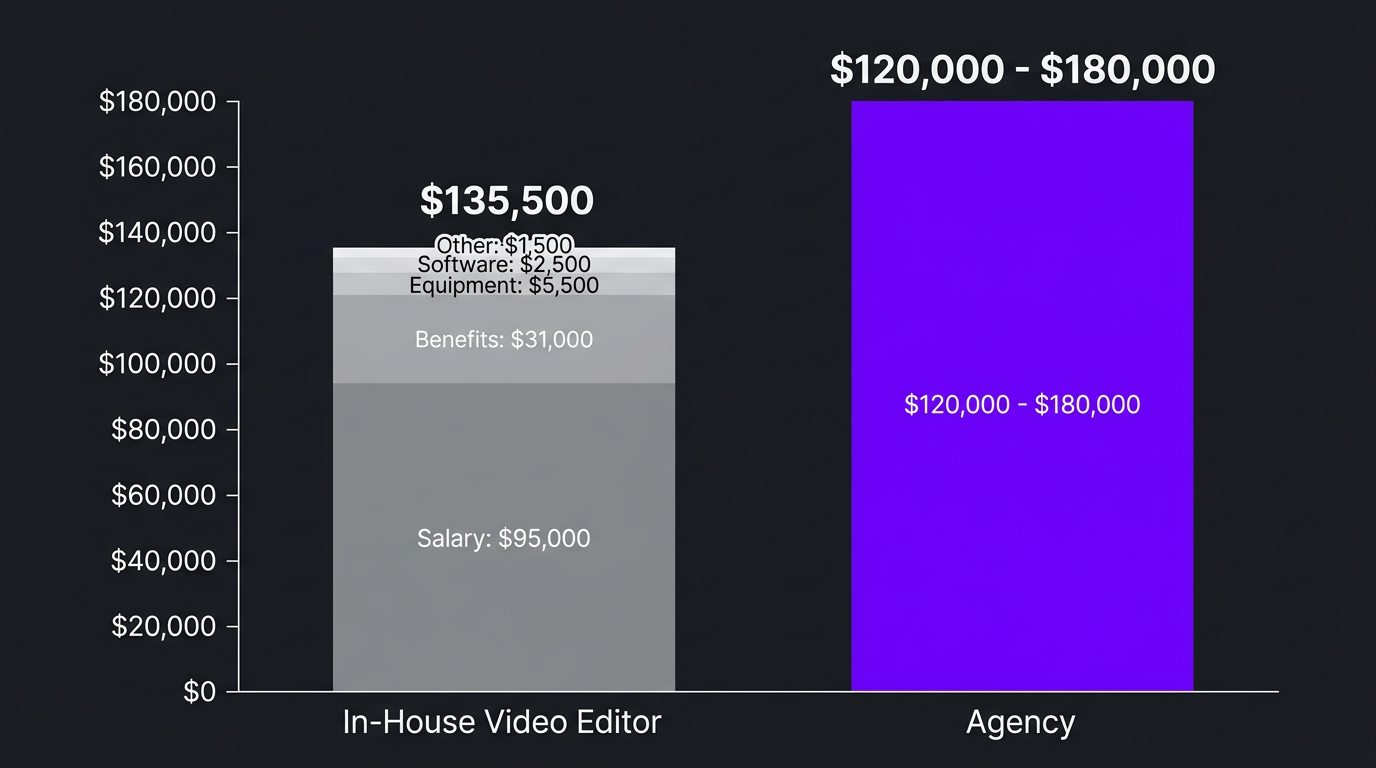
When most business owners think about hiring an in-house editor, they think about salary. That’s the most visible line item — but it’s maybe 60% of the actual cost. The full picture is significantly more expensive.
Salary: The Baseline
According to Glassdoor and Payscale data from 2025, here’s what video editors earn in the U.S.:
| Experience Level | Annual Salary (U.S.) | Monthly Equivalent |
|---|---|---|
| Junior (0–2 years) | $38,000–$50,000 | $3,167–$4,167 |
| Mid-level (2–5 years) | $50,000–$70,000 | $4,167–$5,833 |
| Senior (5–10 years) | $70,000–$95,000 | $5,833–$7,917 |
| Lead/Expert (10+ years) | $90,000–$130,000+ | $7,500–$10,833+ |
In major metros like LA, NYC, or Austin, add 15–30% to those numbers. Remote hires from smaller markets can be 10–20% lower, but the talent pool thins quickly.
The Costs Nobody Budgets For
Salary is just the starting line. Here’s what most hiring managers forget to factor in:
- Benefits and payroll taxes: Health insurance, 401(k) matching, workers’ comp, FICA — add 25–35% on top of base salary. A $65,000 editor actually costs $81,000–$88,000.
- Equipment: A professional editing workstation (Mac Studio or high-end PC, dual monitors, color-accurate display) runs $4,000–$8,000 upfront, plus upgrades every 3–4 years.
- Software licenses: Adobe Creative Cloud ($660/year), DaVinci Resolve Studio ($295 one-time), plus supplementary tools like After Effects plugins, stock footage subscriptions ($200–$600/year), and music licensing ($200–$500/year).
- Storage infrastructure: Raw video footage is massive. A NAS, RAID setup, or cloud storage solution for a busy editing workflow costs $1,000–$3,000/year.
- Training and development: Skills decay fast in video editing. Budget $500–$2,000/year for courses, conferences, or skill development.
- Recruiting costs: Finding a good editor takes 4–8 weeks on average. Between job postings, your time reviewing portfolios, conducting interviews, and running test edits, the hiring process itself costs $3,000–$8,000 in direct and indirect expenses.
- Onboarding: A new editor is typically at 50–70% productivity for the first 4–6 weeks while learning your brand, workflows, and preferences. That’s a month of paying full salary for partial output.
The True Annual Cost
Let’s add it all up for a mid-level editor:
| Cost Category | Annual Amount |
|---|---|
| Base salary | $60,000 |
| Benefits and payroll taxes (30%) | $18,000 |
| Equipment (amortized) | $2,000 |
| Software and subscriptions | $1,500 |
| Storage | $1,500 |
| Training | $1,000 |
| Recruiting (amortized over 3-year tenure) | $2,000 |
| Total annual cost | $86,000 |
| Monthly equivalent | $7,167 |
That’s $7,167 per month for one mid-level editor. Not a team. Not a colorist plus a motion designer plus a project manager. One person who may or may not be able to handle motion graphics, color grading, and sound design at a professional level.
What a Video Editing Agency Actually Costs
Agency pricing varies wildly depending on the tier. Let’s map out what’s available in 2026:
| Agency Tier | Monthly Cost | What You Get | Per-Video Effective Rate |
|---|---|---|---|
| Budget subscription (Vidchops, basic plans) | $300–$700 | 2–4 basic videos, templated edits, limited revisions | $100–$250 |
| Mid-tier service (Tasty Edits, beCreatives) |
$1,000–$2,500 | 4–10 videos, dedicated editor, faster turnaround | $150–$400 |
| Premium agency (Increditors) |
$2,500–$6,000 | 8–30+ videos, dedicated team, motion graphics, shorts + long-form, PM included | $150–$500 |
| Dedicated team model (Increditors Teams) |
$4,000–$8,000 | Full-time dedicated editor(s), 40 hrs/week capacity, PM + QC + specialist access | $100–$300 |
What’s Included That You Don’t See
When you hire an agency, your monthly fee absorbs costs that would otherwise be your problem:
- No equipment purchases. The agency provides workstations, monitors, and hardware. Zero capital expenditure on your side.
- No software licenses. Adobe, DaVinci, After Effects, stock footage subscriptions — all covered.
- No benefits or payroll taxes. You’re paying a flat fee for a service, not employing humans.
- No recruiting costs. The agency handles hiring, vetting, and replacing underperformers.
- No training investment. Agencies train their own editors and keep skills current.
- Built-in redundancy. If your dedicated editor is unavailable, another team member steps in.
A premium agency at $5,000/month gives you access to an editor, a colorist, a motion designer, project management, and quality control — for roughly 60% of what one mid-level in-house editor costs when you factor in total employment expenses.
Side-by-Side: In-House Editor vs Agency Cost Comparison
Let’s model three common scenarios to see how the numbers actually shake out.
Scenario A: Small Business (8 videos/month)
| Factor | In-House Editor | Premium Agency |
|---|---|---|
| Monthly cost | $7,167 (total employment cost) | $3,000–$4,500 |
| Cost per video | $896 | $375–$563 |
| Specialists included | 1 generalist | Editor + colorist + motion designer |
| Your management time | 8–12 hrs/month | 2–4 hrs/month |
| Editor utilization | ~50% (underutilized) | 100% (you pay for what you use) |
| Winner | ✅ Agency (40–50% cheaper) |
At 8 videos per month, an in-house editor is dramatically underutilized. You’re paying a full salary for someone who could realistically handle 15–25 videos per month. That idle capacity is money burning.
Scenario B: Growing Creator (16 videos + 20 shorts/month)
| Factor | In-House Editor | Premium Agency |
|---|---|---|
| Monthly cost | $7,167 | $5,000–$6,500 |
| Cost per piece | $199 | $139–$181 |
| Capacity risk | Editor at 90%+ — one sick day = missed deadline | Team absorbs spikes |
| Shorts quality | Same editor — may not specialize in short-form | Dedicated short-form specialist |
| Winner | ✅ Agency (lower risk, comparable cost) |
Scenario C: Enterprise (40+ videos/month, multiple formats)
| Factor | In-House Team (2 editors) | Dedicated Agency Team |
|---|---|---|
| Monthly cost | $14,334 (2 editors fully loaded) | $7,000–$10,000 |
| Specialists | 2 generalists (may need 3rd for motion graphics) | Full team: editors, colorist, motion designer, PM |
| Scalability | Need another hire = 6-week recruiting cycle | Scale up next month |
| Winner | ✅ Agency (30–50% cheaper, more flexible) |
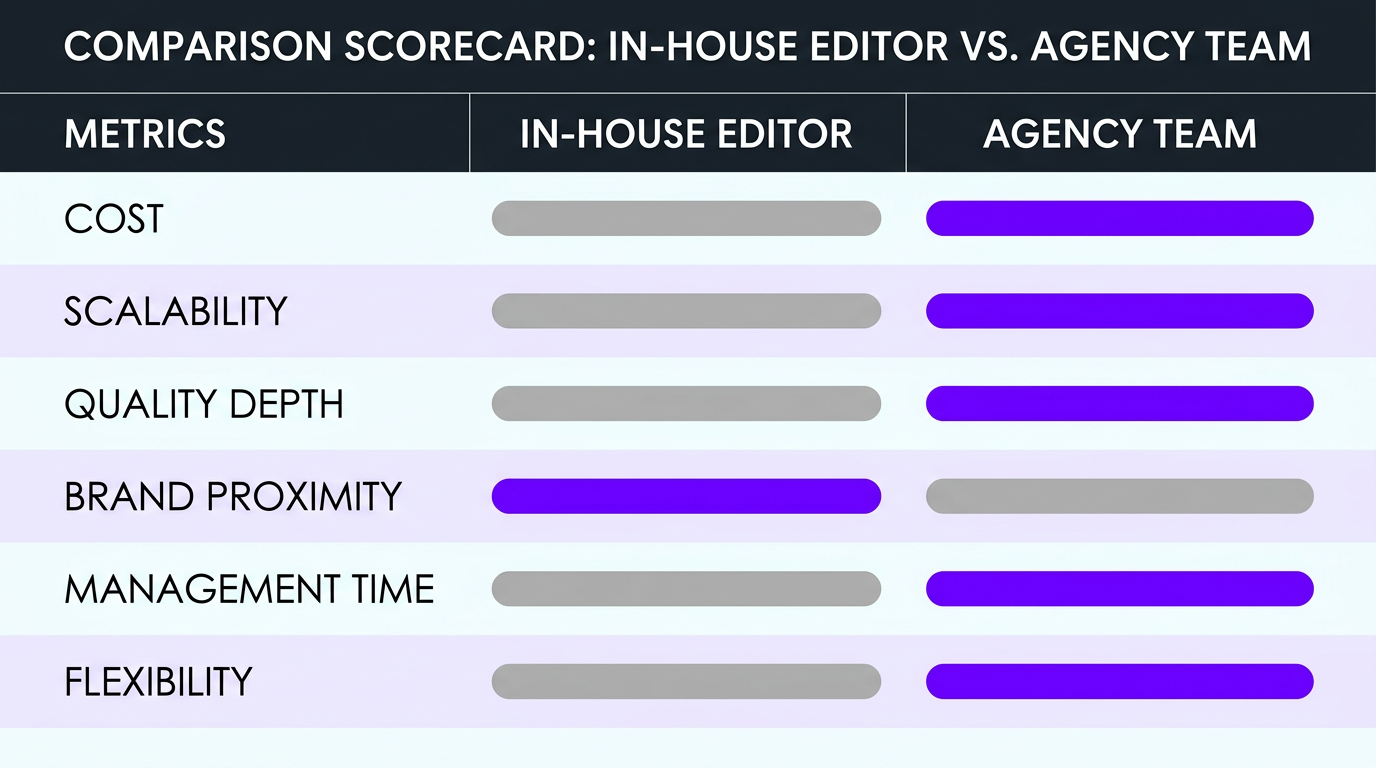
The pattern is clear: agencies win on cost in almost every scenario below the threshold where you need multiple full-time, physically-present editors (daily live shoots, confidential footage that can’t leave your network). Above that threshold — roughly 60+ complex videos per month — a hybrid model starts to make sense.
Quality and Creative Control: Does In-House Always Wina
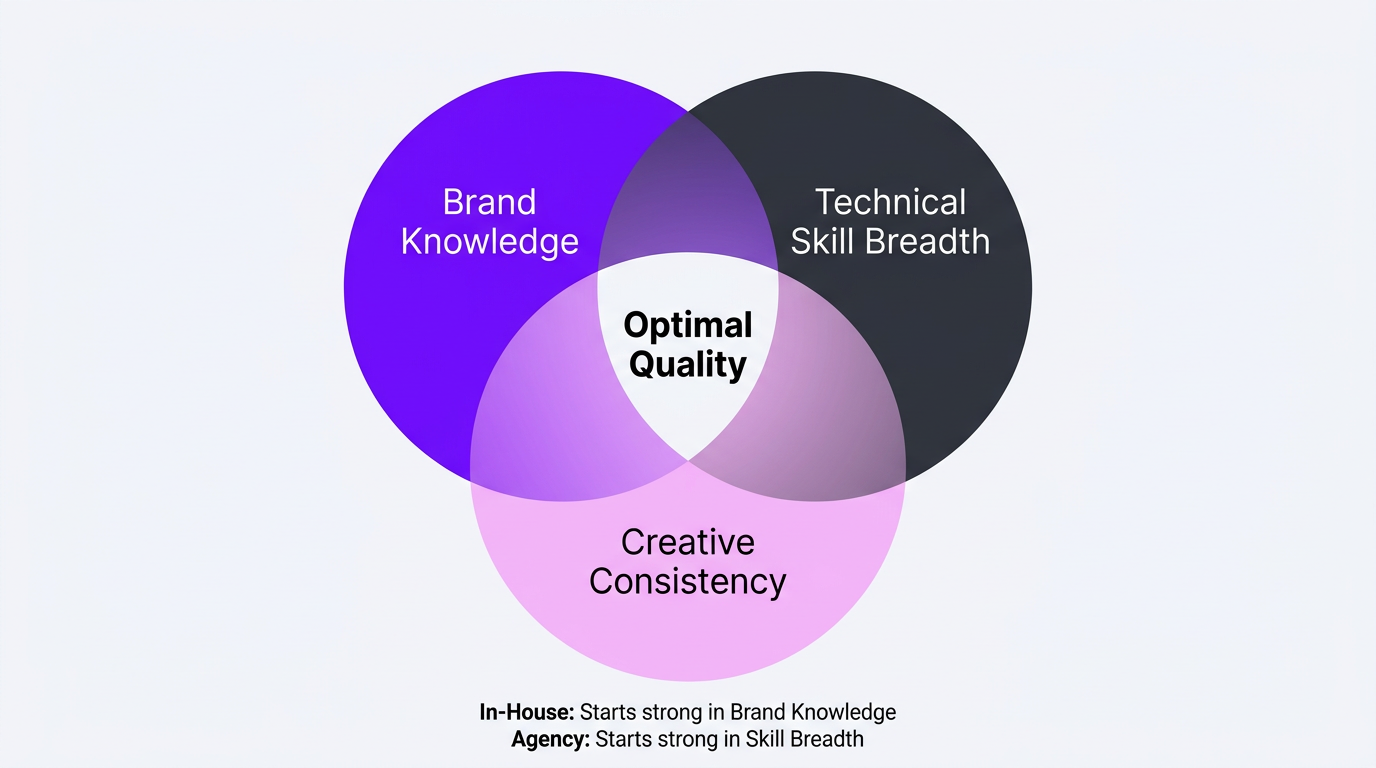
The most common argument for in-house editors is creative control. “They sit in my office. I can tap them on the shoulder. They absorb the brand by osmosis.” There’s truth to this — proximity does accelerate brand fluency. But the argument overstates the advantage and ignores a critical counterpoint: skill breadth.
The Generalist Trap
An in-house editor is one person. That person has specific strengths and inevitable weaknesses. They might be excellent at pacing and storytelling but mediocre at motion graphics. They might nail color correction but struggle with sound design. In a professional editing pipeline, these are distinct specializations — and agencies staff accordingly.
At Increditors, a typical client project touches at least three specialists: the primary editor (cuts, pacing, storytelling), a colorist (grading, look development), and a motion designer (graphics, lower thirds, animated elements). The client experiences this as a single seamless deliverable, but the quality difference compared to one generalist trying to do everything is immediately visible.
The Brand Knowledge Question
Does an agency editor understand your brand as deeply as someone sitting in your office In the first month, probably not. By month three, the gap is negligible. By month six, a dedicated agency editor who has cut 50+ videos for your brand knows your style as deeply as any employee — sometimes better, because they bring cross-client perspective on what works and what doesn’t.
This isn’t theoretical. When we onboarded TuMeke, an AI-powered livestock monitoring startup, their concern was exactly this: “How will an external team understand our highly technical producta” TuMeke creates content around animal welfare technology — a niche that requires genuine understanding of both the technology and the agricultural audience.
Within three weeks, our dedicated editor was producing content that TuMeke’s internal team described as “better than what we were doing ourselves.” The secret wasn’t magic — it was structured onboarding. Brand guide documentation, 5 reference videos analyzed frame-by-frame, weekly feedback loops for the first month, and a dedicated editor who didn’t rotate off to other clients. The startup editing model we built for them became a template we now use across all technical clients.
Scalability and Flexibility: Where Agencies Dominate
Content production is rarely steady. You might produce 8 videos in a normal month, then need 25 for a product launch. Or you might scale from 4 videos/month to 20 over six months as your channel grows. These fluctuations expose the biggest structural weakness of the in-house model.
Scaling Up with In-House
Need more capacity You have two options:
- Overtime: Your editor works extra hours, quality drops from fatigue, and you risk burnout. Sustainable for maybe 2–3 weeks.
- New hire: Takes 4–8 weeks to find, interview, and onboard someone. By the time they’re productive, the crunch might be over — and now you have excess capacity you’re paying for.
Scaling Up with an Agency
You send a message: “We need double capacity next month for our product launch.” The agency assigns additional editors from their bench, briefed by your dedicated editor who already knows your brand. You go from 10 videos/month to 20 with a single conversation and a proportional fee increase.
Scaling Down
This is where the in-house model really hurts. If business slows down or you need to cut costs, reducing an in-house editor’s hours means legal complexity, morale issues, or severance costs. With an agency, you adjust your plan. No HR meetings, no awkward conversations.
For enterprise clients with seasonal content needs — think holiday campaigns, Q4 pushes, or event coverage — the ability to flex capacity up and down is worth thousands in avoided overhead.
Format Flexibility
Your in-house editor excels at YouTube long-form. Now marketing wants Instagram Reels, LinkedIn wants thought leadership clips, and sales needs product demos. Each format requires different pacing, different aspect ratios, different platform knowledge. Your single editor is now scrambling to become an expert in five formats simultaneously.
An agency has specialists for each format. The social media editing team handles Reels and TikTok. The YouTube team handles long-form. The product video specialists handle demos and explainers. You get platform-native quality across all formats without your single editor pulling all-nighters trying to learn Reels trends.
Need to Scale Your Video Productiona
Whether you’re producing 4 videos or 40 per month, we build a team that flexes with your content calendar. No long-term contracts required.
Risk and Business Continuity
Here’s a scenario that keeps content managers awake at night: your in-house editor quits. They give two weeks’ notice (if you’re lucky). Suddenly, your entire content pipeline — the thing driving leads, views, and revenue — grinds to a halt. You spend 6–8 weeks hiring a replacement, another 4–6 weeks onboarding them, and lose 2–3 months of content momentum in the process.
This isn’t hypothetical. Editor turnover in creative roles averages 18–24 months. The better your editor gets, the more likely they are to leave for higher-paying opportunities. You’re constantly one resignation away from a content crisis.
The Agency Safety Net
Agencies eliminate single-point-of-failure risk. If your dedicated editor takes a vacation, gets sick, or even leaves the agency, another trained editor steps in — already familiar with your brand through shared documentation and institutional knowledge. Your content never stops.
At Increditors, every client’s brand guidelines, style references, and editing preferences are documented in a shared system. If your primary editor is unavailable, a backup editor can produce at 90%+ quality from day one because they have the playbook. There’s no two-month gap while someone new “figures out the style.”
Intellectual Property and Institutional Knowledge
When an in-house editor leaves, they walk out with institutional knowledge about your workflows, your content strategy, and your raw footage organization. Rebuilding that context with a new hire is painful and expensive.
With an agency, that knowledge lives in systems, not in one person’s head. Project files are organized, brand guides are documented, and editorial preferences are codified. The knowledge belongs to the relationship, not to an individual.
Management Overhead: The Hidden Time Cost
Nobody factors this in, and it’s often the deciding variable.
Managing an In-House Editor
An in-house editor is an employee. That means:
- Daily management: Task assignment, priority setting, progress check-ins (30–60 min/day)
- Performance reviews: Quarterly or annual reviews, goal setting, career development conversations
- HR administration: Time off requests, benefits questions, policy compliance
- Creative direction: Briefing each project, reviewing rough cuts, providing feedback, approving finals
- Technical support: When software crashes, when the render fails, when the NAS runs out of space — that’s your problem now
- Skill development: Identifying training needs, sourcing courses, allowing time for learning
Conservatively, managing an in-house editor takes 8–15 hours per month of your time or a team lead’s time. If your time is worth $100/hour, that’s $800–$1,500/month in management overhead — on top of the $7,167 in total employment cost.
Managing an Agency
Your interaction with a well-run agency looks like this:
- Weekly: 30-minute sync call or async brief (optional after the first month)
- Per video: 5-minute brief submission, 10-minute review of first cut, 5-minute final approval
- Monthly: 30-minute review of performance and upcoming calendar
Total: 3–5 hours per month. The agency handles task management, QC, technical issues, and creative problem-solving internally. You focus on strategy and approval — the work that actually requires your judgment.
| Management Task | In-House (hrs/month) | Agency (hrs/month) |
|---|---|---|
| Task assignment and prioritization | 4–6 | 1–2 |
| Creative briefing | 2–4 | 1–2 |
| Review and feedback | 3–5 | 1–2 |
| HR and admin | 2–3 | 0 |
| Technical troubleshooting | 1–3 | 0 |
| Total | 12–21 hours | 3–6 hours |
That 9–15 hour difference per month adds up to over 100 hours per year. For a founder, creator, or marketing director, those hours are better spent on content strategy, audience building, or actually creating content.
The Hybrid Model: Best of Both Worldsa
Some businesses land on a hybrid approach, and it can work well in specific situations:
When Hybrid Makes Sense
- In-house editor for daily, quick-turn content (social media reactions, behind-the-scenes, same-day posts) + agency for produced, long-form content (YouTube series, brand campaigns, product launches).
- In-house editor for rough cuts and assembly + agency for finishing (color grading, motion graphics, sound design, final polish).
- In-house for confidential content (internal training, pre-announcement material) + agency for public-facing content (marketing videos, YouTube, social).
When Hybrid Doesn’t Make Sense
If you’re considering hybrid to “save money,” the math usually doesn’t work. You’re carrying the full overhead of an employee (salary, benefits, equipment) plus an agency fee. Unless each piece has a clearly distinct role, you end up with two cost centers and unclear ownership of the editing pipeline.
The hybrid model works when it’s driven by functional requirements (some content genuinely needs to be produced in-house due to speed or confidentiality), not by an attempt to split the bill.
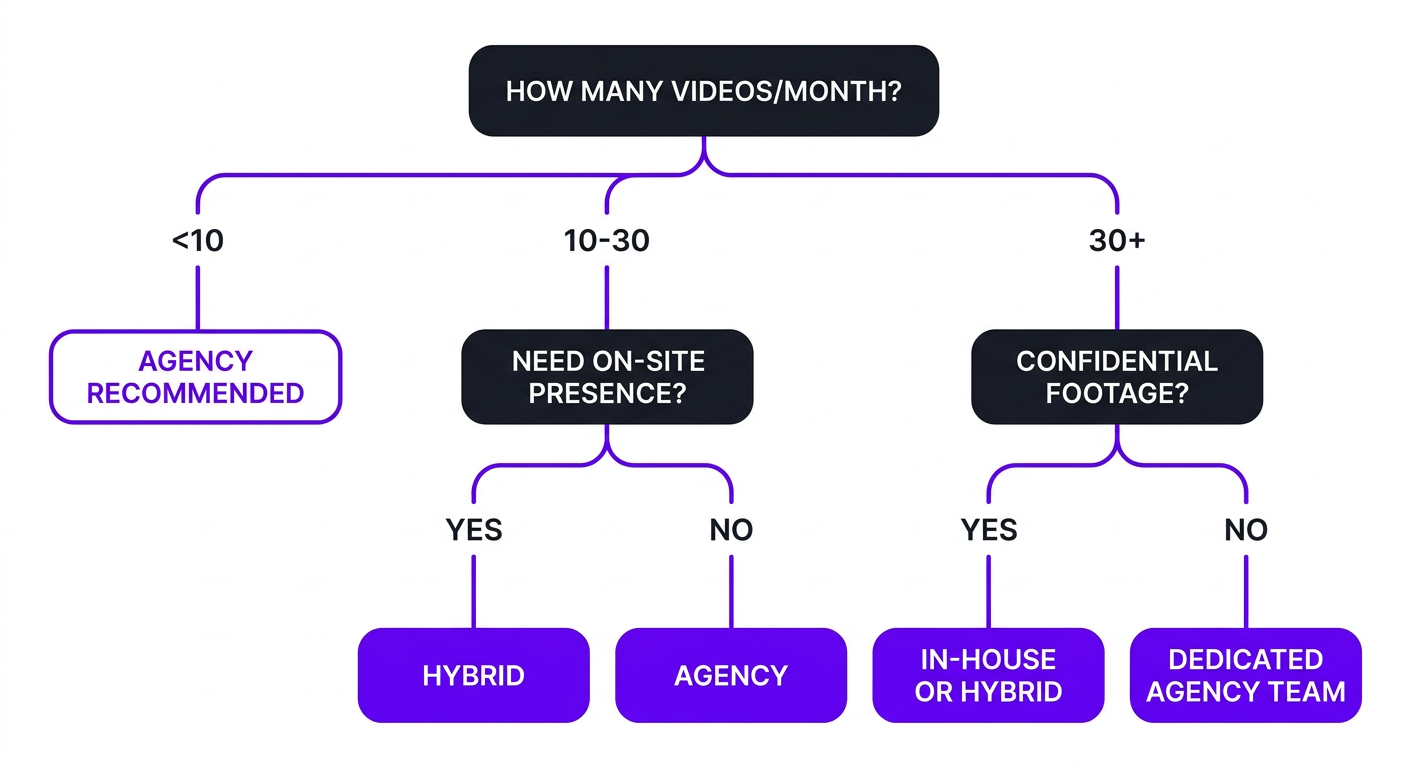
Decision Framework: In-House Video Editor vs Agency
Forget the blanket advice. Here’s a framework based on your specific situation:
Choose In-House If:
- You produce 30+ videos per month that require daily in-person collaboration
- Your content involves proprietary or confidential footage that can’t leave your network
- You need an editor physically present during shoots for real-time feedback
- You have a fully built-out content team (director, producers) and need an editor to complete the pipeline
- Your budget exceeds $8,000/month and volume justifies full-time utilization
Choose an Agency If:
- You produce 4–30 videos per month and want predictable costs
- You need multiple specializations (editing + color + motion graphics + sound)
- Your volume fluctuates seasonally or with campaigns
- You want to minimize management overhead and focus on strategy
- You value business continuity over single-editor relationships
- You’re a content creator whose time is better spent on camera than in the timeline
Choose Hybrid If:
- You have distinct content types that require different production models
- Some content is time-sensitive (daily social) while other content is quality-critical (YouTube, brand)
- Confidentiality requirements apply to some but not all content
The Volume Threshold
Through working with hundreds of clients, we’ve identified a rough threshold: below 25–30 produced videos per month, an agency is almost always more cost-effective. Above 40+ videos with in-person production needs, in-house starts to make financial sense. The gray zone in between depends on complexity, format mix, and how much you value your own time.
Real-World Examples
VYVE Wellness: From In-House Struggles to Agency Partnership
VYVE Wellness, a health and wellness brand focused on holistic content, initially tried the in-house route. They hired a junior editor at $45,000/year who was excellent at clean cuts but lacked skills in motion graphics and the dynamic pacing their wellness content needed to stand out on YouTube.
The result: technically competent but visually flat content that wasn’t converting viewers into customers. They were spending $62,000/year (total employment cost) for output that looked like it came from a $1,500/month subscription service.
When VYVE partnered with Increditors, the shift was immediate. Our team brought a dedicated editor who specialized in lifestyle and wellness content, a colorist who created a signature warm, inviting look for their brand, and a motion designer who built custom animated segments. Total monthly cost: $4,500 — roughly $54,000/year, or $8,000 less than their in-house editor cost, with dramatically better output.
More importantly, VYVE’s founder got back 15+ hours per month she’d been spending managing the editor, reviewing cuts, and trying to explain what “more energy” in the editing meant. With our team, she submitted a 2-minute brief per video and reviewed one cut. The workflow difference freed her to create more content — which drove the growth that justified the investment.
TuMeke: Technical Content That Demanded Specialist Understanding
TuMeke’s challenge was different. As an AI livestock monitoring company, their content required editors who understood both technology demos and agricultural audiences — a rare combination. They’d tried freelancers who could make tech content look good but missed the agricultural context, and agricultural content editors who couldn’t handle product demo pacing.
Our dedicated team model gave TuMeke something they couldn’t find in a single hire: a primary editor trained on their product and audience, backed by a team that could handle everything from conference presentation edits to social media clips to investor-facing content. The startup plan we designed for them scaled from 6 videos/month to 18 as their content strategy matured — a scaling speed that would have required two additional hires in an in-house model.
The cost comparison was stark: two in-house editors to handle the same volume and format diversity would have cost TuMeke approximately $150,000/year fully loaded. The agency model delivered equivalent (or better) output for under $72,000/year.
Frequently Asked Questions
An in-house editor costs $50,000–$85,000/year in salary plus $15,000–$30,000 in benefits, equipment, and software. A video editing agency typically costs $2,500–$6,000/month ($30,000–$72,000/year) with no overhead. For most businesses producing 4–20 videos per month, an agency is 30–50% cheaper when total cost of employment is factored in.
Hire in-house when you produce daily content requiring real-time collaboration, have proprietary footage that can’t leave your network, need an editor physically present for shoots, or have enough volume (30+ videos/month) to justify a full-time salary plus benefits. Below that threshold, agencies are typically more efficient.
Single-editor dependency creates a bottleneck. If they’re sick, on vacation, or quit, your content pipeline stops. Average editor tenure is 18–24 months — meaning you’ll face this disruption regularly. You also get one person’s skill set, which may not cover all formats and styles your content requires. Agencies provide team redundancy and specialist depth.
Yes, with proper onboarding. Premium agencies assign dedicated editors who learn your brand over time. After 2–4 weeks of structured onboarding — analyzing reference videos, studying brand guides, and weekly feedback loops — a dedicated agency editor operates with the same brand fluency as an in-house hire. By month three, the gap is negligible.
Start with a 30-day overlap. Share your brand guide, style references, 3–5 example videos, and your editor’s workflow documentation with the agency. Run both in parallel for the first month to calibrate quality. Most agencies, including Increditors, handle this transition as part of onboarding at no additional cost.
Team depth (backup editors, colorists, motion designers), project management, multi-layer quality control, scalability (ramp up for campaigns, scale down in quiet months), cross-platform expertise, and institutional knowledge that survives individual turnover. An agency is a system; an in-house editor is a person.
Ready to Compare Your In-House Costs to Agency Pricinga
We’ll give you an honest assessment of whether an agency model makes sense for your volume, formats, and budget. No pressure — just real numbers.
Salary data referenced from Glassdoor and Payscale 2025 reports. Total cost of employment calculations follow standard 30% benefits loading factor used by the Bureau of Labor Statistics. Agency pricing reflects 2026 market rates. For current Increditors pricing, visit our pricing page or book a call.