










![3D Explainer Video - ScribbleLive.mp4_snapshot_00.12_[2022.03.09_03.14.16]](https://increditors.com/wp-content/uploads/elementor/thumbs/3D-Explainer-Video-ScribbleLive.mp4_snapshot_00.12_2022.03.09_03.14.16-r7wb53mx72rxst3qcqyrfxdmeyzb5r9jbl0wbjujh4.png "3D Explainer Video – ScribbleLive.mp4_snapshot_00.12_[2022.03.09_03.14.16]")































You’ve decided to outsource your video editing. Smart move. But before you sign anything or send a deposit, there’s a question that will shape your budget, your workflow, and the quality of your content for the foreseeable future: should you pay per project or commit to a monthly retainera
This isn’t just a pricing question. It’s a business model question. The structure of your video editing retainer vs per project pricing agreement determines how your editor prioritizes your work, how fast you get deliverables, and whether costs stay predictable or spiral with every new video.
We’ve operated under both models — as an agency offering retainers and working with clients who initially came to us for single projects. Here’s what we’ve learned about when each model actually makes sense.
What’s in This Guide
- The Four Pricing Models Explained
- Per-Project Pricing: Deep Dive
- Monthly Retainer: Deep Dive
- Hourly Billing: When It Makes Sense
- Subscription / Unlimited: The New Model
- Side-by-Side Cost Comparison
- Hidden Costs in Each Model
- How to Negotiate Better Rates
- Red Flags in Pricing Agreements
- Case Studies: Real Pricing Decisions
- How to Choose the Right Model
- FAQ
The Four Video Editing Pricing Models
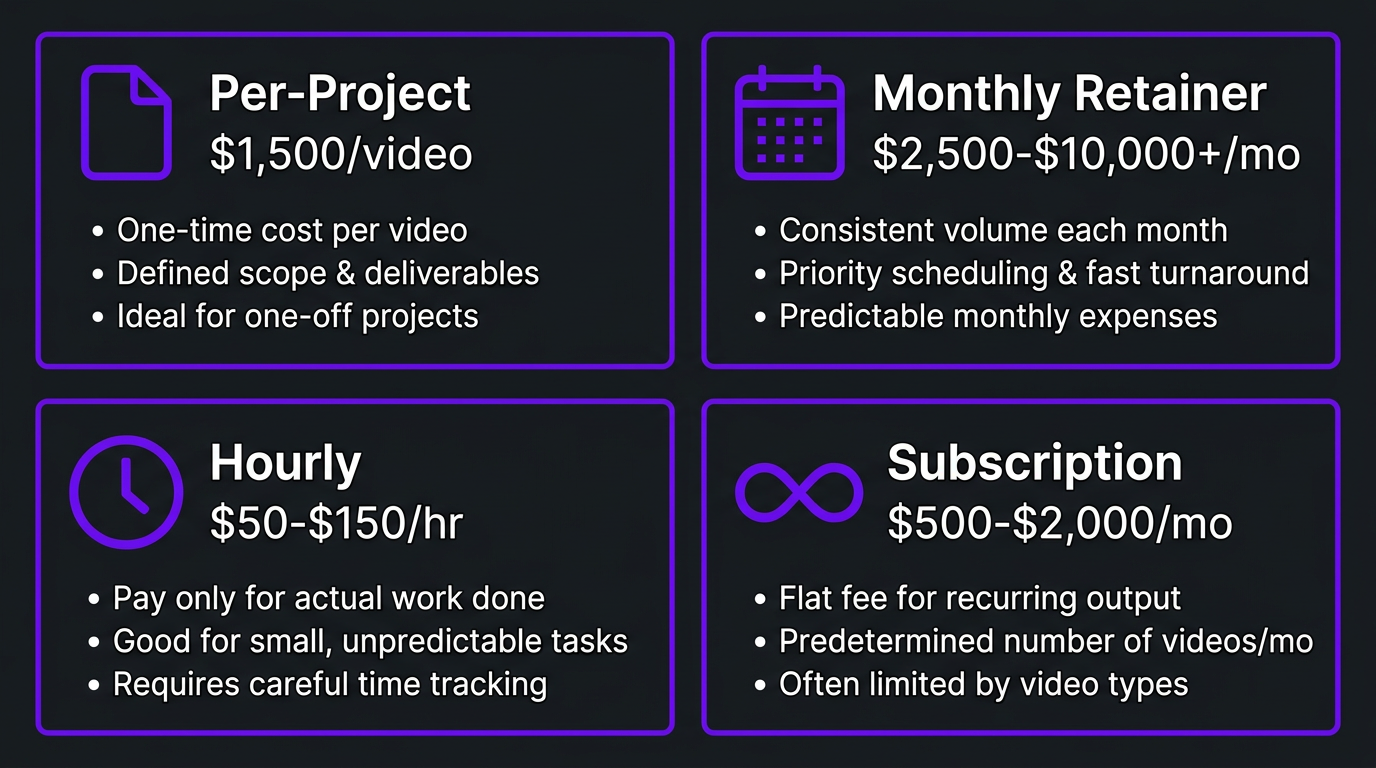
Before we go deep on retainer vs per-project, let’s map the full landscape. There are four pricing structures you’ll encounter when hiring video editors in 2026:
| Model | How It Works | Typical Range | Best For |
|---|---|---|---|
| Per-project / Per-video | Fixed price per deliverable | $100–$1,500/video | One-off projects, irregular schedules |
| Monthly retainer | Fixed monthly fee for agreed deliverables | $1,500–$8,000+/mo | Regular content producers, brands |
| Hourly | Billed per hour of editing work | $25–$150/hr | Undefined scope, exploratory projects |
| Subscription / Unlimited | Flat monthly fee for “unlimited” requests | $500–$5,000/mo | High-volume, standardized content |
Each model has legitimate use cases. The “best” model depends on your content volume, budget predictability needs, and how much control you want over scope.
Per-Project Pricing: The Complete Breakdown
Per-project pricing is the simplest model: you pay a fixed price for a specific deliverable. One YouTube video, one price. One brand commercial, one price. There’s clarity in that simplicity.
How Per-Project Pricing Works in Practice
Typically, you and the editor agree on scope before work begins:
- Video type and length
- Complexity level (basic cuts vs. full production)
- Number of revision rounds included
- Turnaround time
- Deliverable format and resolution
The editor quotes a price — say, $350 for a 12-minute YouTube video with color correction, basic graphics, and two revision rounds. You approve, send footage, and pay upon delivery (or split 50/50 upfront and on completion).
Per-Project Pricing Ranges by Video Type
| Video Type | Budget Tier | Professional Tier | Premium Tier |
|---|---|---|---|
| YouTube long-form (10-20 min) | $100–$250 | $300–$500 | $500–$1,200 |
| YouTube essay/educational | $200–$400 | $400–$800 | $800–$2,000 |
| Short-form (Reels/Shorts/TikTok) | $25–$75 | $75–$175 | $175–$400 |
| Podcast video (30-60 min) | $150–$300 | $300–$600 | $600–$1,200 |
| Brand/commercial (1-3 min) | $300–$700 | $700–$2,000 | $2,000–$5,000+ |
| Product demo/explainer | $200–$500 | $500–$1,200 | $1,200–$3,000 |
Advantages of Per-Project
Zero commitment. You pay for what you need, when you need it. No monthly minimums, no retainer fees collecting dust in months where you produce less content. For creators with irregular posting schedules — maybe you travel one month and don’t film, then batch-produce the next — this flexibility is real.
Budget clarity per deliverable. You know exactly what each video costs before work starts. There are no surprises (assuming you defined scope properly). This makes per-project ideal for businesses that need to allocate costs to specific campaigns or P&L lines.
Easy to compare options. Getting three quotes for the same project is straightforward with per-project pricing. Try getting comparable quotes for three different retainer structures — it’s apples to oranges.
Ability to shop specialists. Different projects might benefit from different editors. A per-project model lets you hire a motion graphics specialist for one video and a documentary-style editor for the next.
Disadvantages of Per-Project
Higher per-unit cost. One-off videos always cost more per unit than committed volume. Editors price in the overhead of scoping, onboarding, and the unpredictability of one-time clients. On average, per-project rates are 20-40% higher than the effective per-video rate on retainers.
No priority scheduling. When you’re a one-off client, you go to the back of the line behind retainer clients. Your turnaround is whatever the editor has available, not what your content calendar needs.
Scope creep risk. Per-project pricing only works if scope is clearly defined. When you discover mid-edit that you need an extra scene added or want motion graphics you didn’t initially request, you’re either paying overage fees or awkwardly renegotiating.
No relationship equity. Each project is transactional. The editor doesn’t invest in learning your brand deeply because there’s no guaranteed next project. You get competent work, but not the compounding quality that comes from long-term relationships.
Monthly Retainer Pricing: The Complete Breakdown
A video editing retainer is a monthly agreement: you pay a fixed amount and receive a defined set of deliverables, editor access, and service levels. It’s the dominant model for creators and businesses producing regular content.
How Retainers Are Structured
Most retainers define some combination of:
- Video count: “Up to 8 YouTube long-form videos per month”
- Editor hours: “80 hours of dedicated editing time per month”
- Deliverable mix: “4 long-form + 12 short-form clips per month”
- Turnaround SLA: “First draft within 48 hours of receiving footage”
- Revision policy: “2 rounds per video included; additional rounds at $X”
The best retainers are flexible within their parameters. If you need 6 videos one month and 10 the next, a good agency adjusts — as long as the average stays within the agreed range.
Retainer Pricing by Tier
| Tier | Monthly Cost | What’s Included | Effective Per-Video Cost |
|---|---|---|---|
| Starter | $1,500–$2,500/mo | 4-6 videos, one editor, standard turnaround | $375–$420 |
| Growth | $2,500–$4,500/mo | 8-12 videos, dedicated editor + PM, priority turnaround | $280–$375 |
| Scale | $4,500–$7,000/mo | 12-20 videos, dedicated team, same-day turnaround, shorts included | $250–$350 |
| Enterprise | $7,000–$12,000+/mo | 20-40+ videos, multi-editor team, full PM + QA, custom SLAs | $200–$300 |
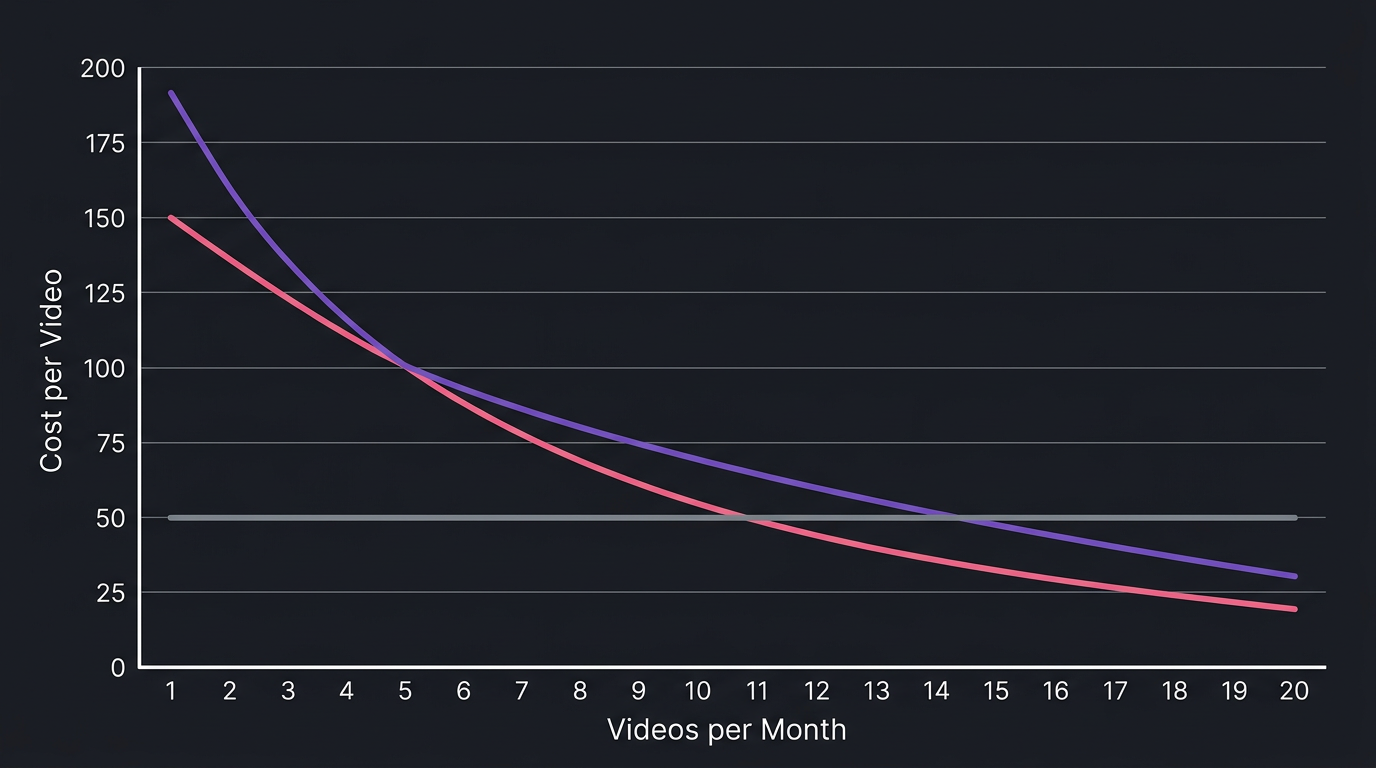
Notice the per-video cost decreasing as volume increases. This is the fundamental economics of retainers: you commit volume, the agency commits resources, and both sides benefit from efficiency gains.
Advantages of Retainers
Lower per-unit cost. As shown above, retainer clients pay 20-40% less per video than per-project clients. Over 12 months, this adds up to thousands of dollars in savings.
Priority and speed. Retainer clients get priority scheduling. Your editor blocks time for your content before taking one-off projects. At Increditors, retainer clients receive 24-48 hour turnaround by default — per-project clients get 3-5 business days.
Predictable budgeting. You know your editing costs on January 1st for the entire year. No surprise invoices, no scope creep costs, no variable pricing based on editor availability. For businesses running content as a cost center, this predictability is essential for budget planning.
Relationship and quality compounding. The retainer structure incentivizes editors to invest in your account. They learn your brand, build templates, create custom assets — because they know the relationship is ongoing. This is where the real value lives: by month 3-4, your editor produces work that requires minimal revisions because they understand your style intuitively.
Built-in infrastructure. Retainers typically bundle project management, QA review, backup coverage, and asset licensing. With per-project pricing, you either go without or pay for each of these separately.
Disadvantages of Retainers
Fixed cost in variable months. If you produce 8 videos in January but only 3 in February, you still pay the same retainer. Good agencies offer some flexibility (rollover hours, adjustable plans), but you’ll rarely get a refund for an underutilized month.
Higher upfront commitment. A $3,500/month retainer requires more upfront trust than a $400 per-video project. You’re betting that you’ll consistently need the volume — and that the agency will deliver the quality.
Harder to switch. After 4-6 months on a retainer, switching agencies means losing the style knowledge, templates, and workflow your current team has built. It’s not a lock-in per se, but it creates switching costs that don’t exist with per-project relationships.
Hourly Billing: When It Actually Makes Sense
Hourly billing is the least popular model for ongoing video editing — and for good reason. It incentivizes slow work, makes budgeting unpredictable, and creates an adversarial dynamic where you’re watching the clock instead of focusing on quality.
That said, hourly rates have legitimate use cases:
When Hourly Works
Undefined scope projects. If you’re not sure what you need — maybe you’re experimenting with a new content format or need an editor to help shape raw footage into something usable — hourly billing removes the pressure to define deliverables upfront.
Editing consultation. Sometimes you need an experienced editor to review your workflow, provide feedback on your current content, or train your in-house team. This is advisory work that doesn’t fit per-project or retainer models.
Emergency or overflow work. Your regular editor is maxed out and you need someone to handle a rush project. Hourly billing for overflow work avoids the commitment of a second retainer.
In-house team augmentation. If you have an in-house editor but occasionally need extra hands for heavy production weeks, hourly freelancers fill the gap without ongoing commitment.
Current Hourly Rates (2026)
| Editor Level | Freelance Rate | Agency Rate | Typical Efficiency |
|---|---|---|---|
| Junior (0-2 years) | $20–$35/hr | $35–$50/hr | 8-12 hrs per 10-min video |
| Mid-level (2-5 years) | $40–$70/hr | $60–$90/hr | 5-8 hrs per 10-min video |
| Senior (5-10 years) | $70–$110/hr | $90–$130/hr | 4-6 hrs per 10-min video |
| Specialist (VFX, animation) | $80–$150/hr | $120–$200/hr | Varies widely by project |
The hourly trap, revisited: A senior editor at $90/hour who completes your video in 5 hours costs $450. A junior editor at $25/hour who takes 18 hours costs $450. Same price, dramatically different output. Hourly rates don’t measure value — they measure time.
For this reason, we recommend hourly billing only for exploratory or advisory work. For actual editing deliverables, per-project or retainer pricing gives you clearer value alignment.
Subscription and “Unlimited” Models: The New Wave
The subscription model — often marketed as “unlimited video editing” — has exploded in popularity since 2023. Services like Vidchops, Video Husky, and several newer entrants offer flat monthly fees for ongoing editing work.
The model typically looks like this:
- Flat monthly fee ($500-$3,000+ depending on tier)
- “Unlimited” editing requests (with fine print)
- One active project at a time (this is the catch)
- 2-4 day turnaround per deliverable
- Managed through a dashboard or project board
How “Unlimited” Actually Works
The word “unlimited” deserves heavy air quotes. Most subscription services process one project at a time. So while you can submit unlimited requests, they’re handled sequentially. At a 3-day turnaround, that’s roughly 8-10 deliverables per month — not unlimited by any practical definition.
Some services offer higher tiers with parallel processing (two active projects simultaneously), which effectively doubles throughput to 15-20 deliverables. But at $2,000-$3,000/month for these tiers, the value proposition starts competing directly with traditional retainers that offer dedicated editors and project management.
We’ll cover this model in depth in our unlimited video editing services guide, but the key insight here is that subscriptions are essentially retainers with different marketing. The economics are similar; the packaging is different.
Subscription vs Retainer: Key Differences
| Factor | Subscription Model | Traditional Retainer |
|---|---|---|
| Pricing transparency | Flat fee published on website | Custom quoted per client |
| Editor assignment | Pool-based (varies) | Dedicated (consistent) |
| Throughput | Limited by sequential processing | Limited by agreed deliverable count |
| Customization | Standardized tiers | Fully customizable |
| Project management | Dashboard/self-serve | Dedicated PM |
| Quality control | Variable | Multi-layer QC |
| Best for | Standardized, high-volume, simple content | Complex, brand-critical, custom content |
Not Sure Which Pricing Model Fitsa
We’ll analyze your content volume, budget, and goals — then recommend the structure that gives you the best value. No commitment, no sales pressure.
Side-by-Side Cost Comparison: 12-Month Modeling
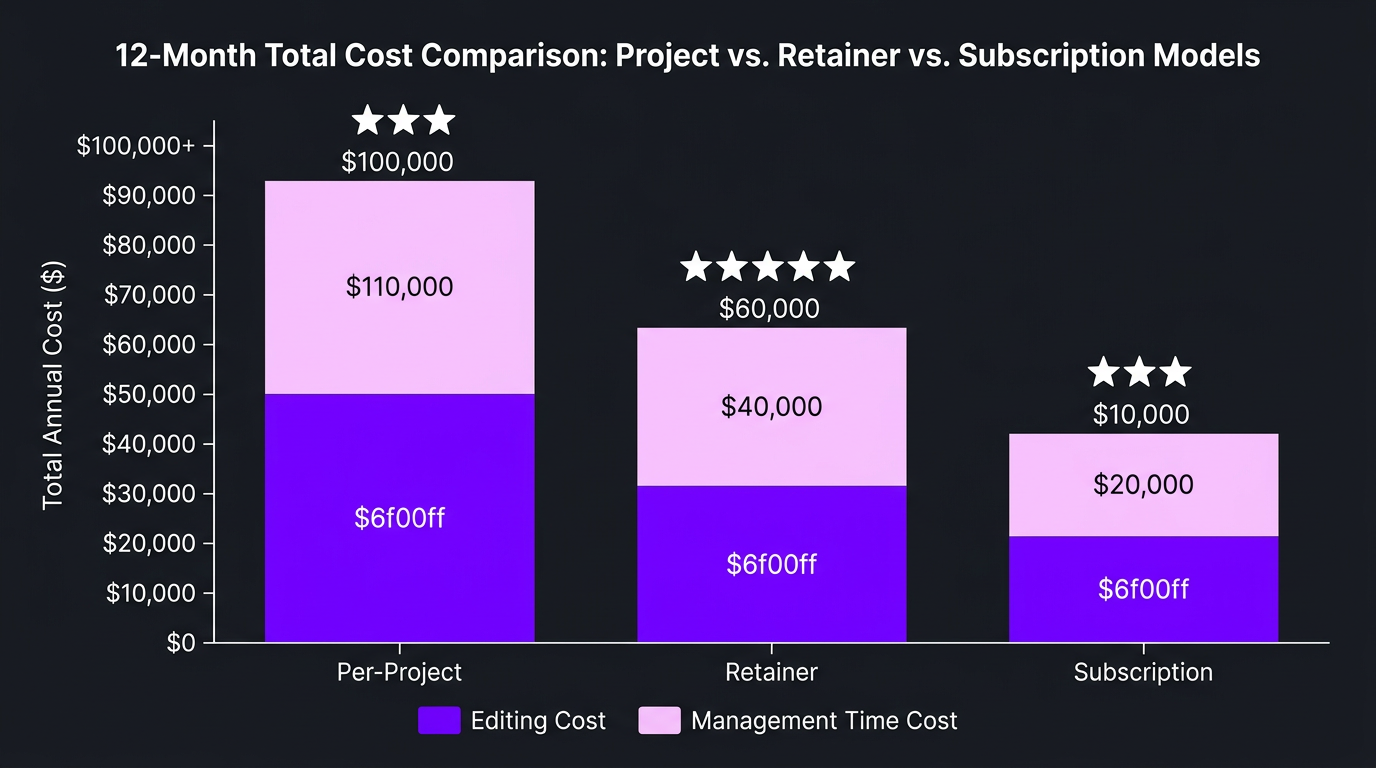
Let’s model what each pricing structure actually costs over a year for a creator producing 8 YouTube long-form videos per month.
| Factor | Per-Project | Retainer | Subscription |
|---|---|---|---|
| Per-video rate | $400 | ~$310 (effective) | ~$250 (effective, if you max throughput) |
| Monthly editing cost | $3,200 | $2,500 | $2,000 |
| Annual editing cost | $38,400 | $30,000 | $24,000 |
| Editor consistency | Variable (may change) | Same editor monthly | Variable (pool-based) |
| Avg turnaround | 3-5 days | 1-2 days | 2-4 days |
| Project management included | ❌ | ✅ | ⚠️ Dashboard only |
| QA review | ❌ | ✅ | ⚠️ Basic |
| Management time (monthly) | ~10 hrs | ~3 hrs | ~6 hrs |
| Management cost (annual, at $75/hr) | $9,000 | $2,700 | $5,400 |
| Total annual cost (editing + management) | $47,400 | $32,700 | $29,400 |
| Quality consistency | ⭐⭐⭐ | ⭐⭐⭐⭐⭐ | ⭐⭐⭐ |
The subscription model looks cheapest on paper — and for straightforward content, it can be. But the quality consistency gap is real. If your brand depends on polished, on-brand content (and most businesses and serious creators do), the retainer model’s premium buys you consistency that the subscription model can’t guarantee.
Hidden Costs in Each Pricing Model
Every model has costs that don’t appear on the price list. Here’s what to watch for:
Per-Project Hidden Costs
- Scope change fees: Adding B-roll, extending video length, or requesting additional graphics mid-project triggers overage charges — typically $50-$200 per scope expansion.
- Extra revision fees: Most per-project quotes include 2 revisions. A third round adds $75-$150.
- Rush fees: Need it faster than the standard timeline Expect 25-50% surcharges.
- Re-onboarding: Every new editor needs time to learn your style. With per-project, you might pay this tax on every project if editors rotate.
Retainer Hidden Costs
- Unused capacity: In slow months, you’re paying for editing capacity you don’t use. Good agencies offer rollover or flex provisions, but not all do.
- Overage fees: Exceeding your agreed deliverable count triggers per-video overages — often at higher-than-retainer per-video rates.
- Onboarding period: The first month is often less efficient as the editor ramps up. Budget for slightly lower output in month one.
Subscription Hidden Costs
- Throughput bottleneck: “Unlimited” means unlimited requests, not unlimited output. The one-at-a-time model caps your actual monthly deliverables.
- Quality variability: If different editors handle different projects, you may spend extra time on revisions to enforce consistency.
- Feature paywalls: Motion graphics, color grading, or sound design are often excluded from base subscription tiers and require upgrades.
How to Negotiate Better Rates (Regardless of Model)
Whether you’re going per-project or retainer, there are proven strategies to get better pricing:
1. Commit to Volume
Editors and agencies price in risk. A one-off client might never return. A client committing to 3 months and 8 videos/month is reliable revenue. Use that commitment as leverage: “I’ll guarantee 8 videos per month for 3 months. What’s your best ratea” Expect 15-25% discounts versus one-off pricing.
2. Provide Clean Footage and Clear Briefs
The biggest time sink for editors isn’t the creative work — it’s figuring out what you want. Organized footage, timestamped briefs, and reference videos reduce editing time by 20-30%. Some editors will price this efficiency gain into your quote if you demonstrate it upfront.
3. Be Flexible on Turnaround
Rush pricing exists because it disrupts the editor’s schedule. If you can give 5-7 day turnaround instead of 48 hours, you’ll pay less. Batch your content creation to give editors more lead time.
4. Bundle Formats
Rather than paying separately for long-form and short-form, negotiate a bundle. “8 YouTube videos plus the short-form clips derived from them” is a better deal than quoting shorts separately. The editor already has the footage open — creating clips is incremental work.
5. Negotiate Retainer Tiers, Not One-Off Discounts
Instead of haggling on individual video prices, negotiate the retainer structure: “At $3,500/month instead of $4,000, I’ll sign for 6 months.” Long-term commitments are more valuable to agencies than per-video discounts.
Red Flags in Video Editing Pricing Agreements
Before signing any pricing agreement — retainer or per-project — watch for these warning signs:
🚩 Vague Deliverable Definitions
If the agreement says “video editing services” without specifying video count, length, complexity, or revision rounds, you’re entering a dispute waiting to happen. Demand specifics.
🚩 Annual Lock-In Without Performance Clauses
A 12-month retainer is fine if there are performance guarantees (turnaround SLAs, quality benchmarks, monthly review meetings). Without them, you’re locked in with no recourse if quality drops. Prefer month-to-month or quarterly commitments.
🚩 No Revision Policy
If the agreement doesn’t specify how many revisions are included and what constitutes a “revision” vs. a “new request,” you’ll fight over every feedback round. Two revision rounds per deliverable is industry standard.
🚩 No Backup Coverage Plan
If your retainer doesn’t address what happens when your dedicated editor is unavailable, you’re one sick day away from a missed deadline. Ask explicitly: “What’s your backup plan if my editor can’t worka”
🚩 Ambiguous Overage Pricing
If you exceed your retainer’s deliverable count, what happens Some agencies charge per-video at a rate higher than the retainer’s effective per-video cost — essentially penalizing you for needing more. Negotiate overage rates upfront.
🚩 IP and File Ownership Gaps
Ensure your agreement specifies that you own all final deliverables and project files. Some editors and agencies retain ownership of project files (Premiere/After Effects files) unless explicitly transferred. For brands, this is a significant risk — if the relationship ends, you should walk away with everything.
Case Studies: Real Pricing Decisions
eSafety Commissioner: From Per-Project Chaos to Retainer Stability
eSafety, an Australian government agency focused on online safety education, needed consistent video content across multiple formats — educational explainers, social media clips, and campaign videos. Their initial approach was per-project, hiring different production teams for different campaigns.
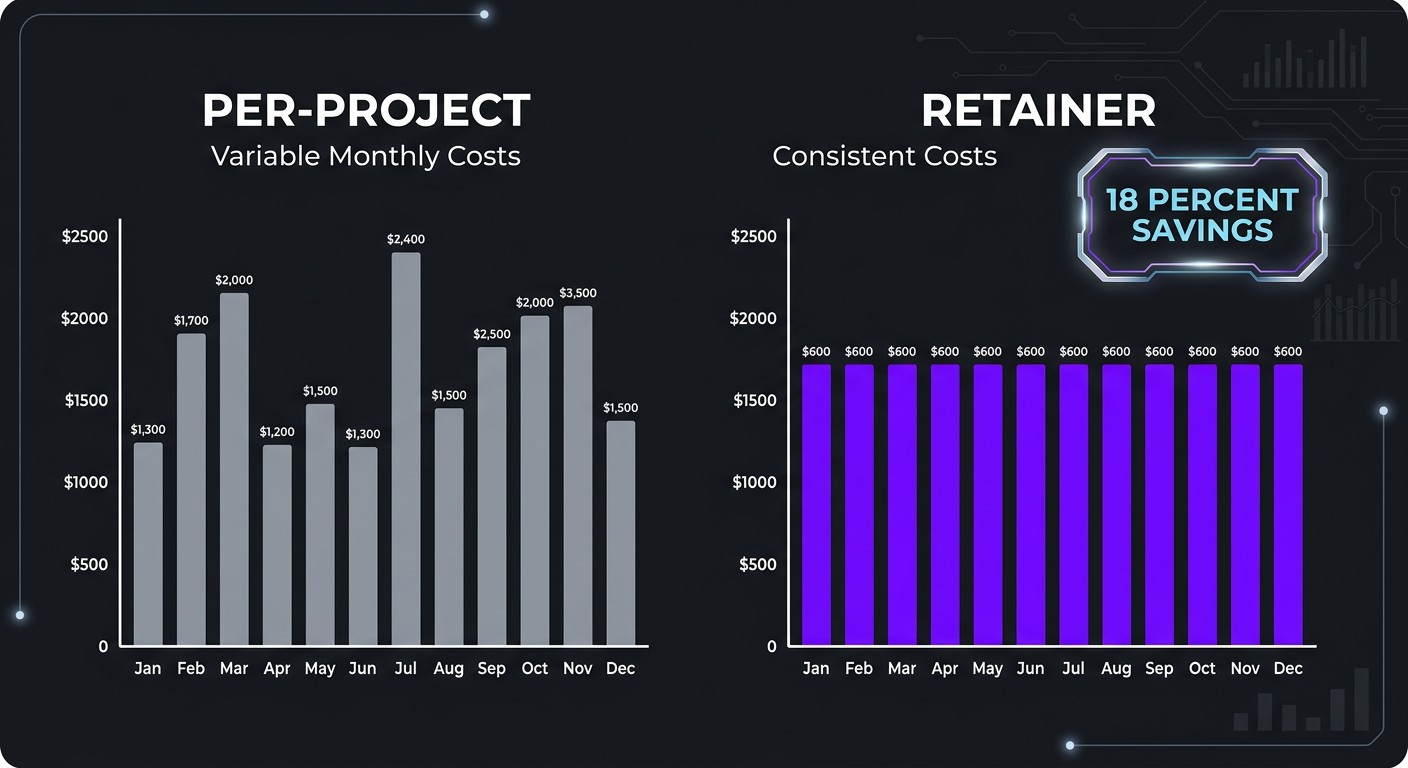
The result was brand inconsistency, duplicated onboarding, and unpredictable costs. One month they’d spend $8,000 on a campaign rush; the next month, $1,500 on a single explainer. Budgeting was a nightmare for their procurement team.
The shift to retainer: eSafety moved to a structured retainer model with a production partner. The monthly fee was fixed at $6,500 for a defined mix of long-form and short-form content. Every video went through the same team, the same brand guidelines, and the same QA process.
Results:
- Annual spending decreased 18% despite producing 30% more content
- Brand consistency improved across all platforms
- Budget variance dropped from ±40% per quarter to ±5%
- Turnaround time stabilized at 3 business days (down from 7-14 days for per-project work)
Blue Zones Health: Hybrid Pricing for Variable Content Needs
Blue Zones Health, a wellness brand building a YouTube presence, faced a common dilemma: their content needs fluctuated wildly. Some months they produced 12 videos (around a product launch or health awareness campaign); other months, just 3-4.
A fixed retainer would over-serve quiet months. Per-project would under-serve peak months and cost more per video.
The solution: a hybrid structure. Blue Zones established a base retainer covering 6 videos per month, with pre-negotiated per-video rates for anything above that threshold. The base retainer ensured dedicated editor access, priority scheduling, and brand consistency. The overage rate was 20% below their previous per-project pricing, rewarding their commitment.
Results:
- Base cost was predictable at $3,200/month
- Peak months (12+ videos) cost $5,200–$5,800 — still 25% less than pure per-project would have been
- Zero loss of editor consistency between base and overage videos
- Annual editing budget came in 22% under what they’d have spent on pure per-project pricing
How to Choose the Right Pricing Model for Your Situation
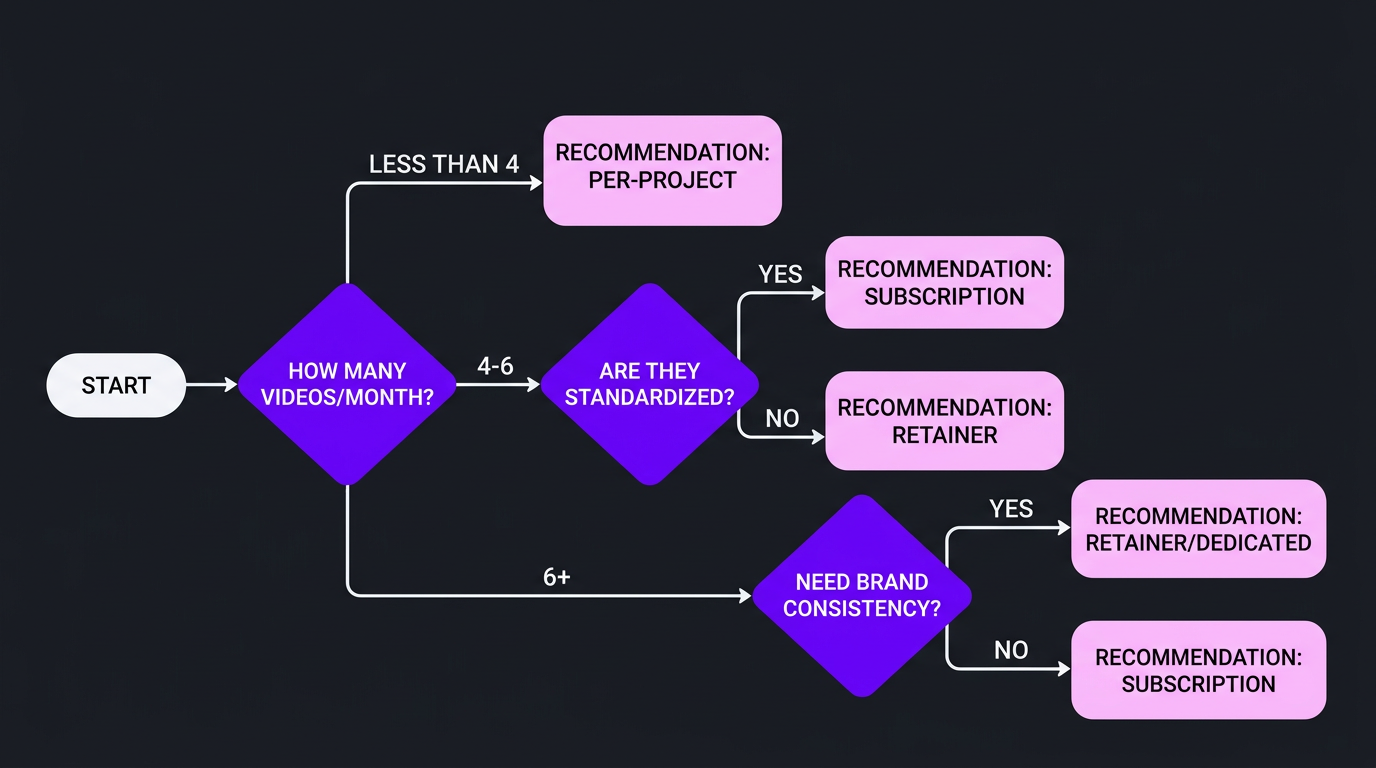
Here’s a practical decision framework:
Choose Per-Project If:
- You produce fewer than 4 videos per month
- Your content schedule is irregular or seasonal
- You need different specialists for different projects
- You’re testing a new content format and don’t know if it’ll continue
- You have a very tight budget and need to control costs per deliverable
Choose a Monthly Retainer If:
- You produce 6+ videos per month consistently
- Brand consistency matters to your audience and business
- You want predictable monthly costs
- You value faster turnaround and priority scheduling
- You’re scaling your content operation and need infrastructure
Choose a Subscription If:
- Your content is relatively standardized (similar formats, similar complexity)
- You’re budget-constrained but need high volume
- You don’t need a dedicated editor (consistency isn’t critical)
- Your editing needs are straightforward (cuts, captions, basic graphics)
Choose Hourly If:
- You have undefined or exploratory projects
- You need consulting or advisory input, not deliverables
- You’re augmenting an in-house team during peak periods
At Increditors, we primarily operate on the retainer model because our clients are serious content creators, startups, and enterprises producing consistent content. But we do offer per-project pricing for first-time clients who want to test the quality before committing — and we think every agency should. A retainer should be earned, not demanded.
Frequently Asked Questions
A video editing retainer is a monthly agreement where you pay a fixed fee for ongoing editing services. You typically get a set number of videos, dedicated editor access, faster turnaround, and predictable budgeting. Retainers range from $1,500 to $8,000+/month depending on volume, complexity, and agency tier. See our pricing page for current options.
At low volume (1-4 videos/month), per-project is usually cheaper. At 6+ videos/month, retainers typically offer 20-40% savings per video compared to per-project rates, plus benefits like priority scheduling, dedicated editors, and bundled revisions. The crossover point depends on your specific content mix.
Most agencies recommend retainers starting at 4-6 videos per month. At this volume, the per-video savings, priority turnaround, and reduced management overhead make the fixed monthly commitment worthwhile compared to per-project pricing.
Most agencies offer month-to-month retainers or require 30-day notice. Avoid annual lock-in contracts unless you’re getting significant discounts (20%+ savings). At Increditors, all retainers are month-to-month with no long-term commitment required.
Most professional agencies offer both per-project and retainer pricing, with retainers being the most popular for ongoing clients. The trend in 2026 is toward retainer-based relationships with dedicated teams, as both agencies and clients benefit from the consistency and efficiency gains.
A good retainer should include: a defined number of deliverables per month, a dedicated or priority editor, specified turnaround SLAs, revision rounds per video, project management, and clear overage terms. Premium retainers from agencies like Increditors also include QA review, licensed asset access, and backup editor coverage.
Get a Custom Pricing Structure for Your Content
Tell us what you produce and how often. We’ll recommend the pricing model and build a plan that maximizes your ROI.
Pricing data reflects 2026 market rates from industry surveys, public pricing pages, and direct research. Individual rates vary by editor experience, geography, and project complexity. For current Increditors pricing, visit our pricing page or schedule a call.