








![3D Explainer Video - ScribbleLive.mp4_snapshot_00.12_[2022.03.09_03.14.16]](https://increditors.com/wp-content/uploads/elementor/thumbs/3D-Explainer-Video-ScribbleLive.mp4_snapshot_00.12_2022.03.09_03.14.16-r7wb53mx72rxst3qcqyrfxdmeyzb5r9jbl0wbjujh4.png "3D Explainer Video – ScribbleLive.mp4_snapshot_00.12_[2022.03.09_03.14.16]")





























Recruitment teams that invest in professionally edited employer brand videos attract more qualified applicants, reduce time-to-hire by up to 50%, and dramatically lower cost-per-hire. This guide breaks down exactly which video types work, how to produce them efficiently, and why outsourcing your video editing to specialists like Increditors is the fastest path to a talent pipeline that converts.
- Why Video Has Become the #1 Recruitment Tool
- The 7 Types of Recruitment Video Every Talent Team Needs
- Why Production Quality Determines Whether Candidates Apply
- Using Video Across Every Stage of the Hiring Funnel
- DIY vs. Outsourcing: The True Cost Comparison for HR Teams
- Video Editing Best Practices That Recruitment Marketers Swear By
- Measuring the ROI of Your Recruitment Video Investment
- Verdict: Is Professional Video Editing Worth It for Recruitinga
- Frequently Asked Questions
Why Video Has Become the #1 Recruitment Tool
The hiring landscape has shifted irreversibly. Candidates now expect to evaluate a potential employer the same way they evaluate a product before buying it — through video. A job listing with walls of text and a stock photo of an office building simply does not compete with a two-minute culture video that shows real employees, authentic moments, and a genuine sense of what it feels like to work there every day. According to research from CareerBuilder, job postings that include video receive 34% more applications than those without, and candidates who watch an employer brand video are 53% more likely to apply.
But this is not just about getting more applications — it is about getting better applications. When candidates self-select based on an honest, well-produced representation of your culture, they arrive at the interview already aligned with your values. Your recruiters spend less time screening out poor-fit candidates and more time having substantive conversations with people who genuinely want what you offer. The efficiency gains compound across the entire funnel: fewer bad-fit interviews, faster decisions, reduced offer-to-accept timelines, and ultimately lower turnover because day-one reality matches day-one expectations.
The competitive dimension matters too. In high-demand fields — software engineering, data science, healthcare, skilled trades — your candidates are evaluating three to five employers simultaneously. Research from LinkedIn shows that 75% of job seekers consider an employer’s brand before even applying. If your competitors have polished culture videos, testimonial reels, and day-in-the-life content while you have a careers page with a mission statement and a few Glassdoor-optimized bullet points, you are already behind. Video is no longer a differentiator; it is the price of admission to a competitive talent market.
The Shift From Job Boards to Social Channels
Historically, recruitment marketing meant posting on Indeed and LinkedIn and hoping the right people applied. Those channels still matter, but the discovery layer has shifted. Passive candidates — the ones who are not actively searching but would consider the right opportunity — now encounter employer brands primarily through social media. TikTok, Instagram Reels, and YouTube Shorts have created an entirely new funnel stage: awareness before intent. A 30-second clip showing your engineering team solving a hard problem, or your customer success team celebrating a big win, can plant a seed with a perfect candidate six months before they start looking.
This shift requires a different kind of content strategy. Social-native recruitment video is shorter, more authentic-feeling, and platform-optimized. It needs snappy hooks in the first two seconds, captions for silent viewing, and aspect ratios that fit vertical screens. These are not production considerations an HR team typically thinks about when writing a job description — they are the domain of video production professionals who understand both storytelling and platform algorithms.
Generational Expectations Are Raising the Bar
Millennial and Gen Z candidates grew up watching professionally produced content on YouTube, Netflix, and social media. Their baseline expectation for visual quality is calibrated against that content — not against corporate HR videos from 2012. When a candidate watches a shaky, poorly lit, audio-compromised “meet the team” video, they do not think “how authentic.” They think “this company does not invest in quality.” That perception transfers directly to assumptions about how the organization approaches its work, its product, and its people.
By 2026, Gen Z makes up roughly 27% of the global workforce, and that share is growing. These candidates are digital natives who consume and evaluate video content with unconscious sophistication. They notice jump cuts that feel jarring versus intentional. They notice when color grading feels flat versus cinematic. They notice when background music undercuts the emotion of a testimonial versus supporting it. Recruitment teams that invest in professional video editing are investing in the first impression that matters most to the candidates they most want to attract.
The 7 Types of Recruitment Video Every Talent Team Needs
Not all recruitment video is created equal. Different video formats serve different stages of the candidate journey, and a mature employer brand content strategy deploys each strategically. Understanding what each format is designed to accomplish — and how editing choices support those goals — is the foundation of an effective video recruitment program.
1. Employer Brand Films (60–180 seconds)
The flagship of your recruitment video library, employer brand films are cinematic overviews of who you are as an organization. They typically blend B-roll of your office and team, employee testimonial snippets, leadership voice, and mission-driven narrative. Think of them as a two-minute pitch for why a talented person would choose you over every other opportunity they could pursue. These videos anchor your careers page, lead your LinkedIn company profile, and serve as the foundation from which all other content is cut.
The editing requirements for brand films are substantial: color grading for visual consistency, music licensing and sync, seamless transitions between interview footage and B-roll, motion graphics for any data callouts, and careful pacing that builds emotional momentum toward a clear call to action. This is not a clip you build in iMovie on a Friday afternoon — it is a professional production that deserves professional post-production.
2. Employee Testimonial Videos
Testimonial videos feature real employees speaking authentically about their experience. They are the most trusted format in recruitment video because they feel peer-to-peer rather than promotional. Candidates watching a software engineer describe what they love about the engineering culture are far more influenced than they would be by a recruiter saying the same thing. Data from Edelman’s Trust Barometer consistently shows that “a person like me” is among the most trusted information sources for major decisions — and accepting a job is a very major decision.
Editing testimonials well requires subtle but important craft. The goal is authenticity that feels polished, not authenticity that feels like it was filmed in a parking garage. Color correction makes the interview subject look their best. Tight editing removes ums and pauses without making the subject feel robotic. B-roll cutaways illustrate what the employee is describing. Lower thirds introduce the subject with name, role, and tenure. These small details signal that you take your employer brand seriously.
3. Day-in-the-Life Videos
Day-in-the-life content follows a real employee through an actual or representative workday, showing the environment, rhythms, and interactions that define the role. These videos answer the practical questions candidates care most about: What does the physical workspace feel like How do teams communicate What is the pace What kind of problems do people solve They also help candidates self-select — someone who watches a fast-paced, high-intensity engineering day-in-the-life and feels excited is probably a great fit; someone who feels overwhelmed is probably not, and filtering them out early saves everyone time.
Why Production Quality Determines Whether Candidates Apply
Production quality in recruitment video functions as a heuristic. Candidates cannot spend 40 hours evaluating your company before deciding whether to apply — they make fast, pattern-matching judgments based on available signals. A polished, well-edited video signals that your organization is competent, invested, and professional. A rough, amateurish video signals the opposite, regardless of how true that impression may be. In talent acquisition, perception precedes reality, and video is perception at scale.
Research supports this intuition. A study by Brightcove found that 62% of consumers have a negative perception of a brand that published a poor-quality video — and this effect applies just as strongly to employer brands as to consumer brands. When a candidate watches a pixelated, poorly mixed company video, they are not thinking “I appreciate the effort.” They are updating their mental model of what it would be like to work there. And that updated model makes them less likely to hit Apply.
The Key Elements of Professional Video Editing
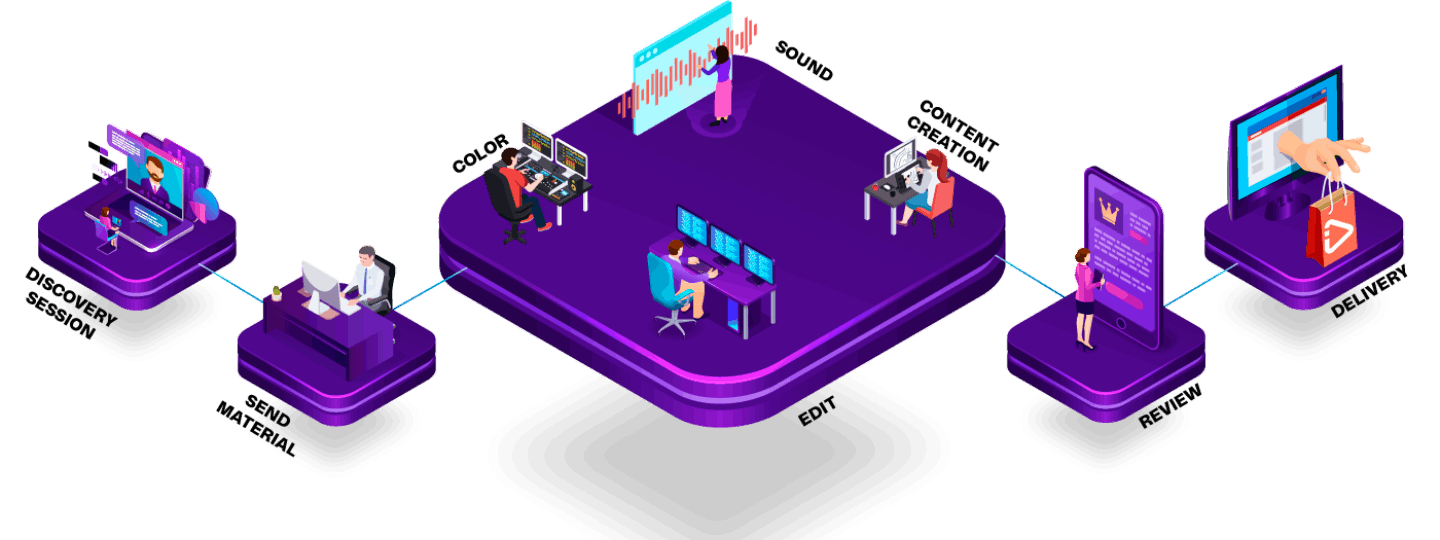
Professional video editing encompasses far more than trimming clips and adding transitions. Color grading establishes the visual language of your brand — warm tones suggest approachability and energy; cooler, more neutral grades suggest professionalism and precision. Audio mixing ensures that dialogue is clear, background music sits at the right level, and there are no jarring audio jumps between cuts. Motion graphics and lower thirds provide context and reinforce brand identity. Pacing — the rhythm at which cuts are made — controls the emotional energy of the piece and determines whether the viewer stays engaged through to the call to action.
Each of these elements requires specialized expertise and professional-grade tools. Premiere Pro, DaVinci Resolve, After Effects — these are not applications you open and immediately produce broadcast-quality work. They have years of learning curves. A skilled editor brings not just technical mastery but editorial judgment: knowing which take has the right emotional energy, when a cut should be on the beat versus off the beat, when B-roll should illustrate versus contrast, when silence is more powerful than music. This judgment is what separates recruitment video that converts from recruitment video that exists.
Brand Consistency Across a Video Library
One of the most underappreciated benefits of professional video editing for recruitment teams is consistency. When your employer brand video, your department-specific testimonials, your social clips, and your job description videos all share the same visual language — same color grade, same title card style, same motion graphic system, same music genre — you build a recognizable employer brand identity. Candidates who encounter your content across multiple touchpoints experience it as a coherent story about who you are. That coherence builds trust and makes your organization more memorable than competitors whose video content feels random and disconnected.
💡 Pro Tip: Before shooting a single frame of recruitment video, create a one-page video brand guide: define your color grade mood (warm/cool/neutral), your preferred music genres, your title card font and colors, and your B-roll shot list categories. Share this with every editor and videographer on every project. Visual consistency is what turns individual videos into a recognizable employer brand.
Using Video Across Every Stage of the Hiring Funnel
The hiring funnel has distinct stages, and video can and should play a role at each one. Most recruitment teams think of video primarily for awareness — top-of-funnel brand content. But the highest-leverage use of video is often in the middle and bottom of the funnel, where candidates are actively evaluating you and where a well-timed video can tip the decision in your favor.
Top of Funnel: Awareness and Discovery
At the top of the funnel, video’s job is to introduce your employer brand to people who may not have heard of you or may have an outdated perception. This is where social-native short-form content shines. A 30-second LinkedIn clip showing your engineering team celebrating a product launch. A 60-second Instagram Reel showing a day in the life of your customer success team. A YouTube Short where your CEO talks about the problem the company exists to solve. These pieces are not meant to close candidates — they are meant to make talented people think “that looks like a place I could see myself.”
Editing for top-of-funnel awareness requires platform fluency. What works on LinkedIn (slightly more polished, professional context) differs from what works on TikTok (raw, relatable, authentic-feeling) or Instagram (visually beautiful, emotionally resonant). A skilled video editor adapts the same raw footage into multiple format-optimized cuts, maximizing reach from a single shoot day. This is one of the most cost-efficient strategies in recruitment marketing: one shoot, six platforms, twelve months of content.
Middle of Funnel: Consideration and Evaluation
Candidates who are actively considering applying need more depth than a 30-second clip can provide. This is where longer-form content earns its budget: role-specific culture videos (what it is actually like to be a designer here), team-level testimonials (hear from three members of the sales team about what makes the culture different), and office or remote culture explainers (here is how we actually work). Embedding these videos directly on job listing pages has measurable impact — LinkedIn data shows that job listings with video receive 36% more applications, and that number jumps further when the video is role-specific rather than generic.
Video in job descriptions also serves a filtering function. Candidates who watch a 90-second “what to expect in this role” video arrive at the application stage with more realistic expectations, which means higher offer acceptance rates and lower 90-day turnover. This is one of the clearest ROI cases for recruitment video investment: the cost of producing a role-specific video is almost always lower than the cost of a bad hire.
Bottom of Funnel: Offer Acceptance and Onboarding
Most teams think of video as a pre-application tool, but some of the highest-value recruitment video happens after the offer. A personalized video message from the hiring manager to a candidate who has received an offer creates a human connection that is extremely difficult for a competing offer letter to match. A professionally edited “welcome to the team” video sent to accepted candidates during the waiting period between offer and start date reduces anxiety and strengthens commitment to join. Even onboarding video — role walk-throughs, culture orientation, meet-the-team montages — has measurable impact on early retention, with research from Glassdoor showing that strong onboarding experiences improve retention by 82%.
DIY vs. Outsourcing: The True Cost Comparison for HR Teams
One of the most common objections we hear from recruitment teams considering professional video editing is the perceived cost. “We have someone on the team who is good with video” or “we can use the marketing team” or “it seems expensive for something we only do a few times a year.” These perspectives underestimate both the true cost of DIY and the true return on professional production. Let us walk through the numbers honestly.
The Hidden Costs of Doing It Yourself
When an HR professional or recruiter spends time editing video, the opportunity cost is significant. The average HR manager in the US earns roughly $75,000–$95,000 per year — call it $40–$50 per hour including benefits. Editing a single employer brand video to a professional standard takes 15–30 hours for a non-specialist. That is $600–$1,500 in labor cost, before accounting for software licenses, stock music, stock footage, and the revision cycles that inevitably follow when the output does not meet expectations.
Beyond the direct time cost, there is the quality gap. A non-specialist produces non-specialist output, and in recruitment video, that gap has a measurable cost. If your DIY video converts at half the rate of a professionally edited equivalent — generating 17 applications instead of 34 for a given role — and your cost-per-hire on quality candidates is $5,000, the difference in conversion represents enormous value foregone. Professional video editing is not a cost center; it is a revenue-adjacent investment in the talent engine that runs your entire business.
What Outsourced Video Editing Actually Costs
The market for professional video editing services has matured considerably. Freelance editors on platforms like Upwork range from $25/hour for less experienced editors to $150+/hour for senior specialists. Agency partners like Increditors operate on subscription and project models that are often more cost-effective than hourly freelancers, particularly for teams with recurring needs. A well-structured agency engagement also provides consistency — the same editor learns your brand, your style, and your preferences, dramatically reducing briefing time and revision cycles on subsequent projects.
The math often surprises HR leaders who have not run it before. When you factor in the quality premium, the time savings, the brand consistency benefits, and the downstream impact on hiring metrics, professional video editing is frequently the most cost-effective option for teams producing more than two or three videos per quarter. For teams with active employer brand programs — producing social content, role videos, and event coverage on a regular basis — an agency partnership pays for itself many times over in recruiter time saved alone.
Video Editing Best Practices That Recruitment Marketers Swear By
Over the years working with HR and talent acquisition teams, we have identified a consistent set of editing practices that separate high-performing recruitment videos from the rest. These are not abstract principles — they are specific, actionable techniques that our editors at Increditors apply to every recruitment project we take on.
Hook Engineering: Win in the First 3 Seconds
Video attention spans are short. LinkedIn data suggests that 57% of viewers who watch the first three seconds of a video will watch through 97% of the rest. That means the first three seconds are not just important — they are everything. Amateur recruitment video typically opens with a logo, a title card, or slow B-roll of an empty office. Professional recruitment video opens with the most emotionally resonant, surprising, or compelling moment in the entire piece, then pulls back to establish context.
Practically, this means your editor should review all raw footage before structuring the edit and identify the single most compelling moment — the employee who gets visibly emotional talking about the team, the CEO who says something unexpectedly candid, the team celebration that crackles with genuine energy — and lead with that. You can always establish context afterward. You cannot recover from losing a viewer in the first three seconds.
Captions Are Mandatory, Not Optional
Research from Verizon and Publicis Media found that 69% of people watch video with the sound off in public places — and that includes LinkedIn and other professional platforms where candidates encounter employer brand content. Captions are not an accessibility afterthought; they are the primary way a significant portion of your audience consumes your content. Burned-in captions (embedded directly in the video) are preferable to auto-generated platform captions because they give you control over styling, positioning, and timing — and they display consistently across every platform and device.
Style matters in captions too. Bold, high-contrast captions with brand-consistent fonts read better than default subtitle styling. Animated word-by-word captions (in the style popularized by podcast clip videos) can significantly increase watch time on short-form social content by creating a reading rhythm that keeps viewers engaged. This level of caption design is something a professional editor can implement efficiently; doing it yourself in a consumer app produces noticably inferior results.
Audio Mixing: The Most Underrated Editing Skill
Most people notice when video looks bad. Almost everyone notices when video sounds bad — even if they cannot articulate why. Inconsistent audio levels, background hum, echo from a reverberant room, music that drowns out dialogue, audio that pops or clips — these issues signal amateur production and erode viewer confidence in your brand. Professional audio mixing cleans up interview audio, applies noise reduction, normalizes levels across all clips so there are no jarring jumps, and creates a music bed that supports without competing.
For recruitment video, there is an additional audio consideration: the music you choose communicates something about your culture. An upbeat, energetic indie-pop track communicates a very different culture than a thoughtful, slightly melancholic piano piece or a driving electronic track. The best recruitment videos are scored deliberately, with music chosen to match the emotional arc of the story being told and the culture being represented — not just whatever royalty-free track was first in the library.
💡 Pro Tip: When briefing your video editor on music, do not just say “something upbeat.” Send three reference tracks that feel like your culture and specify what you like about each one — the tempo, the instrumentation, the emotional quality. This dramatically reduces revision cycles on music selection, which is one of the most subjective and time-consuming parts of the editing process.
Measuring the ROI of Your Recruitment Video Investment
Every dollar in the HR budget is scrutinized, and recruitment video should be no exception. The good news is that the right metrics make the ROI case compellingly. The challenge is that many teams measure video performance with vanity metrics — view counts, likes, shares — rather than the business outcomes that actually matter. Here is how to measure recruitment video in a way that connects directly to hiring outcomes and earns continued investment.
The Metrics That Actually Matter
Application rate lift is the most direct measure. For any role where you add video to the job listing, track application volume compared to similar roles without video, controlling for channel and time period. A well-produced role-specific video typically drives a 25–50% increase in qualified applications, which is a massive efficiency gain for any recruiting team. Track not just total applications but qualified applications — video naturally filters candidates, so the quality-adjusted lift is often even larger than the raw volume numbers suggest.
Time-to-hire is another powerful metric. When candidates arrive at the interview stage already informed by video content about the role, the team, and the culture, the screening conversations are more substantive and decisive. Hiring managers report spending less time on basics (“so tell me about your company”) and more time on meaningful evaluation. This compresses the interview cycle and reduces time-to-hire — a metric that has direct dollar value when you consider the cost of an unfilled role.
Offer acceptance rate is a bottom-of-funnel metric that video meaningfully influences, particularly when video is used in the offer stage. Sending a personalized video message from the hiring manager alongside an offer letter creates a human connection that the offer document alone cannot achieve. Teams that have implemented video at the offer stage consistently report 10–20% improvement in offer acceptance rates — which, at an average cost-per-hire of $4,000–$7,000, represents enormous savings in recruiting effort and agency fees.
Building a Reporting Framework Your CHRO Will Love
The most persuasive recruitment video ROI reports connect video investment directly to hard dollars. Here is a simple framework: calculate your average cost-per-hire across the roles where you have deployed video. Compare it to your average cost-per-hire in the prior period or for similar roles without video. The difference, multiplied by the number of hires in the video-enabled cohort, is your video ROI in dollar terms. Add in the recruiter time saved (hours × hourly rate) and you almost always find a return of 3x–10x on professional video production investment.
The key to building this framework is setting up measurement before you launch. Add UTM parameters to every video link so you can track the specific path from video view to application. Tag applicants in your ATS with the source content they engaged with. Run A/B tests on job listings with and without video for the same role. The data infrastructure takes a little effort to establish but pays off enormously in the credibility of your ROI reporting — and in the budget conversations that follow.
Why Increditors Is the Right Partner for Recruitment Teams
At Increditors, we work with talent acquisition and employer brand teams who need high-volume, high-quality video editing without the overhead of building an in-house production team. Our editors understand the unique demands of recruitment content: the need for authentic feeling without sacrificing polish, the importance of brand consistency across a large video library, the platform-specific formatting requirements for every channel in your distribution mix. We have worked with teams producing two videos a month and teams producing twenty, and we have seen what makes the difference between a video program that transforms a talent pipeline and one that sits unused on a careers page.
Our workflow is designed for the reality of HR and talent acquisition teams: you are busy, you have limited bandwidth to manage creative projects, and you need deliverables that are right the first time rather than requiring three rounds of revisions. We assign dedicated editors to each client so your editor learns your brand, your preferences, and your standards over time. Our briefing templates are built for non-video-specialists — you describe what you want in plain language and we translate it into editorial direction. And our turnaround times are fast enough that video does not become a bottleneck in your recruiting process.
Verdict: Is Professional Video Editing Worth It for Recruitinga
The evidence is clear. In a competitive talent market where candidates are evaluating you through the same lens they evaluate every brand they interact with — through video — the quality of your visual content is inseparable from the quality of your employer brand. A professionally edited recruitment video is not a luxury or a nice-to-have; it is one of the most cost-effective investments a talent acquisition team can make.
The ROI case is straightforward: more qualified applications, faster time-to-hire, higher offer acceptance rates, and lower 90-day turnover. Each of these outcomes has a measurable dollar value that typically far exceeds the cost of professional production. The risk of not investing is equally measurable: you are ceding employer brand territory to competitors who are investing, and that territory is increasingly difficult to recapture once candidates have formed impressions elsewhere.
The most common mistake we see talent teams make is treating video as a one-time project — produce an employer brand film, check the box, move on. The teams with the strongest results treat video as an ongoing program: a library that grows and evolves, a content engine that feeds every stage of the hiring funnel, a consistent visual language that candidates encounter across every touchpoint. Building that kind of program requires a reliable, high-quality production partner who can handle the volume without compromising on standards.
If you are ready to move from reactive, one-off recruitment video to a systematic program that measurably improves your hiring outcomes, the starting point is a conversation about your current content, your goals, and what a tailored production plan would look like. At Increditors, those conversations consistently surface opportunities that teams did not know they were missing — and a roadmap for capturing them efficiently.
Frequently Asked Questions
How many recruitment videos does a company typically need to get starteda
A strong foundational employer brand video library starts with three to five videos: one flagship employer brand film (90–180 seconds), two to three employee testimonials representing different departments or career levels, and one culture explainer or day-in-the-life video. This gives you content for your careers page, your job listings, and your social channels. From there, you can expand systematically — adding department-specific content, role-specific videos for your highest-volume hiring positions, and social-native short clips for ongoing distribution. You do not need a complete library to start; you need enough to move the needle on your highest-priority roles.
Do we need a professional videographer, or can we film on a smartphonea
Modern smartphones can produce excellent footage in good lighting conditions — the iPhone and flagship Android devices shoot 4K video that is genuinely competitive with entry-level professional cameras for interview-style content. The more important factors are lighting (a basic three-point lighting setup makes an enormous difference), audio (a lapel microphone costs $30–$60 and eliminates most room echo and background noise problems), and composition (simple framing choices that signal intentionality). That said, for a flagship employer brand film that will live on your careers page for two to three years, the investment in a professional videographer for one day of shooting is almost always worth it. The editing can then make great footage exceptional.
How do we get employees to participate in recruitment videos without it feeling forceda
The best recruitment video features employees who are genuinely enthusiastic about participating — and you find those people by asking openly rather than volunteering anyone. Send a company-wide invitation explaining what the video is for and what participation involves. You will almost always find enough willing participants without needing to pressure anyone. For interview segments, give participants a list of topics rather than scripted answers, let them speak in their own voice, and create a comfortable, conversational environment. The editing can work with authentic, unscripted material far more effectively than with stilted, rehearsed performances. The goal is to capture real people speaking genuinely — the editor’s job is to find the best moments in that genuine footage and assemble them compellingly.
What is the typical turnaround time for professional video editing on recruitment contenta
Turnaround times vary by complexity and the production partner you work with. For short-form social clips (under 60 seconds), professional editors typically deliver a first cut within 48–72 hours of receiving footage. For mid-length testimonials and culture videos (2–5 minutes), expect 3–5 business days for a first cut. For flagship employer brand films requiring extensive B-roll integration, motion graphics, and audio mix, the timeline is typically 7–10 business days. These timelines assume well-organized footage delivery and clear briefing. At Increditors, we have designed our intake and briefing process specifically to minimize the back-and-forth that extends timelines — clients who use our templates typically receive first cuts faster and require fewer revision rounds.
Can recruitment videos become outdated, and how often should we refresh thema
Recruitment videos can absolutely become outdated, and serving stale content to candidates can actually hurt your employer brand. A video featuring an office space you have since vacated, employees who have left the company, or a visual aesthetic from five years ago signals organizational stagnation — the opposite of what you want to communicate. As a general guideline, audit your flagship employer brand video annually and refresh it every two to three years, or whenever there is a significant change in your workplace environment, culture, or brand identity. Testimonial videos should be refreshed whenever the featured employee leaves. Social content has a shorter shelf life — aim for new content at least quarterly to keep your employer brand channels active and current. Working with a consistent video editing partner makes these refreshes much faster and more cost-effective than treating each update as a new project from scratch.
Ready for Video That Actually Convertsa
Tell us about your project and we will put together a custom plan.