








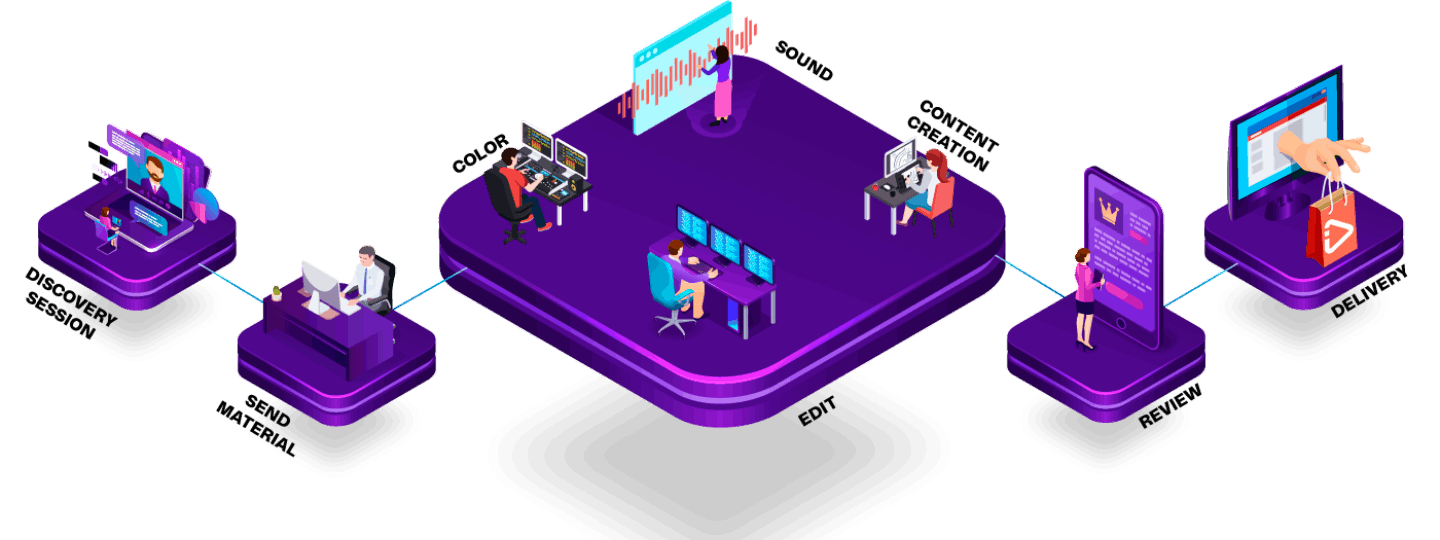
![3D Explainer Video - ScribbleLive.mp4_snapshot_00.12_[2022.03.09_03.14.16]](https://increditors.com/wp-content/uploads/elementor/thumbs/3D-Explainer-Video-ScribbleLive.mp4_snapshot_00.12_2022.03.09_03.14.16-r7wb53mx72rxst3qcqyrfxdmeyzb5r9jbl0wbjujh4.png "3D Explainer Video – ScribbleLive.mp4_snapshot_00.12_[2022.03.09_03.14.16]")



























Kajabi course creators who invest in professional video editing see measurably higher course completion rates, stronger student outcomes, and significantly better sales conversion — because video quality directly signals the perceived value of what you’re selling. This guide breaks down exactly how to approach video editing for Kajabi courses, what production elements actually move revenue, and when outsourcing to a specialized team like Increditors is the smartest growth move you can make.
- Why Video Quality Is a Revenue Variable, Not a Vanity Metric
- Kajabi Video Fundamentals Every Course Creator Needs to Know
- The Editing Elements That Drive Course Completion Rates
- Building a Premium Brand Identity Through Video
- DIY vs. Outsourcing: An Honest Comparison for Kajabi Creators
- What to Look for in a Video Editor for Kajabi Courses
- Building a Scalable Production Workflow on Kajabi
- Verdict: What Professional Editing Actually Does for Your Kajabi Business
- Frequently Asked Questions
Why Video Quality Is a Revenue Variable, Not a Vanity Metric
There’s a persistent myth in the online course world that “content is all that matters” — that if your knowledge is solid, students will overlook shaky camera footage, ambient background noise, and jump-cut-heavy lecture videos. This myth costs course creators real money every single year. In reality, Kajabi’s own internal research has shown that courses with polished production values see dramatically higher enrollment-to-completion rates, and completion rate is one of the single most powerful drivers of word-of-mouth, testimonials, and repeat purchasing behavior.
Think about it from your student’s perspective. They’ve just handed over $297, $497, or $2,000 for your program. The moment they hit play on the first lesson video, they’re forming an instant judgment about whether they made the right call. If the lighting is harsh, the audio crackles, or the screen recording is littered with cursor wandering and awkward pauses, that judgment tips negative — and the seed of buyer’s remorse is planted before you’ve taught them a single thing.
According to a 2024 study by Wyzowl, 96% of people say they’ve watched an explainer video to learn more about a product or service, and 89% say watching a video has convinced them to make a purchase. In the course creator economy, your course preview video and your first few lessons function as a perpetual sales machine — they’re always selling the next module, the next purchase, the next upgrade. Video quality is therefore a compounding revenue variable, not a one-time production cost to minimize.
The Perception-Value Gap
Pricing psychology research consistently shows that perceived production quality of a digital product is one of the top three factors influencing whether a buyer considers the price “fair.” When someone sees a high-ticket course with amateur video editing, they experience cognitive dissonance — the price point doesn’t match the production signal. The result is price resistance, refund requests, and churn. Conversely, when production quality matches or exceeds the price point, buyers feel they got a deal even if the content is similar to cheaper alternatives.
This perception-value gap is particularly acute on Kajabi, where the platform itself already signals premium positioning. Kajabi’s marketing, pricing, and ecosystem all whisper “serious business owner” — which means your students arrive with elevated expectations. Meeting those expectations with mediocre video is a mismatch that erodes trust at the exact moment you need it most.
Completion Rates Are Your Real KPI
Most course creators obsess over enrollment numbers when they should be obsessing over completion rates. A 2023 analysis of online course platforms found that the average course completion rate hovers between 10% and 15% — which means 85 to 90% of people who buy most courses never finish them. But courses with high production quality, clear visual hierarchy, engaging motion graphics, and properly paced video editing consistently achieve completion rates of 40–65%. That’s not a small difference — it’s the difference between a business built on transformation and a business built on transactions.
Why does editing quality affect completion Because attention is finite, and every friction point in the viewing experience — a long awkward pause, a poorly labeled screen recording, a transition that jars the eye — creates micro-moments where students decide to close the tab. Professional editing removes those friction points systematically, keeping students in flow state through the learning material and toward the outcomes you promised them.
Kajabi Video Fundamentals Every Course Creator Needs to Know
Kajabi has a specific technical ecosystem that shapes how your videos should be produced and delivered. Understanding these fundamentals ensures your editing choices actually translate into a great student experience on the platform, and that you’re not creating extra work for yourself or your editor by ignoring the platform’s native behavior.
Kajabi’s Video Hosting Infrastructure
Kajabi hosts videos through Wistia, which is one of the most robust and educator-focused video hosting platforms available. This is actually a significant advantage for course creators — Wistia provides detailed engagement analytics, heatmaps showing exactly where students rewatch or drop off, and adaptive streaming that automatically adjusts quality based on the student’s connection speed. However, Wistia’s analytics are only as useful as the video quality you upload. If your video has poor signal-to-noise ratio or inconsistent pacing, the dropout data will tell you something is wrong, but it won’t tell you it’s an editing problem.
For upload specifications, Kajabi recommends H.264 encoded MP4 files at 1080p minimum, with a bitrate of at least 5 Mbps for lecture content and 8–12 Mbps for screencasts with fine text. Audio should be exported at 48kHz stereo (or properly centered mono), with peaks normalized to around -3 dBFS and an average loudness of -14 LUFS to match streaming standards. These aren’t optional niceties — uploading compressed, low-bitrate video results in Kajabi’s transcoder producing a noticeably degraded output that will frustrate students on any screen larger than a phone.
Video Types Specific to Kajabi Courses
Not all course videos are created equal, and each type has different editing priorities. Lecture videos (talking-head format) need tight audio editing, clean cuts to remove filler words, and consistent color grading that keeps the instructor looking polished across a multi-week course shot over multiple sessions. Screencast tutorials need zoom-to-cursor moments, callout annotations, and audio that clearly corresponds to on-screen actions. Workshop replays need chapterization, intro/outro bookending, and strategic cuts to remove dead air. Mini-course teaser videos function more like ads and need cinematic color work, dynamic pacing, and music design.
Understanding which type of video you’re editing shapes every decision from music selection to transition style. Many course creators make the mistake of applying the same editing template to every video type, which creates a dissonant experience — over-produced filler between lessons, or under-produced tutorial content that should be highly polished. A skilled video editor working on Kajabi content will recognize these distinctions and adjust accordingly without being asked.
The Mobile-First Reality
Kajabi’s own data suggests that between 40% and 60% of course consumption happens on mobile devices, particularly during commutes, lunch breaks, and evening wind-down periods. This fundamentally changes how certain editing decisions play out. Small text overlays that look fine on a 27-inch monitor become illegible on a 6-inch phone screen. Motion graphics with intricate detail get muddy in mobile compression. Lower-thirds name plates need to be larger and higher-contrast than desktop-first designers typically make them. Professional video editors who work regularly with e-learning content will naturally account for these mobile considerations — DIY editors often don’t catch them until students complain.
The Editing Elements That Drive Course Completion Rates
Not every editing element has equal impact on completion rates. Over years of working with course creators across dozens of niches, we’ve identified the specific production choices that consistently move the completion needle — and the ones that are merely cosmetic. This section focuses on the high-leverage elements that Kajabi course creators should prioritize when working with a video editor.
Pacing and Cognitive Load Management
The single most impactful editing decision in course video is pacing. Pacing is not the same as speed — it’s about the rhythm of information delivery relative to cognitive load. Research in educational psychology shows that students learning new material can only hold approximately 4–7 new concepts in working memory before comprehension degrades. A skilled editor will recognize when a lesson has hit a cognitive load peak and use strategic visual breaks — a B-roll cut, an animated diagram, a full-screen callout — to give the brain a reset moment before the next information batch arrives.
Practically, this means cutting out not just filler words and awkward pauses, but also over-long explanations of single concepts. It means inserting recap graphics after complex sections. It means using music beds at an appropriate volume to signal “processing time” during exercise prompts. None of this happens automatically in raw footage — it requires an editor who understands learning design, not just video production.
💡 Pro Tip: Ask your video editor to track “information density” across your course — if more than three new concepts are introduced in any five-minute segment without a visual break or summary graphic, that segment is a dropout risk. An experienced e-learning editor will catch these automatically.
Progress Signaling and Chapter Structure
One of the most underused retention tools in course video is explicit progress signaling. Netflix uses it with episode countdown timers. Video games use it with level indicators. Online courses can use it with chapter intro cards, module completion callouts, and “coming up next” teaser sequences between lessons. When students know where they are in a learning journey, they experience less cognitive anxiety and are more likely to continue — a phenomenon that learning scientists call “competence feedback.”
In practical editing terms, this means designing a reusable module intro template that clearly states “Module 3 of 7 — Advanced Funnel Architecture” before each lesson begins. It means creating “milestone moments” at the end of major modules — a 30-second animated graphic that says “You’ve completed the Foundation phase. Up next: Implementation.” These elements can be templated once and reused throughout the course, making them very efficient to produce while delivering outsized psychological benefits to students.
Audio Quality as a Trust Signal
Multiple studies in online learning have found that audio quality has a stronger impact on perceived video quality than actual video resolution. Students will tolerate 720p video with clean, professional audio far better than 4K video with background noise or reverb. This makes audio post-production one of the highest-ROI investments a Kajabi course creator can make. Professional noise reduction, EQ shaping for vocal clarity, compression to even out volume inconsistencies, and de-essing to remove harsh sibilance — these are the audio editing moves that separate a $47 Udemy course from a $2,000 Kajabi program in the listener’s subconscious mind.
Building a Premium Brand Identity Through Video
For Kajabi course creators, video is not just content delivery — it’s the primary medium through which brand identity is communicated. Unlike a physical product with packaging, textures, and retail placement, your online course brand lives almost entirely in the visual and auditory experience of your video content. This makes consistent, intentional video branding one of the most strategically important investments you can make in your Kajabi business.
Developing Your Visual Brand System
A strong video brand system for Kajabi courses has several core components: a consistent color palette that carries through every graphic element, lower-third templates that identify you and your brand in a memorable way, transition styles that feel proprietary to your content, and typography choices that reinforce your positioning (serif fonts signal academic authority; sans-serif signals modernity and tech; script fonts signal creativity and personal touch).
The mistake most solo course creators make is treating these elements as optional decoration rather than strategic infrastructure. When a student watches a video from Module 1 and then returns six months later for Module 7, the visual consistency of your brand is what tells them subconsciously “I’m in the right place, this is the course I trusted.” Without that consistency, every re-entry into your course content requires the student to re-establish context — a small but real friction that accumulates over time.
When working with the Increditors team, one of the first deliverables we create for new Kajabi clients is a video brand kit: a set of After Effects or Premiere Pro templates that encode the exact fonts, colors, transition styles, and motion design language unique to that creator’s brand. This kit then applies consistently to every video we produce — whether it’s a 45-minute deep-dive module or a 90-second teaser clip for social media.
Using Intro and Outro Architecture Strategically
Your video intro and outro serve very different purposes depending on where they appear. For lesson videos inside a course, a short branded intro (5–10 seconds maximum) signals professionalism without wasting the student’s time — they already bought the course, they don’t need a sales pitch every lesson. For sales page preview videos or YouTube lead-generation content, a longer and more cinematic intro can establish credibility before launching into the teaching content.
The outro is arguably more strategically important than the intro for Kajabi creators. A well-designed lesson outro can include a “what’s coming next” tease to pull students forward into the next module, a clear action prompt that reinforces the lesson’s practical application, and a subtle brand reinforcement moment. This 30–60 second outro window is prime real estate that most DIY editors completely waste with a simple fade to black.
Color Grading for Perceived Premium Positioning
Color grading is one of the most underappreciated levers in course video production. Raw camera footage — even from a high-quality mirrorless camera — has a flat, lifeless look that communicates “unfinished” to a trained or even untrained eye. Professional color grading adds depth, consistency, and a distinct visual tone that makes your content recognizable. More practically, it corrects for the inevitable variations in lighting conditions that occur when you record across multiple days, sessions, or locations — a challenge that every creator who batches content will face.
Different color profiles signal different brand personalities. Cool, desaturated grades with lifted shadows signal tech, financial, or high-intellect positioning — think McKinsey consulting aesthetics translated to video. Warm, slightly boosted midtones with natural skin tones signal approachable expertise — the look of a successful coach who has also lived the advice they’re teaching. Rich, high-contrast grades with specific color accent treatments (a signature teal-orange or a brand-matched hue) signal strong creative identity. Choosing your color language deliberately is a brand strategy decision, not just an aesthetic preference.
DIY vs. Outsourcing: An Honest Comparison for Kajabi Creators
The question of whether to edit your own course videos or outsource the work is not purely a cost calculation — it’s a strategic decision about how you want to spend the finite hours in your business week. Both approaches have legitimate use cases, and the right answer depends on your revenue level, content volume, and the role video plays in your business growth strategy.
The True Cost of DIY Video Editing
The hidden cost of editing your own videos is rarely the software subscription — it’s the opportunity cost of your time. Most Kajabi course creators are knowledge workers whose core value proposition is their expertise and teaching ability. Spending 3–5 hours editing a single course module is time not spent on curriculum development, student coaching, marketing, or product expansion. If your hourly value as a creator is $200 (a conservative estimate if you’re selling courses at any meaningful price point), editing 10 hours of course content per week costs you $2,000 in opportunity cost — every single week.
There’s also the skill ceiling problem. Video editing has a deep craft with a steep learning curve. Most self-taught course creators plateau at “competent but not compelling” — a production quality level that works for content at the $97–$197 price range but creates friction at $497 and above. Breaking through that ceiling requires either years of dedicated practice or access to a professional who has already done that practice. The math almost always favors outsourcing once you’re generating consistent revenue from your Kajabi products.
When DIY Makes Sense
DIY editing is genuinely reasonable at the beginning of your Kajabi journey — when you’re validating your first course concept, when budget constraints are real, or when your content is still in rapid-iteration mode and you need the flexibility to revise frequently without incurring editing costs. There’s also a valid argument for doing your own editing early on to deeply understand what your content feels like to consume — information that makes you a much more effective client when you do eventually outsource.
The signal to switch from DIY to professional editing is usually one of three things: you’re consistently generating more than $3,000 per month from your Kajabi products; you’re spending more than 8 hours per week on editing; or you’ve received feedback from students that your video quality is below expectations. Any one of these is sufficient justification to make the transition. All three simultaneously is an emergency.
What to Look for in a Video Editor for Kajabi Courses
Not every video editor is equipped to work on e-learning content. The skills required for course video are distinct from corporate explainer videos, YouTube vlogs, or social media content. When evaluating editors or agencies for your Kajabi course work, there are specific criteria that separate capable generalists from genuine specialists.
E-Learning Specific Experience
Ask for portfolio samples specifically from online courses — not just YouTube videos, not just corporate productions. E-learning editing requires understanding of instructional design principles, comfort with long-form content (most course modules are 15–45 minutes, not the 3–8 minute sweet spot most video editors optimize for), and experience handling the specific challenges of educational footage: lots of static talking-head content, heavy screen recording work, and the need to maintain engagement across long teaching segments without the natural pacing aids of narrative or promotional content.
Look for editors who ask questions about your learning objectives before beginning a project, not just about your stylistic preferences. An editor who understands that Lesson 3 is meant to be “a challenging but achievable ramp-up moment” in your course journey will make different editorial choices — about pacing, about the placement of encouraging callout graphics, about where to use music for motivational effect — than an editor who simply treats your footage as raw material to clean up and deliver.
Workflow and Communication Standards
Course creators live on launch schedules. A video editor who misses deadlines by even two or three days can derail an entire enrollment campaign. Before committing to any editor or agency for your Kajabi content, understand exactly how they manage projects: What is their standard turnaround time How do they handle revision requests Do they use project management tools that give you visibility into where your files are in the pipeline Do they have backup capacity if their primary editor is sick or unavailablea
At Increditors, we use a client-facing project portal where Kajabi creators can see exactly what stage every video is at — whether it’s in rough cut, audio post, color grading, or final review — without needing to send a single “just checking in” email. This kind of operational transparency is a basic professionalism standard that many freelance editors simply can’t match because they’re managing all their clients through a personal email inbox.
Technical Deliverable Standards
Before hiring any video editor for your Kajabi course, give them a technical specification document that outlines your required deliverable formats — resolution, frame rate, bitrate, codec, color space, audio specs, and naming conventions. A professional editor will confirm they can meet these specs without pushback. An editor who says “oh just send it to me and I’ll figure out the format” is signaling that they don’t have established technical workflows, which will create problems when your Kajabi uploads don’t look right after post-processing.
💡 Pro Tip: Before hiring any editor for your Kajabi course, send them a five-minute sample of your raw footage and ask for a “first impressions” edit — just five minutes, no full job required. The quality of that audition cut tells you everything you need to know about their instincts, their audio processing skills, and whether they understand educational pacing. Any editor worth hiring will do this brief test for free or at minimal cost.
Building a Scalable Production Workflow on Kajabi
The difference between a course creator who is perpetually behind on content and one who launches consistently on schedule is almost never about talent or work ethic — it’s almost always about workflow. A well-designed production workflow removes decision fatigue, creates predictable timelines, and enables you to scale your content output without proportionally scaling your time investment. For Kajabi creators, building this workflow around professional video editing is a fundamental infrastructure investment.
The Recording-to-Publishing Pipeline
A robust Kajabi course production pipeline typically has five stages: Pre-production (scripting, outline approval, asset gathering), Recording (raw footage capture, screen recording, any supplementary media), Post-production (editing, color, audio, graphics), Review (creator review and revision cycles), and Publishing (Kajabi upload, SEO metadata, thumbnail creation). Each stage should have a clear owner, a defined deliverable, and a committed timeline. When any stage is undefined, the entire pipeline slows to the speed of the most disorganized person involved — which, for solo course creators, is often themselves under launch pressure.
For course creators working with an external video editor, the critical handoff points are: the end of Recording (raw files delivered to editor) and the end of Post-production (edited files delivered back for review). These handoffs should have specific, agreed protocols — how files are named, what cloud storage platform is used, what information is included in the brief accompanying each batch of raw footage, and what format the revision notes take. Sloppy handoffs are the #1 reason production timelines extend unpredictably.
Batch Recording for Maximum Efficiency
One of the most transformative workflow changes a Kajabi course creator can make is transitioning from “record and edit as you go” to batch production. In a batch production model, you record all the content for a full module (or even a full course) in dedicated recording sessions — two or three intensive days rather than scattered 30-minute clips across weeks. This creates several powerful advantages: consistent lighting and wardrobe across the entire module (eliminating continuity issues), a creative flow state that produces better teaching energy, and a clean body of raw footage that can be handed off to an editor in one organized batch rather than drips that force the editor to context-switch constantly.
Batch recording also enables your video editor to develop and maintain a consistent color grade and audio treatment across the entire module in a single post-production pass — rather than trying to match disparate recordings made weeks apart with different lighting, microphone placement, or room acoustics. The production consistency this creates is immediately visible to students and significantly elevates the perceived professionalism of your course.
Repurposing Kajabi Course Content Across Channels
A smart Kajabi production workflow doesn’t end with the course upload — it extends into a full content repurposing strategy that extracts maximum value from every hour of teaching footage you record. Your professionally edited course videos are a goldmine for lead generation content: individual module lessons can be reformatted into YouTube videos that attract your target student audience, 60–90 second concept clips can become LinkedIn or Instagram carousel supplements, podcast-style audio versions can be distributed on Spotify to reach commuters, and highlight reels of your best teaching moments can become paid ad creative that converts at a fraction of the cost of cold-produced ad video.
This repurposing strategy is dramatically easier when your source material is professionally edited — because a well-structured lesson video with clear section breaks, clean graphics, and professional audio can be re-cut for different formats in a fraction of the time required to repurpose raw footage. Course creators who invest in professional editing for their Kajabi content often find that the downstream content marketing benefits — in the form of lower paid acquisition costs and stronger organic growth — pay for the editing investment many times over.
Verdict: What Professional Editing Actually Does for Your Kajabi Business
After years of working with Kajabi creators across niches — business coaching, health and wellness, creative education, financial literacy, and professional skills training — we’ve observed consistent patterns in what separates the creators generating $10K–$20K per month on Kajabi from those generating $1K–$3K with similar levels of knowledge and effort. The differentiators are almost never course topic, marketing channel, or even email list size. They are almost always: pricing confidence (which comes from production quality supporting premium positioning), completion rate (which drives testimonials and word-of-mouth), and content output velocity (which comes from having a production workflow that doesn’t depend on the creator’s editing time).
Professional video editing directly addresses all three of these levers. It signals premium quality that supports premium pricing. It improves completion rates by removing friction from the learning experience. And it frees the creator’s time to focus on curriculum, marketing, and student relationships rather than timelines and export presets. The ROI on professional editing for Kajabi course creators is not theoretical — it’s measurable in enrollment rate improvements, churn reduction, and testimonial velocity.
The creators who resist making this investment typically cite cost as the primary concern. But the question is never “can I afford to outsource editinga” — it’s “what is the cost of not outsourcinga” For a creator selling a $997 program with a 3% conversion rate on their sales page, a 20% improvement in video quality that drives a 0.5% conversion rate increase represents thousands of dollars in additional annual revenue from the exact same traffic. That’s the real math — and it favors professional editing every time.
If you’re serious about building a Kajabi business that generates predictable, scalable revenue and delivers genuine transformation to your students, video production quality is not an afterthought — it’s a strategic pillar. The creators who treat it as such consistently outperform those who don’t, at every price point and in every niche we’ve worked in.
Frequently Asked Questions
How much does professional video editing for a Kajabi course typically costa
Pricing varies significantly based on content length, complexity, and the level of motion graphics and branding involved. As a benchmark, expect to pay $50–$150 per edited hour of final content from a competent freelancer, or $150–$400 per edited hour from a specialized agency offering full-service post-production including color grading, audio mastering, and branded graphics. For a typical 6-week Kajabi course with 18–24 hours of total video content, a professional editing engagement might run $3,000–$8,000 for the full course production. This is a one-time cost for evergreen content that will generate revenue for years — context that changes the ROI calculation dramatically.
What video editing software is best for Kajabi course contenta
Adobe Premiere Pro paired with After Effects remains the industry standard for professional course video editing, offering the deepest toolset for motion graphics, audio post-production integration, and color work. DaVinci Resolve is an increasingly powerful alternative, particularly for creators who need broadcast-quality color grading at a lower software cost. Final Cut Pro is excellent for Mac-based editors producing Apple-ecosystem content. For DIY creators just starting out, DaVinci Resolve Free is genuinely capable for basic course editing. The software matters less than the skill level of the editor using it — a skilled editor with any of these tools will produce better results than an amateur with all of them.
Should I use templates or custom branding for my Kajabi course videosa
Custom branding is always preferable for established creators with a defined visual identity, as it creates the distinctive look that builds brand recognition and supports premium pricing. Template-based production is a legitimate starting point for new creators or those doing rapid content validation — Envato Market, Motion Array, and Motion Bro offer high-quality templates that can be customized with your brand colors and fonts to create a professional appearance without the cost of a fully bespoke brand kit. The important thing is to pick one template system and apply it consistently — inconsistency is more damaging to perceived professionalism than imperfect design.
How long should individual video lessons be in a Kajabi coursea
Research from learning science and platform analytics consistently supports lesson lengths of 8–18 minutes as the sweet spot for retention and completion in online courses. Lessons shorter than 5 minutes often feel too lightweight to justify the cognitive context-switching involved in starting and stopping. Lessons longer than 25 minutes see sharply declining completion rates as students defer them to “when I have time” — and then never do. For complex topics that genuinely require more time, break the content into two or three sequential lessons with clearly defined sub-topics rather than producing a single 40-minute mega-lesson. Your editor can help structure these breaks naturally using recap and preview graphics between segments.
Can the same video editor handle both course content and marketing videos for my Kajabi funnela
Yes — and there are significant workflow advantages to having the same team handle both. When your course content and your marketing videos (sales page videos, webinar recordings, lead magnet mini-trainings) are produced with the same brand system and visual language, they create a seamless experience that builds purchase confidence at every touchpoint in your funnel. A student who discovers you through a polished YouTube video, lands on a sales page video with the same visual feel, and then starts a Kajabi course that continues that same production quality has had a frictionless brand journey that makes them far more likely to continue buying from you. This unified visual experience is one of the hallmarks of Kajabi creators operating at the $50K–$500K annual revenue level.
Ready for Video That Actually Convertsa
Tell us about your project and we will put together a custom plan.