








![3D Explainer Video - ScribbleLive.mp4_snapshot_00.12_[2022.03.09_03.14.16]](https://increditors.com/wp-content/uploads/elementor/thumbs/3D-Explainer-Video-ScribbleLive.mp4_snapshot_00.12_2022.03.09_03.14.16-r7wb53mx72rxst3qcqyrfxdmeyzb5r9jbl0wbjujh4.png "3D Explainer Video – ScribbleLive.mp4_snapshot_00.12_[2022.03.09_03.14.16]")





























Your agency just landed a client who wants 12 YouTube videos, 30 Reels, and 8 product demos per month. You said “absolutely.” Now you need to actually deliver.
This is the exact moment where most agencies either hire frantically (expensive, slow) or quietly outsource to a white-label editing partner who does the work under your brand. Option B is how the fastest-growing agencies in 2026 are scaling their video services — and it’s not even close.
We’ve been the invisible editing team behind dozens of marketing agencies, creative studios, and production companies. At Increditors, roughly 30% of our monthly volume comes from agency partners who resell our editing under their own brand. We know exactly how this model works — the pricing, the pitfalls, the workflows that keep clients happy without burning your team out.
Here’s the complete playbook.
What’s in This Guide
- Why Agencies White-Label Video Editing
- The Economics: Pricing, Margins & Revenue
- White-Label Models Compared
- Setting Up the Workflow
- Quality Control Without Micromanaging
- Scaling from 10 to 100+ Videos per Month
- Case Studies: Agencies That Got It Right
- Choosing a White-Label Partner
- Common Mistakes (and How to Avoid Them)
- FAQ
Why Agencies White-Label Video Editing
The demand for video content isn’t slowing down. According to Wyzowl’s 2025 report, 91% of businesses now use video as a marketing tool, up from 86% in 2023. If your agency doesn’t offer video editing, your clients will find someone who does — and that someone might replace you entirely.
But hiring in-house video editors is a nightmare for most agencies. Here’s why:
- Salary burden: A mid-level video editor in the U.S. costs $55,000–$80,000/year in salary alone. Add benefits, equipment, and software licenses, and you’re looking at $80,000–$120,000 fully loaded.
- Utilization risk: If your video client churns (and clients churn), you’re stuck paying an editor with nothing to edit.
- Skill gaps: One editor rarely handles YouTube, Reels, motion graphics, VFX, and color grading equally well. You’d need a team of specialists.
- Scalability ceiling: When a client doubles their order, you can’t double your editor overnight.
White-labeling eliminates all of these problems. You get a variable cost that scales with demand, a bench of specialists you never have to recruit, and zero overhead when video work is slow.
Who Uses White-Label Editing?
It’s not just tiny shops. White-label editing is standard across:
- Digital marketing agencies adding video to existing SEO/PPC/social packages
- Creative agencies that handle strategy and concepting but not post-production
- Social media management firms producing Reels, TikToks, and Shorts at scale
- Production companies that shoot but outsource editing to focus on what they do best
- PR firms and consultancies bundling video into client retainers
If you’re offering any service that touches content marketing, video editing is a natural and profitable extension of your offering. The question isn’t whether to add it — it’s how to deliver it efficiently.
The Economics: Pricing, Margins & Revenue
Let’s talk numbers. This is where white-labeling gets exciting for agency owners.
What You Pay vs. What You Charge
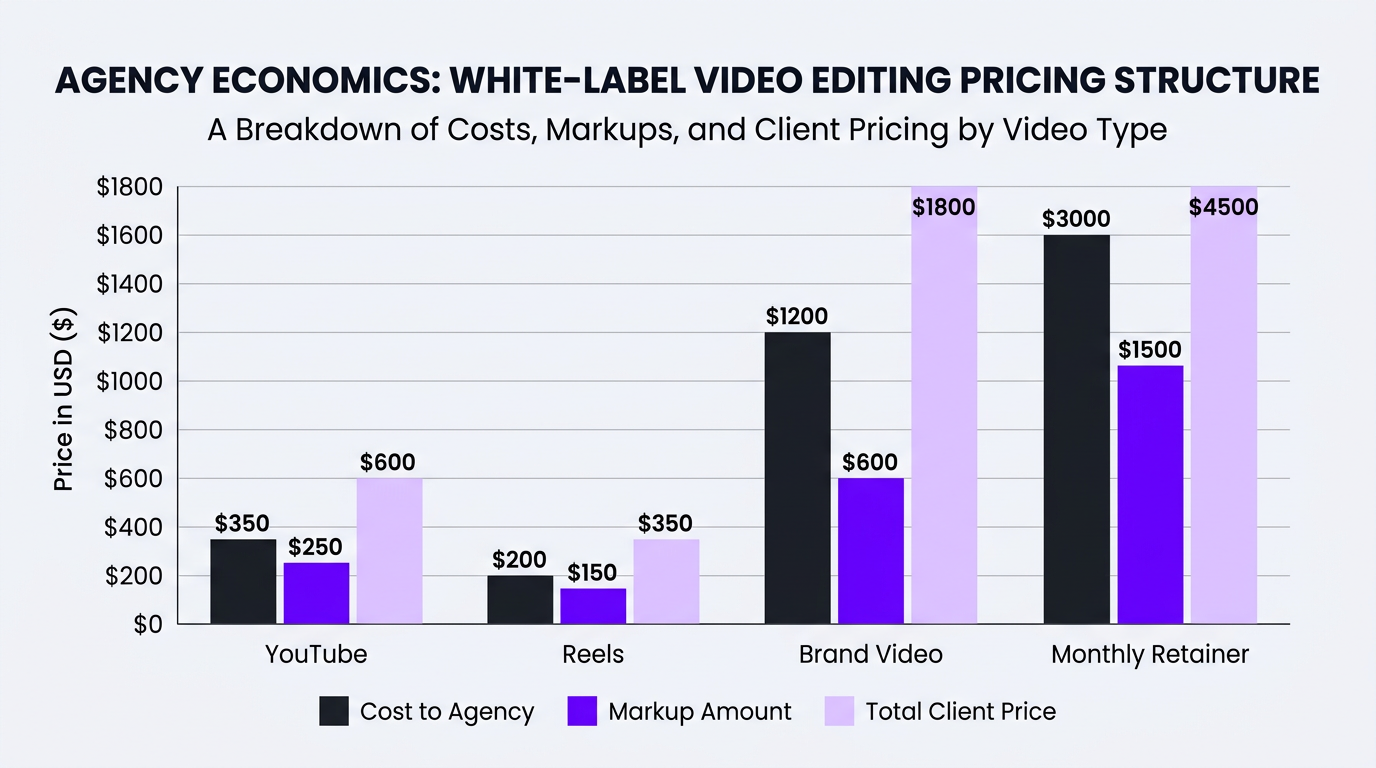
The typical markup for white-label video editing ranges from 50% to 150% depending on your positioning, the complexity of the work, and what else you’re bundling (strategy, scripting, thumbnails, distribution).
| Video Type | Your Cost (White-Label) | Client Price (50% Markup) | Client Price (100% Markup) | Your Margin |
|---|---|---|---|---|
| YouTube long-form (10-20 min) | $250–$450 | $375–$675 | $500–$900 | $125–$450 |
| Short-form (Reels/TikTok/Shorts) | $75–$150 | $112–$225 | $150–$300 | $37–$150 |
| Product demo / explainer | $400–$800 | $600–$1,200 | $800–$1,600 | $200–$800 |
| Brand video / commercial | $800–$2,000 | $1,200–$3,000 | $1,600–$4,000 | $400–$2,000 |
| Monthly retainer (8-12 videos) | $2,500–$4,500 | $3,750–$6,750 | $5,000–$9,000 | $1,250–$4,500 |
At 100% markup, a single agency client doing 8 YouTube videos and 20 Reels per month generates roughly:
- Your cost: ~$3,500/month (retainer with your editing partner)
- Client pays you: ~$7,000/month
- Your gross margin: ~$3,500/month — from one client, with zero employees
Stack five clients like that and you’ve built a $210,000/year revenue line with roughly 50% margins. That’s the power of the white-label model.
Retainer vs. Per-Project: Which Model Works for Agencies?
Most successful agency-partner relationships use retainers. Here’s why:
| Factor | Per-Project | Monthly Retainer |
|---|---|---|
| Pricing predictability | Variable — hard to quote clients accurately | Fixed — easy to build into client proposals |
| Editor familiarity | Different editor each time | Dedicated editor learns your clients’ brands |
| Turnaround speed | Standard queue (3-5 days) | Priority (24-48 hours) |
| Cost per video | Higher individual rate | Volume discount (15-30% savings) |
| Scalability | Capped by availability | Guaranteed capacity |
| Best for | Occasional video work | Agencies with steady video clients ✅ |
If you’re reading this article, you’re almost certainly better off with a retainer. Per-project only makes sense when video is a once-in-a-while add-on, not a core offering.
White-Label Models Compared: Finding Your Fit
Not all white-label arrangements look the same. The right model depends on your agency’s size, client mix, and how much control you want over the editing process.
Model 1: Fully Managed (Hands-Off)
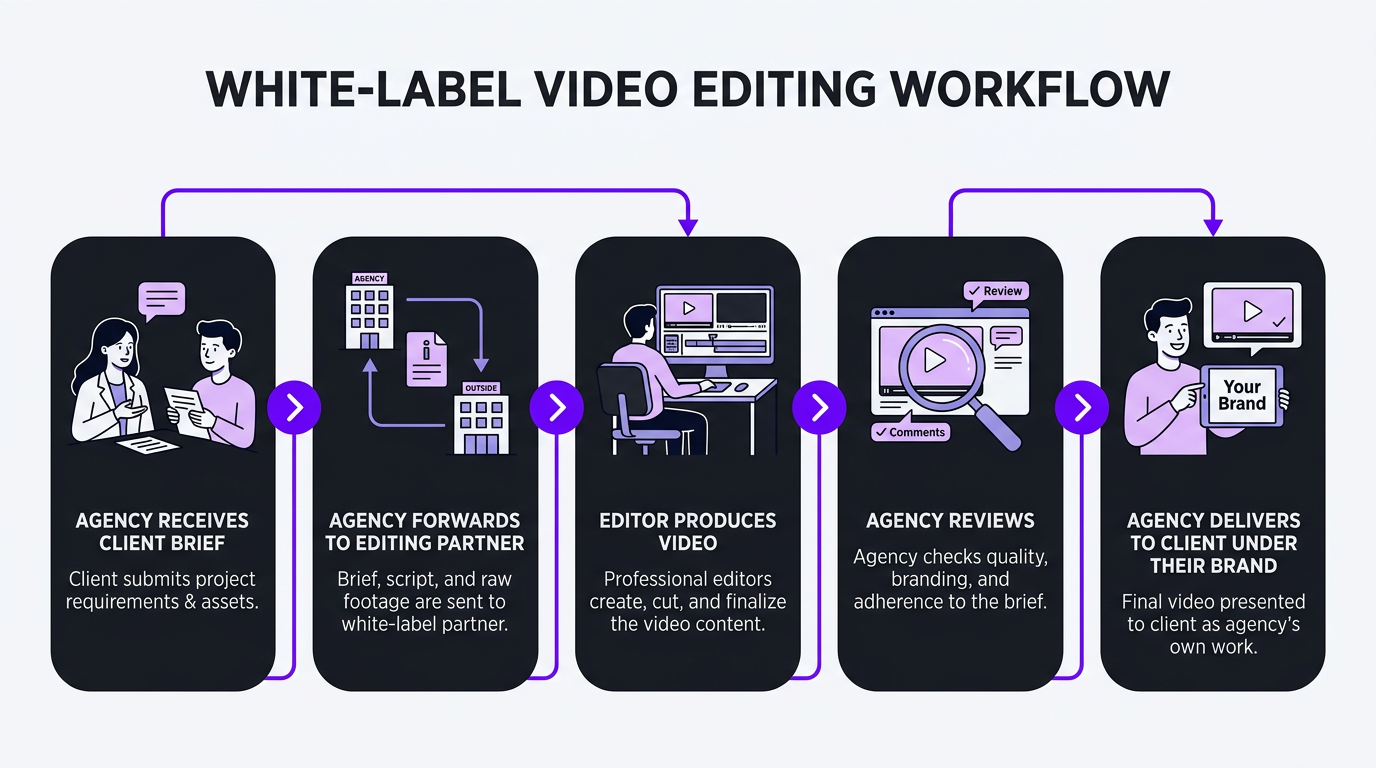
Your editing partner handles everything from raw footage to final delivery. You forward the brief, they do the rest. You review the final cut and pass it to your client.
Pros: Minimal time investment, easy to manage alongside other services.
Cons: Less creative control, requires a partner you deeply trust.
Best for: Marketing agencies where video is one of many services.
Model 2: Collaborative (Shared Control)
You handle creative direction, scripting, and client communication. Your partner handles editing, motion graphics, and technical delivery. You review at multiple checkpoints.
Pros: You control the creative output while offloading the labor.
Cons: Requires dedicated project management time.
Best for: Creative agencies that want to maintain a strong creative vision.
Model 3: Embedded Team (Your Tools, Their Editors)
Your partner’s editors work inside your project management tools (Asana, Monday, ClickUp) and follow your agency’s processes. They attend your standups. To your clients, they’re your team.
Pros: Maximum control, seamless integration, editors feel like internal hires.
Cons: Higher cost, requires process documentation.
Best for: Larger agencies with established workflows and multiple video clients.
Want to Add Video Services Without the Overhead?
Our white-label program lets you offer premium video editing under your brand. Dedicated editors, your tools, your processes. Your clients never know.
Setting Up the Workflow: From Brief to Delivery
The difference between a profitable white-label partnership and a chaotic one comes down to workflow. Here’s the system that works for agencies managing 5+ video clients simultaneously.
Step 1: Client Onboarding — Build the Style Bible
Before a single frame gets edited, document everything about the client’s brand:
- Brand colors, fonts, logo files (all formats)
- Tone and voice guidelines (formal, casual, irreverent?)
- Reference videos they love (and ones they hate)
- Music preferences (genre, energy level, licensing constraints)
- Thumbnail style preferences
- Intro/outro requirements
- Lower third and graphic templates
This document becomes the editor’s north star. At Increditors, we build these collaboratively with agency partners during onboarding and update them quarterly. A good style bible eliminates 80% of revision requests.
Step 2: Brief Submission — Standardize It
Create a brief template that your team fills out for every video. The brief should include:
- Video title and topic
- Target length
- Key moments / timestamps to highlight
- B-roll or stock footage notes
- Graphics and text overlay requirements
- Music direction
- Delivery deadline
- Any client-specific notes
Standardized briefs make editing faster and reduce back-and-forth. If you’re submitting briefs via email or Slack messages, you’re creating unnecessary friction.
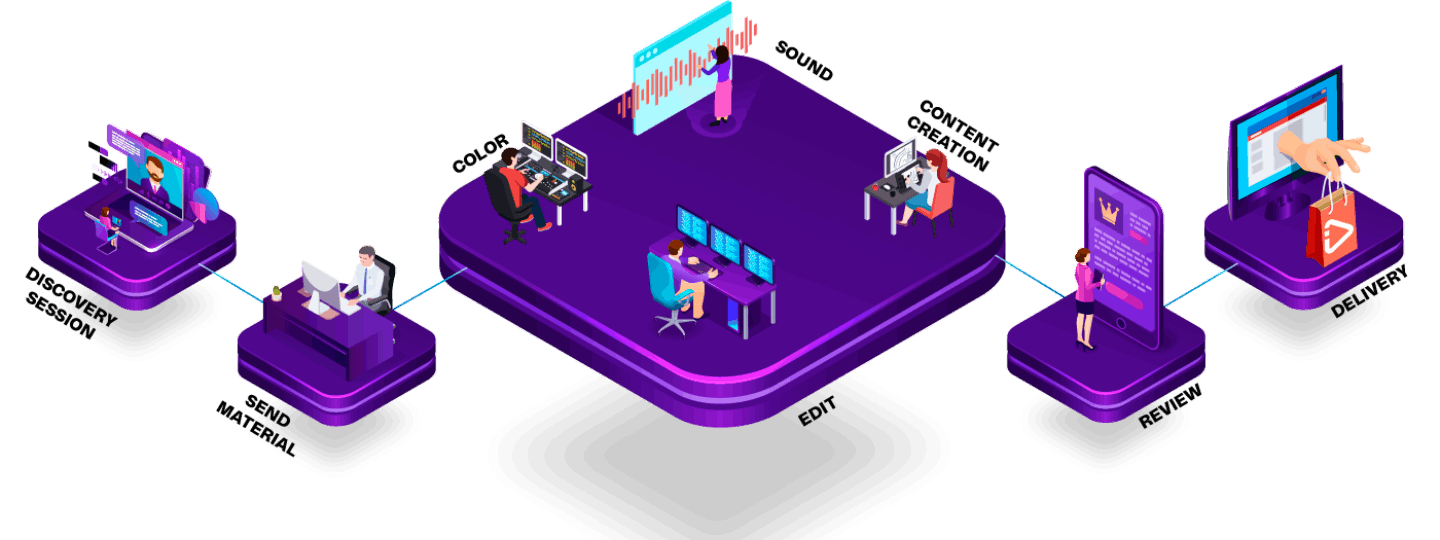
Step 3: Edit → Review → Revise → Deliver
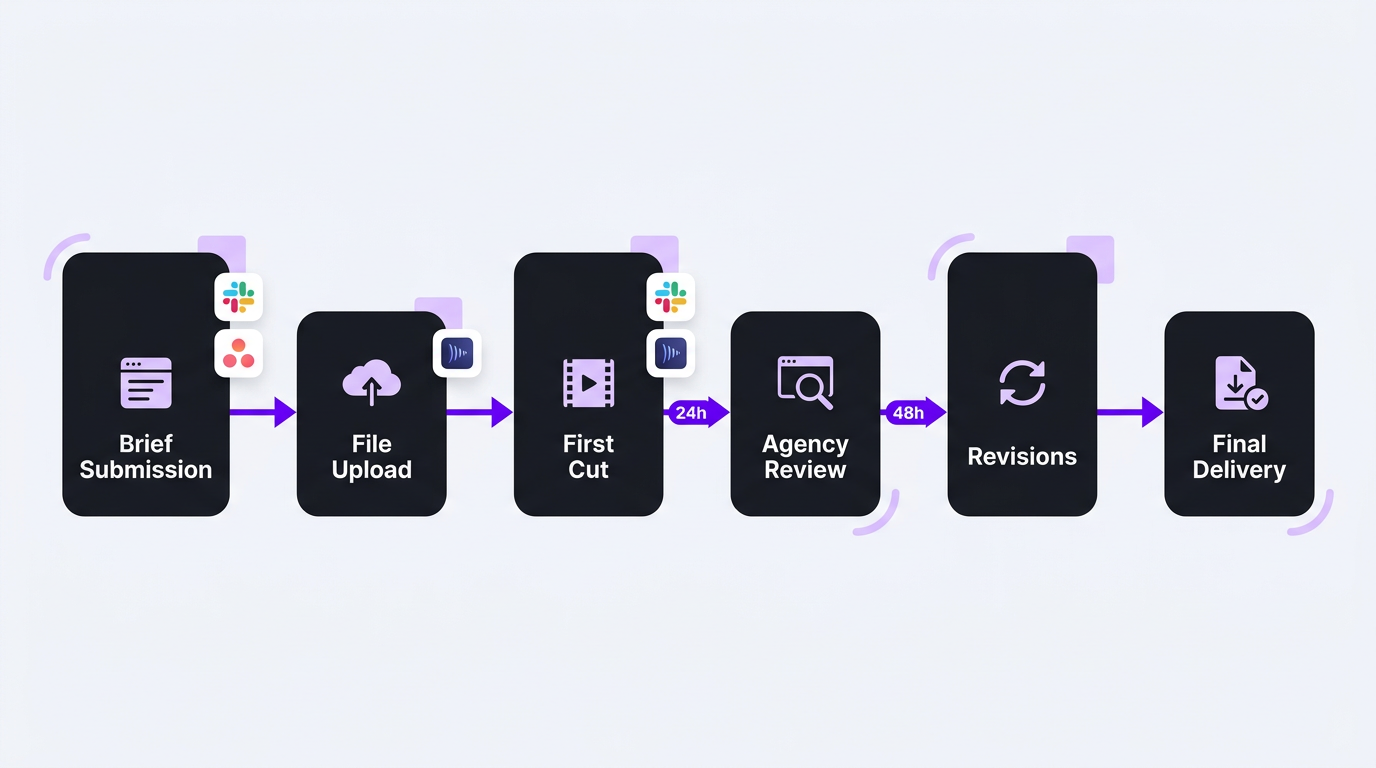
The typical workflow looks like this:
- Raw footage uploaded to shared drive (Google Drive, Dropbox, Frame.io)
- Editor completes first cut within 24-48 hours
- Agency reviews internally (you watch before the client sees it)
- Revisions submitted with timestamped notes
- Final cut delivered within 12-24 hours of revision notes
- Agency delivers to client through your own channels
The critical step most agencies skip is #3 — internal review. Never send a first cut directly to your client. Always add your quality filter first. This is what separates agencies that retain clients from those that don’t.
Tools That Make the Workflow Seamless
| Function | Recommended Tools | Why |
|---|---|---|
| File sharing | Frame.io, Google Drive, Dropbox | Frame.io has timestamped commenting — best for video review |
| Project management | Asana, Monday, ClickUp, Notion | Track every video from brief to delivery with status updates |
| Communication | Slack (shared channel), Loom | Async communication with video walkthroughs for feedback |
| Brief templates | Notion, Google Forms, Typeform | Structured intake prevents miscommunication |
| Review & approval | Frame.io, Filestage, Wipster | Client-facing approval workflows with version control |
Quality Control Without Micromanaging
Here’s the agency owner’s nightmare: you outsource editing and the quality tanks. Your client calls you, furious. You scramble to fix it. The margin you made on that project evaporates in revision cycles.
This happens when quality control is an afterthought instead of a system. Here’s how to build it into the process:
The Three-Layer QC System
Layer 1: Editor Self-Check — Before submitting, the editor reviews against the style bible and brief. Basic but effective for catching obvious misses.
Layer 2: QC Reviewer — A second pair of eyes (ideally from your editing partner’s team) reviews every video before it reaches you. This catches 90% of issues — audio levels, color consistency, missing graphics, pacing problems.
Layer 3: Agency Review — Your creative director or project manager watches the final cut with fresh eyes. They check for brand consistency and client-specific preferences that only your team would know.
At Increditors, every video goes through a dedicated QC review before it reaches the agency partner. This extra layer costs nothing additional — it’s built into our process because we know agencies can’t afford quality surprises.
Setting Quality Standards: The Scorecard Approach
Create a simple scorecard for each video review. Rate each element on a 1-5 scale:
- Audio quality and mixing
- Color consistency
- Pacing and retention
- Graphics and text accuracy
- Brand guideline adherence
- Music fit
- Overall polish
Any video scoring below 4 on any element gets flagged for revision before the client sees it. Over time, this data reveals patterns — maybe audio is consistently strong but pacing needs work — and lets you have data-driven conversations with your editing partner.
Scaling from 10 to 100+ Videos per Month
The beauty of white-label editing is that your partner scales with you. But scaling video production isn’t as simple as ordering more — there are operational considerations at each stage.
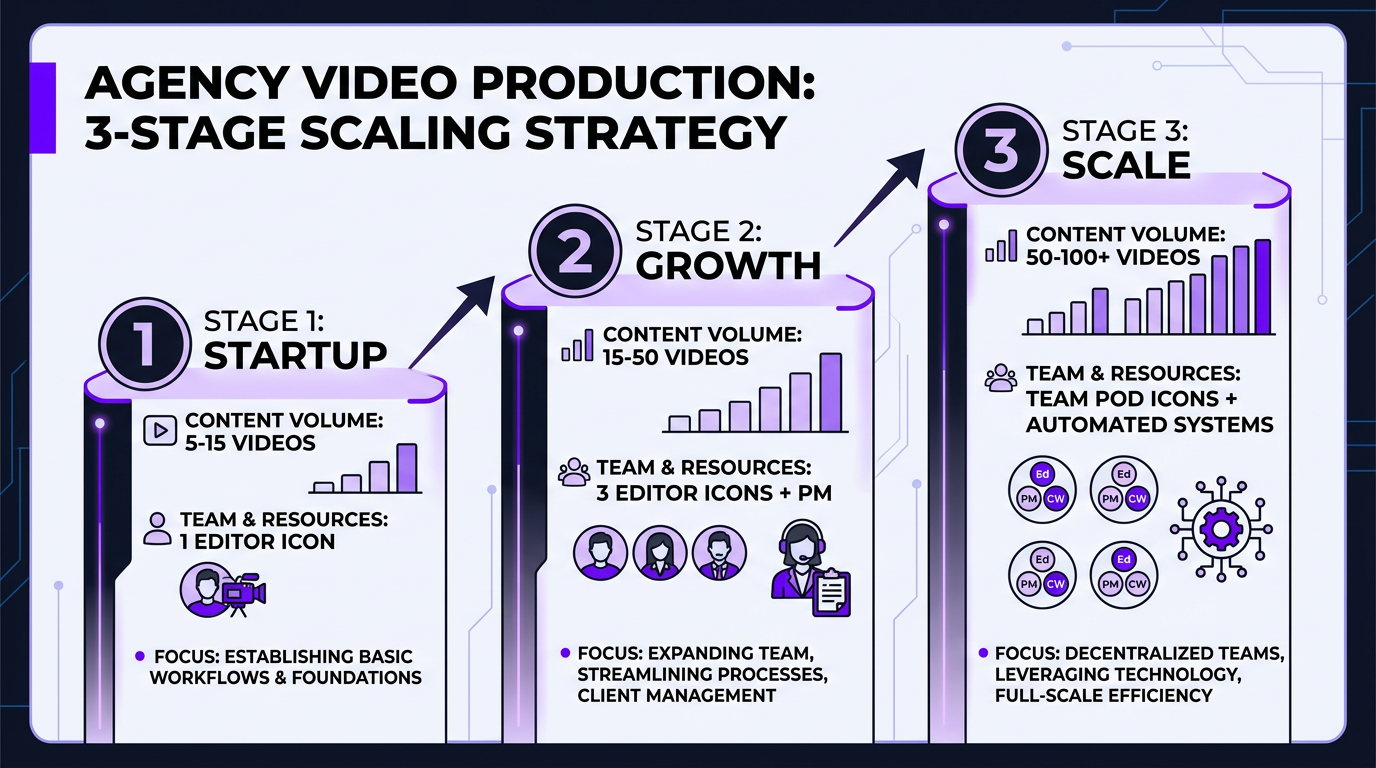
Stage 1: Startup (5-15 videos/month)
You have 1-3 video clients. At this stage:
- One dedicated editor handles everything
- You manage briefs personally
- Review is just you watching every final cut
- Communication is direct (Slack DMs with the editor)
This works beautifully. Don’t over-engineer the process at this volume.
Stage 2: Growth (15-50 videos/month)
You have 4-8 video clients. Things change:
- You need 2-3 editors with different specialties
- A project manager (from your side or your partner’s) becomes essential
- Brief templates become non-negotiable
- You need a shared project board (not email threads)
- QC process must be formalized
This is where most agencies stumble. They try to manage 40 videos the same way they managed 10. Invest in process here or you’ll hit a wall.
Stage 3: Scale (50-100+ videos/month)
You have 10+ video clients. At this volume:
- Dedicated editor pods per client (1-2 editors per major account)
- Full-time PM on the editing side managing capacity and timelines
- Automated brief intake and status updates
- Weekly quality reviews with your partner
- Documented SOPs for every video type
- Backup editors trained and ready for surge periods
At this stage, your editing partner effectively operates as your video department. Increditors’ enterprise program is built specifically for agencies at this scale — dedicated teams, guaranteed capacity, and SLAs that protect your client relationships.
Case Studies: Agencies That Got It Right
Ink Magnet: From Zero Video to a $15K/Month Revenue Line
Ink Magnet is a content marketing agency that had never offered video editing. Their clients kept asking for it, and they kept saying no — until they partnered with a white-label editing team.
Within 60 days, they’d onboarded three clients onto video retainers totaling $15,000/month in new revenue. Their cost with the editing partner was roughly $6,500/month, yielding over $8,000 in gross margin — from a service that required zero new hires.
The key to their success: they packaged video editing with content strategy and distribution, making the editing a component of a broader offering rather than a standalone service. Clients saw them as a full-service content partner, not just a middleman.
Brightwell: Embedded Editors as a Competitive Advantage
Brightwell, a digital agency serving DTC brands, took the embedded model approach. Their white-label editors attend weekly client calls, use Brightwell’s branded email addresses, and operate inside the agency’s Asana workspace.
The result: client satisfaction scores for video deliverables are on par with their in-house design team, and video has become their fastest-growing service line at 40% year-over-year growth. Their clients routinely cite “having a dedicated editor who knows our brand” as a top reason for staying — and they’ve never met the editor in person.
Emerge: Handling Client Surges Without Panic
Emerge, a social media agency, manages content for 20+ brands. Their video volume fluctuates wildly — from 30 videos one month to 80 the next during product launch seasons.
Before white-labeling, these surges meant either declining work or producing lower quality under pressure. With a scalable editing partner, they simply adjust their monthly brief volume. Their partner maintains bench capacity for exactly these situations.
Emerge now says yes to every client request and has seen a 25% increase in client lifetime value since they added scalable video production to their offering.
Choosing a White-Label Video Editing Partner
Not all editing services offer white-label partnerships, and not all white-label partners are built for agency needs. Here’s what to evaluate:
The Non-Negotiables
- NDA and confidentiality: Your clients must never know. The partner should sign NDAs covering all client relationships.
- Consistent editor assignment: Rotating editors kill brand consistency. Insist on dedicated editors per account.
- Scalable capacity: Can they handle 10 videos this month and 50 next month? If not, they’ll become a bottleneck.
- Turnaround reliability: Missed deadlines = missed client trust. Check their SLA history and ask for references.
- Communication standards: Are they responsive on Slack? Do they proactively flag issues? Silent partners are dangerous partners.
Comparing White-Label Partners
| Feature | Budget Partners | Mid-Tier Partners | Premium Partners (Increditors) |
|---|---|---|---|
| Per-video cost | $50–$150 | $150–$350 | $250–$600 |
| Dedicated editors | ❌ Rotating | ✅ Semi-dedicated | ✅ Fully dedicated |
| QC process | ❌ None | ✅ Basic review | ✅ Multi-layer QC |
| Turnaround (long-form) | 3-5 days | 2-3 days | 24-48 hours |
| Uses your tools | ❌ | Partial | ✅ Full integration |
| Surge capacity | ❌ Limited | ✅ Some flexibility | ✅ Guaranteed bench |
| Motion graphics / VFX | ❌ | Basic | ✅ Full capabilities |
| Agency margin potential | High (but quality risk) | Moderate | Moderate (but retain clients longer) |
The cheapest partner isn’t always the most profitable one. If a budget partner’s quality causes you to lose a $7,000/month client, that’s far more expensive than paying an extra $100 per video for reliable work.
Red Flags to Watch For
- They don’t offer NDAs or resist confidentiality agreements
- No dedicated editor option — you’re always in a queue
- Can’t show agency-specific case studies or references
- Revision limits are strict (2 or fewer per video)
- Turnaround times are quoted as ranges rather than guarantees
- They require you to use only their platform — no flexibility on tools
- No account manager or single point of contact
Ready to Scale Your Agency’s Video Services?
We work with agencies of every size — from 5-person shops to 100+ person firms. Let’s build a white-label arrangement that fits your workflow and protects your margins.
Common Mistakes (and How to Avoid Them)
After working with dozens of agency partners, we’ve seen the same mistakes repeatedly. Here’s what to avoid:
Mistake 1: Not Creating Client-Specific Style Guides
Agencies that send generic briefs get generic results. Every client should have a detailed style guide that the editing team references for every single video. Invest 2-3 hours upfront to save hundreds of hours in revisions later.
Mistake 2: Over-Promising Turnaround Times
If your editing partner delivers in 48 hours, don’t promise your client 24 hours. Build in a buffer for your internal review. The formula is simple: Partner turnaround + your review time + revision buffer = client delivery promise.
For most agencies, this means if your partner delivers in 48 hours, you promise clients 4-5 business days. Under-promise and over-deliver beats the reverse every time.
Mistake 3: Treating the Partner Like a Vendor Instead of a Team
The agencies that get the best results from white-label partnerships are the ones that treat their editing partner like an extension of their team. That means sharing context, including them in relevant conversations, giving constructive feedback, and celebrating wins together.
An editor who understands why a client wants a specific style produces dramatically better work than one who’s just following a checklist.
Mistake 4: Skipping the Internal Review
We said it earlier but it bears repeating: never send a first cut directly from your editing partner to your client. You are the quality filter. You are the brand guardian. Ten minutes of review per video can save a client relationship.
Mistake 5: Not Building Video Into Broader Retainers
Agencies that sell “video editing” as a standalone service compete on price and churn quickly. Agencies that bundle video into comprehensive content packages — strategy + scripting + editing + distribution + analytics — create stickier relationships and higher margins.
When Ink Magnet added video to their content marketing retainers, client average deal size increased 65% and churn dropped from 15% quarterly to 6%. The video wasn’t the only reason, but it was the catalyst for a more comprehensive partnership.
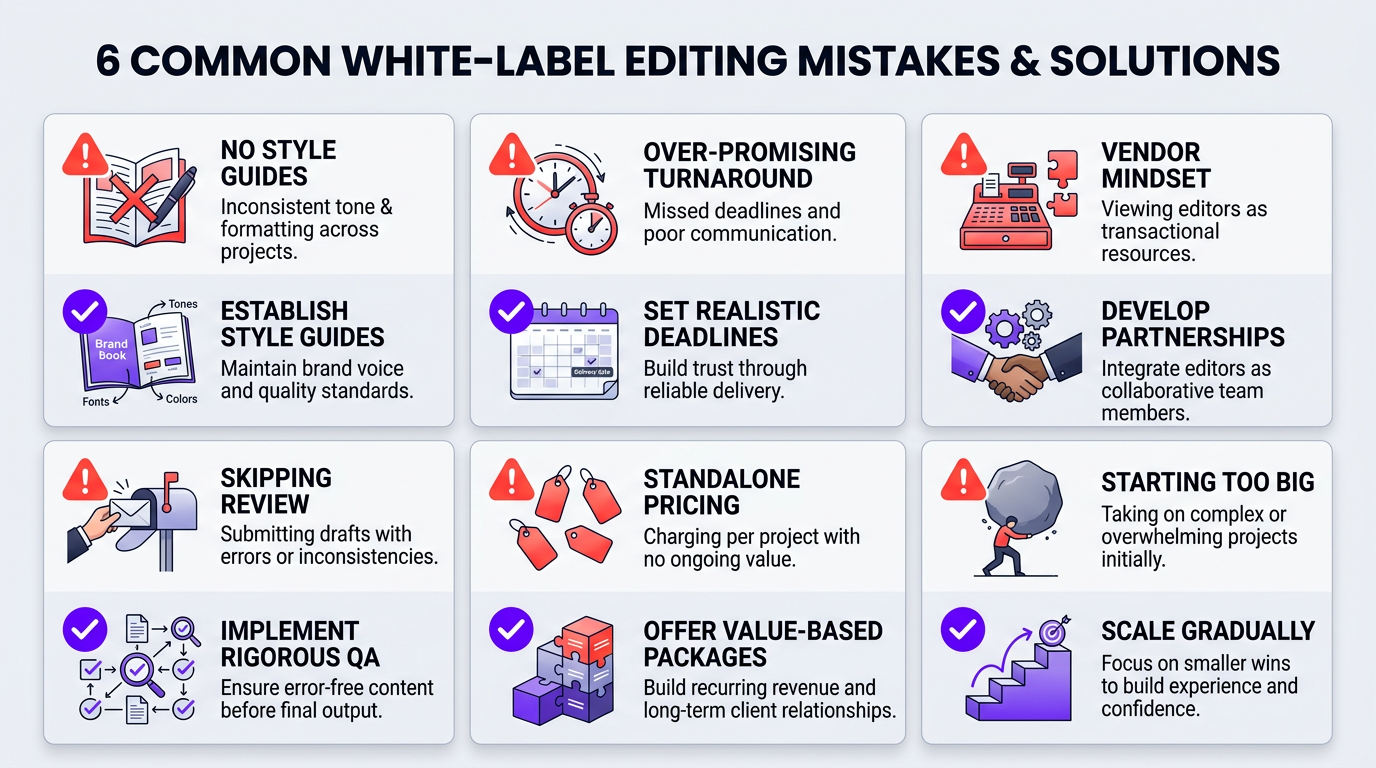
Mistake 6: Starting Too Big
Don’t sign a 50-video/month commitment before you’ve tested the partnership with 5-10 videos. Run a pilot period of 30-60 days with a few clients. Evaluate quality, communication, and turnaround before scaling.
Every successful agency partnership at Increditors started with a small pilot. The ones that tried to go all-in from day one were the ones that hit friction earliest.
Frequently Asked Questions
White-label video editing is when an external editing partner produces videos on behalf of your agency, branded under your agency’s name. Your clients never know a third party handled the editing. This lets agencies offer video services without hiring in-house editors.
White-label video editing typically costs agencies $150–$500 per video for YouTube-style content, or $2,000–$6,000 per month on retainer for ongoing work. Most agencies mark up 50–100% when billing their clients, creating a healthy margin without adding headcount.
Yes. White-label editing partners like Increditors operate invisibly behind your brand. All deliverables, communications, and files can be branded to your agency. Many partners also use your project management tools and follow your brand guidelines.
Key factors include: consistent quality across different video styles, reliable turnaround times, willingness to use your tools and processes, NDA and confidentiality agreements, scalable capacity for client surges, and transparent pricing without hidden fees.
Establish clear brand guidelines and style guides per client, implement a review workflow with defined approval stages, use shared project management tools for visibility, request sample edits before committing, and build in revision rounds at each stage.
For agencies handling fewer than 20 videos per month, white-label partners are typically more cost-effective. You avoid salary, benefits, equipment, and software costs. In-house makes sense at high volume (40+ videos/month) where you need maximum control and have predictable demand.
Established white-label partners can handle anywhere from 10 to 200+ videos per month depending on their team size. Increditors delivers 500+ videos monthly across all clients, with dedicated teams assigned per agency account to ensure consistency.